INDEXING ARTIFICIAL INTELLIGENCE. Alexandra Mousavizadeh is a Danish economist and CEO of Evident, an intelligence platform that benchmarks and tracks Artificial Intelligence (AI) adoption across the financial services sector. Prior to June 2022 Alexandra was a partner at Tortoise Media in London and creator of The Responsibility 100 Index and The Global AI Index. Alexandra specialises in index creation, using data to build benchmarks that rank nations and companies on key social and technological issues.
You can listen to the podcast of this interview here.
Alexandra Mousavizadeh, has your consistent interest in emerging economies been by chance or by choice?
By choice. It has culminated in the mapping and measuring of the AI world. In my education, I studied mathematics, game theory and economics, and game theory lies at the base of a lot of AI today so I have gone full circle. Being an economist interested in emerging economies took me into countries in Africa, but also I was the Russia analyst at Moody’s through the transition and through the default of ’98 and for ten years after that. Moody’s assesses a nation, looking at default probabilities through the prism of an index, and at the heart of what I’ve done all along is seeing the world through the prism of indices.
What is an index?
It is a gathering of data, using standardized metrics and methodology combined in a way that creates an ordinal ranking to assess the relative performance of an entity. For example, on the default risk of nations you can compare the relative strengths and weaknesses of, say, Russia versus Brazil, South Africa versus India on the same parameters, apples to apples. Looking at who’s most at risk of economic crisis versus another country, you have a much better ability to assess strengths, weaknesses and future growth. The many famous indices in the world have been an inspiration for me, especially building our company Evident that I started two years ago. With the Evident AI Index, I’ve taken that approach to show how one critical industry – in this case banking, but it could be any business sector – is able to adopt arguably the most consequential technology we’ve seen emerge in the 21st century. We show what it means to be doing well with AI and then rank the banks according to their AI maturity.
“We have never seen technology change this quickly.”

Alexandra Mousavizadeh is co-founder and CEO of EVIDENT
Alexandra Mousavizadeh, wy do you like working on indices?
I very much enjoy the clarity and driving force a ranking brings to the way that we assess performance. Everyone sits up when they see a country or a company ranked on a particular index. It forces behavioural change and makes people want to do better, ultimately, creating a race to the top. Therefore, the architecture of the index is incredibly important, because to have a powerful positive impact it has to be constructed so that businesses or nations can zero in on addressing change, and avoid negative impacts somewhere down the line.
Is your company Evident completely independent?
Yes. It has to be. An index cannot be influenced nor bend to a particular viewpoint. The methodology needs to be completely independent and transparent both on the data sources that you’re using and in the way its constructed. When measuring something as nebulous and rapidly changing as AI you have to be particularly clear on your definitions and how your source your data. I started getting into the question of how one measures AI as a follow on from my career at Moody’s in developing countries, but it wasn’t until 2018 at Tortoise that we were commissioned to do the first ever Global AI Index. No one had measured nations on the strength of their AI ecosystems before. We were the first to venture into this untrodden territory and therefore needed to establish a network of advisors and build a team with an expertise in AI measurement. Then, as businesses were starting to invest more aggressively into AI, we saw that they urgently needed clarity on what good performance on AI looked like. Since we had established the Global AI Index, they asked us to build one for businesses. And Evident was born.
There are still a lot of doubts about AI and debates – if it is a positive or a negative?
Yes, and the doubt is more pronounced today than it was 6 or 7 years ago. The coining of the phrase artificial intelligence happened in the mid-50s when Alan Turing published his paper on machine intelligence. It wasn’t considered anything but a slight curiosity. Around 2017, there was an emerging thinking that this is actually an important technology and governments need to think about how to strengthen their national AI ecosystem and be part of this race to develop AI in their nation. China, the US, Canada, Singapore, Israel, the UK, everyone emerged with AI strategies, but no one really knew exactly where it was going.
You built the first index that measured the strength of these AI ecosystems because a national race was starting on AI at a global level, but even very recently the English prime minister said London would be the world’s centre for AI, so does this race still exist?
The race has never been this intense before. It’s perceived as a winner takes all race. Geopolitics are being formed by AI and policies rolled out to hinder other nations while accelerating the pace of development at home. There are big questions as to who wins it, i.e. who is able to develop the most cutting edge AI capabilities. Is it China? Is it the U.S.? And how will they use it?
Surely AI is going to be the same for everyone at the end of the day?
It is ideally, and everyone should and hopefully will benefit from AI, but the race is happening because who can create the strongest large language model, the best AI, the fastest AI, has the ability to not only harness the businesses within that country – better than others that don’t have that capability – but it also has a big impact on defence. Drones, precision bombing, there are all sorts of areas where AI is being used, so there’s a military race to consider too.
What about quantum computing?
Quantum computing is at the cusp of being developed, and once that breakthrough happens quantum can help combat climate change, accelerate drug discovery and build unhackable data security using quantum cryptography. However, it can also be used to decrypt systems and therefore could significantly destabilize the world in a way that even very powerful AI can’t do. There is no real knowledge about who’s ahead in the quantum race. Experts tell me that China is leading, but we will know when they have it because that will be felt through all of our supply chains and financial systems.
“Implementing AI in a business is a difficult task and requires a compete re-think of how the business is organised.”
Alexandra Mousavizadeh, the potential uses of AI are already numerous, from defence to creating novels and works of art, to talking with your dead relatives?
Yes, and there is a lack of clarity around where AI is going, what it can unleash and the opportunities that it’s unlocking. There is also a lot of fear around AI taking away jobs or creating systems that we can’t control. There are currently two schools of thought on AI, one belongs to the so-called “doomers” who are very concerned about letting it loose and not actually knowing what is at the end of that path and potentially leading to human extinction. The other group, the “techno-optimists”, believe that AI will be harnessed for good, and at the end of the day AI will produce much more good than it will create negative impacts, because we will be able to put the right regulatory frameworks in place. The fact is that AI capabilities are advancing so quickly that we have to revise our outlook every six months. GenAI is evolving into agentic AI, which has been called “a digital assistant on steroids”. Agentic AI will embed in how we live and work, becoming your ever present assistant, taking on tasks on your behalf.
That will take time. Is it easy to implement AI?
While the capabilities of AI are racing ahead ever faster, the implementation of it is really difficult, so we will have time to manage the risks and to point it in the direction where it does create great opportunities, for example, education and health. AI gives access to developing drugs that will solve conundrums that have been with us for a long time. On the environmental side, AI will find the solutions to things like the breaking down of plastics because of the speed with which it can make calculations. This capability will help us solve some of the big climate issues that we have today.
And at a business level?
At a business level, the opportunities are numerous as well. AI can basically enhance any function and support every employee. This will enable us to focus on the bigger problems and be much more productive. However, implementing AI in a business is a difficult task and requires a compete re-think of how the business is organised. While investing in AI is not new, at Evident we have seen a breathtaking acceleration in investment in AI. Some of the spending is targeted and some is experimental, a business might not know exactly where it’s going, but they do know that they have to do it. Not investing in AI is not an option. You will simply go out of business.
Is this similar to people investing in the internet in the early days?
This is similar to that time but much more powerful, because the technology is much more powerful. At Evident, starting with the banks, we’ve established the first ever pubic ranking of businesses’ AI adoption journey and how AI mature they are. Before we came in and did that there was no insight or transparency for businesses on how you were doing vis a vis your peers on AI, and what that was actually delivering for you in terms of efficiency gains and the products that you could develop from it. The mission with Evident is to create the global standard benchmark of AI adoption, and the vision is that the benchmark will help drive growth and prosperity locally and globally.
Are there environmental cost implications for AI?
That’s very important to reflect on. People have not properly factored in the environmental cost. Every time that you’re using ChatGPT has a knock on effect and an energy usage that is much higher than people are aware of. New data centres need to be built and some nuclear power plants are being considered to be reopened again because there’s simply not going to be enough on current energy levels that we have. Something’s got to give. The energy usage of the AI that is being rolled out is going to be placed on more and more efficient chips, as Jensen Huang would argue with the rollout of Blackwell earlier this year. But a year or two from now it’s going to become very clear that the energy usage is going to be immense, and we don’t have the solution for that real risk.
Is America making enough AI chips to be as independent as they are with oil and gas?
There are some really big risks on the horizon from a supply chain perspective. The chip wars already drive a lot of the tension between China and the US. Both want “chip sovereignty”, or at least not be curtailed in their ability to control the supply of chips, as these are crucial for running all things compute. Chip production rests on very few nodes, such as US, China, Taiwan and Amsterdam. Such few clusters is a huge risk to economic growth in the future, if there’s a war with Taiwan, for example, or if there’s a disruption anywhere else in the supply chain. That is inspiring a lot of the current policy by the Biden administration towards China, to try and hamper development of Chinese capabilities and enhance the ability for the US to create in-house national champions and not be reliant on anyone else.
What are the main risks to the success of AI?
The supply chains of chips is incredibly vulnerable, on top of the risks on the energy supply chains where energy data centres are being built in areas that are taking energy from people who need it, and right now a lot of them are in developing countries. It’s going to be too energy costly for it to continue to grow at this pace. Solutions to make it more energy efficient are on the way but there is the risk that this will create big disruptions on the energy market, and it can lead to higher oil prices and reopening of risky nuclear power plants at a speed that might not be safe. There are definitely risks on the horizon.
Will AI change many things in society?
Even if there’s a lot of fear about how AI is going to replace what we do, my view is that it augments, it doesn’t replace. It takes care of the work that you don’t need to do. AI is meant to be an agent for you. It will never develop consciousness. It will never be as creative as I know many artists are worried about, but it will take away some of the lower-level work. When you look at it as an enhancing mechanism, then you can envisage a world where we are going to be more productive, and where AI will create more jobs. AI is going to be a strong enhancer of economic growth and productivity.

Alexandra Mousavizadeh

Alexandra Mousavizadeh

Alexandra Mousavizadeh
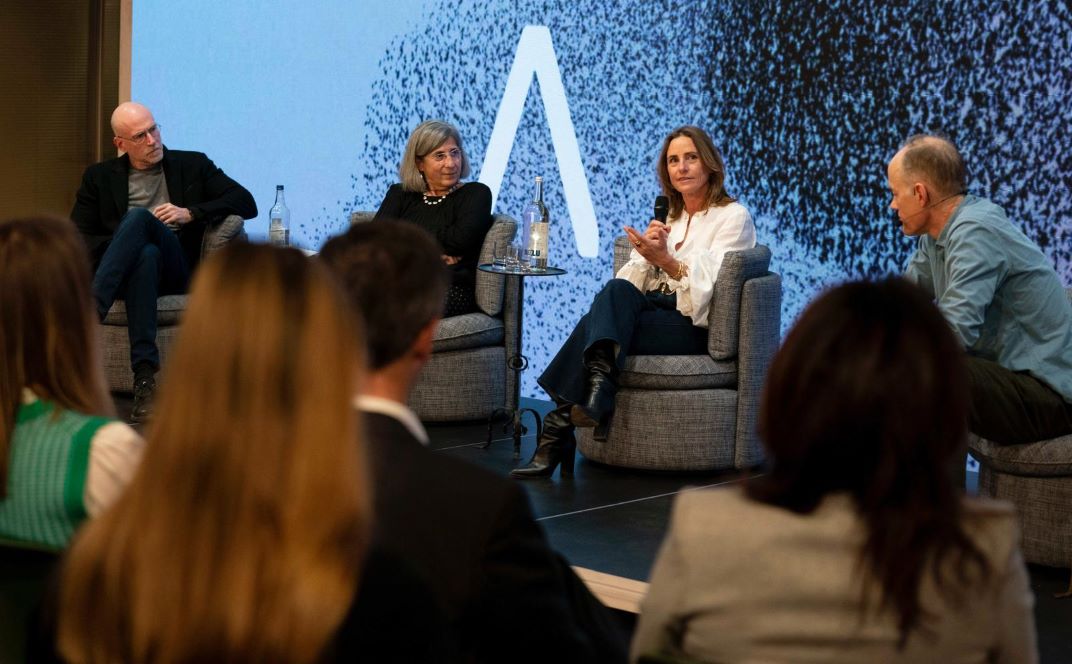
Alexandra Mousavizadeh

Alexandra Mousavizadeh

Alexandra Mousavizadeh
“The race has never been this intense before.”
Alexandra Mousavizadeh, please give me an example of the sort of insights that the Evident AI Index delivers?
We can see that Italian banks have somewhat lagged behind their peers on AI adoption. Unicredit is ranked 43rd out of 50 banks we track. It hasn’t been able to hire AI talent, but it’s interesting that CEO Andrea Orcel is now pursuing Commerzbank, and, as we noted, if those two banks were to combine, Unicredit would immediately add a lot of AI talent muscle, and that’s the key to success here. The point here is that transparency is important for business, Having an index and having a ranking on how AI maturity is emerging and creating clarity around where AI is being implemented will save businesses a lot of time, a lot of experimentation and a lot of costs. The index creates this transparency, while we also have an aspect called responsible AI, looking at the responsible frameworks that you need to have in place from a business perspective, so AI can progress at speed but with the right parameters to avoid unintended consequences.
Which companies are using AI and how?
Most big manufacturing companies, banks, insurance companies and telecommunications are investing and using AI in very different ways. If we take the biggest banks, the one that performs the best is JP Morgan. They are the largest US bank and they have also invested the most of all the banks in technology, and of banking technology investment they invested the biggest proportion into AI.
What advantages are they achieving for their clients?
In every area that you can think of they will have some aspect of AI. To make the trading faster and more accurate, you can now use AI to identify issues and losses and fix that right away. On wealth management, all of the financial analysts have an AI tool that can help them pull together all the information that they need to help a client on their investment strategy. That might have taken them a week some years ago, but now they can pull all the latest data together into one memo in ten minutes.
Does this mean they don’t need analysts anymore?
The analysts are still there, but the AI takes away the drudge work. For the retail side, if you’re on the JP Morgan app or online, it will be smoother and provide you with something that is specifically relevant for you. When a bank invests in AI it’s investing also in a lot of research, so when you’re looking at loans that are better and more precise, that rests on synthetic data, on neural networks, on machine learning. All of these tools that lie under the hat of AI make your assessment of who you’re lending to and the surrounding processes easier and smoother for you. Investment in AI goes into every nook and cranny of the bank.
What would you advise students to study in the face of these rapid transformations?
The banks and businesses that lean into AI investment and equip their teams with AI are not losing people. Those are actually the businesses that are hiring more than any of their peers. Any technological change usually leads to job creation rather than job loss. There might be pockets in businesses where there is now less need for certain types of people, who maybe would have done that research, for example, or the analyst hours. Whenever there is such rapid change, obsolescence comes very quickly, but when the calculator was first produced for the market, there was a demand for calculators to be banned because children would never learn their mathematics properly, and, as we know, that’s not the case. People are studying mathematics and pure mathematics and applied mathematics to a degree far surpassing what we would probably ever have thought. The fundamentals do not go away. History, Greek, music, theatre, English, all of that is just as important to study as it has been in the past, while a lot of innovation, whether it’s quantum physics or quantum computing or AI, rests on mathematics. If there’s anything that I would advise it is that we continue to encourage people, women and men, to study mathematics very deeply, because that is at the root of the innovations that we’ve been seeing for many decades and is incredibly important to continue.
This rapid development of technology has also created high levels of anxiety in young people.
There’s a quest for speed and rapid response that has seeped into the way that we live today. With social media, we know that that anxiety is coming through and mental health statistics and suicide rates are alarmingly high. The anxiety levels are not only just the young, also the old. As AI comes in it can turbocharge the speed to even more rapid dissemination of information. That is something that we should be extremely mindful of, but the risks that come from not embracing the technology are significant, and if countries don’t all have the same access to AI, we will increase inequality across the world.
In what ways?
If your governments are not creating environments that give you access to AI, for your business, for your education, for your health development and drug discovery and so on, that is going to be a very different path from the countries that are embracing it. I worry about the gap and the bifurcation that might happen in the world of the nations that move ahead with this technology and those that fall behind. That is exactly the same for businesses. Those that don’t embrace it will fall behind, and the risk for jobs lie in the businesses that don’t embrace it. Adoption is happening so quickly right now and accelerating at such a pace that if you take your time as a nation or as a business, it is going to be more and more difficult to keep up. The shakeout could be quite significant.
Will investment at this stage be obsolete very rapidly?
In my view, it’s never going to be obsolete. If you’re a business investing in AI today, what you’re investing in is not just the tools. They might be obsolete in a year or two, but 90% of the investment goes into all of the integration readiness, so that your data is clean and not fragmented, and so that your team is innovative and able to think on their feet on how you adapt to this oncoming change. It is investing in your organisational structure and how you make decisions and have the ability to understand what’s going to happen next.
How can Evident help in this regard?
What we do creates the ability to see where the impact of AI is. Because if you know where that impact is and you can see it from other businesses that are successful, you’re going to avoid a lot of risky and bad spend. You don’t want businesses to spend a lot of money where they don’t need to. You want to be able to get to the most efficient use of AI and that’s where we come in. We provide the data. We mine for data. Every day we gather millions of data points that funnel into building this benchmark.
Do your clients subscribe to your data?
Yes, and we sell the underlying data, but the ranking is public, which is very important to me. It’s a public service that you can see who’s leading and why. We write a lot about the mechanisms, what the leading businesses do, and how you onboard all of this technology as it’s changing. But if you want to have more information around what’s really driving those rankings, you pay to get access to that because a lot of work has gone into it.
How many people are at Evident and where are you based?
We have a team of about 35 and are based in London and New York. We have a very strong team of data scientists in London and there’s a lot happening in the UK on AI with Google DeepMind here, but overall the US is leading AI by far. AI is happening, whether we like it or not. We cannot stop the innovation. The acceleration is breathtaking. It’s surpassing Moore’s Law by far. We have never seen technology change this quickly, which again, is why transparency is so important in the AI race.
Alexandra Mousavizadeh, thank you.
ENJOY THIS INTERVIEW? SHARE IT WITH A FRIEND.