DEFENDER OF JUSTICE AND HUMAN RIGHTS. Bianca Jagger is the Founder, President, and Chief Executive of the Bianca Jagger Human Rights Foundation (BJHRF), a UK-based human rights organisation that defends human rights and civil liberties, promotes international justice, campaigns to end violence against women and girls, addresses the threat of climate change, and advocates for the rights of Indigenous peoples and future generations.
She is a Council of Europe Goodwill Ambassador for the Abolition of the Death Penalty, a member of the Executive Director’s Leadership Council for Amnesty International USA, an IUCN Bonn Challenge Ambassador, a Patron of the Circle of Conscience for Amnesty International, and a member of the Coalition for the International Criminal Court.
For decades she has campaigned for peace, justice, and environmental protection around the world, including in Iran, Iraq, Afghanistan, Syria, India, Bosnia, Croatia, Kosovo, Mexico, Nicaragua, El Salvador, Guatemala, Honduras, Ecuador, Peru, Brazil, the United States, the United Kingdom, France, Germany, and Albania.
Bianca Jagger is also a strong believer in the power of social media, which she uses extensively to raise awareness about human rights.
25 minutes read time.
You can listen to the podcast of this interview here.
Bianca Jagger, did you work closely with Jesse Jackson, the American civil rights activist who recently died?
Yes. In 2000, Jesse and I witnessed the execution in Texas of a man named Gary Graham, who wanted to be known as Shaka Sankofa. Jesse was a passionate opponent of the death penalty.
When I lived in the United States, I campaigned against the death penalty and particularly against the execution of juveniles, arguing that it violated the Eighth and Fourteenth Amendments as a “cruel and unusual punishment” and that the ‘Evolving Standard of Decency’ recognised in other parts of the world against the juvenile death penalty should be taken into account. In the end the Supreme Court argued that it violated the Eighth and Fourteenth Amendments and that ‘Evolving Standard of Decency’ and scientific evidence regarding juvenile immaturity, vulnerability, and lack of developed culpability made the death penalty disproportionate for minors.
Do you do such things under the banner of the Bianca Jagger Human Rights Foundation?
I try to keep separate what I say in my personal capacity as ‘Bianca Jagger’ and what I say as the Founder and President of the Bianca Jagger Human Rights Foundation, or as a Council of Europe Goodwill Ambassador for the Abolition of the Death Penalty.
As a human rights defender, I wear different hats, and I must be careful to respect those distinctions. Until a few years ago, speaking about the death penalty was often considered a political issue. But, as you know, the sanctity of life is not political – it is a fundamental human rights issue.
“Being born in Nicaragua shaped my understanding of repression, injustice and inequality.”
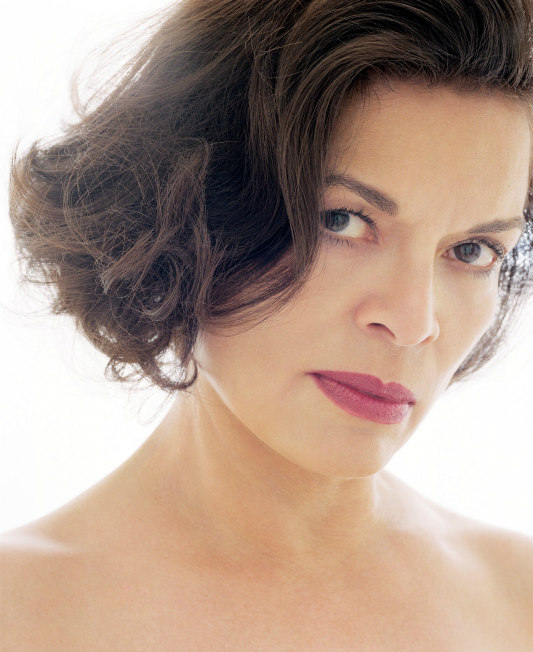
Bianca Jagger by Phil Poynter
Binca Jagger, more recently you have been very concerned about human rights in Gaza and Israel?
I have been very vocal in condemning the Hamas attack of 7 October, which I described as a heinous crime against innocent civilians, and I have called for the immediate release of all hostages. But I have also condemned Benjamin Netanyahu’s government.
I have been haunted by the harrowing images emerging daily from Gaza: the targeting and killing of children, medical personnel, doctors, nurses, paramedics, and journalists; the destruction of hospitals, schools, and homes; and the deliberate and systematic policy of starvation imposed on an entire civilian population.
Witnessing what I believe to be war crimes, ethnic cleansing, and an ongoing genocide, while the international community fails to act decisively, has left me with a profound sense of outrage and helplessness. History will judge our silence.
On my social media platforms, I often amplify the voices of prominent Israeli human rights defenders and organisations such as B’Tselem and Breaking the Silence – an NGO composed of former Israeli soldiers who aim to expose the reality of the occupation. I often share the reporting of the excellent Israeli newspaper Haaretz.
Above all, I highlight Jewish voices calling for an end to the occupation, including the voices of Holocaust survivors, which in my view are among the most eloquent in condemning the horrors being inflicted on the Palestinian people.
Whenever I undertake fact-finding missions, I focus particularly on how war crimes affect children, and I try to meet victims on both sides of a conflict.
For example, in April 2002, I travelled on a fact-finding mission to the West Bank – Jenin, Hebron, Nablus, Ramallah – and to Gaza, to document the plight of the Palestinian people. During that visit, I also met President Shimon Peres and asked him to arrange a meeting with an Israeli mother whose child had been killed by a Palestinian.
He organised a meeting with an extraordinary woman, Robi Damelin, an Israeli peace activist whose son David was murdered in 2002 by a Palestinian sniper. Rather than seeking vengeance, Robi joined The Parents Circle – Families Forum, a joint Israeli-Palestinian organisation dedicated to dialogue and reconciliation. She has devoted her life to promoting peace.
You were born in Nicaragua to a businessman father and a very political mother during the Somoza dictatorship, your mother initially supported the Sandinistas?
At first, my mother supported the Sandinista revolution, but she soon became disillusioned. Very early on, in the 1980s, she realised how repressive the Sandinista regime had become.
This created tension between us because she recognised it before I did. She took my entire family out of Nicaragua and applied for asylum in the United States, and at the time I did not agree with her decision. I thought she was mad.
But she was not. My mother was right, and I was wrong.
Why did you change Blanca, the name your parents gave you, to Bianca?
My grandmother, Blanca, died very young. She had blonde hair, blue eyes, and fair skin. My mother had auburn hair and was also fair-skinned, and my brothers and sisters have green eyes. But I looked like my father.
I felt that “Blanca” sounded very formal, almost royal. And the name itself means ‘white’, which did not reflect who I was – I am a brunette.
After I left Nicaragua, I insisted that my parents call me Bianca. Eventually it became my official name.
You left Nicaragua at age 16 and were awarded a scholarship to the Paris Institute of Political Studies (Sciences Po). Why did you go to France?
When I was an adolescent, I read a book by Eduardo Galeano, Las venas abiertas de América Latina (The Open Veins of Latin America). It had a profound impact on me.
Through that book, I became aware of imperialism, of the exploitation of our natural resources, and of the long history of U.S. intervention in Latin America.
My dream was to go to Paris – not to the United States. I applied for a scholarship to study political science in Paris before my parents even knew. When I received a positive response, my mother supported my decision, although my father did not. For many Nicaraguans at that time, Paris didn’t seem to be a safe city for a young girl.
I have never regretted that choice. I am a Francophile. When I arrived in France, I immersed myself in French culture, even though I barely spoke the language – I had only taken French lessons at the Alliance Française for three months.
Did you read The Stranger by Camus?
Yes. I read Camus on the train returning from Besançon, where I had been sent to attend a month intensive French course.
L’Étranger had a profound effect on me, and it continues to resonate today. In the book Camus explores alienation, the feeling of being an outsider, and the question of belonging. These are questions that have followed me throughout my life. I think of myself as a citizen of the world – but am I Nicaraguan? British? Or European? I am a woman of the Global South.
Perhaps the question of belonging can be summed up very simply: where would I like to be buried?
Fascinated by European culture, philosophy, and history, did you study philosophers such as Voltaire?
Yes, I did. I love French literature and philosophy. I deeply resent Brexit, because I have always valued been a European citizen. It was very painful for me to have my European citizenship taken away. I remain very upset by the outcome. The United Kingdom has lost so much because of it.
Is your language English, Spanish, or French?
On social media I primarily write in English, but I also write in Spanish and French, and sometimes in Portuguese and Italian.
At one point in my life, I became so enamoured with the French language that I felt I was losing my command of Spanish. But when I became involved in the struggle against the dictatorship of Daniel Ortega and Rosario Murillo in Nicaragua, I recovered my Spanish and began again to write and think in it.
Every day I speak English. When I am in France, I find myself thinking and speaking in French.
“I have dedicated my life to the defence of peace, justice and human rights.”
Bianca Jagger, are you still a proponent of Gandhi’s philosophy of non-violence?
Non-violence is at the very heart of the work that I do, and yet today it is more difficult than ever.
As a human rights defender, what we are facing now is worse than anything I have seen in my lifetime. World order is under threat.
The election of Donald Trump in the United States who is not only threatening democracy and the rule of law in his own country but also undermining justice and stability throughout the world.
At the same time, we face the danger of a broader conflict involving Iran, and the ongoing aggression of Vladimir Putin in Ukraine — a threat not only to Ukraine but to Europe and to the wider world.
These are some of the realities that keep me awake at night.
Throughout your life you have fought for peace?
Yes, I have dedicated my life to the defence of peace, justice and human rights.
After the devastation of the Second World War and the Holocaust, the international community created institutions designed to prevent the scourge of war and genocide from happening again. In 1945 the United Nations was established to maintain international peace and security. Soon after came other essential pillars of the international legal order, including the Genocide Convention, the International Court of Justice, and the United Nations Security Council.
Today, I am deeply concerned that this system – the international order that has existed for almost eighty years – is under serious threat.
The policies and actions of heads of state such as Donald Trump, Vladimir Putin and Benjamin Netanyahu are threatening our ‘world order’. When powerful states choose wars of aggression and disregard international law, they replace the rule of law with what the United Nations Secretary-General António Guterres would describe as the “law of the jungle”.
Yet despite these threats, I still believe in the importance of the UN and in the role it must continue to play in protecting peace, justice and human dignity.
I also look forward with hope to the next election of a Secretary-General of the United Nations. After eighty years, it would be both historic and necessary for the organisation to be led by a woman. There are currently remarkable candidates, including two distinguished Latin American women leaders, Michelle Bachelet and Rebeca Grynspan.
Does being born in Nicaragua still mean a lot to you?
Yes, very much so.
Being born in Nicaragua shaped my understanding of repression, injustice and inequality.
Today the Nicaraguan people are living under a brutal dictatorship.
Political opponents, religious leaders, members of civil society, human rights defenders and journalist have been persecuted, imprisoned or forced into exile.
Thousands of Nicaraguans have been stripped of their nationality and expelled from their own country. Universities, independent media outlets and thousands of civil society organisations have been shut down or confiscated by the State.
In recent years the persecution has extended to the Catholic Church itself. Bishops, priests, nuns and laity have been harassed, detained imprisoned or expelled from the country. Religious processions have been banned, Catholic media outlets have been closed and several religious orders have been forced to leave Nicaragua.
I have denounced the persecution of the Catholic Church, including the case of Bishop Rolando Álvarez of Matagalpa, who became one of the most courageous moral voices defending human rights and democratic freedoms in Nicaragua. When he refused to abandon his country under pressure from the authorities, he was arrested and later sentenced in proceedings that were widely condemned by international observers.
I campaigned in support of Monsignor Alvarez to raise international awareness about his case calling for his release.
The UN Group of Human Rights Experts on Nicaragua, created by the UN Human Rights Council, has documented grave and systematic violations committed by the Nicaraguan authorities, including arbitrary detention, persecution of civil society and the forced exile of hundreds of citizens.
What is happening in Nicaragua today is not isolated abuse, but part of a deliberate policy designed to silence dissent.
It is a tragedy for the Nicaraguan people and for democracy in the region.
Another important aspect of my work has been the defence of Indigenous peoples. Indigenous communities are the best custodians of the natural world. They are often the most effective protectors of forests, rivers and biodiversity – what we describe as Mother Earth.
Sometimes people find it difficult to reconcile my love of European culture and my life in Europe with my deep commitment to Indigenous peoples in Latin America and throughout the world. But for me, there is no contradiction. My identity and my work are rooted in both.
You also love being part of the art world and were friends with Andy Warhol and Robert Rauschenberg?
Art plays a very important role in my life. I learned a great deal from Andy Warhol. He taught me so much about art and about other artists, not just about his own art. One of my most cherished memories, with Andy, was every time I met with him Joseph Beuys, who was an artist I greatly admire. Beuys was profoundly political in his art and in his thinking. I disagree with those who say that Andy was not political. The electric chair images, for example, are political and important to me. I did a recent video about conversations I had with Rauschenberg.
I also deeply admire the work of Tracey Emin. Her work is powerful, raw and deeply personal. It confronts pain, vulnerability and the experience of being a woman. I find it deeply moving.
Do you see art as a political metaphor?
I do not believe that great art must be political to be important.
But art often reflects the moral and social realities of the time in which it is created. Artists frequently challenge power, injustice and social norms. They have the ability to capture truths that society may not yet be ready to confront.
This is one of the reasons why I launched the Arts for Human Rights benefit auction gala for the Bianca Jagger Human Rights Foundation. I have always preferred to gather moral and financial support for our human rights work from artists and cultural figures rather than to rely on large corporations whose ethical values I may not share.
The first gala took place in 2011. I was inspired in part by the courage of the Chinese artist Ai Weiwei, who had been detained by the Chinese authorities for speaking out in defence of freedom of expression. His example reminded me of the extraordinary role artists can play in defending human rights.
Through the gala we brought together my two great passions: art and human rights.
Some of the world’s most remarkable artists – including Anselm Kiefer, Antony Gormley, Tracey Emin, Yoko Ono, Marc Quinn and others – generously donated works to be auctioned in support of the Foundation’s work.
The purpose was not simply to raise funds. It was also to highlight the essential role that artists play in defending democracy and freedom of expression and in reminding us of our shared humanity.
Today, young people have lost faith in politicians and large institutions. Artists can help inspire a new generation to stand up for justice and human dignity.
You spent time with gallerists like Thomas Ammann and today you are close to Thaddaeus Ropac?
You mention people who have been very important in my life.
Thamas Ammann was a dear friend, I was very fond of him. I admired him and learned a great deal from him. He was not simply an art dealer, he was a visionary with an extraordinary eye for artists and their work.
The same is true of Thaddaeus Ropac, he is a very dear friend and a trustee of the BJHRF. Thaddaeus is a patron of the arts and genuinely loves and supports artists and their creative process. His relationship to art goes far beyond commerce.
Many of the people who have been close to me in the art world have also been my mentors. They have helped shape my understanding of culture, creativity and ideas.
I have always had an insatiable curiosity and a deep desire to keep learning every day.
What does Bianca really do?
I am a human rights defender. That is my mission.
At one point I was asked whether I would consider running for President of Nicaragua. But I had to ask myself: am I a politician or am I a human rights defender?
Politics often requires making compromises to survive and to succeed – particularly in a country like Nicaragua, where being a politician can be extremely dangerous.
I realised that I was not prepared to make those compromises. My commitment is to remain truthful to my principles and to what I believe is right.
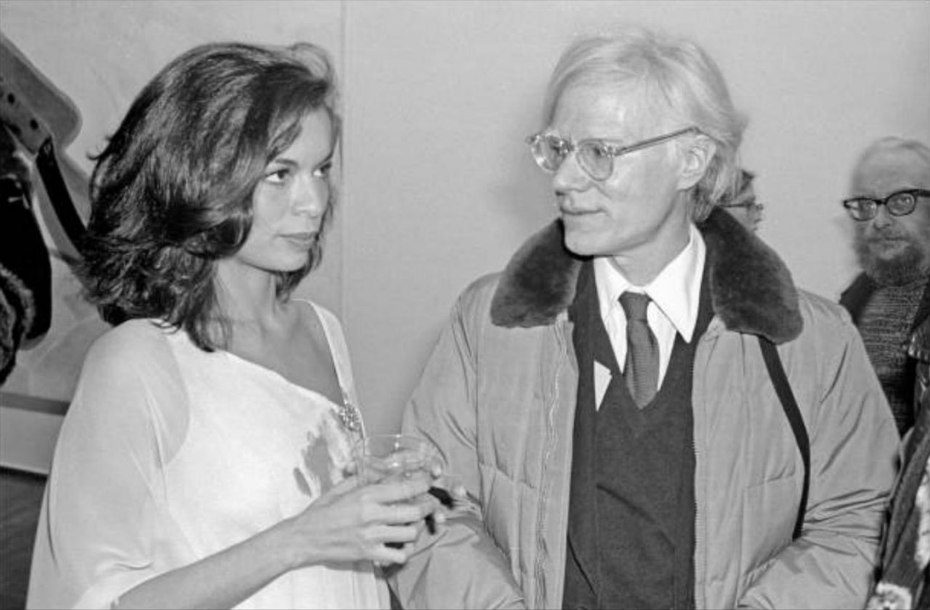
Bianca Jagger and Andy Warhol at the opening of the latter’s ‘Hammer & Sickle’ exhibition at the Castelli Gallery, New York on January 11th 1977.
Photo by Allan Tannenbaum/Getty Images
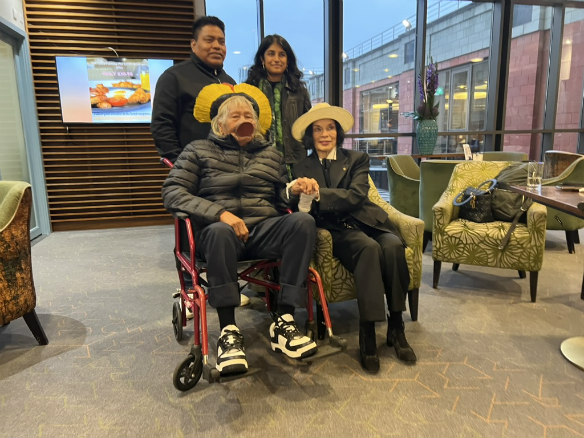
Bianca Jagger with Chief Raoni on 15th October 2025 during his historic visit to London to deliver his urgent plea to King Charles III and the people of the UK to save theAmazon rainforest and his ancestral land.
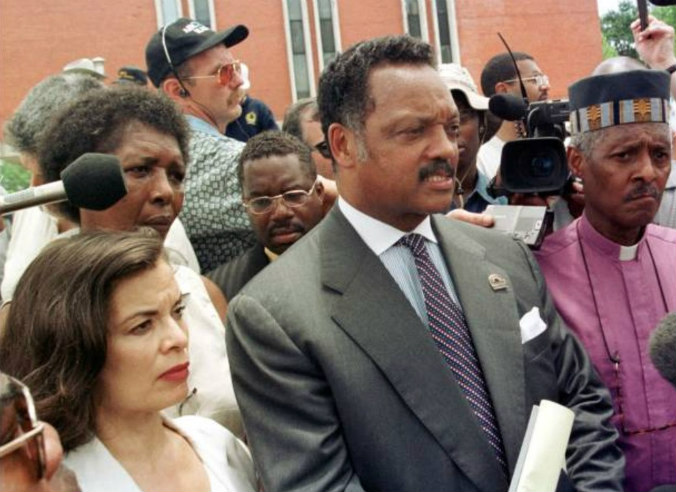
On June 22nd 2000 Rev. Jesse Jackson and Bianca Jagger held a press conference in Huntsville, Texas USA, to urge then Governor George W. Bush to grant a reprieve to Gary Graham, who wanted to be known as Shaka Sankofa, and to grant a 30-day stay to be allowed for a new hearing and the consideration of new evidence.
Photo by Paul Buck/AFP via Getty Images
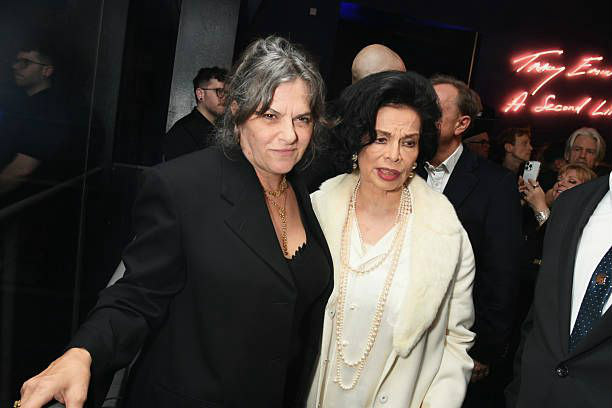
Bianca Jagger at Tracey Emin’s private view of her exhibition ‘A Second Life’ at the Tate Modern on February 25th 2026.
Photo by Dave Benett/Getty Images
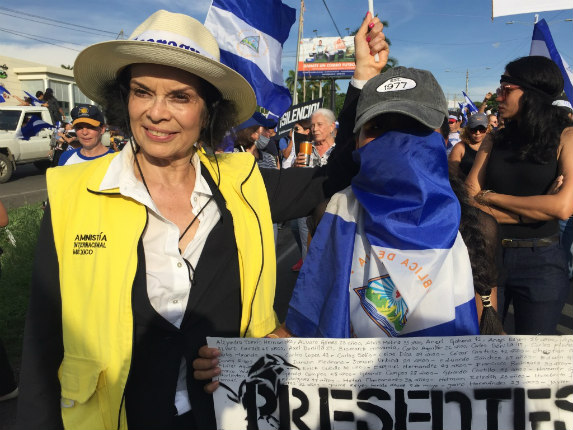
On May 30th 2018 Bianca Jagger participated in one of the largest demonstrations in Managua, Nicaragua, widely known as ‘the Mother’s Day March’ (May 30th is Mother’s Day in Nicaragua). The march was organised by the “Madres de Abril” (Mothers of April) movement and was held in solidarity with the mothers of students and protesters who had been killed by police and pro-government forces during the civil unrest that began in April 2018. Bianca Jagger travelled to Nicaragua to support the protesters and monitor human rights. During the march, which was estimated to have drawn hundreds of thousands of people, the Ortega-Murillo’s snipers and police opened fire on the peaceful crowd. Witness Account: Jagger described the scene as a “horrific” act of murder. She witnessed first hand the “shoot-to-kill” policy she had come to denounce alongside Amnesty international. Outcome: At least 11 to 19 people were killed nationwide that day, with many more wounded, making it one of the bloodiest days of the 2018 Nicaraguan civil unrest.
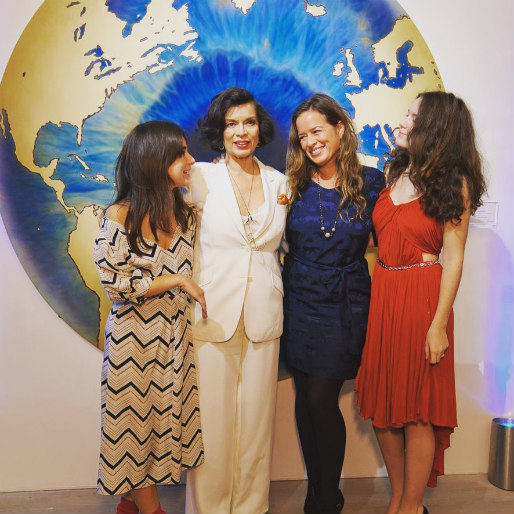
At the launch of the Bianca Jagger Human Rights Foundation (BJHRF) Arts for Human Rights Gala October 14 2011: Assisi Jackson-Jagger, Bianca Jgger, Jade Jagger, and Amba Jackson-Jagger; standing in front of the BJHRF logo painted by Marc Quinn and auctioned during the event.
“At the end of the day, what matters is not fame or public perception. What matters is whether you stood on the side of justice when it was needed.”
Bianca Jagger, with your beauty you have always been a charismatic figure. Did you use that influence?
From early on I understood that public attention could be used as a tool. I tried to use that visibility in the service of causes that matter: human rights, justice and environmental protection.
I do not take it for granted, but I see it as something that carries a heavy responsibility.
You are also a mother, a grandmother and a great-grandmother. Do you speak to younger generations about these issues?
Yes, and I believe it is extremely important.
Young people today are very aware of the world they are inheriting – climate change, war and injustice. In many ways they are more open to discussing these realities than the older generations.
I try to share with them what I have learned through my work and through my experiences.
Are young people today different from previous generations?
Yes, I think they are. Young people today grow up with a constant awareness of global crises – particularly the threat of climate change. That sense of existential threat was not something that most of us felt when we were young. Their generation carries a heavy burden, but they also have extraordinary energy and moral clarity.
How do you imagine the world of tomorrow?
I try to keep hope alive. Hope is not simply a word. It is a decision – a commitment to continue working even when the challenges feel overwhelming.
If we lose hope, we lose the motivation to act. I believe that each of us has the capacity to change the world, even in small ways.
Have you written a book?
One of my regrets is that I have not yet written a book.
For many years, I avoided doing so because I did not want to focus on my personal life. But I now feel that it may be important to write something for younger generations, to show that someone born in a small country like Nicaragua can still make a difference in the world.
If I write a book, it will not be focussed only on my personal life. It would be about what I have learned through my work.
Are you a feminist?
Yes, absolutely.
I have fought throughout my life for the empowerment of women and for gender equality. We have made progress, but there is still a long way to go.
Even in some of the most developed societies, women still struggle for equal pay, equal representation and equal opportunities.
What does it mean today to be from Nicaragua?
It is deeply painful.
Nicaragua today is living under a repressive authoritarian regime. Many religious leaders, politicians, human rights defenders, activists, members of civil society and journalists have been forced into exile or imprisonment.
It is a tragedy for the people of Nicaragua and for democracy in the region.
Do you feel fear when you go to dangerous places?
Of course.
Anyone who says they are not afraid in dangerous situations is not being honest. Fear is a natural human response. Often the fear comes afterwards, when you reflect on what could have happened. But I believe that being a witness can make a real difference. I have seen situations where the simple fact that international observers were present helped save lives. That is why I believe so strongly in the importance of bearing witness.
Do you feel called to go to those places?
Yes, I feel I have a mission.
It is not the same to read about atrocities from afar as it is to see them with your own eyes, to meet the victims, and then to testify about what you have witnessed. When you have been there, your voice carries a different weight.
Has being a beautiful and intelligent woman ever created contradictions in your life?
Yes, there have always been preconceived ideas about who I was supposed to be, but I have always believed that the work itself should speak louder than those perceptions. Over time, the body of my work has become the answer.
Are you strong?
Yes, I am strong – but I do not think of myself as tough. Strength is about remaining faithful to your convictions and refusing to submit to injustice or power. Toughness often suggests hardness or lack of vulnerability. I do not believe that is necessary to be strong.
Thank you very much Bianca Jagger. What would you like to say in conclusion?
I would like to end the interview with something that reflects my lifelong philosophy:
“At the end of the day, what matters is not fame or public perception. What matters is whether you stood on the side of justice when it was needed.”
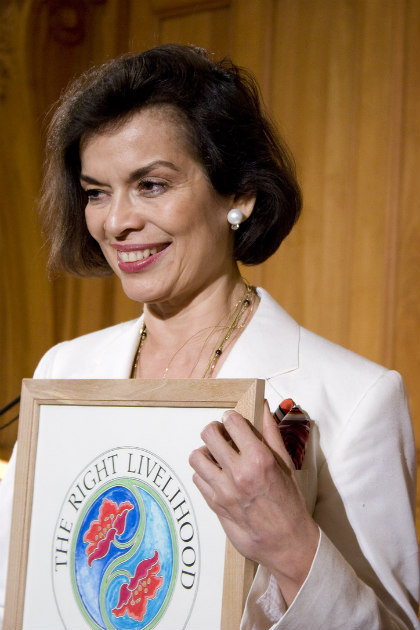
Lead portrait: Bianca Jagger receives the 2004 Right Livelihood Award known as the “Alternative Nobel Prize ” for her dedicated commitment and campaigning for human rights, social justice and environmental protection.”
All images courtesy of Bianca Jagger.
ENJOY THIS INTERVIEW? SHARE IT WITH A FRIEND.