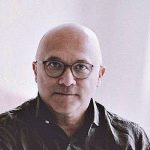
THE GALLERY IS A PALESTRA WHERE AN ARTIST CAN EXPRESS HIS POETRY. Franco Noero is an influential Italian contemporary art gallerist. Born in Cuneo, he is founder of Galleria Franco Noero in Turin, and board member of ITALICS art consortium uniting over 70 of Italy’s leading ancient, modern, and contemporary art galleries. He opened his baseline gallery in March 1999, focusing heavily on conceptual practices and radical artistic research.
15 minutes read time.
You can liten to the podcast of this interview here.
Franco Noero, for almost three decades your name has been closely associated with Turin and contemporary art. How did your interest in art begin?
My first real encounter with art was when I was about twelve. My mother took me to Lugano, to Villa Favorita, where the Thyssen-Bornemisza collection was then housed. Coming from Cuneo, which is a beautiful city but, especially at that time, had very little contemporary art, it was already an extraordinary experience.
Then, when I was fourteen, in 1984, my mother took me to the newly opened Castello di Rivoli. That day, in a way, changed my life. I did not really understand everything I was seeing, but I remember it perfectly. I remember Joseph Beuys’s Olivestone. I remember a wonderful little blue room with feathers and pigment by Lothar Baumgarten. And, most of all, I remember a very narrow, very long room, at the end of which there was Giovanni Anselmo’s Verso oltremare.
Whenever I return to Rivoli, I still look for that room. Of course, the work was part of a temporary exhibition and is no longer there, but I still have the hope of finding it again.
After that, I began asking my mother to take me back to Rivoli whenever there was a new exhibition. I became certain that somehow my life would be connected with art, but I went to the Liceo Artistico in Cuneo, and quite quickly I understood that I was not an artist. Thank God I recognised that early, because I had no particular talent for making art, but I discovered that perhaps I had another talent: observing, following artists and understanding what they were trying to do. I am not an especially passionate person by nature, but I have always had this passion for looking closely and following the work of artists. I have been fortunate to follow many artists, in some cases from the very beginning of their careers.
“From the beginning, I wanted the gallery to do more than simply represent artists. We wanted to produce exhibitions and works, and to accompany artists in their development.”

Franco Noero Gallery – Installation View: The Largeness of China by Pablo Bronstein
Franco Noero, when did you become a gallerist?
My first experience was when I was twenty. I went to Milan and worked as an intern at Philippe Daverio’s gallery on Via Monte Napoleone. Later, I was asked to keep open a small space they had in Corso Italia. I spent about six months there, opening the gallery every day.
Then I returned to Cuneo and opened my first space. It was a difficult experience because I knew very little about the business side of running a gallery. But it was also important because during that period I met Gian Enzo Sperone. I soon closed my first gallery and went to work with him in Rome for three and a half years.
That was a fundamental period for me. Working with Sperone changed the way I thought and the way I looked at art. It was an extraordinary education.
Why did you decide to be in Turin, when Milan and Rome were the principal centres of the Italian art market?
There were several reasons. The first was personal: my fiancée, who is now my wife, was studying in Turin. But there was another, very important reason. The artists of Arte Povera were living there, and there was already a very cultivated environment for contemporary art.
Turin had a bourgeoisie that knew how to look at contemporary art. People were curious, sophisticated and open to new ideas. I thought there was good soil in which to plant something.
There was also a practical reason. I was coming from Rome, which I love and consider one of the most beautiful cities in the world, but it was very expensive and I had limited resources. In Turin, real estate was much more affordable. I could have an apartment in the centre and a gallery on the street level of the same building, and pay very little compared with Milan or Rome.
You moved the gallery many times over the years?
Yes. That was another privilege of Turin. We moved perhaps nine or ten times before arriving at the space where we are today. Each time, it was possible to find an interesting place in the centre without having the enormous costs that would have been necessary elsewhere. Now we are in a much larger space, slightly outside the centre, with an outdoor area. It gives artists much more freedom.
How did you begin working with artists?
It was a process. At the beginning I travelled a lot—to London, Berlin, sometimes New York. I visited exhibitions, met artists and other young gallerists. There was a whole generation of gallerists of roughly my age, and many of us were beginning at the same time. With the artists it was similar. I met many of the artists I still work with today when they were starting their careers and I was starting mine. What I love most, looking back, is that we made beautiful paths together. From the beginning, I wanted the gallery to do more than simply represent artists. We wanted to produce exhibitions and works, and to accompany artists in their development.
“Artists can move in almost any direction, using every possible language and technology.”
Franco Noero, you work with relatively few Italian artists.
Yes. We work with Francesco Vezzoli, Lara Favaretto, Pier Paolo Calzolari and Martino Gamper. Pier Paolo Calzolari is the most recent addition, and it is extraordinary to work with him. He is one of the masters of our time and one of the artists of the original Arte Povera generation. We presented a show with him in 2025, and he has already asked us to do another. We will have a second solo exhibition in Turin during Artissima.
You were deeply influenced by Arte Povera, yet you initially chose to work in Turin with artists of your own generation.
It was an intuition to work with artists who were my contemporaries, but I always felt it was important to bring the experience of the older generation into the gallery. I remember once walking through Turin with Simon Starling. We had lunch in Piazza Vittorio and met Giulio Paolini. Then, a little later, in Via Po, we met Gilberto Zorio. Simon said to me afterwards: “Franco, it is so great to be in Turin. It is like being in London and meeting the Rolling Stones and the Beatles on the same day.” That is still one of the secrets of Turin for me.
Has your clientele changed over the years?
Very much. In the beginning, most of our clients were from Turin. It was not easy to gain people’s trust, but once we did, it was wonderful. Then things changed, particularly around 2008 and 2011. Our clientele became increasingly international. We began participating in more art fairs abroad, and for many years we travelled constantly—to Basel, Paris, Hong Kong, New York, Los Angeles, Brazil and elsewhere. Now we have reduced the number of fairs because it is exhausting and extremely expensive, but they remain important. We have also begun working more in the Middle East, participating in Art Dubai and Art Abu Dhabi, and looking towards the new fairs in the region. For us, fairs are opportunities.
Is the art world today very different from the one you entered?
It is much more complicated, particularly for a medium-sized gallery. My partner, Pierpaolo Falone, and I have deliberately chosen to remain a medium-sized gallery rather than trying to become a smaller version of a major gallery. We want to keep researching. That research is the most beautiful part of the profession. For example, we met Anna Boghiguian in Kassel in 2012, but we only began working together ten years later. She is an extraordinary woman, and when she opens the door to her poetry and to her life, it is difficult to describe what happens. It is something tactile, intimate and very special.
For me, the gallery has to be a palestra—a gymnasium, a place of exercise—where an artist can express his or her poetry, ideas and imagination. That is why we chose such a large space. We want artists to be able to do, in a sense, whatever they want.
Today there is no longer one centre of the art world, nor one dominant movement such as Arte Povera.
Arte Povera was one of the last great movements. Before that we had Futurism, Cubism, Dada, Pop Art, Minimalism and so on. These movements opened art to an extraordinary freedom.Today that freedom is perhaps greater than ever. Artists can move in almost any direction, using every possible language and technology.
Artificial intelligence is one example. I am very interested in it, but I am still researching. Some of our artists are already using AI in their practice. I think we have to look carefully before deciding what its real importance will be. We have already experienced the NFT moment, when enormous amounts of money were invested, and I am still not sure what truly happened there. Fortunately, I was not caught up in it. In the end, I believe that good art will survive.

Franco Noero Gallery – Installation View: Pier Paolo Calzolari – HYPNOS, 2025-2026

Franco Noero Gallery: Martino Gamper – SITZUNG A TORINO, 2024-25

Franco Noero Gallery: Simon Starling 24 hr. Tangenziale, 2006

Franco Noero Gallery: Henrik Håkansson – A Tree with Roots, 2010

Franco Noero Gallery: Darren Bader -Rocks and Mirrors installation view

Franco Noero Gallery: Henrik Olesen – The Euphoria of Turin, 2016 Installation view
“Turin continues to give us possibilities. Artists love coming here.”
Franco Noero, how do you recognise good art today, when there are so many artists and so many different directions?
The role of the gallery remains very important. The artist is, in a way, our first client. We are there to serve the artist. With young artists, we help select the work, organise exhibitions, introduce them to collectors, curators and museums. We are a filter, but also a support system.
With an established artist, the relationship is different. You are entering the life of someone who already has a history and a language. You have to understand that history and find a way of contributing to it. I cannot imagine doing anything else. I am a gallerist. It is what I love, but it is also what I know how to do.
How is the market at the moment?
Difficult. For a gallery of our size, it is a complicated and sometimes very high-risk moment. Consider an art fair. You travel to Hong Kong, ship the works, pay for the booth, the travel, the hotels, the meals and the people who accompany you. Then you arrive and you do not know whether the fair will be successful. Everything is paid in advance.
The art-fair world has changed enormously over the last twenty-five years. Basel remains extraordinary, and I still believe it is one of the places where art can be seen in the best possible way. I was on its selection committee for eighteen years, so I know it very well, but the economics have changed. In the past, Basel could represent a very significant part of our annual revenue. In 2025, we did not even cover the cost of the fair. Fortunately, in 2026 we did. So we are, as we say in Italian, navigando a vista—navigating by sight. I think all of us are.
Do you see a new generation of collectors emerging?
Yes, particularly in Asia and the Middle East. In Europe, perhaps less so. There are young people, even in their twenties, who come with enormous curiosity and enthusiasm. They want to visit exhibitions and museums. I hope they will also discover Turin, a beautiful Baroque city with extraordinary museums, royal residences, the Egyptian Museum and contemporary institutions. Rivoli, the Pinacoteca Agnelli, Fondazione Sandretto Re Rebaudengo and Fondazione Merz all contribute enormously.
After twenty-seven years, are you still convinced that choosing Turin was the right decision?
Absolutely. It requires effort, and lately it has required more effort than usual because we have gone through some serious difficulties and we almost lost our space. The art world knows this and of course Turin. We have overcome them. The fact that the city, the collectors, and our artists have stood by us is yet another reason why I would choose Turin again. Turin continues to give us possibilities. Artists love coming here. They can research, think and work. Pier Paolo Calzolari, for example, came five times to Turin in preparation for his first exhibition with us in 2025. He came to understand the space, to have conversations, to return and rethink. Turin is a place where things can be discovered. Some are new; others are very old but become new to you because you are seeing them for the first time. The city keeps some of its treasures hidden. And, of course, we have excellent wine and excellent truffles.
Franco Noero, thank you very much.
ENJOY THIS INTERVIEW? SHARE IT WITH A FRIEND.