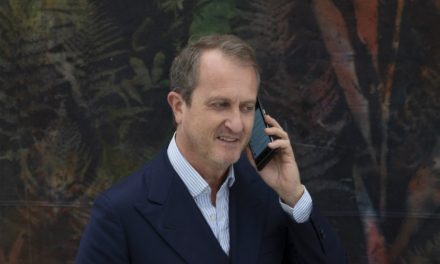
THE ART OF BOOKSELLING. Johnny de Falbe runs John Sandoe Books, the independent bookshop near London’s Sloane Square, together with his wife Arabella von Friesen and their staff. He has worked there since 1989. The small Chelsea shop stocks around 30,000 books and is one of London’s best-loved independent booksellers.
16 minutes read time.
You can listen to the podcast of this interview here.
Johnny de Falbe, has the book industry changed a lot over the years?
The industry has changed, of course; the world has changed. But from our point of view, we are simply paddling our own canoe, as we always have: we buy books and we sell books. Of course the background has undergone great shifts: Amazon, the collapse of the Net Book Agreement in the 1990s, Brexit; Kindle and audio, from which independents like us are excluded. But we still have plenty of people to sell books to. People – particularly older ones – sometimes say, “It must be very difficult running a bookshop nowadays because the young don’t read.” One wants to answer, “Do you ever go into a bookshop? You would find it swarming with young people.” We are very busy.
What makes John Sandoe Books different from other bookshops?
We have about 30,000 books, of which about 28,500 are individual titles. Some people find the way we shelve them unusual. But there is a logic and an order: we have to know where things are. But we don’t put up signs saying “Biography this way, psychology that way,” because we believe such things prevent conversation. Above all, one wants human-to-human contact. We have a very deep stock, which makes it an interesting place to rummage around in. It may look old-fashioned; I don’t mind that. The small premises put you in immediate touch with a much wider range of books and there’s a rich density of ideas in our space. The juxtapositions so appreciated by our customers depend on the limitations of the space.
“It matters to me that we have clients in America, Italy and all over the world. I want us to feel international.”

The welcoming interior of John Sandoe Books. Photo by Arabella von Friesen.
Johnny de Falbe, how do you keep so many titles in stock?
Several times a day I look at what has been selling from our shelves and re-order, re-order. They tend to be single copies. If somebody buys a Colette novel or The Book of Disquiet by Pessoa then I re-order it. If it’s East of Eden by Steinbeck, I want it back the next day, so I get it from a wholesaler at a slightly reduced discount. A lesser-known novel by Eleanor Catton can come from the publisher, where I get a better discount. Every day we make lots of tiny decisions. Sometimes we think, “We don’t need that book back. It’s done its service; now let it go.”
How do you decide which books to stock?
Big publishers such Penguin or HarperCollins have sales representatives. Every quarter we go through the books they are presenting and say, “No, no, three copies, ten copies, one copy, no, no. no” It is partly experience and partly how much you trust the sales rep. We also comb the lists of small, even tiny publishers or private individuals to keep our selections fresh and balanced. So many interesting books come from them. They may take risks that larger publishers don’t. If a book is good, then we want to stock it.
How do the classics coexist with new publications?
Of course there is an appetite for new books. A selection of the best of these can be found on our two ground-floor tables. How we choose them depends on several factors, including who the publisher is, how the book is pitched, reviews, and what Arabella or I may know of the author. Probably what makes the till ring most is new books, but what brings people into Sandoe’s is often the perception that we might have something else they want lurking on our shelves; our backlist, some of which you might call classics. They come for the new Elizabeth Strout, wander around for a while and find other treasures. They know they could get Strout cheaper on Amazon, and we know it too. Twenty years ago they asked us for discounts. Nowadays that conversation never happens.
Do customers come to you for recommendations?
This relates to a word not often used about books: taste. In the past, customers went to a particular bookshop because they liked that bookseller’s taste. They developed a relationship. The role of taste has been eroded by the media, prizes and centralised buying by retail chains. Prizes are fantastic and booksellers inevitably stock the winners and shortlists. But the individual bookseller can still have a significant role. People come to us because, whether they phrase it that way or not, they are responding to taste. We ask what they have read recently and pitch something to them, often something we like but above all it’s something that we hope that they will like. We publish catalogues four times a year: usually 150 to 200 books, and 450 to 500 in the autumn. These selections reflect our taste and our customers find them extremely useful.
Do young people still read the classics?
Yes, they do. But the literary canon has become broader in in a way that I welcome. It now includes far more women writers than a generation ago and more translated works too. We have young visitors from all over the world, probably finding us through social media. They might buy Murakami, Sylvia Townsend Warner, Ginzburg, the new Katie Kitamura or Kafka… they are multicultural, open-minded and international – and are just as interested in our backlist as in the latest fashionable debut fiction. I rejoice in this development more than I can begin to express. My colleagues love it too. It is why we do what we do.
Joyce’s friend Valery Larbaud once said there were only 1,500 real readers in each country. Is that still true?
There may always have been a central core of committed readers. I don’t believe there are fewer now. More people in the world are literate, after all. Throughout my time in bookselling there has been a media narrative that people don’t read, particularly young people. It’s a version of “the world is going to hell in a handcart.” I think the media thrives on it. Recently we were asked to launch a book about how terrible it is that nobody reads anymore. I declined because I don’t want to associate our precious bookshop with such a narrative and also because it is not our experience. Sometimes I wonder whether the people who trade in this narrative ever actually go into bookshops.
“Above all, one wants human-to-human contact. The relationship with an independent shop goes beyond the simply transactional.”
Johnny de Falbe, can people buy books online from you?
Yes, we sell books online.
Why do people buy from you rather than Amazon?
Some people find things on our website that are not widely available, such as privately published books or oddities. Others buy ordinary books from us because they have discovered them through us and value their relationship with us. Of course people sometimes photograph an ISBN in the shop and order it from Amazon. One can’t police that, nor would I wish to. But people buy from us because they find what they want, including what they didn’t know they wanted until they found it. The relationship with an independent shop goes beyond the simply transactional.
Are books becoming too expensive?
I don’t think books are relatively more expensive than they were thirty years ago. Spending £20 or £30 on a book is not nothing, of course, but the price of a bottle of wine or a restaurant meal has increased much more. Although sometimes books can be strangely expensive, I don’t generally feel I’m selling inordinately expensive things. Don’t you think it is astonishing that you can buy Don Quixote or a volume of Tang Dynasty poetry for the price of an ice cream or a couple of cups of coffee?
Among your customers have been famous people like Mick Jagger and Tom Stoppard. Does that matter?
People like those stories, but the day-to-day purchases of people buying a £14.99 paperback are much more significant. What matters is having interesting customers who buy a lot of books, as Tom Stoppard did. You can be confident they will want a particular book, so you stock it. One customer interested in Islamic art can help you build a good section on Islamic art.
Do you know many of your customers personally?
Yes, absolutely. We know lots of them.
Do some come in simply to say hello?
Yes. Some people come to say hello, while others don’t want to be greeted; they want to be left alone. You gauge that pretty instinctively.
Is bookselling a particularly human experience?
Knowing what regular readers read is knowing an intimate part of them. For habitual readers, what they read touches their soul. My old boss John Sandoe used to say it was a bit like being a GP: you may know nothing about somebody’s practical life, but you know something their friends don’t. The independent bookseller can know something about a customer that even their friends may not know, unless they are book friends. That is a great privilege. I love helping people with what they read.
What kinds of books sell best?
We are broadly arts-based. We sell more essays than thirty years ago, more nature writing and books about the environment. We still sell a lot of art books, also cookery, gardening, children’s books, poetry… But probably what sells most is paperback fiction. People ask, “Where are your classics?” and you wonder whether they mean Homer and Cicero, Tolstoy, or George R. R. Martin. There are very different ideas of what a classic is. This is how conversations begin and thrive.
Are literary critics becoming less influential?
Perhaps. And there is the mysterious rise of the blogger. I don’t use social media personally and don’t really understand why people buy books that way – they should go to a bookseller – but they do. There is less space given to critics in newspapers and there is less consensus so their recommendations carry less weight, but it would be wrong to say that they have no influence.

Johnny de Falbe runs John Sandoe Books, the independent bookshop near London’s Sloane Square. Photo by Arabella von Friesen.

An interior view of John Sandoe Books. Photo by Arabella von Friesen.

An interior view of John Sandoe Books. Photo by Arabella von Friesen.

The stairway inside John Sandoe Books. Photo by Arabella von Friesen.
“Bookselling is very physical, and sometimes absolutely exhausting, particularly as one gets older, but I go on thinking it is a valuable and enjoyable thing to do.”
Johnny de Falbe, how much do you read?
I read every day, probably for an hour or two, sometimes less, sometimes more. Mostly I read books completely. Perhaps I get bored more easily than I used to and think, “I’ve got the hang of this now. I don’t need to know any more.” We also read aloud to one another – Arabella and I – during the night, or on long car journeys. We’ve just read the two trilogies by Olivia Manning.
Do newspaper bestseller lists influence you?
Not much. We stock some books on the bestseller lists, but there are many on those lists that we would simply never be asked for.
What happens when a much-publicised book appears, such as the one on Diana by her brother Charles Spencer?
A book like that has a lot of noise in advance. Everybody wants it for a week or two, and three weeks later nobody wants it. Charles Spencer, though, is a good historian and a good writer, so there was sound reason to order his book whatever the subject. Even so, interest tails off quickly.
Can you return books that do not sell?
Much of the book industry works on sale or return, so we can send unsold copies back within a certain window. But you don’t want huge carriage costs from sending books to and fro.
Will there always be room for small, personal bookshops?
I think so. It is less “Johnny is my bookseller” than “John Sandoe is my bookseller.” In the wake of huge multinationals, there is an increasing sense of the value of small businesses and of the person-to-person relationships they entail. People who grew up in the digital age are no longer necessarily wowed by the digital. Perhaps it is wishful thinking, but I believe more and more of them will come to value the personal relations that have been so widely abandoned.
Can one make a living as a bookseller?
It depends what you mean by a living. Some people think it means earning £100,000 a year. No bookseller I know is going to make that sort of money. Nobody working for us is going to get rich. I’m not going to get rich!
But can you pay a living wage?
Yes. People are paid a living wage with us, and we are still in business. I expect to be in business next year. There are highly intelligent young people who want to work in a small bookshop, knowing perfectly well that friends of theirs will be much better paid elsewhere.
Is bookselling a profession in England?
In the UK, the idea of the professional bookseller hardly figures. There isn’t much of a career structure. In parts of Europe there are courses, diplomas and a recognised career path; not in England. People find their way to it. Some of our young colleagues could earn more elsewhere, and some move on to academia or other work. It isn’t necessarily a matter of money. I am optimistic that we can continue doing what we do, though I don’t expect us suddenly to become rich.
After all these years, are you happy?
I enjoy going to work. I enjoy being at the centre of sharing a culture of books. Young people from all over the world find their way to us, look around and say, “Wow, I didn’t know places like this existed.” And I think, “Welcome aboard.” Our young colleagues get a tremendous buzz out of that too. Bookselling is very physical, and sometimes absolutely exhausting, particularly as one gets older, but I go on thinking it is a valuable and enjoyable thing to do.
What do you think of the proliferation of literary festivals?
Culturally, they are a good thing. They get people talking about books and feasting on ideas. I don’t quite understand their economics without a big sponsor. We generally stay in our bookshop, though we have run a pop-up at the wonderful Cliveden Literary Festival since it started. Its proximity to London makes it workable, but it is a big logistical enterprise.
How did Brexit affect the shop?
There has been a proliferation of regulations and a loss of confidence among overseas customers. It is improving, but dealing with it takes an inordinate amount of time. We deplore Brexit because it culturally removes us from overseas, which we don’t want. But we will get over it.
Do you have many foreign customers?
We have English people living abroad and English-speaking readers overseas, as well as visitors who take books home in their bags. We have always sent books overseas. These customers are commercially valuable, but also culturally significant. It matters to me that we have clients in America, Italy and all over the world. I want us to feel international.
Johnny de Falbe, thank you for this very interesting conversation.
ENJOY THIS INTERVIEW? SHARE IT WITH YOUR FRIENDS.