

TAKING FASHION SERIOUSLY. Valerie Steele is an American fashion historian and the Director and Chief Curator of The Museum at the Fashion Institute of Technology (FIT) in New York City. A pioneer in the field of fashion studies, she has been instrumental in establishing fashion as a legitimate intellectual and cultural subject.
27 minutes read time.
You can listen to the podcast of this interview here.
Valerie Steele, why have you devoted your life to the study of fashion?
I simply found it really interesting. Initially, I was especially struck by the amount of hostility towards fashion, as well as the incredible attraction that many people felt towards fashion. So both the allure and the problematic aspects of fashion attracted and interested me.
You could have devoted your life to art or philosophy but you don’t believe that fashion is superficial?
Fashion is widely seen as being superficial, not serious or unimportant, just vanity about surface appearances. Literally, it is superficial – your clothes are on your body or extensions of your body – and yet from the beginning I felt that the fashion/body connection was, in fact, what made it so powerful. It took me a while to realise that it wasn’t just the body, but rather the body as the foundation of the individual self. Even in cultures that have no clothes, the concept of fashion still exists, because you have body paint, jewelry, tattoos, and other modifications that keep you from being in the raw human state of nakedness.
“Both the allure and the problematic aspects of fashion attracted and interested me.”

Installation view of Paris, Capital of Fashion. Christian Dior, blue embroidered silk shantung haute couture dress, spring/summer 1952, France. Lent by Hamish Bowles
Yves Saint Laurent for Christian Dior, “Soirée de Paris” black silk velvet haute couture dress with replica silk satin sash produced by Christian Dior, fall 1955, France. Kent State University Museum, Silverman/Rodgers Collection (Gift of Marti Stevens) 1983.1.1253ab
Jean Paul Gaultier, haute couture ensemble, black silk crepe dress and gold lamé overdress with paniers, spring/summer 1998, France. Lent by Jean Paul Gaultier
Christian Dior, “Mystère de New York” black haute couture chiffon over silk faille dress, 1955, France. Lent by Hamish Bowles
Balmain, “Chateau Haut Brion” haute couture red silk satin dress, fall/winter 1955-1956, France. Lent by Hamish Bowles
Valerie Steele, we see in paintings and images of the past how fashion itself means change. Is fashion a human need?
For a long time, scholars in Europe and North America assumed that fashion was something invented by the West in medieval or Renaissance Europe. But although Westerners said that dress in, say China was ancient and unchanging, in fact you can date Chinese art by the clothes that people are wearing. The Chinese had fashions for millennia. The changes in Chinese fashion may be imperceptible to most Westerners, who think it all looks the same, but for people in that culture fashion clearly differentiated between men and women, married and unmarried, from country and from city. Fashion makes all kinds of messages and distinctions, so it does seem to me to be something which is innately human.
What are examples in the Western world of how things change?
The long robes that were worn in the Middle Ages by both men and women go back to the draped garments of the Mediterranean. Trousers came from Central Asia, both to Europe and further East, often trousers were associated with horseback riding. Yet, Westerners wanted to distinguish themselves from the rest of the world. They thought that only they had modernity, and fashion became associated with the rapid pace of change of modernity. But there’s no culture without history, and therefore no culture without change. Even the smallest and most isolated cultures change.
Today big names such as Dior and Chanel and others sell clothes for a lot of money, and at the same time Zara and Uniqlo are elegant copyists and much cheaper. Is the end of luxury fashion in sight?
It seems like a transitional period. We’ve seen increasingly over the last 20 years that big corporations have eaten up smaller independent designers. Whether those are the great luxury corporations like LVMH or Kering, or the great fast fashion corporations like Zara and Uniqlo, they’re able to buy designers and family companies that were formerly independent, which has created a real split. It used to be that there was much more in the middle, in terms of independent designers and small manufacturers. It’s certainly a difficult period for independent designers. That’s been the latest shift, but I don’t think it means that luxury disappears, although it may be going more and more towards a kind of gilded age 1%, or less than 1%, compared to the 99% that will wear fast fashion. But there may well be a reaction to that, as people try to respond in a way that’s not dependent on exploitation of children in factories in Bangladesh, but that responds to creativity more locally. So there may be a response where people are buying locally from small designers. We don’t know what’s going to happen, but it can continue like this only so far before there’s some kind of a reaction.
This year we lost two famous Italian designers, Mr Valentino and Mr Armani, and until recently Mr Valentino and Mr Armani were the designers and the owners of their names. Mr Saint Laurent and Mr Dior are no more but companies bought their brand names and the new owners take on designers with a lot of talent?
It’s a strange phenomenon because you can’t imagine it happening in art. You don’t say, “Picasso is dead, but Julian Schnabel is the new creator for Picasso and will continue to help that brand.” The designers try to brand themselves to maintain some kind of independence, but the corporations have much more power and when they want a change they can even dismiss a designer who’s created billions for them. Especially this year, we have this bizarre shuffling of designers all moving around in a game of musical chairs. Like sports players, they’re sold to other teams. Of course, the clients these days are all different too.
In the 50s and 60s European designers came to America, and then it became all about China and the Far East. Today if you go to a Hermes shop or a Dior shop you don’t see many Europeans or Americans?
You definitely see consumers from economically upward countries who appear at all the fashion shows. Slowly there’s a response and the brands start putting more Asian models on the runway and start advertising more in Asia, because they see that’s where they can grow their audience. It’s fairly stable in Europe, or even shrinking because the population is not growing.
The Uniqlos and Zaras of this world produce copies of designer clothes that look very nice. Why spend much more money to get the same cashmere or the same shirt?
Copies today are much better looking than in the past. I frequently will say to someone, “Oh, is that Prada?” And they’ll go, “Oh no, it’s Zara.” It’s beautifully done. It doesn’t last as long. It’s usually made of cheaper materials, but sometimes they can actually be made in the same factories, because the dirty little secret is that the luxury houses are not usually making things out of rare materials by artisans in Europe; they’re often producing them in the same factories that produce less expensive goods. That has caused a real commotion because, with a few exceptions like Hermes, people think, ‘Is that really a luxury object or is that not made in a factory in China or by Chinese labourers in an Italian city who’ve been brought in there to work in sweatshop conditions?’ There are different qualities of cashmere. Some is really good. Some is just the cashmere left on the factory floor that they sweep up with the dust and everything else.
But in fashion today, whether men’s or women’s, there is much more emphasis on sustainability?
Yes, there have been many attempts to incorporate greater sustainability into fashion, although it’s still questionable to what extent this is really making an impact on the vast production and waste of fashion. Jeans are tremendously destructive to the environment, and to the extent that you can re-cut and re-use those jeans again it is definitely better for the environment, but there’s an awful lot of greenwashing as well, where people are saying it’s more sustainable than it really is. Young people always say they’re interested in sustainability, but unless they’re buying from thrift stores, they’re buying from the likes of Zara and Uniqlo. There are also all kinds of terrible problems, such as child labour.
As there is no longer a concept of having a wardrobe that you keep and mend, perhaps it doesn’t matter if things don’t last very long?
That’s how people think. It’s a tremendous change from the past. Clothing today tends to be regarded not as a valuable thing but just an ephemeral thing, especially in the States, where most people can’t even tell the difference between a good material or a bad one. In Europe and Japan there’s more connoisseurship. You can tell a lot just by feeling fabric, but most people are not aware of that.
In a personal or family budget how much is now spent on clothes?
Much less than before percentage-wise, because they can get it cheaper and it’s even disposable. It used to be that you’d have to spend a considerable proportion of your middle-class income on clothes, but now you don’t have to and you can still be shopping every month or every week, because people do like to refurbish things a lot more. They’re not thinking in terms of a seasonal wardrobe and keeping it for years.
“Although most people don’t get any exercise, they want to look sporty.”
Valeri Steele, today people dress casually. Everybody wears sneakers and you rarely see people in a suit or tailor-made clothing?
In the old days I would have to be wearing heels now. But casualization began more than 100 years ago. I remember seeing a joke in Punch from about 1890 where a young man has proposed to a young woman and he’s wearing a business suit. Her father asks how he can propose wearing a business suit, and he responds, “Well, I mean business!” Only a few years earlier, he would have been wearing a formal frock coat, so he’s already dressing down by wearing a business suit. By the 1970s you started to have much more casual clothes like jeans and later you had Dress Down Fridays and people had no idea what to wear! They came in wearing what they would wear normally to clean out the garage, and the HR department said, “You can’t wear that.”
Will more formal dressing return?
I don’t think that you’re going to have everybody wearing suits and ladies wearing dresses, girdles and stockings. Some people will, and they will for certain occasions but not all the time, so that won’t be a reversal. But people also want to show off that they have money, so they might have a prestigious label like Dior cashmere sweatpants instead of cheap cotton sweatpants from the athletic store down the street. You have people showing off in strange ways that mix the semiotics of wealth and status with those of casualness and athleticism. Although most people don’t get any exercise, they want to look sporty.
Are blue jeans still very popular?
Not anymore, they’re way too restrictive. We’ve gotten used to clothes that stretch, and sweatpants have replaced blue jeans for most young people. But in other ways, bodies have become more important than the clothing on them. In the past women could wear a corset and it would push the fat around, but then it became important to say, “I don’t need to wear a corset because I already have that perfect ideal body.”
One of your many books is titled “Fashion and Eroticism: Ideals of Feminine Beauty from the Victorian Era to the Jazz Age.” Can the way women dress still be erotic?
Yes, that doesn’t seem to be going away. The idea of nude dresses is the latest phenomenon, where you’re dressed but just barely. There are many ways in which you can emphasise eroticism in dress, which people still do because being sexually attractive is important to a lot of people.
If you consider the designers Coco Chanel and Azzedine Alaïa, one was copying men’s tweed jackets and the other molding to the woman’s body?
Yes, but those little Chanel dresses were showing more leg than any other designer of the 1920s. A little chemise dress was not necessarily masculine, even if the woman had super short hair and was smoking a cigarette. She was showing off a girlish body as well as boyish components. It wasn’t just la garçon, but the young girl dressing up as a young boy. It was androgynous chic, and youthful, like Diana replacing Venus as the ideal. The youthful ideal hasn’t gone away.
What do women look for?
You can’t generalize this, because they want different things. Very often they want to look sexy. It’s particularly important if that’s the only way they can get ahead. Actresses or singers professionally have to look sexy because they’re rejected if they don’t. Unmarried women, if you’re never going to make money unless you catch someone rich then it pays to look sexier. For men, it’s more problematic. Gay men want to look sexy, but most straight men want to be perceived as sexy but not to look naked, because looking naked for them means looking vulnerable and they also are phobic about looking gay. If they’re gay, then they’re more clearly angling to be looked at, particularly if they are young. Whereas women will often show a lot of their bodies, most men are much more reluctant to do that unless it’s in a sport context.
Nowadays people of all ages dress pretty much the same?
Much of the time, yes, and dress is usually very casual. Already by the 1960s many people just wanted to be comfortable and to look young and hip. Their costume was blue jeans and a t-shirt, and so older people started wearing blue jeans and t-shirts, because youth was more desirable than it had ever been before and everybody wanted to look young.
Why do even children not dress as children anymore?
They, too, want to look like teenagers, and parents buy their babies t-shirts like their own. I looked at my grandson who’s four and he’s wearing a little Italian soccer shirt. I said, “Oh your grandfather bought you that because he’s a fan of Italian soccer.” He looks so cute in it but it’s not a child’s thing, it’s a teenager’s or a young man’s thing.
Another revolution is that children wore shorts – that has all but disappeared but now you see grown-ups in shorts all the time in the summer in the city.
That took a long time. It started in the 1920s when tennis players were in the forefront of bringing shorts into acceptability. I remember reading that one famous tennis player put on shorts one day to go out to play tennis instead of long trousers, but he was embarrassed so he put a trench coat over it and his doorman ran after him going, “Sir, sir, you’ve forgotten your pants!” Shorts were seen as juvenile, because little boys wore shorts, but was also shocking to see all that naked leg after a century of men being all covered with trousers, and no more silk stockings like before. You saw a lot more of men’s legs in the 16th, 17th, and 18th centuries than you did in the 19th and early 20th.
There is also a great change in the clothing materials which were heavy and now are very light while at the same time keeping you warm?
Yes, light clothes are again perceived as more comfortable and more seductive. Somehow silky, lighter cottons and materials, including artificial materials like rayon, became modern and still were mostly worn by women but increasingly with technical materials also bought by men.
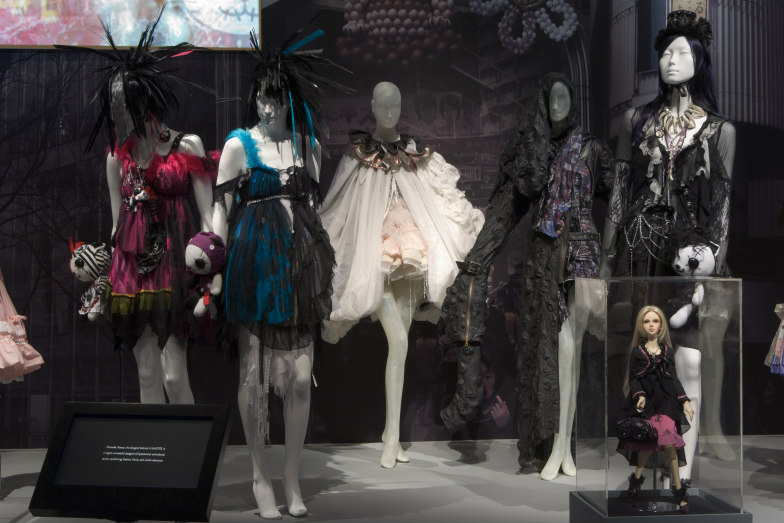
Installation view of Japan Fashion Now
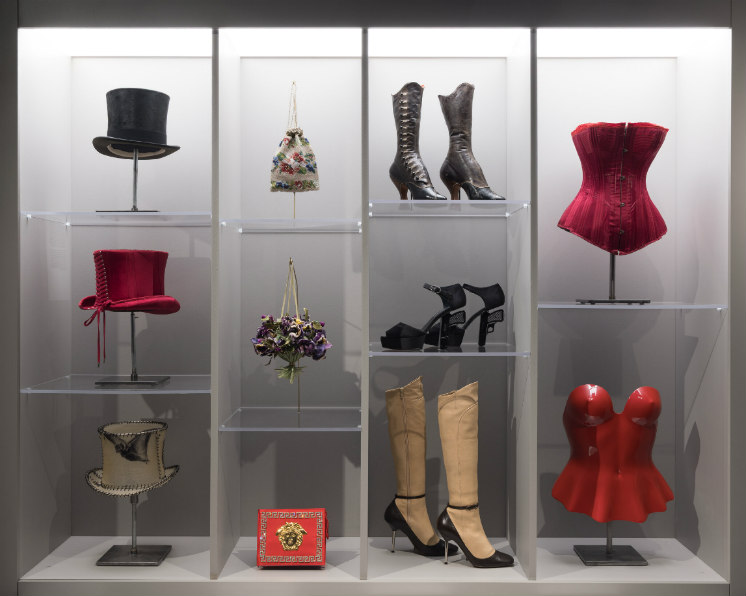
Installation view of Dress, Dreams, and Desire: Fashion and Psychoanalysis
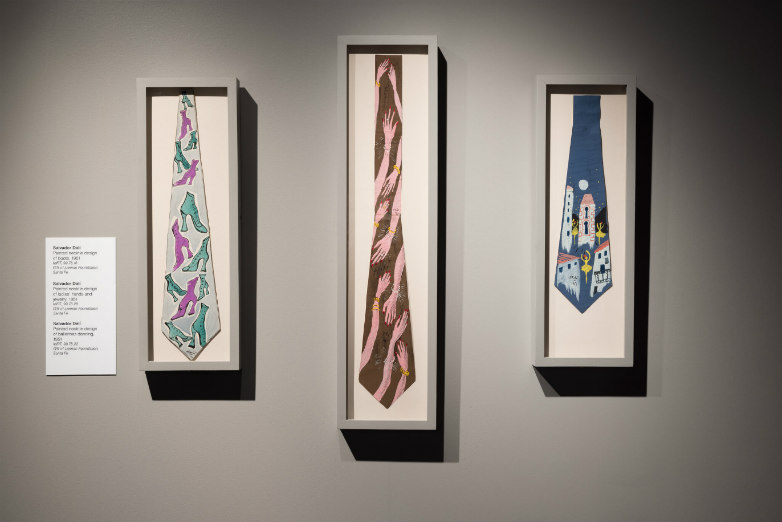
Installation view of Dress, Dreams, and Desire: Fashion and Psychoanalysis
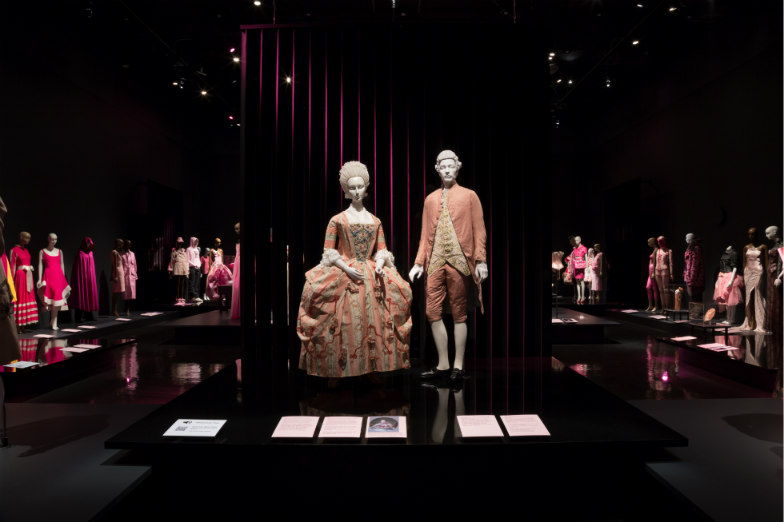
Installation view of Pink: The History of a Punk, Pretty, Powerful Color
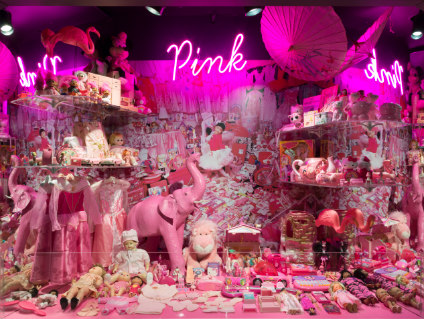
Installation view of Pink: The History of a Punk, Pretty, Powerful Color

Installation view of The Corset: Fashioning the Body
“The body is central to fashion.”
Valerie Steele, what about changes in fashionable colours?
Colour is very important culturally. The connotations of colour change constantly. Michel Pastoureau wrote fabulous books about colour. A genius, he wrote on the subtleties of black, how it could be erotic but could also be authoritarian and menacing:- night is black, the devil is the prince of darkness, but the dandy is also the black prince of elegance. Colours have both their good and their bad side, so yellow when it’s like gold is prestigious, but other yellows were stigmatized and Judas wore yellow. I was inspired by Pastoreau to do my exhibition on pink, which I call the most controversial colour in the modern era.
Because pink can be both masculine and feminine?
Pink had been androgynous in the 18th century, when it was the fashionable colour at court, but it quickly began to seem feminine. Pink was identified as feminine, because of pink parts of the body like lips, nipples and genitals and then blue was brought in as masculine, but as late as the 1920s people couldn’t tell which was which. Life Magazine did a whole story on which department stores said that blue was for boys and pink was for girls, and which ones said, No! pink is for boys and blue is for girls. It was equal. They couldn’t make up their minds. Some said, blue is the colour for the Virgin Mary and pink is a diminutive of red, which is a virile military colour so pink has to be for boys. Ultimately it was probably because the millionaire Henry Huntington bought two famous 18th century paintings, Pinkie, a little girl by Thomas Lawrence, and then Blue Boy by Thomas Gainsborough, who had done a Pink Boy but it already belonged to the Rothschilds. There are millions of pictures of little 18th century girls wearing blue dresses or blue hats and sashes, but because Huntington happened to buy these and pay so much money for them, people thought that as long ago as the 18th-century it was blue for boys and pink for girls. But there’s nothing natural about that.
French men like blue shirts, Americans wear white shirts, Valentino is famous for red?
Colours are a culturally constructed variant. White is another incredible colour, a colour for mourning in Asia, and here a colour of virginity and cleanliness. Green is very interesting, and associated with nature, but only with the romantics. Prior to that, it was more associated with envy and evil. In Balzac’s book Cousine Bette she wears green. Today, for most people in America anyway, green is a very unpopular colour. It still has a lot of negative connotations. Americans like blue and red. Europeans in general have blue as their favourite. Asians generally speaking prefer red. America is a more multi-ethnic country. Blue is top in America, but red is close after.
If you work in the movies or the arts do you need to be dressed in black?
Bohemians have an association with black. I find black the most interesting colour, precisely because of the mixture of meanings that it has. Black signifies both anarchy and fascism. Just as red was a revolutionary and communist colour and then it became the colour of the Republican party. That really seems to have happened under Reagan, partly just for the totally accidental thing that Mrs. Reagan wore a lot of red. The meanings of colour are culturally constructed.
Now you have a President who always has a red tie?
Yes, it identifies him. Last December I saw the operetta of Robinson Crusoe at the Théâtre des Champs-Élysées in Paris, and when the “savages” came out, all of them were dressed and made up to look like Trump with long red ties and yellow wigs. It was a stupid operetta but a very funny moment.
Today which are the most elegant women?
I would say women in Milan are intimidatingly elegant. Men too in Milan are extremely elegant. I don’t know why. The Italian spazzatura is there, but also this northern Germanic discipline. Their only competition is upper class Japanese women, who are extremely elegant. There are elegant women in America, but elegance is not held to be such a high value.
What is elegance?
Traditionally it would be savoir faire and restraint, but we know it all has to do with what was regarded as elegant by the elite of a previous generation that was passed down. It’s very much a class-oriented definition, which is being challenged. Fashion touches all social levels, but just as luxury is not exactly synonymous with fashion nor is elegance. Fashion is multiple and changing and elegance is more associated with a certain kind of classic style as opposed to changing fashion.
Were mythical designers of the past like Saint Laurent, Dior, Balenciaga, fashion geniuses?
They certainly had a major impact on the fashions of their time. Whether current designers will be said to have had the same kind of impact is harder to know because they’re not independent players anymore. They’re increasingly working for corporations.
Does inventing something new make a designer very special?
That is probably one of the most important things, novelty and the influence on contemporaries. Chanel, Dior, Saint Laurent, Armani, all had a major impact, and more recently Prada, and Rei Kawakubo.
What is the link between art and fashion?
These are two aspects of visual culture that run parallel and intersect with each other repeatedly. They are both ostensibly involved in beauty, but that’s not the definition of art anymore. Art has changed. Art is also originality and about saying something meanigful. Art is still to some extent, a kind of religion. Fashion is a religion for a few people, but it’s a much smaller number. Fashion is taught in fashion schools and design schools, and maybe future artists and future designers are at the same school but they enter into completely different industries. Art is theoretically without utility, although it has commercial value and we can use it as collateral. Fashion is to wear and thus to present yourself to others. Even the most expensive fashion is nowhere near as expensive as the most-expensive art. Usually, fashion’s greatest price will be at the moment it’s sold, and then it declines in value.
How many people come to visit your museum at FIT?
It’s a small museum. In the last couple of years, because of closing different galleries for renovations, it’s dropped to about 100,000. For a while, we were having about 200,000.
And you have many beautiful dresses?
A collection of about 50,000 objects from the late 17th century to the present. We tend to buy things as we’re planning exhibitions. I’m working on an exhibition about the image of the witch, fashioning the sorcière, the strega. I just bought a look from Comme des Garcon’s Blue Witches collection.
Who finances this museum?
The City of New York and the State of New York pay for FIT as a college. We’re a division of the college, which teaches art, design, business and technology. It was founded as a fashion school, but now has 50 different majors. Many people still want to work in fashion, more in business than in design though, being a buyer or an executive.
The era of the supermodel is over and today it’s all on your little screen. Is a lot of importance given to influencers?
Yes, all the influencers who are now in the front row of fashion shows in place of editors.
Today you don’t have to sell in shops, but you sell a concept?
Ultimately, you want to sell product but it’s true that products can range from a lipstick to a couture evening dress, so you also want to show images and reputation.
And spend millions on stores?
Of course, because that will increase your reputation and you’ll sell, if not that many more clothes, at least that many more handbags and lipsticks and perfume.
Why don’t we see women wearing hats anymore?
That changed in the 60s because hair became more important. John Kennedy had the hair, he didn’t wear a hat when he was inaugurated. Mrs. Kennedy had the hair. Ultimately the pillbox hat had to go.
To be fashionable, everyone wants to look young and so they dye their hair and make lifting injections or whatever?
Exactly. The body is central to fashion. Already in the 1920s we see women who want to look like their daughters. In the late 19th century, it was the woman of 30 who was fashionable, but then increasingly it became the woman of 20, then the woman of 16.
Do you know where fashion is going?
No, if I knew where it was going I’d be a very rich person. It’s very rare that you see things coming back. It may do a spiral, aspects of it may come back, but it won’t circle around to what it was before.
Maybe America actually won in the sense that the rest of us didn’t really think a lot about being comfortable?
Yes, it didn’t really exist as a concept in most places. In America people don’t want to be uncomfortable, unless their image at that moment is more important. When I did my corset exhibition I had a replica of an 1880s corset made, but in leather, and people said, “Isn’t that uncomfortable?” I said, “it was made for my body. It feels quite comfortable but my feet are killing me in high heels on a concrete floor.” It’s all about what you’re willing to put up with.
When you look at paintings of other centuries, women and men were dressed more differently?
That’s right, and a corset not only would push the fat around and make it the right shape, it was also padded and padding out, so if you were a skinny little person, the corset padded you right out. I remember seeing a corset from a brand called La Fiancée in one collection, and it was so heavily padded I actually remember thinking, ‘Well, I hope she married someone who actually was in love with her, because he was not getting the body that he thought.’
To give a concluding synthesis, fashion is dressing the body?
It’s dressing the body, absolutely, and fashion is more than clothing. It’s everything that transforms your body, from your hairstyle to your makeup. People will always want to fashion their bodies in some way and today people are more visually literate.
But at the moment there are no movements like punks or hippies, these kinds of aesthetics of young people who changed the world completely?
Subcultures have changed too, with the industrialization of everything. Subcultural styles emerge, like skaters, but they become commercialised almost instantly.
Dr. Valerie Steele, thank you very much.
ENJOY THIS IN TERVIEW? SHARE IT WITH A FRIEND


