

A REMARKABLE BOOKSELLER. James Daunt is the founder of the Daunt Books chain in the UK, and has been managing director of Waterstones, the bookshop chain of more than 300 stores, since 2011. In 2019 he also became CEO of Barnes & Noble, the American bookstore chain of some 650 stores. An Honorary Fellow of the Royal Society of Literature, Daunt was appointed Commander of the British Empire (CBE) in the 2022 Birthday Honours for services to publishing.
You can listen to the podcast of this interview here.
James Daunt,why did you decide to become a bookseller?
As a young man straight out of university I had joined an American bank, JP Morgan in New York, which I enjoyed but my university student girlfriend, who became my wife, thought that it was a terrible job, extremely boring. I read a lot and I travel a lot, and I thought about various things that might bring those interests together, and in 1990 opened a bookshop.
You still own Daunt Books but why did you also become the managing director of Waterstones, a much larger chain of stores?
Book selling in the UK had become perilous for booksellers generally. I was fine sitting in Marylebone High Street with my own shop, and had opened six shops so I had an idea about how you could run more than one shop, but around me all of the chains had either consolidated into Waterstones or gone bankrupt. And then Waterstones itself, which had become a subsidiary of HMV, a primarily music seller, was in big trouble. They were about to close what was effectively a bankrupt business, and I felt that they should be saved because they represented by far and away the greater part of physical book selling in the UK. Shops in towns who would otherwise probably never again have a bookshop would disappear, and that seemed a calamity, so I set about trying to save Waterstones. Happenstance brought me to the door of a Russian businessman who was happy to put up the money, and we took it from there.
“The real joy of a bookstore is that it does curate and it does the job of ensuring that readers and customers are browsing the best that’s available.”
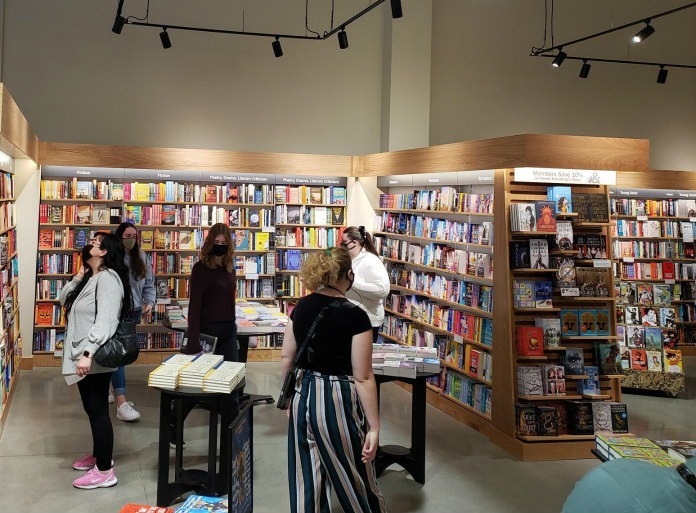
Barnes & Noble bookstore in Kirkland, Washington, USA – Fiction & Romance Room
James Daunt, what is the difference between your own bookstores and Waterstones?
I worked in Marylebone for 21 years and it’s a really nice bookshop, beautiful and full of lovely books and with a very established customer base in a pleasant part of town. Waterstones is perhaps more democratic and inclusive inasmuch as they cover everything and bring a chain bookstore to multiple places – from shopping centres to high streets to big city centres to really quite small communities – and does so in a way which everybody feels extremely comfortable with. It’s a different sort of book selling, but the insight that I brought was that if you let the booksellers in each shop have autonomy to do as they want, they will craft the best bookshop for their community.
Are the British good readers?
Everybody is a good reader to one extent or another. Education is an aspiration for most people for their children, and everybody understands that books and reading and engagement with thoughts and ideas will lead to better educational outcomes. Right through almost all our communities, people are interested in bookshops and value them.
Is bookselling in America very different from the UK?
Not in the core principles. Bookshops are highly valued within the communities in which they sit. They were doing very badly and the only large bookseller that was left in the USA was Barnes & Noble. In vast numbers of communities, they were the only possibility for there ever being a bookstore. But booksellers will act with intelligence and common sense if they’re allowed to, and will create very good bookshops, and if you create a good bookstore, customers will come to it.
What is essential for the success of a bookstore?
First and foremost, that as a bookstore you recognise that you are there to sell books. That isn’t as foolish a statement as it sounds, because as Amazon started to take their market share away from them many of my predecessors tried to sell lots of other things that weren’t books to try and make up for that revenue. They got themselves into a vicious downward cycle, whereby they had fewer and fewer books and more and more other stuff that they were trying to sell. In doing so, they precipitated the decline of the quality of the bookstore itself. What we say is, “You are first and foremost a bookstore. Get books back into your shop, curate them to the best of your ability to reflect what your customers are interested in, and you will win back your customer base. You will sell lots more books and can be a good business again.” It really is that simple.
Is browsing and handling books in a bookstore a pleasure for many people?
Yes, the book as a pleasure in and of itself, and the exercise of reading physical books as opposed to e-books – or listening to them – is as strong as ever. Bookstores are so important within communities as social spaces in which people of all ages can gather and find and enjoy books, each in their own way. Our job is to create a space in which everybody from the youngest child to the oldest citizen feels welcome. We do so through the way in which we present books and the attractiveness of our stores, often with a cafe in it. Nobody charges you to come in. You can browse and look at books without interruption, and they’re very gentle, very inclusive places.
There was a time when the bookseller would advise you what to read, but is this still the case?
Our engagement with our customer bases is at the heart and core of how we operate as booksellers within our bookstores. Many of our customers are regulars. We know them well. We know their names, what they read, what they bought the last time they were in, what they’re interested in, what their children are interested in. For new customers, it’s about welcoming them in and enticing them to explore and read new things. Most people at the core of our bookselling group are vocational booksellers deeply committed to our trade.
The world of books is a very large one. How do you handle this?
Our very largest bookstores are enormous. The Piccadilly flagship of Waterstones in London is a 60,000 square foot shop. Foyles, which we also own, is also 50,000 square feet. Hodges Figgis in Dublin, Barnes & Noble in the United States, will have tens of thousands of titles. We cover a huge range that’s constantly changing and turning. We frankly don’t really care who publishes a book, but we care very deeply about the quality of the books that are being published, and we take all the ones that we believe to be the best and the ones that our customers will be interested in. The real joy of a bookstore is that it does curate and it does the job of ensuring that readers and customers are browsing the best that’s available.
Are there more readers nowadays?
Yes, readers are becoming more adventurous, buying more, and more people are reading and the book market continues to expand and grow. There’s a huge appetite for foreign works in fiction and non-fiction, and a very vibrant publishing industry which supports the translation of books. We are hugely successful with Japanese and Korean literature and probably the most dynamic of all, in fiction at least, is the Latin American market, where the talent coming out of Central and South America is extraordinary. The fact is that we’re selling more and more books with each passing year.
Do you sell more fiction or non-fiction books?
Broadly speaking, ever since I started selling books, a third of my sales have been through all the genres of fiction, a third have been non-fiction, and a third have been children’s books. That really hasn’t changed a great deal. What has also not changed is that the biggest dynamic part of our market has been that for young adults. Occasionally that becomes extremely obvious with the big, big bestsellers like Harry Potter. The latest instalment of Suzanne Collins’ Hunger Games came out recently and we sold over 100,000 copies in the United States and over 30,000 in the United Kingdom. Teenagers up to early twenties were queuing up at midnight and having parties, really excited about a new book.
“The book is ultimately the most satisfying way in which to educate oneself and to illuminate around the issue of interest.”
Is it true that today young people are not as interested in the classic books and their taste is a bit different?
Oddly not true at all. Social media allows young people to communicate their enthusiasms around books, and what they’re buying does change quite quickly, but coming out of Covid and right through 2021 and 2022 we sold enormous numbers of classics – Jane Austen, Middlemarch, Dostoyevsky… A massive young readership of late teens into their early 20s buy, collect and read nice colourful hardback editions of the classics. They discuss them and get very enthusiastic about them. In my 35 plus years of book selling we’ve never sold more. It’s extraordinary, exciting and wonderful to pluck out perhaps slightly lesser-known classics and find yourself being able to sell them hugely effectively to 20-something-year-olds.
With so much to read on the internet and our phones how does reading work nowadays?
How people engage with books hasn’t changed fundamentally. Children are hugely encouraged to read by their parents, and that in turn brings parents into bookshops. Young people absolutely adore books and it’s one of the ways in which friendships are built and courtships are made. Our book shops are stuffed full of young people because they like to come there to meet and talk and engage with each other as much as with the books themselves. As people, particularly men, become extremely busy with building their careers we see a lull. Then as people move into later stages of life, they suddenly re-engage with books, particularly as they have children. And then, as they get to the twilight of their careers and into retirement, they read a lot. The book is ultimately the most satisfying way in which to educate oneself and to illuminate around the issue of interest.
What are people more interested in reading nowadays?
At the core of what we sell are good biographies, good histories, good narratives that cast some insight onto the world, and we will always be picking those and we will always be selling lots of them. I don’t see a huge difference between the books that we championed over the last 30 years to the ones we do today, albeit that there will be trends that we will seek to amplify for good reason, but at the core of it, it’s good publishing, well-edited books, well-written books and well-made books. So good designed, good paper quality, good type-setting, all of those core and fundamental and quite old-fashioned virtues of a good book.
Beyond the classics how do people discover new writers?
One of the most important roles that we perform as booksellers is to provide a place of discovery for new authors. Otherwise it’s very difficult for them to break through. Amazon is a terrible place in which to discover books. It’s a fantastic place if you know what you want to buy. What we do vastly more effectively as booksellers is promote the best new writing, the best new voices and promote them strongly and heavily. We pick good books, interesting books, new voices, in both fiction and non-fiction. That is the exercise of curation. That is the exercise of taste. That is our job, and that allows for new people to be discovered and new careers for authors to be developed.
Is it your job to create bestsellers?
Yes. We, particularly as a national bookseller both in the United Kingdom and the United States, can create the bestsellers, and we do that all the time. We have our monthly book of the month. We choose books and really promote them very strongly, and if we sell 20,000 copies of Paul Harding’s This Other Eden, Carys Davies’s Clear, Ron Rash, Claire Keegan, books that are really fabulous, Amazon will sell the same very quickly, because it creates that word of mouth and that buzz. It will sell probably the same again on Kindle as an e-book. The audio book will sell and then the big box retailers like Target and Costco will take it and it’ll appear in the airports, and our little 20,000 will become 200,000. Every time that we major on a book, you can multiply by 10 the number of copies that the author and the publisher will sell, and that is why we’re hugely valuable within this ecosystem.
How is your business doing?
I inherited a business that was in extreme difficulty in the United Kingdom in 2011, largely self-inflicted because the bookshops weren’t good enough and they lost confidence in the face of Amazon and were no longer prepared to really concentrate on the standards within their individual bookstores. Once we’d restored that, our business has gone extremely well. The same in the United States. We had a moment of introspection and confusion when we were closed during Covid, but when we reopened were busier than ever before and people were reading more than ever before. We’ve got a really fundamentally extremely strong and growing business, and we have become very profitable, which is allowing us to reinvest in our business, above all to open new bookshops. We opened 60 new bookstores in 2024 in the United States, 20-ish in the United Kingdom. This is really strong growth and I feel very optimistic.
Do you not suffer from inflation and increased costs?
We’re very lucky to be selling a product which is really of relatively low cost and which even in difficult economic times has tremendous value to it. Read a book and it will cost a fraction of what it costs to go to a restaurant, less than it costs to go to the cinema, and it will take you much longer to enjoy it. And then you have a physical object which will decorate your house. In hard times, booksellers tend to do very well, but they also do fine in good times. There is inflation, book production has cost more and paper costs more, but that in the United Kingdom is taking a typical book from costing £9 to costing £10 or £11. This isn’t taking things out of reach of people. Compared to most of the other forms of entertainment that people look for, we are very good value.
What about newspapers and magazines?
The newspaper industry is a much more challenged environment. If you have a product that’s good enough, and you have a paywall around it, then obviously, through a phone, you can still extract value. The New York Times does very well, as does the Financial Times. We are a major seller of magazines, which we do effectively and well, because we’re just about the last people to do that at scale. We carry pretty much every magazine that is in publication, but there are fewer of them and they come out less frequently. That is a declining market, but I believe that if you do things well, and you apply yourself to the quality of what you’re providing your customers, there remains a very strong market. I’ve backed that up by investing strongly in selling vinyl music, CDs and DVDs, whose sales in the United States and the United Kingdom have gone up over the last three years quite strongly. Vinyl is hugely up. There is still a great appetite for the physical product, and vinyl is a lovely thing to own and we’re selling lots and lots of them. Being the retailer that respects the physical product and sells it extremely well in an attractive environment has given us a very good business.
What is the secret of your success?
The secret of being a very good chain bookseller is to allow the individual store managers and bookselling teams within each store to create the best possible bookstore for that location. My management philosophy is to let people do what is most sensible, to trust in common sense and in the vocational integrity of the bookselling teams. Of course, some of them get it wrong, but that’s quite obvious when that happens because their sales go down. If a bookshop in Atlanta has clearly gone off the rails, we get another bookshop and bookseller in Atlanta to drive 20 or 30 miles down the road, knock on their door and sort them out. We use local people to solve these things. Everything about the way I run my bookstores is to take away the central burden. My job is simply to support the local booksellers as best I can, to provide the things that they need. And what they need is money so they can refurbish themselves and look smart, and they need good IT and good supply chains. They don’t need somebody to come and tell them what to do or what to sell, and I do as little of that as I possibly can.
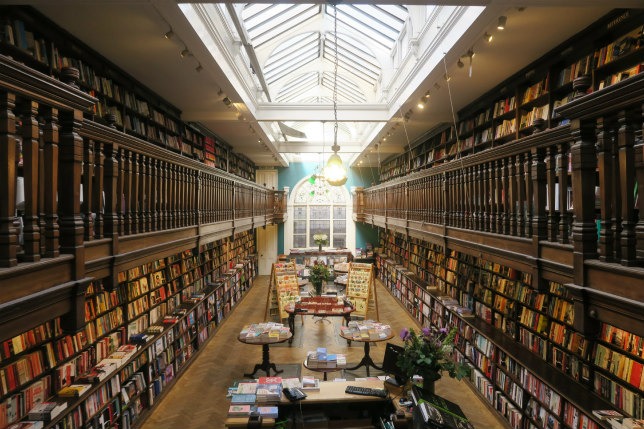
Interior of Daunt Books, Marylebone, London, UK
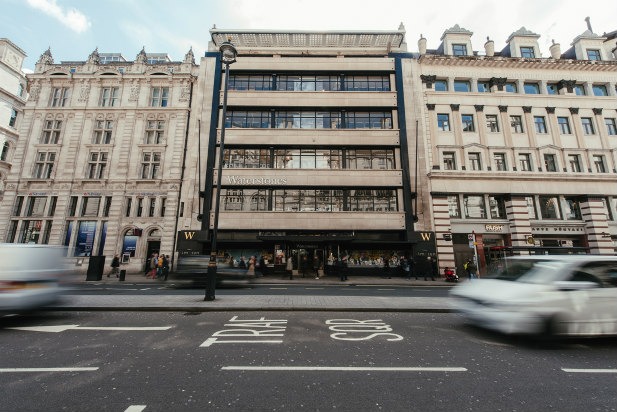
Exterior of Waterstones, Piccadilly, London, UK © Mike Massaro
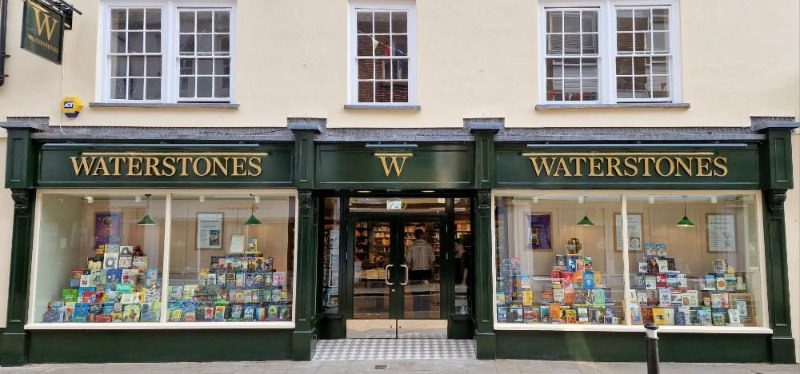
Exterior of Waterstones, Romsey, Hampshire, UK
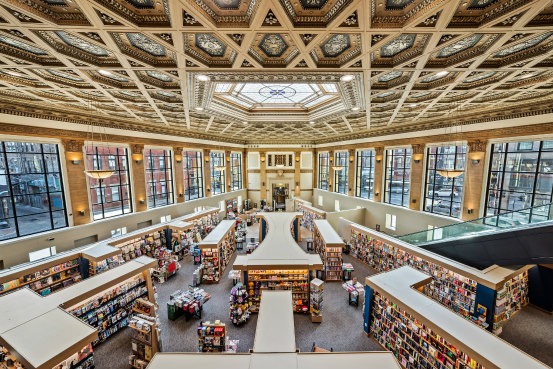
Interior of Barnes & Noble, Wicker Park, Chicago, Illinois, USA
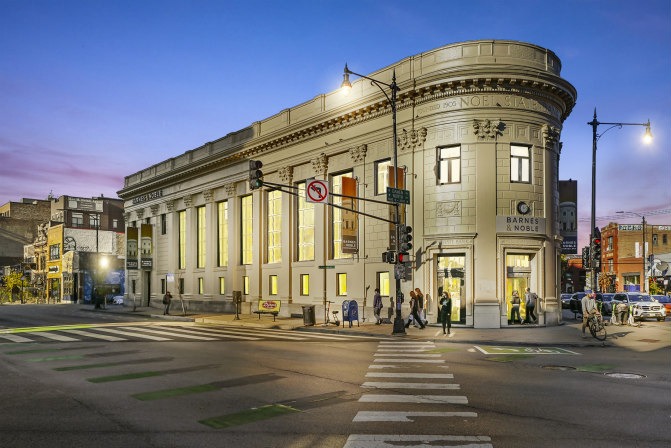
Exterior of Barnes & Noble, Wicker Park, Chicago, Illinois, USA
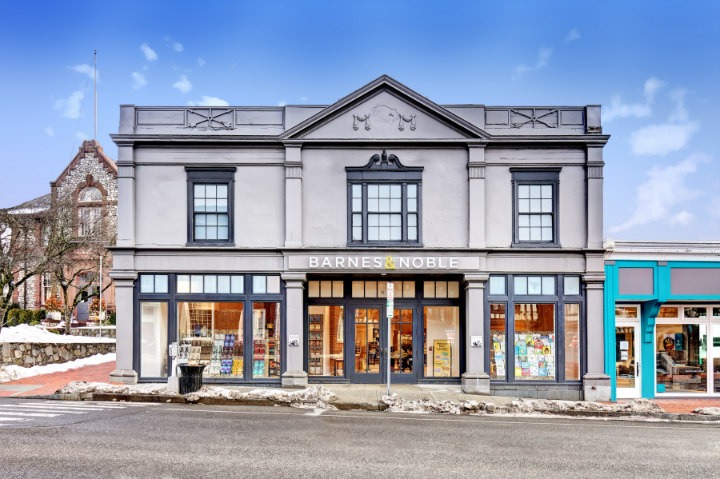
Exterior of Barnes & Noble, Westport, Connecticut, USA
“There are booksellers up and down, particularly in Europe, who are espousing the same principles, which is let the booksellers in each shop run their own bookstores.”
James Daunt, as the owner of your own six Daunt bookshops, do you still work in them?
I understand what it is to run a bookshop because I have my own bookshop, and I understand and would never want anybody to tell me how to run my bookshop. I actually only work in my Marylebone bookshop, and I don’t want anybody to tell me how that should be set up. I fundamentally understand what it is to run your own bookshop, and that’s why I let each of my own bookstore teams – and it’s a team, it’s not just an individual – do so.
How many people work in your bookstores?
Daunt Books now have our own publishing arm and a couple of hundred people working for us. Waterstones has 5,000 people, Barnes & Noble 20,000 people. It’s a lot, but within all of them, the same philosophy abides: within each individual store or shop, let that team really concentrate on producing the best possible bookshop for its customers. This will produce quite different shops around the countries, books being sold at different prices, different promotions, different enthusiasms, different ways of engaging with customers, different events, different story times, different kids’ clubs, different this, that and the other. At the heart of it is a fundamental respect for the trade that we practice. If there’s anything that we do across all of these businesses, it’s just hold true to the fundamental nature of what it is to be a good bookseller.
Does technology now underpin the activity of the business?
There’s a certain amount of technology, which is helpful, particularly in the logistics at the back end, the bits that you never see. There’s automation in warehouses, and there’s fantastic technology around printing, which allows short-run printing of books and gets books to bookshops very quickly and efficiently. All that’s invisible to you is quite underpinned by technology, but within the book shops themselves very little has changed in the last 35 years. We still have a machine to tell us what books are in print and we can get them for you, but we are very wedded to the old-fashioned virtues of book selling. You can’t self-check-out in any of our shops. We don’t entertain that at all.
What about artificial intelligence?
We are a curator of the best, and it seems highly unlikely to me that we will be wanting to promote books written by AI.
Is the presence of authors in the stores important for the bookstores?
I’ve always believed that one of the important roles of a bookseller is to give access to an author and provide author access to readers, and that a bookshop is one of the best places in which to do that. There are book festivals and many other ways in which book authors are able to do it, but if you’re lucky enough to have a bookshop, particularly in a metropolitan place which makes it easy, as I do with my own store on Marylebone High Street, we run lots of events all the time. They’re a hugely entertaining and energising part of the bookshop experience.
Is there a connective thread between all bookstores, whatever their size or wherever they are?
There are booksellers up and down, particularly in Europe, who are espousing the same principles, which is let the booksellers in each shop run their own bookstores, and we will have a much stronger industry of physical booksellers and we can stop worrying and being concerned about Amazon. Feltrinelli in Italy is very similar to ourselves in terms of the philosophy by which they run themselves, and because they do that they’re becoming a much stronger business. Italy is actually a fantastic example of that. Italy has a central school for booksellers, which teaches the fundamental principles of good bookselling to everybody, to chain booksellers, to independent booksellers, and as a result of that has increasingly good bookstores. Many more independents in Europe have survived elsewhere than in the Anglo-Saxon world. There are the big chains, but there is also an incredibly vibrant independent sector, and they’ve understood how to adjust to this post-Amazon world and have a broadly positive and optimistic future ahead of them. Evidently government policy such as price protection and the distribution of money for students and young people to be able to spend on books has an impact on that. Fundamentally there are reasons to be highly optimistic about book selling and publishing in most of the European markets today.
Did you sell many books during Covid, because people had time to read?
Yes, we switched to an online world and that worked nicely for us. But we are fundamentally a physical bookseller, and that’s where my true passions and interests lie. The shop is where we as booksellers are. That is where we provide value.
What is the proportion between Amazon’s market and the bookstores market?
Amazon has been much more successful in the Anglo-Saxon world than it has in Europe because price protection has protected the European markets, including Italy, France, Germany more so. But typically, and it’s the same in the UK and the US, roughly 50% of the market is Amazon’s, roughly 20 to 25% is the big chains like Barnes & Noble or Waterstones, and then the rest is divided between a small part which goes to the independent booksellers, maybe 5 or 6%, and then the supermarkets who also sell a lot of books. So typically it is Amazon with half, 20/25% with the big chains, and then the rest split amongst the rest.
Are sales sensitive to book awards like the Booker Prize or the Nobel Prize?
It’s a very big thing, and different in different markets. We will also be looking very closely and carefully for who wins the Prix Goncourt in France, we look for the translation and we will get a bounce from that. For us the Booker Prize is the largest in the United Kingdom, the National Book Awards in the United States, and then the Pulitzer or Nobel Prize on top of that being good in both markets. New authors burst into our consciousness, but equally you can have a very good author like Samantha Harvey, who won the Booker prize this year, who we’ve known about and loved for many years but have never managed to break through into the bestseller list – and then suddenly she becomes a major player. We’re always looking at the new. One of the great things that we do is understanding where the talent lies, and if it’s the Nobel Prize that brings it to people’s attention, because you win the Nobel Prize for a body of work it’s our job then to say where you should start reading this author and how you start that addiction.
Is reading an addiction?
Reading is an addiction. Visiting bookstores is an addiction. That’s why if you create good bookstores, people attain the habit of being in bookshops, and the more they’re in it, the more they want to be in it. Again, that is why having really attractive, nicely presented friendly bookstores is so important.
Do we have to learn how to read and train ourselves to make the effort?
We have a bestseller at the moment which is about the attention deficit and why people can’t concentrate anymore. Reading is a habit, and we obviously live in a world which is hugely distracting at present for political reasons. That probably detracts somewhat from the amount of reading that’s going on at the moment, but it won’t last long and then we’ll all settle back to reading again.
Do you still have time to read your favourite books?
I certainly have a lot of time to read. It feels like I spend half of my time on an aeroplane, so actually the one blessing of that has been that it gives one a lot of time to read. That I will always do and continue to do. One of the joys is finding new authors, finding new interests, and I rely on the best editors to push books my way and they do that.
What formative books do you keep coming back to? For me it is War and Peace.
I’ve always thought Anna Karenina is one of the most glorious novels possible. War and Peace I’ve always quarreled with, maybe I lack the intellectual ability to really get past just how interminable it is. There are a huge number, the classics of course, but then at various times of one’s life you read books that make a huge impression on you and then you reread them at a later stage of life and you wonder why. For example, I just reread Naguib Mahfouz’s Palace Walk, which is a completely different book rereading it to the one that I remember reading back in 1997. I do think there are books that are hugely formative, not always the classics in my case, but still fundamentally I will go back to Middlemarch, I’ll go back to Dostoevsky, I’ll go back to the Russians and the great Americans. Sometimes in rereading I find that with the passage of time, my perceptions and understanding of them have really fundamentally changed.
Do you normally read a book from the beginning to the end or sometimes do you just read the beginning and then drop it?
Unfortunately, I will read and start lots and lots of books and drop them if I find that I don’t like them for whatever reason or find that they’re not working for me. That’s predominantly how I read fiction. Non-fiction, I will almost always finish the book because I’m reading it for a purpose. I always have a non-fiction on the go, which I’m reading to educate myself and I’m very eclectic in my tastes.
Do you have a private library?
I do keep books. I also have a wife who finds that I leave piles hanging around too often. So there’s a wonderful charity called Oxfam who also run bookstores and Oxfam gets most of my books.
Is your wife pleased with your more interesting job?
Certainly not more interesting than her job, predominantly working in the National Health Service, but we each of us do our own thing and the world of books is a nice one. She finds it certainly preferable to being a banker, or I hope so. I preferred working in my bookshop than running lots of bookshops, but one follows the strange twists and turns of careers. One’s often a slave to them, as much as propelling them oneself, but it’s an interesting and very fulfilling time at the moment.
Do you consider yourself a businessman?
Inevitably one is if one’s trying to, particularly when running businesses that are in trouble, and for many years that was the case at Waterstones – no longer – and initially it was very difficult as was Barnes & Noble. There were a lot of business decisions to take. When we went through Covid was a challenging time obviously for retailers. Yes, one is behaving as a businessman, responsible for the livelihoods an awful lot of people working for you.
If you were selling something else, like food or clothes, would the same principles apply?
I can’t imagine being a retailer of other things. It doesn’t interest me fundamentally enough, but I am a believer in the worth of shops as such in high streets. I certainly argue very strongly, particularly in the United Kingdom, that government should support and not penalise physical retail – as it does through its taxation system. Bookshops and all other retailers provide really good employment at a local level and they provide an essential part of the social fabric of local communities.
Is working in a bookstore a good career?
It is, for those who are not frightened of hard work – because it’s definitely hard work. It’s hard physical work, it’s hard intellectual work, you’re on your feet all day, you’re talking to people all day, you’re physically moving around books and arranging them and dusting them and cleaning them and unpacking them and packing them up again. If all of that is enjoyable and fulfilling – and it’s certainly intellectually challenging – then a bookstore is a great career. Unfortunately it will never be the most well remunerated career because retail isn’t, and book selling in particular isn’t, but I would rather be a bookseller than a publisher any day.
James Daunt, thank you very much.
ENJOY THIS INTERVIEW? SHARE IT WITH A FRIEND.


