FINDING JOY IN DESOLATION. Colum McCann’s eight novels and three collections of short stories have been published in over forty languages and received some of the world’s most prestigious literary awards and honours, including the National Book Award for his novel Let the Great World Spin in 2009. His novel TransAtlantic was longlisted for the Man Booker Prize in 2013, and his most recent work, Apeirogon, also longlisted for the Man Booker Prize, is an international bestseller on four continents.
16 minutes read time.
You can listen to the podcast of this interview here.
Colum McCann, you are Irish, but also very much a New Yorker. What does New York mean to you?
I adore New York. I feel very at home here. It challenges me. New York is one of the few places in the world where you can arrive and immediately become a New Yorker. You can step off a plane, a train, or simply walk in, and somehow belong. Other places can’t do that. You can’t become an immediate Dubliner. I don’t think you can become an immediate Parisian, either. There is an energy here, a swerve, an attitude. New York is much kinder than people give it credit for, although it likes to pretend that it isn’t kind.
You were born in Dublin. Why did you leave?
I was 21 when I first came to the United States. At that age I thought I was going to write a book. I bought a typewriter. I had the arrogance of youth: I thought I could write. I soon realised I needed to live a little more. So I spent about a year and a half travelling by bicycle, from Boston through Florida, Texas and Mexico, then across the West to the Golden Gate Bridge. After that journey, I was a different person. Before, I didn’t know what I wanted to write about, or even whether I had anything to say. The road gave me that. Looking back, it was the most formative period of my literary life.
“Storytelling is the thing we have between us that is perhaps the most profound, the closest thing to God that I can recognise.”

Colum McCann, you wanted to write the great Irish novel?
The great Irish novel has already been written. Ulysses. And about a dozen other novels too. If, at 21, I said I wanted to write the great American novel, that was simply young man’s foolishness. I wanted to write, but I didn’t yet know what writing meant. After the bicycle journey I worked with juvenile delinquents in Texas, including supervising a wilderness survival programme. Then I went to the University of Texas in Austin, where I really began to write.
And you also went to Japan?
My wife Allison wanted to go to Japan to learn Japanese, and we were in love, so I went with her. Her family is Italian; her grandfather, Antonio Ferri, was an aerospace engineer. When the Nazis came into Rome, he destroyed his wind tunnel in Guidone and burned his papers, became a general in the partisan army. Quite a story.
When did you finally feel like a writer?
I was making a living as a novelist before Let the Great World Spin. This Side of Brightness did particularly well in France, and Dancer did well in Germany. But it wasn’t until 2009, with Let the Great World Spin, that I had a genuinely life-changing book. Before that, when people at parties asked what I did, I might say I was a teacher or a bartender. After Let the Great World Spin, I could finally say, “I’m a writer.”
New York is at the heart of that book.
Yes. The desire to write it came out of 9/11, which was a pivotal moment for my family and for New York, and obviously for American history. The book also came out of my fascination with the way a huge historical event touches the lives of ordinary people. That has remained important to me: the tiny within the epic, and the epic within the tiny.
Then came Apeirogon. How did that begin?
I went to Israel and Palestine with Narrative 4, the nonprofit organisation I co-founded, which brings young people together to exchange stories. I wanted to see whether we could bring the programme to the West Bank and Israel. In Beit Jala I met Rami Elhanan and Bassam Aramin. They were sitting at opposite ends of a table. I thought I knew what I was about to hear: an Israeli at one end and a Palestinian at the other. Within fifteen minutes my assumptions had been completely overturned. They told me their stories and I was deeply moved. Both had lost daughters. They had met through a parents’ circle for people who had lost children. Their grief had brought them together.
What did you do?
I went back to New York and tried to write something else, but I couldn’t stop thinking about them. I thought: I’m an Irish, middle-aged, white man. I’m not Muslim or Jewish. This isn’t my territory. But they kept haunting me. I called them and asked if they would allow me to write about them. I told them I was a novelist, that I make things up. They said yes. And then they added: if you can capture even the tiniest portion of our grief, you will have done us a mitzvah, a favour. That gave me the creative licence to begin.
But what kind of book was it?
I didn’t know at first. Samuel Beckett said that the job of the artist is to find a form that accommodates the mess. I felt I had to find a form that could accommodate this particular story. I knew it would be fractured. I travelled with Rami on his motorbike, went through checkpoints and spent time with their families. At first I thought I might write fifty chapters, then a hundred. Eventually I realised that Rami and Bassam were telling the story of their daughters in order to keep those children alive. That suggested Scheherazade: the act of telling stories to postpone death. And I thought, what if the book had 1,001 chapters, in acknowledgement of One Thousand and One Nights?
Some chapters are only one line.
Two are blank. I didn’t even know who the narrator was until I was about two years into the book. Then I realised the narrator was the reader. The book moves from one to 500, then comes chapter 1,001, and then descends from 500 back to one. It’s built like a minaret. In chapter 1,001 I give away the whole plot, although I suppose there isn’t much of a plot. I realised that whoever reads the book becomes its narrator. I say, in effect, you and I are sitting together, silent and complicit, listening to these two men tell their stories.
“Writing is a little like being a musician who wants to learn different instruments.”
Colum McCann, you also bring in the writer Jorge Luis Borges, history, memory, and birds!
I did a huge amount of research. I travelled there five or six times, read many books, walked, listened and spent time with the families. I think of myself as a kind of ventriloquist. I’m good at listening. I learned that on the bicycle journey. I like listening to people, whatever their background. The birds emerged almost accidentally. Before writing the book I wasn’t interested in birds. Then, in Beit Jala, I discovered a bird-ringing centre. Birds are caught, tagged and released, given an identity, but the birds don’t know where Israel ends and Palestine begins. They don’t know whether they have come from South Africa, Algeria, Ireland or Norway. That piece of land is part of the second-largest migratory pathway in the world, and also one of the most dangerous for birds. For me, it became a perfect metaphor. The birds cross boundaries that human beings have created.
And the falcons?
I became fascinated by the stories of boys in Palestine capturing falcons and taking them to the markets. Those details matter to me. In the first twenty-five pages of Apeirogon, I wanted to confuse the reader. Is this a book about birds? Israel? Palestine? A man on a motorbike? I wanted the reader to surrender to that confusion. To stop trying to organise the politics into Area A, Area B, dates and borders, and instead begin to care about the tiny details, especially the two girls at the centre of the story. They are almost like two birds that have flown.
Is Apeirogon a novel?
I think of it as a hybrid novel, yes. I wanted it to be something like Ulysses, which is a compendium of human experience. This was a compendium of grief. Although it takes place in Israel and Palestine, it could have taken place almost anywhere. We all go to Jerusalem, literally or in our imaginations. Anyone who has thought about Jesus, Muhammad, prophets, religion, history, goes there at some point in the mind or heart.
And Rami and Bassam become brothers.
Exactly. They are more than friends. If you’re friends, you can unfriend one another. You can’t unbrother one another. They share a grief that neither of them can escape. They once asked me, when I told them I would write their story, to harness the power of my own grief. When I met them, I cried my eyes out as I listened to their stories. Their request made me think about where joy can be found in desolation. There is a line from the Mu’allaqat, those pre-Islamic Arabic poems that were traditionally hung in marketplaces such as in Damascus: “Is there any hope that this desolation will bring us any solace?” I think that is profoundly beautiful. If I had to give Saint Peter a credo at the gates of heaven, that might be mine.
Then you wrote Twist, a very different novel.
Very different. Twist is a traditional, chronological novel with one narrator. I wanted something apparently simple, perhaps closer to The Great Gatsby: a single narrator, a mysterious man, a story that moves forward. I like to challenge myself. Writing is a little like being a musician who wants to learn different instruments. You want to find out what another instrument can do. Twist still asks questions that concern me —colonialism, belonging, communication, connection — but it does so in a completely different form.
What connects all your books?
Human connection. Displacement. History. Big events and small people caught inside them. I am interested in the tiny stories inside enormous world events. I feel very lucky. I like life, and I like people. I want to live my life out loud as much as possible, and then write about it. Storytelling is the thing we have between us that is perhaps the most profound, the closest thing to God that I can recognise. And it’s not simply telling a story. It’s listening to somebody else’s story. When a book makes me listen in that way, I feel grateful to be alive.


“I love being out in the world, listening to people, travelling. Then I have to come indoors, close the door and shut everything out.”
Colum McCann, you are also very attentive to language.
Language is music for us Irish. Our Gaelic language was taken from us, and in a sense we got our revenge by using English extraordinarily well. Joyce understood that. We delight in language. We use three words when someone else might use two. We’re often deliberately ambiguous, sometimes torturously poetic. But at the core, we have fun with it, and that matters. At the end of their lives, some of the great thinkers and writers have said that what matters most is kindness. I can’t disagree. For me, there is nothing more important than looking someone in the eye, listening to their story and saying: you exist, you’re valuable, I want to spend time with you. There is no better medium for that than a book.
Your books are also full of opposites.
Yes. This Side of Brightness was about homeless people living in the subway tunnels of New York. There are tunnels, distances and bridges between opposites. In Let the Great World Spin, Philippe Petit balances between the Twin Towers. In Twist, I was interested in how we are now more connected than ever and, at the same time, more disconnected than ever. Those dichotomies fascinate me: the two things at the far ends of one another.
And now you’re writing a memoir?
For the first time. I’m 61 and I’ve never really written directly about myself — not about the bicycle journey, not about my own life in that way. I needed the challenge. I had been trying to write about Rami and Bassam again, but I couldn’t. Then I thought: perhaps I should write about not being able to write that story. I also had two brain surgeries last year. I had a condition called trigeminal neuralgia. The doctors call it the “suicide disease.” A nerve gets caught in the brain and the pain can be extraordinary. They repaired it. I am very lucky. I wouldn’t be here without modern medicine. Everything feels like a special moment now. It’s all gained time.
Does that change the memoir?
I think so. The book begins on the day of my first headaches and ends more or less when I go into hospital for the surgery, but it goes backwards as well. For the first time, I’m writing about the bicycle journey. I’m writing about Ireland, and, eventually, about my family. It’s a strange experience to turn the attention I’ve always placed on other people back onto myself.
How do you write?
I have a slightly schizophrenic life in that sense. I love being out in the world, listening to people, travelling. Then I have to come indoors, close the door and shut everything out. I write directly onto a computer. I think I write like a language camera. I bring people into a room and move the camera around, showing them the room, but I’m also a painter. Perhaps I’m a painter of photographs. At the beginning of a book, I can barely write for an hour or two. But at the end, when I know what I’m doing, I can write eight hours a day, sometimes twelve or fifteen. That’s probably not very healthy. I love the solitude. I need it to recover.
Where do you write?
In New York, in Connecticut, wherever I can find the right room. When I was in Geneva, I wrote in the Society Library overlooking the lake. They opened at nine, and I was there at five to nine every morning waiting for them to open. I stayed until they closed at six.
What does writing give you now?
Time. Attention. A way of recognising people. I keep coming back to the idea that we matter. It doesn’t matter how rich or poor, black or white, famous or invisible we are. Every life has a particular meaning, even if we don’t yet know what that meaning is. Perhaps that’s what I’m always searching for: the place where the smallest human story becomes part of something much larger. Perhaps that is why I keep travelling, listening, and changing the form of the books. I don’t want to repeat myself. I want to discover what I don’t yet know. The strange thing is that writing begins with solitude but ends in connection. You close the door, sit alone and find the words. Years later, someone you have never met opens the book. For a moment, you are together. That’s the miracle.
Colum McCann, thank you very much.
ENJOY THIS INTERVIEW? SHARE IT WITH A FRIEND.
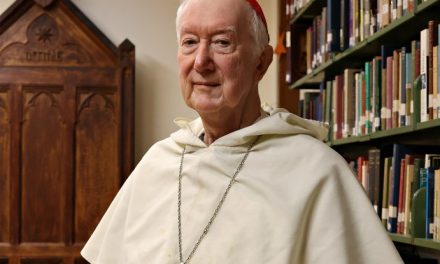
Portrait of Colum McCann © Christopher Booth.