

IN CONVERSATION WITH CARDINAL TIMOTHY RADCLIFFE : A LIFE OF HOPE AND HUMANITY. Timothy Radcliffe OP is an English priest who served as Master of the Order of Preachers from 1992 to 2001. He is the only friar of the Dominican Order’s English Province to hold the office of Master-General. Created a Cardinal by Pope Francis in 2024, he took part in the recent Conclave to elect Pope Leo XIV, the first American Pope.
27 minutes read time
You can listen to the podcast of this interview here.
Timothy Radcliffe, did you first come here to the Blackfriars Priory of the Dominican community in Oxford many year ago after your schooling at Worth Preparatory School in Sussex and Downside School in Somerset?
Yes, it was a religious education in the sense that you lived in the presence of God and the saints were our friends, but it wasn’t strict and it wasn’t pious. It was a very relaxed but very Catholic education. I have to confess that at school I was a bad boy, I used to love going to the pub, smoking, and I was almost expelled for reading Lady Chatterley’s Lover during Benediction. When I left school friends who weren’t Catholic said, “What you believe is not true,” and then for me the question became: “Is it true?”. So I was drawn to the Order which had the motto ‘Truth’, veritas. I first came here in 1967, two years after I joined the Order, but I’ve had spells in London, Paris, Rome, San Francisco; so I’ve lived in a lot of other places. The simplicity also attracted me. It is a very simple way of life. We are just brothers.
How was it to give up smoking, drinking, and having fun?
I don’t think we gave up having fun or withdrew from the pleasures of life. In the Dominican life we recognize, as we have for 800 years, we are flesh and blood. Saint Dominic founded the Order of Preachers in a pub, and most of his earliest miracles were about producing wine. We have a good, happy human life, and we also believe that the fullness of happiness that we seek is in God.
“What really sustains me all my life has been friendship.”
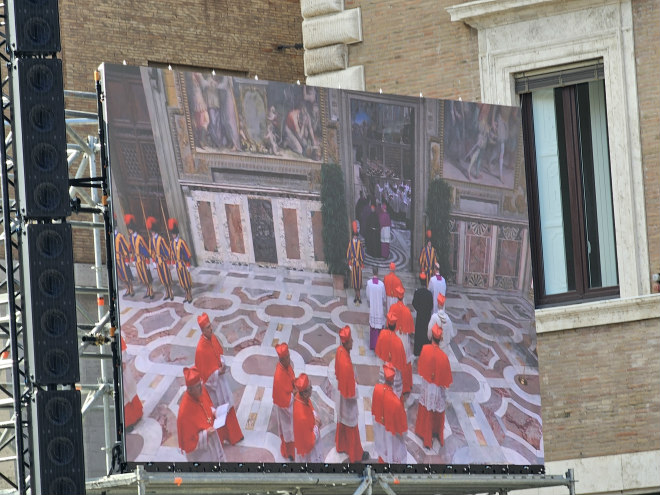
133 Cardinals enter the 2025 Conclave held on May 7 and 8 May to elect a new Pope to succeed Francis, who died on 21 April 2025.
Timothy Radcliffe, when did you discover your fate?
From childhood I realised that there was a depth to life. I had a wonderful great-uncle who was a Benedictine monk. A very brave Chaplain in the First World War, every night he went to No Man’s Land to look for the dying. His commanding officer told him he must not go, it was too dangerous. He lost an eye. He was shot at. He lost most of the fingers of his hand. But he still went every night to look for the wounded. I experienced him as the most joyful, alive person that I ever knew, filled with life and with joy, so I knew religion was about being deeply joyful.
Whatever you did, have you always had this joy?
You only really become alive if you know joy but also are touched by the suffering of the world. I saw suffering in Syria, Iraq, Rwanda, Angola, Algeria. Part of my life has been in the painful places of the earth, and that hollows you out to be more joyful. I love it in Ezekiel where God says, “I will take out your heart of stone and give you a heart of flesh.” If you have a real human heart then you will know sorrow, the pain of the world – the pain that people suffer from in Gaza now, for example – and also the joy.
You were Master of the Order of Preachers, and now as a Cardinal an advisor to Popes, and you have received many honours. How do you combine personal faith with these honours?
You don’t think better of yourself because you’ve got honorary doctorates; the joy of my life has been to be with people in their joy and in their sorrow. Then, in the moment, you discover what it is you can say or what it that you should do. Pope Francis was wonderful because he was a man of encounter. He loved to be present to people in difficulty and in suffering. After I had a big operation for cancer, where they removed and rebuilt my jaw, the next time I met him was with two or three hundred people. He came over, and just rested his forehead on my forehead for twenty seconds. That’s the secret. Meet people. Share their lives. However difficult their lives are, they will give you so much. They will give you hope. They will give you friendship. What really sustains me all my life has been friendship.
Was it a huge job to be the Master-General of the Dominican Order?
Yes, and I was are eight months a year on the road. First of all, you have to be with your brothers and sisters, to eat and drink with them. You have to be quiet with them, and laugh with them, share their lives and learn from them, and hope that you can also teach them something too. We are in 107 countries, and I had to go to every country at least twice. That was an enormous learning experience: I learnt to hope.
What does it mean to hope?
To hope is to believe that, in the end, life will triumph over death and love will triumph over hatred, so we must never give up. As a Christian, the great sacrament of hope for me is the Mass, the Eucharist, which Jesus gave to his disciples when there seemed to be no future. When everything seemed to be over and they were running away and denied him, in this darkest moment, he said, “This is my body and I give it to you.” An act of extraordinary generosity. When we celebrate Eucharist, we remember how the gift came in the darkest moment, and I know in my own life, when I’ve been through difficult times, often that’s when you receive great gifts.
Do you give a lot of importance to charity, and things like gratefulness, education, prayer?
Absolutely.. Charity means love. Caritas. A lot of my life has been involved in education. Education means that you never give up on trying to understand. Human beings are made to seek to understand. I learned this so radically in the Middle East. In the north of Iraq, the plain of Mosul, Nineveh, we have many schools established by Dominican brothers and sisters, and there we have young Muslims and Christians studying together. We’re saying to them: “Go on learning. Go on seeking to understand. Go on. Don’t succumb to fundamentalism.” The motto of our college in Baghdad is ‘Here no questions are forbidden’. I find it so exciting to be with young people and to help them go on searching for the meaning of their lives, not just in religion but in art. If they find it, it’s a gift. Often the door is opened when they love. Every time you love anybody, the door is opened to the meaning of your life.
You are well-known all over the world as a gifted preacher. What does it mean to preach?
To preach you have to listen to discover what it is that needs to be given to this person at that moment. You must not know too much beforehand. Recently I was in Ljubljana, Slovenia. We had this meeting of a thousand mainly young, creative people, artists and politicians, people with projects to take away mines. They wanted to know beforehand what I would say and to have a rehearsal, but I said, “How can I know what I must say until I see them?” You have to look people in the eyes and you have to listen to them. It’s in conversation with people that you are given what it is that needs to be said. My next plan – not immediately – after this is to go to Kiev, Ukraine, and then Kharkiv on the Russian border. I don’t know what I will find.
“You meet people as a fellow seeker after meaning, because every human is really in the depths of their being a seeker.”
Timothy Radcliffe, what is preaching really about?
It’s a shared joy. You share the joy of the Gospel, and with each person it’s something slightly different. You read the Word of God, and it’s always good news. Sometimes when you read the Bible it can seem a bit gloomy. There are passages which are quite violent. So always the task is finding, “What is the joy here?” In my experience, normally, even when people are suffering, you can find joy together.
Do you give people a moment of joy?
I discover it with them. Preaching isn’t just saying something to them, it’s being with them in conversation and discovering what is good and true and beautiful together. One of my good friends Brian Pierce, an American Dominican, at only 60 began to suffer from Alzheimer’s. When the Prior said to him, “I’m afraid, Brian, the stage has come when you need professional help.” Brian said, “Aah, wonderful. I will go to that home and it will be my last ministry.” It was beautiful that he saw going to the home as the way to give something. If you’re going to give something to people, you have to receive from them. You have to take delight in them. You have to enjoy people.
In our increasingly secular world how do you encourage people to faith?
Everybody has a little seed of faith in them. Everybody believes something, so you have to start with what they believe in. In gardening, when you see a little plant struggling, it needs some light and water. You encourage it to flourish. If you find somebody who has a passion for music, then you help them to make the journey through beauty and seek what is most beautiful of all, which is God. If their journey is through intellectual curiosity, you accompany them as they search. We’re all searchers. Whenever you meet somebody, you want to know, “What are you searching for?” “What can I learn from you?” “What can you teach me?” “What can i teach you?”
Do you have example in this?
I lived for a year with a wonderful Dominican called Marie-Dominique Chenu, one of the great masters of the 20th century. He was 80, which I thought was terribly old then. Every evening he went out and had meetings with trade unionists, artists, academics, politicians. We would meet him at 10pm k in the refectory and he would say, “What did you learn today?” and “This is what I learned today.” You meet people as a fellow seeker after meaning, because every human is really in the depths of their being a seeker.
What is the difference between religion and faith?
Everybody has faith. It may be faith in the power of their love for somebody. It may be faith in music; when they face death, they want to listen to music. They may have faith in all sorts of things. Religion gives a form and a shape to your faith, an encounter with what is transcendent. A friend of mine John Rae was the headmaster of a famous school called Westminster and he could never decide whether he believed or not. When he retired he wanted to meet six atheists and six Christians, and he said, “Now, which of you will convince me?” We met each other and became friends, and always the argument came to this: He loved his wife, he loved his children. Was his love just an emotion? Or was his love something transcendent, the door to infinity? One day he rang me up and said, “Timothy, I’m dying. Can we meet a last time?” I went to see him that afternoon and he said to me, “Let us talk about this again. What is the nature of love? Is love a door to the transcendent, to infinity? Does it carry you beyond everything? Or is it just an emotion in your brain?” Most human beings know deep down that when they love something extraordinary is happening.
Love is a big word. Sometimes there is lebensschmerz, life pain, le mal de vivre, melancholy?
You should always live with it with other people. When you share the difficult moments, you share the pain. Then you are carried further, and then you can share each other’s joy. Often we’re ashamed somehow if we have pain or melancholy or depression, and we should not feel ashamed. We should be truthful. We must dare to step into the light and to say, “Here I am. This is who I am.” A French Dominican in the 19th century said, “A friend is somebody with whom you have no shame.” I am who I am, as I am.
To be a friar you gave up a lot of material things and acquired the privilege of existing without belongings. Did you still feel well?
If you have friends – and friendship is the secret of the Dominican life – then how can you ever be lost? When I had this cancer and wondered how long I would live, I realised that who I am is shaped so much by all the friendships I had. All the people I’ve loved, the people who love me; I’m the fruit of all that. If you want to encounter God, make friends.
Were you frightened?
It’s hard to say. I wouldn’t say I was frightened. I was disappointed in that I thought there are so many more interesting things I wanted to do, more friends to make. I had just agreed to write a book with Ɫukasz Popko, a Polish-Dominican who’s half my age and twice as intelligent, fluent in twelve languages. We agreed to write this book, and then I got the diagnosis of cancer. While I was really ill in bed in hospital for five weeks it helped me enormously to have this project that I must realise with Ɫukasz, and so I didn’t just “curl up my toes” – as we say in English – and die, because there was something I had to do. I had to complete this project. And I didn’t die. (Laughs)
A Dominican monk, dressed in white, a brother, you became a Cardinal. What happened?
It was a total surprise. The brothers here knew before I did. I was in Rome at the Synod, and when I went to have my siesta I checked my emails, as I obsessively do, and I wondered why I got 43 e-mails in half an hour? I learned from the Prior of Blackfriars in Oxford, that Pope Francis had announced that I was to be a Cardinal, but I remain one of the brothers. I’m on all the rotas. I do my bit of washing up. I have my jobs, to go shopping. I have the parts of the house I must clean. I don’t want to be anything more than a brother.

The Swiss Guard is a small, ceremonial military unit of the Vatican City, responsible for protecting the Pope and the Apostolic Palace

Cardinal Timothy Radcliffe processes with his colleagues into the 2025 Conclave

The world’s press awaits the white smoke which announces the election of the new Pope

The crowd waits in the Piazza in front of St Peter’s, built by Bernini in 1657-1667

The Cardinals asembled on the balconies to welcome the new Pope
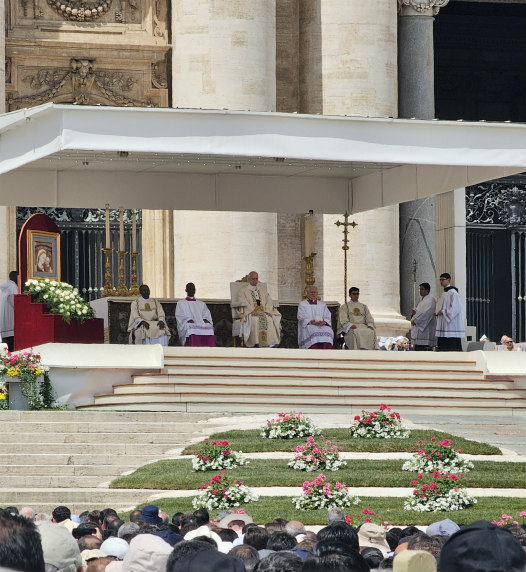
Leo XIV is the first Pope from the Order of Saint Augustine and the second Pope from the Americas (after Pope Francis), and is counted as the 267th Pope
“The Conclave was a fascinating experience. We have to honour these moments of change.”
Timothy Radcliffe, what does it mean to be a Cardinal?
It implies that when the Pope needs you, if he wants to discuss something, you go. It also gave me a role in the election of the new Pope. The Conclave was a fascinating experience. In the film The Conclave the details are correct, but the atmosphere is entirely different. We had a tremendous sense that we had to make a responsible choice, but at the same time we were there in a light-hearted manner and joked and laughed together. One of the good things was for three days we were cut off from the social media. No Wi-Fi, no emails and no news. I thought that would be awful, because I love to watch the news and see what’s happening, but actually it was liberating, a detoxification of the senses. We were with each other more deeply, because instead of being tempted to look at our iPhones or our iPads, we would just be there with each other, for each other.
What did you talk about?
I can’t obviously tell you the details, but before the Conclave we searched together to understand the challenges that the Church faces. Then quietly, often at table during dinner, we talked about our impression of people and who would be good. There are many challenges, even if the number of Catholics is still going up worldwide. The biggest challenge was identified by Pope Francis, that everybody should be welcome. Francis repeated time and again, “Todos, todos, todos.” “Tutti, tutti, tutti.” “All, all, all.” Everyone is welcome. It doesn’t matter what you’ve done, who you are, what your sexual orientation is. This is your home, and if you’re at home of course we must listen to you. The big challenge that we face is learning truly to listen to each other, patiently and humbly. Sometimes in the past priests have been too authoritarian, too remote, and put themselves above the people of God. What Pope Francis saw, absolutely rightly, and what Pope Leo sees, is we all belong to each other. We’re all part of each other. We must be open to each other as we listen, learn and travel together.
More than one hundred of you talked about that?
Yes. A hundred and thirty-three of us. We were there for nine days, talking before the Conclave. But also most of the Cardinals were at the Synods, which lasted for a month each for two years. We know each other and we have thought deeply about how we get beyond what Pope Francis called clericalism.
Popes are very different, one from the other, Benedict from Francis. What are the criteria for a person to be the Pope?
Every time you have a Conclave, the needs are different. John Paul II, highly intelligent, intellectual, saw the big need was to reach out to the young. That was one of his great priorities, and he was enormously successful. Pope Benedict, a great theologian, saw that faced with secularism we had to show that the faith was interesting and intellectually credible in people’s search for meaning. That was a necessary priority then, and remains so. For Francis the priority was: Open the doors, open the windows, let in fresh air. Meet each other. Be vulnerable to each other. With Leo it’s a new moment, and we have to carry on what Francis did, but some people were a bit frightened by Pope Francis, so they need to be gathered in and made at home as well.
Did you feel that the event of the Conclave was a great spectacle, watched by the whole world?
What was extraordinary was that I was just by the furnace that burnt the ballots that sent up the smoke, and when we put in the white material to make the white smoke you could hear the roar from the Piazza. They loved him before they saw him, and that was a deeply moving moment. They welcomed him as somebody given to them.
Did you think beforehand that Cardinal Prevost might become the new Pope?
I had a suspicion that he might be. He is extremely good at making peace. When there were some tensions within the church, Leo had the great gift, as Cardinal Prevost, of bringing people together, healing wounds, and letting people go forward together. I think this is not betraying a secret…. When I went up to greet him afterwards and gave him the kiss of peace, he said “Timothy, I don’t think I’m going to be able to call you ‘Your Eminence!’” That’s very typical of the humanity of the man. He is a very human person.
It must be frightening to suddenly become the Pope. Were you preparing yourself for such an eventuality?
Oh, I knew I would never be the Pope. (laughs.) Too old, too sick. It never occurred to me. But you would never want anybody to be the Pope who would then take themselves too seriously. If you take God seriously, you can’t take yourself too seriously. Immediately after the Conclave, the first thing Leo did was to have a gathering of the Cardinals and say, “Let us have conversation together.” Conversation is one of the most human things there is. Friendship and conversation go together, and conversation has to be at the centre of the life of the church. Conversation with ourselves. Conversation with people who disagree with us. It was a wonderful day for us and it was a wonderful day in the Piazza. Tens of thousands of people rejoicing.
Is the creation of a new Pope a strange moment of transition?
But don’t we all have such moments? People get married; that changes them. People die; that changes them too. (laughs) We all go through these transitions in our lives. We have new positions of responsibility, somebody becoming a father, having children, is a transformative moment in their lives. We have to honour these moments of change. Most traditional societies have rights of initiation which help people to become fathers or mothers, brothers and sisters, leaders. In our society, we’re not so good at helping people to live fruitfully these great changes in our lives.
Even if human beings have always been at war, you preach peace?
Many people think war is inevitable and say that there’s always been war, but we have to believe war is not inevitable. It is possible to find peace. In the Holy Land there’s a movement called ‘Musalaha’ – Arabic for reconciliation. They take young Israelis and Palestinians, Jews, Christians and Muslims, into the desert; and they listen to the desert. First they listen for the silence; and then they learn to listen to each other, so we must never say war is inevitable. Secondly we have to be able to imagine peace. Often we do not seek peace because we can’t imagine it. The scriptures are filled with wonderful images of peace, the lamb will lie down with the lion and so on in Isaiah. We have to use our imagination. If you encounter the brutality of war, how awful war is, then you will want to fight for peace. By chance, I came across a video of a young Russian soldier in Ukraine, hunted down by a drone. In the end, he was cornered and he knew there was no future. One saw him take his life. I wept for an hour afterwards, because you just saw how awful war is.
Now it is worse, we have atomic bombs, before they were fighting with stones. What progress do you see?
When I look at the young I know they are carried beyond little national identities.. This is the good side of social media. They have friends all over the world. When I get up in the morning there’ll be emails from the Philippines, Nigeria, Australia. We all live globally, and let us grasp this new moment where we’re all global citizens. None of us are prisoners of a narrow, small national culture. I have great hope in the young, because the young know that war is foolish and wrong.
Since you were a young boy, why did you always read novels?
When I was eight I had a wonderful teacher and if we were good he read to us aloud from Charles Dickens. I said to my mother, “I’d like a novel by Dickens for Christmas,” and my mother thought it was ridiculous, I was only eight years old. But my grandmother, a wonderful, wise woman, said, “Let him read Dickens. He will not understand most of it, but he will be captured by the beauty, the music of the language.” I go on reading novels because they expand your heart. When I went to Latin America, I would read people like Isabel Allende, Gabriel Garcia Marquez, Mario Vargas Llosa, because then I had to open myself to another way of being human. Everywhere I go I always ask people, “What are your best novelists?” and “What are your best poets?” because if I want to be a citizen of the kingdom of God I’d better become a citizen of the globe today. Poetry, novels, films and music stretch you open. Thomas Aquinas called this expansio cordis – expansion of the heart.
Is Dostoyevsky your favourite novelist?
I greatly respect Dostoyevsky, but I am ashamed to confess I prefer Tolstoy. Anna Karenina is one of my favourite novels.
And films?
Des Hommes et des Dieux is an extraordinary film about the dramas of Algeria in the 1990s when these monks were threatened with death. It’s a true story. Every word is taken from their diaries. They knew their decision to stay to be with their Muslim neighbours might lead to their deaths and they were all killed. We had a brother living there, Bishop Pierre Claverie, the Bishop of Oran. I went and stayed with him a week or two after the murders, and saw the whole drama of the Algerian people. That film, Of Gods and Men in English, opened the door to the drama of the whole Algerian people. What a privilege to share their life, to share their love, to share their suffering.
And poets?
I love the Irish poet Seamus Heaney. He was a friend of this community and often used to stay here. I had many a pint of beer in the pub with Seamus, one of the great poets of the 20th century. He struggled with faith. Often it was not clear whether he believed or not, but he was a seeker, and that’s what I love. I love to be with people who seek.
And music?
Until recently I would have said Mozart, but in Slovenia I watched the most extraordinary Indian dancer called Aakash Odedra and he was astonishing. I was bowled over. I’m afraid I dance like an elephant, but it was such a joy to see this man dance, alive in movement and music.
Present at the Conclave in the spectacular Michelangelo Cappella Sistina, was it something very special to be in close contact with great art?
It was wonderful. It’s a boiling image. It’s incredible. I hadn’t realised how powerful it is. Initially I was a bit depressed: the sight of the damned going down, but I saw it in the end as the triumph of life, the triumph of love, because there are people rise from suffering together. Those who are saved are together, and Jesus says to them: “I was in prison and you visited me. I was hungry, you fed me.” What you see in this picture is the triumph that happens when we are close to each other. If we surrender to that love for each other, then life will triumph.
Cardinal Timothy Radcliffe OP, thank you so very much for your wise words and for being with us today.
All images courtesy and copyright of Father Lawrence Lee OP, Editor of “The Dominicans”, The Magazine of the Dominican Friars of the English Province.
ENJOY THIS INTERVIEW? SHARE IT WITH A FRIEND.


