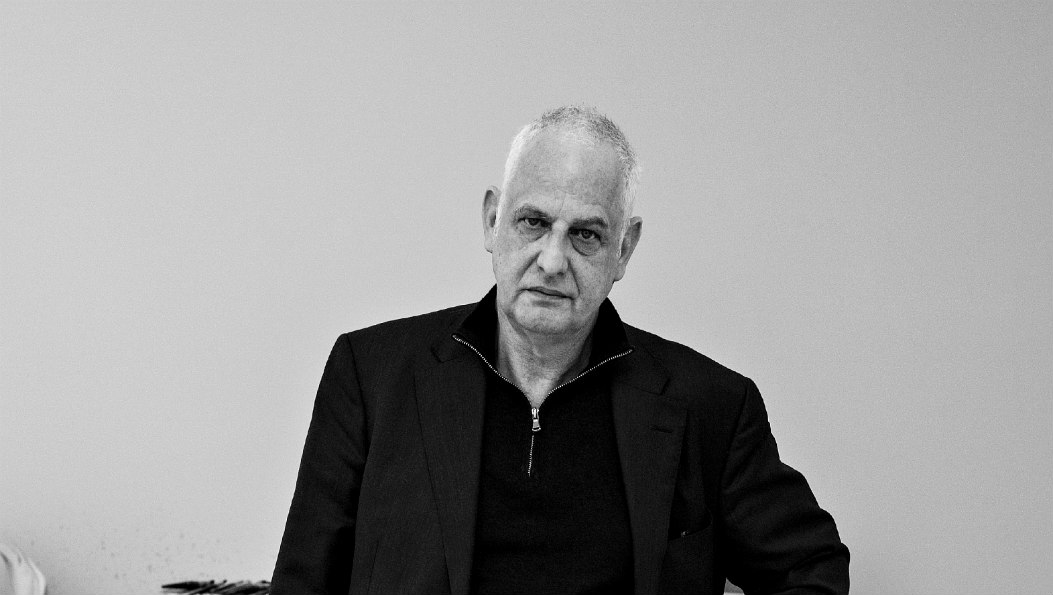
A LINEAGE OF THE REAL AND THE AUTHENTIC. Luc Tuymans is a Belgian visual artist, many of whose paintings explore people’s relationship with history and confront their ability to ignore it. World War II and the horrors of the Holocaust is a recurring theme in his many faceted work. Tuymans is a key figure of the generation of European figurative painters who gained renown at a time when many believed the medium had lost its relevance due to the new digital age.
You can listen to the podcast of this interview here.
Luc Tuymans, if I was a student of yours, who would you tell me you are?
Essentially, I’m somebody who is extremely shy. That is why I work with visuals, but I also have a great respect for people who write, because writing is one of the most antique forms of expressing yourself. It evolves very slowly but has an extreme sense of formulation and exactitude. As an artist, it’s important that you try to be genuine in what you are doing, or try at least to be relevant in what you are trying to bring across. Art’s not something you do for yourself, it’s about extrapolating, and also about a humongous amount of generosity. Without generosity, there is no culture left.
You mean creative generosity?
Generosity that’s in comparison with the element of pragmatism of timing and precision within what you do; what you perceive, and what you give on to the world. These things are a responsibility for an artist in terms of how he positions himself towards himself, but also to the rest of the world. The element of what is relevant is always imminent. When it is not, there would be no interest for me to do anything with it. An element of detachment is necessary in order to create.
“I want the feeling of doing something special”

Luc Tuymans. Body, 1990. Photo Ben Blackwell, Courtesy David Zwirner
Luc Tuymans, do you need an obsession, such as the one you had about the Holocaust?
The obsession of a visual artist is the visual itself. It is the compulsion. It’s the compulsive element of doing it all the time. To a certain extent, you can’t stop. So it is a sort of addiction.
How did your work with murals come about and what is the motivation behind them?
The murals came about on the one hand as something specific and on the other hand something extremely pragmatic, because there were certain shows where I didn’t get the work so I decided to paint them directly on the wall in order to have them in the show. Then I also decided to change the scale, because when I installed a show I tried always to encompass the space in which it was happening. So when a curator wanted to do a show but didn’t have any money to pay for the loans, the transport or anything else, I just proposed to him that I’ll go there for a week or so and I’ll paint you an entire show on the wall – which then of course will disappear. It’s completely ephemeral. It will go on in the mind as a souvenir, as a memory, and not so much a real artefact. This gives it a different form; a form of being liberated from the idea of the commodity of the artwork. Also, you can work with an instantaneous element which is so urgent that it doesn’t stick to the commodity of the object itself.
Giotto and many others painted murals, often sacred images. Do you do it for a religious purpose?
All art might be sacred to an extent, but no. It is mostly adapting to the space in which it has to happen. The theatre in Dresden gives a really particular example. Dr. Ulrich Bischoff wanted me to co-curate his last show at the Albertinum, Die Erschütterung der Sinne (A Shock to the Senses), where he brought together Goya, Delacroix, Caspar David Friedrich and Constable, and made a whole exhibition around that. Founded in 1913, the theatre in Dresden was having its 100th birthday, and the entrance hall has two staircases by which you go into the theatre itself. I took the first imagery of Technicolor, that went back to 1913, and put an image of peaches and flowers – of which I made paintings too – on that wall.
Was it a similar inspiration for what you did at the Louvre in 2024?
I didn’t want to make anything about the Louvre, because that’s idiotic. I tried to make something that makes sense to the Louvre, that is about the act of painting. The only compromise I made was the painting I did, because I had lost it – it was the back of a doll’s head called The Orphan. I blew it up to the size of 4.5 metres, and it’s cut underneath the neck. One should not forget that Georges Bataille said that once the guillotine became operational that specific place of the Louvre became a public space. There is always a specific element.
The same inspiration as in the Haus der Kunst for the exhibition Wenn der Frühling kommt (When Spring Comes) in 2008?
Yes, this wall drawing was 12 by 16 metres of the entrance of Alice in Wonderland. There was a smaller painting of about 5 by 7 metres that I couldn’t get because it was on show in New York. I positioned it into this little doorway to this golden salon that gives to the English garden, which is completely not in proportion with all the other proportions of the building. It also goes back to the fascination Adolph Hitler had for silent Walt Disney films, which he watched at the end of his life. And so that all made sense.
How do these ideas come?
I actually don’t want to think anymore. I just want to execute on the canvas, and the intelligence has to go from my head to my hands. I know how and what I’m going to do for months, and then I pick the day, prepare myself, and then it has to get out. I’m very nervous still before every time I start painting, as I was ever. That didn’t change. The minute I lose this nervousness, I will lose everything.
Is the quick execution of a painting very similar to a short story writer, it has to be made quickly?
Yes, painting largely is about timing and precision. You can easily overwork a painting and kill it so it will not look fresh. Caravaggio worked very fast, and Sir Henry Raeburn worked very hard and decisively. This is the exactitude that I’m looking for, because I know that I can’t do Jan van Eyck. That’s too difficult. After van Eyck, everybody became a dilettante, so we’re not going to repeat that. This is a specific physical concept, working with your own determination and limits within what you can do with paint. When I leave my studio after that particular day, I want to have the feeling that it worked. This doesn’t mean that I will not come back at it for very small details that you barely can see with your naked eye, because adjustments are made sometimes even a month later on the painting, because they are sometimes a long time in the studio. But the initial point that I have to have is not only visual, but also the feeling and the conviction that it has worked. I can’t do that in steps. I also don’t want the feeling of going to work. I want the feeling of doing something special.
“For young artists now, it is very strenuous and very difficult”
Luc Tuymans, do you belong to a school of artists, or are you a loner?
Nothing is really original. Nothing falls out of the sky. There are huge lineages, and the lineage I come from is clearly Western European. Specifically the region where I come from is a region that has dealt with the idea of the real. Belgium is a country which is very young, a bit like Italy. It became a country in 1830, after the Napoleonic wars and after the failure when it was given back to the Dutch king. Before that it was a region that was overrun by foreign powers, so people had to have a great deal of opportunism just to survive, also on a visual level, and it created the idea of what is pictorial and what is valid and relevant and what is not. It is in that line that my art goes all the way back.
Is this similar to when people talk about Magritte and surrealism?
It has nothing to do with surrealism when he actually made his famous painting, La Trahison des Images (The Treachery of Images). He painted the pipe and underneath it says “Ceci n’est pas une pipe.” (“This is not a pipe.”) Of course not! It’s the image of a pipe. So there is this element of pragmatism, this element of taking on the real. You see this even with Ensor, who was not really crazy or grotesque, he was a precursor of expressionism. Most of the painters in this context and in this region were loners and were individuals less than partaking in a group. The lineage would be the real. And the other idea is to be authentic, trying to be genuine. That is the most important thing; as well as the idea of positioning yourself. I like artists that position themselves.
How do you position yourself?
By using the right amount of understatement, so your work can be understood in layers and not just in one track, blatantly, with overtly evident imagery. The signifiers should be multiple, but at the same time they should also take in some kind of a position. That lineage goes back to people like Manet and Goya, even Van Eyck to a certain extent, because it’s unforgiven since his motto was If I can (Als ich can). Which means I’m big on humility (or pretending to be humble) but behind that I have gigantic ambitions! In that sense there is always this lineage.
What is your gigantic ambition, and are you getting better and better over the years?
That remains to be seen. Time will tell. After 15 years of delay I just did this show at the UCCA Center for Contemporary Art in Beijing with 90 paintings, called The Past. It was a sort of survey of my work, because I owe the Chinese that, and it was very shocking for me to see, because it was all in one space and you could see the collision between the very old work and the most recent. The recent work has grown in size, but also was painted completely differently. Colours had changed, and they looked twice as big; whereas the small, older ones work from a distance in a very weird and particular way. As a painter and an artist, you cannot go back, and while I could physically and technically make all these old works again, intentionally they wouldn’t be there. That is the limitation you have. If that’s better or not I don’t know; other people have to make that assessment. I always aim to go a step further with what I’m doing, and the gallery space has changed enormously. It became so big and institutionalised and oversized, and that also has an impact. My own studio has changed. My first studio was a small apartment by which I was limited to a certain size, and now I have a big studio. So you make bigger works because you think it’s a bigger statement. If that’s necessarily the case I don’t know.
How do you perceive the increasingly globalised art world?
I’m very good friends with Kerry James Marshall, whose work I got to know 25 years ago, and there are other artists that I know from Iraq, Iran, so it’s not so much the idea of the ethnicity of these works as what their relevance is. Whenever they are relevant I will take them as relevant and look at them with my eyes, which are clearly not the eyes of the people that see them over there, or even the people who make them. When my wife – who’s also an artist – and a colleague were in Busan we met a Buddhist painter who made these very large scrolls which were amazing. We took a take upon Western religion and the response in terms of Buddhism, and these things are really interesting when they enrich each other, when they are in dialogue. When they are in opposition it becomes dangerous.
How has the art market changed things?
First of all, we have to see how the art market came about. Up until 1975 it was still humane, but then it all changed when a work of Julian Schnabel was linked to the stock market. Actually it was before that, but it was still an American pop artist. That moment, when the art market was installed as a machinery, as a thing, was largely the consequence of the Japanese that had over-invested into New York and many other things. It actually started out with the Second World War and with the covert operation of the CIA, making America the international centre. They won the war and also wanted to win it culturally.
Was the turning point in 1964 when the American painter Robert Rauschenberg won the Venice Biennale?
Yes, but then there was the Gulf War, and a lot of the old powerhouse galleries collapsed. This was the moment that my gallerist David Zwirner came into the game; there was a loophole to do that. Then this whole new generation came out, and the art market evolved and became stronger, with more and more impact. It has made the artists secular, and put much more pressure on the artists than there was before. The whole situation became a billion-dollar market, and still is, and that has an impact in how not only it is perceived but how it’s worked and how people assess themselves and position themselves towards that.
How did this affect you?
In my case, it was still doable. For young artists now, it is very strenuous and very difficult. I started to work with David Zwirner when there was one assistant and I was with the five first artists. Now there’s 500 people working there. This is the change. The art world has become corporate, with an element of superficiality. When I went to New York two years ago to have a big operation on my neck, before going into surgery I went to look at the gallery shows, and I was flabbergasted by the poor quality and by the fact that it didn’t have a lot of relevance. It was like putting your head into the sand. Seeing the circumstances the world was in, it was very poor. Also, it looked all very dated. It looked like 35 years ago. There is the resurrection of action painting, which in the late 80s became pathetic and is completely back. Then you have the influencers that influence the collectors, who are not really educated and also less passionate. There is the speculation. All these elements have now been entangled, which makes the situation rather mediocre. Therefore, the idea of integrity in the work and the relevance of the work, and to be genuine, is actually the main option that you have.

Luc Tuymans. Wonderland, 2008 @ Haus der Kunst Munich. Courtesy Studio Luc Tuymans
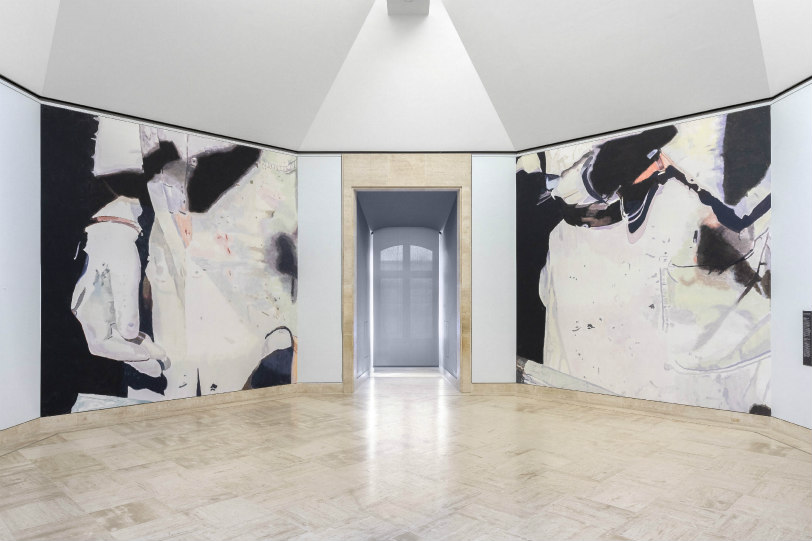
Luc Tuymans. The Orphan, 2024 @ the Louvre. Photo Nicolas Brasseur, Courtesy David Zwirner

Luc Tuymans. The Orphan, 2024 @ the Louvre. Photo Nicolas Brasseur, Courtesy David Zwirner
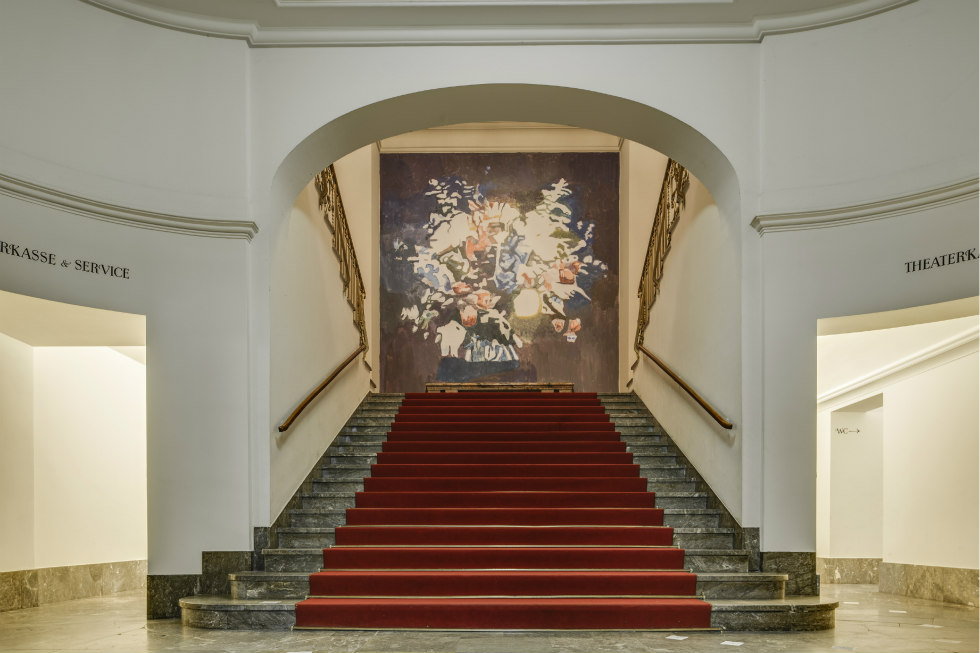
Luc Tuymans. Technicolour, 2013 @ Staatsschauspiel Dresden. Courtesy Studio Luc Tuymans
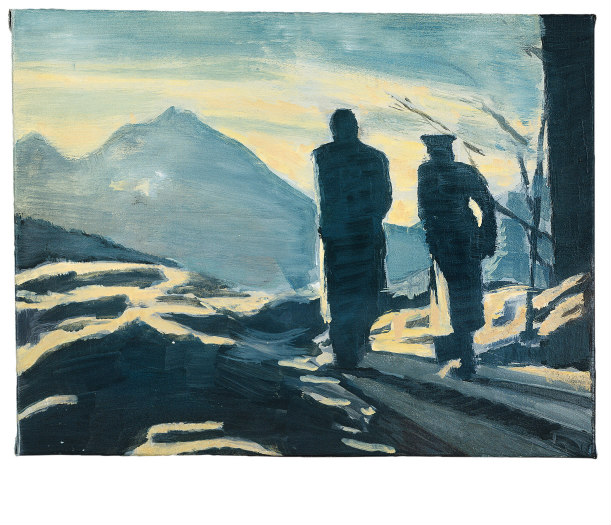
Luc Tuymans. De Wandeling, 1991. Photo Felix Tirry, Courtesy Zeno X Gallery Antwerp
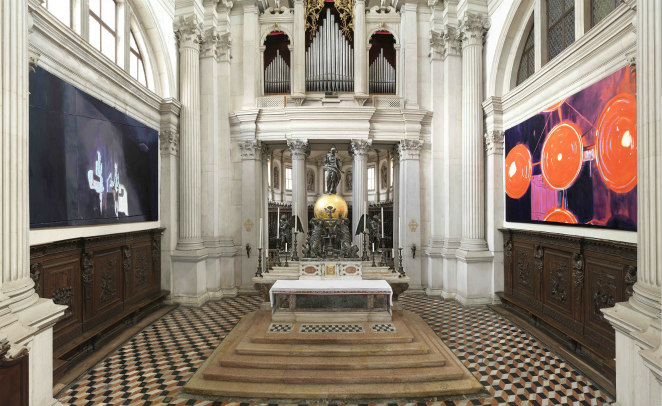
Luc Tuymans. Musicians, 2025 and Heat, 2025 at the Basilica di San Giorgio Maggiore in Venice. Photo Mauro Magliani
“There’s a big difference between a drawn line and a painted line”
Luc Tuymans, is there a lack of talent?
I don’t want to put it that harshly because I don’t believe that. There’s probably a great deal of talent, but it’s the way how it’s communicated. Social media has a gigantic impact, not only on the world and civilisation as a whole, but also in a cultural sense. Instagram, all those elements that are now put into play. I don’t fight new technology because we can’t win that and you have to incorporate it into the toolbox, but it’s mostly the way how things are analysed. This has a great deal to do with education, and that’s where we’re failing, in the sense that the idea of depth within what could be perceived or understood is largely taken away by a sort of greed in terms of imagery. It’s so easy. You go to the internet when you want to find something. The idea of access has become a sort of power zone that has created its own bubbles, but it also created its own time span and its own superficiality. The big dream of high-tech, that politics would be no longer interesting or important because people would have access through the internet to all the situations, is not true, because, of course, it’s also controlled by algorithms and by companies. In the old days, the thing that was the scarcest was the more valuable. Now the thing that has the most access is the most valuable. That’s an interesting shift in how you think about the world and how you access it. The element of access has been enlarged but extremely diminished, and it has incarcerated groups and polarised entire societies. That’s where the artist is predominantly very interesting, because the artist still has that purposeful situation where on an ethical level he or she can make the decision to differ that assessment of what time is, and what perception within it is. That was always important; but is now predominantly important.
Does drawing still form the basis of a visual artist’s work?
Drawing is very important. I do make photographs with my iPhone, as everybody does, but I also make drawings when I travel. I don’t make works when I travel, I do that at home in my studio. Informationally, in terms of keeping something or trying to understand something, drawings are quite important. Also they’re absolute. You can erase a drawing, but it’s different than the painting where you can overpaint. This is a momentous element which makes the urgency a different one. I mostly don’t show drawings together with paintings, because it’s a completely different medium, a completely different assessment of time also. We did the catalogue raisonné for my paintings, but I am now planning to do a similar thing for my drawings, but which is not a catalogue raisonné.
Your catalogue raisonné made by Eva Meyer-Hermann and published by Yale University Press?
Yes, and this project will be probably a little bit the same. I started it a couple of years ago and we are trying to select 1500 or 2000 drawings that will give an insight. One part will be directed towards the paintings that came out of it, i.e. the way of thinking, the process of how an image comes, and then there are the ones that are completely standalone. So we have these different categories, and it’s interesting because there you see probably much more the way how an image comes about and how it’s thought of and how it’s produced, how it comes to finalise itself to go into a different medium. That’s one thing, and the other thing is that you have the drawing in itself as an artefact that is completely independent of that.
The way a young Picasso or Van Gogh draw, just to mention two, is something amazing.
That is true. You can easily see when a drawing is invested with a certain physicality which is authentic. Look at the drawings of Egon Schiele, which are extremely important and even better than his paintings according to me. He translated a drawing into a painting, and there’s a big difference between a drawn line and a painted line, that’s for sure. In the drawings of Klimt or Ensor you can see the talent in terms of how there is this knowledge that is not completely embedded upon the idea of drawing from perception or being correct. Luckily I had a good teacher who was a very mediocre artist, a sculptor but a very good pedagogue, and he always told me that you have to look and then draw.
What do you teach your students?
This is already a long time ago, but when I teach, first of all I explain to them what I do myself. I give a lecture so that they know who I am in terms of the work, and then I say that what I can be able to deliver to you is limited and subjective, so if you have a conviction and stand on it, you have to make it hard; and when it makes sense I will for sure accept it. When it will not make sense, I will try to fight it but it’s still your conviction. That I understand that this is highly subjective, that there’s no objectivity, was the sort of openness that I could start with.
You said that life is harder for young artists nowadays?
Yes, because of the whole structure, and because there is much more information, there are many more institutions. There’s an abundance of all these things, which sometimes might make it hard to focus and make it also harder to evolve in a pace that is a bit more humane. There’s a lot of pressure on young people, not only in the art world but in general, and that pressure is not always the right one. So it takes a strong resilient person to make it.
What are your future plans?
Recently two people from the church San Giorgio Maggiore in Venice came to me with a specific project. They took out the two Tintoretto’s of the church to restore and wanted me to replace them within a month. I did, in two weeks, and now they are hanging in this church in Venice. That was a project that fell into a whole process, because I was working on a new big show for the States for David Zwirner in LA for next year, with specific work which is called The Fruit Basket.
The Fruit Basket is inspired by Caravaggio?
No, The Fruit Basket is a very large painting consisting of nine pieces that will have to be put together, because it doesn’t fit in my studio. I was invited into a project about Casa Malaparte a couple of years ago, and we were at Capri to see the villa and also we were invited to the moment when they give The Malaparte Prize that they give every year. This American writer Daniel Mendelsohn got this literary prize, and the day before he gets the prize there is a sort of fruit basket that they all have to hold but don’t get with fermented fruit. And the day of the real official opening, they hold it up and give it back. But the day before that, they have to give a talk in Italian and also show an Italian movie, and behind that, there was a flat screen in nine parts where you would see this basket, but it turned blue and this is what I’m actually making. It’s the vast size of The Raft of the Medusa by Théodore Géricault. That’s the main project now.
Are there other smaller projects?
There’s a smaller project in Japan that I’m working on, and then there is a project for my 70th birthday – the city of Antwerp wants to give me a big show in the Museum of Fine Arts in my hometown. The Stedelijk Museum in Amsterdam wants to do that, and probably something in Basel. Those are the more institutionalised shows, and there’s also the drawing project. If I want to make a drawings only show that goes alongside when we bring out the publication, which will be in a couple of years, in a couple of museums I only will show 300 to 400 drawings. Those projects are in the making.
Luc Tuymans, on the eve of your 70th birthday, I’m happy that Antwerp, the city of Rubens, is going to celebrate you. My warmest wishes for your growing success. As you say, history will judge what is the best of your work.
That is always the case. It is clear that no artist of my generation will have the same legacy as Velázquez or Rubens, or Picasso even. Because it’s become a different world. That means that as an artist, when you’re still alive, you have to take care of that legacy. So that’s the last plan.
Luc Tuymans, thank you very much for this interview.
Portrait Luc Tuymans in his studio. Photo Alex Salinas, Courtesy Studio Luc Tuymans.
ENJOY THIS INTERVIEW? SHARE IT WITH A FRIEND.