

PORTRAYING THE DESTRUCTION OF CULTURE. Piers Secunda studied painting at Chelsea College of Art in London. Since the late nineties he has developed a studio practice using paint in a sculptural manner, rejecting the limitations imposed by the canvas. Piers’ work examines some of the most significant subjects of our time, such as the deliberate destruction of culture.
19 minutes read time
You can listen to the podcast of this interview here
Piers Secunda, why did you decide that the canvas was too small and change your work?
Painting is the application of colour to a surface, but when you’ve expanded to the edges, the limitation of painting, are that same surface. One day I made a painting where I didn’t fit everything in, and I suddenly realised that I wanted a more organic system where paintings could grow and have an unlimited ability to expand in any direction. I developed techniques where, by utilising sculptural processes, I was making paintings only with paint. The processes of production were traditional sculptural techniques – carving, casting, cutting. That’s the digression that I made away from the standard format of painting.
Why were you so affected by the destruction of the Bamiyan Buddhas in 2001?
When I saw the Bamiyan Buddhas being destroyed I realised that there was a level of destruction and deliberate targeting of culture that we had not seen before. The remit of the Taliban was to flatten the culture that existed prior to their rule and to put their imprint over the top. I couldn’t get the Buddhas out of my head. Then six months later September 11th happened, and I stopped making abstract assemblages out of blocks of paint and started making art about what was happening around me. In the same way that the Bamiyan Buddhas represented a system of belief and a way of life alternative to what the Taliban represented, the Twin Towers represented similar notions but to a Western capitalist society, and so they were attacked for the same types of reasons.
“I make the work so that in the future people can learn from them”
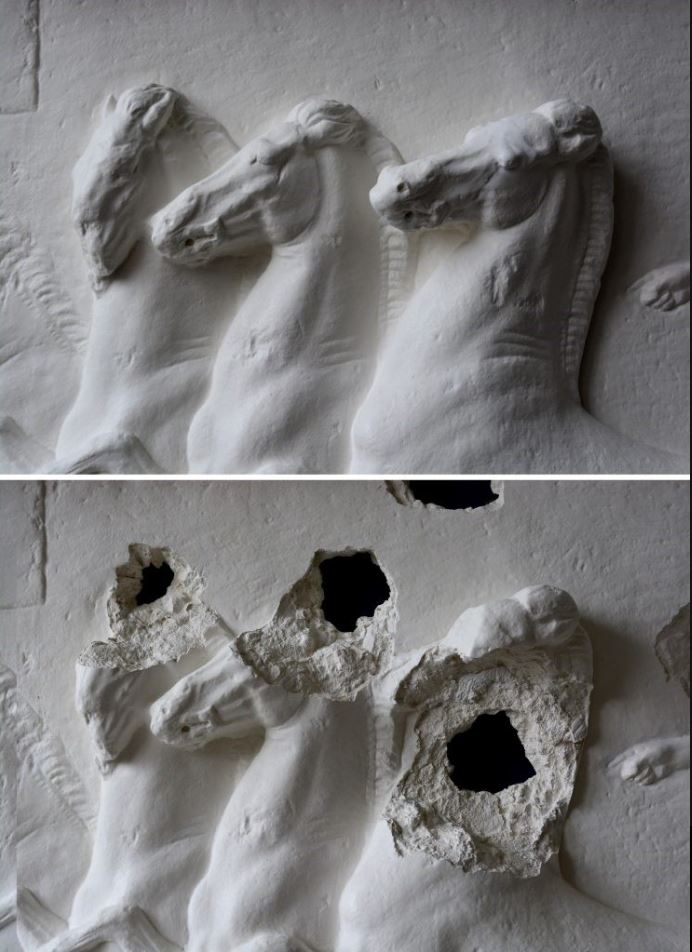
Piers Secunda ISIS Bullet Hole Painting – Horses 2016 – 92 x 350 x 12 cm
Piers Secunda, you also memorialized the disappearance of Spanish citizens during the Franco era?
Yes, I designed a memorial pin NomeOlvidesPorEspana.org for the families of the ‘disappeared’. Free thinking people – artists, writers, people who dissented, even on a very low level, with the Franco government – would be taken away, killed, and put into mass graves. Both Franco’s government and the Taliban kill people to stop them speaking. These are markers of the flattening of culture, to impose upon it something else. Free speech is the first rung on the ladder in a free society, which means it’s the first rung to be smashed away.
What language do you use to express your rage?
I use three or four. Mostly it’s sculpting, print making and painting. Art is the first system of human communication. These are visual languages. One method I use is moulding with dental putty – I take it to places where damage is being done to culture, and make molds of the broken surfaces of sculptures or of bullet marks to make relief sculptures. Or I gather up materials such as charcoal that I find in places where buildings have been burned, such as the Mosul Museum. More recently, I’ve been using my own carbon capture, which is soot that I scrape out of exhaust pipes. I use the charcoal and the soot to make prints and paintings which document what’s happening around us.
Why at the end of 2025 will you show work about the loss of protected nature in Florida?
Cypress swamps are primordial territories with clusters of cypress trees which are often many hundreds of years old. They are habitats which traditionally supported huge numbers of indigenous people, who lived all over Florida. Nowadays the only predators living in the marshes and swamps, are the ones unchanged since the Jurassic era; turtles, alligators, dragonflies, even the flora and fauna are very ancient and largely unchanged for hundreds of thousands of years. These places are being cornered and drained by property development, expansion of roads, turning fields into shopping malls. I witnessed this personally, because my parents have lived in Florida since 1980 and we had a cypress swamp literally ten feet behind the back gate of our garden – and now it’s a lawn. I want people to see these paintings and want to go and explore the Cypress Swamps, to embrace them and marvel at the wonderment that they present.
You are trying to convey different types of degradation and destruction?
Yes, ultimately, there are three different forms of destruction of culture. Most of it happens during wartime, because industrial scale machinery and explosives can be used to destroy the culture of a place. Think about Ukraine, that’s exactly what’s going on there. I travelled a lot to Iraq between 2015 and 2024 and have looked at the actions and effect of ISIS at great length, and it’s very similar. Russia has taken the knowledge of ISIS and is implementing their tactics against Ukraine. So that’s the war side. Another reason that destruction of culture happens is because of the expansion of agriculture. That’s then usually followed by the development of the agricultural land. The third way is that Governments close down culture quietly, when its truths become inconvenient to them. The UK Arts Council are recent victims of this.
How would you describe your anger in relation to all this?
It’s exasperation. I’m acutely aware that I’m just one person, and there’s a limit to what I can do, but I try to understand these situations and express them through the art in order to put the material and the knowledge which I’m accumulating into the public domain, to help people to understand. If people don’t understand, they can’t choose to change their attitudes or their approach to dealing with the location or its products. The destruction of culture happens because of a lack of critical thinking in education. Without the capacity for critical thinking people become sheep and do what they’re told. This is the greatest danger of a lousy education, that all our values and freedoms can be stolen from us.
“Sometimes people come into art galleries and see my work and cry”
Piers Secunda, how do people absorb and react to the work you make?
Sometimes people come into art galleries and see my work and cry. I made an exhibition in New York in 2017 presenting relief sculptures which had been damaged. I did this by a sculptural process, merging the relief sculptures with forensic quality molds of damage made by ISIS in Iraq. Because there’s no veil of the media in between the physical reality and the human experience, it’s very visceral and people become very emotional.
Do people buy and take your work home?
Yes, plenty of people do. The works on paper sell very well. Many people fall in love with them and marvel at them, they’re beautiful and a joy to live with. They have a calm that the ruptured surfaces of Assyrian sculptures don’t have. There are art collectors who like art that challenges them and those serious collectors buy the damage works.
Unfortunately there seems to be an essential violence in the world?
It does appear to be that case. However, there are many billions of people in this world, and if people feel comfortable and brave enough to speak and to press their sentiments, the leaders of nations ultimately will have to do what they want. That’s one of the great wonders of democracy. If people decide across an entire nation that they are going to make demands and refuse to go home until their demands are met, then governments have to concede. We see this quite often in France, when people protest in the streets – like the farmers relatively recently – and simply refuse to go home until the government concedes to what they want. So the mass of the population is much more powerful than twenty people sitting around a cabinet office desk.
Do you interact directly with governments?
Yes, for example, I’ve known three consecutive Iraqi Culture Ministers and the heads of the state boards of Antiquities and Heritage, and they’ve always helped facilitate what I’m doing. One of the ways in which I try to move forward my intention to tell people what’s happening is to interact directly with the governments who are involved. In 2018, I was asked to organise a collaborative exhibition between the Iraqi ambassador and the Kurdish high representative to the UK. Their respective militaries, the Peshmerga and the Iraqi army, had been at war with each other over the city of Kirkuk. Ultimately the Peshmerga withdrew from Kirkuk and handed it over to Baghdad in order to prevent the city being destroyed in the same way that Mosul was. When those two parties asked me if I could help organise a collaborative project in the form of an exhibition of my Isis-related art, immediately I said yes. I saw it was an opportunity to try to somehow bring these parties together. I had no idea how I was going to do it, so I followed their guidance. Today, some of these people still speak to each other on a regular basis, but initially they were completely unwilling to even enter the same building. So there is, in every person’s life, the opportunity and the possibility to try, if you want to, to improve just a little tiny bit the way that the world functions. I’m very certain that art has a role to play in that, if artists choose to utilise it that way.

Piers Secunda in Odessa Cathedral, Ukraine, December 2024
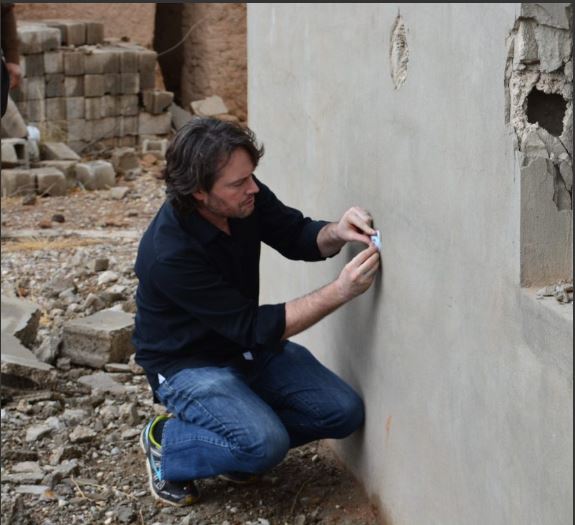
Piers Secunda in Mosul, Iraq, collecting bullet mark
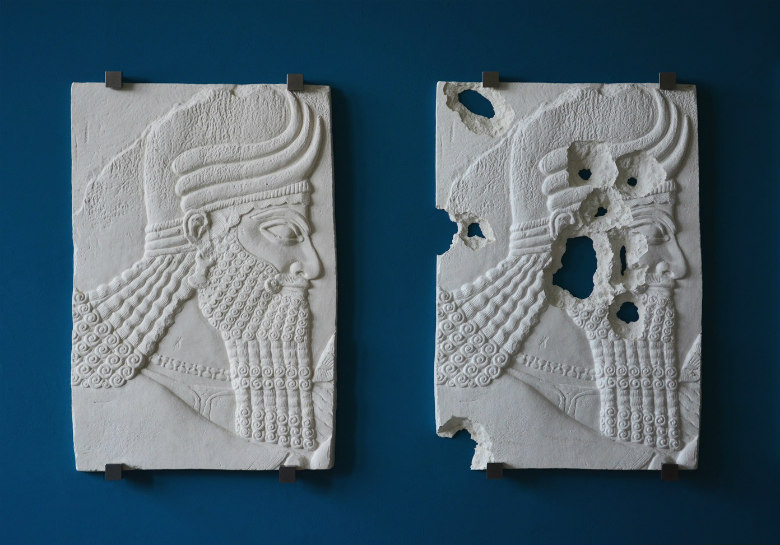
ISIS Bullet Hole Painting (Assyrian Head) 2015 Industrial floor paint and metal fixtures 73cm x 100cm x 3.5cm

Portrait of Piers Secunda in his studio – Photo Credit Lorna May Wadsworth

32 x 40cm Hand finished etching Mosul Museum III charcoal ink on Somerset Satin 330 gsm Edition of 20
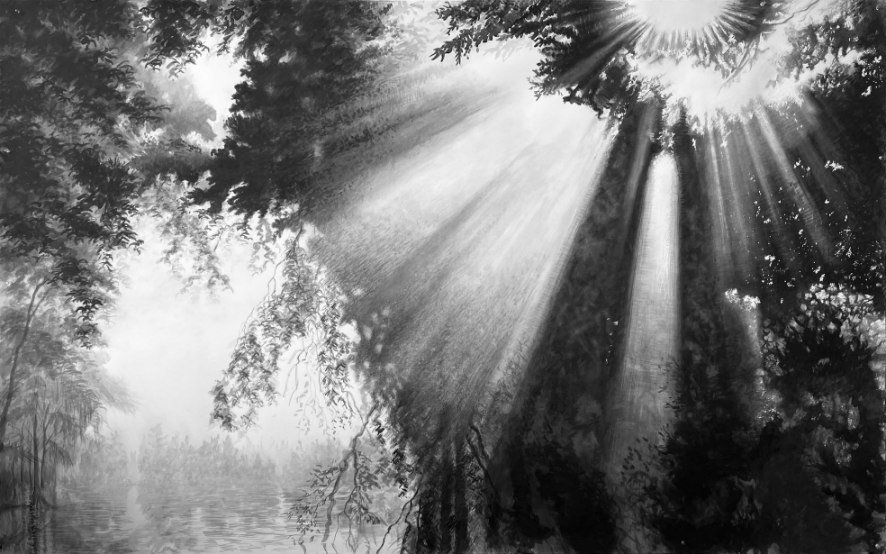
Piers Secunda Cypress Swamp #2. Florida Carbon Capture Ink on Fabriano Paper – 55in x 88.5in – 2025
“The bottom line is a level of awareness”
Piers Secunda, as soon as there is a revolution, the first thing people do is destroy the monuments, the busts of the Mussolinis and the Saddam Husseins of this world?
Absolutely, naturally, and the people who tear down those symbols are the people who feel most strongly what those symbols represent and their hatred towards them. In the occupied regions of Eastern Ukraine, Russia is putting back up the statues of Marx and Lenin. Putin clearly sees himself as one of their equals, but he can’t follow from them if the busts and sculptures of them are gone. So in Russia, they’re putting those statues back up as well.
Is there hope in your work?
Absolutely. They’re all hopeful. I make the work so that in the future people can learn from them. The desire and the need to be educated are based on hope. Hope that you can teach the next generation and that they can avoid the problems of the prior generation.
You witness these horrors so that they will not be repeated?
Of course that’s the hope. When Saddam Hussein was arrested by the American authorities in Iraq, the Kurds realised that they were completely free. They went to their libraries, which were filled with multiple volume biographies of Saddam Hussain and his versions of history, and they looked at those and they now could take those out the back and burn them and be done with that history and so much pain for ever. A hundred and thirty thousand Kurds died under Saddam. Or they could take a step back from it and say: this is a lesson from history which we absolutely cannot forget, so let’s close this section of the library off and keep it, and anybody who wants to understand what that type of authoritarianism in Iraq looks like can come here and examine it and understand it for themselves.
Besides the upcoming Florida project, what is your obsession at the moment?
I’ve been working for five years on a project relating to the German occupation of a British Channel Island called Alderney in World War Two. Officially 355 or 357 people had died on the island. Those were forced and slave labourers, taken from 30 different countries, who were brought there to build concrete fortifications as a deterrent to the invasion of France by the Allies. In reality, around 2,000 to 3,000 people died on that island. I started researching it, and the more I researched, the more material I found and that has snowballed as a project. The exhibition which I organised about it was from February to March 2023. Two months after it closed, the UK government opened an inquiry into what happened on Alderney, and they officially changed the numbers of dead on the island up to 1,100. It will go much further in time, and I presented a large volume of data from archives around the world, especially one archive inside the U.S. National Archives in which there was a wealth of information about Alderney that had never seen the light of day. Part of the reason I put that exhibition together was because there was a personal connection. The guns on Alderney fired at my grandfather in an aeroplane which was flying into the Cherbourg Peninsula the night before D-Day. He was a commander of American Pathfinder paratroopers, and they set up beacons the night before D-Day to guide in all the aeroplanes at daybreak. Because the guns on Alderney had shot at him, it made it rather personal.
Do you do all this by yourself or with the help of a team?
With the Alderney project, I had a small team of researchers who helped me. They were mostly retired professional academics and researchers who I contacted because they were recommended to me. I found a fellow in Germany who I was introduced to and he said, oh, I’d love to do this. He was retired and he wanted a project that was engaging. This happens often. I have an assistant periodically in the studio to help me with admin, and I have another who’s very effective with filmmaking and Photoshop, but that’s the limit of it.
Are your works now in many museums around the world?
I just heard from a print publisher who I’m working with that the British Museum are acquiring five prints which I’ve made with charcoal from the inside of the ISIS burned Mosul Museum, in Iraq. I have worked in the Iraq National Museum in Baghdad and in the Mosul Museum. My work is in the Victoria and Albert Museum, and the UK Government Art Collection. The 9-11 Museum in New York bought work from me last year, and I have a work on permanent display in Oxford University’s Ashmolean Museum. So museums are acquiring the work. The information is getting out to the world, and the art is getting into the world.
Is your work mostly made in London?
90% of my work is. My wife is a New Yorker, and she has a very small studio apartment in New York. When we’re in New York, which has to happen fairly frequently for her work and for mine, I make drawings in the apartment. So I continue to work there, but most of what I make is produced in London.
Do you need to have a lot of intellectual energy, courage, and awareness; and then find the vehicle, the material, to express it?
Exactly. It takes a lot of time and effort and energy to do the research, so that I understand a situation well enough to feel that I’m portraying it effectively. The research side takes a long time, and having researchers who can help me is incredibly valuable, because that means that I have more studio time. In the end I always have to procure the material to make the work – whether that’s ink or moulds, because the medium tells the story.
How do you react to contemporary events in Gaza and Ukraine?
Making work about Gaza is inevitable. The war in Ukraine is the greatest existential threat to Western Europe since the Second World War. These situations are always initially a huge shock, but we can quite quickly see what’s happening if you have a capacity for critical thinking. I’ve started travelling to Ukraine to understand as fully as possible what’s happening there, and to work out how to present that narrative in the work that I’m making. The bottom line is a level of awareness. The shifting movement of politics to the right wing that is happening in the Western world is extremely worrying. It’s part of the reason why the Alderney project was so important for me, because it serves as a warning from history. There’s a notion of British exceptionalism during World War Two. The reality is that fascism and the Holocaust came to British soil, and that needs to be very clearly understood. It’s extremely important that people understand what that looks like, because it has happened in Britain. We are not immune. We have to stop this swing of politics to the right. It’s excessively dangerous.
Piers Secunda, thank you very much.
Portrait of Piers Secunda – Photo Credit Lorna May Wadsworth
ENJOY THIS INTERVIEW? SHARE IT WITH A FRIEND.


