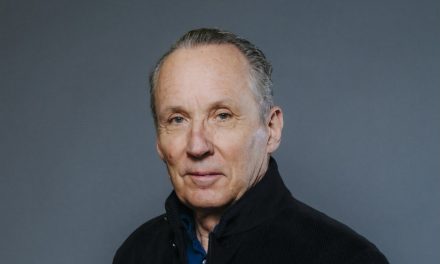
WORKING FOR GLOBAL SECURITY. Sir John Chipman KCMG is Executive Chairman of The International Institute for Strategic Studies (IISS). As former Director-General and Chief Executive of the IISS he directed its growth globally as the world’s premier institute providing facts and analysis on international security issues. He developed the IISS role as a convener of vital inter-governmental summits, conceiving and establishing two regional security institutions under IISS auspices: in the Asia-Pacific the IISS Shangri-La Dialogue hosted by Singapore, and in the Middle East the IISS Manama Dialogue hosted by Bahrain.
25 minutes read time.
You can listen to the podcast of this interview here.
Sir John Chipman, can you please tell me what came out of the recent Shangri-La dialogue in Singapore?
There were a few interesting themes and some surprises. Many people thought the US Secretary of Defence, Pete Hegseth, would come to the Indo-Pacific and focus uniquely on the Chinese threat and issue a bellicose speech. In fact, his remarks were very close to the traditional mainstream of both the U.S. Democrat and Republican Party when their Secretaries of Defence have deployed overseas. He emphasised the fact that the US was a resident power in the Indo-Pacific, that it was wishing to work with partners and allies in the region, and rather curiously, he said with a wry smile on his face, “I’m surprised that I’m saying this, but I hope all of you in the Indo-Pacific follow the European example which is to begin moving towards 5% of GDP on defence.” The Trump administration, having pressured the European NATO allies radically to increase their defence expenditure, has come to the view that they’re moving in the right direction and the Indo-Pacific allies have to do the same.
What about other surprises?
Another surprise was that the Chinese did not come at defence minister level, as they have since 2019. The consensus is that they were not certain how to comport themselves with an unknown US presence and so deployed a very low-level delegation. The third surprise was the great interest of European countries in the Indo-Pacific, despite the war that is now occupying most people’s minds in Europe. President Macron gave the keynote address and appealed to the Indo-Pacific by saying that ‘just as in Europe we need to develop strategic autonomy, so does the Indo-Pacific.’ Clearly the event displayed all the uncertainties that today’s geopolitical world offers.
“Europe’s strategic personality will be ushered in through NATO’s new spending doors.”

Sir John Chipman, Executive Chairman IISS with Kaja Kallas, High Representative of the EU for Foreign Affairs and Security Policy and VP of the European Commission, at the IISS Shangri-La Dialogue in Singapore, 2025.
Sir John Chipman, what is the link between all these geopolitical issues?
The outburst of geopolitical crises is a natural consequence of there no longer being a single country in the world that either wishes to or is able to act as a global policeman. Other states are beginning to gain their own strategic personality. There’s a lot of hedging going on among states, not wanting to be dependent on any single great power friend. Medium powers are therefore gaining a lot more room for manoeuvre. Clearly what has happened in Europe was a consequence of the Russian administration in Moscow judging that the United States had a declining will to support Europe following its rather hasty and not well-planned withdrawal from Afghanistan, and Putin decided then to take his chances with the invasion of Ukraine.
And in the Middle East? And elsewhere?
Hamas was seeing that the Israelis were beginning to gain more diplomatic recognition in the region, literally and figuratively, with the Abraham Accords, and there were rumours that a Saudi-Israeli agreement was in prospect, and therefore they decided to move rather dramatically on 7th of October. Since then there has been huge changes, including the attacks on Hizboulah and the Houthis, the fall of the Assad regime and the unilateral strikes by Israel against Iranian nuclear targets, the military command, and the scientists central to their programme.
As Prime Minister Kishida of Japan said two years ago at the IISS Shangri-La Dialogue, Ukraine today could be Asia tomorrow. He warned that unless Asian countries built up their capacities for deterrence, there might be a good deal of instability within Asia. Meanwhile no one’s paying much attention to Africa, and the Trump administration intends in effect to modernize the Monroe Doctrine with a Trump Doctrine to create a secure sphere of influence for itself across all the Americas.
So the Rubik’s Cube of geopolitics is moving, and none of the colours are happily aligning.
Is it really necessary to increase defence spending in Europe?
If we move towards 3.5% of the GDP in defence we’re only moving towards the norm of the Cold War. And this at a time when the European theatre is more unstable because Russia has conducted an invasion; the United States seems less interested in throwing all of its strategic weight behind Europe; and there are no arms control arrangements that regulate the balance of power in Europe. Recently the debate in NATO has moved towards moving from the floor of 2% of GDP of defence to an eccentric combination to arrive at 5%: 3.5% of defence expenditure directly and 1.5% in infrastructure. Europe’s strategic personality will be ushered in through NATO’s new spending doors.
What if President Trump decides to agree that Russia can take over a lot of territory?
President Trump tends to look at these crises as purely territorial questions — real estate dilemmas which can be discussed in those terms. Yet President Putin’s goal was to eliminate the Ukrainian nationality and reabsorb Ukraine into Russia. This same real estate attitude of mind goes to answering the question as to why it has been so difficult to resolve the Gaza crisis. Again, the instinct is rather about finding out how one could create an entirely new Gaza without answering the question of what sort of Palestinian administration might credibly be able to govern it as one moves towards a different outcome. What is unsettling for the region is that the US has given up on the so-called ‘two state solution.’ Many of these problems are quite intractable, and the strategic patience required to work through them is fading fast.
Will he withdraw?
As one approaches 150 days of his presidency, he’s not even close to fixing these problems that he said he would fix in a day. I doubt that he wants to be associated with a failure, so he may withdraw by saying, in the Russia-Ukraine case, “I did my best, neither side really wants a ceasefire, let them fight it out,” and in the Middle East he’ll put pressure on the Arabs to take the lead in finding a new dispensation for Gaza, the West Bank and the like. His attention might move towards other parts of the Middle East, not least Iran, where he is again trying to negotiate a grand bargain whereby Iran both gives up their nuclear aspirations and their regional proxy activity. That too will be a frustrating negotiation. It’s sometimes said in the world of strategy that Iran has never won a war, but never lost a negotiation, and that might be something that also frustrates President Trump. And there remains the risk that Israel will take matters into its own hands.
Why do the international media focus on Gaza and pay little attention to the horrors of Russia-Ukraine?
It is extraordinary that little attention is being paid to the three quarters of a million or more children that have been taken from Ukraine, mothers separated from their young ones, and the wholesale destruction of Ukrainian culture. The cultural genocide that is taking place in Ukraine has also not inspired too much comment. And within Israel, sadly too little attention paid to its international reputation. The Israeli war cabinet focused on several battlefronts – the Gaza one, southern Lebanon, West Bank, Syria, Iraq, Iran – but didn’t concentrate on the international front, which is finally the front which is most necessary for the Israeli state to prosper, and international public opinion has turned very much against Israel. Netanyahu has never been a champion of the two-state solution and is using the opportunity of this war to deal with a number of regional enemies at the same time, so the mindset around Netanyahu is ‘let’s take strategic advantage of this uncertainty and create the largest security ring we can around us.’ But his difficulty will be that international public opinion will remain very critical.
“It’s sometimes underestimated how diverse the power centres have become in today’s world. Big companies in particular, having more power than most medium-sized states.”
Sir John Chipman, is Israel becoming less strategically important in the Middle East?
There’s no question that for the Trump administration the riches of the three or four larger economies in the Gulf Cooperation Council are a principal attraction. President Trump has no special personal connection to Bibi Netanyahu, as we saw when Prime Minister Netanyahu visited President Trump in the Oval Office and President Trump waved to him to say, ‘you’ll just have to deal with my friend President Erdogan of Turkey, and you’re going to have to compromise.’ Having called Trump the greatest ally that Israel ever had, Prime Minister Netanyahu was surprised to see President Trump almost dismissive of some of his concerns. The decision taken on 13 June to attack Iran’s nuclear programme and its supporting structures, in the full knowledge that the US would not participate in the operation, shows that the Israeli leadership feels it must act to shape its strategic environment in all directions, and create ‘new realities on the ground’ to which others must submit or react.
Putin is very much dependent on China. What is your view on Trump trying to take him away from the Chinese influence?
The argument that I put to the Biden administration and that I’ve put to some in the Trump administration is that while the United States has strategically decided to tilt towards the Indo-Pacific, the Indo-Pacific has tilted towards Europe. You have not only China providing lots of technology to the Russian military, but also the North Koreans sending their own troops to fight alongside Russians in Europe. Therefore if one really wanted to limit Chinese influence, one would give much greater support to Ukraine to expel the Koreans and to show the Chinese that NATO will not allow a Russian victory in Ukraine, and therefore it’s a waste of strategic time of China to be there. Iran is also another power that’s very present in Europe. The Shahed 136 drones that rain regularly on Kiev all come from Iran, and that is why so many in the West speak of Russia, North Korea, Iran, and China all finding convenient strategic marriages to engage in. The combination of those four countries meddling in Europe is something to which insufficient attention has been paid.
What is going to happen when some of President Trump’s policies fail to deliver the result of making America great again?
One of the paradoxes of President Trump is that he engages in a lot of shock and awe diplomacy to achieve immediate successes and then when there’s a bump in the road, is content to argue that these things will work out in the long term, and one needs to take pain first and then ultimately it will all turn right. He seems to work on two very separate time horizons, the immediate and the long-term future. His mind will become more focused around the turn of the year and into the first quarter of next, when he will have to think about the midterm elections and whether he will still be able to hold the House of Representatives. As the Spring of next year approaches, the President’s priorities will turn to campaigning, and his policy promises will need to be shaped by what his base considers to be the most pressing concerns.
Who are the real superpowers in today’s world?
The first is the bond markets. President Trump had to bend to the will of the bond market. The second is the big tech companies who have an important role also in this Trump administration and whose various leaders the president is balancing. Coming back to Europe, the US technology companies are perceived as the equivalent of what the East India Company was a few centuries ago. When Meta or Google or Apple are fined by the European Union X billions of euros they just see that as the cost of doing business and then carry on. The bond markets and the tech companies have themselves quite a say on domestic and international politics and both will from time-to-time temper what happens out of political Washington. As commentators are obsessed with a focus on the personality of President Trump, it’s sometimes underestimated how diverse the power centres have become in today’s world. Big companies in particular, having more power than most medium-sized states.
If Trump wants America to be bigger and stronger why does he sometimes act in ways which make it look weaker?
President Trump is relatively indifferent to his international image because he’s only interested in his domestic image. He doesn’t place much value on international public opinion or what Europeans or others would think. He does value what other strong men think whose style he respects, so he’s happy that he can tout a good relationship with Putin or with Xi Jinping or with Modi or with Erdogan. He’s not interested in the general international public opinion at all, totally indifferent to it, and even happy to upset 48% of his own domestic opinion, so long as he hangs on to enough of it to be able to push through his ideas. If there’s going to be a real challenge to the stock market or to the cost of borrowing, he’ll adjust his policies to that, but he’s not going to adjust his policy to general international public opinion, and least of all that part of European public opinion who he sees as woke.
If the price of goods increases will even his own people like him so much?
There are some constituencies that were previously his that he’s beginning to lose. The farmers who sell soybean are very worried about the tariffs issue. Walmart telling all of its customers the reason the prices are going up is because of tariffs has an enormous effect. There’s a Walmart within 10 minutes of almost every American town, so ‘Walmart public opinion’ is important. But he’ll only change his policies if he believes that there’s a real threat to his electoral power. I return to the point that the first test will come with the midterms next year, but he still has some time to do a lot of things before he needs to adjust to ensure that he holds on to the Houses of Congress. Americans, like all citizens, are sensitive to what happens to their wallet, but they’re not very sensitive to America’s reputation internationally. The East Coast elite no longer corresponds to the identity of the United States, which is now much more rooted in that large ‘overflight America’ that lies between New York and Los Angeles; and that public opinion has always in the American mind been relatively isolationist and quite protectionist.
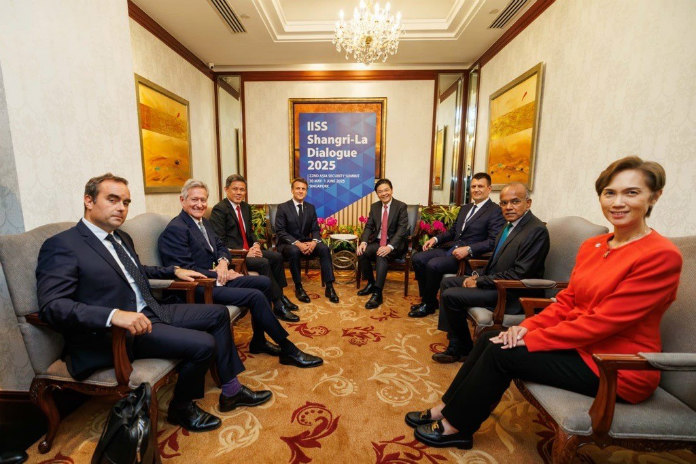
French President Emmanuel Macron and Singapore Prime Minister Lawrence Wong at the IISS Shangri-La Dialogue 2025. (To Macron’s right, Chan Chun Sing, Coordinating Minister for Public Services and Defence minister, Singapore, Sir John Chipman, Sebastian Lecornu, French Defence Minister) (To Wong’s left, Dr Bastian Giegerich, Director General and Chief Executive, IISS, K Shanmugam, Coordinating Minister for National Security, Singapore, and Josephine Teo, Minister for Digital Development and Information, Singapore)
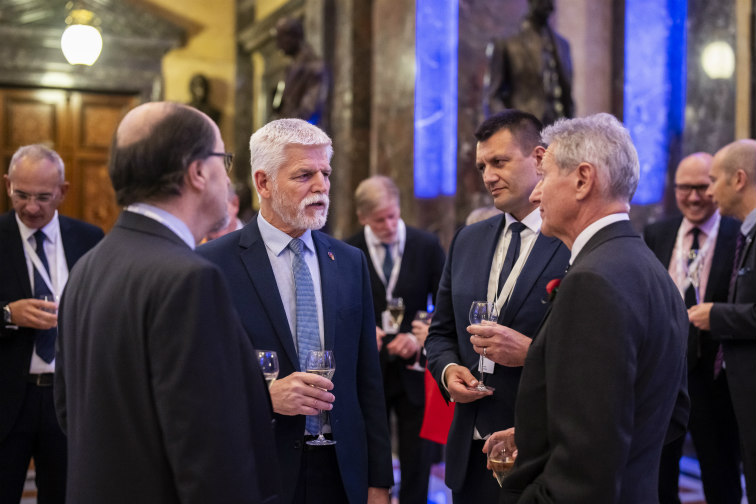
President Petr Pavel, Czech Republic, chatting to Sir John Chipman, at the IISS Prague Summit, 2025.

Deputy Prime Minister and Defence Minister Phumtham Wechayachai of Thailand, Sir John Chipman, Dovile Sakaliene, Defence Minister of Lithuania, and Gilberto Teodoro, Defence Secretary of the Philippines at the 2025 IISS Shangri-La Dialogue in Singapore.
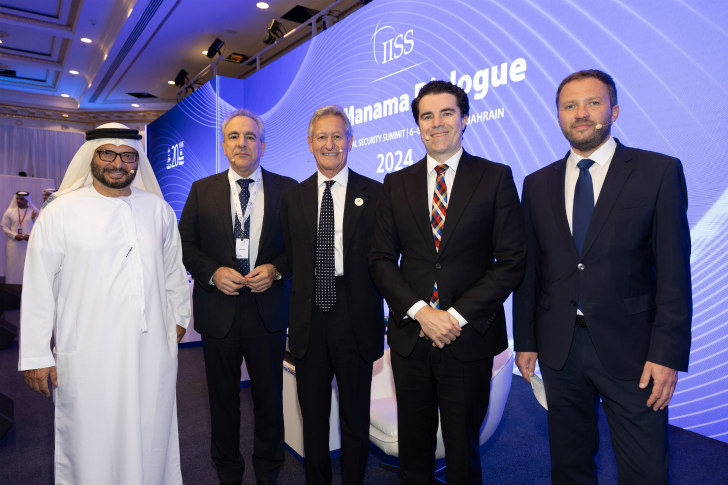
At the 2024 IISS Manama Dialogue Plenary Session on The Interplay of Global and Middle Eastern Security. Dr Anwar Gargash, Diplomatic Advisor to the President, UAE. Margus Tsahkna Minister of Foreign Affairs, Estonia. Sir John Chipman, Executive Chairman, IISS. Tim Watts Assistant Minister for Foreign Affairs, Australia. Dr Thanos Dokos National Security Advisor, Greece.

His Royal Highness Prince Salman bin Hamad al Khalifa, Crown Prince and Prime Minister of Bahrain, with Sir John Chipman at the 2023 IISS Manama Dialogue.

Sir John Chipman, Dr Bastian Giegerich and HRH Prince Turki bin Faisal Al Saud, at the 2024 IISS Manama Dialogue.
“The proliferation risk is very high right now.”
Sir John Chipman, what do you think about the fact that one way or the other this administration is fighting against the leading American universities?
This has become another element of the cultural wars, and if continued bad for the United States’ scientific leadership unless the attacks slow down or are quietly reversed. American educational leadership at the university level is so vital. You’re going to see a lot of brain drain from the United States, people who are scientists at MIT thinking about coming to Cambridge University or to Zurich or other places. You will see fewer ambitious international students choosing to risk going to an American university where their visa might be annulled. It might also be something that affects America’s technology companies, because there will be fewer Indians seeking H1B visas to go to California and work at Google or Apple if they believe that they’re treated as undesirable aliens and so they’ll maybe try to start companies in India rather than join ones already existing in the U.S. There can be no net gain for the United States from these activities, and I wonder if they can continue at this level of intensity.
Does the Trump administration not see that?
The reason why they don’t weigh it as heavily as you or I or others in Europe might is that Trump sees his presidency in part in these eccentric civilizational terms. It’s a rebellion against what 20 years ago we would call the politically correct and for the last 10 years we called woke. Recall that already last year, several large private funders of universities were withdrawing their pledges because they saw the universities as becoming too political. Therefore it is not a shock that this administration would use the pro-Palestinian protests in some of these campuses and the uncertain attitude of mind of the presidents of these universities, whether it’s Columbia or Harvard or University of Pennsylvania and the like, as an excuse for saying these are not well-governed places and they’ve become political actors rather than academic establishments. Because these liberal arts universities have become perceived as political organs who are naturally predisposed against his politics, he’s hitting them hard as if they were a political opposition, not as if they were universities.
Do we live in a particularly dangerous turning point moment of our history, or is it just another period of turbulence?
We are now in a very dangerous moment of history because the sources of disruption and violence have become various. In Europe in particular we do have a Russian enemy. We should no longer speak about Russia as a challenge or as a discomfiting power, or one whose politics are different to our own. Russia is an enemy right now, and Russia is fighting in the air, at sea, under sea, in cyber, in space, at all times. It is correct that Europeans acknowledge that they over-cashed in the peace dividend and it is necessary to move to ensure we have stronger defence and more resilient societies. That is going to be a real stretch on the welfare state in Europe that many of us enjoy and feel is morally vital to ensure the coherence of our societies, but, however shocking it might sound, we do now in Europe need to move towards a war footing. We need to build that societal resilience and those defences and the awareness in our publics of whence the threat comes from, that hopefully will deter actual war. At present, we are seen by our adversaries as weak and therefore fresh for picking.
What do you think of the UK government’s recent strategic defence review?
It is better than all the ones that have been done since Lord George Robertson did his for the Labour government in the mid 1990s. It assesses the threat correctly and it makes a couple of important statements. Firstly, that in our defences we have to look to new technologies if we are going to be able to increase our lethality and our ability to win on the battlefield. Secondly, we have dramatically to reform our procurement processes. This strategic defence review underscores the importance of heavily reducing our procurement times, and particularly in the case of new technologies bring them down to as short as 90 days. This strategic defensive review has a sense of double urgency: the need to move towards greater defence expenditure and the move towards refining our procurement processes, but it will still be constrained by the little fiscal headroom we enjoy. The UK will be challenged to move way beyond the 2.5 or 2.7 per cent it’s promised towards that 3.5 that will be set as a minimum.
What about the re-emergence of preparations for strategic nuclear warfare?
The IISS were very proud that we contributed a great deal to the thinking around nuclear arms control: how to account for nuclear weapons on both sides, how to balance asymmetric capabilities in a mutually agreed way to maintain a nuclear balance of power. Now all those arms control agreements have been abandoned, and no new ones are being forged. Meanwhile, precisely because of uncertainty of the U.S. commitment, there’s debate in many countries as to whether they themselves have to gain nuclear weapons. There’s a debate in South Korea, and in Japan. The Singaporean foreign minister recently stated that ‘we might find ourselves with five nuclear powers in East Asia soon’, and so this risk of nuclear proliferation is serious, and all the more so because some people will remember that Ukraine inherited nuclear weapons from the Soviet Union and gave up their nuclear weapons in return for a security guarantee that was not abided by. Even the most basic strategist would ask: would Russia have invaded Ukraine if Ukraine still had nuclear weapons? The answer is probably not, and therefore this idea that nuclear weapons can be the ultimate guarantor has resurfaced. Following Israel’s attack on Iran’s nuclear programme, it is likely that Iran will feel the need to redouble its efforts to move fast to an established capability. Israel may then find itself having to ‘mow the lawn’, striking again if they see evidence of re-building. If negotiations with Iran cannot be revived, then others in the region — Turkey, Egypt and Saudi Arabia will consider acquiring the nuclear option for themselves. The proliferation risk is very high right now.
Even so, in many European countries the idea of war simply does not figure in the minds of people?
There are definitely big differences in the national strategic cultures of a variety of European countries. The centre of geopolitical gravity in Europe has moved from Western Europe to Central and Eastern Europe. The countries who used to make the running were the Western European countries: UK, France, Germany, Italy, the Netherlands. The ones who are making the running now are the Czechs, the Poles, the three Baltic states, the Finns, the Swedes and Norwegians. The leaders in the Baltic States believe that there’s an existential threat to them now, because they’ve only been 30 or 40 years independent and they worry about the new Russian Empire. There is now a division of opinion within European political society between the slightly more relaxed and distant view of the Western Europeans and those who now find themselves on the front line. Within both NATO and the European Union, the arguments of those on the frontline are going to be given more and more weight. There is in Finland a strong sense that you need to be resilient and willing to go to war to defend your country; wholly different from the domestic view in Spain. A feature of our debates over the next year or two will be how much does the existential threat felt by the Eastern Europeans and the Baltics filter westwards into our Western European societies and our political cultures.
Sir John Chipman, thank you.
ENJOY THIS INTERVIEW? SHARE IT WITH A FRIEND.