
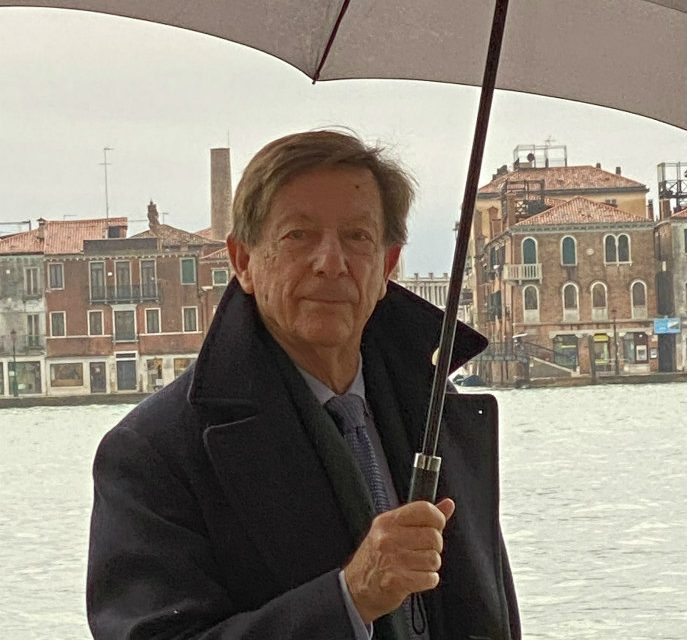
A STRANGELY HAPPY LIFE AS A CHILD. Mario Andreose was born in Venice in 1934. A prominent figure in Italian publishing, he spent 35 years at the Italian publishing house Bompiani, where he served as an editorial director and played a critical role in the Italian and international success of authors like Umberto Eco, Alberto Moravia, and Leonardo Sciascia. In 2015, following the sale of Bompiani, Andreose, along with Elisabetta Sgarbi and Umberto Eco, left Bompiani to found a new publishing house: La Nave di Teseo. His recent book of memoirs, recollections and thoughts, is titled Un’educazione veneziana (A Venetian Education) and published by La Nave di Teseo.
27 minutes read time.
Mario Andreose, why did you write this book about the Venice of your childhood, your youth, your family, your reading, and your passion for cinema?
I decided to do it because I felt a certain urgent need, first of all to retrace that past myself, and secondly to make it available to friends and readers of my previous books. Also because I came across a quote by William Faulkner, one of my favorite authors, who says: “The past is never dead. It’s not even past.”
Your book begins on June 10th, 1940, the day Italy enters the war. Then we arrive at July 25th, 1943, the fall of Benito Mussolini and fascism. You describe your childhood in a modest family; your father is a baker. You live at the Zattere in Venice, a very privileged place, but part of your family lives in the countryside. Why did you choose these two dates for the first chapters?
Because these are the dates that are most deeply imprinted on my memory. Entry into the war is certainly an exceptional and also very dramatic event. I was completely unaware of it, even though a certain nationalism, a patriotism, hinted at this inevitable conclusion. I don’t talk about it in the book, but sanctions against Italy had already been imposed. The states that would later become our enemies had already taken steps to hinder Italy’s economy with restrictions that prevented the export and sale of essential consumer goods, so there was widespread animosity against these states. On the day Italy entered the war I went out and saw the flags expressing joy because we would “finally destroy England”, which was then the main enemy. This gave me a first awareness, because they didn’t tell me these things at school. In the book I quote two verses from the Corrierino dei Piccoli, a weekly magazine for children and the newspaper of my generation. In four lines in rhyming couplets they tell us that King George of England, fearing war, summoned Minister Churchill, then known as Ciurcillone, because King George could not have made a better choice. My awareness of the war came from these sources.
“Perhaps because of my blond appearance with blue eyes, I didn’t exactly have the features of the enemy.”
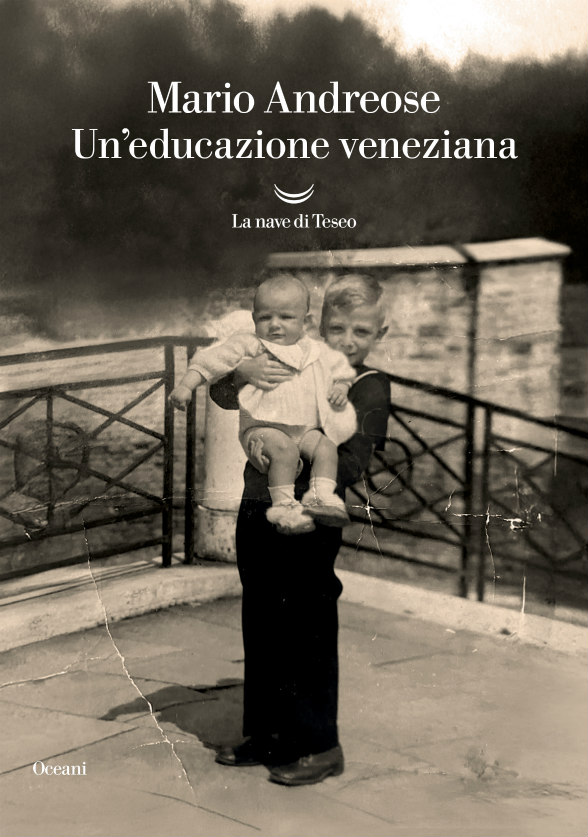
Cover photo Un’educazione veneziana (A Venetian Education)
Mario Andreose on the day of his First Communion and Confirmation, showing his newborn brother Vittorio.
Mario Andreose, the beauty of this book is that you speak like the child you were, very innocently putting yourself in your childhood shoes. You’re a Son of the Wolf, you live in fascist Italy, you’re raised very Catholic, you go to Mass all the time and serve Mass too. You follow funerals. In short, you live within the Catholic religious world assiduously. Regarding your family, you describe the poverty of that time very well, without shame. Your parents were very, very careful about what they ate…
And they were struggling for that, every day.
But in your bedroom you were already reading comics, The Mysterious Masked Man, Dick Lightning, and so on. Later, books like Cuore (Hearts), from which the story From the Apennines to the Andes comes. Then you come across Pel di carota (Carrot Head) by Jules Renard, and then Senza famiglia (Nobody’s Boy) by Hector Malot. Then, since the protagonist for three-quarters of this book is the city of Venice, your city, you describe very well how you spoke Venetian dialect at home—Italian wasn’t the language spoken. Also, after July 25, 1943, the German language and then later the language brought by the Americans. How well do you remember these transitions?
I remember them very vividly because I was there and could sense exactly what the signs of change were. For example, when Venice was occupied by German troops of the Wehrmacht following the armistice, suddenly our ally against England, France, Russia, and the United States became a rather furious enemy. Since the Wehrmacht officers requisitioned the Seguso guesthouse which was very close to my house, and I was a good friend of the owners and their son Tonino, I gladly went there because I ate excellent snacks, but I was surrounded by Wehrmacht officers. Perhaps because of my blond appearance with blue eyes, I didn’t exactly have the features of the enemy. So much so that every now and then an officer would ruffle my hair, because they didn’t see me as a potential spy. So, I saw the city change in climate, colour, and language. It would happen again at the end of the war of liberation, when Italy found itself on the side of the Allies. All this struck me and made me participate, and I took sides. Even though no one explained to me exactly what was happening, I instinctively felt a great antipathy towards the former ally, also because the Germans did everything they could to appear grim and evil.
But with the arrival of English Senior Service cigarettes, which are very different from the national ones my dad smoked…
A perfume!
…the Anglo-Americans arrive, and life obviously changes. The war ends and you live very simply, but you’re in the heart of Venice’s cultural, political, and even elegant life: the Zattere. During that period, you dive into the pool that was built on the Giudecca Canal, you go boating, you live the life of the young people of Venice.
A perpetual holiday, diving all summer long into the Giudecca Canal.
In Venice, you experienced this life of water, of the sea, as opposed to life in the countryside at your relatives’ house, in the stables where you lived in the winter next to the cows. In the midst of great political turmoil, was your life as a child in Venice strangely a rather happy one?
Absolutely. It’s privileged for one reason or another, because while I’m at the Zattere I have the opportunity to sit next to and watch the protagonists of Venice’s cultural, artistic, musical, and theatrical life, because the immediate postwar period saw the rebirth of the Venice Film Festival and the Biennale in its various forms. Everything, somehow, flowed at the Zattere, because everyone came for coffee or ice cream at the Zattere, but at the same time I had the alternative of going to my uncles in the countryside. This was a completely different world, very natural, which during the war became essential to our survival through the exchange of goods. At nine years old I carried a bag of salt—a rare commodity because Italy was divided in two and the state monopoly produced salt and tobacco in the south—with my own hands to my peasant uncles who had to slaughter the pig. I had to walk a few kilometres, but I returned with delicious salami and cheeses. The stable was also a place for reading, because immediately after the liberation, the new freedom of the press had created an almost morbid interest in crime news, which had been prohibited under fascism. Intelligent publishers had begun to publish specialised periodicals with significant titles such as Crimen or Giallo nero.
Your passion for noir began there. But before arriving at your literary and cinematic passions, you survive a very serious childhood. You and your siblings contract diphtheria, and your twin brother, Vittorio, sadly dies, as does your sister Annamaria. Your mother and father have two more children, whom they name after your deceased siblings, and a wealthy aunt protects you, both from the disease and later. When you make your First Communion she gives you a beautiful sailor suit, which you are portrayed wearing on the cover of the book. At her house you eat very well, with porcelain and magnificent tablecloths. You’re in touch with another world. One gets the impression that you’re a very special child, bridging so many different realms, both historical and personal?
Yes. I must say this was very gratifying, primarily because I had an alternative, albeit not a permanent one. It was like living two different lives. When I was at my aunt’s house I felt comfortable, and recognised myself in that environment. I liked eating well, having silver cutlery, and certain customs, such as the use of seltzer, which was even added to a finger of wine for the children, a foretaste of the spritz I would drink as an adult. Growing up in that environment also helped me in my future choices, in gaining a greater capacity for discernment.
When you were a child your family was friends with Arrigo Cipriani’s rich aunt and you wore his hand-me-downs.
He was two years older than me, so as he grew older I received almost new or barely used clothes.
“An aunt, lowering her voice, explained to me: “You can’t go anymore because she’s Jewish.” This was my discovery of the racial laws in childhood.”
Mario Andreose, in your early youth, you hung around the legendary Harry’s Bar, where people like Orson Welles and Hemingway hung out. You wanted to see all these people and were curious about cinema, started watching films. The book also details your relationship with America, discovering American literature with Faulkner, but before that, Hemingway, Fitzgerald, Steinbeck and other writers. Then you give a long description of Russian literature, which was all the rage in those years, and you recall a question many people asked you: Tolstoy or Dostoevsky? You also portray characters from both War and Peace and The Brothers Karamazov very well, and you identify with some of these characters yourself, just as you identify with the protagonist of Thomas Mann’s The Magic Mountain. You enter European and American literature, and the same happens with cinema, and with theatre, and also with music. From a young age you have this contact with culture, and it’s Venice that by chance leads you in this direction?
Especially because the war had prevented us from learning about the art and literature of enemy countries. America, France, and Russia were enemy countries, so neither literature nor cinema were available to us. Even German literature and cinema were lacking, because the great artists and writers were either Jewish or opposed to the regime, like Thomas Mann. Thus, my curiosity, my interest, my hunger I dare say, for these worlds—which I witness, as you said, in those chapters—stemmed from the fact that freedom meant having access to a whole world that had previously been denied us. And furthermore, I must say very wisely, the United States had established an institution in Italy’s major cities called the United States Information Service, with a library in beautiful, heated offices, where they even offered you a drink, and so I had access to all the North American literature I had previously been unfamiliar with. Film festivals had resumed immediately after the war; we went to the Lido, I snuck in everywhere and saw all the films without paying. As for the theatre, I was part of the claque at La Fenice. I was invited to attend performances to clap my hands according to the organisation’s instructions, and so I saw premieres I could never have imagined. I mention in the book the world premiere of The Rake’s Progress by Igor Stravinsky; I saw Peter Brook’s Shakespearean Titus Andronicus with Lawrence Olivier and Vivien Leigh; I attended the first exhibition of Peggy Guggenheim’s collection, designed by Carlo Scarpa, whose design I had overheard in an ice cream parlor on the Zattere, where Scarpa himself and his assistants explained how Peggy Guggenheim had asked him to design this installation for a pavilion at the Biennale. I had learned about it beforehand and attended the pavilion’s inauguration at the 1948 Biennale.
You’d already read the books that would later haunt you: Don Quixote, The Betrothed, the works of Verne, Salgari, and then the great Russian novels. But there’s a chapter called Sentimental Education where you talk about your relationships with your girl schoolmates. You fall in love with a girl named Andreana, who comes from Alexandria, Egypt, and lives in a strange apartment. You become very close to her, but then your family forces you to stop seeing her.
I was devastated because I really liked that little girl, who in my eyes had an exotic charm. Her house was beautiful, full of rugs and sofas. As always, afternoon treats were very important, but I had a role, one that the usual Aunt Nana, who was a friend of her family, had arranged for me: I was a sort of free-time instructor for this little girl. We were very close. I remember that when we played puzzles, she was better than me. She would take my hand and squeeze it to help me put the little piece of cardboard in the right place. That handshake touched me deeply. So when at home they suddenly told me, “You can’t go there anymore,” I just didn’t understand. I almost wanted to cry. No one said anything to me. I insisted, and after a while, finally, an aunt, lowering her voice, explained to me: “You can’t go anymore because she’s Jewish.” This was my discovery of the racial laws in childhood.
Then there are other stories about other classmates, guys. There’s a chapter dedicated to the two cycling champions, Gino Bartali and Fausto Coppi. Your relationship with cycling is strange for someone from Venice, a city where it’s not easy to ride a bike. It was the era of these two champions, with their adventures and victories in the Tour de France, the Giro d’Italia…
They were the heroes of our time.
…told by Gianni Brera, a great sports journalist who would later become your friend and whose book you would also publish.
It was an era of great dualisms. We kids sitting at the Zattere always had two champions to compare ourselves to: Bartali and Coppi, Tolstoy and Dostoevsky, Hemingway and Fitzgerald, Marilyn Monroe and Ava Gardner, Gina Lollobrigida and Silvana Pampanini, and of course Sartre versus Camus. In short, we were always projected into a dualism that allowed us to discuss, to compare, perhaps even engage in a verbal duel.
At a certain point in your youth you lose your faith, become secular, and are unsure what to do with your life. One of the few things your father allowed himself was to buy the Gazzettino newspaper in the morning, and you end up thinking you could become a journalist. In those years, the great emerging Italian newspaper was Il Giorno, a Milanese paper that many writers and intellectuals contributed to. So you approach the editor, who is in Venice at a festival, and say: “I’d like to write for your paper.” From that sentence begins the adventure of your life and your work, because from Venice, this Venice so beloved, so well known, so experienced as a child and a young man, you will go to Milan.
Yes, and there, as often happens, my mission fails. When I go to the address the editor of Il Giorno had given me, he isn’t there, and I speak to the theatre manager, Roberto De Monticelli, father of the philosopher Roberta. He welcomes me attentively, listens to me, and says, “We’ll let you know,” which is a common formula. Except that I had proudly burned my bridge behind me a bit and I didn’t want to return to Venice with a failed mission. I was fortunate to experience a Milan of the era when all you had to do was sit down at a café or at the Bar Jamaica in Brera, and you’d immediately chat with young people who were themselves writers or aspiring writers or painters—a lot of painters—photographers; it was the era of Ugo Mulas. Above all, there were many publishing house collaborators, who did proofreading and other tasks, who introduced me to Feltrinelli, to a woman who was Spinazzola’s wife, with whom I began to collaborate, proofreading. I specialised in compiling indexes of names, or analytical indexes which are even more demanding, and so I made ends meet. Back then, life wasn’t expensive. A friend would put me up, but in the meantime I was beginning to learn about the book trade, since the newspaper hadn’t welcomed me as I’d intended. I came in to learn. My familiarity with the Italian language, my studies, and so on, made me well-rounded and prepared to tackle that kind of work.
Between English and French, you chose French, which you spoke better, as your main foreign language. This would later come in handy when you moved from Feltrinelli to Alberto Mondadori’s publishing house Il Saggiatore, where you started out as a proofreader and then worked your way up to editorial director. But within Alberto Mondadori’s extraordinary publishing house, you also worked as a translator.
I translated, among others, The Second Sex by Simone de Beauvoir, which is still in the Saggiatore catalogue.
And there begins your life in the world of book publisher, which will lead you to an important role at Saggiatore. Then you move to Bompiani, then to the Fabbri group, with many publishing houses, then to the Rizzoli group. You deal with everything: literature, art books. But at a certain point—you describe it in the book—after a while in Milan, you buy a Fiat 500 and drive back to Venice.
For me, driving a car is a kind of imprimatur of a new phase in my life. I got my licence late, as Venetians generally do, not having the opportunity to drive. I got it in Milan when I was already in my thirties. I remember driving through the tunnels near Vicenza. I experienced it as an initiation, like emerging from a womb and entering my city in a new guise, like someone who owns a car and can visit his uncles in the country in a totally different guise. It was an important transition that reconciled me with my abandoned city.
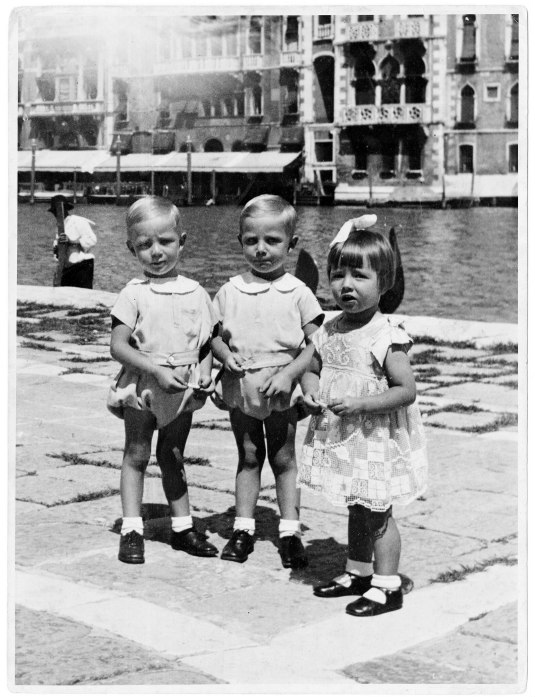
The three siblings
From left: Mario, Vittorio, and Annamaria in a photo, I was told, taken by the Duke of Genoa, who seemed to like us very much. Within a few months, I would have been left alone.
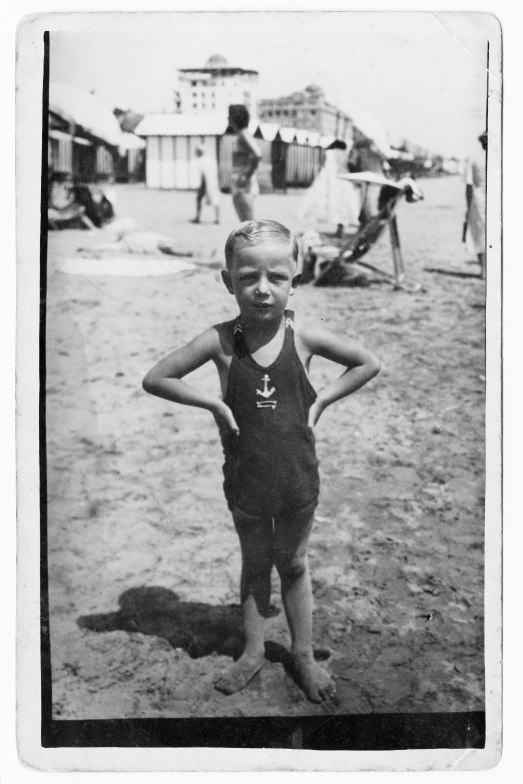
Mario as a child at the Lido in a swimsuit
Survivor. At the Lido, hands on hips à la Mussolini, I am ready to become a “child of the she-wolf,” if only I manage to get a bit stronger. The one-piece wool swimsuit takes a long time to dry, and if I sit or lie down, it remains soaked with sand for a long time.
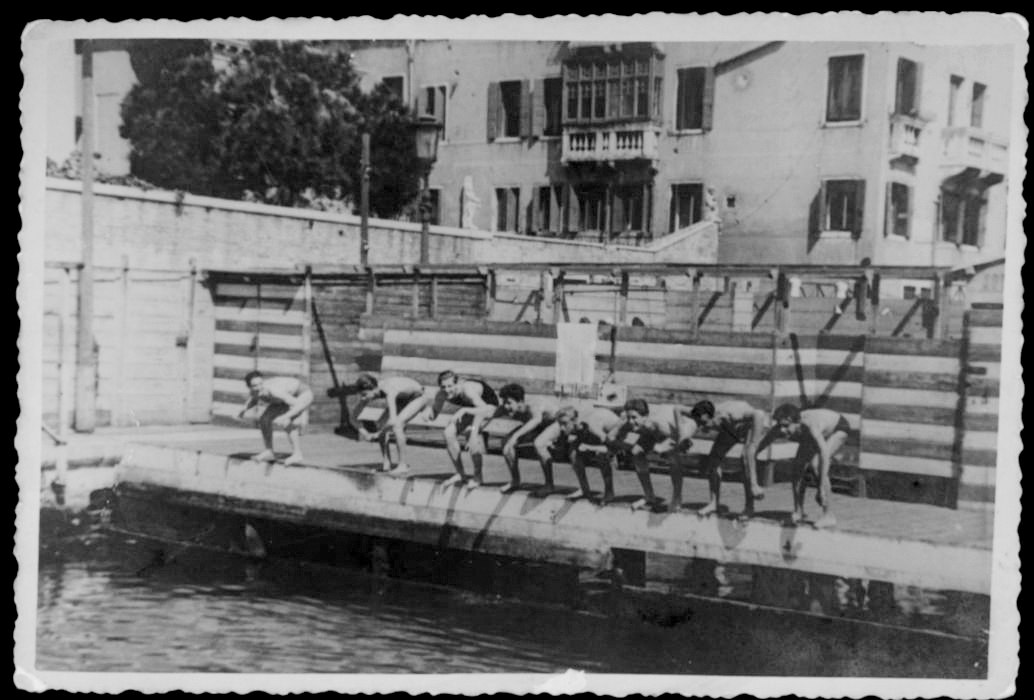
Piscina Passoni
Venezian swimming club, also known as Piscina Passoni. The start of a race.
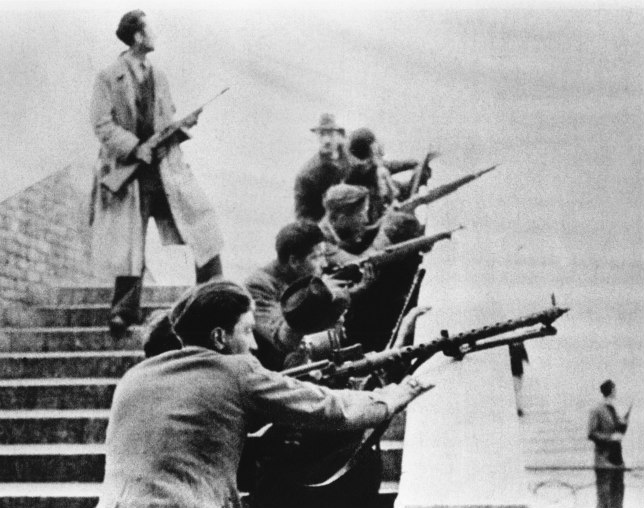
Partisans in Venice © DUfoto/Foto Scala, Florence
On April 25, 1945, simultaneously with the Allied troops, armed partisans appeared, of whom I had heard my antifascist uncle speak. Still, their weapons were silent, as by that time the Germans had already abandoned the city.
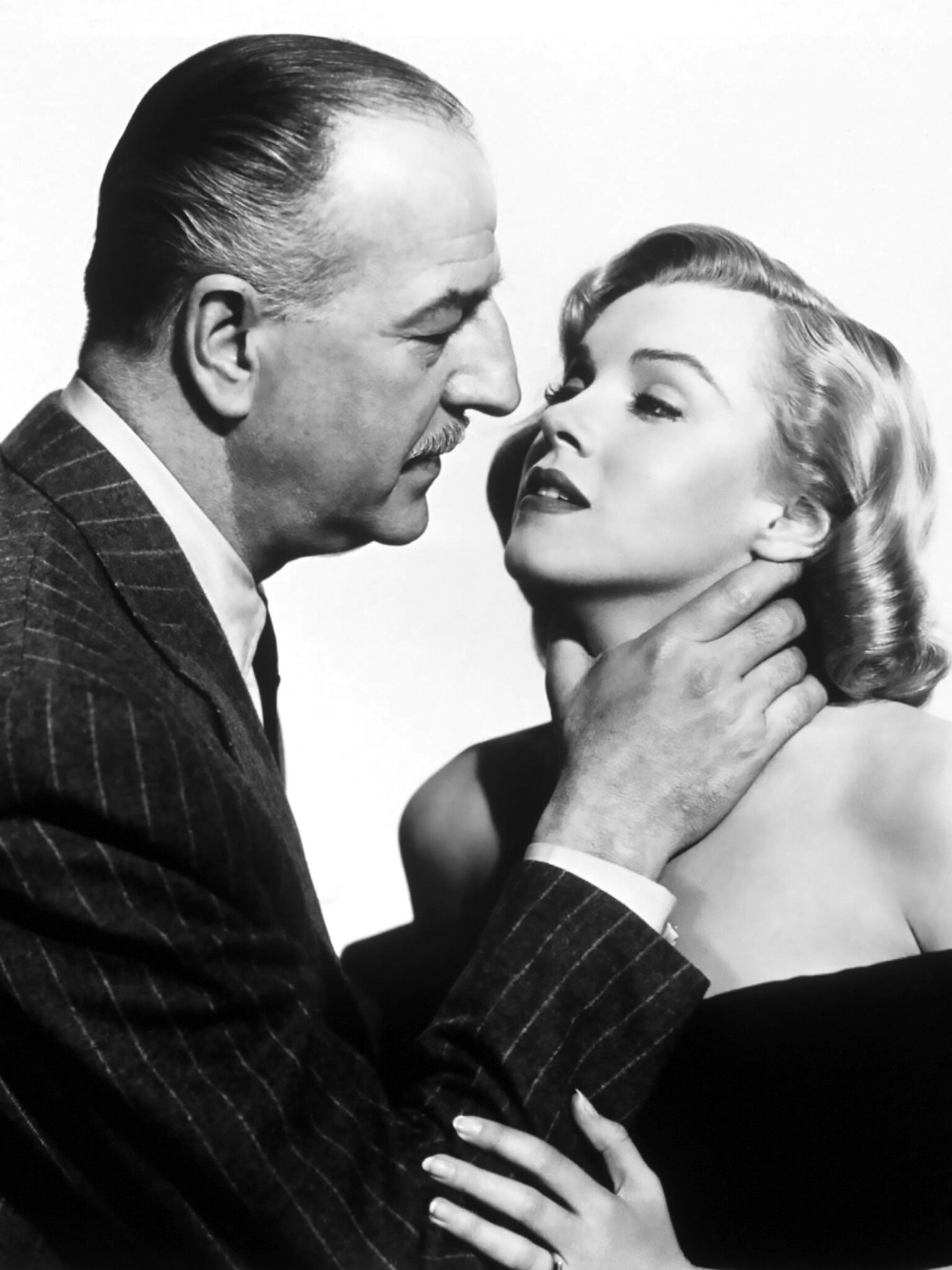
Marilyn Monroe and Louis Calhern in The Asphalt Jungle. © Pictorial Press / Alamy Photo Stock
Marilyn Monroe and Louis Calhern in The Asphalt Jungle by John Huston, 1950. This is where the character of Marilyn as the “dumb blonde” begins, although from the magnificent biography of her life by Joyce Carol Oates, Blonde (La nave di Teseo, 2021), we learn that “she was neither blonde nor dumb.” Among her films, I preferred the musicals, for the tone of her voice, almost childlike, mischievous, ironic. Like Gentlemen Prefer Blondes by Howard Hawks (1953), with Cole Porter hits, and Some Like It Hot by Billy Wilder (1959). Chilling, in hindsight, was her shaky performance singing birthday wishes to President Kennedy on May 19, 1962. She would die shortly after, on August 4.
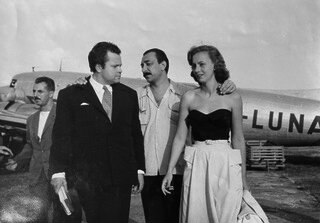
Alberto Mondadori, Virginia, and Orson Welles
Alberto Mondadori and his beautiful wife Virginia welcome their friend Orson Welles at the Lido airport, 1951. Sebastiano Mondadori, in his biography of his grandfather (Verità di famiglia, La nave di Teseo, 2022), recounts that one morning, Virginia, having met Orson in the Excelsior elevator, arrived significantly late for her appointment with Alberto at the bar.
“For me, the book was created to recount my Venetian years up until adolescence.”
Mario Andreose, you find yourself in a different guise because you’re now a successful man. There are some beautiful images. You see Alberto Mondadori walking by arm in arm with Hemingway or Orson Welles, you go to Harry’s Bar… In short, you enter a different world, one that as a child you gazed at with curious eyes, without even thinking you’d enter that world…
I couldn’t think of it.
… but suddenly you’re part of it.
It was almost a premonition, perhaps, sometimes.
You meet Emilio Vedova on the Accademia Bridge, a friend from the past, and you realise you’re also friends with writers, with people from the worlds of literature, entertainment , cinema— which becomes your world—and art above all. Because then you return to Venice, to Palazzo Grassi.
Palazzo Grassi was a wonderful twenty-year adventure, with exhibitions that drew crowds from all over the world. Back then these exhibitions had a level of attendance and sales of the catalogues I published that would be unimaginable today. At the inaugural exhibition on Futurism, conceived by Pontus Hulten, one hundred thousand catalogues were sold, which I published both in Italian and English because they were also for tourists. Having relived my professional experience in Venice, in places closest to my context and thanks to my training—well, that was a wonderful celebration.
In the book you recount not only the Venice of your life as a boy, but also the architectural evolution of Venice, from the arrival of the Bauer Hotel to the new wing of the Danieli Hotel, with these modern buildings that fit into the city’s skyline.
Terrible. Terrible. In Venice, there has always been a great jealousy over maintaining its identity, but when the Grandi Alberghi Company got involved, it did what it wanted. They even denied the construction of a new building to masters of architecture, to defend its identity. They didn’t allow Frank Lloyd Wright to build a new building precisely because of this strictness.
You mention Peggy Guggenheim, Vedova, Hemingway, Orson Welles, actors, people who are part of the mythology of Venice, Harry’s Bar, Cipriani. Why is Ezra Pound missing?
Because Ezra Pound came later. He lived at the Locanda Montin with his daughter. But during my childhood or adolescence he was still in Paris or America. He hadn’t yet come to Venice. I glimpsed him as an adult when I returned to Venice, but he wasn’t there in my day.
You don’t say “My parents” but “The health of my parents,” which is very poetic. You talk about the health of your mother—who, by the way, is quite strict with you—whom you are very fond of, and of your father. Why do you describe your parents through their health?
I chose health because I always saw them in poor health. When my mother lost two children in the space of six months—my twin and another little girl, Vittorio and Annamaria—she had contracted chronic bronchial asthma. As a child, I would hear her wheezing at night, and sometimes I would get up to check on her, only to see her standing by the window smoking a cigarette with a sweetish taste, which at the time seemed to be helpful for asthma, which I think closely resembled some contemporary drug. Unfortunately my father drank, because as a shopkeeper he was constantly visited by passing policemen and friends saying: “Let’s go for a glass of wine.” It was something that, when it became a regular occurrence, didn’t exactly do him much good. So my parents’ health was the leitmotif of my relationship with them. I helped them as soon as I could.
You have not denied anything about this transformation from a child altar boy in fascist youth organisations to an adult life that spans all the events of the war. Is your book essentially sincere?
Yes, and it is told in the present tense, therefore alive.
Then the important things you’ll do in life, the professional meetings with publishers from all over the world, your very close friendship with Umberto Eco, the fact that you were Alberto Moravia’s publisher for years, and so on, even the bond you had with Elisabetta Sgarbi, whose professional mentor you were in some way… Why do you rarely talk about these?
Because it’s a different season. I stopped when I left Venice. In the final chapter, on my return to Venice, I evoke what you also highlighted, some of the milestones in my professional life, especially those involving Venice, like the Palazzo Grassi. But that’s the final chapter. For me, the book was created to recount my Venetian years up until adolescence.
There’s Venice, your city, your Venetian dialect, which isn’t Venetian but something else entirely. When you go to Venice today, what remains of everything you’ve remembered in this book?
Unfortunately, going to Venice today is difficult, both for reasons of age and because many of my peers have followed my professional path, albeit on different paths, outside the city. In Venice, you couldn’t work except in the liberal arts, as a lawyer, teacher, doctor, or selling Murano pearls or Burano lace; otherwise you had to go and work elsewhere. So I hardly see anyone from my generation, and when I return I talk more with new friends, perhaps with some author I’ve acquired in the meantime who still lives in Venice. For me, however, from the perspective of belonging to Venetian civilisation, it certainly hasn’t vanished.
Being a Venetian child is a very special thing. What is clear from your book is that in this city, regardless of whether there are Germans, fascists, Americans, or Communist or Christian Democrat administrations, the Venetian child is free.
Absolutely.
He goes alone, he wanders around, he jumps into the water, he gets on a boat…
…and talks to anyone. At the time I’m writing about, Venice had 180,000 inhabitants. Currently it has 50,000. So even from a livable perspective, such a concentration, such proximity, made communication easier. From the greengrocer to the fishmonger… you could find the countess, the lawyer, the soldier, the beggar right next to you waiting for a coin. And everyone would talk together, unaware of their background, the abysmal distances between their social classes.
In fact, you often have a transversal existence, moving from one world to another: from the bourgeoisie and intellectuals, to farmers and simple folk. This eclectic, free way of living is palpable. Thank you for sharing your Venetian upbringing with us. We look forward to your next book, in which you’ll tell us about the famous publisher Mario Andreose, who has had the privilege of being the publisher, friend, and advisor to some of the greatest Italian and foreign writers throughout your career, which continues today as president of the publishing house La Nave di Teseo which you founded with Umberto Eco.
And with Elisabetta Sgarbi.
Your desire to be a journalist hasn’t entirely faded, as you’ve been contributing interesting articles to the Sunday supplement of the financial newspaper Il Sole 24 Ore for many years. Thank you, and best wishes for your book.
Thank you. See you soon.
Lead portrait of Mario Andreose: Courtesy La nave di Teseo editore
ENJOY THIS INTERVIEW? SHARE IT WITH A FRIEND


