
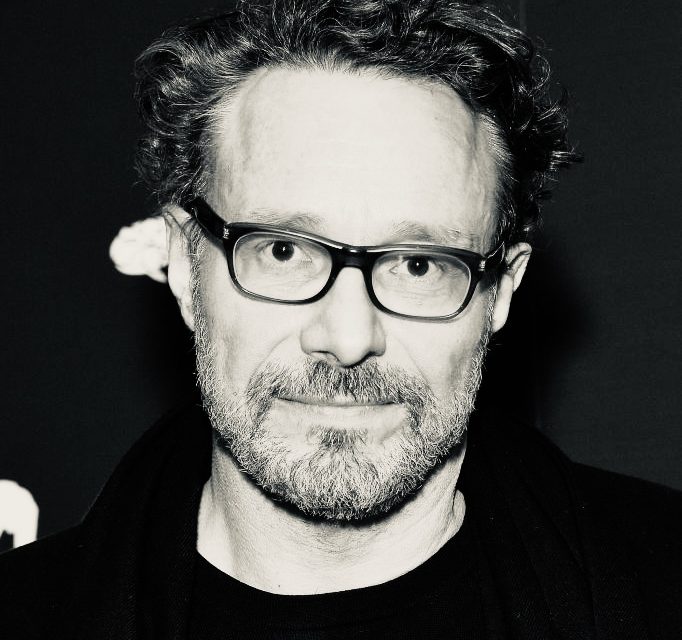
PIONEER OF VIDEO ART AND CULTURE. Marco Brambilla is a leading figure in contemporary video art, internationally recognised for his pioneering use of digital imaging technologies and immersive moving image installations. The Italian-born Canadian artist and film director is best known for work that re-contextualizes archival imagery into visually elaborate, often satirical spectacles that explore the excesses of contemporary culture. His work has been exhibited at numerous major global institutions.
22 minutes read time.
You can listen to the podcast of this interview here.
Marco Brambilla, why did you stop being a film director after great success in Hollywood and decide to become an artist?
I moved to Hollywood when I was 23, and made my first feature film when I was 29. The movie was called Demolition Man (1993), starring Sylvester Stallone. It was early for me to be working on such an ambitious project, and I was unprepared for the amount of collaboration that goes on in a major movie studio with a large 70- million-dollar budget. I wasn’t prepared to make such a commercial film for my first outing, the films I’d made prior to that were all very experimental personal films.
Have you always wanted to be a filmmaker?
Yes, and I’ve been a filmmaker since I was 14 years old. I was making esoteric experiments in film and then this opportunity came up which seemed too good to pass up. After having finished Demolition Man I was exhausted, and disenchanted with the lack of creative control that one has working in that system. Spending that much of other people’s money, you sacrifice a lot of creative control. Subsequently I decided this wasn’t for me, moved to New York and had my first gallery show.
“In the 1980s Francis Coppola famously said that at some point he would be able to dictate his films and out will come Lawrence of Arabia.”
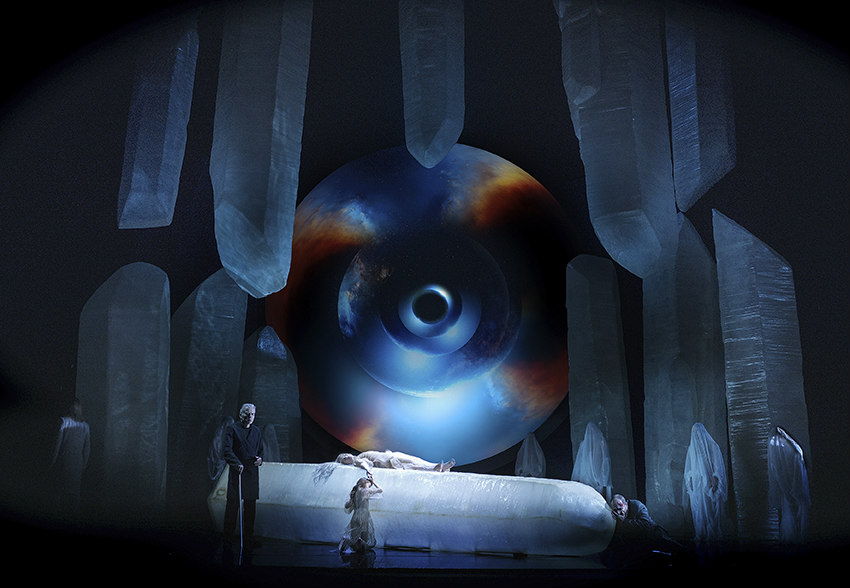
This 2025 production of Debussy’s only opera, Pelléas et Mélisande, presents a new concept of abstract staging where the entire scene is formed by a concave mirror, creating the impression of being inside a silver eye ball. Commissioned for Opera Vlaanderen, Brambilla’s staging employs surreal celestial imagery to craft a
metaphysical journey through themes of loneliness, violence, drama, resolution, and death. The abstract video backdrop transforms the opera into a psychological portal, immersing viewers in the subconscious realms of its characters.
Marco Brambilla, how long did you stay in LA?
For about eight or nine years and, as one does in Los Angeles, I developed many projects. Snow Crash was based on the Neal Stephenson book which first coined the terms ‘metaverse’ and ‘avatar’. We worked on Snow Crash for four years. I also worked on Face/Off, a film that was made later with another director called John Woo, with Nicolas Cage and John Travolta. I developed probably ten or twelve films, but for different reasons out of ten films only one usually gets made, so it’s also a very frustrating process that depends on which movie star is available, who is interested, the financing, the distribution. There are so many factors involved that you’re not working all the time, so I found it quite frustrating. I already started to shift my focus into making personal projects while I was in Hollywood.
Were these personal projects movies?
No, I was working with a smaller canvas. It was invigorating because they were more experimental, and I was able to use all the knowledge I learned making films, with special effects, with directing actors, on personal projects. I started doing that in Los Angeles, and then in 1999 I decided to move to New York.
Like many other artists you also had good training from your experience in the advertising world?
You could say it’s a good training, but it also contaminates the way you communicate. There’s an element of commercialism that becomes part of who you are if you work in advertising, as many artists, such as Yorgos Lanthimos, a famous film director, have. You could argue that Andy Warhol was always in advertising! For me it was interesting, and in advertising in Canada at the time we were shooting 30 second commercials that were all based on films. Canada was based on the British advertising system, where the commercials were being made by Ridley Scott, Howard Guard, Hugh Hudson. These commercials were cinematic, so you were making many films.
In fact, your career really started in Canada?
Yes, I had the credentials to be offered the film based on my commercial career, which started in Toronto, Canada, where I grew up. At that time, one week I would be making a pirate film for an airline, the next week making Blade Runner for a candy bar. Every week you’d be shooting a completely different genre. From my early childhood I’ve always been completely fascinated by film and by the language of cinema, so it was a way to experiment with many different genres at the same time.
Then you turned this experience into art?
Let us say it became more about self-expression. I knew what I wanted to say. My artwork has always been about our relationship to technology in the world, our relationship to the shifting patterns of the world which are now accelerating.
Have you always been excited and interested by the new technology?
Yes. In 2002, for one of the first pieces I made, I was the first artist to use the type of computer graphics that one finds in video games, and for a week I shot a work in a small town in California where they had actual street violence based on what was going on inside this multiplayer video game. We showed that at the New Museum in New York, and as part of that work I lectured about the idea of being immersed in this kind of alternate reality, which I also investigated when I was developing Snow Crash. Then I was the first artist to use LiDAR technology, an architectural technology that scans buildings. I made a piece titled Anthropocene for the Art Production Fund in Time Warner Centre in 2013 where we scanned all of Central Park with LiDAR, and then we sent sound waves from the city of New York through Central Park, creating these ripple effects inside the Park. Those were all brand new things at the time.
“I thought it was appropriate to imagine a world which is not chronological, not geographic, but could only exist in the mind of a machine.”
Marco Brambilla, you worked in New York, and then you worked all over, in China, in Germany, Belgium, France, in many countries?
Yes, I started in 1999, so I’ve had quite a few shows, and I was lucky enough to be collected by institutions. At the beginning the Museum of Modern Art bought one early work and then the Guggenheim had another work. That was very important to get the kind of reputational credential one needs to be taken seriously. But I also make a lot of site-specific work, so I’ve done public art projects with venues.
Recently you did Approximations of Utopia in Times Square in New York and Heaven’s Gate in London. Is this a kind of story-telling with millions of images?
The Megaplex series started as a reflection on my own background as a film director and witnessing the takeover of spectacle in cinema. The idea is that spectacle has overtaken content in mainstream cinema. I’m not talking about independent cinema, which is still quite interesting, but in mainstream cinema one could say that there’s interchangeable storylines and scenarios. Netflix is a prime example, where you have eight versions of the same film on Netflix. I wanted to make a work that would speak to that, and in doing so I wanted to create a kind of hyper-spectacle, so I sampled hundreds of films and I created loops of characters, and created a thing called a video collage that hadn’t been done before. The first one was made in 2006, and since then I’ve made four. They’re very labour-intensive to make, and it becomes a stream of consciousness project, putting it together with my own knowledge of film. Sometimes you remember something that didn’t really exist that way, and then it leads you in different directions, so it’s an exploration of my own past and my own relationship to cinema, but it’s also a commentary on how oversaturation of images removes the idea of an image. Heaven’s Gate has now been shown in eighteen spaces all over the world; the next show is in Taiwan, and then there’s a few others. It’s a video collage that superimposes a Renaissance theme based on Dante’s Purgatorio. It’s at the seven levels of purgatory, but expressed through pop culture.
Although an artist, you seem also to be a kind of engineer or technician?
That comes from my background, which I’ve never forgotten. Making film and working with very early special effects has always been there like a hobby, researching what the latest technology is. Approximations of Utopia is based on World Expos, which are based on the promise of technology giving us a better future, and I decided to use artificial intelligence for the first time because I thought it was appropriate to imagine a world which is not chronological, not geographic, but could only exist in the mind of a machine. AI was a technology that was just starting back then when I made that work, and it informed the concept of the work. Sometimes you use a technique that will help communicate the very genesis of what the work is about. This work is about how the future that was promised to us by these utopian World Expos never quite came to fruition, never happened.
You just gave a lecture about AI and your feelings about it. In a few words, what did you say?
Perhaps artificial intelligence will give us a version of a future over which we may not have agency. We may not have control. There were a lot of questions. The Google engineering team that develops their new AI tools was there, and they asked me what I find interesting about using AI and how it affects an artist’s process. I said that at this point I don’t think it’s terribly interesting, because we’re in the kind of George Méliès phase of this technology: it’s not really sufficiently developed. It will become more interesting when it can be disrupted, when it is commonplace enough for people to be familiar with it, and then you can add an element of disruption to the technology.
Do you have a positive attitude vis a vis AI?
I don’t have a positive or a negative attitude. It allows people who would not ordinarily have access to being able to express. You could find a new D.W. Griffith! Maybe there is a kid in a basement in Cincinnati dictating a film, and we may see that film and think it a masterpiece. In the 1980s Francis Coppola famously said that at some point he would be able to dictate his films and out will come Lawrence of Arabia. Two years from now, even today, you could theoretically dictate what you would like to make.
Are you going to use it?
No, not at all, because I actually enjoy making images. For me to delegate that to a technology removes the pleasure of what I do, but I think it’s very interesting, and that it’s something that as people learn to subvert it, to use it in an experimental way, the same way Marcel Duchamp painted a nude descending a staircase inspired by Eadweard Muybridge’s photographs, there’ll be something interesting that comes out of this, maybe in a couple of years, maybe in 10 years.
Are you always interested in what is coming?
Yes, and AI will force people to think more conceptually too, which is also interesting, because many crafts will be rendered obsolete by this, and when some practices are replaced by this technology that allows you to visualise things through dictation it will force people to think more conceptually, to think about what the concept is as opposed to just the execution of the concept. AI is just an executional tool, and it doesn’t look into the future. It looks into the past and relies on archives that exist. You could argue that if Picasso was looking at everything that had happened before, AI could never generate something that has never been done before. It will approximate it. It will throw a shotgun approach at everything, but the idea of disruption, the idea of innovation, that’s still conceptual and still human.
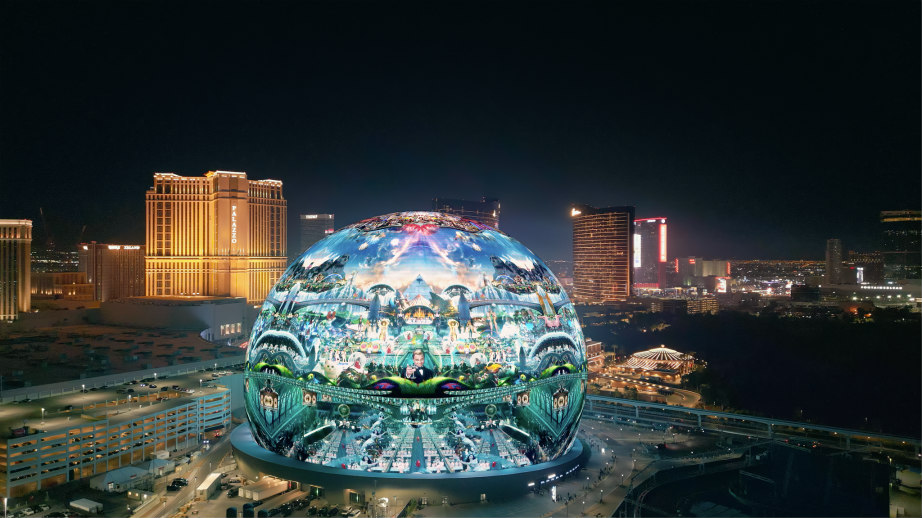
Marco Brambilla’s Heaven’s Gate is part of the Megaplex series of video collages (2021-2025), presenting an explosion of visuals that engulfs viewers in a kaleidoscopic dreamscape.
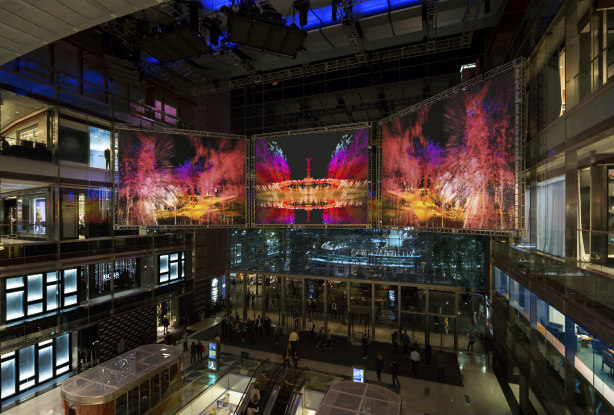
Anthropocene (2013) is a site-specific video installation that visualizes the dynamic between the natural and man-made. Exploring the relationship between New York’s Central Park and the surrounding city, Brambilla employs advanced technology LiDAR, scanning to digitally map the terrain, presenting a surrogate view of the geography within and between these spaces.
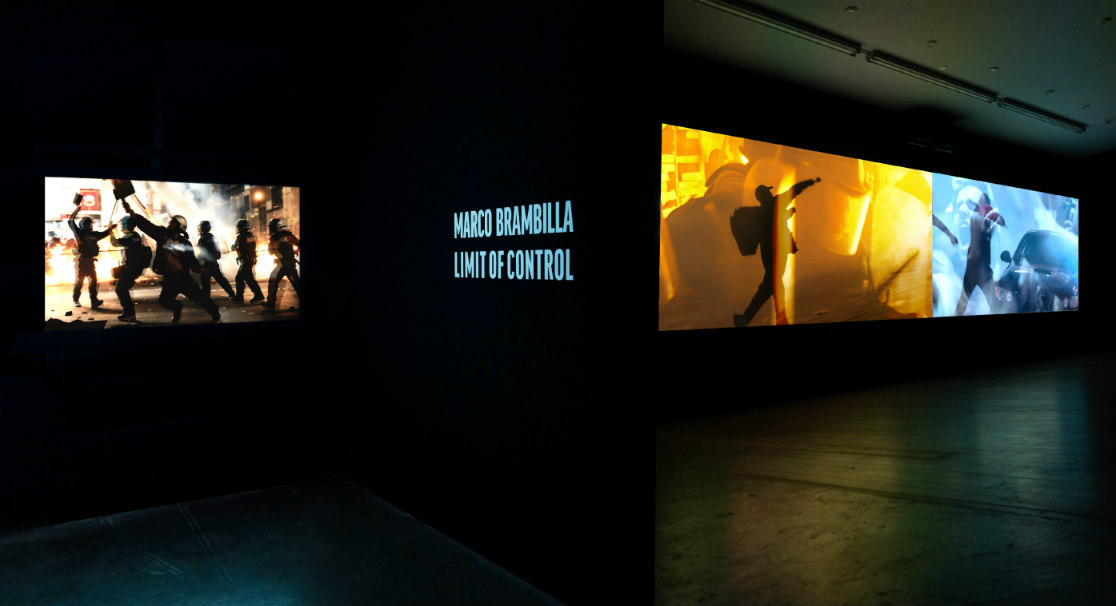
Marco Brambilla’s Limit of Control (2024) examines the convergence of media spectacle and political unrest in contemporary American culture. Using sampled clips from Hollywood films and news footage, Brambilla constructs a non-linear sequence that mirrors the visual and rhetorical structures of the 24-hour news cycle.
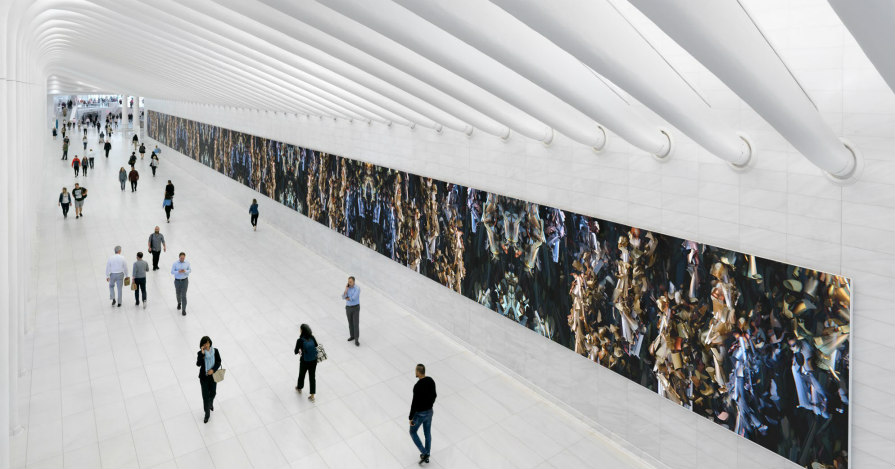
Brambilla’s Nude Descending a Staircase No. 3 (2019) is a kinetic interpretation of Marcel Duchamp’s seminal 1912 cubist painting. Employing digital technology, the work re-envisions the illusion of movement as layers of figures cascade down an unseen stairway, expanding the original’s exploration of motion into the dimension of time.
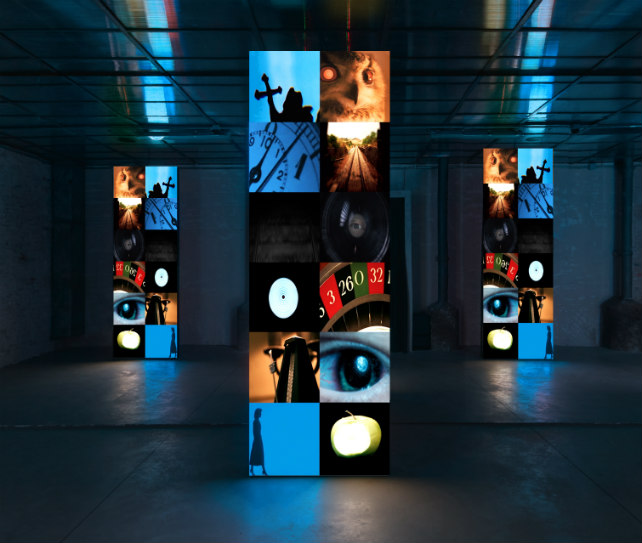
Marco Brambilla’s Flashback (2025), a hypnotic video collage of archival footage with pop culture imagery, is inspired by the subliminal messaging of 1970s advertising. In this work, Marco Brambilla blends historical references with cinematic tropes, investigating Freudian associations ranging from childhood memories to adult desires.
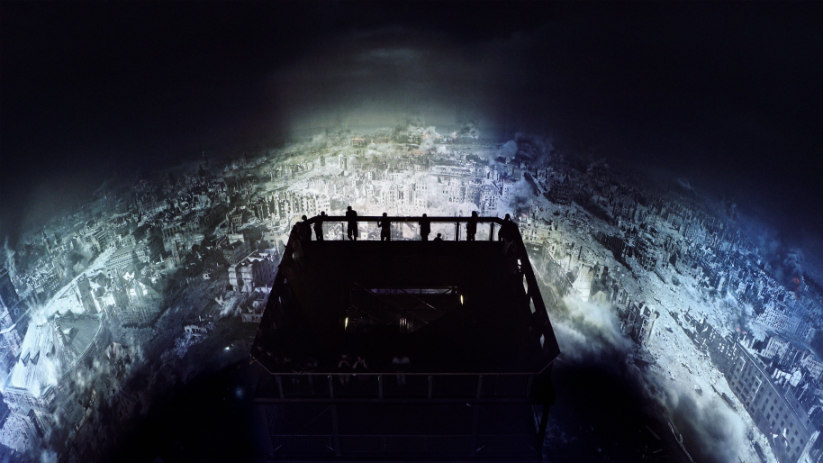
In Dresden (2025), Brambilla unveils a multi-channel video installation that juxtaposes the harrowing aftermath of the 1945 bombing of Dresden with contemporary imagery, exploring the transformation
of collective memory in the digital age.
“If you make things that can be broadcast, that can be projected, that can be re-performed, people are very well versed, and there’s a thirst for this right now.”
Marco Brambilla, you worked with Marina Abramovic on two important pieces, one inspired by Debussy, Pelléas et Mélisande, and the other The 7 Deaths of Maria Callas. How did you and Marina Abramovic come to work together?
About twenty years ago we were both involved in a film anthology called Destricted, which were pornographic films made by artists. There were ten artists such as Matthew Barney, Larry Clark, Marina Abramovic and myself, making short films that were meant to be shown in museums and distributed later on DVD. I met Marina during one of those screenings and we became friends, and she approached me to do Pelléas et Mélisande. That was a big collaboration with a very talented choreographer called Damien Jalet.
Where did you perform it?
We opened it in Antwerp, and it since has been to Geneva and maybe six or seven different places. It was Debussy’s only opera and the libretto is based on the heavens. I was working with NASA at the time on another project, and was able to access many archives from NASA directly and I used that to create the backdrop for the opera.
What about the Maria Callas?
Maria Callas was an interesting experiment, because originally it was meant to be a seven-part film, and Marina had talked to some very notable directors, Alfonso Cuarón and Alejandro González Iñárritu. They were good directors, I was attached to one of them, and then for some reason the films became too expensive to make and so she decided to make it an opera. We would have the intermezzos from each opera where Maria Callas performed and her character subsequently died in that opera performed by a different tenor or soprano, and the backdrops were all visual, so projected. I contributed the video intermezzos. I like to work with Marina as we have an unspoken language of understanding.
Do you have future projects together?
Yes, we’re talking about another project that may come up in the next couple of years, but we don’t know if it’s actually approved yet or not. Working with her is just pure collaboration, we are very similar in a strange way. I’ve only worked in performing arts doing three operas, The Magic Flute with someone else, the Marina Abramovic project, and then U2, who commissioned four artists when in 2023 they opened the Sphere, a music and entertainment arena in Las Vegas. John Gerrard, Brian Eno, myself, Es Devlin, were four artists asked to contribute video works for U2. I love working with people in performing arts. I have only done two: Kanye West fifteen years ago, which was a much trickier collaboration, and then with U2. Their studio handled all the visuals for the Sphere. It was a very ambitious project, but it was effortless, because basically I finished it and the only changes were simply for the technical aspects of the space.
What are you working on now?
I’m talking to Damien Jalet right now about a piece that has to do with Roman Emperors. Donatien Grau from the Louvre wrote an excellent thesis about Roman Emperors, and I decided to make The Body of the Emperor based on that. It’s a multi-discipline hybrid; part video installation, part performance, and part music. I will be collaborating with various people and working with Donatien will be a pleasure. It’s a very ambitious project with the concept of the decline of the Roman Empire as a metaphor for the current state of the world today.
Is it difficult to be an artist today?
No, I think it’s easier than it’s ever been, because there’s more material to reflect today than there ever has been and there’s more opportunities to show your work, especially for what I do. If you make things that can be broadcast, that can be projected, that can be re-performed, people are very well versed, and there’s a thirst for this right now.
Like many artists did in the old days, you have travelled extensively and worked in different locations such as LA, New York, Germany, Paris… Do you become bored or are you just restless?
Probably a combination of those! But you do look for different inspirations, and people bring you to a new place. I was working with a studio in Berlin and I’d met some people I really enjoyed working with in Berlin, so I decided to open a studio there and split my time between New York and Berlin. And then I was in Paris working on one of the operas, and I ended up just meeting people there and feeling that this was a city where culture is significant and in the foreground. I felt that New York had become a little bit more commercial and less about arts and culture, especially in Manhattan, a very difficult place to find an artist living today. So Paris was very nurturing, and both the projects I’m working on today are in Paris; The Body of the Emperor, and the film I shot in the empty Pompidou Centre called Metamorphosis. It’s about: what is the function of an arts institution that contains no art for five years? The Pompidou is going to be closed for five years and the piece is really about what can happen to a building if it animates, and how does the emptying of its content affect the building itself? It’s a very abstract notion of what this building transforms into as a stasis before it reopens. It involves an actor inside the building wandering through the empty gallery. I was lucky enough to be the last person to shoot inside the building.
How many people work with you?
It depends on the project. I have three people that work with me consistently, but when I worked on the project for the Sphere we had forty people working for four months because we didn’t have much time to finish it. There’s a great freedom involved in working with only a few people consistently, because I do go from what is appealing to me to the next thing that’s appealing. I don’t like to work in a way that I’m forced to make things.
Is there a great difference between working in Europe and working in the United States, even if nowadays art is everywhere and you could be in Mexico or Korea?
Mexico and Korea are two of the most interesting places to be an artist today. Mexico City is probably the most vital, but I’m very happy with my base being in Paris, where I’ve produced more work that I consider more interesting.
What about London?
London, I had a great time. I worked at Outernet, the largest immersive space in Europe in London, and I developed an arts programme for them. I also made Heaven’s Gate in London during COVID. The technical people I work with in London are excellent, because the film industry in London is actually as good as Hollywood. London was great, but I didn’t find that London was terribly inspiring.
Having been raised by Italian parents and born in Milano in Italy, do you still have links with the original country?
Very much so. I had a show during the architectural biennial in Venice a year and a half ago, and I feel most comfortable speaking and communicating in Italian, although my Italian is not as good as my English. Being someone who’s moved around this much, my home somehow subconsciously, metaphysically feels like Italy. That feels to me like the place where I would probably want it.
Good luck for your projects and thank you very much for having been with me today.
Marco Brambilla Portrait by Dia Dipasupil
ENJOY THIS INTERVIEW? SHARE IT WITH A FRIEND


