

BUILDING RESONANT CONNECTIONS. James Snyder was Deputy Director of MoMA from 1986 to 1996. He then led the Israel Museum in Jerusalem through 22 years of dramatic growth, securing its stature as one of the world’s foremost museums. In 2023 Snyder became Helen Goldsmith Menschel Director of the Jewish Museum in New York, which has been located in the former Warburg Mansion at 1109 5th Ave at 92nd Street since 1947. The Jewish Museum maintains a unique collection of nearly 30,000 works of art and archeology, ceremonial objects, and media reflecting the global Jewish experience over more than 3,500 years.
You can listen to the podcast of this interview here.
James Snyder, what brought you to the Jewish Museum in New York?
As the oldest continuously operating Jewish museum in the world, the Jewish Museum commands a tremendous power of place. I felt this at MoMA and then and even more so at the Israel Museum. At the Jewish Museum, I was immediately taken by its site, setting, and history – the neo-Gothic limestone mansion was originally home to the Warburg family, one of the great German-Jewish families that empowered the banking empire of America, and was gifted for use as a museum in the 1940s. Today it provides a very meaningful backdrop for presenting the Museum’s narrative through its unique holdings.
What difference is there between this job and your two earlier positions?
I am a modern art historian by training and profession, and my whole focus at MoMA was on the invention and unfolding of the story of modern art from 1850 to the present. When I was asked to lead the Israel Museum in Jerusalem, it seemed at first like arriving to another planet, but I soon realised that the story there is this narrative of universalism. The Israel Museum’s collections cover all periods and cultures around the globe. It was as if I peeked under the platform of 1850 and exposed the foundational history of world material culture. This awakening would set the stage for my appreciation, given the social and political challenges of these last several years, to understand the role and responsibility of museums, especially those devoted to specific cultures, to show how individual cultures fit within this larger universal narrative.
“We are all foreigners, wherever we are. Even at home, we are foreigners.”
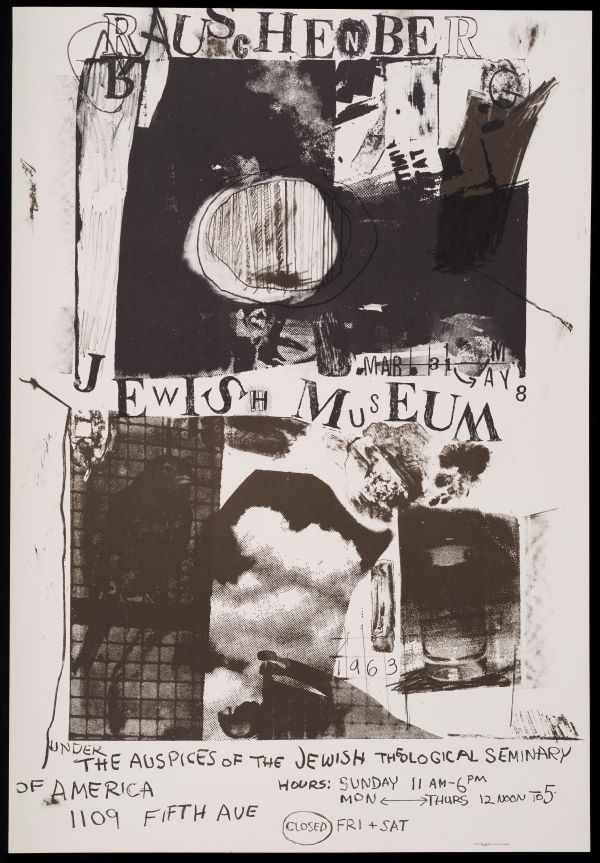
Poster for Robert Rauschenberg exhibition at the Jewish Museum, 1963. Offset lithograph on
paper. 32 × 22 in. (81.3 × 55.9 cm). © 2024 Robert Rauschenberg Foundation / Licensed by
VAGA at Artists Rights Society (ARS), NY. Image courtesy the Jewish Museum.
James Snyder, what is the consequence for the Jewish Museum?
Twenty or so years ago, people framed their lives in relation to before 9/11 and after 9/11. Now we’re are doing the same with October 7. I embraced coming to the Jewish Museum in August 2023 and began in November 2023. Even before October 7, Covid and all the social challenges of the last five years had already called for a rethinking of how museums fulfilled their role and responsibility in a meaningful way. October 7 only exacerbated the need to refresh how the Jewish Museum, and museums everywhere, served their audiences in beneficial ways.
Today are people confident to come here or frightened?
On my first day in the Museum, the board urged me immediately to write a message to our community, responding to the events of October 7 in relation to the Museum’s mission. Our message stated that we condemned savagery and brutality and called for the restoration of humanism. Museums exist to be custodians of the history of world culture, and, without humanism, there is no such history. We noted that our hearts and minds were with innocent Israelis and Palestinians caught in the crosshairs of the conflict and that we would put together a plan of action so that the Jewish Museum could be identified as a platform for engagement and education in a time when it could not be needed more. A few weeks later we set out a plan that we are still continuing a year later.
What was the plan?
Central to our plan has been to make the Museum and its mission relevant to all of the constituencies we serve, through opportunities for discourse and learning, including workshops for our staff addressing the mechanisms for civil discourse, the history of racism and anti-Semitism, and the history of the Middle East after the fall of the Ottoman Empire and how Israel and Palestine fit into this story from the creation of the State of Israel until today.
We also started an ongoing series of Director’s Talks, engaging with cultural personalities to look at the state of the world today through a social and cultural lens, rather than through politics. Importantly, we’re also presenting works of art by artists responding to trauma, whether it is today or from a time passed.
Such as?
Last December, we opened a very moving installation of drawings by the Soviet émigré Israeli artist Zoya Cherkassky responding to October 7. The media embraced the power and the meaning of those drawings, and the response was incredible. We subsequently acquired and put on display Michal Rovner’s moving series of “Poppies”, also responding to October 7. And we currently have on view an exhibition of the work of Ilit Azoulay, an Israeli photographic artist whose work is about how objects are not only objects, but also carry the memory and meaning of what they are, whose they were, and where they were found. The three examples that I’ve mentioned are all Israeli artists, but our focus is really on creative making by artists who are responding to the challenges of their times.
“….an important point about the history of the region is to understand how, during the Ottoman Empire, there were not countries but rather cultures….”
James Snyder, what else did you do in response to October 7?
We were very clear from the very beginning that we wanted to be a platform for engagement and discourse, and this continues to be our position and it has been very gratifying to benefit from endorsement and support from colleagues for our doing so.
In your exhibition program?
We are continuing our ongoing program of exhibitions engaging with archeology, Jewish world culture, and the fine arts, but we are also focusing on how each of our exhibitions can be sensitive to the times we are in. Currently on view is an exhibition of Trenton Doyle Hancock and Philip Guston in confrontation and conversation. At MoMA I knew Philip Guston both as an abstractionist and also as an artist responding to the social turmoil of the ‘60s through a new visual vocabulary. The Jewish Museum was his docking station, in great part because he felt Jewish culturally, but not religiously. His subjects were white supremacy, racism, anti-Semitism. Trenton Doyle Hancock is a 50-year-old black artist from South Texas whose visual vocabulary draws explicitly and directly from Guston. Today, 60 years later, he is dealing with the same issues of white supremacy, racism and anti-Semitism, using that same vocabulary and formulating his own response in dialogue with Guston.
How do you feel at the moment?
The Venice Biennale this year, Foreigners Everywhere, could not have offered a more meaningful theme for me at this moment. We are all foreigners, wherever we are. Even at home, we are foreigners. I am Jewish. I was brought up with a very deep Jewish inner core, not trained religiously but with foundational sense of Jewish identity at my core. At the same time, you can benefit from cultural assimilation wherever you are, so that you are also at home wherever you are. The Holy Land is the fountainhead for several monotheistic faiths, not just Judaism, all of which began there and then grew to become diasporatic cultures. When I was asked to join the Jewish Museum, I started thinking about how the Jewish world has been wandering in the global diaspora for over 3500 years. Across that time, Jewish people have either wandered in the diaspora or lived in a ghetto, either for security and protection or for confinement and, at times, extermination. This narrative is central to an understanding of the history of Jewish culture, and it resonates with the histories and stories of many important other cultures as well. In the global diaspora, your core identity can be religious or spiritual, or otherwise, while your identity also engages with the other cultures where you live your life. Understanding this balance carries great meaning today and can perhaps also help us ease the social tensions of these times.
Is it also very important to be attuned to the times and places that you’re in?
Yes, especially so that you don’t seem tone deaf to these times. As an example, we are currently working on an exhibition for next year on Paul Klee and Fascism. It’s about the last ten years of Klee’s life when, after he became the poster child for degenerate art, he left Austria and went to Switzerland, where his work reflected the demise of the creative spirit that had given him his artistic prominence. And this late work carries that much more meaning in the climate that we are experiencing today.
Is it your idea that culture is a diplomatic universal language for peace, that there are accidents created by politics, but art goes on?
Yes. We spent 22 years in Jerusalem, and when we arrived there we saw that the Jewish community, the Christian community, and the Muslim community co-existed in a practical and pragmatic way. They lived together, they worked together, they did business together, and they understood the benefits of doing so. This struck us almost immediately as an example for the rest of the world, often derailed by political agendas that can easily overturn this equanimity. During our workshops in the Museum, an important point about the history of the region is to understand how, during the Ottoman Empire, there were not countries but rather cultures that moved throughout the Empire doing business with each other, living and working together.
That was the narrative of the region for a very long time?
Yes. In the coming weeks, we will be displaying the Tel Dan Stele, an ancient inscribed stone tablet – like an analogue Instagram – from 900 B.C. Excavated 30 years ago in Tel Dan in the north of Israel and written in Aramaic, it records the story of a Mesopotamian king boasting that he had defeated the Kingdoms of Israel and Judah. The Kingdom of Israel is the House of David, and the Tel Dan Stele offers the oldest recorded archaeological evidence of the existence of the House of David, which was the fountainhead for the unfolding not just of Judaism, but also of Christianity and Islam over the succeeding 1500 years. We are bringing the Tel Dan Stele here for five weeks, beginning right after Thanksgiving through the New Year, and our message is about narratives like this that remind us of the origins of the connectedness among us that politics today want to replace with fractiousness.
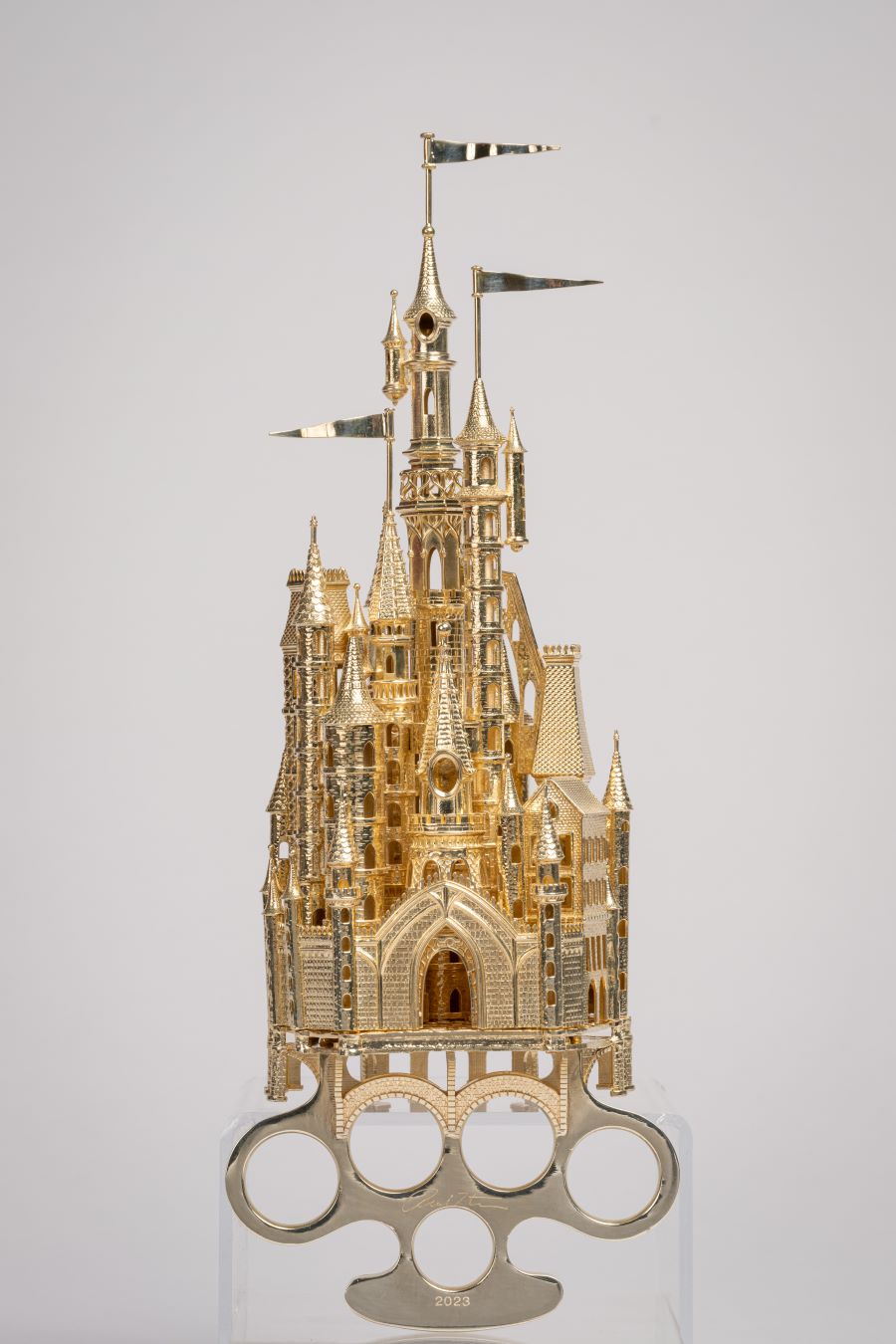
Rachel Feinstein and IPPOLITA. Marriage Ring. 2023. Gilt silver. 11 × 4 × 3 1/4 in. (27.9 × 10.2 × 8.3 cm). The Jewish Museum, New York. Commission: Judaica Acquisitions Committee Fund, Contemporary Judaica Acquisitions Committees Fund, and Contemporary Deaccession Fund, 2023-110.
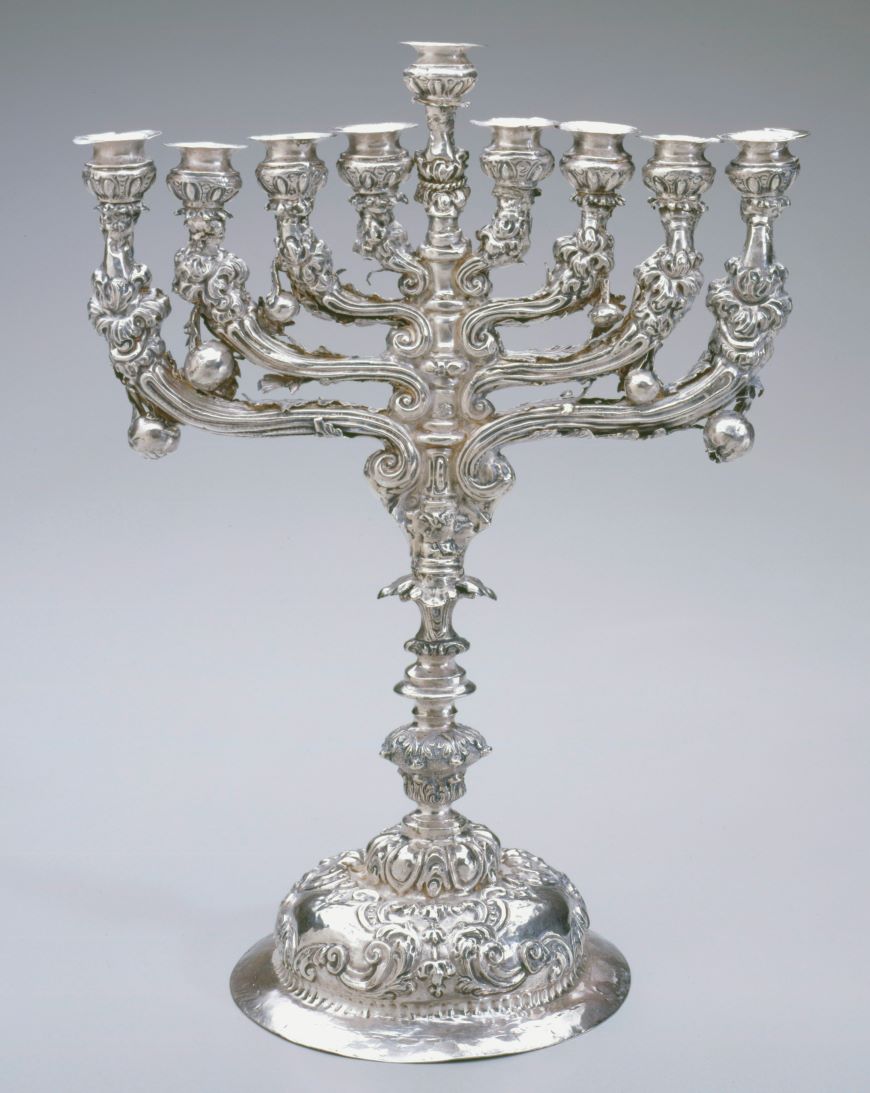
Hanukkah Lamp. Venice (Italy), 1712-49. Silver: mold-pressed, repoussé, appliqué, and cast. 12 7/8 × 9 15/16 × 5 1/2 in. (32.7 × 25.2 × 14 cm). The Jewish Museum, New York. Gift of Dr. Harry G. Friedman
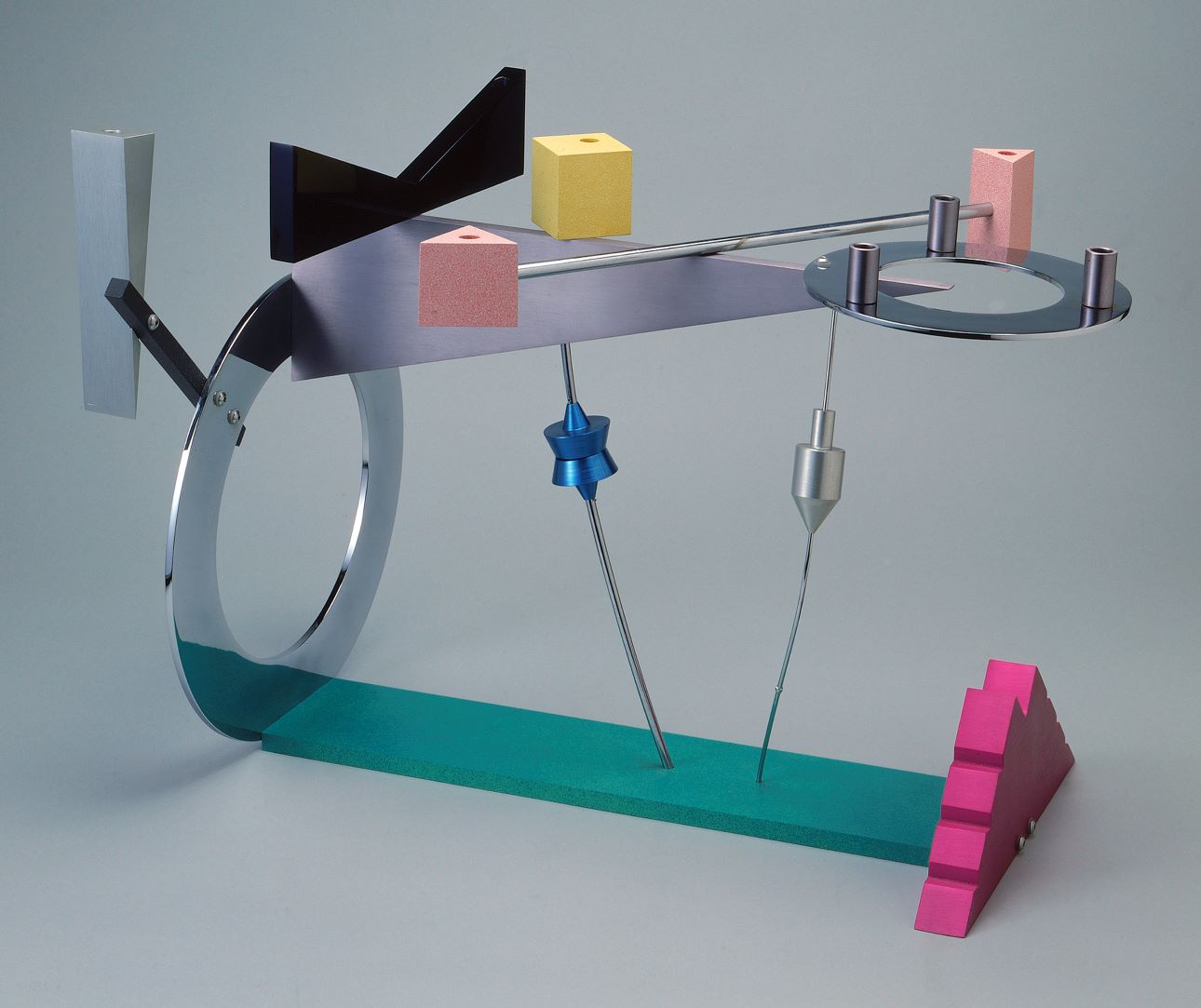
Peter Shire. Menorah # 7.Los Angeles, California, 1986. Steel: painted; aluminum: anodized;
chromium. 17 1/2 × 24 1/4 × 15 1/2 in. (44.5 × 61.6 × 39.4 cm). The Jewish Museum, New York.
Purchase: Judaica Acquisitions Endowment Fund, 1989-20.
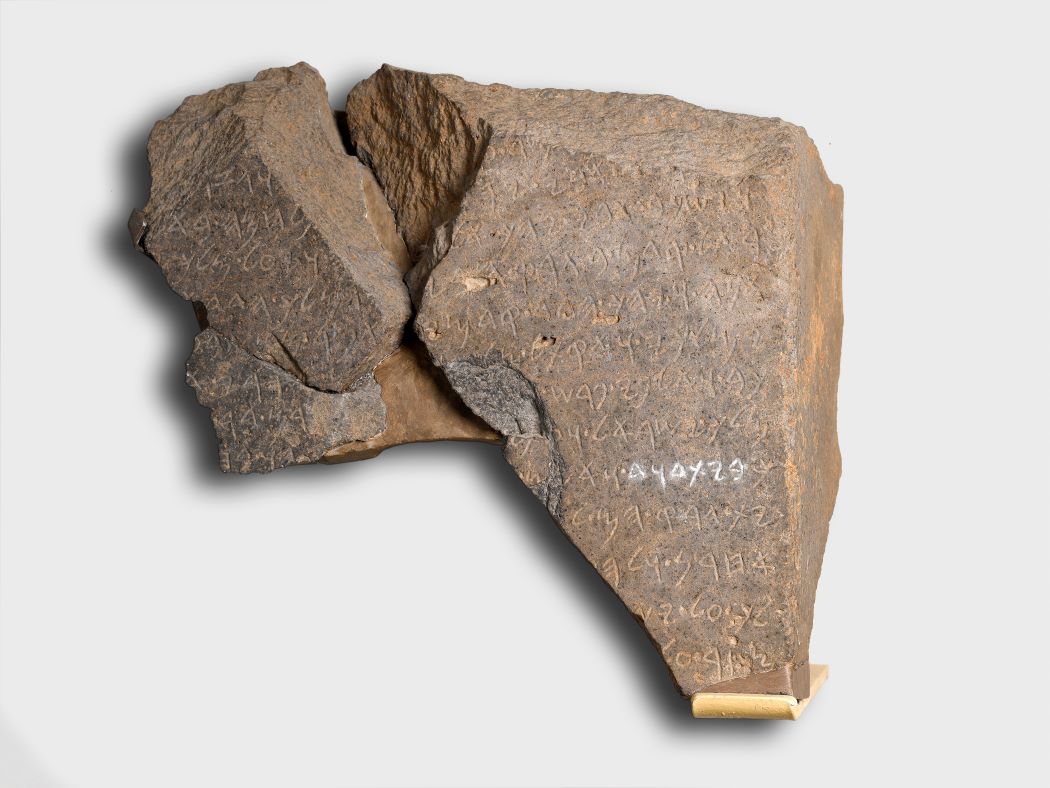
“House of David“ inscribed on a victory stele. Dan. Iron Age II, 9th century BCE. Basalt. H: 34; W: 32 cm. Collection the Israel Antiquities Authority, 1996-125, 1993-3162. Photo © The
Israel Museum, by Meidad Suchowolski
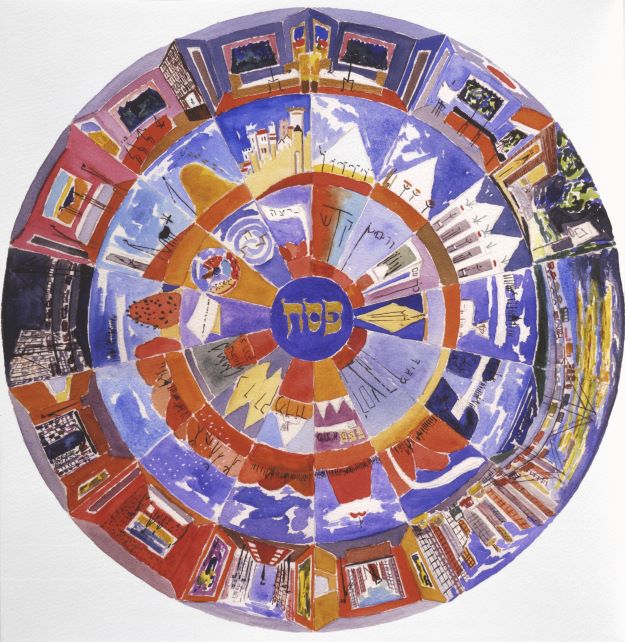
Avner Moriah (Israeli, b. 1953). Calligrapher: Izzy Pludwinski. Publisher: Artworks Israel LLC.
Moriah Haggadah. Made in Israel, 2002. Printed on paper, leather binding. 12 × 11 1/2 in. (30.5
× 29.2 cm). The Jewish Museum, NY. Purchase:Gift of Bonnie Tisch and Contemporary Judaica
Acquisitions Fund
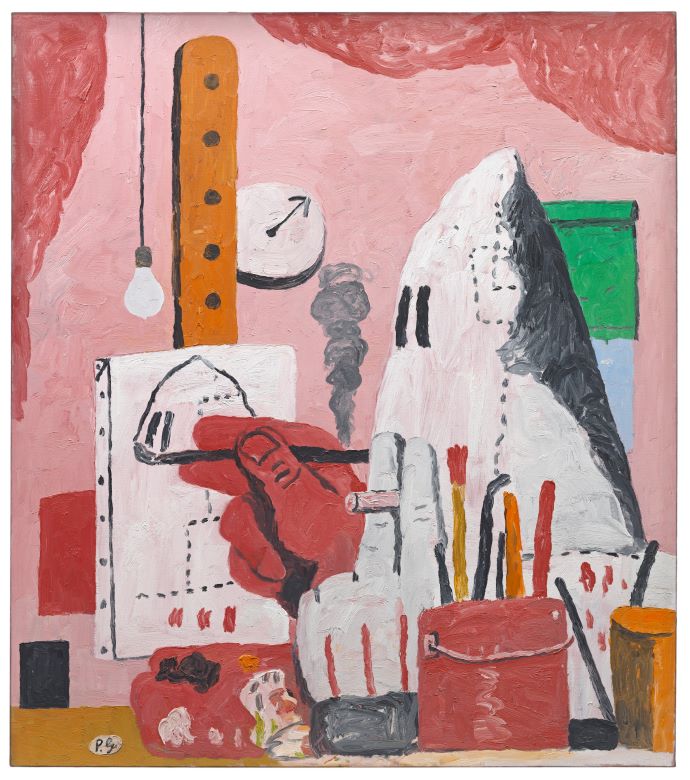
Philip Guston, The Studio, 1969, oil on canvas, 48 x 42 in. (121.9 x 106.7 cm). Metropolitan Museum of Art, New York, promised gift of Musa Mayer © The Estate of Philip Guston.
“…there does not have to be a disconnect between your core identity and your cultural identity.”
James Snyder, did you not have an exhibition with Ai Weiwei in Jerusalem in 2017 called “Maybe, Maybe Not”?
We did, and Weiwei and I agreed from the start that our exhibition needed to be about the resonant connections between Jewish people and Chinese people. Our first meeting was a breakfast that lasted through lunchtime, by the end of which Weiwei looked across the table and said, “You know, I now understand that you are the Chinaman, and I am the Jew.” And this is really what cultural engagement and cultural activism can help us achieve, and especially in times like these.
Are the younger generations and college students curious about their identity and coming to your Director’s Talks?
Yes, and they seem to have a fresh understanding that there does not have to be a disconnect between your core identity and your cultural identity. There can rather be a resonant connection, a resonant synthesis that enables you to function with an embrace of your identity and also an embrace of life where you live and how you live. Three of my own talks so far have been with artists – Zoya Cherkassky, Michal Rovner, and Ruth Patir, the Israeli artist for this year’s Israel Pavilion at the Venice Biennale. And one has been with Tarek Masoud, the Egyptian-heritage Muslim who Directs the Middle East Initiative at the Kennedy School, where I am a Senior Fellow. Our talk was called “Isaac and Ishmael, brothers, looking for a brighter path.” Tarek and I come from different cultures, but we are brethren.
In essence you are promoting the importance of cultural dialogue and mutual respect of different cultures so that people can live together peacefully and respect each other?
Yes. After October 7, directors of a number of museums across the country that collect all cultures, but have not yet collected Jewish ceremonial art, have been in touch about building collections of Judaica. My response has been that our Jewish Museum holds a collection of more than 14,000 examples of Jewish world culture, and we are ready to lend. In June, we inaugurated this initiative with the Cleveland Museum of Art, which a group of exemplary objects of Jewish ceremonial art from different periods and cultures, placed in the galleries of those cultures and timeframes where and when they were made. We are working now with a number of other museums who want to do the same, underscoring our point about looking at specific cultures in the context of the other cultures with which they have resonated throughout history. It is really moving to see that this is not theory, but practice, implemented quickly and smoothly among museums eager to demonstrate their role, responsibility, and relevance in these times.
Do you have a very good relationship with the other Jewish museums around the world?
In part thanks to my own background in the field, we have been able to strengthen our relations with modern, encyclopedic, and culturally and subject specific museums in the US and internationally, including Jewish museums which, like us, are working to determine how best to serve the broadest possible audiences in these times. We are doing our best to lead the way with them and among them.
James Snyder, thank you very much for this conversation.
ENJOY THIS INTERVIEW? SHARE IT WITH A FRIEND.
Portrait of James Snyder and other images courtesy of the Jewish Museum.


