BREAKING THE MIRROR. Michelangelo Pistoletto is one of the most celebrated artists in Europe. Born in Biella, Italy, in 1933 and a leading figure of the radical Italian Arte Povera movement, Pistoletto created his first Mirror Paintings in 1961–62. These influential works earned him international acclaim and have become a hallmark of his oeuvre. Robilant+Voena’s recent exhibition in Dover Street, London, presented works by Pistoletto divided across two rooms: the first room showcasing black and white mirror pieces, and the second offering mirror works in bold colours.
You can listen to the podcast of this interview here.
Michelangelo Pistoletto, it has been some years since your last show in London, are these Mirror Paintings very different from those you did before?
This work starts from when I broke my mirrors in ’94 and for the first time in a public space I destroyed the mirror.
Why did you destroy it?
Because I wanted to show that there is physicality behind the mirror. It is not just untouchable. The mirror doesn’t have any consistency, it is just image, but there is material that makes it possible which is so flat that it can reflect. Without the material, we don’t have the reflection. When you think about the mirror you have the illusion that everything is just image. But the image is given by the fact that the mirror doesn’t add any personal image because it is ready to have all the images that exist taken inside of it. Zero and everything. I destroyed the mirror in the sense that the physicality became evident.
“I do not call it black and white because the mirror doesn’t have the colour white. I call it light: light mirror.”
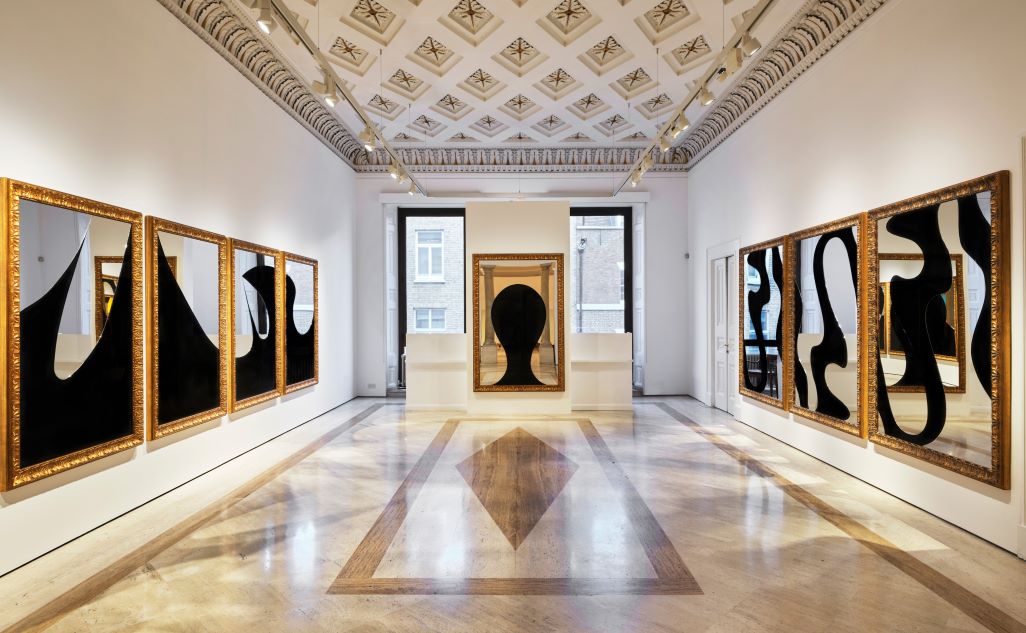
Michelangelo Pistoletto: BLACK AND LIGHT at Robilant+Voena 2024
On left and centre: Black and Light, 2024. Black and white mirror with a gilded wood frame. 180 x 120 x 5 cm
On rightL Vortice-trittico (Vortex -triptych), 2010-13. Silver and black mirror with a gilded wood frame 201 x 141 x 5 cm
Michelangelo Pistoletto, in these paintings you broke the mirror and then left a space?
When I break the mirror it is very casual. Like the existence of humanity, it happened casually. We are body, but we also have mind, and we reflect. Humanity is not just an animal body, but humanity is animal and mind. We are born from no specific reason, there is just chance at the basis of everything, but as human beings we know that chance is there so we can use it in the right way. The moment I break the mirror, I transform chance in this conscious sense.
Why are these paintings in classic Old Master gold frames?
The frame is necessary because the mirror is not a work of art. It is just an object, like a chair or a lamp. We could use it, but it is not art. The moment you put it in the frame, the mirror is concentrated in a specific space, and your mind is concentrated in that space, but this is not enough. You need also an image that comes from the history of art, like an abstraction, a design, a drawing, or a photograph. If you put a photograph against a mirror, the mirror becomes representative. I did mirror paintings where a photograph of a human moment is fixed as memory against the mirror, and the memory of that moment activates the mirror. Then each moment of the mirror becomes a memory that never stops. Memory is always becoming an image and we need the image and the frame, and then the mirror becomes art in my work because there is the path before Mirror Painting when we have canvas, frames, everything that is part of the history of art. We put the canvas on the wall because it takes the place of the wall and we don’t paint directly on the wall.
Why is one room at Robilant+Voena hung only with black and white Mirror Paintings?
I started with black and white. My first mirror painting in ‘61 was done with very black, shiny, refined colour on very refined canvas. Black is not a colour but a pigment we burnish, so the canvas became mirrorly. I perfected the mirroring canvas using other materials like polished metal, because polished metal is very durable while glass is not. I do not call it black and white because the mirror doesn’t have the colour white. I call it light: light mirror. When I made the first broken mirror in this series, I called it black and light. From the black we started again from the beginning, and then I started to use colours on the canvas instead of black. The tradition of painting is always included in the work that I do now.
Why do you cut shapes in the mirror?
I cut the mirror as if it is broken, and many pieces become evident because the division produces different pieces. I take one piece and I put it on a canvas with a colour. I put another piece in another painting. Each piece becomes autonomous. It is like having all the pieces of society together but afterwards you create the individuals, and each piece becomes an individual painting.
If I were visiting this Robilant+Voena gallery space with you to view your work there, where would we begin and where end?
We always have the beginning and the end, crossing, coming from both sides. There is time: past and present. What is important is that in all this work you never have just the colour, the form, the material, the tradition, but you have time and space. You have what is there forever, with all the possibility of anybody that will come on this earth having the possibility to be part of it. We are always included. We are never excluded.
You say that everything is by chance, so when you break a mirror is it by chance, and then whatever comes, comes by chance and by the work of chance?
Everything happens by chance, whether by consciousness or by sense but sense dominates everything, because we have all these elements that combine. The moment they combine by chance they create something that didn’t exist before. The creation of the universe happened by chance, and by chance everything that exists is made by different elements that always combine in the same way. We have always said that the origin of something is combination, that is what happens in nature. We know it because we are not animals that are passively part of chance, but with our intelligence we are able to double, to re-present reality. And so now we have two elements: reality and intelligence. And intelligence is able to use the chance that is in nature.
“You are already in the painting.”
Michelangelo Pistoletto, Lucio Fontana was the first known artist to slash a hole in his paintings, and you and he both exhibited at MoMA in New York. When you met him in Milan around 1963 he said to you, “You destroyed the world without touching it.” Please explain this.
Fontana suffered from the fact that modern art had stopped the Renaissance perspective of Piero Della Francesca which had opened a mathematic and scientific process. When Fontana was working he suffered from the necessity of having a free space that offered a new perspective, because with Modernity there was no perspective anymore. The Renaissance perspective always looks in front of you, but in the Renaissance perspective the viewer is not inside, because it’s like looking outside of a window. It’s easy: become a door and you are inside. Fontana was still thinking of the concept of a window, and he wanted to find a new perspective, but he was unable to find it. He was trying to make a hole against the wall. Unlike Mondrian who said OK, now we live in the cube, Fontana wanted to go outside of that white cube that Cubism invented, so he was making the hole to find perspective again for society.
Did Fontana succeed?
No, he was just expressing the desire to go out through the wall, but when I made the Mirror Paintings I totally opened the view. Everything that exists is in front of you, not just one perspective, it is completely 360 degrees, because what you see in the front is at the back and what is at the back is in the front. You are included. The viewer and the artist are included. You are already in the painting. In the Renaissance you were not in the painting. In the cube you were in the work, but without perspective, without future. Now with the mirror we have the past and the future together and you are in the middle. When Fontana saw my work he understood that it was not a quest to make a physical hole, but a virtual hole, because the mirror is virtual, and after the virtuality I break the mirror and I recuperate the physicality that you have here.
In the London Frieze pavilion of Robilant+Voena there was one of your big colour paintings, and in one corner there was a smaller Fontana painting that was like a polished mirror?
Yes, and if you look at its date it is made after he met my work, because he went to New York in 1964 when my Mirror Painting was already at MoMA. Two Italian works of art were at MoMA at that moment: one work of Fontana and one work of Pistoletto. One is the hole and one is the mirror. And it’s funny that from following Picasso, the big maestro of the 19th century, Fontana then tried to make the hole in the mirror, and Fontana became my pupil and started thinking about my progress.
Probably he was sufficiently intelligent to know that in art you learn without copying?
Without the past I could do nothing. Not one step. But also, a person like Fontana, who was looking for something, was more able than anybody else to see the result that he was looking for in my work. He was following me. It is like father and son, and son and father.
As you are the son of the celebrated landscape and still-life painter Ettore Pistoletto Olivero?
My father was a traditional painter who I brought to work with me to make a still-life. I put some polished metal cups and bowls on a table, and told my father to make his own self-portrait in the still life. He painted what was going on in there, and he was reflected inside, and so he became my pupil. When my father did that work to make a father and son show with me he was 75 years old. When I arrived at 75 years old I took my father’s painting and the same objects that my father used in his painting and I made a self-portrait, then I put the two works together and I called this Same Age Artists. My father was 75 when he did that portrait with these still life objects, and I made the same objects with myself reflected inside when I was 75. These two works with the same image, two persons, the father and the son. And there they are the same age! This is fantastic. Me and my father changed time totally.
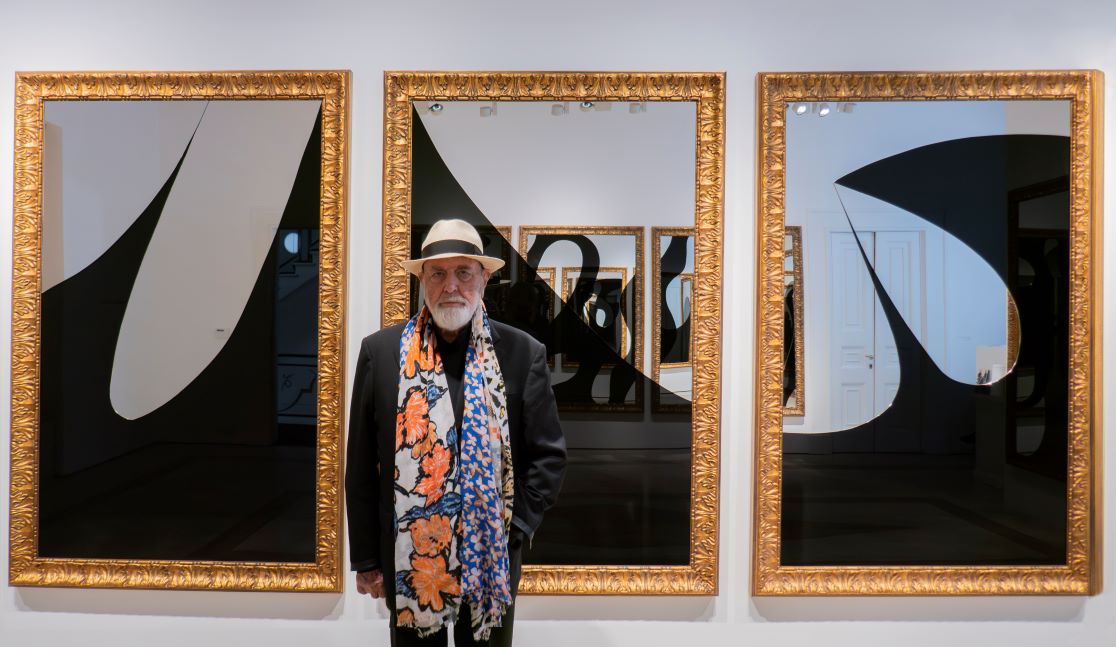
Michelangelo Pistoletto: BLACK AND LIGHT 2024
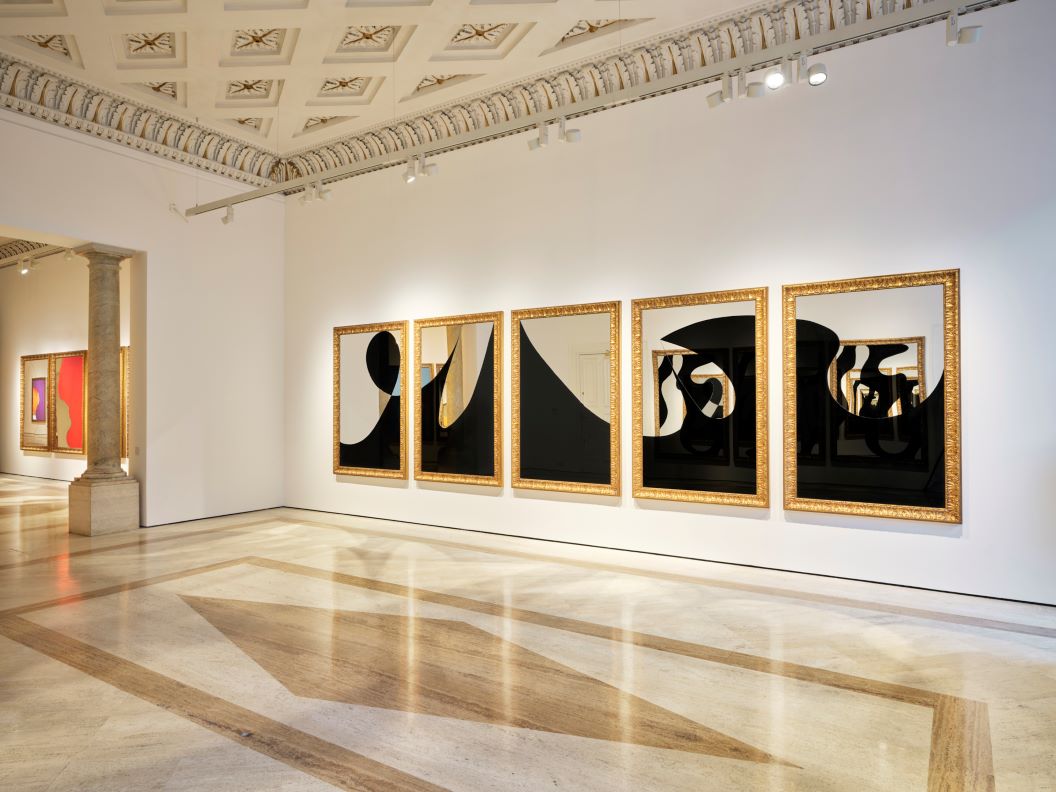
Michelangelo Pistoletto at Robilant+Voena in collaboration with Galleria Continua. The exhibition featured a selection of the artist’s signature Mirror Works
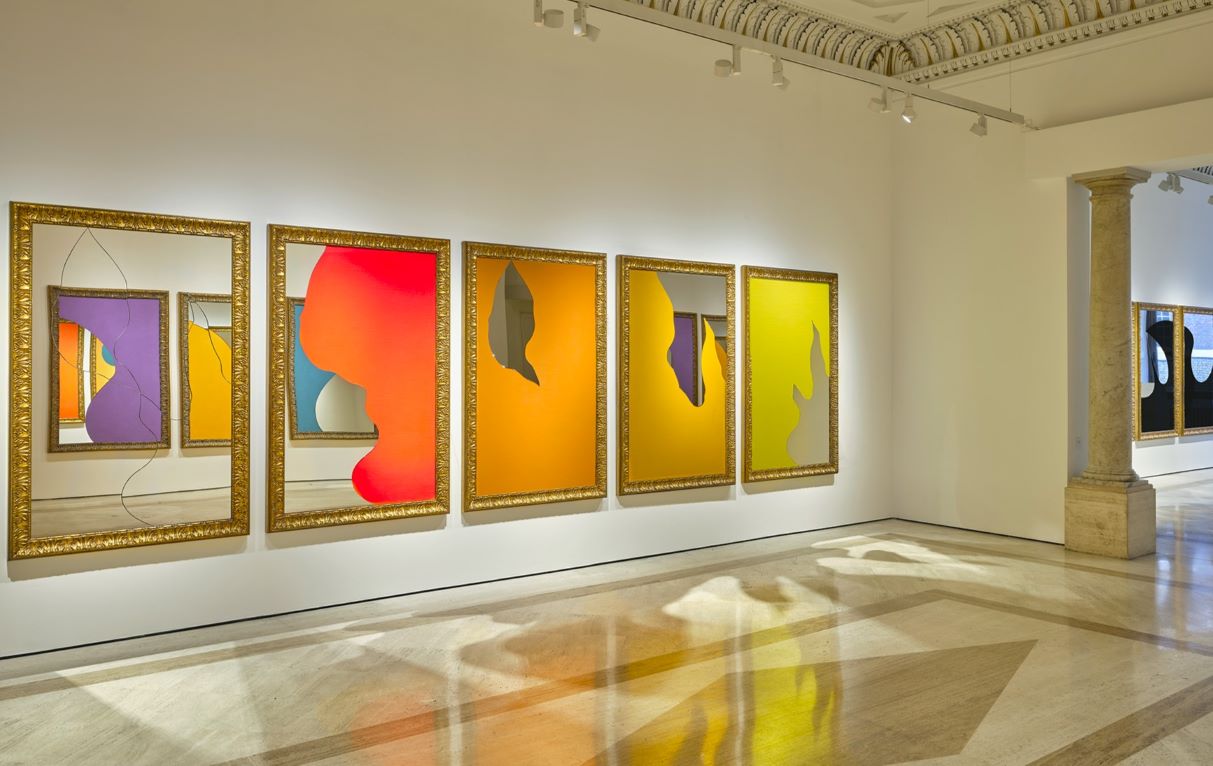
Michelangelo Pistoletto: COLOR AND LIGHT 2024
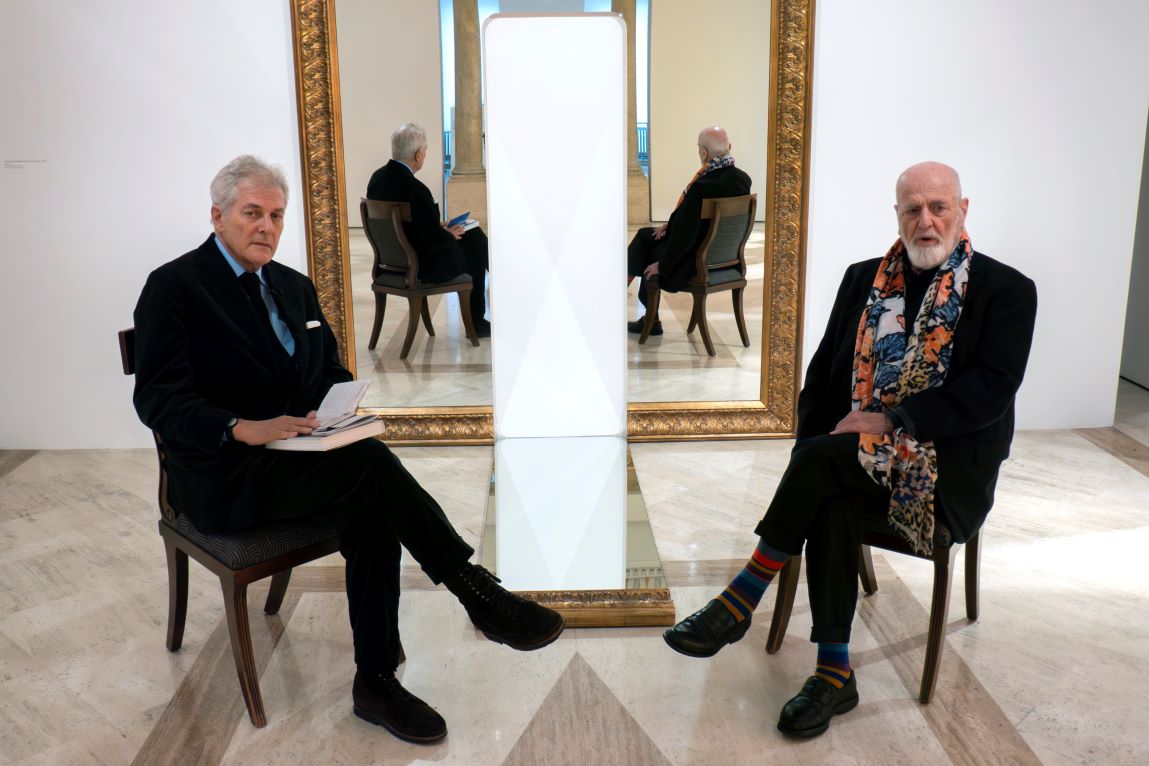
Alain Elkann Interviews Michelangelo Pistoletto by Paula Chandon

Michelangelo Pistoletto
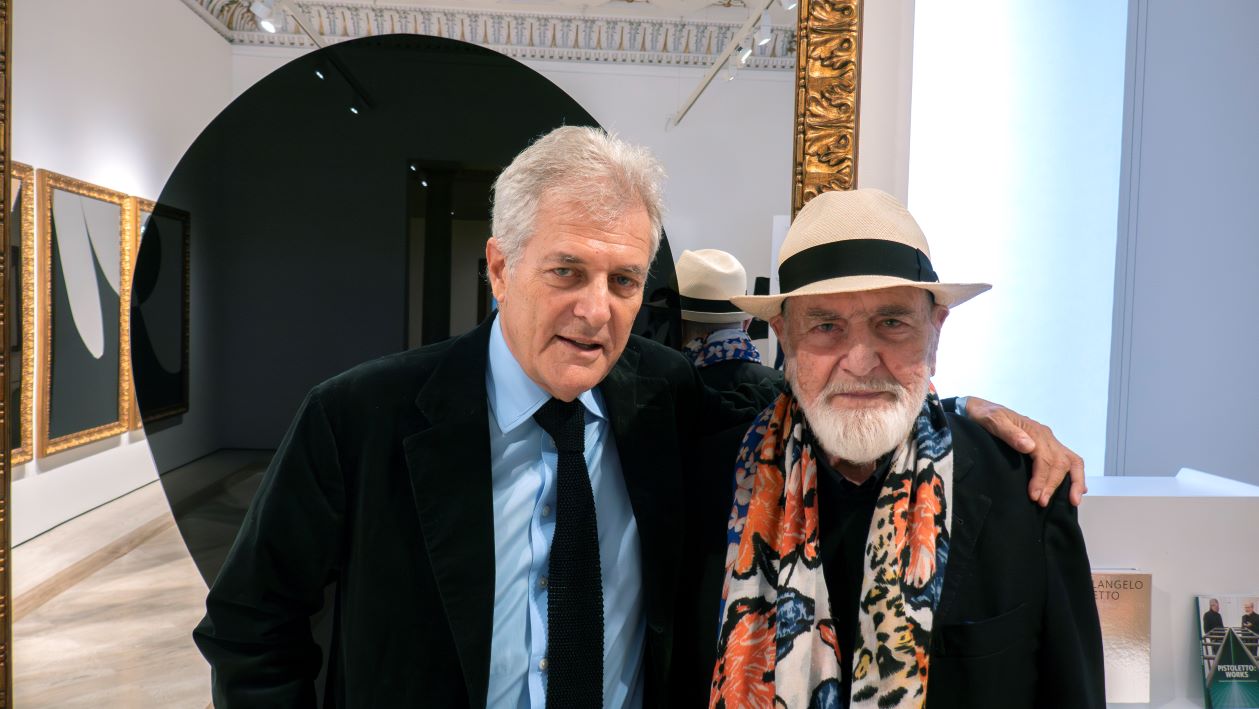
Alain Elkann and Michelangelo Pistoletto by Paula Chandon
“We have to decide if we want peace or war.”
Michelangelo Pistoletto, you came to London from Paris where the big Arte Povera show is in the Bourse de Commerce – Pinault Collection. Do you belong to the Arte Povera movement?
Before Arte Povera I was part of the New York Pop Art movement because they wanted me to be included, but I doubled my work with the Minus Objects, making a multiplication of my identity with a series of works, one different from the other. I couldn’t be only Pop Art. Pop Art was like having a label and I wanted to destroy the Pop label, and when I destroyed the Pop label Arte Povera came out.
Do you believe that Arte Povera is as important an art movement as Pop Art?
I don’t give specific importance against something. Something happens after something. Arte Povera is a consequence. It is also a consequence of the minimal art that was happening in the States. Minimalism was to reduce the concept in a very simple way, but Arte Povera was to reduce it in a radical way. Radicality means something that is between the physical and the conceptual, but the physical should be there. The phenomenology of life should be there. Minimalism is just intellectual, and Arte Povera is both intellectual and material, like the Mirror Paintings.
Is Arte Povera over now?
Arte Povera is finished in that it is a movement that arrived at the extreme point of the series of modern art movements. It was the last movement, because we arrived at the radical point where the physics and the concept fit together. The Mirror Paintings is the point of connection. Now the critics give more importance to the fact that I elaborated this combination that comes from Arte Povera, because it was a real passage after Modernity. For example, there was another movement in Italy called Transavanguardia. Transavanguardia means that avanguardia, avant garde, is finished and Arte Povera was the last one. So we had two movements in Italy that confirmed the importance of Arte Povera: Arte Povera and Transavanguardia.
Today there are no more movements?
There are, kind of. For example the Street movement. Personally, starting from ’67, I opened my studio, going in the street, activating performances in the street. Street wanted to go outside the cage of traditional organisations, and so recreate the system of real organisation – which is art as a possibility to recreate society starting from creativity. To give artistic creativity responsibility for society, not something that is apart. It is not that you work in society and when you want to relax you go to a museum or to the theatre or to see artworks. No. Artwork is included in the whole structure, all the systems, all the textiles of society. This is why I opened the City of Art, Cittadellarte, at Biella. City/Citta also means civilisation, so art for a new civilisation.
At the age of 91 you seem to have the same passion, energy and curiosity that has motivated your life?
I work with politics, religion, schools, everything. Art is connected with life. Cittadellarte is the connection of what is happening in society. Now art has to take responsibility for society, because art is the maximum of freedom – but you don’t know what to do with freedom if you don’t transform freedom in responsibility.
Is your work with mirrors a metaphor of your life?
It is a metaphor of the world’s life. It is our life. I am not alone. We have a formula now. There is me and you, and between us we are producing a third element that can be taken with a camera and people can use it. Alone I can say what I want and you can say what you want, but together we produce something that didn’t exist before. We are making a creation, two persons working together. In politics we also have the same possibility to make a solution by talking together.
Talking together is a work of art?
It depends if you are able to bring a solution that can be made with balance and harmony. Then you have a new world that is peaceful. If we decide to make war and fight we will make war and the world will become a war world. We have to decide if we want peace or war. We have to decide how to use chance.
Thank you very much.
ENJOY THIS INTERVIEW? SHARE IT WITH A FRIEND.
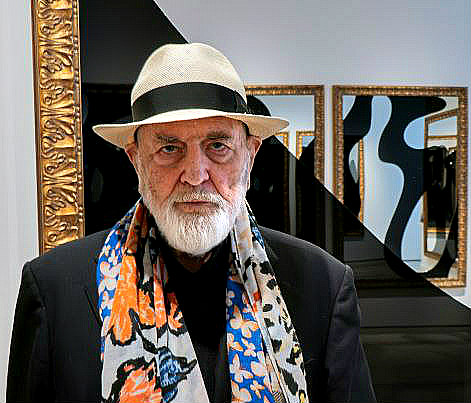
Portrait of Michelangelo Pistoletto by Paula Chandon.
Images courtesy of Paula Chandon and Robilant+Voena.