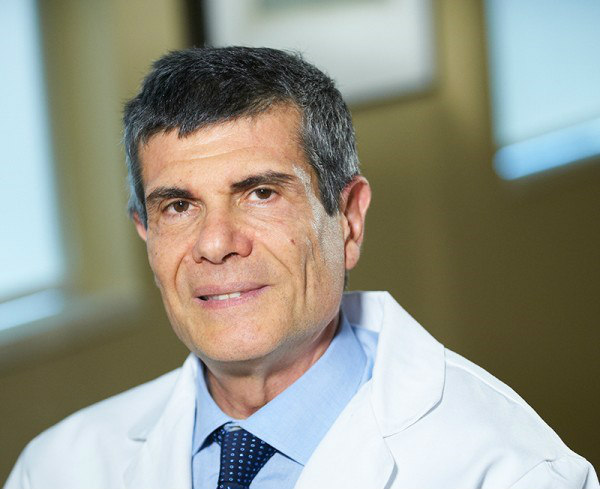
BELIEVING IN HOPE WITHOUT COMPROMISE. Dr Virgilio Sacchini is dedicated to caring for people with breast cancer at the Memorial Sloan Kettering Cancer Center in New York. He originally trained at Universita degli Studi di Milano (UNIMI, Milan, Italy) where he is Professor of Surgery, and cooperates with the European Institute of Oncology in Milan (IEO, Milan, Italy). Dr Sacchini is a 2023 and 2024 Castle Connolly America’s Top Doctor, the peer nominated group of the top 7% of all US practicing physicians. His goal is to achieve the best possible cancer outcomes and cosmetic results for his patients.
You can listen to the podcast of this interview here.
Virgilio Sacchini, how does emerging technology change the way you cure cancer?
The way to cure cancer is to benefit from biomedical engineering. Mechanical, physical, genetic and pharmacologic engineering is helping the researcher to better diagnose and better treat cancer, or indeed all diseases. There are many implications in biochemical engineering, just as mechanical engineering is now applied for robotic systems and we are doing robotic surgeries more and more, with a better exposition of the surgical field and with more precision. And in image engineering we are developing special medical image technologies using MRI, PET scans and CT scans all together, to better diagnose and better localize alterations.
Is this a step change in the treatment and curability of cancer?
It is a major step, because it is the application of the best technology in treating cancers. Of course, sometimes these technologies need to be proven with initial clinical trials. Most of the time these clinical trials show a benefit in better treatment, more curability, better quality of life. Biomedical engineering is now something that you need to consider when you do your research to treat a patient, and medical schools are incorporating biochemical and biomedical engineering, so it’s very important. Pharmacology bioengineering is now the most diffuse and the most useful for treating cancer.
“The new concept is to target only cancer cells.”
Virgilio Sacchini, is the Pre|CISION® platform of Avacta, a British life sciences firm, a good example of how new technology can expand the reach of highly potent cancer therapies?
Avacta is an incredible application of biomedical engineering. For a treatment to have most efficacy we need to have a very powerful medication, and to be sure that the medication targets the right cells. If you have a very powerful medication going everywhere in the body, of course it can go to the cancer cells, but it may also go to other healthy cells, creating toxicity. The new concept is to target only cancer cells.
Can Avacta limit the side effects of chemotherapy by going straight to the point?
Yes, it goes straight to the environment of the cancer cells. There are other technologies, but Avacta’s is a very interesting one that combines a well-known and very powerful chemotherapy medication called Doxorubicin with a special molecule which is able to target and concentrate it in the cancer environment. The cancer environment is different to normal, and finding this difference and targeting the medication based on this difference means targeting only the cancer to be treated and not the other organs. In the specific Avacta situation they discovered that in the environment between the cancer cells there is a special protein called a fibroblast activation protein (FAP) and with a special molecule they can target this FAP and put a very high concentration of Doxorubicin into the FAP targeted cancer environment. In this way they kill more cancer cells and spare the other organs, because the other organs don’t have a high concentration of that FAP, and for this reason are preserved from the toxicity of the chemotherapy.
How does this change your way of operating in your hospital?
We are experiencing different types of target treatment. One of the most tested target treatments in breast cancer and gastric cancer are the HER2 targeted medications. In some cells there is a gene producing a lot of this so-called HER2 protein that helps cancer cells to grow quickly, and they were able to develop a monoclonal antibody able to kill this protein, and once you kill this HER2 protein the cells would die. This treatment can improve the curability of breast cancer by 40% and for gastric cancer by more than 40%.
Is such targeted treatment also shorter in duration?
It is more or less the same in terms of how long the treatment lasts, but the intensity of the side effects is much less. This means that you can give less drug, because the drug concentrates more in the target tissue. It is like having a rocket with a nuclear bomb inside, and the rocket is directed right away to the cancer cells – not to the body, because it would destroy the body, but to the cancer cells – and therefore able to spare the other parts of the body. Avacta has an incredible technology, because the drug that they that are using called Doxorubicin is an incredible drug. It was one of the first chemotherapies, but the limitation of this medication was heart toxicity, so you had a strong limitation in giving Doxorubicin because of increasing the risk of heart attacks. Now you can improve the dose, because the drug will concentrate only in the tumor environment. This is very, very important.
Are most people definitely cured by such treatment or is there still a risk of relapse?
The problem is that cancer is always a mixture of cells, so some cancer cells may have the target antigens and some other cancer cells may not have the target antigens. Your nuclear bomb will go only to the cells with the special marker antigens, but not into the other cells, and some cells may be resistant to this medication and may survive and later on the cancer may reappear. But with this special Avacta technology we target the cancer environment rather than the cancer cells, which means that even if you have differing cancer cells the medication goes into the cancer environment and kills all the cells independently of the type of antigen that they have. This means we may now target all the cancer tissues instead of selected cells with Doxorubicin, which is not a new drug. Also called Adriamycin, it was discovered in Italy in the 80s by Farmitalia, which was bought by Bristol-Meyers. The name Adriamycin means “from the Adriatic”, because they first discovered this medication in the algae of the Adriatic Sea. So the drug is not new, but the engineering is new, because Avacta were able to combine this powerful well-known chemotherapy medication with an engineered peptide (PDC – peptide drug conjugate) which is able only to target the cancer environment where there is FAP, and so make this medication even more powerful.
Because of this new technology do you, an oncologist but also a surgeon, now have to operate on fewer patients?
Treatment going directly into the target cells is better for the surgeon, because when you do surgery you are not 100% sure that you eradicate the cancer – some cancer cells may be in the body. So if you give a very powerful medication after surgery you have more curability. Or you can give this medication before surgery, and the cancer can be destroyed, or you can have a smaller cancer, and this means that you can do a better surgical operation. There are studies in progress which show that when you do your medications before surgery, you can have complete resolution of the cancer, thereby avoiding the surgery.
“To cure someone and give him or her a miserable life is terrible, so the target in this moment is both better survival and better quality of life, less side effects.”
Virgilio Sacchini, how do you make your treatment decisions?
With this so-called precision medicine we can predict better and better, knowing better the biology of the cancer and the response to the treatment. You see the cancer in the MRI. You do the biopsy. You study the genome, the genetic material. You study the biology of this cancer and you may say, well, this cancer is very sensitive to this medication, and you start your treatment. Because you know that the treatment can work very well. You repeat the MRI after four months and you can see that the cancer is completely gone, destroyed. Of course, in your biopsy you may see that the cancer may not respond to a treatment and then you decide to do surgery upfront and not do chemotherapy before.
You are a specialist surgeon and an important doctor, do you decide on the treatment with other colleagues?
Yes, we are a strong group. Medical oncologist. Radiation oncologist. Pathologist. Geneticist. Genomist. The group give information on how to treat the patient, and the decision is made together. With precision medicine what you need is information. If I have the information from the pathologist that the cancer is incredibly sensitive to a specific medication I can take the decision myself, because the decision is part of a protocol, the pathway of treatment that we discuss together. It is only necessary that everyone sees the patient in some special situations. Usually it is a personalization, and what you need is to interpret this specific information to decide the next step for the treatment.
How do patients react when you describe their treatment regime?
The most important thing is to have a very good relation with the patient and spend time with the patient, speak to the patient yourself and explain the science base of your decision, because there is always a science. When you explain in detail it is extremely rare for a patient to say, no, I don’t trust it. The most important thing is to be very clear and explain the risks and benefits, the pros and cons, the possible complications.
Are these new treatments being used everywhere or only in some specific centres?
This Avacta study is experimental, so for this new technology there are different phases. There is a first phase in which you text the toxicity, because you need to be sure that the drug is not toxic, so there is an animal model and a human model that you apply. Then you have a phase two, in which you start to treat patients and see the results. And then there is a phase three, in which you compare the standard treatment with the new technology. Once the phase three study is completed the different agencies can approve the drug and the drug is made available everywhere. The drug is available only in the protocol when it is still in the experimental phase, but there are more and more centres in which it is becoming available. Now the so called “evaluation of the intermediate endpoints” is becoming more and more popular. You can test the medication in the patient before the surgery and then on the surgical specimen you can see if the medication was effective, evaluating some biology factors. This approach can make the medication available much sooner.
Can you be cured with this new treatment in the United States, in Europe, and in other parts of the world?
Once we prove that the combination of the medication with the Avacta technique works, of course it is approved and you can be cured everywhere in the world. The clinical trials that are done at the beginning are only in some countries. The clinical trial results may be positive or may be negative, but sometimes you don’t have a choice because there isn’t any other treatment available and the clinical trials may be an opportunity to have better results.
Cancer doesn’t necessarily have symptoms, and the very word creates a lot of fear. How can we prevent it?
First by not smoking, eating well and exercise. Second, the earlier the detection the better the outcome. There are normal screening guidelines, mammography and colonoscopy and the examination of your skin, but we would like to be able to detect cancer before the cancer has clinical symptoms. There is a new engineering technology that is becoming popular, the so-called Circulating Tumor DNA (ctDNA) in the blood. When cancer starts, cells deteriorate and put some DNA in your blood; and the DNA of cancer cells is different than the normal cells. There are now very powerful technologies able to detect this different DNA in your blood, and you can understand if this DNA is from the breast, from the prostate, from the lung, from the pancreas, and say, look, there is something that is starting, and then you can investigate. The future will be that I see this special different cancer DNA has a special gene, and we can give the patient the target medication against this gene and destroy the cancer before the cancer is even visible at any conventional level. We need to have a very high specificity, but the concept is to try to find a different DNA in your blood stream that is the DNA of a possible cancer.
“Once we prove that the combination of the medication with the Avacta technique works, of course it is approved and you can be cured everywhere in the world.”
Virgilio Sacchini, I like that Avacta say that they offer hope without compromise. Do you feel that one day we will be able to eliminate cancer?
Some cancers can now be completely treated without any problem. Prostate cancer. Some breast cancer. You do the surgery, you do some medications. Sometimes you don’t do anything because the cancer is very inactive. So for some cancers, yes. For other cancers, we are still working on it. Pancreatic cancer, some lung cancers. But there has been an incredible improval in survival.
In what percentage from when you started to today?
I would say 35% of improvement of survival without any problems. There is early and better diagnosis and better medications, but the most important thing is that there is both a better survival and also less compromise of the quality of life. To cure someone and give him or her a miserable life is terrible, so the target in this moment is both better survival and better quality of life, less side effects. This is the most important thing in cancer treatment. Sometimes we can do it, and sometimes in some terrible situations we may not be able to, but this is the target for now and the future.
Is cancer an illness that is increasing or decreasing?
It depends if you are able to decrease the risk. In Brazil they had an incredible advertising campaign against smoking, and they were able to decrease the risk of dying of lung cancer. The most important thing is to create more information regarding the risk and to try to avoid the risk, and then you can succeed and have less cancer. But some cancers, like pancreatic cancer, are increasing, and we really don’t know why.
Might there be a vaccine against cancer?
We have vaccines. For example, we have the vaccine against the papilloma virus which is the cause of cervical cancer in women or throat cancers in women and men, and with vaccination we have an incredible decrease in these types of cancers. Unfortunately, we don’t know all the causes of cancers and often the cancer is not due to a virus, but in these cases due to a virus we were able to do it. A lot of mRNA vaccines are mainly to amplify the immune reactivity of the cancer. Cancer cells have a different DNA, so in some cases the immune system can recognize the cancer cells as foreign and destroy them before you know about the cancer. In other cases, the cancer cannot be destroyed because at a certain point the DNA of the cell is different, but not too different than the normal cell. What happens is that there is an initial destruction of the cell, but the immune system becomes alert and says look, if you destroy these cells completely you may destroy other important cells of the body – and then the immune system is closed and the cells cannot react anymore. However, there are new medications now called immune medications, and with the so-called check point medication inhibitors the immune system continues to work even if the cells are similar to normal cells. There are side effects, of course, because the immune system may compromise some other body cells, but it may destroy your cancer. And then there is this new fascinating mRNA in which the DNA is able to enhance immunity to release more antigens in the cancer cells, and this is the so-called vaccination. You inject mRNA that would at a certain point attack the cancer cells and release more antigens, and then the T killer lymphocytes are able to destroy the cancer cells. So this is another interesting mechanism for the possible destruction of cancer cells, and we are using more and more this checkpoint inhibitor medication in melanoma cancers and it is very active.
They say that the older you are, the more possibility that you have cancer. So how come children or adolescents develop cancer?
Probably the mechanism is different. When you are old your cells accumulate more DNA damage that cannot repair, and that is the reason why you may develop cancer in general. Your immune system is a little weaker and cannot fight. This is the mechanism whereby the older you are there is more risk of cancers in general.
Does cancer develop slowly in old people?
Not really. It depends on the cancer and its biology. Sometimes you have a very good biology and it’s low, or sometimes you have a very active biology in the cancer cells and no matter what the cancer can kill you. From the statistical point of view, the biology of cancers in older people is better, but of course they can have very aggressive cancer. In the younger population, often the cancer is because of a genetic predisposition. The genes that produce proteins able to fix errors in their DNA and restore the DNA don’t function very well, so at a certain point the DNA is damaged. And then there is another condition that is very interesting at this moment, the so-called epigenetics.
What does it mean?
Epigenetics is a modification of the production of the genes caused by your behaviors and environment. The gene works very well, but there are situations in which the gene is shut down or cannot work very well due to external factors like diet, or neurologic depression. We don’t really know why, but there is a shutting down of the genes producing proteins able to restore the DNA. Epigenetics is becoming more and more interesting in the cancer field. For instance, we are seeing a lot of young women with breast cancer now, and we didn’t see that in the past. In my clinic, every week I see three or four women aged less than 35 and probably epigenetics play a role. They start to drink earlier and earlier – there is heavy drinking sometimes here in the United States – and they are exposed to more hormones, and the diet is different. All these factors may influence gene production, creating lower levels of the good proteins able to repair the DNA. This is a theory, but it may be the reason why we are seeing more and more cancers in the younger population in general. Now you see more and more colon cancers in 25-year-olds and before it was exceptional. And they have a perfect genome. They don’t have any alteration of the genes from the genetic point of view, but probably the environment, the epigenetics, play a role in decreasing the production of the good proteins.
Is artificial intelligence helpful for you or is it a danger?
I remember when the genome was decoded and the articles against the decodification of genomes because we will create monsters, human clones. But we are saving more and more lives now because we know better about genomics. Artificial intelligence looks the same to me. We are very scared about artificial intelligence, but in my opinion it will be so useful for the future. We would make less mistakes in treating. We would have a better quality control system. I think that AI will be positive, but then I don’t know about the possible bad things that may happen with AI that probably didn’t happen with genomics because genomics is a very complex technology for which you need incredible skill.
Are these new treatments very expensive, because in medicine it seems that when it’s something new it costs a lot of money and then after a while it costs less and less until it becomes affordable?
A new treatment, especially for the five years when the treatment is patented, is very expensive. There are medications that cost $40,000 for one dose for one month’s treatment. That is crazy an incredibly frustrating for everyone. So yes, new technology is extremely expensive at the beginning and then becomes less and less expensive. The big problem in the world is not to create two different medicines – medicine A for people that can pay, and medicine B for people that cannot afford them.
Professor Sacchini thank you for having explained so many different aspects which, if I am not wrong, taken all together are encouraging?
Yes, they are. We are more and more confident that cancer can be cured completely. This is what we would like and everyone would like, and in my opinion we are on the right way.
Virgilio Sacchini, thank you very much.
ENJOY THIS INTERVIEW? SHARE IT WITH A FRIEND.