
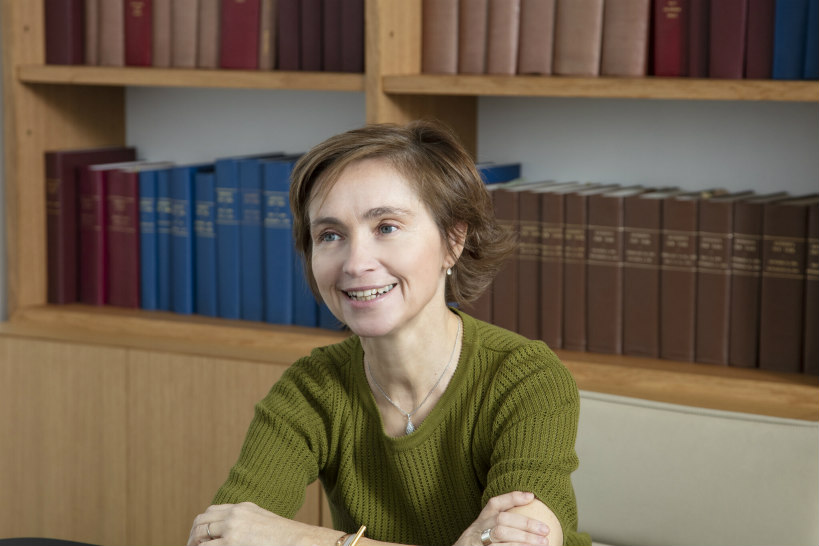
ART ELEVATES YOU EVERY DAY. Cécile Verdier is President of Christie’s France. She graduated from Sciences Po and Art History at Paris IV, before spending 4 years at Christie’s as Head of Valuations then moving to the 20th Century department, in parallel of taking the hammer for Christie’s France since the inauguration sale in 2001. From 2008 to 2018, she was heading the 20th Century Design Department globally at Sotheby’s and Vice President of the French office at the end of her tenure. In 2019, she came back to Christie’s as President for France.
You can listen to the podcast of this interview here.
Cécile Verdier, were you passionate about decorative objects from a very young age and did you dream of the life you are living now?
From a very early age, I was interested in art and have been lucky to see a lot of it through family members, even if my parents were not collectors. Then, it is really when I was at Drouot that I discovered the world of objects. I did not plan on becoming an auctioneer but very early I have been impressed by this fantastic world.
Now that you are President of Christie’s France, are you still an active auctioneer?
I have three different hats. I run the Paris office, which regroups about 150 to 200 people, I am an auctioneer and 20th-century design specialist. Christie’s Paris is a much smaller office than London or New-York, therefore I work closely with everybody, including all specialists to find deals. My job is to make sure that Christie’s France embodies the global vision of the company but also to develop its specific identity due to our French cultural landscape. The company being owned by François Pinault for more than 25 years also gives a specific position to the French office. Thanks to our size, we can act as a laboratory that can try and implement very quickly new initiatives.
“An auction house is rightly called a house, not an auction company. We are a home.”
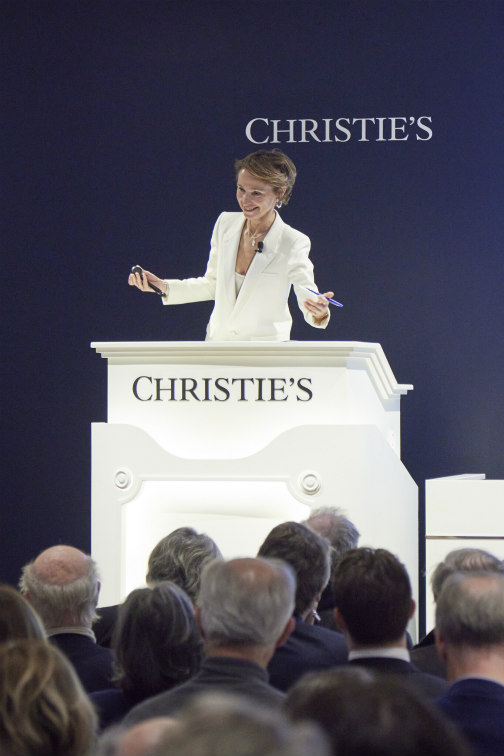
Cécile Verdier, President of Christie’s France, Auctioneer, Sale ‘Barbier-Mueller: Art as Legacy’, 6 March 2024 © Christie’s images limited
Cécile Verdier, why do you still do your original job as an auctioneer and specialist?
Remaining a specialist and an auctioneer enables me to keep an overview of the market on the ground, from the first contact with the vendor to the resolution of the sale. It also enables me to stay close to collectors and advise them and be able to say to a client: “This is not at your level, it’s nice for us to sell, but honestly it’s not something you should be looking at for your collection.”
Some people say that clients are more important to an auction house than objects, but if you have an extraordinary Picasso painting to sell, surely you will find a client?
Yes, we need objects and we need clients; but if you have no clients, you have no objects. We are an art business, but we are also a people business. It’s about the trust you build with people, whether they’re buyers or sellers who entrust you with selling their collection. It’s one of the most human jobs there is, because it’s about the way you build those relationships. The medium between people is art, but it’s all about people. An auction house is rightly called a house, not an auction company. We are a home.
Do you get business by being aware of estates that come on the market when people die, or do clients simply come to you without you looking for them?
Both ways exist, but it’s still about the trust clients place in the Christie’s name, the trust that has been built up over the years with our reputation and the heritage of our auctions. That is what we do every day, with excellence and expertise. Some people who come to Christie’s don’t know anyone, and at the same time they come to you as a person because they know you and trust you. So, it is both trust in Christie’s and trust in Christie’s individuals.
Is there a lot of competition between auction houses?
There is. In France, you have Christie’s and Sotheby’s, but you also have a lot of smaller auction houses: Drouot in Paris is not an auction house by itself, but a place rented by individual auction houses that share the space. The business is very competitive, but perhaps more so in France than in the UK or the US, because there are so many different people working in this environment. Our business in France is also linked to notaries managing estates. They keep links with smaller auction houses because they traditionally conduct the valuations after estates, taking care of all collections whether it is a large collection of paintings or just an apartment full of ordinary things and furniture.
Including art dealers, who set the price of a painting and sell it for that money, whereas at auction it might sell for a much higher price or not at all?
A client may prefer to go to an auction house to be sure to get the best price, due to the transparency of the transaction between the vendors and buyers in an open market. At the opposite, a dealer is buying to resell the piece with profit, when Christie’s is only acting as an agent. We also remained intermediaries in private sales deals, an activity that has developed in the last years after covid and that is becoming very important part of Christie’s business.
Now that you are President of Christie’s France, how do you intend to grow?
There is a big difference between masterpieces like Magritte’s Empire of Light, which fetched over $100 million at Christie’s NY last autumn, and the daily open auction house. At Christie’s Paris, the average price last year was around €70,000. For the last five years I have been trying to develop the idea that you can find something at Christie’s from €5,000, so I am developing the price point but also the spirit. I remember very well how different Christie’s was in this very building twenty years ago, because I was there at the opening.
When you were head of the valuation department?
Yes, and at the time the message was that you should come to Christie’s because it’s a free museum, you don’t have to buy a ticket, it changes every week and it’s a fantastic way to discover art. That is obviously still true, we welcomed 40,000 visitors to our exhibitions in 2024, but now the way we are approaching art in a very different way. We are still selling classical art, but also have enormously developed 20th/21st Art, which now represents about two third of the market, and gave visibility to a larger range of art. But the difference lays also in the way we present art. In fact, the moment I rejoined Christie’s five and a half years ago, we had the opportunity to expand our space downstairs with a large, windowed gallery on the corner of Avenue Matignon, so you could see from outside what is happening at Christie’s and encourage you to come in. We also offered our space to younger contemporary artists and designers, sort of “cartes blanches”. This enables us to promote Christie’s as an artist’s house, to offer a wider price range to collectors and to discover new artists.
“You can hear English being spoken all over the city. Paris definitely became more international.”
Cécile Verdier, what else do you want to change about Christie’s?
We will continue to sell art, we are an art auction house, so when we sell a handbag, we sell it as a work of art and not just as a bag. We sell luxury goods, but as art, because we really believe that art is something different from luxury, and it is something that elevates you every day to give another dimension to your life. Our purpose is about bringing art to the life of our clients. Art is not always worth 50 million. You can buy a very nice piece of art for 1000€ at the flea market, at Drouot, and starting at about 5000€ at Christie’s.
Your auction house sells famous paintings and sculptures, of course, but now it also sells cars, jewellery, handbags and so on?
We have been selling jewellery for centuries (from the sale of Madame du Barry jewels), handbags for more than 10 years and we indeed recently renewed our activities of selling cars with the acquisition of Gooding. The luxury departments, including wines, have been existing for a very long time but expanding in the recent years. Other specialities have also developed, including 20th Century Design, which started with the sale of Arts and Craft and moved to selling more contemporary creations. The appetite for Design can be explained by many factors, notably the fact that it is more accessible financially and intellectually. Design is a fantastic way to get into art. This shift starts from the beginning of the 21st century, giving a collectible aspect to many contemporary design pieces whereas the classical market has largely fell. However, if a collection succeeds in mixing classic furniture with more contemporary art, it often raises the interest of our collectors. The best example is the Givenchy auction in 2022. Hubert de Givenchy was a classical collector, but he mixed Giacometti sculptures with decorative objects and contemporary art.
Did the Givenchy sale revive interest in classical art?
Yes, and since then a few collections that came on the market – the Ann and Gordon Getty Collection or the Rothschild Masterpieces – have aroused a new interest in classical art. There is a taste for quality, and now clients and collectors really like to mix more and more. We have always said that people like to mix, but now the understanding of how to mix – with an African piece, for example – has developed a lot. At the same time, there is a taste for memories and roots. When the young maitresses de maisons, French women between 35 and 40, show their homes on Instagram, there’s not so much design, it’s much more about classic art.
Why do people like to have a piece that belonged to Hubert de Givenchy or a Rothschild or other people like that?
Art is about people, as I said at the beginning. It is a connection between two people, from one human to another. You love the piece, but you love the story behind the piece, and more and more people are thinking that way. It is also a way of reassuring yourself about authenticity. Provenance has always been something that people value, to have the traceability and the history of a piece, but now it’s more than that. It’s like the collector spirit that you put on a piece, whether it’s a painting or an object, to know that it has been owned by Colette, Hubert de Givenchy, Yves St Laurent, etc.
Do people buy for investment or for love?
Some are real collectors, some are investors, and some are just furnishing their homes with high-value pieces. Old Master drawings are a collector’s world because it requires precise knowledge and research, it is quite intellectual and really the domain of the connoisseur. Whereas in the 20th century design market, you have all ranges of artworks, from a unique piece by Eileen Gray to Jean Prouvé more affordable desks, attracting all kind of collectors, from investors seeking for a brand name to real amateurs.
Paris is having a renaissance in terms of art exhibitions, but are the people who come to your auctions mainly French people living in France, or are they people from all over the world?
Christie’s has four auction salerooms around the world: New York, London, Hong Kong, and Paris. As a global auction house, our buyers in Paris are coming from all over the world – more than 90 countries last year. After Brexit, Paris has benefited from a global Renaissance, with all major art galleries opening a branch in town here on Avenue Matignon as it is more efficient to target Continental Europe clients. The transformation of the FIAC, the Paris International Contemporary Art Fair (Foire Internationale d’Art Contemporain) to Art Basel Paris is another example of this global shift. Therefore, we developed our activity in parallel. For some European vendors, it becomes easier to sell in Paris, in terms of shipping, paperwork, and sometimes even taxes. So, it is true to say that Brexit has brought us some business. Last October, all the collectors in the world were in Paris, and we did 85 million euros during the week of the fair. Everyone was here and the atmosphere in the sales was fantastic.
What did you sell the most?
Italian Art. We relocated in Paris the Italian art sale, which initially took place in London for twenty-five years. For our Italian collectors, it is easier to sell in France, as mentioned above. We also presented more contemporary artist that we used to present only in London or New-York in the past, like Baselitz, Kiefer and Polke, which reflects the internationalization of the Paris scene.
Paris has really changed?
Yes, we have seen it coming for a couple of years, but last year was a real push with the Olympics and the success of the Art Basel Paris edition. Six years ago, when I had a full year off, I planned on seeing all exhibitions in town, but couldn’t as there were so many. There is still a very specific French art ecosystem including, dealers, antics furniture galleries, flea markets, decorators, restorers, on which the art market relies. But it has expanded to many more layers and younger generations and artists. You can hear English being spoken all over the city. Paris definitely became more international.
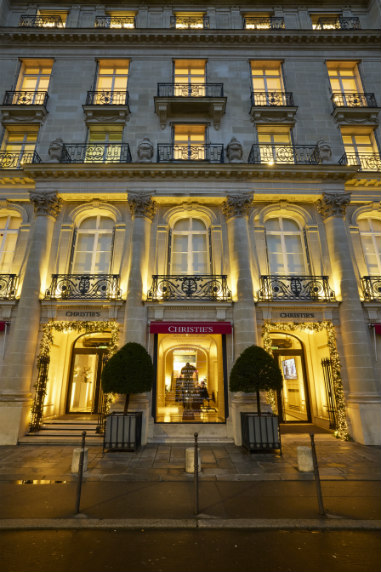
Façade of Christie’s France, Christmas 2024 © Christie’s images limited, Ana Buklovska
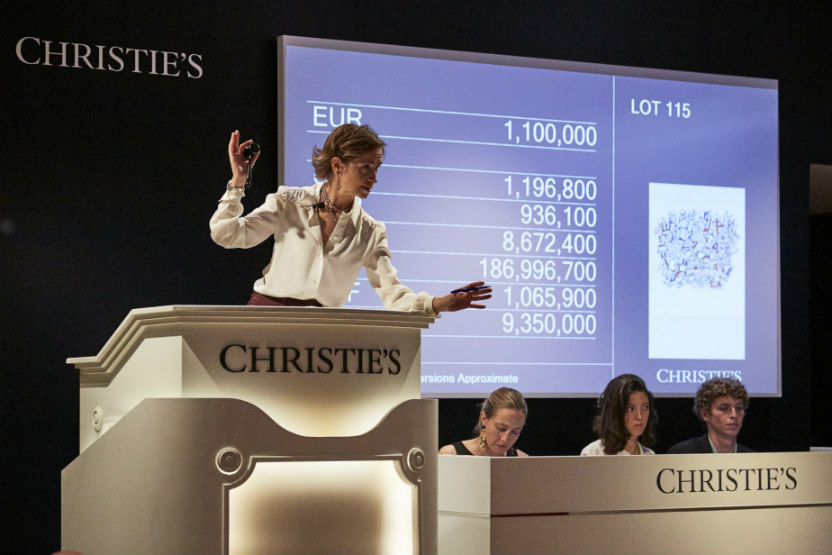
Cécile Verdier, President of Christie’s France, auctioneer auctioning Lice tapisse (1972) by Bernard Dubuffet, sold for €1,371,000 from the Renault Collection, A step ahead 6 JUNE | VENTE LIVE 23440 © Christie’s images limited
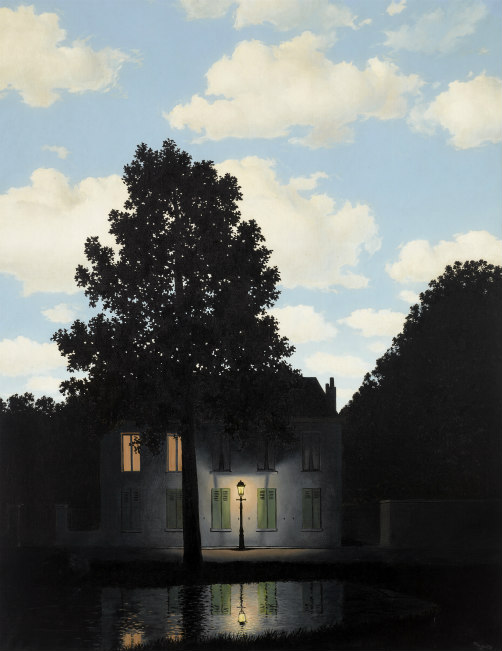
RENE MAGRITTE (1898-1967) The Empire of Enlightenment, 1954 Oil on canvas 145.4 x 113 cm Price realized: USD 18,810,000 Estimate : 6.000.000 – 8.000.000 USD © Christie’s images limited

9 APRIL | VENTE LIVE 22924 Impressionist & Modern Art LOT 13 FRANCOISE GILOT The Country Concert Oil on panel, 130 x 162 cm Executed in 1953 Estimate: €200,000 – €300,000 Price realised: €1,310,000 World record for a work by the artist © Christie’s images limited

3 DECEMBER| LIVE SALE 23005 LOT 68 DIEGO GIACOMETTI Promenade des Amis’ console, Bronze with patina; glass. 88 x 121 x 35cm. Made in 1975 Estimate: €1,500,000 – €2,000,000 Price realised: €9,480,000 World record for a work by the artist © Christie’s images limited
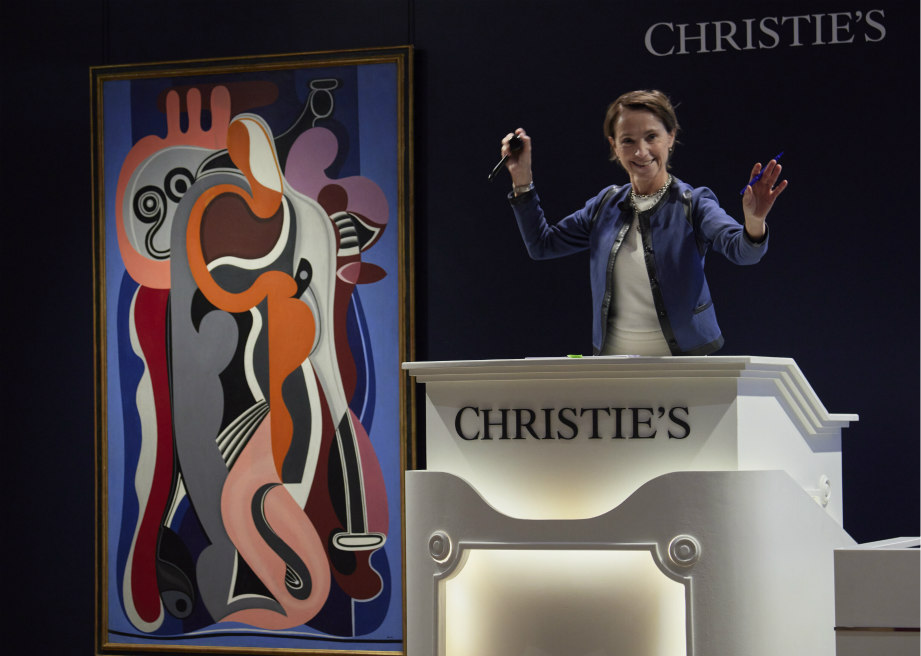
Cécile Verdier, President of Christie’s France, auctioneer, auctioning Composition (1928-29) by Auguste Herbin, sold for €252,000 from the Crémieux Collection, a private passion,© Christie’s images limited
“There are no bad questions. “How much do you think it will cost?” is always a good question to ask.”
Cécile Verdier, what is the difference between Sotheby’s and Christie’s these days?
I am not in the position to speak about competition, but it is for sure a reality that Christie’s has been owned for more than twenty-five years by François Pinault a real collector, and it is a big plus. The Pinault family is very attached to Christie’s, where they come frequently, and they each have different fields of interests. Do not forget that Mrs Pinault has been a dealer in classic furniture a very long time ago. Christie’s is not just an investment for our owners, it’s part of a larger ecosystem. Our results have been very strong in Paris in 2024, plus 24% compared to the results of 2023.
How do you make valuations?
We need to understand the market, observe the changes that happen very quickly from one season to the next. So, we use comparables, knowledge of the work of each artist, we work very collectively with our colleagues regarding estimates. To understand the market, we attend the fairs, spend time with our clients to understand what they want to buy. Estimating is a combination of all that, the smell of the atmosphere from all the conversations and the insights you get from the market and the mathematical reasons for the last sale. Expertise is not only about recognizing an artist piece but also about pricing the works accurately. With a slowdown of the market, it is key to explain to your sellers that we need to adjust the estimates. Sometimes, we say “thank you, but no thank you” to a piece if we think the estimate that the vendor wants it too high.
When you don’t sell a piece, do the vendors complain?
Not if they can see that we have done our best, because anything can happen. You can have a good estimate, but on that day, there are only three collectors for this artist, and one died, a second lost a lot of money on the stock market, and the last one was busy that day. If you have valued and promoted it properly, and if you have spoken to all the clients who are possible buyers for this work, then you have done your job. It is all the mystery of the auction timing. But, sometimes, the planetary conjunction is fantastic: the best example is probably the Lalanne Rhinocrétaire we sold in 2023 (estimated 4-6M€ and sold for 18,4M€). With two bidders fighting for the piece, it ended up doubling the world record for the artist. Sometimes the atmosphere in the saleroom is purely magical, with bids on the telephones, the internet and hands raising in the auction room, like in the old days, when telephone and internet bids were not existing.
When you do your valuation, you estimate in a range of, say, 12 to 15. What does that mean?
It means that we think the result at auction should be within these estimates. It serves as an indication for the buyer of where we think the result will land. However, we use to give reasonable estimates, expecting to achieve a price above the top estimate. But as auction is about competition between bidders, to propose a reasonable estimate is the best way to bring the bidders in and they end up bidding above what they expected to do at the beginning. In other words, it is an estimate, not a limit! We encourage buyers to ask questions to specialists, we are happy to guide them if they seek our advice. There are no bad questions. “How much do you think it will cost?” is always a good question to ask.
Do you have a relationship with museums?
Christie’s specialists have developed very good relationships with museum curators in their fields, some of them even studied together. We are much closer to the curators than we used to be when it was two different worlds. Now they understand how much we can bring to them in terms of knowledge or research about the provenance of pieces in their museum. My job is to connect very regularly with the Heads of these institutions to understand their needs. On a personal side, I have been on the board of the Musée des Arts Décoratifs in Paris for ten years. It’s very different from what I do at Christie’s, but it’s a fantastic way to be involved in museum life. Being at the helm of Christie’s has given me a really deep understanding of how we are part of something bigger than just the art market.
Are you involved in fundraising?
Christie’s is buying tables at all museums galas to participate to the fundraising. On a personal side, for the Musée des Arts Décoratifs, I am promoting the museum within the community of collectors to bring their supports.
Is the major David Hockney show in Paris at the Fondation Vuitton in the spring of 2025 linked to your auctions?
No, there is no direct link. But it is true that an exhibition devoted to an artist participates in revisiting their art and refreshing the interest of the market. However, even if our Italian sale was organized in parallel of the Arte Povera exhibition at La Bourse de Commerce, reflecting the interest of the moment, we cannot tell if it has a real influence of the results at auction.
Thank you Cécile Verdier.
Leading portrait of Cecile Verdier © Francesca Mantovani
All images courtesy of Christie’s.
ENJOY THIS INTERVIEW? SHARE IT WITH A FRIEND


