

CREATING A CULTURAL HUB. Nancy Olnick and Giorgio Spanu are the co-founders of Magazzino Italian Art, a museum and research center dedicated to postwar and contemporary Italian art that is located in Cold Spring, New York. Magazzino opened in 2017 at the former manufacturing site of Cyberchron rugged military computer systems. The name Magazzino translates as “warehouse”.
You can listen to the podcast of this interview here.
Giorgio Spanu, you are Sardinian, which is not exactly the same thing as being Italian, and your wife Nancy is a New Yorker. Please tell me about your encounter with Nancy?
Nancy and I met in New York. We are both born on an island. I was born on the island of Sardinia in the town of Iglesias, while Nancy was born on the island of Manhattan, which is part of New York City. Sardinia is bigger in territory and New York is way bigger in population, however they are both surrounded by water, so that is what Nancy and I have in common. We are two islanders and we both love waterways.
Is this why you decided to find a home along the Hudson River?
That was going to be our family weekend house. We moved to the Hudson Valley in the fall of 1990. The foliage was at its peak when we entered Cold Spring, this little village that is part of Philipstown, and the next day we went for breakfast in a local small café called Karen’s Kitchen that does not exist anymore and were served with a wonderful cappuccino. The foliage was perfect and the cappuccino too and we said, maybe we have found the right community. We initially rented a house, and then we ended up buying a property that had a small log cabin.
Today this is the site of Casa Olnick Spanu?
Yes, in 2004 the log cabin was replaced by a house known as Casa Olnick Spanu, built by the Spanish architect Alberto Campo Baeza. The site hosts some of our collection of Italian art. We started an Italian artist residency program and until 2015 every year we invited a young mid-career Italian artist to develop a site specific artwork for the land that surrounds our home.
“Magazzino made the step that has made Arte Povera better known today.”

Giorgio Spanu, why did you become important collectors of Murano glass?
This was absolutely not intentional. The first piece of glass that we purchased was an hourglass that Nancy spotted while I was purchasing the catalogue for a contemporary art sale at an auction house. She saw this beautiful hourglass in one of the vitrines, showed it to me and I probably said that was French glass. The person in charge of the auction sale in the back told her, “No, this is not French. This is actually Italian, and it was made by Venini.” “Wow!” Nancy said, “Venini is a very prestigious Muranese glass maker.” For me Murano was not an artistic creation, it was more something made for the tourists, but thanks to Nancy, who is a visionary, we started our research.
What did you discover?
That Venini was in fact a very prestigious glass maker. I went on a business trip for a few days and when I got back to the apartment in Manhattan I saw on the window sill that was facing the East River 5 or 6 pieces of Murano glass. Nancy told me she went to 50/fifty a design gallery located in New York City and found additional pieces of Murano glass to accompany the hourglass that we had just purchased, and that was the beginning of the collection.
Did you go back to Italy in search of Murano glass?
From that moment, since the beginning of the 1990s, Nancy and I started going to Italy at least four times a year in search of Murano glass. We met a very young, tenacious, talented and friendly gallery owner, Sauro Bocchi, who suggested that Nancy and I go to Rivoli to see contemporary Italian art. We followed his instructions, took a train to Torino, stayed the night and drove to Castello di Rivoli, where there was a remarkable exhibition curated by a Dutch curator, Rudi Fuchs. Every single piece that we saw was absolutely stunning.
Until then you knew nothing about the Arte Povera movement?
We had no idea what Arte Povera was. We were sent there to see contemporary Italian art. When we got back to Rome, Sauro’s first question was, “Who was the artist that you liked the most?” We looked at him and said, “We liked them all. There was no one that we did not like. We love the exhibition. We love the artworks.” And he said, “You have just seen one of the most spectacular Arte Povera exhibitions that has never been done before and is curated by Rudi Fuchs.” And we said, “Sauro, how can we get to know more?”
And how did you?
Nancy and I always try to educate ourselves in something that we don’t know. Sauro lent us several books and also took us to a gallery in Rome run by one of the pioneers of contemporary Italian art at the time, Mario Pieroni. We immediately purchased 6 or 7 pieces of art by Giovanni Anselmo, Alighiero Boetti, Luciano Fabro, Mario Merz, Giulio Paolini, Gilberto Zorio, and the others followed immediately. So we pretty much had most of the 12 artists that we started collecting immediately after the visit to Mario Pieroni.
The 12 leading Arte Povera artists are Giovanni Anselmo, Alighiero Boetti, Pier Paolo Calzolari, Luciano Fabro, Jannis Kounellis, Mario Merz, Marisa Merz, Giulio Paolini, Pino Pascali, Giuseppe Penone, Michelangelo Pistoletto, and Gilberto Zorio.
Into this group, we have also added Piero Gilardi whose work we have grown to love. Magazzino hosted a wonderful exhibition of Piero Gilardi two years ago. So for us, the Magnificent 12 are now 13 and gradually we have purchased each one of them. We started the collection of Arte Povera knowing nothing and loving a lot. We realised how much need there was to display, to share, to bring this art to the United States. In fact, in those years very little was known in America about this group of artists. I have to add that we did not have it easy at the very beginning, showing these artists and this art to our friends. Magazzino made the step that has made Arte Povera better known today.
“Magazzino will never stop displaying the 13 heroes that we have in the group of Arte Povera, so the original ‘main building’ will always remain a museum dedicated to Arte Povera.”
Giorgio Spanu, how would you define the Arte Povera artists’ work relative to Pop Art or abstract or conceptual art?
They do not relate. They all were very much socially engaged, with very big ties with the Italian academies. Fabro, for example, was a teacher at the Academy of Brera in Milano for many years. Pistoletto was the first to have international recognition, thanks to an exhibition organized by Ileana Sonnabend in Paris. Outside Italy most of the collectors of Arte Povera were in Northern Europe, especially in Switzerland and Germany, thanks to Galleria Christian Stein and several other galleries. These artists all continued to work individually, even if they were part of a group, and each one of them expressed his own way of doing art. The Italian art historian Germano Celant was the one who really put them together as a group for the first time (from September through October 1967) at Galleria La Bertesca in Genova. He always supported their work and wrote about them, and Germano was a big supporter of Magazzino. Germano loved Magazzino and we loved Germano.
Why is it called Magazzino?
Originally we stored the artworks in a storage warehouse in London. In fact, the first exhibition in which our collection participated was organised by the director of the Italian Cultural Institute in London, Mario Fortunato. Simultaneously the Tate Gallery London was doing an exhibition. That was the very first time that Nancy and I realised that we had a collection of Arte Povera. As time went by we felt the necessity to share this art with our friends, as we had done with the Murano glass through a series of museums in the United States, in Italy, Belgium, and also thanks to Pentagram Stiftung / Le Stanze del Vetro located in the island of San Giorgio Maggiore, Venice, that has exhibited many of our Murano glassworks in the multiple exhibitions (curated by Marino Barovier) that they have organised over the past 25 years. The same was necessary for Arte Povera.
And you designed something specially?
As the Arte Povera artworks have a tendency to be larger in scale, this L-shaped building that we found in Cold Spring, NY, and that had been built in the late 1950s was perfect. Its first incarnation was a centre for the bottling of milk that was distributed locally, and then it was some sort of military facility building rugged computers for the US Army. As they had stopped producing the facility became available. The original idea was to give it a coat of white paint, move in the art and start showing it to our friends. We gave this assignment to a New York based Architect Miguel Quismondo, who is not only an extremely talented architect, but he’s also very creative. He showed us a beautiful project that included the main building of Magazzino that was made out of concrete to host the Arte Povera, and by connecting the L-shaped building with the new building he created an internal space suggesting a piazza in a small town in Italy.
And you gave him the assignment?
Yes, thanks to Nancy’s creative vision the project went on. We discussed it further with the architect and we gave him the assignment. He came up with a beautiful construction, a magnificent space to display the art, and the American Association of Architects in New York awarded the construction several Chapter awards for the architecture. Immediately Magazzino started drawing in a multitude of visitors coming from New York City and the local community, but also from abroad. For some reason unknown to us, it became very popular not only with Italians but also with Koreans, both for the architecture and for the art. And there was the beginning of Magazzino. 2017 was the opening, and around 2020, 3 years after, we realised that it was never conceived to be a museum, it was conceived to be an exhibition space where we would have a certain amount of visitors, but we didn’t have an educational center, a cafe, we didn’t have a facility to organise the art, and we didn’t have storage.
You then added the Robert Olnick Pavilion and the very well appreciated Café Silvia with the famous chef Luca Galli?
This project was opened in 2023 and the cafe has totally changed the dynamics of the museum. Now visitors can rest between the visit of one building and the other. In the newly built Robert Olnick Pavilion we do not necessarily exhibit Arte Povera, but other post-war Italian artists that in the course of years we have added to our collection. Several of them are from the school of Piazza del Popolo. The opening exhibition that we did for the Pavilion was dedicated to Mario Schifano, an artist that is part of that group, which also includes Tano Festa and Franco Angeli. We also collected other artists such as Carla Accardi, Giosetta Fioroni and Maria Lai. We have collected much of the work that was made in those years, and now we are starting a new programming (with the supervision of the new Directors Adam Sheffer, Paola Mura and Nicola Lucchi) that will permit us to show all these artists in the Robert Olnick Pavilion. Of course, Magazzino will never stop displaying the 13 heroes that we have in the group of Arte Povera, so the original ‘main building’ will always remain a museum dedicated to Arte Povera.

Nancy Olnick

Robert Olnick Pavilion
Alberto Campo Baeza & MQ Architecture
Photo by William Mulvihill Courtesy of MQ Architecture
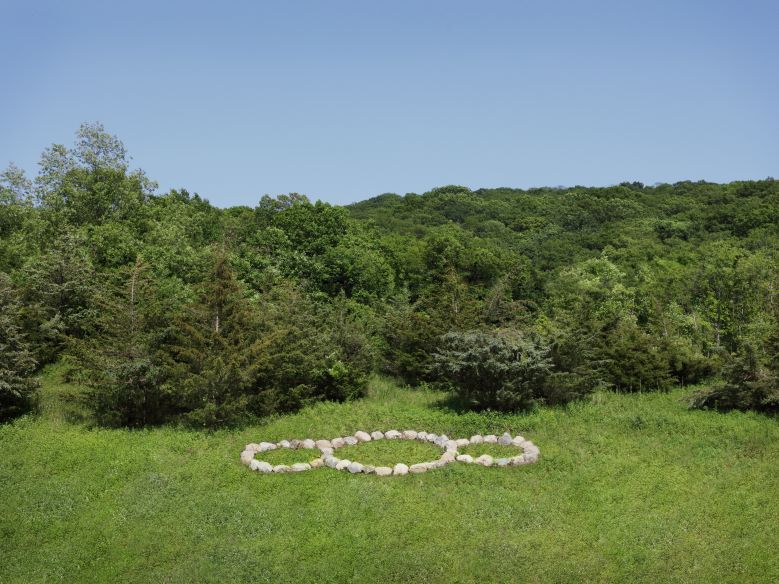
Magazzino Grounds: Michelangelo Pistoletto – Terzo Paradiso.
Photo by Marco Anelli / Tommaso Sacconi

Magazzino Italian Art: Arte Povera installation view.
Photo by Marco Anelli / Tommaso Sacconi
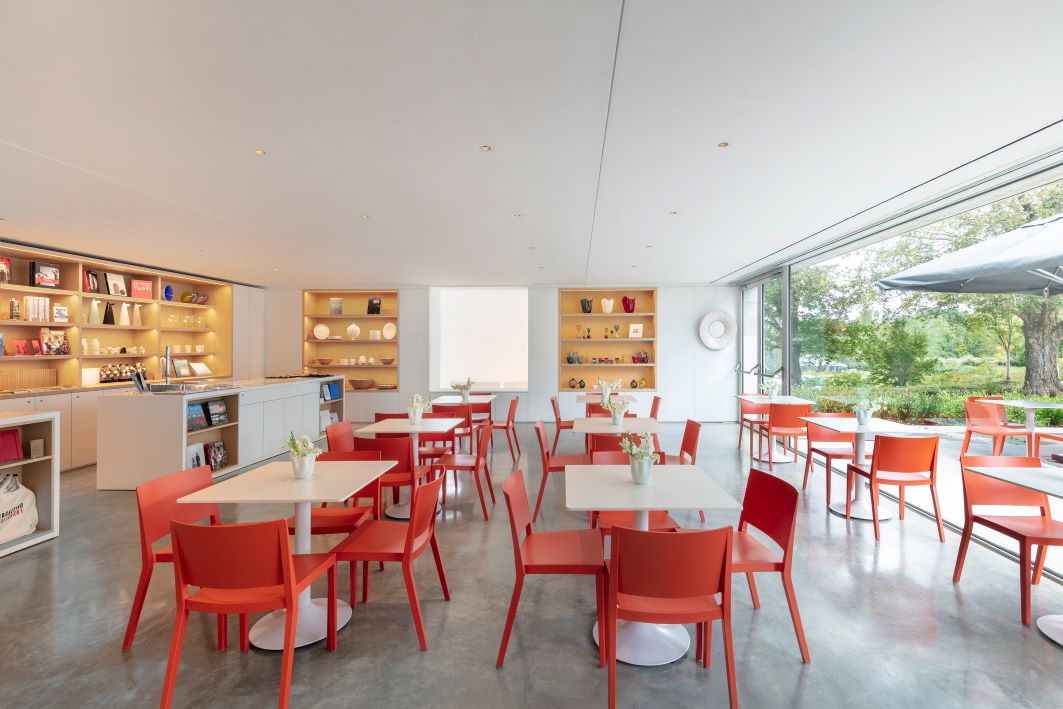
Café Silvia and The Store
Photo by Marco Anelli / Tommaso Sacconi

Magazzino Italian Art: Sardinian Donkeys
“The donkeys in Sardinia were on the verge of extinction and were under very strict protection with laws that would not allow their export outside Sardinia.”
Giorgio Spanu, you also have many publications and archive material so people can come and research and study?
This is another very important aspect of Magazzino. When Germano Celant passed away, we dedicated our research center and our library to him. Nicola Lucchi is the new director of education and research at Magazzino Italian Art that operates out of the Germano Celant Research Center. The library hosts over 6000 rare books dedicated to the history of post-war Italian art up to today, which are valuable not only to students and researchers but also to – by appointment – anyone that wishes to enrich his knowledge of post-war Italian art.
Recently Rizzoli published a book of photographs that you commissioned to document the buildings of Magazzino?
We made that first commission in 2014. On the same day we got the keys of the property we were visited by Massimo Bartolini, the artist that in 2024 represents Italy at the Biennale in Venice. At the time Massimo was teaching at UPenn. He called me and said, “Giorgio, could you please open your house? I would like to bring our students to visit your collection of Luciano Fabro.” I said, “Why don’t you go to the local museums in Philadelphia?” And he said, “Because they don’t have Luciano Fabro in their collection and I would like my students to see what you have and what Luciano Fabro represented for the history of Italian art.” I invited him and he came with a huge bus with 44 students and faculty. The driveway of our property was too small to accommodate the bus, so the bus was invited to go and park in the parking lot of the Magazzino to be. We documented the event photographically and some workers were already working, dismantling the front part of the Magazzino, and that gave me the idea of giving an assignment to Marco Anelli – an incredibly talented photographer – to document the making of Magazzino, but also to document the people that have made it possible: the workers, from the simplest of the gardeners to the highest of the engineers and architects. Everyone was photographed, and that was part of an exhibition that was initially presented in Cagliari, and recently for the opening of the Robert Olnick Pavilion at Magazzino Italian Art that was curated by Paola Mura, our new artistic director. It is a wonderful, beautiful book, and it was very highly received by both the local community and also the art critics.
Magazzino has grown into a cultural hub?
Yes, we no longer only represent a segment of the Olnick Spanu collection, but a place where you can come, learn and educate yourself on cultural Italian life going from the post-war to our days. We recently presented a wonderful book on the work of Luciano Fabro written by Margit Rowell, and I’m very proud of this because for me the work of Luciano Fabro is very important. And it is very important that Magazzino continues to present not only art, but publications that will allow people to study and know more about Italian art of the post-war period.
You also created a landscape around Magazzino where you have a Giuseppe Penone sculpture, a Domenico Bianchi sculptural bench Panchina, two Handkerchief chairs by Massimo and Lella Vignelli, an artwork by Michelangelo Pistoletto symbol of Third Paradise, a sculpture by Namsal Siedlecki, but also something which is a different kind of art. How come you have a stable of Sardinian donkeys?
Sardinian donkeys are very peculiar. They’re very special. They’re very different like Sardinians are. Sardinians are and will remain Sardinians. Many different invaders have tried to make us look like them, starting from the Phoenicians, the Romans and the Spanish, who remained the master of the island for close to five centuries. The Piedmontese Savoy was the King of Sardinia before becoming King of Italy. And last but not least, the Republic of Italy. So yes, Sardinia has a special status.
How different are Sardinian donkeys?
Very different. When I was a little boy, I used to see a lot of these donkeys that were widely used in the nearby farms, and my grandmother was a big fan of donkeys. A local farmer would come in the village where we lived every single day with a small cart full of fresh produce pulled by a donkey. We didn’t have a fresh produce store in the small village of Masua, which was in the mining system of Iglesias, and I still remember this little donkey coming every day and on the way back up it was very hard for him to pull the cart. All the boys were called to help push this cart in exchange of the reward of a piece of fruit and we all loved the fruits and the donkey. I particularly fell in love with the donkey, and at one point when we decided to devote part of our property in Garrison to a farm I felt the obligation to have a Sardinian donkey to share with my daughter Stella, as I had the opportunity to have when I was a child.
How did you get them?
The donkeys in Sardinia were on the verge of extinction and were under very strict protection with laws that would not allow their export outside Sardinia. When I first started looking for the donkeys in the mid-1990s there were less than 300 in the entire island, whereas in their census of 1938 they were close to 50,000. That was a big shock. But America is the land of opportunity, and a very wise gentleman had imported 18 of them from Sardinia to New England in 1936. I traced the family and I asked them if they could sell me a pair. Initially, they said, “No, absolutely not. We don’t sell our donkeys.” They moved to Texas, and later I was able to convince them with a presentation on the history of the Sardinian donkey, and they agreed to give us Chip and Voile – the only two donkeys that had non-Italian names – and they were my gift to my newborn daughter, Stella. They arrived the evening of Christmas, and what a great Christmas gift that was! Since then they have been part of our daily life.
Now they are at Magazzino?
They were immediately a huge success. They become as famous as Arte Povera. We realised that not only were they loved, but people wanted to get more and more involved in their lives, so every time there is a newborn we run a contest and ask our followers to give us an idea of the name. We start naming them all with a D. D as in donkey. The last one has some sort of Spanish name, because his name is Donqui Xote. So it is very creative. But they have names like Dante, Dino, Donatello and Donatella, Dolce, and now we have 14.
So now you need one more Arte Povera artist because of them, you have only 13?
You are the first one to tie the artists of the Arte Povera with the donkeys. That is something that needs to be investigated. Let’s ask our followers on social media.
What about adding in the artist called Salvo, Salvatore Mangione, who is well-known in Italy and has exhibitions everywhere?
We have a beautiful work by Salvo in the collection, so why not make Salvo the 14th. It is an Italian flag that he made when he was sharing his studio with Alighiero Boetti. We should also not forget that one of the first galleries to exhibit Arte Povera was Christian Stein Gallery in Torino.
The first exhibition Magazzino did was dedicated to the gallerist Margherita Stein?
Yes, because we realised that many of the works that we had in the collection had been in the collection of Margherita Stein, the founder of Christian Stein Gallery. Christian her husband never worked in the gallery, and I don’t know the reason why she decided to name her gallery after her husband, but I know that the work that she did for the divulgation and the protection of the artists and the art related to Arte Povera was immense. Without her, they would not have been able to be so well known. Most of them were represented by her.
You and your wife Nancy have created in America this great jewel Magazzino, and today Arte Povera is recognized as one of the most important movements in art in the 20th century.
I just want to finish by saying that currently on view at the Robert Olnick Pavilion of Magazzino Italian Art we have an exhibition of the Sardinian artist Maria Lai titled “Maria Lai. A journey to America”. I invite you all to come and visit. It is a wonderful exhibition curated by Paola Mura, and it is the work of an incredibly talented artist.
Thank you very much.
ENJOY THIS INTERVIEW? SHARE IT WITH A FRIEND.


