BETWEEN WORLDS. Priscilla Rattazzi was born in Rome in 1956, attended Atlantic College in Wales, UK, and moved to the United States in the 1970s where she studied photography at Sarah Lawrence College in New York. The themes of her recent London solo exhibition, titled Between Worlds and at Robilant+Voena, offer a reflection of the photographer’s life, with an interlinking chronology, examining human relationships, and relationships between people and their dogs, while suggesting the increasingly profound reassurance of nature as an eternal point of reference, especially in uncertain times.
You can listen to the podcast of this interview here.
Priscilla Rattazzi, why did you want to be a photographer?
It’s something that I liked to do as a teenager. I fell in love with photography while I watched Michelangelo Antonioni’s movie Blow-Up, about a photographer in London in the swinging 60s played by the actor David Hemmings. The scenes of him in the darkroom and as a fashion photographer all seemed incredibly cool. I had an artistic bent, but at Atlantic College I was not particularly good at drawing or painting and so I decided that photography might be what I should try. My mother gave me a Nikon camera and I started shooting film, and I fell in love with the darkroom at the school’s Lady Anne Tower, where I spent a lot of Saturday afternoons developing my own film and printing my work.
What was so attractive about the darkroom?
There was something fantastic about the darkroom, because a darkroom obviously is dark but there was this yellow light that made that made it very dim. You could still see, but it was all very mysterious and magic. When you developed film you had to be in complete darkness, and the film was in a canister that was completely dark, but when you were printing photographs, then you could have the yellow light. You would put the negative in the enlarger which projected onto a board below where you would put in photographic paper, and then count the seconds: one, two, three, four. Then you took the sheet and ran it through various trays: the developer, the stopper, and the fixer. Then the prints were washed and dried in a dryer, usually a drum dryer. It took a long time, and it was magic because you would watch the pictures appear in the developer as you agitated the trays. I did it for about 13 years, then when I became pregnant with my first child the smell of all the chemicals in the darkroom started to bother me and I decided it probably wasn’t particularly healthy for my unborn child, so I stopped.
“I have gone back and forth between worlds, not knowing who I am…”
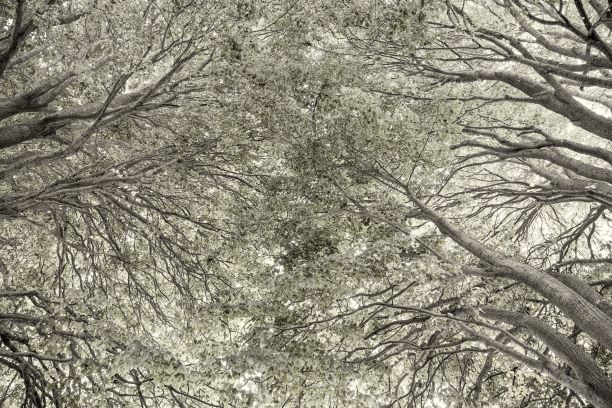
Priscilla Rattazzi: Three Lindens III
Priscilla Rattazzi, nowadays this process of printing in the darkroom has been completely taken over by the computer?
Yes, now it’s all downloading digital files onto computers and looking at the files in various sophisticated programs like Photoshop, or others that I honestly tried to learn how to use but didn’t quite figure out. I now spend time shooting and editing, and delegate the production process of my work.
In your exhibition Between Worlds half the pictures are old fashioned analogue and half are digital. Looking at them, how can you tell the difference?
You can tell an analogue file from a digital file because in an analogue file the grain is different and the grain is called grain, whereas in a digital file the grain is called noise. You can only blow up an analogue file shot on 35-millimeter film to 30 by 40 inches, whereas a raw uncompressed digital file shot with a professional Nikon you can blow up the pictures to the size of murals, 2 x 4 meters. When you decide to go digital, you can print work much, much bigger.
Do you still have the same Nikon camera that your mother gave you?
My daughter is using it now, so I have another film camera I use to shoot portraits because I like the idea that I can put black and white film in my analogue camera and come up with a contact sheet and negatives in black and white. For the last five years I shoot with a new camera called a Nikon Z7, and the files are in colour and then I transform them into black and white, and I find that process unsettling. I would rather start with a black and white file.
In Between Worlds you show Hoodoos from Utah, Three Linden Trees in East Hampton and some special portraits, all in black and white?
Yes, but there’s one in colour, and then the three very large Lindens are not quite in colour and not quite in black and white. I desaturated them, but not entirely, to give them an eerie tint. I wanted them to look ghostly, because the day I shot them was a very difficult day in my life so I decided to do something completely surreal.
You have published several books, starting with pictures of your family members?
In 1982 I did a book for my mother’s 60th birthday called Una Famiglia in black and white. After I did that book, my mother said to me, “You know, you’re talented.” I said, “Thank you.” Four years later, I became pregnant with my son, and after he was born I wasn’t able to take magazine assignments any longer. It was too hard for me to be the mother of a young child and run off and be available to do big shoots for magazines, so I decided I would just do books. When my son turned two years old I decided to do a book about people and their dogs called Best Friends.
Doing this, were you able to control your own schedule completely?
Yes, which was great, and it was fun to do because nobody turned me down. The publisher Rizzoli asked me to make it all about celebrities and their dogs, but I didn’t just want to do that. There were many celebrities, but there were also many people who were not celebrities. My uncle Gianni Agnelli wrote the sweet introduction to Best Friends in which he tells a very funny story about how much he loved his Siberian husky, Dyed Eyes, and didn’t like at all the fact that his dog would die before him. So he bought a parrot. And the parrot ended up being eaten by the dog!
What is the difference between taking pictures of a family celebration and shooting a portrait?
A portrait is much easier to take than a family photo of a large group of people. My rule is the more people there are in a picture the harder it is, because there’s always somebody who’s going to make a face or do something odd. I like to shoot people individually, maybe couples. I like to photograph people who have interesting faces. Alighiero Boetti had a very interesting face because he was a very interesting man. I was with him in Spoleto in 1975 and we were having coffee, and I pointed my camera at him and took just three pictures. As I looked back, I kept saying, “Wow, that’s a good picture of him,” because he had these incredible, very penetrating, very beautiful eyes.
“I only tend to photograph things I love now, and I do my best work when I get upset.”
Priscilla Rattazzi, what motivated you to shoot the prehistoric wildernesses of Utah and their hoodoos?
I went with my daughters first in 2009, and this guide called Yermo took us around. Southwest Utah is a very remote part of the United States – a four-hour drive from both Las Vegas and Phoenix – but there were quite a few tourists. When I went back two years later I asked Yermo to please take us to places where there isn’t anybody else, so he took us to this canyon which is so remote that it is unnamed. He said, “I named it for myself, so we’re going to call it Yermo’s Canyon.” It was quite tricky to get to. He had to help us down a ravine, and then once we got there we went into a basin, and the basin was covered with these rocks called hoodoos, which I was sure were manmade Native American sculptures. In fact, they are nature made, carved by erosion and flash flooding, because these rocks have a soft bottom made of sandstone and a rock on top made of hard rock. As the water rushes through these slot canyons it causes these natural sculptures to happen, and they are thousands of years old.
In this landscape trees are rare?
It’s considered high desert plateau at about 2000 meters, and in Yermo’s Canyon there was very little vegetation. In another place called Wahweap there was some vegetation, and in a photograph called Wahweap Thunderstorm is a very lonely juniper in the middle of this valley. We were the only people there. I never saw anybody else, not even animals, though there are animals and I was worried about rattlesnakes and scorpions, but we didn’t see any.
When did you first show these photographs?
In New York in the fall of 2020 in the Staley-Wise gallery. It was just hoodoos and there were many pictures. I also had pictures of maps and articles about the monument, because what caused me to go back in 2017 was that then-President Donald Trump decided to cut this national monument called Grand Staircase-Escalante in half, to open it up to resource extraction. I got very upset, because I knew that this monument was very special. It had been created in 1996 by President Clinton, and I have never in my life seen such beautiful landscapes of mostly rocks.
Your pictures touched The New York Times so much that they gave you a front page feature in the Arts Section?
Not too many photographers had photographed hoodoos, because hoodoos are very unusual and rare, even though they do exist in arid basins like Cappadocia and Wadi Rum, but also because I made it a political project that could draw attention to the fact that this national monument had been cut in half for no reason that made sense to me. When The New York Times published the article about my show, it was Election Day in the United States – November of 2020 – and then Biden won. He appointed a Secretary of the Interior called Deb Haaland, a Native American woman. She reinstated the two monuments in Utah that Trump had cut in half: Grand Staircase-Escalante, and Bears Ears, which was created by President Obama.
Your “Three Linden Trees” pictures moved the architect Peter Marino, who gave you an exhibition in his Southampton museum of these trees that were in the garden of your house in East Hampton where you raised your children?
I photographed these three trees over the span of 30 years, and the theme was always that I would photograph them through storms, real and metaphorical, as I write in the artist statement of the book that I did with Peter Marino Three Lindens. The three large pictures in the London exhibition are the pictures that I took the last day before I left the property, the two snow pictures across from them were taken in 1996.
In some of these pictures you see all the trees, in some you only see parts of the trees. How did you take these pictures?
I literally just took my camera, lay on the ground under the trees, and pointed my camera up. I wanted to record. I wanted to do close-ups of the trees. For the first time, I noticed that all the branches were intertwined. That’s when I realised that this cluster of trees which stand alone in the middle of this enormous lawn were in fact a family. I have three children and it was symbolic of our leaving the property, the three lindens and their roots. Trees are deeply rooted, especially these trees , which happen to be 200 to 250 years old, and I was being violently uprooted from a place where I had lived and raised my children. I decided that I was going to do something poetic, so I went back the year after and I placed an enormous boulder under the biggest of the three trees and then I put a plaque on it to say, “Whoever owns this property next, please look after these trees. One of them is a champion, which means it’s the biggest tree in New York State.” I signed it with our family name from 1991 to 2021. In my sadness, to do that, made me happy. Those trees were/are deeply personal. I only tend to photograph things I love now, and I do my best work when I get upset. When I went to Utah, I was very upset because the monument was cut in half and that propelled me to take those pictures, and when I had to leave the property in East Hampton, I was very upset. That’s why I put that project together, and as an artist succeeded in turning something difficult into something beautiful.
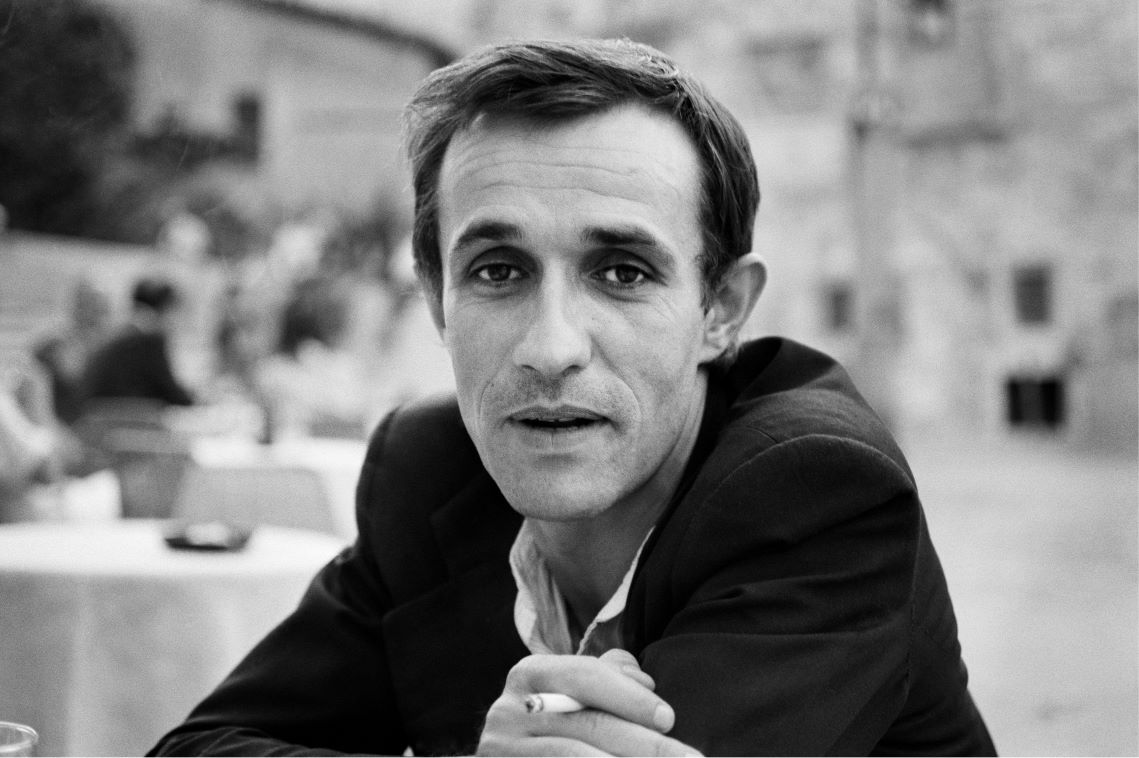
Priscilla Rattazzi: Alighiero e Boetti 2
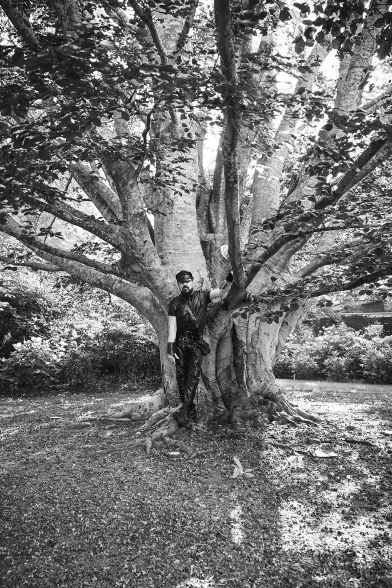
Peter Marino and his beech tree, Southampton 2023
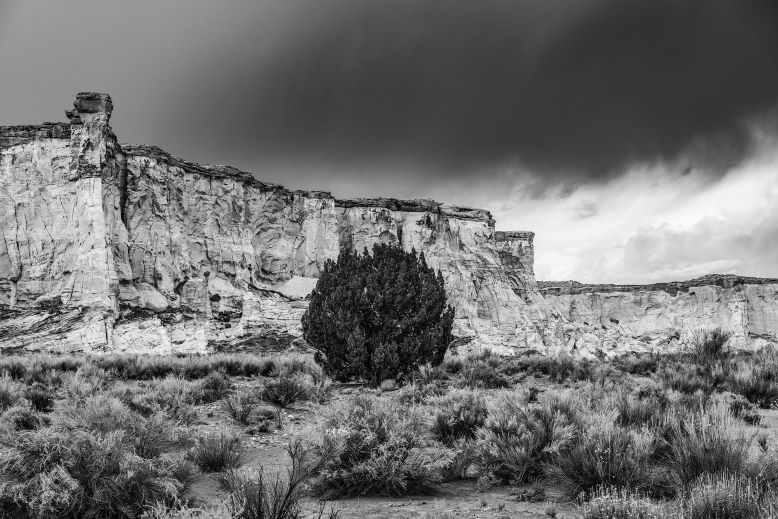
Priscilla Rattazzi: Storm at Wahweap

Priscilla Rattazzi: Alberto Moravia

Priscilla Rattazzi: Three Lindens in the snow 1996

Priscilla Rattazzi: Yermo Canyon III, 2019
“I’m deeply focussed on making sure that I’m a respected artist 20 years from now.”
Priscilla Rattazzi, one sees that in your images you prefer clouds to blue skies?
Typically during a storm or right before a storm or right after a storm, the light is more muted and I much prefer that. I’m very sensitive to sharp light and strong light and contrasty light. I don’t like it. I typically shoot either very early in the morning or at dusk, what I call the indigo hour after sunset. Or if it’s cloudy that’s ideal. When I was in Utah I was praying for clouds, so that the light would be more gentle.
What are your next projects?
I would like to stick to the environmental theme, and since the glaciers are shrinking, I would like to photograph them in Patagonia, also perhaps in Alaska and Iceland. I’ve also had this idea to shoot olive trees in Italy. I would like to have an exhibition in Italy, but I don’t know where or how. I see myself producing more visual work, but also accompanied by words. When I wrote the artist statement for Three Lindens and for this catalogue of Between Worlds, I found the process of writing to be extremely therapeutic. I am in the process of writing a memoir about my life, and obviously, as a photographer, the memoir will be accompanied by a lot of pictures.
You were born in Rome into an Italian family, and moved to Anglo-Saxon countries, England, Wales and America, so spent much more of your life abroad than in Italy?
Doing this project Between Worlds with Marco Voena, Edmondo di Robilant, and the designer of the catalogue Luca Stoppini, and working with Italian men after so many years of having left Italy, has been a very interesting cultural experience, because I really have gone back and forth: Who am I? Am I an Italian woman? I’ve been in America for 50 years. I was married to an American for 30 years. Yes, I’m Latin, but I’m much more Anglo-Saxon than I am Latin, just because of time. Working with Marco, Edmondo and Luca, I realise how much more you laugh when you work with Italians. I have gone back and forth between worlds, not knowing who I am, but in the end the answer is I’m both Italian and I’m American. I belong in both cultures, and I’m comfortable in both cultures.
Is the eye the most important thing for a photographer?
If you don’t have the eye, you cannot be a photographer. I learnt a lot from my mother. She had an eye, but you grow up with an eye, and also in my case it comes from the fact that I was the youngest of six children, and that makes you, by definition, an observer. An eye is being able to observe, and I am a keen observer. I see things that other people don’t see.
What do you say to young people who ask if they should be a photographer?
I tell people it’s hard to make a living being a photographer these days because nobody wants to pay anyone for anything any longer. I was recently approached by a publisher about a picture that I took of the fashion editor Diana Vreeland in 1982. They didn’t want to pay me anything, and I said, “Look, it’s really a matter of principle for me. You have to pay me something.” They are paying me something, but 25 years ago they would have paid me a lot more. The business has been changed so much by digital technology. All my pictures are now searchable on Google, but I don’t even know how to protect myself against copyright infringement. I suggest photography more as a hobby than as a profession. Some photographers have figured out how to do it to make a living and as a fine art photographer it might be easier, but in my case, my goal is to leave some kind of legacy behind for my children. I’m deeply focussed on making sure that I’m a respected artist 20 years from now.
Are you grateful for and happy about your life as an artist?
Yes, I don’t regret anything, I am happy. I’m happy with the transition that I took towards shooting landscapes. What I shoot reflects who I am as a person. I’ve become a bit of a loner. I like empty landscapes. I like deserts. I like the sea. Now words have become very important, and I want to accompany my photographs with my thoughts. The two go together very well, so I would like to do more of that going forward. That is perhaps the difference of when I was younger and it was just about pictures.
Priscilla Rattazzi, thank you very much.
ENJOY THIS INTERVIEW? SHARE IT WITH A FRIEND.