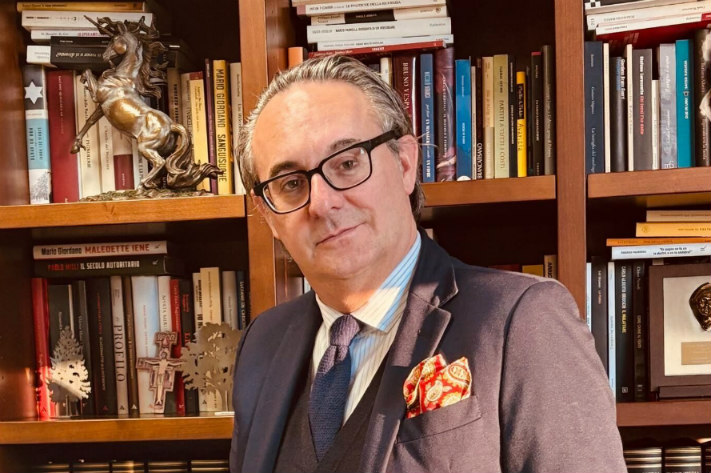
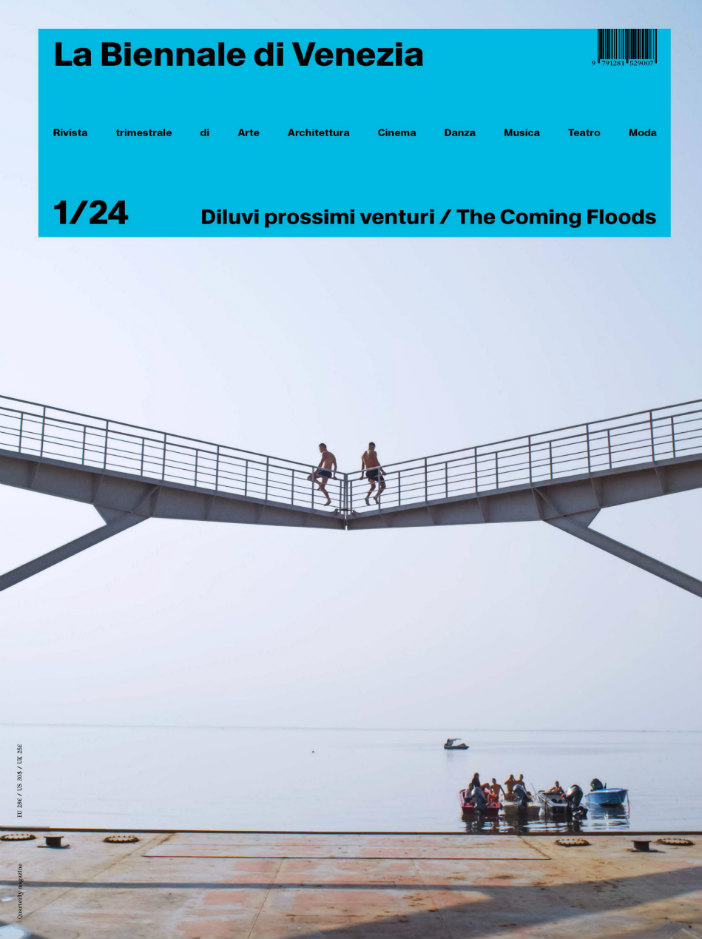
THE COMING FLOODS. Luigi Mascheroni is a well-known cultural journalist and a writer at Il Giornale. He is also the editor of an old and new magazine: La Biennale di Venezia. The magazine was created in 1950 and ran until 1971, with the publication of 68 issues. Now, many years later, the Venice Biennale has decided to revive this prestigious bilingual magazine. The first issue was entitled Diluvi prossimo venturi, in English The coming floods.
Luigi Mascheroni, can you tell us why the directors of the Venice Biennale decided to revive this magazine?
Because the magazine was one of the many excellences of the Biennale, which is certainly the best known Italian institution in the world. For a number of reasons the magazine had gone into hibernation for many years, and Pietrangelo Buttafuoco decided to relaunch it when he was appointed President of the Biennale towards the end of 2023. It was in a way a countertrend decision, because it is a quarterly and international magazine, and only in print, a detail of no small importance. With the revival of the magazine, the Biennale is opening up another field of action in pursuit of its first, major objective: doing research.
Is the magazine closely aligned with the Biennale di Venezia’s Historical Archive?
Yes, it is grafted onto their activities, for which Debora Rossi is responsible. She is also the magazine’s editorial director. This very rich and prestigious archive collects the memory of everything that the Biennale does and has done in the fields of its interest: art, architecture, cinema, dance, music, theatre and fashion. It is an extraordinary reservoir of material to study the past but also to confront the present and the future. Active 365 days a year, it is a true research centre on contemporary arts, whose research activities are also developed in collaboration with other cultural institutions and universities. Indeed, one of the magazine’s ambitions is not only to try to understand or intuit or outline some horizons of what may happen tomorrow, but even the day after tomorrow.
“It is a great opportunity for the Italian cultural world, because an international print magazine of this level is unique.”
Luigi Mascheroni, is the first issue dedicated to water because the Biennale is in Venice, a city built on water?
The theme of the first issue was fitting, not only to pay homage to Venice, where the Biennale is based, but also because, as one of the magazine’s articles is entitled, there are many ‘Venices of Tomorrow’. The survival of many large cities in the world is threatened by rising seas and oceans, and which have to manage their lives on water. For example, the Italian scholar Andrea Rinaldo – who won the ‘Stockholm Water Prize’ known as ‘the Nobel Prize for Water’ in 2023 – tells of other cities that may have the same survival problems as Venice. And like him, there are many personalities from the world of international culture who try to decline the word ‘water’, each in their own field: architects, writers, scientists, artists….
Halfway through the magazine there is a dialogue with Nobel Prize winner for Literature Orhan Pamuk, in which he talks about his memories of water, Istanbul and Venice: one is his own city and the other he has great admiration for.
Yes, the Turkish writer Orhan Pamuk remembers when, as a boy, taking a sip of water was a sign of greeting in his hometown. We liked the idea of sending Stenio Solinas, a great journalist, to the small island opposite Istanbul on which Pamuk lives, to chat with him and have him tell us about his relationship with water. The Istanbul-Venice route is one that he knows well and on which history with a lower-case ‘h’ – like his childhood – and history with a capital ‘H’ is grafted. The history of the Mediterranean, the history of great cities, the history of literature…
Another important intervention is by Cardinal José Tolentino de Mendonça, the Holy See’s ‘minister’ of culture, entitled ‘How to understand thirst in the world’.
Yes, it is a testimony that goes beyond the strictly religious aspect. José Tolentino de Mendonça is Prefect of the Holy See’s Dicastery for Culture and Education, and in his text he proposes a parallel between the aridity from which part of our planet suffers and the spiritual aridity that affects much of the world, especially the West. It is a more philosophical text, which addresses the crisis of great values. It helps to understand what the problems are between science and faith, problems not only of today and perhaps not even of tomorrow, but precisely of the day after tomorrow. The Moroccan architect Aziza Chaouni and the Chinese engineer Kongjian Yu talk about how to build in arid climates, and about the sponge cities project currently being implemented in China which aims to manage rainwater and river water in such a way that it remains a subsistence element for the city and at the same time does not cause flooding. It is a gigantic engineering, urban planning and architectural work that attempts to solve a major problem in China, but which could be the problem of other countries the day after tomorrow.
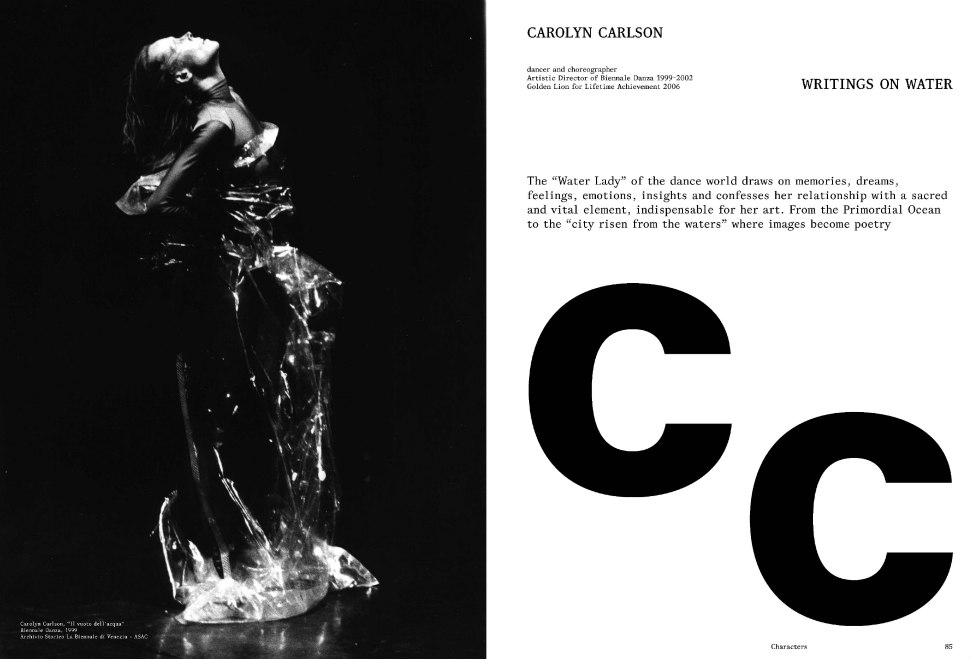
The eclectic people who write or talk about water in this first issue of the magazine include the American choreographer Carolyn Carlson who titles her article ‘Writing about water’.
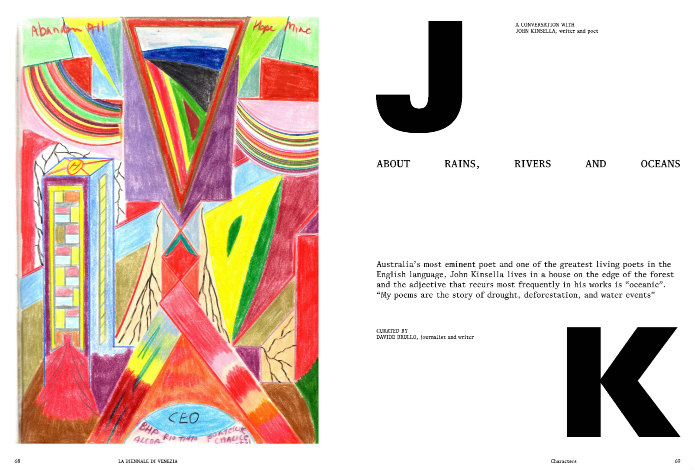
Carolyn Carlson is the ‘Lady of Water’, choreographer and dancer extraordinaire, artistic director of the Biennale Danza from 1999 to 2002, one of the most famous in her field. She has worked extensively on water-related choreographies and offers a very original point of view related to dance, which is one of the organisation’s disciplines, but the magazine does not remain narrow and closed within the Biennale’s fields of interest. It also opens up to literature, poetry and science. There is a conversation with John Kinsella, an Australian poet who has worked richly on water as an engine for stories. He is an anomalous poet, one of the most extraordinary English-language poets, and then there is the article by Peter Weir, director among others of the film Master and Commander, who talks about what it means to film on water. He gives a piece of advice: “When you shoot a sea scene, the secret is not to film the sea.”
Continuing on this eclectic journey there is also a detail of the Italian language. The Italian judge and politician Luciano Violante chooses the word ‘Adacquare’ as his guiding word.
Luciano Violante says, ‘adacquare is a beautiful word’. It is a little-used word that is not in Italian speaking people’s everyday vocabulary, but in its synthesis is perfect for defining the idea of water bringing life. Violante starts from childhood memories of his origins in farming country, where having water meant securing the harvest and the season, i.e. one’s survival. In another example, there is a dialogue between the writer and chemist Piersandro Pallavicini and the scientist Elena Pettinelli, professor of Geophysics at the University of RomaTre and leader of the international SWIM project which with ESA and NASA is searching for water on the moons of the planet Jupiter, a project whose outcomes could really change our ‘day after tomorrow’.
You conclude your own introductory editorial with the title of one of Primo Levi’s short stories, ‘Excellent is the water'( ‘Ottima è l’acqua’).
Yes, I mention it because I was reminded of the story by Primo Levi – whom we know as one of the great Italian 20th century writers, but sometimes forget that he was also a chemist – that closes the collection of his science fiction stories, ‘Vizio di forma‘. ‘Ottima è l’acqua‘ is also the verse with which Pindar’s ‘Olympic Ode #1’ opens, ‘the most beautiful of all songs’.
“Every week, we have a face-to-face meeting in Venice with the entire editorial staff, a truly great working group, more like a scholarly study centre than an editorial office.”
Luigi Mascheroni, this issue begins with a series of mostly unpublished photographs showing life on the Lido in Venice in the 1930s when the film festival was born.
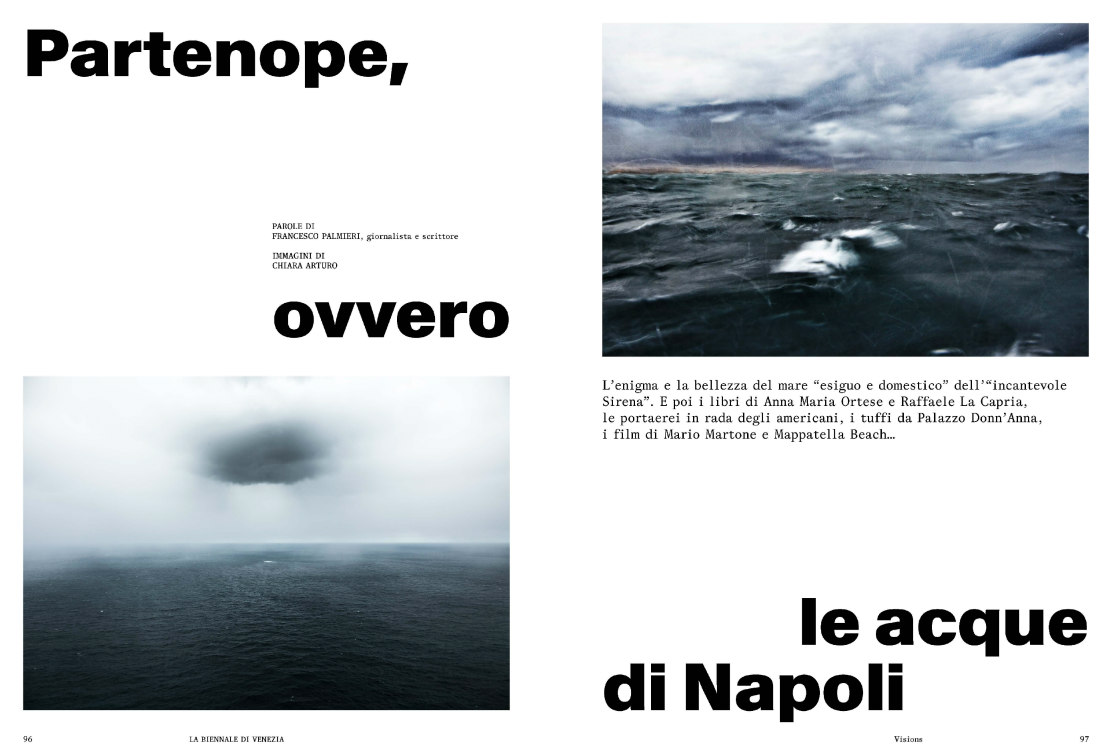
The Biennale’s archive is impressive. It contains incredible material, and the magazine was born within the archive, exploiting its riches; many features of the magazine (interviews, reports, speeches) are accompanied by historical photographs. Debora Rossi, director of the archive, and her staff do an enormous amount of research work to find the best images for each article. Sometimes they are like a photographic portfolio, not tied to a text, which tells a piece of history of everything that has passed through the Biennale. In the first issue we have a photographic portfolio of the Lido in the 1930s, where the Venice Film Festival was born. The photos seem to have been taken on a film set, but in reality they are real people from the high society of the time who came on holiday to the Lido and then found themselves at The Excelsior to attend the screenings of the first editions of the Venice Film Festival, which today is one of the world’s cinematic excellences.
I understand that a second issue is coming out in February and a third issue is in the pipeline. Can you tell me what the second issue will be about?
In the second issue, the key word is precisely ‘archive’. Archive not only in the sense of memory, but also and above all as ‘that which brings order to chaos’. This opens up very interesting areas of reflection, in all disciplines: from music to science, from anthropology to poetry. The questions we ask are: should everything be archived, i.e. preserved? Does it make sense to always remember everything, to save everything, or is there also a sort of right-duty to forget? When can and should one also forget? An archive is not an indiscriminate and irrational accumulation of everything that a person may have in his or her hands. The true archive is that which selects and sorts best. A challenge of the future is precisely to decide what and how to archive, and to do so in a way that is most convenient for consultation and securely protected so that it can be used as research material.
Once you have chosen the theme of an issue, given the eclecticism of the international contributors how do you go about the production work for the magazine of the Venice Biennale?
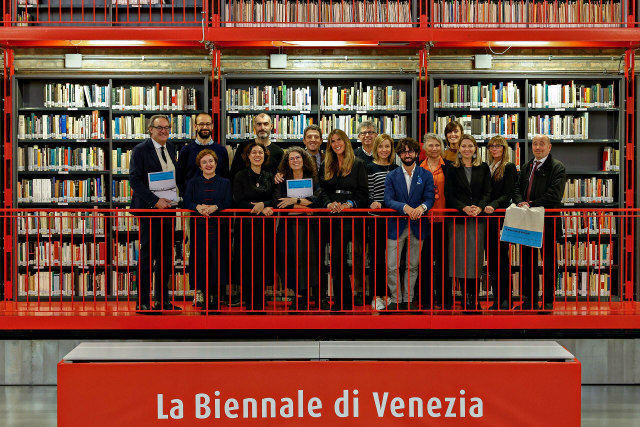
I am a journalist who has always worked in newspaper editorial offices. Working for a magazine at this level, which is quarterly and international, is really a different step. The basis of the work is the choice of the keyword and the topic of the issue; a collective decision that gives us the horizon. It is a question of what the field of reflection will be in the near future. Every week, we have a face-to-face meeting in Venice with the entire editorial staff, a truly great working group, more like a scholarly study centre than an editorial office. There is Debora Rossa and the general director of the Biennale Andrea Del Mercato; there are the heads of the various sectors (art, architecture, cinema, theatre, dance, music), the communication managers, there is the editorial staff of the Biennale’s editorial office… In this very broad editorial staff we are talking about at least fifteen people, and each one provides a series of ideas in their own field of expertise. A lot of ideas come out, are evaluated, selected, an outline is decided. Then the collaborators are asked for their availability, the iconographic apparatus is chosen, the various contributions are formatted, they are titled, then they are translated. The graphics are taken care of by the Tomo Tomo design studio, while the printing of the magazine is entrusted to an excellence of the Italian printing arts, Grafiche Antiga, which guarantees a peerless level of quality.
Italy is a country of extraordinary museums, churches, but also libraries and important archives. Do you also talk about this in the magazine?
Yes, we talk about it. Debora Rossi speaks precisely on the meaning of archives and also references the great challenge of today and tomorrow, namely digitisation. There is also a report by a journalist- about a very special museum in Trieste, the Bora Museum. It sounds crazy, but it is a small museum where a strange ‘character’ collects in special jars the different winds in various parts of the world. Obviously it is somewhere between the pataphysical, the metaphysical, the scientific and the poetic, but how many doors can be opened by an archive of world winds?
The magazine is a showcase of what the Biennale is, it does not talk about what the Biennale’s programme is but is about all the various arts and sciences that are part of the Biennale?
In the first issue I give the example of a piece that could be the manifesto of the magazine’s project. It is entitled ‘Sabir, the language of water’, written by Gilda Palusci, which tells the extraordinary of Sabir, which is the language that was spoken throughout the Mediterranean Sea between the 13th and 19th centuries in ports, on quays and in markets. Sabir was a mixture of different languages and dialects with an elementary syntax of great communicative effectiveness that enabled all those who sailed and traded in the Mediterranean to understand each other, whether they were in a port in Spain or North Africa or France. I believe this common language, a mixture of dialects, idioms and sayings, which brought everyone together, is the metaphor for the magazine’s project. The article ends with an ‘Our Father’ recited in this language, which contains Slavic words, Spanish words, Italian words, words that seem to refer to Arabic, words with Latin roots and so on. Seafarers had in common not only trade, selling or sailing, but also life; and hence the invocation for the protection of body and soul.
“It is a not inconsiderable challenge that is of interest not only to the audience of insiders, but also to readers who want to try to go beyond the horizon of today and tomorrow.”
Luigi Mascheroni, the magazine has a ‘welcoming’ backbone, without borders and without discrimination?
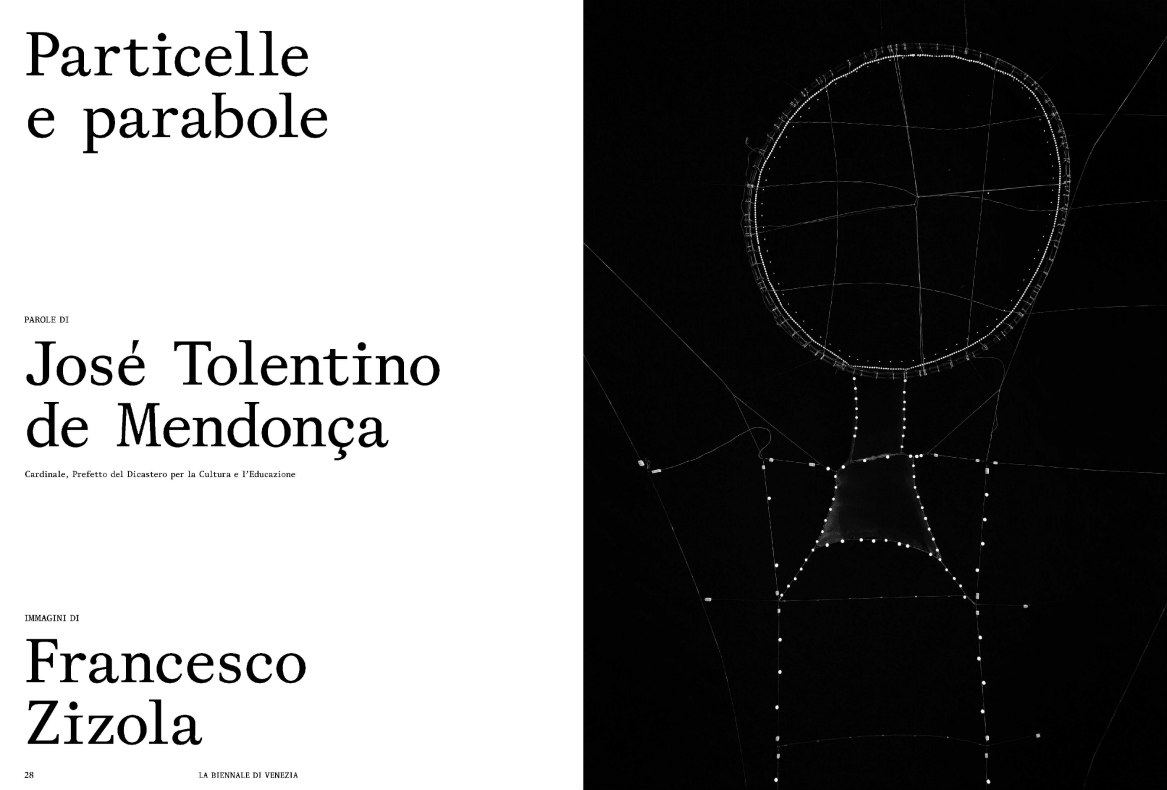
Yes, of course. The idea is to have no fences, neither of disciplines nor of ideas, excluding only the commonplace and the banal. If there is one thing Pietrangelo Buttafuoco teaches us at every editorial meeting, it is that when we think about who to get to write a piece on a given subject, the first thing that comes to mind is the most banal and we should immediately discard it and look for a more difficult one. When we think that that is the right photo for that piece and it is the first one that comes to mind, that is the photo that everyone is already thinking of so we should discard it and choose another one. For example, the article by Cardinal José Tolentino de Mendonça entitled ‘Particles and Parabolas’ brings together science and faith. It has a series of images by Francesco Zizola that anyone would at first glance think are constellations. In reality they are fishing traps photographed at night from above: lights on the water draw what appear to be constellations.
How can people buy this printed La Biennale di Venezia magazine?
The magazine has a large format. In the first issue we are at 176 pages and in the second issue we will reach 200. Some of the texts are in the mother tongue of the writer: Arabic, German, French, Italian and so on. Most of the texts are presented in English, all are in Italian. We have printed 5,000 copies of this first issue, and the most efficient way is to buy it at the Biennale bookshop at Ca’ Giustinian, Giardini and Arsenale or at the Biennale’s online store. You can also subscribe to the four annual issues, and it will soon be available in museum bookshops and large bookshops.
The magazine is an initiative that fits its time very well and in your words I detect a great enthusiasm.
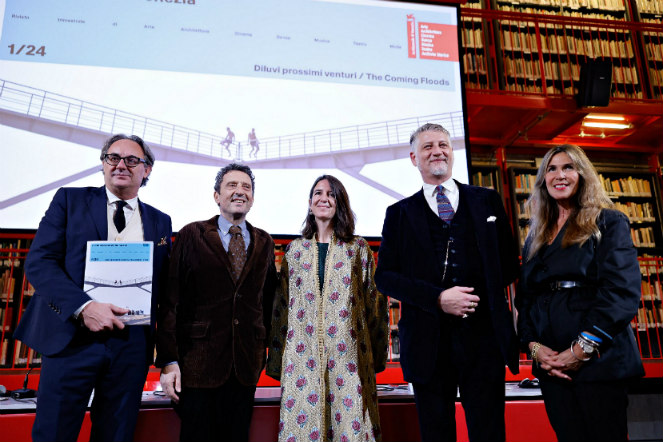
Yes, the magazine is an extraordinary opportunity and adventure. In May 2024 we started work on the first issue, which was all to be invented, as was the very idea and form of the magazine. We worked throughout the summer, and in October we published and presented the first issue in Venice in the presence of Minister of Culture of Italy, Alessandro Giuli. Then we immediately started work on the second issue. If it is a great gamble for the Biennale, I believe it is also a great opportunity for the Italian cultural world, because an international print magazine of this level is unique. It is a not inconsiderable challenge that is of interest not only to the audience of insiders, but also to readers who want to try to go beyond the horizon of today and tomorrow.
Thank you for being with us.
Portrait of Luigi Mascheroni © Dasha Brook. Images courtesy La Biennale di Venezia.
ENJOY THIS INTERVIEW? SHARE IT WITH A FRIEND.