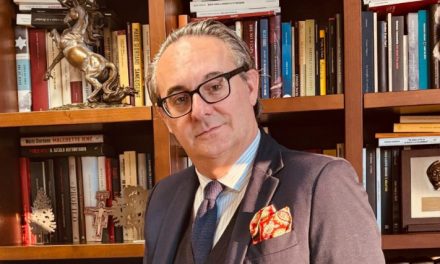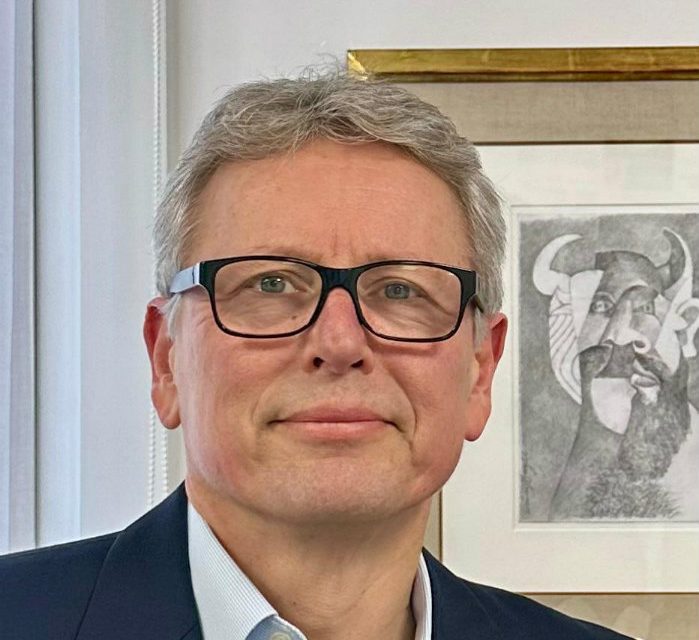
CHANGING TASTE AND VALUE. Jussi Pylkkänen is now an independent art advisor. After 38 years of service, his career at Christie’s culminated in the global presidency of the auction house. Among his many outstanding achievements, in 2017 he was the auctioneer at the sale of the world’s most expensive painting, Leonardo da Vinci’s Salvator Mundi, sold at auction in New York for $450,312,500, a new record price for any artwork which is likely to stand for many decades.
You can listen to the podcast of this interview here.
Jussi Pylkkänen, as a young child, you came from Finland to live in England where you were raised?
Yes. I came to England in the early 60s as a babe in arms of a very Finnish family, when my sisters were five and seven and my parents were in their mid-30s. None of us spoke any English, and my sisters and my parents had day and evening classes to study English together. I grew up in England in a very Finnish environment.
Why did your parents decide to move to England?
Finland was a small nation of 5 million people at the time. My father had travelled the world trading in specialist non-ferrous metals and my mother was a textile engineer. Finland didn’t offer their children what they hoped for. This was in the 60s and they had very expansive views of what the world could be for young people, and so they came with their three young children to live in London. For me, it was the start of an amazing journey.
Did you speak Finnish at home?
When I left home at the age of 17 to go to university, it was my first experience of really being in a completely English environment. My grandfather was a prominent journalist, critic and arts professor in Finland, and as a child I spent a lot of time with him, meeting great actors, filmmakers and playwrights. Along with these Finnish literary figures, others who were friends of my father’s, such as Marcel Marceau and Dario Fo, made a lasting impression on me. That ability to be living in their own space, thinking in an avant-garde way and being very positive about what the world could offer – in the 70s when things were pretty bleak – influenced me hugely when I was growing up. I wanted to follow their example, work in the arts and pursue my own path in the creative industries.
“Art is the esssence of humanity.”
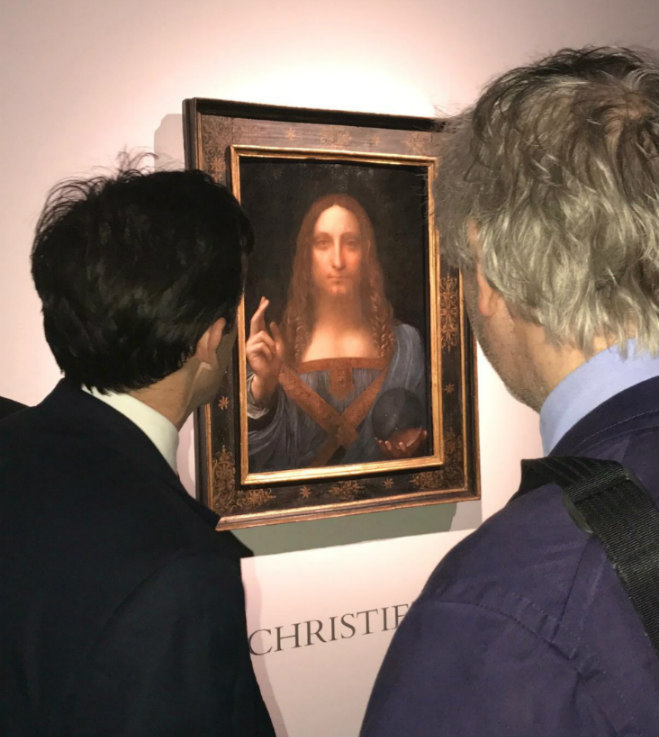
Viewing Leonardo’s Salvator Mundi in London in 2017
Jussi Pylkkänen, you joined Christie’s in 1986 and left at the end of 2023. Why did you stay so long?
The irony is that I didn’t intend to join Christie’s. When I was 22, they called me out of the blue, asking me to go and talk to them, but I didn’t know what the agenda was and when they offered me a position I turned them down. By chance, I met my father on the very same day, and when I told him that I had just turned down a job at Christie’s he was horrified and marched me back there. On that very day I was invited to see the same person who’d interviewed me, Christopher Davidge, the new Managing Director of Christie’s, and I changed my mind. It’s the best decision I’ve ever made. I had the most extraordinary career at Christie’s; from relatively humble beginnings, I could not possibly have predicted I would become the Global President of the firm. I was very fortunate – the booming market of the late 80s gave the firm the opportunity to allow my generation so many opportunities. The art market grew exponentially and the massive shift in values meant that the firm had fresh capital to invest in their youngest recruits, particularly those who spoke languages, were prepared to travel and keen to put together ever bigger auctions of international art to feed the appetite of a whole new generation of collectors. Sadly for the young experts of today, I don’t think that the incredible adventure I enjoyed in the booming market of the 1980s is repeatable.
What changed?
Until 1987 the world record for any painting was held by an Old Master picture, namely Andrea Mantegna’s “Adoration of the Magi”, which had made £8.1 million in 1985. Specifically, there was a notable signal of a seismic shift in taste from classicism to modernism when, in April 1987, Van Gogh’s Sunflowers made three times the record for any painting at £25 million. Then, following that, in the early 2000s, we saw another shift begin, away from modernism towards post-war and contemporary art: the likes of Bacon, Freud, Koons, Hockney and de Kooning, whose works started selling for the extraordinary prices we see today. The buyer of Sunflowers was the Yasuda Fire and Marine Insurance Company of Japan, and with that we also saw a movement of the power base from America and Europe to Asia. Post that, it’s been the fresh drivers from China, broader Asia and the Middle East competing with the established markets in North America and Europe. Shortly after I joined Christie’s in 1986, I stood on the balcony in awe watching the sale of Sunflowers and could never have guessed where my personal journey in the art world would lead. Prices had changed with the drop of that gavel. The buyer was Asian and the high numbers were destined to be paid for modern paintings rather than Old Masters.
How did this sale affect you?
I understood that my life needed to be in the paintings’ arena. I wanted to be at the top of the market, to work with modern art and to be an influencer, and at these great institutions, whether at Sotheby’s or Christie’s, I was acutely aware that one could follow, with great intimacy and great insight, what was actually happening in the art world in a way that one couldn’t from outside that marketplace, whether as a dealer, a collector or a member of the press. Unless you know the truth of what’s happening in the art market, who really is buying and why they’re buying, you simply can’t learn as quickly, and that’s why I stayed. It’s a very intoxicating environment full of colour, great art changing hands and access to the greatest collections in the world. Every day you learn something fresh about the market and there is a huge amount of information to look at and assess. I love and enjoy information, analysing the reasons for shifts in taste, and the subsequent changes in value these shifts activate.
How did you prepare for your career at Christie’s?
I studied. My experience at Oxford had been: if you want to be able to analyse, criticise and comprehend great works by literary giants, you must read them in depth. Similarly, if you want to understand the greats – Picasso, Monet, Cézanne or de Kooning – you have to know their work from A to Z. You have to look at their early work, their high points or perhaps when they became more commercial because they worked with a particular dealer. You take your decisions about what is great by visiting the museums and seeing what the great curators of the last 150 years bought when those artists were in their prime, or even before they became well known. The initial learning period was about five years before I felt comfortable talking to collectors about my own taste and what new or established buyers might enjoy looking at or adding to their collections. I enjoyed encouraging people to look differently at what they might buy, challenging their taste. and that advice giving became a reason people came to me. I have been lucky enough to strike up some tremendous relationships with many great collectors over the past four decades. Sadly, not all of them are still with us, but each helped me forge my taste and develop my eye.
Who should collectors seek out for advice?
If you’re buying a work of art, you should seek out a person whose knowledge in the field is exemplary. It doesn’t really matter whether they work in an auction house, are an art advisor or are a museum curator. In the auction houses, be sure to speak to one of their senior specialists – the best of them have been there for a great number of years, examining countless objects, advising collectors on a daily basis, working with museums, organising loans, and generally giving advice to collectors from all around the world. You have to feel comfortable that you’re getting great insight from an individual who has intelligence, credibility, and information that they’re prepared to share. The late Michel Strauss, David Nash, Francis Russell, Noël Annesley were superb role models. My life in the auction world was all about giving advice and working as one of these senior specialists, the best in the world in their fields. They’re as knowledgeable as many museum curators and, of course, much better advisors on market values.
Over time do you come to know who owns what?
If you’ve worked for over 35 years in a field as I have, you tend to learn a great deal about what the major collectors own because they reach out to you. I have always found collectors very happy to discuss what they have and what they are looking for – after all, it helps experts find objects they might wish to acquire. If you’re working at the epicentre of the art world, people come to you, and they ask for your advice and show you things. It’s a wonderful, high-octane, intellectual environment. Collectors also show you things that even the specialists who have written the “catalogue raisonnés” of artists have not seen; during my career this led to the discovery, or rediscovery, of works by Van Gogh, Monet, Schiele, George Grosz and many others.
Do you also get to know the collectors?
Yes, and some of the most beautiful relationships I’ve created are with collectors who don’t collect just in my field, but they’ve come to see me about a Cézanne, a Picasso drawing or a Peter Doig and it’s led to conversations about their own areas of expertise. Many of the collectors I work with buy in 8 or 9 different fields, and the friendships that you create with them add great colour to your life because they are experts in many areas and are prepared to share their knowledge with you. When I visit those collectors today and talk to them about the objects that we bought together, I always ask them what else they have acquired and I look around the room at the magnificent things they own in fields I’m less familiar with. We share our knowledge, share our passions; it’s a beautiful journey and it’s endless.
“As I brought the hammer down on Salvator Mundi I was conscious that that one last bid, at an extra $30 million, was the equivalent of the total price of the Van Gogh Sunflowers, the painting and price that had transformed the art market forever in 1987.”
Jussi Pylkkänen, you are an expert and you became a senior manager, the global president of a big company, yet you were also an auctioneer. Is it a different job?
I thought it would be a distraction for me but I was encouraged to become an auctioneer by Christopher Davidge, the man who persuaded me to join Christie’s as a 23-year-old. He made me the Director of the Impressionist & Modern Department at Christie’s at a very young age, and he said the only way to be taken seriously was if everybody knew who I was, and the easiest way to achieve that in the marketplace was to become the auctioneer of the major sales we held. I was very intimidated by that, because it’s not an easy environment. As you become more experienced, it becomes easier as you hopefully get a little bit better at it. As an auctioneer you never stop learning. It’s Hamlet on stage with his monologue, and every performance is different.
How is it to bring down the hammer on a high value painting at an important sale?
It can be a magical moment, when everything aligns and world records are broken. I was lucky that for a decade I enjoyed breaking world records in every sale, particularly in New York. Our team of experts was outstanding and, particularly from 2014 to 2016, we raised the bar for almost every 20th-century artist. As for the auctioneering, I’ve always been a great preparer, I like to have everything at my fingertips that I might require for that particular situation. With auctioneering you have to be fully informed, and I was known at Christie’s, and probably throughout the world, as the auctioneer who prepared the most, by talking to all the collectors who were keen to bid on particular things, getting great information from very collaborative colleagues, and preparing for each of those evening sales as though it was the most important sale that was ever going to take place. And every sale was the same, whether it was a Chinese furniture sale I was asked to take by a great paintings collector who flew me to New York to do it, or a sale of prints from the Josefowitz collection – one of my last Christie’s auctions for lifelong collectors and lifelong friends – or Leonardo’s Salvator Mundi, which I knew would be in the public eye in a quite a significant way. I didn’t really appreciate how well-known it would make me, or how much of an impact it would have on the art market or people’s perceptions of it, but I was very well prepared. I travelled with the picture around the globe and there must have been 60 Christie’s specialists in the final “interest meeting” at 6 pm before the auction at Rockefeller Center, sharing their final thoughts on particular interest they had in the sale.
Where did you travel with Salvator Mundi?
It came to London, then we went to Asia with it before it returned to New York for the auction. All the great collectors came to view it. The queues were extraordinary around every building where we showed it. Celebrities, museum curators, high financiers, religious figures, spiritual leaders, great collectors and countless members of the general public rubbed shoulders in the queues. It really was quite exceptional. Everybody wanted to see it because they sensed it would be the greatest sale of our generation. And that is exactly what it turned out to be.
What was your initial estimate of the price?
We set the starting point at around $120 million and my forecast was that it would make $220 million, so a further $100 million, which would make it the first painting to sell for over $200 million at the time. Our view was that there would be five, six, seven bidders for it, and there were. At the end, there were three that really took on the bidding and duked it out to the final historic price of $450 million including premium. What a moment for the buyer and what a moment for everybody in the room. The painting appeared on the cover of countless newspapers around the globe and the art world received a huge boost. I understand that over 5 million people have watched the recording since the sale.
What kind of people bid on a painting like that?
People who are completely committed to buying major works of art. It’s a serious business. You’re buying the essence of humanity. Artworks aren’t just to hang on walls, they make a statement about who we are. The greatest of them – Leonardo, Michelangelo, Raphael, Monet (the Beethoven of the 19th century), and Picasso (the Mozart of the 20th century) – define who we are. It’s not just about what they’re worth, it’s about what they mean to us as reflections of ourselves. The collectors buying at the top end of the market are totally aware that they are buying timeless masterpieces, bidding for historic objects which will resonate forever. This sharpens your appetite when you are bidding for the most extraordinary image of Christ by Leonardo, the greatest artist who ever lived.
How long did your performance selling it last?
19 minutes. It didn’t feel like it. It went very quickly. I paused for a minute at about 12 minutes when we reached $200 million because I felt that we needed “a new beginning”. We’d hit a number that was so high and so strong that I needed to give the three bidders time to mull over where they were going next. Given that the record for any work of art was below $200 million, we were now entering completely uncharted territory. I also needed to catch my breath, have a drink of water and ask the audience, politely, to put their mobile phones down. After all, a phone being held with an outstretched arm could easily be misinterpreted as a bid! Psychologically, the gladiatorial battle of auction requires two bidders, but I had an almost unique situation as there were still three bidders in the game at this spectacular price level. I didn’t want to lose any of them, I hoped to carry them all with me, and interestingly, the third – who was the quiet one – didn’t drop out but followed and followed, waiting to put a bid in at a very high number. But the others were duking it out and going at each other with very large bids – $20 million bids, $30 million bids. That was the last bid increment, the knockout blow. As I brought the hammer down I was conscious that that one last bid, at an extra $30 million, was the equivalent of the total price of the Van Gogh Sunflowers, the painting and price that had transformed the art market forever in 1987.
$450 million is a great deal of money for one painting.
Yes, and totally justifiable. The underbidder was very regretful afterwards that he didn’t get the painting and came to talk to me immediately after the sale, as I got out of the rostrum. This is a sign of a man who really would have loved to own the picture. He lost at the final bid, but the final bid against him was an extra $30 million and that destroyed his one chance to own the painting. That’s auction at the top level. A gladiatorial battle with only one winner.
How do you have the time to think in such a situation?
I’m Finnish. I have cold blood running through my veins! You have to stay very calm under pressure. It’s a bit like skydiving, the moment when you’re on the edge of the plane and you’ve got to jump, or when you go deep-sea diving and you’re going deeper than you’ve ever been before and it darkens. You just have to be sure of yourself, be sure of your equipment around you, make sure that things are going to work. And Christie’s was very, very organised.
At the time you were the President of Christie’s and this was surely a good year for the firm?
Yes, I was the President of Christie’s and we had an amazing run of ten years, from 2014 onwards. The specialist team organised some extraordinary sales, with many pictures at $20, $30, $40, $50 million. In those days we were having sales worth $700/$800 million. Today the sales are $300/$400 million. It’s a different market to the one I worked in a decade ago. The appetite to buy great works of art is still as keen as it ever was, but today many more of those pictures are being sold privately.
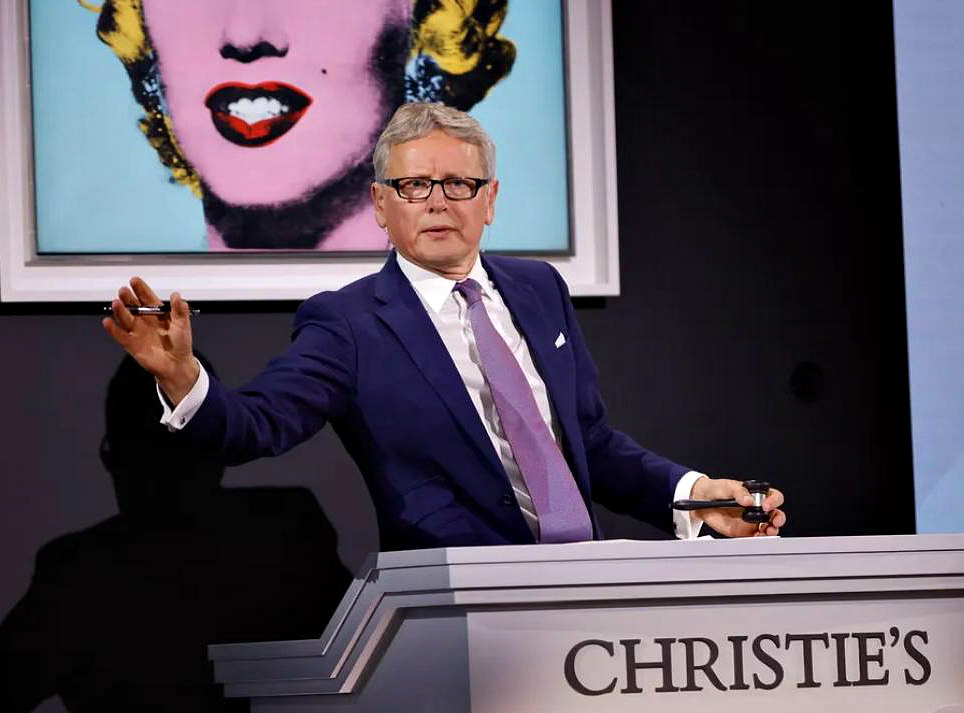
Jussi Pylkkänen selling Warhol’s “Shot Sage Blue Marilyn” for the Doris and Thomas Ammann Foundation for $195 million in New York in May 2022. The world record for any 20th Century work of art.
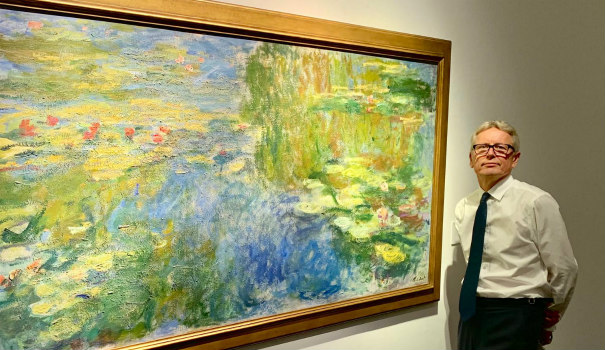
The last painting that Jussi Pylkkänen sold at auction at Christie’s New York. Fittingly the Monet made the highest price of the year, selling for $74 million in 2023.
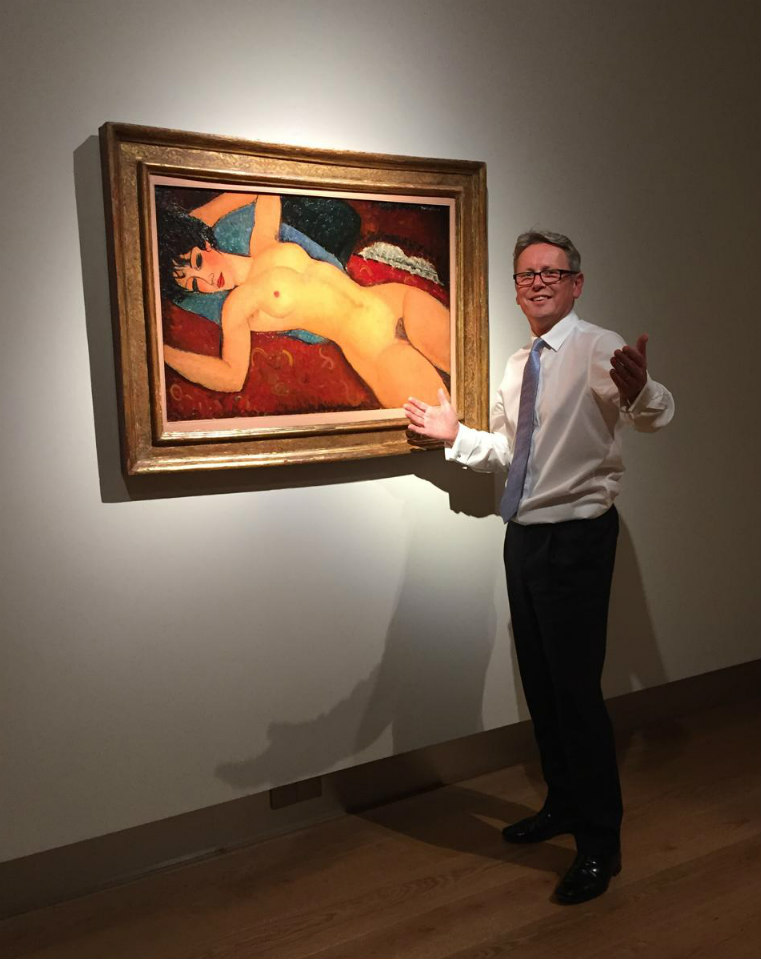
Selling Modigliani’s masterpiece for $170 million in 2015 hugely helped to broaden the market for 20th Century paintings in the decade that followed.
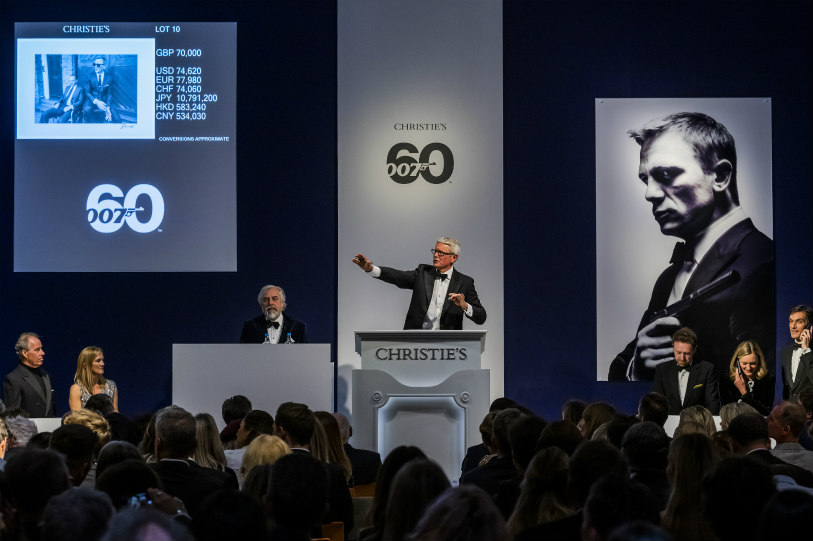
Jussi Pylkkänen auctioneering the 60th anniversary James Bond charity sale in London, September 2022.
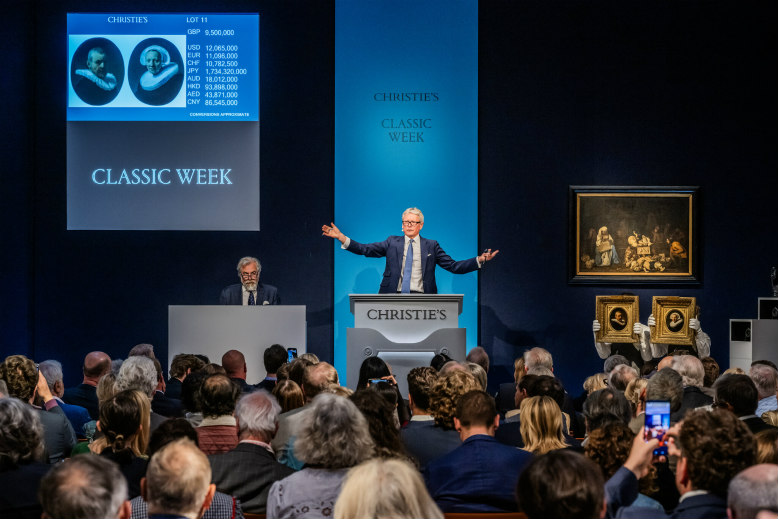
Jussi Pylkkänen selling at Christie’s global headquarters at King Street in London, 2000.
The Art Pylkkänen team. From left to right: Chester Pylkkänen, Jussi Pylkkänen, Guy Agazarian.
“I will be back auctioneering alongside my art advisory. The two will go hand in hand.”
Jussi Pylkkänen, does fashion in taste affect value, in that you may buy a painting for $100 million and then when you come to sell it’s worth $50 million?
That’s far less likely than you buying a painting worth $100,000 and it being worth $10,000. If you’re buying a major work of art, it’s much more likely that it will increase in value than drop. You can buy many types of Picasso, and not all of them will increase in value to the same degree, but certainly the best – let’s say a Marie-Thérèse of 1932 – will always be a painting that’s in demand. At one point 6 out of the top 10 Picassos ever sold were of 1932 Marie-Thérèse pictures, and that was over a long period. Which goes to say that there are certain works of art by certain artists that resonate and will continue to resonate with buyers over many generations to come. I could name countless artists and works of art that are in this category. Indeed, it’s what collectors now pay me to do.
Do people like John Richardson and Norman Rosenthal influence taste?
Of course they do. John Richardson was the world’s greatest Picasso specialist and brought the Spaniard’s brilliance to life in all his exhibitions and his writings. Norman Rosenthal has a much broader insight and was a huge influencer in my early days and still is. He’s putting together a great late Hockney show in Paris this spring. He believes totally in Hockney’s work and probably knows him as well as Richardson knew Picasso. It’ll be fascinating to see how this period of Hockney resonates with a younger audience when it’s presented in a curatorial manner. Norman is one of the great curators. He put on extraordinary shows at the Royal Academy, such as his New Spirit in Painting in 1981 and the YBA Sensation show in 1997. We’ve always enjoyed comparing notes and he is a lucid, single-minded exhibition genius. It’ll be very interesting to see how his eye influences people’s taste over the next 20 years after that show takes place.
Leaving Christie’s at the top of your career and starting to work as Pylkkänen, just you, do you feel free?
My career is just starting and yes, I feel very free and very focused. I work with a small number of great collectors based in different parts of the world, looking for major works to acquire for them. I now also have more time to work with institutions, which has always been a major ambition. For example, I have recently been talking to a collector who has a beautiful Picasso painting that’s never been shown in London which I’d like him to lend to a major museum here in England so that the public can see it. It would add a great deal to the hangings at the Tate or The National Gallery. I want to continue to research the things that I’m most interested in and share this with other people. I have a business based in Knightsbridge that I am running with my business partner, Guy Agazarian, who had a 18 year career at Christie’s, and my 27-year-old son Chester, who joined me last January. Together we can choose to focus on projects that are exciting and important. We’ve had an amazing first year defining what those adventures will be. In 2025 we will be properly “open for business”.
Are you concerned that the art market is not as good as before?
The auction market has changed and there’s a paucity of material, a lack of great things. A lot of the collectors are advised by people who have access themselves to great things and so many collectors are buying more paintings privately right at the top of the market. This is what I will be doing and what I have been doing with some success whilst at Christie’s in my final years. The days of the auction market being the only forum where high prices can be achieved have changed significantly over the last ten years, and the willingness of collectors to sell privately has increased very considerably. The very lucid, knowledgeable collectors who say, I really want that painting, I would love to own a work like it, are the people I want to continue to work with; from my perspective, they are as likely to be private collectors as museums.
The new younger people with a lot of money can be technology billionaires who come from many other countries?
Yes, and don’t be frightened of the new taste of young people. Embrace it. Most scientists have their moments of genius in their early 20s. The human mind is at its most inventive between the ages of 23 and 27 and those individuals who have made their fortunes in the 21st-century industries of new technology, science or finance often have great clarity, lucidity and fine taste. I find it curious that people say the art market has become more challenging or less predictable because there are so many new collectors from different backgrounds and from different parts of the world. This is what gives the art market now so much colour, variety and energy. Long may it last. I love the fact that there are new collectors coming into the market in droves. The museums have never been fuller – try getting a ticket for the current Van Gogh or Monet shows on view in London! Also, the salerooms are filled with new, enthusiastic buyers. Some say these individuals don’t really appreciate what they are buying, which is, of course, nonsense. When they apply their taste to the acquisition of art or cultural artefacts from other parts of the world, why is it for us to judge whether they are able to quantify or pinpoint the calibre of what they’re buying? They have lots of their own personal yardsticks. Moreover, anybody who comes into the art market today can very quickly get a measure of what they might have to pay for certain things by asking advice or turning to information providers such as Artnet. Information is available in the way that it was not in the 80s, when things were much more opaque. With the advent of new technology, you can become pretty adept at understanding almost anything in the world, and particularly the value of art and what people are currently prepared to pay for it. Art is everywhere. As I said, art is the essence of humanity, and we are all entitled to have a view on that and to own it.
What sort of thing do the new buyers like?
Justin Sun, a 34-year-old entrepreneur who has made fortunes in new technology, and is a great judge of many things, bought the Catalan banana installation entitled “Comedian” recently, which he described as “a cultural phenomenon”. Some preferred to describe this as absurd, which is ironic since absurdity is the very essence of the piece. More traditionalist commentators might have been happier if he had bought a Picasso as a sign of his good taste. These critics will be pleased to hear that Sun is also the proud owner of a 1932 Picasso Marie-Thérèse painting! So youth and new collectors coming into the market have never troubled me. In fact, quite the contrary. We should embrace their taste and passion to collect. Tastes change, fashion prevails, the art world keeps turning. The world has always been thus and changes in taste are a sign of progress and engagement.
Since you started your own venture, which is a synthesis of what you did before, are you happy?
Yes. It’s interesting to look at what you want to focus on. For me, it’s analysing the top of the market, curating private collections and supporting the museums as they look for works that haven’t been shown before. It’s also looking at contemporary art and supporting artists. We are working with a great sculptor from the north of England on a series of monumental bronzes just now. It’s going to be a very interesting ten years ahead of me, working with my team. I want to give it a good run. I will be looking at how the auction world will change and adapt, which it will need to, and I’m sure that I’ll play a part in that in the future. I will be back auctioneering alongside my art advisory. The two will go hand in hand.
How do you feel when you see other auctioneers?
I see where I might do things differently. I learn from them. Sometimes I witness where they trip themselves up, as one can do, but I’m always with them. It’s a small team of highly dedicated, professional people and we’re very supportive of each other. I recall sitting in the front rows in New York in May when one of the auctioneers asked me from the rostrum whether he’d done the right thing. It was a very funny moment for me; I felt that he had done the right thing and said that it was perfect, well done, you nailed it. And similarly, seeing auctioneers over the last couple of months, being able to congratulate them on their performances is a very nice thing to be able to do. Of course, some performances are better than others.
What are the most important qualities of an auctioneer?
You have to be very calm. You have to be very well prepared. The most difficult thing is to remain genuine and develop your own recognisable style. You need the audience on your side, so you have to be very much a people person. You have to judge each individual who’s bidding, because they all have a different view of life and they think differently about the process of giving bids and you taking them from them. You have to learn how best to encourage them to bid on. Thus, some don’t want you to acknowledge them. Others want the acknowledgement, to feel more secure. So the better you are at knowing your audience, the better an auctioneer you can be. I don’t really believe in having auctioneers taking major sales who don’t know the top collectors in the world. I always make a point of introducing myself to all the emerging collectors. You have to pay attention to each of them; the auction room is a democracy where everyone is entitled to compete on a level playing field.
Have you been disappointed sometimes in your long career when things didn’t go so well?
After sales, I never ever felt entirely comfortable with the performance. There’s always room for improvement!
Even with the Salvator Mundi?
The Salvator Mundi was described as the most orchestrated sale in the history of the art market. There was no orchestration. It was just how it went. It went like a dream. It’s beautiful when everything goes well and ticks like a fat gold watch. I was very fortunate. I have had many moments where things have fallen into place, but I also had the support of great people who really knew what they were doing. My greatest successes have always been a team effort.
Jussi Pylkkänen, thank you.
Images courtesy of and © Jussi Pylkkänen and Christie’s.
ENJOY THIS INTERVIEW? SHARE IT WITH A FRIEND.