

CURATING THE VERY DIFFERENT IDENTITIES OF THE PELLICANO HOTELS GROUP. Marie-Louise Sciò is CEO of the Pellicano Hotels group in Italy, which today comprises Hotel Il Pellicano in Porto Ercole in Tuscany, La Posta Vecchia Hotel near Rome, and Mezzatorre Hotel & Thermal Spa in Ischia. The youngest child of hotelier Roberto Sciò, Marie-Louise studied design and architecture at the Rhode Island School of Design in the USA and then worked in interior design beside Massimo Zompa in her native city of Rome before returning to her first love, Hotel Il Pellicano, her father’s establishment in which she grew up.
You can listen to the podcast of this interview here
Marie-Louise Sciò, how was it for you as an architect to jump into the family business of hotels?
It was difficult and exciting. I had no clue. My father just said, “Do it!” so it was a sink or swim situation. And I swam.
What did you do?
I started by doing the interior design of Il Pellicano. It needed to be revitalized to better resonate with a younger generation. The graphics were still in the ‘70s and I changed that, then slowly I started changing other things. Slowly because the hotel world was very closed and male and everything was in silos. The chef would choose the plates for the hotel, the front office person would choose the uniform, the barman would choose the music, and things were dissonant. I started harmonising it by curating all those things like the books, the music, the uniforms, the plates, you name it. I created the brand and a visual language.
“I curate the whole aesthetic experience of the hotels”
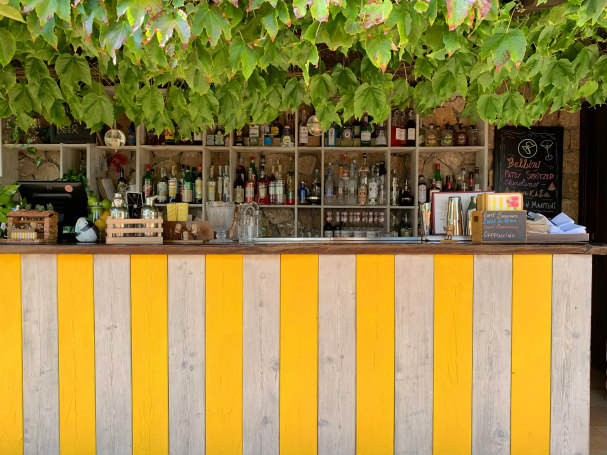
Hotel Il Pellicano – Bar All’Aperto
Marie-Louise Sciò, do each of the hotels, Hotel Il Pellicano, La Posta Vecchia Hotel and Mezzatorre Hotel & Thermal Spa, face the Mediterranean in a different way?
They have very different identities. The expression of each place is crucial for me. It’s so important to keep your identity, especially now in a world that everything is becoming so flat and so the same, and in hotels as well. I don’t want to create hotels that if you go to Japan or Ischia or Paris it’s the same thing. Each place has its own narrative to be curated.
Is it true that when your father first came to the Pellicano in its small bay near Porto Ercole in Tuscany the first person he encountered was Charlie Chaplin?
Yes, absolutely true. The Pellicano had a reputation for catering selectively, with few Italians among its usual guests, which only strengthened his resolve to become part of such a unique and storied place. When he arrived he saw Charlie Chaplin at the door. He was a little bit surprised to say the least, but Charlie Chaplin owned one of the houses there. The average age of the residents was in their 70s and 80s, and my father was 30. There was a candlelit gala night on Fridays around the swimming pool with live music, and Charlie Chaplin said to my father, “Will you please dance with my daughter because you’re the only two young people here.” He spent the evening dancing with Geraldine, a lovely memory of his first encounter with the magical world of Pellicano.
How did your father become a hotel owner and manager?
It was intuition and the love for this beautiful place that made him buy it, and it was an investment. He was an entrepreneur doing different things and then, at the age of 50-something, he said, “Well, I actually have no idea about hospitality so I’m going to go learn about it.” He went to Cornell and did an advanced Master’s course for hospitality, and then dedicated himself to it and enjoyed it. It starts from a love of beauty. He then bought La Posta Vecchia, and that was in the 80s, when I was just a kid, and it was a home for a while and then he turned it into a hotel.
Many well-known people, including actors, politicians and royalty, come to the Pellicano. Who do you remember that came when you were a small girl?
As a child I was always a spectator hiding behind rosemary trees and bushes, because children were not allowed. I would look at these wonderful parties and very elegant people and it was like watching a film. I remember very well Slim Aarons, the American photographer, who was always there taking pictures of these wonderful days and evenings. People like Douglas Fairbanks would come in and out. It felt like a different era and a different world.
Do young people come to the Pellicano today?
The really great thing about it is that it’s multi-generational. You find people who’ve been coming since maybe the ‘80s and who are in their 80s coming with their nieces, or 25 to 30-year-olds who want to be part of it. What makes it very interesting is the mix of people that come who are in the creative fields of film, music, cinema, fashion, finance or arts.
What is the magic of Il Pellicano, which is quite a small hotel with how many rooms?
It started off with 18 rooms and 18 rooms for the drivers and a few cottages that were owned by different people. Then slowly these cottages became parts of the hotel. Currently it is 50 rooms, which is still quite small, but there’s an old school charm. There is simplicity. The area has a very special magic, something in the water and in the air.
Why is this?
The nature is very beautiful, and there’s a wonderful energy. The sea is amazing on the whole Argentario peninsula and the Tuscan Islands off the coast. The hotel is a quite intimate place on a cliff with a beach, and there are 60 years of stories and people generally happy because they’re on holiday. It keeps that energy in the walls, and you feel this joyfulness. While people stay at the Pellicano they never, ever leave. They’re not obliged, but they just tend to not want to go out.
“We have Il Pellicano lovers, we have Mezzatorre lovers, and we have La Posta Vecchia lovers, but it’s the same very international clientele”
Marie-Louise Sciò, and then there is La Posta Vecchia, a palazzo in Ladispoli near Palo Laziale that your father bought from Jean Paul Getty?
Yes, it’s a 1640 villa which was the post house to the Castello Odescalchi. Built on Roman ruins, it was all one property until the 18th century. When Jean Paul Getty wanted a place near Rome he found this falling apart place and completely renovated it. He found two Roman villas in the basement and also in the garden, so he was very responsible to make this place glorious again. He then had Federico Zeri decorate it with a wonderful collection of Renaissance furniture, tapestries, and beds, and you name it, which is still there today. My father and he happened to share the same lawyer, and when La Posta Vecchia came on the market, my father went to visit. That visit marked the beginning of a long chapter — it became our home for many years, and remarkably, it remains unchanged to this day.
Your father then decided to make a hotel there, but are the clients of La Posta Vecchia Hotel different from those of Il Pellicano?
A little bit.. Il Pellicano clients go for 10 days for a long vacation, while people who come to La Posta Vecchia on average stay shorter. The décor is also very different, because it mainly is decorated in 15th century pieces. With 21 rooms it’s smaller than Hotel Il Pellicano. La Posta Vecchia is another wonderful and very unique place, a bit off the beaten track in a non-obvious destination.
Then there is Mezzatorre Hotel & Thermal Spa on the island of Ischia, nearby Naples, where many famous people had homes.
Yes, Mezzatorre is another off the beaten track place. We got it in 2019 and it was an existing beautiful hotel. We took over the management and redecorated it, restyled it, and repositioned it for the younger generation. I did the same thing I had done with La Posta Vecchia and Hotel Il Pellicano.
What is special about Ischia? The English poet Auden lived there for a long time and famous cinema people like Luchino Viscontihad a house there.
Yes, his house neighbours with our hotel. Ischia had its moment in the 50s and 60s, and then went quiet and Capri became very popular, but there’s a big difference. You don’t find the shops that you find on 5th Avenue or on Bond Street, which you do find in Capri. Ischia is wild and wonderful and feels very authentic and very contemporary and it also feels like you could be back in the 70s. There is something so beautiful about that past and present.
In Ischia do you have a different kind of client?
All three of the hotels we currently have are on the sea. Ladispoli and La Posta Vecchia is more sand, and Mezzatorre and Hotel Il Pellicano you go for a beach holiday because of the nature of the sea. The base is always the same, a very international interesting and diverse clientele with many creatives, a really lovely community of people who follow us and who come to all three hotels with their tweaks. We have Il Pellicano lovers, we have Mezzatorre lovers, and we have La Posta Vecchia lovers, but it’s the same very international clientele.
When are the hotels open and when do they close?
The season is April to October. I love May and September because I personally prefer softer, quieter light. I love the sea in October because it’s heated up from the whole season, so it’s actually quite lovely. I do not like to travel when everyone travels, so I don’t like to travel in December and I don’t like to travel in August. On holiday, I will go to Scotland, to places with very few people and lots of nature.
Is the price of the three hotels similar?
The most expensive is Hotel Il Pellicano, then it’s a tie between Mezzatorre and La Posta Vecchia. Right after COVID a lot hotels tripled their rates because there was a big demand for travel, but we just grew naturally, as we always do.
Do you have a Mediterranean cuisine?
All three hotels have their own regional menus. It is very important to give a sense of place. In Ischia it’s very rustic and the local produce is very different. The tomatoes in the south have a very different taste because the ones in Ischia are on volcanic soil. The food is regional. In La Posta Vecchia it is more Lazio cuisine, more Tuscan at Il Pellicano, and more Campanian at Mezzatorre in Ischia. We serve a lot of fish, and vongole are such a thing in Italy. People love them! In all three hotels, amazing spaghetti with vongole. At the Pellicano they do them without the shells.
Do the wines you serve also differ by location?
Yes, and we’re going strong on the natural wine, which I love. It is becoming a big movement. I personally drink the red at night so I go to sleep better, but many people drink white wine.
Do you have special named drinks?
We have about twenty-five named after different people. It’s really a big deal in Il Pellicano if you get your drink on the menu. I have quite a few friends who have their drinks on the menu, and they’re all signature drinks of people who’ve been coming for a long time.
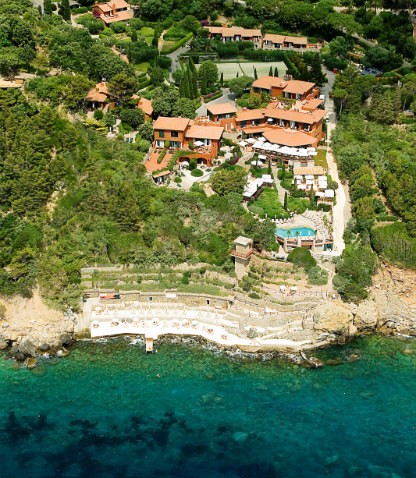
Hotel Il Pellicano – Airview
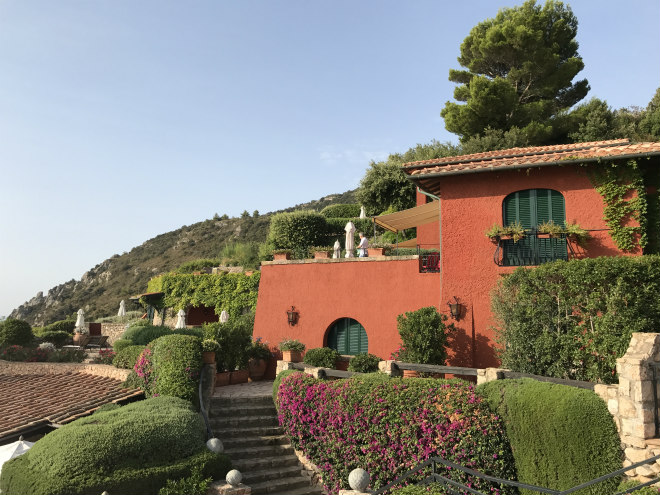
Hotel Il Pellicano – Main building
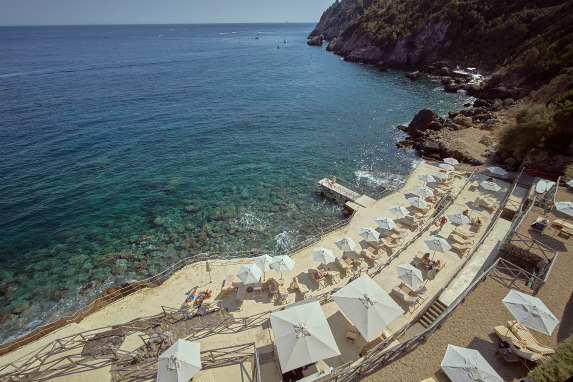
Hotel Il Pellicano – Beach Club
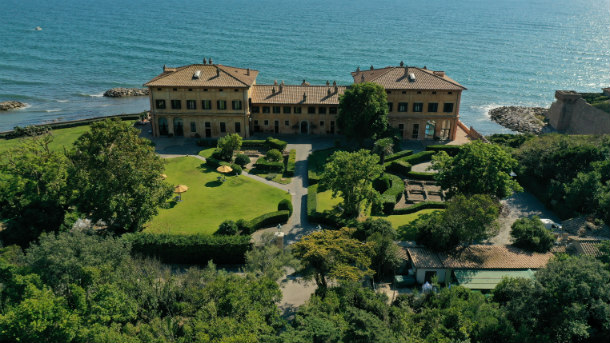
La Posta Vecchia Hotel – Airview
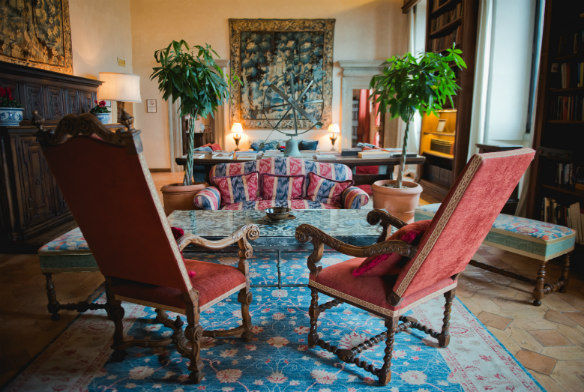
La Posta Vecchia Hotel – Studio Getty
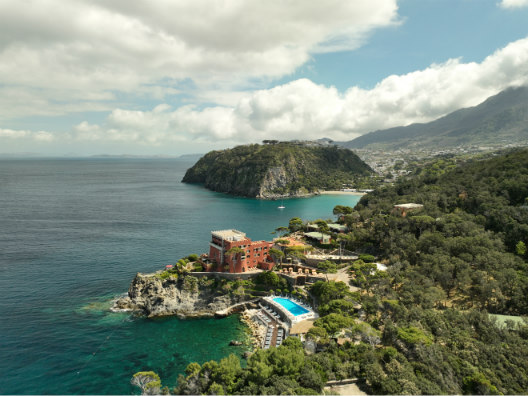
Mezzatorre Hotel & Thermal Spa – Airview
“There’s a magic about it. The region is great, the atmosphere is great”
Marie-Louise Sciò, Do you give a lot of importance to your hospitality concept?
Yes, to every single detail. It’s important if you pick up a book that you pick up a book of quality, and if you watch a film that it’s a film of quality. Everything is very curated. It is an extension of personal interest, and what I would want to find when I travel to hotels. I ask an author to curate the books or a filmmaker to curate the selection of films. We still have DVDs. Maybe you only get four guests in a season that will ask to see a movie, but those four are very happy to find quality.
Nowadays people like sport, spas and gyms. Do you have facilities in your hotels?
Yes, absolutely. We call it restorative hedonism, because you can eat fabulous food, you can do great sports and have great treatments. We have all of it. There’s a lot of hiking now. There’s obviously walks at the beach, and at La Posta Vecchia if you’re adventurous you can go to Cerveteri and around there there’s some beautiful walks, and then. Ischia has the thermal waters, which are a big aspect.
What do you do when the hotels are closed?
I work all the time to prepare for the new season, but also we’re expanding our group, buying more hotels, only in Italy so far. We bought a hotel outside of Siena called La Suvera which is going to be open in two years. The goal is to do a group of really unique small Italian hotels. We’re embracing Italy as a whole. We’ve acquired two additional properties, though I can’t reveal their locations just yet. What I can share is that they’re set in the countryside.
Do you easily find people to work for you in these hotels in order to give to your clients a maximum comfort and service?
Yes, but there’s a lot of competition now. A lot of international groups are coming to Italy wanting to do hospitality, so the landscape has changed a little bit in terms of finding staff, but after many years one builds a reputation. So far we haven’t had too many problems – but knock on wood.
There is an anecdote that people very attached to Hotel Il Pellicano used to steal an ashtray or towel or some souvenir. During COVID your hotels closed and you decided to create the website ISSIMO where instead of stealing them, you can buy them!
Yes, one of our claims was all the things you want to steal now you can buy. And it worked. ISSIMO is really also a love letter to Italy. ISSIMO is a suffix we Italians put on everything to underline if something is really fantastic – buonissimo, bellissimo, chicissimo.
What do you sell on ISSIMO?
We sell fashion and food and design, and we try and take you under the skin of Italy. We make you explore, and discover different things that maybe are not obvious and that you would need to be Italian to know. It’s a way for us to keep in contact with our clients all year around. We write about travel and places that you should see, and discover restaurants and all sorts of things. ISSIMO is our digital footprint and has many followers.
Are people still stealing some things?
Yes, they always do. Sometimes I even take away the satisfaction when I say, “Can I just give you the ashtray before you steal it?” Stealing is still kind of a thing, but the ashtray is also our most sold item on the website – even though people no longer smoke. I have a lot of friends in the area of Porto Ercole and sometimes they come by boat and I look at them and I’m like, those are our towels. Yellow and white is the colours of our towels and I see yellow and white towels very much in Ansedonia, Capalbio and Porto Ercole. They always pop up. It’s quite funny when I get invited to dinner at someone’s house and I see the towels.
Italian resource and Italy in general is a very beloved place?
Yes, and this is what ISSIMO is about. It’s hard to find such quality in so many different fields. Enogastronomic is extraordinary. The architecture, the culture, the design, the fashion, the level of quality we have is extremely high and well-rounded.
Has Italy bounced back after the COVID crisis?
Very strongly, especially in travel. That’s why now you see such an influx of international groups buying property in Italy. Italy is such a destination, and there’s so much to see, and there is so much quality. Coming from a perspective of someone who’s grown up in hospitality and works in it, it feels like it was nearly dormant for the rest of the world in terms of investments, and now it’s just exploded.
And you changed. You started as an architect and designer and became a manager?
Yes, and hotel management is managing people. I design all the hotels. I come up with what the hotel should look like, what the guest experience should be. I do the creative side of it, which for me is obviously very important, and then I manage quite a big team because we have about 40 full-time office people in Rome and then we have another 250 staff. The ones in Rome work all year round because we’re buying, building and designing new hotels. We have the finance department, the design department, graphic department, sales and marketing and development. We have ISSIMO. We have real estate. There’s a lot to do!
How is your work day?
I do many different things within my job, which is like when you try to focus a camera that goes macro to micro, big picture to tiny details. Because I’m the CEO of the company, I oversee the whole strategy of the group, the whole running of it and the growth of it. But also I’m at the same time the architect, and I do all the marketing. Now I’m structuring a great team of people who are helping me. I curate the whole aesthetic experience of the hotels – so all the interior design and the choice of whatever is visual and whatever is part of a guest experience. We are constantly renovating the hotels, we’re always investing in the hotels, and I can express myself very much because deep down inside I’m a creative. I’m a business creative.
What is so special about coming to your hotels?
There’s a relaxedness and an easiness, and there’s no arrogance about it. Everyone feels well, if that makes sense. It’s very relaxed, but it’s nicely put together. There’s an old schoolness – it feels like a world apart in some way. There’s a few of these places in Italy. It comes down to having a point of view that is of a human being who has an opinion, who has thoughts, who has an expression – not the point of view of a corporate office in New York. There’s a magic about it. The region is great, the atmosphere is great.
What is the ultimate feeling when one comes to one of your hotels?
It is a welcome home. It’s also that everything can happen. There’s always so many interesting people that you meet. When you go back home after those five days at Hotel Il Pellicano, you had great conversations, you had great swims, you had great food. There’s also a social aspect to it. When you’re on holiday your guard is down, so even the apparently most awful people become really nice on holiday. It’s happened to me quite a few times that I said to someone, “Oh, I met this person and she’s lovely.” And they’re like, “She’s absolutely awful,” and I said, “No, she’s so nice.” The dynamics change a lot with people on holiday.
As the family owner do you stay in the hotels yourself?
Yes, and that’s important and it differentiates compared to other hotels that don’t have a face to them. Also I need to see that everything’s running smoothly. There’s also a lot of people who I know who come. It’s a mix of reasons, and I also want to check on what is obviously a very good team. We have 150 people at Hotel Il Pellicano now and it’s a noble job of making people happy, because at the end of the day you have people’s time in your hands. It is a big responsibility, making sure that that time, which for everyone is the most precious thing we have, is well spent.
Marie-Louise Sciò, thank you very much.
All images courtesy of Pellicano Hotels.
ENJOY THIS INTERVIEW? SHARE IT WITH A FRIEND.


