

ART FOR PUBLIC PURPOSE. Dr Caroline Campbell was born and educated in Belfast, and became Director of the National Gallery of Ireland in 2022. She studied Modern History at University College Oxford, and has an MA and PhD from the Courtauld Institute of Art, University of London. A former Fellow of the Center for Curatorial Leadership, New York, before joining the National Gallery of Ireland, Caroline was Director of Collections and Research at the National Gallery, London. Earlier in her career she held curatorial positions at the Ashmolean Museum, Oxford, the Courtauld Gallery, London, and the National Gallery. Caroline has published widely on European art from the Middle Ages to the twentieth century, particularly on the Italian Renaissance, most recently Mantegna & Bellini and 14th Century Siena.
25 minutes read time.
You can listen to the podcast of this interview here.
Caroline Campbell, is the art of the Italian Renaissance and in particular of Mantegna and Bellini close to your heart?
They certainly are, but many other things too. I had the great privilege earlier this year of bringing to conclusion a project I’ve worked on since about 2012 “Siena: The Rise of Painting, 1300–1350”, an exhibition at the Metropolitan Museum and the National Gallery in London. So, yes, I love Italian art, but I love art of all ages.
I visited your very interesting exhibition in New York.
Thank you. It was an honour to be able to work on it. People often perceive the art of the Trecento as being very far removed from their lives, but there are always points of connection, interest and novelty. However old something is, it’s always fresh if you continue to look at it. This very much guides how I think as an art historian and curator.
“The Taking of Christ is an absolutely astonishing painting because of the moment of drama in it, and that, as much as the name Caravaggio, is what really excites our visitors.”
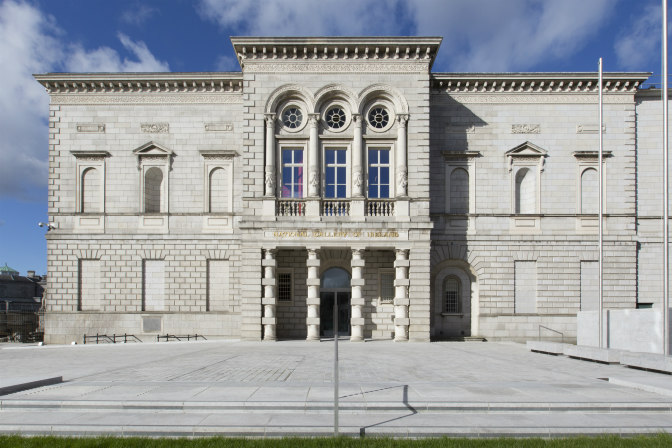
National Gallery of Ireland, Merrion Square
Photo © NGI Photographer Roy Hewson
Caroline Campbell, the splendid National Gallery of Ireland in the centre of Dublin was created in the middle of the 19th Century. The superb collection of Irish and European art built out includes masterpieces from Vermeer to Caravaggio. How do you describe it?
Speaking personally, it’s the first great museum collection I ever knew. My mother brought me here when I was a teenager on the train from Belfast. She showed me John Lavery, one of the great Irish artists, and she showed me great European art. It made a deep impression on me. I owe the gallery that I now direct an enormous amount, because it’s given me such pleasure throughout my life and it’s expanded my mind in all sorts of ways. Speaking professionally, this is one of Europe’s great art public galleries. It’s much less known than many of them and that’s a huge opportunity for us because the collection is absolutely outstanding, the greatest collection of Irish art in the world, but also among the strongest collections of European art.
Do you have icons and which are they?
There are three. One is the Caravaggio Taking of Christ, probably the icon of the museum. Then the beautiful late Vermeer we have of a woman and her servant in front of a window, Woman Writing a Letter, with her Maid. Third would be a painting which we only show several times a week which was voted in 2010 Ireland’s favourite painting – a very wonderful watercolour of a man and a woman on a medieval staircase called The Meeting on the Turret Stairs from 1864 by Frederic William Burton. Very similar to Il Baccio in Brera by Francesco Hayez, and with the same sort of impact. Another artist who people come to see is Jack B. Yeats. The son of a painter, the brother of the famous poet William B. Yeats, people love his pictures of the West of Ireland and The Liffey Swim, a painting he made of a famous swimming race in Dublin in the 1920s.
How on earth did a Caravaggio arrive here?
It’s an extraordinary story. The painting left Italy in 1802, and went first to Scotland, where was bought in the early 1920s by the widow of an Irish policeman. She brought the painting back to Ireland, not thinking it was a painting by Caravaggio. It had had an attribution to Honthorst, but by the time that it was sold in Edinburgh in the 1920s it was not a painting that anybody had looked at significantly for years. Then, as history relates, the great Italian conservator and art historian, Sergio Benedetti, who worked at the National Gallery of Ireland for most of his career, went to visit the Jesuit House on Leeson Street about 10 minutes’ walk from here, and he saw this very dark picture in the room. He thought that picture looks really interesting and with a colleague undertook a technical study at the Gallery – and, at the same time, several Italian art historians, Francesca Cappelletti and Laura Testa, were researching the history of the lost Taking of Christ by Caravaggio. In 1993 the discovery was made and the documents and the pictures came together. It’s an absolutely astonishing painting because of the moment of drama in it, and that, as much as the name Caravaggio, is what really excites our visitors. We don’t lend the painting very often, but we do lend it and it was in the great Caravaggio exhibition in Rome this year, and last year it travelled to Belfast, for an incredible moment of collaboration with our colleagues at the National Gallery in London. The two Caravaggios from the Mattei collection were united in Belfast, and it was an absolutely extraordinary thing watching people of all ages with the pictures there.
Is there is a genuine interest in Old Masters or are children simply obliged to study them for their education?
There is a real interest in great art of all ages and the Old Masters are definitely among some of the greatest interpreters of the human condition in visual form. There is a very strong connection. More and more people are coming to visit our collection and our museum in Dublin because they want that moment of special exchange and discovery. These pictures are very much living objects, because more people across the world are looking at them, and there are new centres worldwide for these both to be studied and enjoyed. People come to galleries to learn, but primarily they come to have an experience, a connection, a communion with a piece of art. I see people doing that every day here with Caravaggio, with Vermeer, with other artists. People have their special, particular favourites. I see the role of these pictures as being what it’s always been, terribly alive.
Doubtless many Irish nationals are visitors, but do the many foreigners living in Dublin come here?
Dublin, and Ireland, have changed incredibly since my childhood. It’s a very open civilisation and country, and there are many people who were not born in Ireland who are now living and working here. So, yes, we have a lot of visitors who are from Ireland and also those from abroad. We have many American and European visitors, and expect more from the Far East in the years to come as well. The gallery has been in the centre of the city since the 1860s, and that was really intentional, so that it would be beside the biggest forms of transport. A railway engineer called William Dargan was the individual most behind the formation of the National Gallery of Ireland. He brought the railway network to Ireland, and also felt very strongly that access to great art was something which everybody should have. Today, we honour that in different ways, partly by having the permanent collection open for free every day, by working with galleries across Ireland and beyond, and also encouraging and growing our education programme. People sometimes feel there are barriers in looking at art. We wish to diminish those barriers as much as we can.
You came here just after COVID, when people couldn’t physically visit museums but became used to doing so virtually. Do you have a strong interest in new technologies?
I’ve always been an advocate of embracing new technologies and possibilities, and the experience of visiting a museum is now a 24-7 one. You can visit digitally or you can visit physically, but there is something very special about the physical visit and the way things make you feel. The challenge for the digital is how, if at all, that can have the same impact. Can it make you feel how you feel when you stand in front of an actual work of art? I think sometimes it can, and some ways in which we and other institutions are doing that is really good, and in other ways we have to learn. If you are physically prevented from coming to a museum, you can still have something of that museum experience from your home, and certainly we find that our education programme runs fantastically on digital technologies, particularly for an older demographic, and also for a very young one. I don’t think there’s one way or another, they’re complementary, but they have to be driven by the objects themselves, and it’s wonderful that these parallel strands can develop, together, in ways we wouldn’t have thought possible only a few years ago.
Is it an advantage for the Republic of Ireland to remain in the European Union vis-à-vis the Brexit that happened for Northern Ireland and Britain?
I’ve always felt European regardless of politics, a feeling that many people in these islands of Britain and Ireland would also share. Certainly for us, being a gallery of European art – and I include British within that – having strong connections to Europe is really important. For six months from July 1 2026, Ireland is hosting the Council of Europe Presidency and we’re very excited about how we can use that opportunity to welcome more visitors from continental Europe here, and also strengthen the connections between museums. We’re planning a great programme of activity for that period that is very focused on Ireland and Europe.
“Irish art is really strong, but it is much less known outside of Ireland. I would love people to be able to appreciate it more, as part of the more widespread European and Western tradition.”
Caroline Campbell, does the very large Irish community in the United States support the museum with donations and feel proud of it?
There is a special connection, and it’s one I particularly also feel myself, because as a child my family moved from Ireland to America. We came back, but I went to school in Chicago for a year, and so I feel this diaspora is part of me as well. Yes, we have some very dear friends in America, and there are people who feel great loyalty to the gallery and to the other Irish cultural institutions. We have an American Friends organisation and work extensively with American institutions. This year our Vermeer has been at the Frick for a beautiful small exhibition, and their Vermeer came to us last year. In a few weeks I’m travelling to Indiana to see an exhibition about the very short lived, but very talented Dublin painter, Walter Osborne, at the Raclin Murphy Museum of Art, University of Notre Dame, ‘Homecoming: Walter Osborne’s Portraits of Dublin, 1880–1900’ presenting forty years of the artist’s work. We’re working with Boston College on a major show of the Yeats family for next year. Irish art is really strong, but it is much less known outside of Ireland. I would love people to be able to appreciate it more, as part of the more widespread European and Western tradition. These partnerships in America, and hopefully elsewhere, are important for fulfilling our mission.
Is there a lively talented community of artists in Ireland nowadays?
There is, and we work with them and celebrate them a lot. We also work with our colleagues at the Irish Museum of Modern Art, because we share this responsibility. We are additionally very focused on the development of the portrait collection. In London, there is a National Portrait Gallery and a National Gallery. In Dublin, the two institutions are combined. We just unveiled two important new portrait commissions, one by Irish painter called David Booth of the actress Ruth Negga, and another a photograph by David Stephenson of Stephen Rea, the Belfast-born actor. We do work a lot with Irish artists in Ireland and outside, because many artists have left the country temporarily or otherwise. Hopefully they will return. We see that as part of our mission as well. For instance, we run a prize every year for portraiture which is supported by the Irish bank, AIB. We have a young portrait prize and an adult prize, and that’s open to anyone living and practicing in Ireland or from the diaspora.
Does the museum belong to the Irish State or the City of Dublin?
It belongs formally to the guardians and governors of the National Gallery in Ireland, who are our board of trustees, but we are owned by the State and we’re for the State. The City Art Museum of Dublin is the Hugh Lane Gallery, just on the north side of the river on Parnell Square.
Are you well-funded or do you need private help?
Every museum needs more support. We benefit from the support of the State, but also from private individuals, from corporations and businesses, and we have our own commercial activities as well. Everything here is for the public, so whatever the source of the funds, it’s for public purpose.
Do you sometimes buy additional masterpieces?
It’s very important for a museum to be developing its collection, not to be static, so we do buy across many areas. The most important acquisition that we’ve so far announced this year is a great Irish painting of the 1920s by Jack B. Yeats, who made very few paintings that are political in reference and we acquired one of these. Singing ‘The Dark Rosaleen’, Croke Park (1921) is an elegiac response to an atrocity that happened in Dublin during the Irish War of Independence, when a group of innocent, unarmed civilians were killed at a sporting event at Croke Park. We also acquire works by important non-Irish artists. In 2023 we bought the first painting by Cézanne for a public collection in Ireland, La Vie des Champs (Life in the Fields), a wonderful painting of the late 1870s. Another acquisition of the last years, which is proving a huge favourite with our visitors, is by Hannah Höch. the German surrealist. We bought Duft 1937, a very beautiful painting where she shows herself in her studio in Berlin. She was not allowed to paint because she was considered a degenerate artist, but she made this self-portrait surrounded by flowers. We recently added the first two Rembrandt prints to the National Collection. We have two paintings by Rembrandt, but no works on paper, so we bought a self-portrait and a landscape print. I hope we will be able to add more in this area, too. We’re always looking.
Does the tax regime in Ireland encourage donations to the museum?
There’s always more that any museum director would want the tax authority to do, but yes, there is a scheme known as Section 1003, which enables people who pay tax in Ireland to avail of a very considerable rebate if they make a gift to an Irish national collection, which is deemed by a separate independent panel as being of national significance. We have acquired a number of important works through that great scheme, including paintings by Irish artists such as John Lavery, and also Hughie O’Donoghue. We also have an American Friends organisation, which people who pay tax in that jurisdiction can avail through, and we have a similar arrangement in Britain, which people have been able to access in the past. We want to keep works of art publicly available, and add to those that are part of the National Patrimony of Ireland, and these schemes really help.
What new exhibitions are forthcoming?
Planned many years in advance, we have a Picasso exhibition opening in a few weeks, which is a collaboration with the Musée Picasso in Paris. Titled Picasso: From the Studio, it’s putting into focus two great works from the national collection: a very important Picasso still life of 1924 and a collage made at the earliest point of his experimentation in that form. Next year, we’re working on a William Blake exhibition with Tate, the first Blake exhibition in Ireland. We are also collaborating with the Hilma af Klint Foundation on the first Hilma af Klint exhibition in Ireland and there’s a very nice connection there with people like Yeats, as her passion for Theosophy was shared by him and others of the most important and significant Irish thinkers, writers, poets of the late 19th century and early 20th century. It’s nice to celebrate Irish art and European art and to do that together. We’re working on programmes and activity up to the early 2030s at the moment, and one other project we’re particularly working on is a re-display of the collection here. The gallery reopened in 2017 after a very significant capital project which refurbished the historic parts of the gallery and added a beautiful courtyard, which in my childhood was a dank space that was not publicly accessible. We’ve turned this into a space at the centre of the museum experience, and, 10 years after that project completed, in 2027 we will re-display the collection. We’re thinking very hard with the curators about how we celebrate the collection, how we celebrate the building, and how we make it all work better and more visually together.
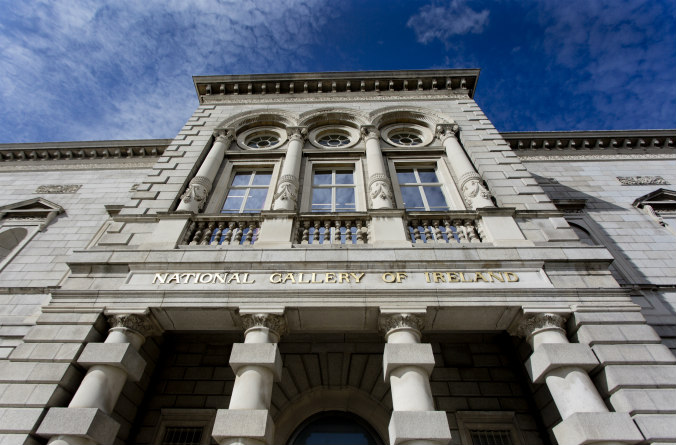
National Gallery of Ireland
Photo © Fennell Photography
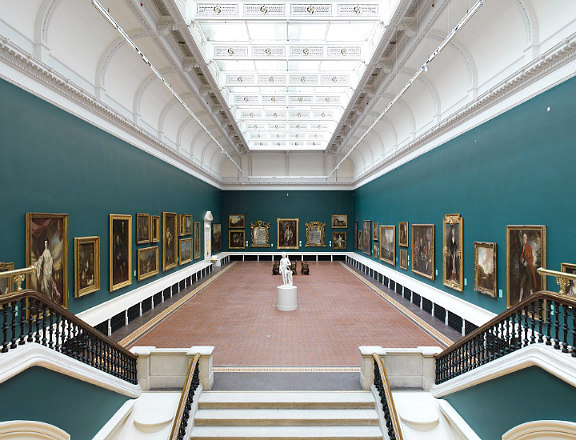
National Gallery of Ireland, Grand Gallery.
Photo © NGI Photographer Roy Hewson
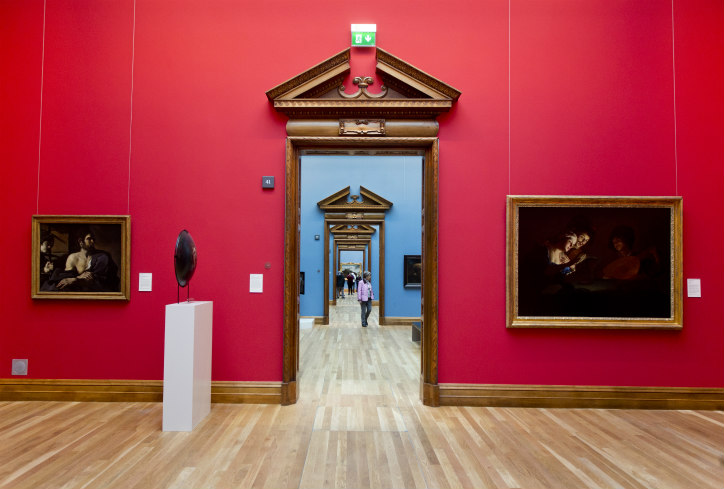
National Gallery of Ireland
Photo © Fennell Photography
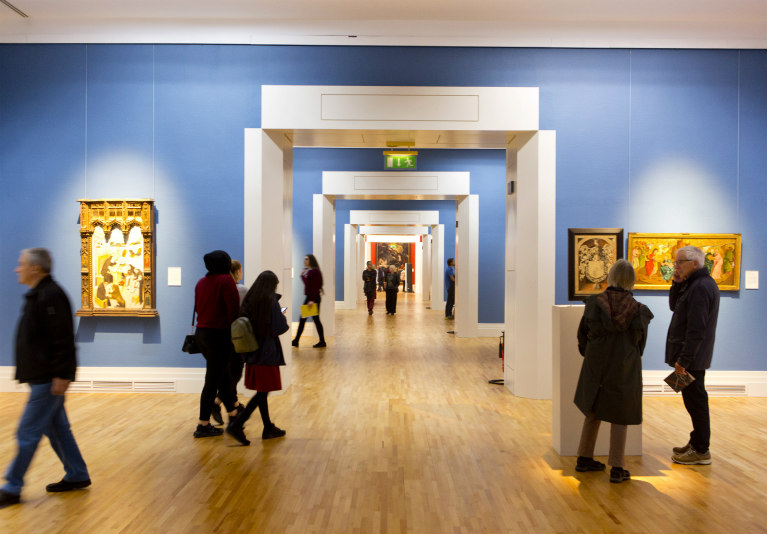
National Gallery of Ireland.
Photo © Fennell Photography

Dr Caroline Campbell, Director of the National Gallery of Ireland.
Photo Julien Behal
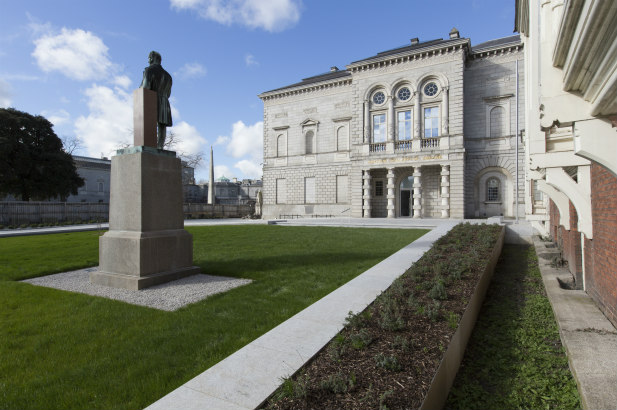
National Gallery of Ireland, Merrion Square
Photo © NGI Photographer Roy Hewson
“I love the connection that people have with the gallery.”
Caroline Campbell, Ireland is probably better known for its writers than its artists. Does the National Gallery of Ireland connect Irish poets like Yeats, novelists like Joyce and playwrights like George Bernard Shaw with Dublin’s amazing parks and overall environment?
The museum has the power to connect and also to convene, by making connections between art forms, the environment and the visual art. Ireland has visual artists now and in the past of really exceptional calibre, not just Jack B. Yeats but John Lavery, one of the most beautiful painters of landscape and of “moment” I know, whose career was focused on portraiture, but actually he was a much wider artist than that. William Orpen, whose life was tragically curtailed by the impact of the Great War, being a war artist, was an artist of exceptional complexity. Evie Hone and Mainie Jellet, two artists we celebrated this year in an exhibition, brought radical painting in the 1920s to Dublin. They were castigated at the time, but they made a lasting impact.
There is a whole array of Irish artists I would love to be as well-known as the great writers and thinkers, but there’s no denying that Ireland is a country of the word, and also of music, and what’s exciting is that these expressive forms permeate the visual arts too. The landscape is a significant influence on all of them. One of the great things about living in Dublin is the proximity to nature. I know of very few other capital cities where you can get into the clean and open countryside in so little time, and Dublin is also a city on the sea. The sea is omnipresent here and does create a very special environment.
I’d like to see Irish art being known in the way that the art of the Nordic countries has been discovered in the last 20 years. Very few people had heard of any Nordic artist other than Munch before 30 years ago, and now they are really well known, and I feel we have the same opportunity with the visual artists of Ireland.
You come from Northern Ireland originally, so what passport do you hold?
I have two passports, an Irish passport and a British one. I have always felt very strongly Irish, but I also have my British identity. What is important for us in Ireland is to be open to possibilities. Identity is not a binary thing, not an ‘either or’. For instance, I would always support the Irish team in rugby, but I have the British identity as well. Here I am working for the Irish government. I am an Irish public servant, and my responsibility is to look after this collection and also to enable this collection to be enjoyed by people across the island of Ireland (and beyond), regardless of politics, regardless of boundaries.
How is the relationship between North and South today?
It’s wonderful to see how that has changed. When I was a child it was quite difficult to even travel between Northern Ireland and Southern Ireland. You did it, but you were always worried because there was the border, there were checks – there were also The Troubles. Now people go back and forth all the time. There are many people who work in one jurisdiction and live in the other. National Museums Northern Ireland hold the other great trans-historical national art collection on the island apart from ourselves, and we work more and more together on exhibitions, we get our colleagues together, we work on projects together. It’s going to be more and more important for us to do that as time continues, and that is such a positive thing. One of the reasons why I moved back to Ireland to take up this job is because there is such a role that art and galleries, museums, can play, as well as the other art forms, in giving us ways of talking and of admitting and realising differences, but also the connections.
When you talk about Irish art and Irish artists, are there borders between the Republic and Northern Ireland, or when you talk about them, are they all Irish?
They are all Irish. The National Gallery of Ireland is for everyone in Ireland. Art doesn’t stick to borders and we have many Northern Irish artists in our collection, of the past and of the present. I see Ireland in a larger sense, but also Ireland for us involves the Irish diaspora, artists who were born in Ireland but who lived elsewhere. One example is Roderic O’Conor, who’s now seen as one of the most important Irish painters of the period around 1900. He spent most of his life in France. What he considered himself is unclear, but he certainly was working within an Irish environment, and in a French one too.
Probably many American artists have an Irish origin?
Some American artists have an Irish origin, but of course, so do many British artists. Everybody is interconnected in these two islands. Hughie O’Donoghue, who’s one of the most successful and important Irish artists of today, maintains a studio in Ireland and also has a studio in London. He lives between the places.
Yours is a big job with a big mission?
A wonderful job. I’m very honoured to be in this job and I love being in the gallery and watching people engage and have pleasure with the collection every day. It gives me real joy.
Do you have many visitors?
We have around a million visitors a year. When you consider Ireland has a population of about 5.3 million, the island about 7, that’s really substantial. We have international visitors too, but we have a lot of visitors per capita of the population. I love the connection that people have with the gallery. When I first moved back to Ireland I was really struck that when I got into a taxi in Dublin a taxi driver would normally have an opinion about the National Gallery of Ireland. Good or bad, they would have an opinion – and they would probably have visited, and probably not that long ago. I rarely had that experience when I was living in London. I do feel that the gallery has a really important role and context in the city, but I want it to be visible more across the island and also more outside Ireland too.
Caroline Campbell, thank you very much.
ENJOY THIS INTERVIEW? SHARE IT WITH A FRIEND.


