
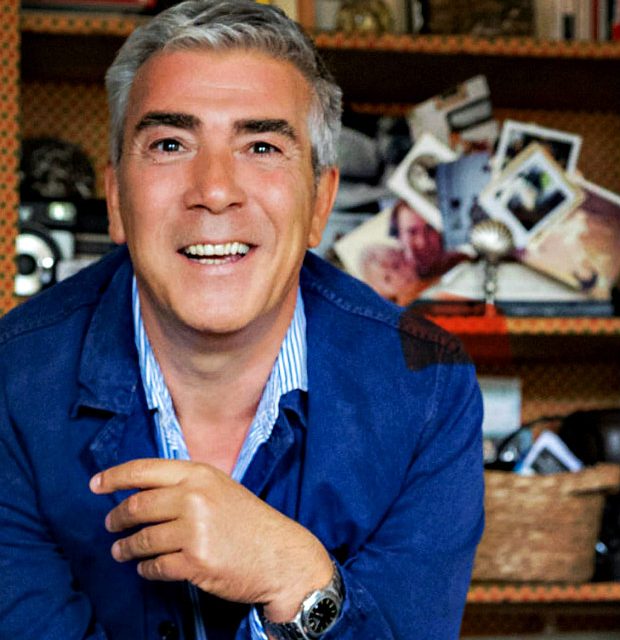
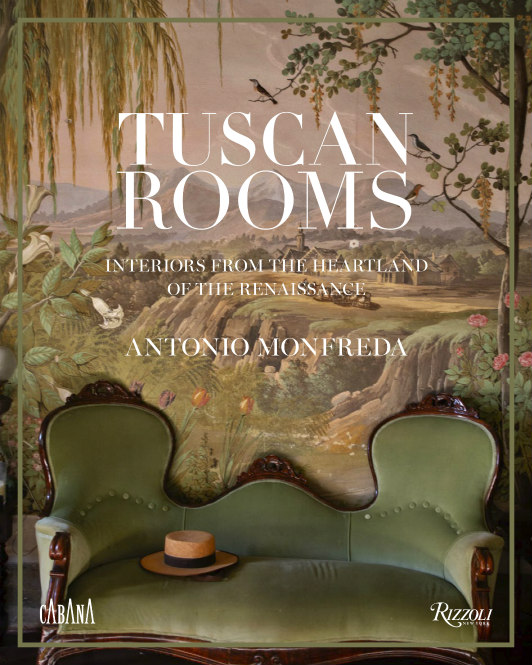
COSINESS NEVER GOES OUT OF FASHION. Antonio Monfreda is an Italian art director and curator who has become a defining figure in the worlds of design, photography, and art direction. As international editor of Martina Mondadori’s Cabana Magazine since 2016, from the very first issue he turned his talent to the photography of interiors and lifestyle. Monfreda’s new book Tuscan Rooms: Interiors from the Heartland of the Renaissance, published by Rizzoli International Publications and Cabana, is an exclusive look into Tuscan interiors that has the hallmarks of Cabana Magazine’s coverage of remarkable, eclectic, and dramatic spaces.
20 minutes read time.
You can listen to the podcast of this interview here.
Antonio Monfreda, how would you define yourself?
I am someone who was gifted with a special eye – and now that I have a certain age, I can say that to myself. I use my eye on any occasion, and in an aesthetic way, related to whatever I do.
You started your career in the very different world of business and banking?
Unfortunately very late, in my 30s, I decided to change my life and follow my passions, one of which was to exploit my gift. A difficult moment because when you decide to change everything you can be a bit spaced out. I came back to Italy from London and began a totally new career, joining my friend Mauro Nicoletti, who was starting a contemporary art gallery. At that time contemporary art wasn’t fashionable as it is now, but artists are the people that are able to open windows and to change the landscape so it was incredibly formative and interesting.
“Tuscany is the biggest garden of Italy”
Antonio Monfreda, around 2004, you started collaborating with photographers such as Mario Testino and Patrick Kinmonth. What happened?
I met Patrick on a set, I think in Los Angeles – Patrick observed the way I worked and decided to give me a chance and asked me to join him in his adventure of an exhibition at the Metropolitan in New York titled AngloMania: Tradition and Transgression in British Fashion. In the New York offices of Vogue America, Anna Wintour, Patrick and I plotted together with Andrew Bolton, the curator of this incredible exhibition exploring street fashion and fashion in England from John Galliano to Alexander McQueen.
You became further involved in fashion because then you worked with Valentino?
Yes, after AngloMania we started to specialise specifically in fashion exhibitions. Working with Giancarlo Giammetti, Patrick and I set up the 45th anniversary exhibition of Valentino, Valentino a Roma: 45 Years of Style, in the Museum of the Ara Pacis, which wasn’t the perfect space for a fashion exhibition. It’s an ancient Roman altar in a glass box built by Richard Meier. We created a procession towards the altar, dividing all the Valentino clothes into colour blocks, so we did all the glittering at the entrance and then the white, but they were going towards the red and then passing the altar and being transformed in all the black. In that way Valentino’s work took on a very ecstatic rigour. We were working with Hamish Bowles from Vogue America, who curated the exhibition in a scientific way, not just in the way it looked. We kept working very happily for Valentino for many years, doing our exhibition at Les Arts Décoratif in Paris and we did Valentino: Master of Couture at Somerset House in London.
You have worked on many diverse projects, even recreating the Cinema Manzoni in Milano?
Cinema Manzoni in Milano was again a fashion exhibition, concentrated on all the clothes that Fendi produced over the years for the cinema. We managed to create a transparent pavement over the red chairs of the cinema, and walking over the chairs gave you this idea of the surreal, because cinema is surreal as well. On top of this transparent, huge pavement, we built sections to see pieces of films and the clothes themselves. Fendi did a lot of cinema collaborations, starting with the famous movie Gruppo di Famiglia in un interno (Conversation Piece, 1974) from Luchino Visconti and Silvana Mangano which Silvia Fendi and Pietro Beccari decided to restore and bring the film back to its original splendour – Mangano is incredible in this movie.
In 2017 you did a major exhibition at Chatsworth, the Devonshire family’s famous English country house, called House Style: Five Centuries of Fashion at Chatsworth?
Yes, 500 years of fashion in the same family, from the Renaissance until nowadays. We built a timeline of 80 metres containing letters and objects related to the Devonshire family, including letters between Georgiana, the famous Duchess of Devonshire, and Marie-Antoinette, exchanging fashion suggestions and talking about which kind of hat was fashionable in Versailles or in London.
You became international editor at large for Martina Mondadori’s very successful Cabana Magazine in 2016, and now are publishing a new book called Tuscan Rooms with 300 of your photographic images of important houses in Tuscany. Why did you do this?
To talk about my photography, I have to talk about Cabana first. Martina Mondadori gave me the possibility of 30 pages in the very first number of Cabana, this magazine she was plotting. I’ve been collaborating with her since the beginning. It’s a cult magazine about lifestyle and interiors, a must-have which comes out twice a year. It has been very successful in terms of lifestyle in America, in England, in France, and all around the world, and this is also related to the fact that I understood that fashion was a little bit in a crisis but lifestyles and storytelling was something which was coming up. Interiors are now more relevant than what you wear. In the meantime, my dear friend Manfredi della Gherardesca – who unfortunately is not with us anymore – asked me to expand my photographic work, doing a book on his own land, Tuscany. We started this project together and he did a list of the places where in his memory Tuscany was at its best, and we started to photograph them. Then, sadly, he left us; and I stopped for a while. Then I decided to finish the book, because it was already in the making, and Cabana and Rizzoli made a joint venture and are publishing it. The incredibly talented Christoph Radl is the art director, and Tuscan Rooms is coming out 16th September, 2025.
What is your book Tuscan Rooms really all about?
Manfredi used to tell me that Tuscany is the biggest garden of Italy. The relationship between the city and the country is very tight – similar to Veneto and the Venetians going to the villas in the country for the summer, but not the same. This vision of Tuscany as a huge garden impressed me, and we decided to photograph 22 different places from Siena and the city of Florence, and castles to more normal houses in country places such as Castagneto Carducci or in Maremma.
“It’s as if everything was there since ever”
Antonio Monfreda, are some of the houses in the book particularly special for you?
I was impressed by many of them, and especially by their atmospheres, which is exactly what I try to catch with my photography. You have to understand the energy of the room. The light is incredibly important, especially in still photography, and in interiors’ photography it’s absolutely crucial, that’s why you can photograph just in determined hours of a day: early in the morning or late in the afternoon when there is that moment named “the magic hour”. The light in Tuscany is amazing. I don’t have any preferences, but the front cover that Rizzoli and Cabana chose is a beautiful painted frescoes room in Castello Sonnino, which is owned by Caterina de Renzis Sonnino, who also wrote a beautiful piece in the introduction of the book.
What about the Villa Le Corti that belongs to the Corsini family and was abandoned for many years until Duccio Corsigni and his wife Clotilde decided to live there?
Yes, it’s fascinating. I was really impressed. I had the chance to spend more than one day there and the beautiful light is incredible and what’s inside is so natural and effortless. It’s as if everything was there since ever and was very easy to photograph. They live in these rooms and there is a parrot who goes freely around and is treated as a domestic animal. It can’t stop saying things and even makes comments; a fantastic animal! On the top floor of the house they managed to regroup all the Corsini archive, more than a kilometer of paper of all the family documents and transactions since probably the Renaissance. They very kindly allowed me to take pictures of it – it has been exposed to a camera for the first time.
Did you like the house of the prominent noble Ginori family in Florence?
Yes, it’s absolutely spectacular, and some Ginori pieces are always in my mind because of their beauty. Florence became capital of Italy in 1856 for six years, when the capital of Italy was moved for political reasons from Turin to Florence, and Caterina explained to me that most of the palaces, probably also the Ginori one, had to rearrange to be at the level of being in the capital city of Italy. Lots of things that were not useful anymore in the palaces went straight to the country houses, and this is one of the reasons why you find in the country houses of Tuscany, in Siena or around Florence or at the Frescobaldis, this incredible sense of “cosiness” which comes from this putting together of pieces that were leftovers from the palaces. It’s a style whose result is very cosy and natural, without any effort. It’s a magic mix of grand and cosy.
Did you also photograph houses owned by English foreigners who love the Tuscan countryside?
Yes, Villa Cetinale, an amazing place that now belongs to Marina Lambton. It reminds me so much of a Palladian Villa, but it’s not. It’s so beautiful in the way it’s conceived and is so much a place to enjoy the country life with its double façade and double garden. Cetinale was built in the 17th century by Cardinale Flavio Chigi, and was conceived architecturally by Carlo Fontana, who was trained by Gian Lorenzo Bernini. That’s probably why it’s so particularly fantastic and close to perfection.
Antonio, by origin you are Venetian, your adopted city is London, you live in Rome, but perhaps your heart is in a small Aeolian island near Sicily called Panarea. Have you taken pictures of this island that belongs to your childhood memory?
It’s a long story with Panarea, because I was living in a beautiful town named Bassano del Grappa, where my father decided to go and live, a fantastic little city crossed by the Brenta River in the middle of the hills. When I was 13 my father’s sister bought this house in Panarea, and for my holidays I moved from the Lido di Venetia – a very quiet and beautiful place – to Panarea. Suddenly I was naked in the middle of the sea in Sicily, where everything was very transgressive and very violent in terms also of climate: the sun, incredible wind, the rocks. Such a change of landscape! The rocks are very similar to the Dolomites which I was used to, but in the middle of the sea! This landscape was devastating for me and it was a big love, but it was also a big love with my aunt Fiore, who had a prodigious influence on my aesthetic because she was a super creative person who used to express her creativity through her cooking and her gardens. She loved to have people over and she built these impossible gardens in front of the sea. She’s not with us anymore, but my cousin Lucia Fabiani keeps this fantastic house on the sea going very well, with these gardens full of lemons and cypress trees.
Going back to fashion, in a previous interview with the British journalist and fashion editor Suzy Menkes you mentioned that “fashion is out of fashion”. Can you explain this please?
It’s quite a strong statement, especially without context, but yes, I think it’s a little bit out of fashion because the time is different now and sustainability is very important for the young generations. But it’s not just because of that. There is a change of desires. There is a change in the concept of what is luxury now. It is different from it was five years ago, even before the pandemic changed things a lot. It’s more luxury now to have a beautiful place to live than what you wear. Fashion is also in a little bit of a crisis because it is not sustainable. To survive and to expand and to make a lot of money out of it, fashion creates a new desire every season. Every collection you have something new, and in this world that’s not possible anymore. The only way for fashion to be sustainable is to just do couture – then you don’t have any waste!
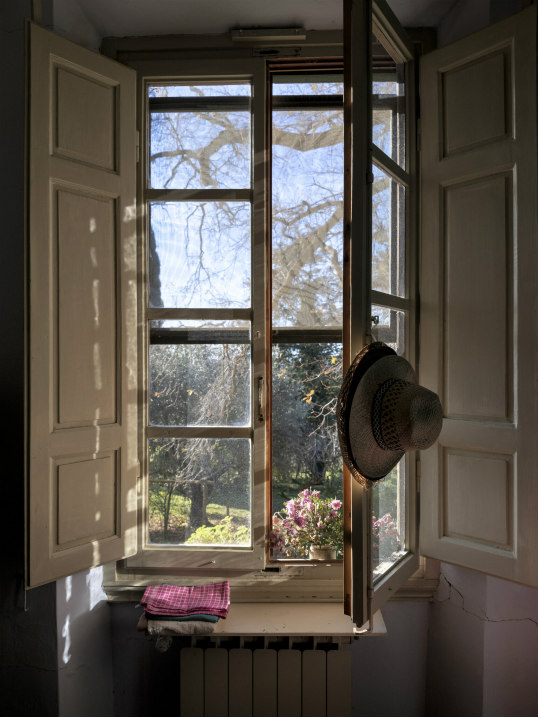
Villa Le Corti belongs to Duccio and Clotilde Corsini
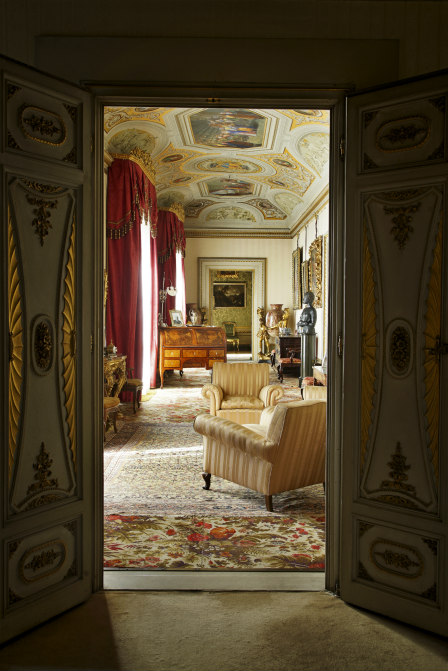
The Ginori Palace in Florence
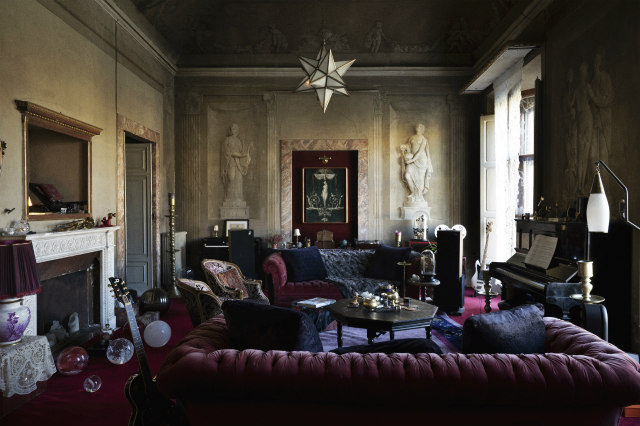
Eva Cavalli’s home in Florence
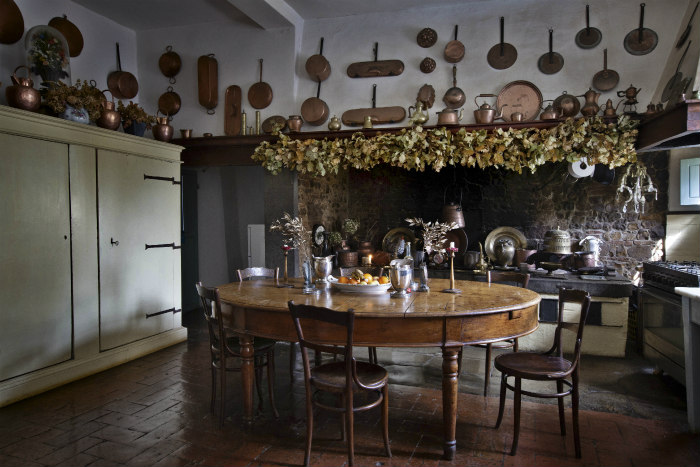
Castello De Renzi Sonnino in Montespertoli in the countryside near Florence
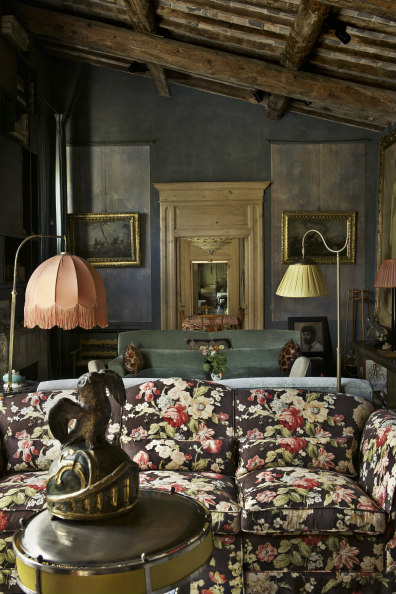
A house in Florence that belongs to the San Giuliano family
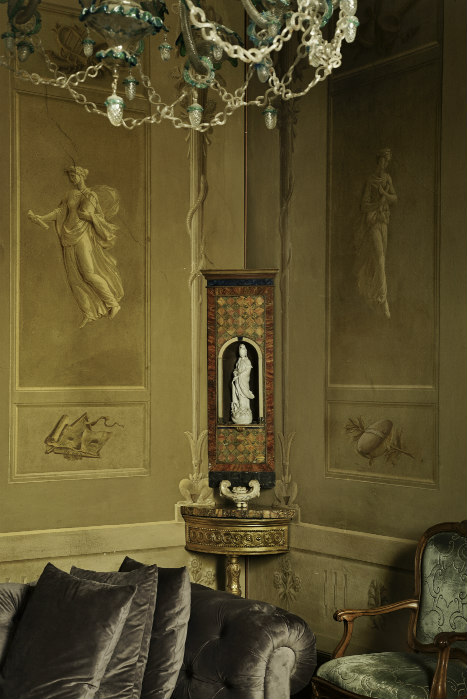
Emanuel Corti Grazi Palace in Florence
“Recently I discovered that the word ARTISAN has inside it the word ART!! Like an artist!!”
Antonio Monfreda, why do you also say that fashion should listen to young people?
Because young people are very much related at the moment to buying second-hand clothes, something that already exists, so there is not a waste. Vintage is picking up incredibly, because young people love that. Before, what you were wearing was cool. Nowadays, what you are is cool. There is a big difference! The coolness comes more from the way you are engaged in saving the planet, from the care and the attention we must give to try and save it. I love fashion and fashion history is an incredible expression of the moment we are living in. It’s a mirror of the way the society is and evolves – let’s say that fashion is an expression of this evolving moment we are all witnessing.
You have worked for big names like Bally, Fendi, Missoni, Moncler, Valentino and so on, but what about Uniqlo and Zara, the inexpensive fashion that one finds all over the world?
Uniqlo is a case apart. It’s very practical and like wearing a uniform that gives you the possibility to be okay on any occasion, and it is perfect. Zara and all the others have probably a shorter life because they are made with absolutely no quality, which is actually what fashion should aspire to more. It’s all about quality now – something that will last that is made in a sustainable way, something that will be with you for a long part of your life. That’s why artisans are so important now, more than ever. They are able to bring uniqueness. Recently I discovered that the word ARTISAN has inside it the word ART!! Like an artist!!
Fashion is out of fashion, but exists since a long time. You talked before about 500 years of fashion at Chatsworth, and Marie-Antoinette corresponding with the Duchess?
Well, we have to wear something! When I say it’s out of fashion, it’s because it’s less relevant compared to the ‘80s or ‘90s. London street fashion is famous because you see people mixing what they are wearing, and you can see a look that you know will determine a new fashion or a new way to wear something. It’s amusing for me to sit there and look at people in cities like that, but especially in London, which is full of multiracial people and you get that kind of inspiring energy there more than Paris because it’s more natural and people assemble stuff in a more creative way.
Many years ago, I asked Giorgio Armani RIP, Where do you get your inspiration? And he said, Walking in the streets of London. What are your next projects?
I developed this passion I have for anything visual and that goes also with videos. I’m doing a series of videos for the new Cabana issue which will be out in October. These videos are teasers which are going online. Cabana has a double face. One is this incredibly sophisticated magazine where the paper changes, the cover is in fabric, each time done by a different designer and art directed by Cristoph Radl in a genius way. And then it plays a big part on the net. I am also working on an exhibition of my own photography in Venice at Lo Studio – Nadja Romain, which will open on 22nd November and will have a special focus on architecture.
How do you decide what story to tell?
First I write messages to myself on WhatsApp. When I have an idea or I see something suitable for the magazine I am working for – or in relation to a special project we are doing – I often do a little research or if I am somewhere I love particularly and I see things, I just take pictures and exchange ideas with my editor. My telephone is a way to communicate verbally or via texts, but most important is my visual diary, a sort of infallible memory.
Do you also design furniture?
With Angela Missoni and Patrick Kinmonth we designed a shop for Missoni which still exists in Los Angeles on Santa Monica Boulevard. We even designed the furniture inside, and recently a friend of mine in Naples asked me for a suggestion, because he badly wanted a bar in his beautiful living room. I designed it and I produced it and used my artisans and the result is pretty good. I’m very happy with it and I think he is too.
When young you were a businessman and a banker. Are you happy about the choices you made for your life?
I’m very happy. I have no doubt about that, because it’s very difficult and one of the biggest luxuries in life to do something you like. You’re never bored and never sad. I keep my curiosity up all the time. I also love to confront younger generations, especially now when there is all this talk about AI. My young assistant Guido León is very keen about AI, thinking it’s better to know it, and I am not. We have this discussion several times a day because he tends to ask AI often. Recently we were doing a document for a perfume competition of photography, and he prepared it using AI but in the end we realised that the wording was wrong. AI is a fantastic revolution and it’s something to explore, but it’s something to exploit more than to be driven by. It’s a huge, incredibly useful shortcut for many practical things, but aesthetically you need the presence of a human. Fortunately, you need the presence of a human who can also be over 59, laughs, because being 24 years’ old in this world is now different.
You have a future Antonio! Thank you very much.
I have a future! laughs.
ENJOY THIS INTERVIEW? SHARE IT WITH A FRIEND.


