A VISION OF TRANSFORMATION. Maja Hoffmann is a Swiss art collector and patron. The Founder and President of LUMA Foundation, she has led the development of LUMA Arles in Provence, an important international cultural project. By addressing urgent issues in culture, nature, scientific experimentation and ecology, she has promoted new structures for innovation and positive change. Her efforts have earned LUMA widespread recognition for its diverse projects and artistic programs. Appointed President of Locarno Film Festival in 2023, Maja Hoffmann is the President of the Swiss Institute, New York (USA) and the Fondation Vincent van Gogh Arles (France), the Vice-President of the Emanuel Hoffmann Foundation, Basel (Switzerland), and serves on the boards of Serpentine Galleries, London (UK), Kunsthalle Zürich (Switzerland), the New Museum of Contemporary Art, and the Center for Curatorial Studies at Bard College, both in New York (USA).
35 minutes read time.
You can listen to the podcast of this interview here.
Maja Hoffmann, you are known as an enabler, an art collector, a movie director and producer. How would you define yourself?
I try to mix some means – which consist of energy, of finance, and of know-how – to make projects happen. Mostly with artists, because I really like the way that artists are thinking.
The daughter of two very special parents, your father Luc Hoffmann was a naturalist, among many other things, and your mother, Daria Hoffmann-Razumovsky, an intellectual?
There were some intellectuals in the family, and she may have been the lesser intellectual of them but the most active one.
Even if you are Swiss by origin, here in Arles is where you spent your childhood. Are your roots here in the Camargue, one of the last remaining wild wetlands in Europe?
I was one month old when we arrived back in the Camargue to the Domaine de la Tour du Valat after I was born in Basel, so yes, we really grew up in the marsh there. When I turned 11 I came to town in Arles for secondary school and spent four more years here before we moved to Geneva. Switzerland is where I was born, but the Camargue is where I grew up.
Is French your language?
Well, it was certainly not English at the time, and it was difficult for me to speak German. Our parents were trying to speak German with us, but we would always respond in French. Even my sister, who is much cleverer, was already starting to respond in French and not in German.
“I was called a utopist, but I was always seeing the reality of what I can do.”

View of LUMA Arles
Maja Hoffmann, your eponymous grandmother Maja Sacher was an art collector who created a Foundation in the name of her husband, Emanuel Hoffmann, the son of Fritz Hoffmann-La Roche, a founder of the pharmaceutical company Hoffmann-La Roche. Are you on the Board of this Foundation?
I am the Vice President. I’m active only in collecting for the Foundation, but not active in showing the art, which is mostly displayed at the Kunstmuseum Basel or at Schaulager.
Did your father teach you and your siblings to have great respect and love for nature?
He taught us to have respect for him, which was easy because he gave us a good example. We had a beautiful life at Tour du Valat. For people who like freedom, it’s amazing. We were very free!
Later you studied cinema?
I was a journalist. I have a diploma as a journalist in a Swiss-German school, but wrote my memoire in French. After two years of studying biology, I opted for journalist school, probably because I met photographers and people who were interested in photography and publishing here in Arles during the photo festival in the summers. I love cinema, but I only took one cinematography summer course at New York University when I was already 28. I didn’t do the whole course. At 21, I also worked in a photography magazine called Camera Magazine during the times I was attending journalist school.
What did you do when you finished your education?
Even during school I worked in theatre, and then I worked for Swiss TV music productions with Werner Düggelin, an important Swiss-based theatre director. I also started to travel with him. It was exciting to live and to work with him. We were travelling to America a lot, and, as of 1977, with my grandmother, we were both part of the board of the Emanuel Hoffmann Foundation, as you already mentioned. I was looking at art a lot. The influence of my grandmother was much more important in collecting than the influence of Werner Düggelin, who was more influencing my reading material and with whom I was learning life.
You were with Werner Düggelin from ages 21 to 28. What did you do at the time?
I was his assistant at Zurich Schauspielhaus for some productions. I was impressed by Chekhov’s Three Sisters, The Seagull, The Cherry Garden – in German language always. I also remember Becket’s Waiting for Godot and Happy Days, and Swiss authors like Dürrenmatt, Anselm Stalder and Thomas Hürlimann’s plays.
Were you working in Germany or Switzerland?
I was working in Zurich, and I worked on opera in Duisburg and Düsseldorf. I never worked in Berlin. At Schauspielhaus Zurich we had an ensemble, so were always working with the same people, and being the first assistant you are on every rehearsal. Then the director leaves and he sets you the task to oversee the evenings, so you are supposed – at the age of 22 – to let the theatre director know who the actor is who misbehaved on that evening, who did not hold the rule. This police making was terribly difficult, and I was of course not always reporting, but I loved seeing the shows night after night. I enjoyed this and every period in my life.
In fact, you always were very active and hardworking, since the beginning?
I was working for a little money but then came the moment when I started to receive money from my father. Because I was not at university and I was working, my parents had more or less forgotten to give me some allowance, which was repaired as soon as I asked. I was living a lot over my means but was invited all the time. I bought a coffee machine with the first money I earned on a production. We were insouciants à l ‘époque.
Where did you live when working in theatre?
We rented an apartment in Basel, and one in Zurich, living with Werner Düggelin. We oscillated between the two, sometimes together and sometimes separate. Then I ended my story with him, because I felt I was starting to be overwhelmed by doing something that I did not earn myself. Seriously, I thought: this is too easy. I wanted to go back to school and learn about what I was already so easily living. This was when I went to New York to study cinematography, but as I said for only one semester, the summer course. I was already 28, and one day I thought, now it’s time to jump into your life. At the end of the day, you cannot catch up on these things. I love cinema, but I didn’t do the whole course.
Did you think you would become a director?
Well, I thought a lot of things! I was a journalist. I spent time in Paris. I had my allowance, I travelled around – and then I went to Mauritania to do a documentary film with a purpose; I called it “Fishermen in the Desert”. I was the director and a little bit of everything else, because it was a really small budget for a non-profit – it was more like a trip to Mauritania that you document and I documented maybe one of the last moments when the yellow mullets were still big enough to be fished, jumping around like crazy in spectacular ways, moments of a treasured nature that were disappearing. With “Fishermen in the Desert” cooperation and extinction really formed an interesting topic which I continue to explore until now. We could have shot much better-quality images, but we were shooting in Betacam and so I would see and show the images as we were travelling from one village to the other. I was showing the images on the village square, so every time the word would pass over and in every village I was arriving to they knew we were arriving, and we were greeted and welcomed as “This is the woman who comes with the images”, and we went from party to party alongside the coastline…. I understood the social role and impact of documentary filmmaking. I still like adventure, to be independent and free. At the time it was really a good moment to travel, I must say.
“I love to ride horses and to come to Arles on Saturdays, drink pastis with the men and genuinely try to say what I believe in and think.”
Maja Hoffmann, did you do other documentaries after this?
No, when I came back from Mauritania I met the Cypriot concert pianist Nicolas Economou, who was a genius. It was quite a mission to try to make his career take off and to be with a genius who is hurting himself at the same time. A passion can sometimes be very destructive, and this was four years of love and destruction – and the last year we split. Unfortunately, he passed. He suffered recurringly from his Moscow learning years at the conservatory and being split from family at an early age, and one night actually died from driving too fast on the highway. He had a true gift – a brilliant pianist, very joyful, loving and tremendously talented – but he was drinking. I do miss him a lot.
How were you living?
Until I was blessed with my children, I was living out of a suitcase. That’s why to be defined as a collector really does not feel right. You cannot carry a collection in a suitcase! As for settling down, I bought little things, yes, but I had no pets. In Paris I had a plant, a type of asparagus plant in a pot where you can put water in the reservoir and it feeds itself. I stayed mostly in Paris for a few years after my Swiss time with Düggelin, travelling to New York, then going to Mauritania and to different places and with Nicolas we were in Munich and spent a lot of time in Cyprus.
Were your parents worried about your way of life?
Very worried. My mother was worried first because I was living with a man that was much older than me, and second she was worried because I was living with a genius pianist. But as a family we were always close. Also with my siblings.
You had on one side your family life, and on the other your adventurous independent life?
Life is all one piece. I was quite happy to move around with my suitcase. I just moved with my time. I’m in movement, and I still am now. I’m still curious and trying to figure out what is going on today. Maybe you know where you are, and maybe you know what is going on. I don’t. I’m always looking.
Are your children interested in working with you?
I cannot speak for them, which I never do, but I must say they are a comfort for me. They are unconditionally with me in different but interesting ways. So is Stanley, my partner in life, who is really very supportive. They are all three very supportive.
From a suitcase, you also built many different things?
Yes, probably I went over the top the other way! When I do something, I want to do it well and so it’s never-ending. At heart I’m a little girl in the Camargue with cowboys. I love to ride horses and to come to Arles on Saturdays, drink pastis with the men and genuinely try to say what I believe in and think.
The Rencontres d’Arles are the first international festival of photography, making Arles a very important place in the world for photography?
I witnessed the start of the Rencontres because they were born in ‘69 and I was here already. Later, I was the assistant of Lucien Clergue for one whole summer, but then I didn’t want to do it again. I was in Arles a lot – we always had a house in the Camargue – the big place of my parents with the lab and five or six houses on it feels like a village.
At a certain point you created LUMA Foundation and LUMA Arles is one of the projects of the Foundation?
LUMA Foundation is based in Zurich. We now call this place in Arles LUMA Arles, but I first called it the Parc des Ateliers, which it still is. LUMA Arles is one of the projects of the LUMA Foundation. LUMA Arles is not a Foundation, but it is close to where I grew up and at the time I started this project I had two major preoccupations. One was that the photo festival would be relaunched – it was kind of dying but part of my life from ‘68-69 and all the way to 2002, when I joined the Board and helped relaunch the International Photography awards. Secondly, I was also concerned that the work of my father could become a dead end, because at the time we had difficulties finding exterior financial support, and I thought that by doing some major project in Arles, I could bind art and culture – which were missing elements – into the work of my father. This was a determinant for doing the LUMA project here.
When it came to local politics, was it easy or difficult to do things in Arles?
It was interesting to do, and when you build something you always have the ups and downs of a situation. Nobody said, You cannot do that! Everybody was supportive. I did not want to only have one building built with a star architect. I wanted also to show that we can do exhibitions and offer space in the big old railway repair halls that were decaying rapidly. I thought it would be with the Rencontres all the way, but they turned against it at a moment when the government changed. It’s funny, the word has it that everybody was against it, but no, it was supported locally, except for the usual unhappy of whom many came from outside. And then we started the long obstacle race. It takes 10 years. Everybody who built something – big or small – that is public will tell you that, and this is a public-private project.
You bought a big piece of land where there was a derelict factory?
Yes, and in another country they would have rented it or gifted it for a project like this. I had to buy it, but it was not expensive if you compare it with other places. It was a factory until the ‘80s. When I bought in the 2000s it was an abandoned factory.
And then you made this huge project with Frank Gehry?
For Frank it’s not huge. For Frank it’s a small project.
But you put Frank’s building and the old factories together?
Yes, it’s a plan that I worked on with experts – with urbanists, with culture makers and with artists – and with myself, that is with all the experience of a woman who is over 50 years old. Our experience is not always acknowledged in a male dominated world, but fifty years’ old women know a lot and this wisdom is embedded in the project too. We didn’t organise a competition; I chose the architect because I knew him. Stanley and I had been working with him on a documentary by Sydney Pollack, and his way of thinking was incredibly creative. It was an artwork at the same time it was architecture. Not at all a brutal tower, as people have sometimes called it. The metal around is his signature, but it’s not to show glitter, it’s to catch the light that Van Gogh also saw in the stars and the changing skies. That I also can see, and I’m sure you do too – but not everybody does. Then the often-misunderstood height came, because I wanted to look to Switzerland at the same time as to look to the Mediterranean sea. This is the type of vision you have sometimes when you wake up in the mornings and say, Wow! Yes! and it clicks and makes these connections.
You had all this planned in your mind?
Yes, but we had exhibitions that needed to be optimised in white cubes, and this is why we changed the plan and put practical white cubes in the base. We had the huge Grande Halle, the 5000 m2 former 19th century ironworks that had been redone with regional funding and the Rencontres could not afford to program anymore. Actes Sud were supposed to take the building, which is now called the Magasin Électrique, but they quit mid-way. That was a difficult moment and, in order to complete the project and retain a diversity of spaces, I jumped in again. We have this big campus now and the idea is that it is in a park that is public and private – although I’m still trying to get more public money to run it!
Why does your friend Hans Ulrich Obrist, the Director of the Serpentine Gallery in London, say this project is like an archipelago of many islands together?
Our mission statement at LUMA Foundation is to be a center where several disciplines meet. Hans added the metaphor of the archipelago following Edouard Glissant’s writings. Whatever we call it, it’s a production center first: photography, cinema, art, social involvement, nature, ecology. Every day is a new discussion. We inaugurated in the middle of Covid – which was amazingly exciting I must say and brought a lot of new options to this town simply because something was going on at a frozen time. In parallel over the years of our construction, the only French national school for photography, our neighbours, developed. Then Lee Ufan moved here, first introduced by Actes Sud. We, at Foundation Vincent van Gogh and LUMA were here in Arles, and we were all meeting on the Board of the Rencontres. It all came together and would probably not be existing without the Parc des Ateliers next to it.
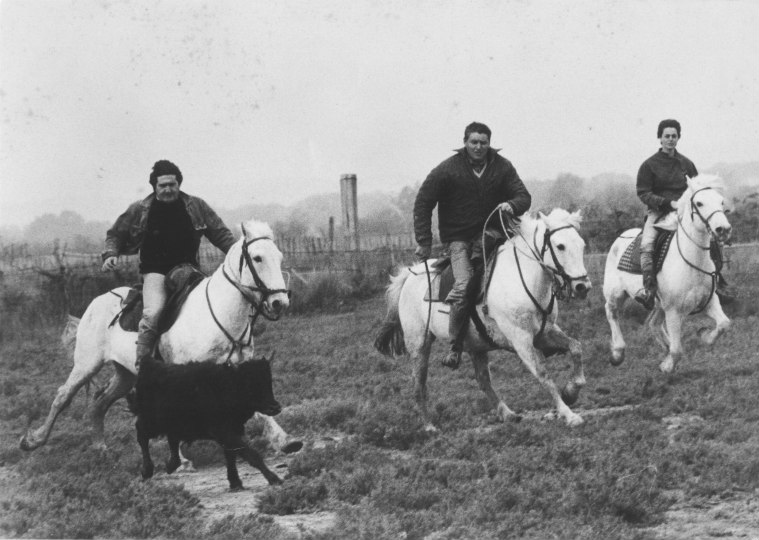
Maja Hoffmann riding with companions in the Camargue – a large area of salt marshes and wetlands that is home to pink flamingos, white horses and black bulls.

La Chassagnette is a gourmet restaurant 12 minutes away from Arles, at the very heart of the Camargue Regional Nature Park.

Maja Hoffmann with Jorge Pardo, a Cuban-American artist and sculptor who lives and works in Mexico, at Hotel L’Arlatan. Pardo’s artwork explores the intersection of contemporary painting, design, sculpture, and architecture.
Photo: Pierre Collet

Interior of Hotel L’ Arlatan, which has been described as “as much an art installation as a hotel.”

Once a provincial capital of ancient Rome, Arles is also known for many remains from that era, including Arles Amphitheatre. Arles is on the Rhône River and is famous for inspiring Van Gogh.

Maja Hoffmann at the Locarno Film Festival conference presenting her new Presidency © Locarno Film Festival. Courtesy Ti-Press
“I’d like to see a change in the mentalities that allows a real movement, because I think we are here and now in the capacity of changing things.”
Maja Hoffmann, why did you put Arles in the name of the LUMA project here?
Because my first thinking was for Arles and not LUMA. Arles being the Camargue too. For me, Arles does not exist without the Camargue. When I decided to do this project here it was at the heart of what I was thinking, with an urgency to preserve the Camargue. It was interesting to do something bigger here in Arles, because in the reserves there is no capacity to welcome a great number of visitors. The Parc des Ateliers could be a place where you can bring people up to date with what is happening in the whole territory. A center of production and a Garden, which loops in again with my interest in living theatre, performances and film, as well as exhibition making – a place that brings people together. Next to active production of realities we are informing about the bioregion and hosting. A whole other part in our endeavor is the hospitality – we build places to stay with a little more character than only fast making money during the season.
You made the incredibly special Hotel L’Arlatan out of The Palace of the Sovereigns of Provence, and the hotel was designed by Jorge Pardo who is based in Mexico?
It’s a coming together of different things that hit the time for the artist. It’s all about synchronicity. Some people call it serendipity, but it’s all about putting things together that are ready to happen; and they happen against something. By this I mean that it’s always a type of struggle when you are not mainstream. It’s like an act of resistance – with hope for a great outcome as a main component.
You also have a notable restaurant called La Chassagnette?
Chassagnette was the first project, at the beginning of the years 2000. It’s a restaurant in a garden in the middle of agricultural land. Originally a nature reserve was meant to protect the birds or the plants, but the humans were missing. I realized you need activities in the buffer zones between the frozen reserve and real world, and that this would be the best protection for its core. I thought Chassagnette and organic agriculture could really help this region to maintain their commitment to healthy nature. We also went to Italy to buy the red biological rice. We created “heureuse Camargue”, an association of farmers with the same belief in organic farming. This is now dissolved and we resold the red rice brand since.
It strikes me that this whole project is like a puzzle with many elements?
Ethically, they all fit together. This is why I need also to find partners that are ethically engaged in a similar vision of the world. It’s diverse, and it bounces from one to the other, but the essence is the same and so it fits together. We can all participate in the same effort to provoke a mini catharsis that can transform the thinking of people about what art is or may transform a little bit the way people are so set in their minds. We can create these opportunities.
Have things changed a lotIn the many years that you worked in the world of art?
There is more dichotomy between commercial art and research. I position myself in research and experiment, but some people prefer to describe me as a philanthropist, to which I do not react anymore. What has changed in the world of art is one thing. What has changed in the perception of what philanthropy is or can achieve is maybe the more important question to ask. What impact can you have and for what? Right now, when something is only in the hands of politics or public domain, without private participation, it doesn’t work.
If private people come together then things move, because to do all these things you need one person who has the passion and the vision?
It’s not my passion. There are so many projects that I try to fit together. It’s nearly a calling. Without taking myself so seriously, it is nearly that you cannot do it any other way. It’s difficult to explain to someone from the exterior. When you are inside, you want to do things the best you can. It’s not my passion. I’m not really interested in my passion, but the vision, yes. There is a vision for something that could look and function differently.
And that’s what you do?
I was working at finishing my Mauritania film with an editor whom I really like very much. I haven’t seen him in years and now I don’t know where he is. He was very sensitive, and every day I was saying, “This is not what I meant.” And he was answering, “It has the merit of existing.” – I guess to make me feel good about it. Today it’s true that here we have something that has the merit of existing. Now, where does it bring us? That I can hardly tell you right now, and probably it would be wise to step back a little, which I’m trying to do. I tried to go on distance two years ago, but then I had to come back, because it’s a big project with many different elements to watch and that need to evolve.
I’m not here to compliment, but it is one that I think amazing.
Finally, we’re putting all the projects together with all the aspects we did not have proper time to discuss here, which are the bio-regional materials, the garden, the Camargue, again in the middle with new possibilities with and for the Tour du Valat. We have a relationship with MIT now, the program will develop over 10 years. We are finally getting where I wanted to. I have had one recent set back, which I trust is only temporary – and that is with trying to establish our school. Since before Covid we were working on a prototype for an institute, and will continue to do so, but with the political changes abroad we had to stop for a while. My next thing is really to seriously work on the “School for Planetary Transition”. Our campus is now ideally located in space and time to make it happen, and the time to organise a group to continue thinking about it is now.
You’re very grounded in nature and I am impressed by the way nature has grown here in your garden that at the beginning was rather small.
We planted it with a purpose. It’s only three years of finished garden with the seasons that go with them. You feel a big change because it was following a plan, and it is crucial to understand that it’s not random at all. Visit the Atelier LUMA and see what they do with the bio-regional materials, and you will understand that everything is like a living organism. My hope is that we can create a movement. In the beginning I was called a utopist, but I was always seeing the reality of what I can do.
Now the decline of Arles is over and lots of people are coming and there are many artists here?
We initiated a wave. It should not be a fleeting one. I want what we build up to be sustainable, and I don’t know yet about its sustainability – there are days when I am not completely sure we will pull it through because you cannot count on one person only to bring all the funding, you need partnerships. We need to be more solid, and I don’t know how it’s going to work. I’d like to see a change in the mentalities that allows a real movement, because I think we are here and now in the capacity of changing things. What I wish is enough things with similar meaning to come together to create a true impetus.
During Rencontres this year you are showing films on encounters with whales in the St Lawrence river and then also reconstructions of Pompeii as part of a broader exhibition at LUMA Arles that delves into themes of human experience and planetary disruption?
Wael Shawky’s film-based installation “I Am Hymns of the New Temples” in the Grande Halle is mixing humans with mythology, but you can also see that mythologies from different religions or regions all come together at some point. It’s really stunning, in an unexpected way. We rebuilt an entire Pompeii street, with booths featuring Wael’s ceramic masks and glass sculptures which were also used in the movie that is projected in the same space.
You have plenty of other exhibitions around like the Korean Artist Koo Jeong A’s major solo exhibition titled “LAND OF OUSS [KANGSE]” which transforms LUMA Arles into a cosmic wonderland?
The world of Koo is one of a kind, in which human, nonhuman and trees have the same voice.
Our public comes and says, “Oh, I’m going to do LUMA today.” You cannot. You should just come and see one show at a time, in my view, and it’s enough for now. Then come back. We are open the whole year and this makes a difference, but most of the town is seasonal, still. Although we have been stretching the season already big time.
Yes, you did something for the Van Gogh Museum in November, and therefore opened the city for the winter?
We want to do more of this.
Your father Luc Hoffmann provided the organisational structure for the Fondation Vincent van Gogh Arles, which Yolande Clergue had the ambition to create, establishing the Foundation in 2008 to preserve Van Gogh’s memory and promote contemporary art in Arles?
My father took the project of Yolande Clergue and put it into a shape that is legal, which is a Foundation. She had created an association, and she started to ask many artists to come to do work in homage to van Gogh. So, what my father did is give a frame and find a long-term lease for a building that is still city-owned, so he was able to establish exhibition spaces and offices for a Vincent van Gogh Arles Foundation. After three years helping him setting up and find an artistic director, we opened the museum ten years ago, and I jumped in as the President with the backing of my siblings. At the time our father was over 90.
Last year you exhibited the amazing painting “The Starry Night in Arles” by Van Gogh?
I’ve been working with Bice Curiger, the artistic director towards this goal for a long time. The opportunity came from the previous Minister of Culture, Rima Abdul Malak. For the year of impressionism in France, in 2024, she fostered exchanges with local museums in the whole of France – and by opening this possibility suddenly the Nuit Étoilée, the Starry Night from the Musée d’Orsay, was given as a loan for a period of time which was rather short, but at quite a good moment in the year. That attracted many people, because Van Gogh and Arles together, that’s an amazing duo! The painting had come back to the place where it was created.
Maison Fragonard, located near the LUMA campus, opened in July 2025 and focuses on the textile and costume heritage of Provence. It includes a ground-floor boutique and upper-floor character rooms, showcasing Provençal style and the traditional costume of the Arlesiens. There really are lots of things happening here!
Yes, and Jean-Marc Bustamante wants to do his private Foundation in the Roquette. And we have Lee Ufan, which is really quite someone.
We can say that now Venice is not the only city of art?
I don’t think we can be like Venice. Venice makes people dream. Here, I don’t know – maybe they can dream, but in harsh reality. I hope we do not become the playground for the rich and famous. I hope we can stay like Arles – but for how long, I don’t know. The people who come to Arles are people who sense Arles’ authenticity.
You are also President of the Locarno Film Festival in Switzerland, and this is yet another big job?
It’s reconnecting me to cinema. After two years trying to understand Locarno, it’s still difficult for me to get why, with the quality of movies that we present, with Lake Maggiore, with the mountains, with the Swiss functional systems, the engagement, the ethics behind, so few people from the film world come, except for professionals who have been coming for many years and come back! Starting to build a community around Locarno Film Festival, with a climax in the second week in August, seems to be a right endeavor at a wrong time in the year. We will continue to invite the best Swiss and international films, and try to change what’s possible. It’s not easy to try and change habits, but it’s also very energising and inspiring. There are incredible possibilities that I want to help develop.
Is it your job to create the jury?
No, I’m the President, so I’m responsible for the good health of the festival. I work with an artistic director who is Italian, and I work with a young CEO since the start of this year, who under my predecessor was working for the festival in another function. He is from Ticino with a foot in German Switzerland, and understands Swiss society well. But even Swiss society is changing. I also established a new Board. I asked the former President of the Biennale di Venezia to come and join, Roberto Cicutto, who was there just before Buttafuoco. I also asked Gilles Marchand, the former director of the SRG SSR – who is French and who knows how to navigate the Swiss media world. I had forgotten that Switzerland has very specific qualities and is somehow complicated with the three regions speaking different languages. I’m also lucky to have a Vice President on board, a former conseiller d’états of Ticino. He is precious to represent the Ticinese people and is in charge of the local while I try to tackle the festival more globally. I’m looking for ways to internationalise the festival more, because this is what the Ticinese asked me to do by calling me in. At the end of the day, I was born in Switzerland, and Locarno is good for me because it’s in the south and closer to here.
From living out of suitcases in the past, how do you now organise your life?
I now have houses and tables filled with papers and books. These days I have too many suitcases, and not for the same reason as when I was young. I’m more inclined to Buddhism. I’m really living in the moment – no kidding. Of course I have a family, a plan, responsibilities.
How do you feel when they give you awards such as your Honorary Doctorate at Bard University, or the Legion d’Honneur in Paris?
I should be more serious on the matter because ultimately I care about these signs of recognition. My father had a very strong personality and was an important person with a modest attitude, and towards the end of his life I felt that he lacked the right amount of recognition from others and at times felt his frustration. I was given the Légion d’Honneur, but I never did the ceremony needed to receive it, so it’s like it doesn’t exist – and I should take care of it because it would be counterproductive to become frustrated for things that I have but did not acknowledge. I have received a few distinctions this year.
These are a bit like passing exams, meaning that you did well and are recognised for what you do? I don’t know if it’s ambition or if it is pride or if…
…you get a better table at a restaurant! That’s why you say Yes usually to the French Legion d’Honneur! laughs I’ve had it for five years and I didn’t find time to organize my own ceremony, as for my Commandeur des arts et des lettres, it was a surprise organised by the minister of culture. I’ve also had the Medaille de la ville d’Arles for years now. Like Nick Cave who became chevalier and merit of Arles at the same moment this past July!
Is there a rhythm to your life?
I don’t have a life with always the same rhythm or watch out for my sleep or my health. This is not the way I function. I’d prefer to speak about creativity. If you are creative today you will take the medium you need to fulfil your vision, to pursue your work at the time you need it. This spans from established techniques all the way to AI. AI has brought a lot of possibilities to film that are appealing to artists. You will always have the purists who prefer to say photography is only valid when taking the form of a black and white print, and then you will have the others, who have been involved in commenting, analysing, writing and shaping the evolution of photography. Healthwise and for balance, I just go occasionally to check my blood, and they told me lately I am 10 years younger than my biological age, whereas I was 15 older 10 years ago! So, I’m questioning the fact that sleep must be the same for everyone. At the same time, I believe that age reversing is a possibility that will become more common in the years to come. All rhythms apart, I think that, if you want to go somewhere, you just go and just do it with a smile.
Maja Hoffmann thank you very much for this long and interesting interview.
Portrait of Maja Hoffmann, photo by Brigitte Lacombe.
ENJOY THIS INTERVIEW? SHARE IT WITH A FRIEND.