INSCRIBING IDEAS TO MEMORY. Amos Gitai is an Israeli film-maker, internationally known for his documentaries and feature films about the Middle East, the Arab-Israeli conflict, and personal and collective memory. Born in Haifa, Israel in 1950, Gitai was wounded during the Yom Kippur War in 1973, when a medical evacuation helicopter in which he was travelling was hit by a Syrian missile. He has drawn on biographical, familial and generational themes throughout his career, as well as the trauma of war and the celebration of life in the face of adversity.
27 minutes read time.
You can listen to the podcast of this interview here.
Amos Gitai, among your many diverse achievements, you edited a book about your mother Efratia Margalit’s letters, and another one about your father Munio Weinraub Gitai’s achievements?
Yes, I like both the people who coproduced me! They are very courageous. My mother was born in Tel Aviv in 1909, the year that Tel Aviv was created. When she was 18 or 19 she felt it a bit provincial so went to Vienna with two other girls to meet Freud. She stayed until 1932 when she went to Berlin, saw Hitler speaking in Alexanderplatz, and decided to come back. Coming from Tel Aviv, a province, and going to Vienna, which was like the Mecca of psychoanalysts, shows she had courage. In a similar way, Munio, my father, came from a relatively provincial Schlesien town and went straight to the most avant-garde school of art and architecture at the Bauhaus.
Why did your father go to Israel when Mies van der Rohe and others of the Bauhaus went to the USA?
In the 30s my father was a student at the Bauhaus and working for Mies van der Rohe. Hitler came to power in January 1933, and in April the racial laws against the Jews. Only a week after he was picked up with four other students in the Bauhaus, beaten very badly and thrown into jail. His lover at the time, a German woman, helped him to get out to Switzerland, and Paul Klee helped some of the Bauhaus students to cross the border to Switzerland, and Munio went to Basel and stayed there. At some point the Swiss started to give the German Jews back to Hitler, so he knew that it was coming and most of his teachers went to Chicago or to New York, but he was very enthusiastic about the social experiments of the kibbutz, of creating a modern society in Israel, and he decided to go to Israel. He was a bit worried, so he went to British Palestine, as it was then, with his non-Jewish Swiss friend and they got a certificate, which the Brits at this point would only give to Jewish immigrants who had some craft, so a lot of people could not come to Israel and be saved.
“You have to inscribe some ideas in memory”
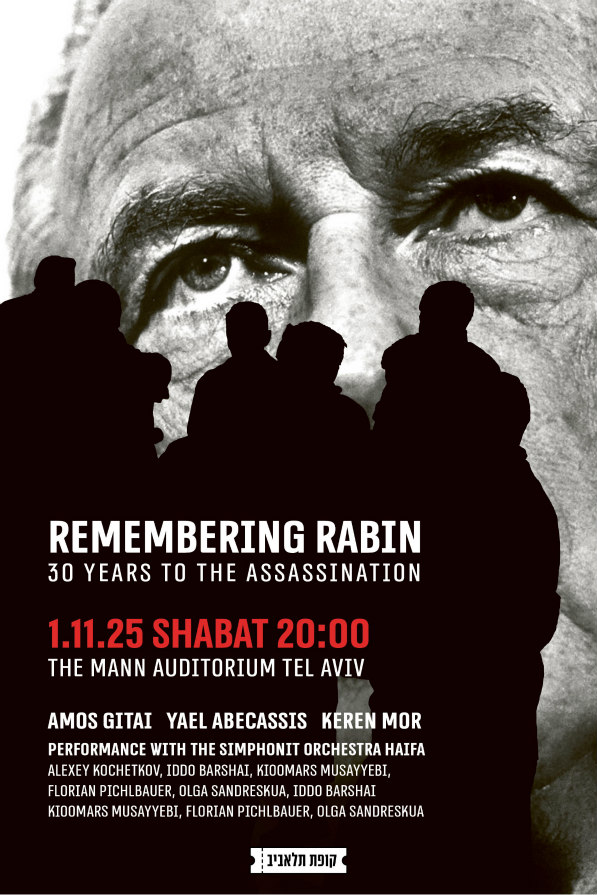
REMEMBERING RABIN: 30 YEARS TO THE ASSASSINATION
November 1st 2025 at The Mann Auditorium Tel Aviv
Amos Gitai, at the end of the 30s both your parents were living in Israel, having arrived in different circumstances. While your mother was born there, your father was there because he was obliged to leave Europe?
There was a difference between these two groups which made a composite of the Israeli population. There were people who came by ideology, like the family of my mother. In 1905 her father came from Bialystok in Poland through Odesa to Alexandria, and then by camels to Palestine. They were a kind of anarcho-socialist, and wanted to create a modern society. Not a traditional Jewish society, not a religious society. On the opposite, they were not religious at all even if they felt very happy to be Jews, since anyway Judaism is a strange composite between national and religious feeling. On my mother’s side they went more to the national identity and when my mother was born to these Russian socialist immigrants, there were only 50,000 Jews in Palestine. The difference is that Munio is of the people who were ejected by Europe, and if they would not go, that was it. They would perish.
Did your parents think that there would be a State of Israel?
The family of my mother thought that it would be a State, and they worked for it. My maternal grandfather was in charge of major economic institutions to build the infrastructure and was very close to Ben-Gurion, the first prime minister of Israel who is considered the architect of the modern State. When people attribute the creation of Israel only to the Holocaust, the Shoah, they are wrong. Actually, the project of modern Israel started before 1948, even before the immigration of my grandparents. It was started at the end of the 19th century by the first modern wave of immigration. These people believed that there would be a State and that was their project. On the other hand Munio, my father, was ejected by Europe, and if he wouldn’t go, he wouldn’t be alive. This is the two different groups.
Israel was at the beginning a socialist country where for many years people, including non-Jews, went to experience a kibbutz. With the idea of modern Judaism, Jews suddenly became agricultural experts, soldiers, aeroplane pilots, and so on. When did this image of Israel change?
This image of converting the Jew, not just to be a merchant or intellectual, but to be a soldier and a peasant, is the legacy of the Labor movement. When the Labor movement lost power in the mid-70s and Menachem Begin took power with Likud for the first the time, then it changed. A very interesting sounding of public opinion was commissioned by the Right-wing, asking asked the Israelis to define if they are Israeli or Jews. Those who define themselves as Jews traditionally voted for the Right, and the people who define themselves as Israelis traditionally voted for Labor. The power shifted in the 70s to the Right. There were several not very long intervals in the domination of the Right wing, when Yitzhak Rabin came to power in the 90s, or when Ehud Barak came to power in 1999. Now, there is an absolute hegemony of Likud and the extreme Right. That’s the tendency.
How do you view the extensive cinematic and theatrical work that you have done, and which shows the changes that have taken place?
I don’t think the arts change the reality in a direct manner. They don’t. Recently I was invited by Miguel Moratinos, the ex-foreign minister of Spain, to make a public speech at Guernica for the anniversary of the bombardment by the Luftwaffe in April 1937. I told him that in the duel between Franco and Picasso, Franco won and Picasso lost. But, in the long term Picasso won. If you think about the Spanish Civil War today, you think about only one image, the Guernica, one painting which will be remembered among all the hundreds and maybe thousands of paintings of Picasso. Art can hit back at politics, by preserving the memory. Franco did not want it to remain the memory, but this is the memory and part of the work that I do is inspired by this idea. It’s not going to change immediate political elections, for the good or the bad, but you have to inscribe some ideas in memory. The planet is not always changed by machine guns and money, but also by ideas. This kind of way of thinking contributes to change, but in a way in which the art is the central focus, not demagogy or simplistic prejudice.
You live and work between Israel, where you fought in the war, and France, your second home where now you directly encounter the anti-Semitism of Europe?
The problem of Israel is the contradiction that it became too strong military-wise and with sophisticated technology. They think that everything is easily fixed by resolving to force. A few days ago, they bombarded Qatar and now the sky is the limit. The strength is a weakness, because then you are not obliged to find solutions which are not based only on force. They think that the more they hit and destroy Gaza, they will get victory. I don’t know even what is the meaning of victory. Not just me, but a good chunk of Israelis who also love this country – because there are a lot of things to love in it, the creativity, the sensitivity, the human quality – are devastated. They feel that they have been picked up and kidnapped collectively by a regime that doesn’t want to listen to anything but only the rapport de force and even selling it as an idea.
Are artists now leaving Israel to live in other countries?
The catch is that some people are going away and then a lot of people are being refused by the world, and boycotted. I have an argument with that, and I said it to the Spaniards when I was in Spain recently to show my theatre House, which was also in London, Rome, Berlin, and Paris. If the world refuses point blank to accept every Israeli just because he’s Israeli, first of all, it’s racist. Secondly, it helps the current Israeli government who want us all to feel claustrophobic, so in a way they support and help Netanyahu and they diminish the capacity of the opposition forces within Israel to have their say.
This boycotting applies not only to Israelis but also Russian artists because of the Ukraine war. What do you think about that?
It doesn’t matter if they are Russian or Israeli, if they stand for the diminishing of the other, whether it’s Ukrainian or Palestinian, then you can disinvite them, but some artists are fighting for the rights of the other, and you cannot just outright refuse them, otherwise, you don’t help the inner struggle. It’s simplistic to refuse them.
“We have to always take into account the other, because if we will only think about us it will never bring reconciliation”
Amos Gitai, did you personally face discrimination through your work in theatre and cinematic production?
No, I didn’t confront it, but that’s why I feel very comfortable to defend other Israelis which I feel are defendable. The Golem piece was a major success in Paris; we played to a full house 25 times, although the thematic of the Golem is anti-Semitism so you could have thought that people will be against me making a piece of theatre with these thematics. Part of the language of the Golem is in French, but a big chunk is in Yiddish and nobody raised the flag or resisted, but I also have to say that I include in the performance Israelis, Palestinians, Iranians – all together – and for me this is the achievement beyond the artistic achievement. This was the case of the performers in House, and now it’s the case of Golem, which was recently in Pompeii and next year in March will be in Madrid. We are considering playing both in New York. Part of the statement is that we ourselves do not refuse to work with the other. On stage, side by side, you have Israelis, Palestinians and Iranians talking to each other, even loving to be together. This is by itself an act of resistance in a world which wants everybody to hate each other.
You are in Tel Aviv as we speak, and every day we see another act of violence in Israel, as well as in Gaza. How are you able to continue to live in this much changed country?
It’s difficult, because we are confronting a government led by a guy that swallowed the text of Machiavelli. He’s a manipulator on a very high level, and people feel they are held hostage by him in the country. There is major mental pressure on people who don’t agree with the acts of the government but are here. Every Saturday, every Shabbat, there is this ritual of tens of thousands, sometimes hundreds of thousands, going to demonstrate, now already for more than two years.
It doesn’t seem to be noticed.
No. They are ignored, and even confront violence by the police, but they’re still doing it, every Saturday, every Saturday, every Saturday. On the other hand, life continues. The Israeli economy is in pretty good condition. The restaurants are quite full. But it’s a sad moment to a country because if this regime will continue the way they continue, they can destroy their own country. This is now becoming the expertise of some leaders, including the guy in America. They start by destroying their own countries: the universities, the cultural centres, the things that every modern democratic society needs like oxygen. That would be a tragedy, because the Americans will prevail – it’s a big, strong country and they have much better structures of constitution – but Israel is a fragile country surrounded by a hostile environment. If they keep on going like this for a long time more, people are worried.
Do you find a difference between being a French citizen and Jewish, or being an Israeli citizen and Jewish?
The conflict put these things together in an unjustified manner, but they are together. We also see the gradual divorce of the young generation of intelligent American Jews from the Israeli project who say they don’t know what these crazy cousins in the Middle East are doing and don’t want to be associated with it. This government is hitting the most sensitive and essential elements.
Even as an Israeli war veteran, do you sometimes feel in danger because of what you say or do in your work?
I don’t feel it, but my attitude throughout the years has been that I cannot predict that it will continue. We will do quite a big event on November 1st, which according to the Hebrew calendar is the 30 year anniversary of the assassination of Rabin in Tel Aviv. It will be like the performance we did in London and at the Lincoln Centre, and more recently in Salzburg and in Paris, both a reading, a video and music. I never did it in Israel, so this time we’re going to do it in Israel. We’ll see if I’m able to talk to you after that!
Why are you so inspired by the figure of Yitzhak Rabin?
I’m not in the cult of personality, not even for Rabin, but he has certain characteristics that I like. He was shy, a modest man who did not consider himself as the perfect PR guy, like the guy we have now. He was stuttering sometimes, but he was sincere and had integrity, and it was only in this very brief moment 30 years ago that there was a real effort to reconcile the almighty Israel-Palestinian conflict. Left or Right, they never did it as he did it, methodologically. There was a committee about Jerusalem, a committee about territories, about water, about recycling, about money. As he and Shimon Peres said – let’s put all the questions on the table and let’s discuss them. Maybe we will not reach an agreement because it’s obviously not only Israel which is concerned. Palestinians also have a part in the failure of this period and even in the destabilisation of this government. Right from the beginning, this particular conflict – Israel / Palestine – is the centrepiece.
More generally, what do you think about cinema today?
Cinema is in a crisis, because we have very powerful structures like Netflix – but not just Netflix – who want immediately to dominate the market but create very clear structures so we miss the wilder propositions of people like Pasolini, Visconti, and Jean-Luc Godard. People who question the medium are given less and less space, and it’s a pity. Cinema is becoming poorer. This fantastic medium, between image and music, is becoming too predictable, because the pressure of conventional production is too big. The arts are suffering in a similar way. I’m not so aware of literature, but even literature. We have less and less space for works which challenge the medium, like a Joyce would challenge it.

A Performance of Amos Gitai’s play Golem 26/02/2025
Photo: Simon Gosselin

A Performance of Amos Gitai’s play Golem 26/02/2025
Photo: Simon Gosselin
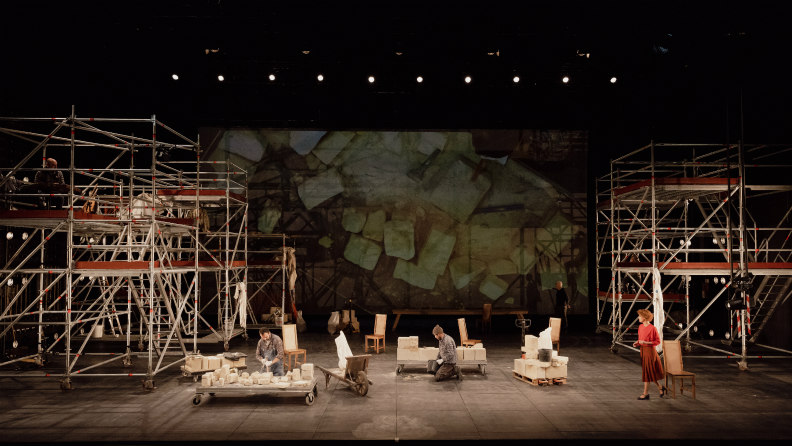
A Performance of Amos Gitai’s play House 04/03/2023
Photo: Simon Gosselin
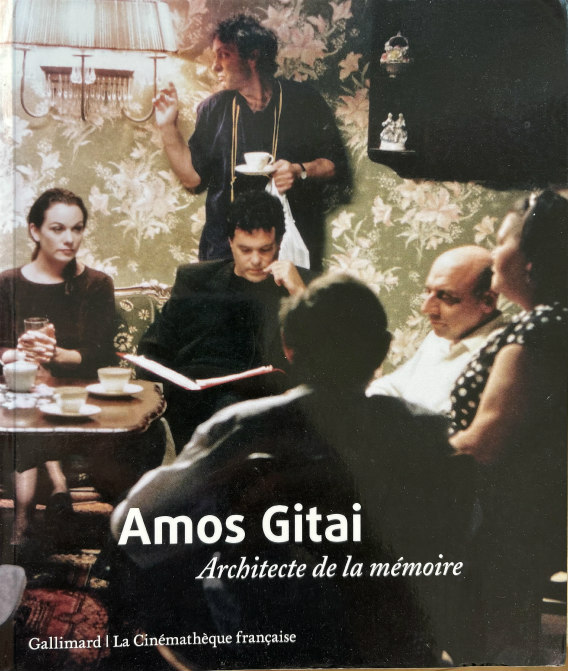
Amos Gitai: Front cover of Architecte de la mémoire. Published by Gallimard.
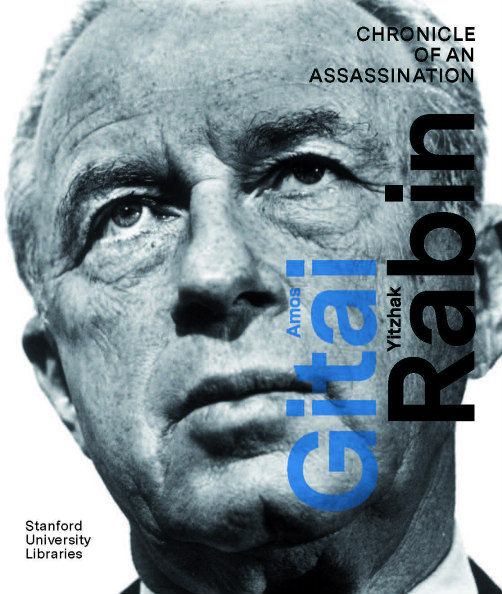
Amos Gitai visited Stanford for the screening of his acclaimed movie Rabin, the Last Day. In his film, Gitai revisits the assassination of Prime Minister Yitzhak Rabin, the tragic night that sent shock waves throughout the Middle East, and across the world.
“The human answer to mechanical reproduction is to propose a non-linear association that AI cannot predict”
Amos Gitai, in fact, cinema used to be much discussed as people waited for anew movie to come out or what they had just watched. Nowadays this hardly happens.
Well, you have in most cases very strong and shining markets, because the investment continues, but you are asking me about the content, not just the procedure or the commercial aspect, and there is a problem. We will see. Yesterday we got surprising good news in the ocean of bad news. My new film Golem in Pompeii is going to be shown in the main section of the Tokyo International Film Festival, so there are exceptions.
What do film festivals like Venice, Cannes or Locarno mean to you?
It’s a way to show new work. But the issue is: what is the value of the work? I was in agreement when Alberto Barbera, the Venice film festival’s artistic director, decided not to boycott any Netflix film, but just to judge the quality of the film. For me, this is the issue, and I thought he was right.
In this world of AI do people still want cinema?
AI is an interesting challenge, and I’m not scared by it. Look at the beautiful library in London of Aby Warburg which they are restoring. The basic question of Aby Warburg is: Let’s think: How do we organise knowledge? And how can we associate a painting of Leonardo with quantum physics? The freaky way that Aby Warburg proposed to us, to think how to connect disciplines just by proximity on the shelves, cannot be done by any AI, because this really depends on the human brain and the way you want to associate elements. The human answer to mechanical reproduction is to propose a non-linear association that AI cannot predict. They can predict elements which are in the realm of predictability, but a lot of the creative process is intuitive. Before Jean-Luc Godard died, I had a very interesting visit with him at his surprise invitation to go to Rolle in Switzerland, where he lived, to meet him. After a lot of discussion – I actually filmed part of it – he told me that he’s very fascinated, you will be surprised to hear, by the Kabbalah! For me, it’s actually clear, because sometimes you see a film by Godard and you feel that when he did the montage he put one scene next to another, and only after he put one next to another did he try to find the meaning of putting one next to the other, so it is a purely intuitive procedure. This cannot be imitated, because there are no parameters to imitate. AI can help us in many fields, such as for lawyers to research all the previous judgements so they don’t have to go to some dusty libraries, or even different options for medical treatment, and so on. But there are some domains, especially creativity, which cannot be pre-simulated.
Do you consider yourself an artist?
I don’t know. I always sign my film saying Amos Gitai architect, film builder. But I like the artistic way of going about things, yes.
Can you tell us about the rapport you have with actors, as it is very strong in your work?
I believe in what John Huston says, that when he was casting somebody he would look at their eyes. The eyes are a way to communicate intelligence, sensitivity. Obviously, you need to see the choreography, the body, the movements, and so on, but I don’t like any more to do traditional casting. I like to have a coffee or a discussion and then to see if we can connect. The mechanical thing of the almighty director with sunglasses and some scared actors is not really what I am interested in. I’m interested to see if I can touch a kind of a human soul, and in that I’m not conventional. In Laila in Haifa, one of the lead actresses is a Palestinian who doesn’t work as an actress; she works in a kindergarten in Tel Aviv. One of other actors who played in the Kippur film as one of the judges of Rabin, now decided to be a carpenter. These are people who like to preserve some authenticity and not just go into the machine and then publicising Dior or stuff like that. Which can be quite distracting. They can get a lot of money, but they can become a kind of a consumer object themselves. Sometimes when I saw big stars doing this activity I’m not impressed.
Were you particularly impressed by Jeanne Moreau?
Jeanne Moreau was very exceptional, because she was opinionated. She didn’t like flattery and if you start by flattering her, she will throw you out. She didn’t want to become marketing, she wanted to be challenged, and when she was challenged, she loved it. If you didn’t, she was getting bored. I loved when she said to me: “I will do a theatre or film only if I can learn something that I don’t know already,” and this is very different from many people who like to repeat again and again. So when I did the opening of the Avignon Festival on the text of Josephus Flavius on the Jewish wars and the destruction of Jerusalem, you come to a study with a table full of books about anti-Semitism, the Roman Empire, exile. She would take a project as a pretext to learn something that she did not know, which for me is a good attitude.
What about other actresses like Juliette Binoche, like Lea Seydoux? You had many famous actresses in your movies.
In Disengagement, a film which now is shown a lot here because it was about the disengagement of Israel from Gaza, the Sharon projects, Juliette had to play a role where there is a duality. When she’s in France, she’s very agitated, almost hysterical, so the turmoil is inside her. And when she comes to Israel, she becomes very calm because the turmoil is outside. She had to play this transition, which was very interesting to build with her. It is also about intimacy, about nudity, about other things. It’s like people. The wonder of the world is that we have several billion people and each one is different. So you have to adapt the methodology again and again and again, and this is not something that you can standardise. Juliette Binoche is different to Natalie Portman, and Rosamund Pike is different, Hanna Schygulla is different, and I like this human richness.
Are you more interested by women actresses because you see them as the other?
I do see them as the other, and they had a certain phase. Now it’s different, but they had to resist against suppression, so they had to find all sorts of sophisticated ways to do it. In the last two films, I used quite a lot of text of Virginia Woolf. The last film, the Golem in Pompeii, is also a relatively short text of Virginia Woolf, which is called Thoughts on Peace in an Air Raid. She writes it under the blitz, and it’s a beautiful text because it’s about the sound, the whistles of the bombs. You can take an essay of Virginia Woolf written in 1940, and since I’m in a region that this is an experience, the echo is beautiful. Also Susan Sontag in the film we did, Why War. The text she read about the suffering of the other is an essential text because there will never be peace if we only think about ourselves, about us, about our suffering, about the tragedies. We have to always take into account the other, because if we will only think about us it will never bring reconciliation. The problem right now of the both groups is that they are completely convinced by their own suffering, so there is no space for the other. This is a problem, because for peace – like love – you have to have the other. If not, it’s not love and it’s not peace. It’s a unilateral. So I’m drawing ideas from these texts, which are not new.
You are an architect, a movie director, a theatre director, and you are obsessed by literature and philosophy. Amos Gitai, who are you?
I am all of that, maybe more, maybe less. I also want to be a father and grandfather. I love my two children; they challenge me, they’re fascinating, and they’re good, honest people. We have to leave something to the world, among the people that are close to us. The uni-occupation of a filmmaker who is just going to festivals and all his obsession is about film and film I find relatively boring. I like to be stimulated, sometimes by a poem, by a work of art, an old text, a biblical text. All of that is there for us to choose and to be inspired by and to say what we want to say through this maze of complexity.
Does this flame of enthusiasm that you keep alive come from always looking forward and talking to young people?
I talk to young and to old. I’m not against old people. I’m not especially for young people, but I’m not against young people. I’m open to experience new things, and I’m curious, and anyway, at some point it will stop, and by itself, so I don’t feel a necessity to intervene and to force myself into retirement. There is no reason to retire. Our voyage on this beautiful planet is short, so let’s do what we love to do. I consider it a privilege that I only did films I wanted to do. I never did anything I did not want to do. Also that I have the help of good people. Wajdi Mouawad, the director of Théâtre national de la Colline in Paris, gave me the stage and the means to do House and Golem. I invite you to come to see Golem in Madrid next March, and maybe in New York. I don’t have a sombre idea of humanity, although we live in a sombre moment, but there are also good people who stretch their hand and without any reward, they come and say, okay, we’ll work for you, we will help you. I met wonderful people.
Thank you, Amos Gitai very much for being with me again. Good luck for your work, and all my wishes, also for the coming Jewish holidays. I hope we will see each other in Paris as we did before on the Day of Atonement.
A pleasure.
Bye-bye!