“EDUCATION IS THE NEW WORD FOR PEACE AND PLACES HOPE ON THE MAP OF THE PRESENT AND FUTURE.”
José Tolentino de Mendonça is a theologian, university professor, and one of the most original voices in modern Portuguese. Born in the island of Madeira in 1965, today he is Prefect of the Dicastery for Culture and Education, an administrative unit of the Roman Curia. He is Grand Chancellor of the Pontifical Institute for Christian Archaeology and a Bishop since 2018. From 2018 to 2022 he was Librarian of the Holy Roman Church. He was made a Cardinal in October 2019.
25 minutes read time.
You can listen to the podcast of this interview here.
Your Eminence, you are a member of the Third Order of Saint Dominic; does this mean you are a Dominican?
It means I belong to the spiritual family. I am not a professed Dominican; I am a diocesan priest, but on a spiritual level I also adhere to Dominican values and tradition.
You were still very young when you began writing poetry. Did you feel a calling to start writing poetry?
First of all, I felt a calling to be a reader of poetry because, for as long as I can remember, poetry has always played an important role in my curiosity, in my internal combustion, in my research. Perhaps because I was brought up in an environment where the oral tradition played a very important role. Poetry is a dominant factor in oral literature. It’s very close to music, to song. Even the oral romances have the rhythm of poetry. I can say that, from my earliest years as a reader or listener, poetry had an almost magical impact, like a spell; I was seduced by it. Initially, I thought it was about speaking, saying, and then I realised it’s a way of thinking about the world, of seeking meaning, of going beyond.
“The common thread running through my story is the importance of attention to culture, dialogue, and the power of knowledge and science.”
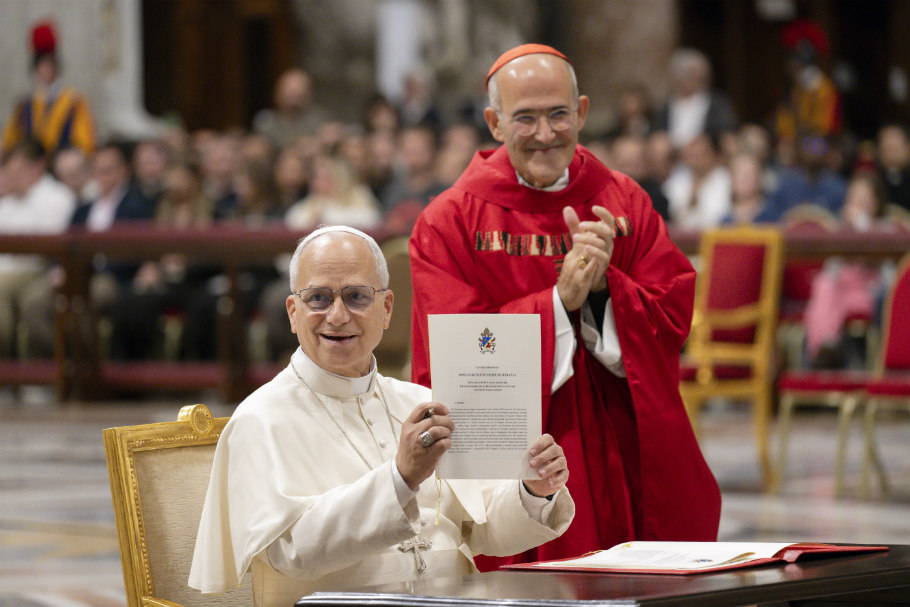
Pope Leo XIV, flanked by Cardinal Jose Tolentino de Mendonca, right, shows the apostolic letter on education before celebrating a Mass for the opening of the academic year of the Pontifical University and for the the Jubilee of the World of Education in St. Peter’s Basilica at the Vatican, Monday, Oct. 27, 2025. Credit: AP/Alessandra Tarantino
José de Mendonça, you were born in Madeira but spent your early childhood in Angola because your father was a fisherman there, after which you returned to Madeira. What memories do you still have of that African childhood?
Thank you for the opportunity to talk about this, because I believe the secret of a person always lies in their childhood, so we’re looking for my secret. We can never praise enough the original professions, such as that of the fisherman, which, through the simplicity of resources and forms, connect us to the primordial world. In Africa, people live closer to nature, to the land, to the daily rhythms of life; with my father, I truly had the opportunity to intercept a vision of the world that I recognise within myself today. For example, one thing that fascinated me about my father was his ability to look at the sky, the constellations, and find his way; to be able to look at the clouds and predict the weather the next day. It was a skill I longed to have for myself too. In a life very different from the one I live today, I recognise in myself many attitudes similar to those I saw in my father: attentiveness, which I think is something I inherited from him; the desire to pay attention to even the smallest details; and resilience, an indispensable quality for fishermen.
In your current role, you have said that culture must play a central role in Catholic life. Is this what you, in one way or another, have always been working towards?
This is something I deeply believe in. The hermeneutic core of the Christian religion, and Catholicism in particular, is the Incarnation; we believe in a God who became man. This represents a valorisation of the human experience. I believe that it is precisely human experience, the deepening of the meaning of this experience, that allows us to draw closer to God. In this sense, faith cannot exist without culture, without the expressive, sensorial, and intellectual dimensions of a humanity that becomes history and not just metahistory, that becomes a daily presence in time and not merely eschatology. For this reason, when I look at my biography, I see that – in faith’s journey – the common thread running through my story is the importance of attention to culture, dialogue, and the power of knowledge and science. Otherwise, faith would become abstraction, while culture brings reality, realism.
You organised important meetings with museum curators, filmmakers, and scholars during the recent 2025 Jubilee of the World of Education in Rome. You therefore attach great importance to contact with the people who actively create culture or are involved in disseminating it?
This stems from the awareness that we Catholics, we as a Church, need alliances, friends; because the scale of contemporary challenges is such that we need to work together to address them. The cultural code that was the foundation of the so-called Western tradition is no longer the same today. An adolescent, a child, a young adult who enters a national museum, is no longer capable of recognising the code that the masters of the past were inspired by. For example, they are unable to recogniSe Piero della Francesca, his themes, who the characters in his paintings are, or why Leonardo da Vinci or Michelangelo depicted their figures in a certain way, and who those figures are. This code shift is something that greatly concerns the Catholic Church, but that’s not all; I think a museum curator also has the same concerns. Ultimately, the question is: is our world still legible or has it become an enigma that is increasingly difficult to decipher? In this complex modernity, we must unite to decipher the world, and in this sense, the curator of a major museum is a partner in a dialogue. We must educate the public, convey the keys to the understanding of a heritage that partly belongs to the Church, but extends beyond the Church. We can say that today, a twenty-year-old is the heir to a heritage for which he lacks the keys. The Church can only provide these in part, because all the components, all the cultural actors, must collaborate in a process of transmission, because transmission enriches us all. The same can be said, for example, of dialogue with contemporary artists, because art is not only the heritage of the past, but is also incessant research into the present, albeit with very different languages, because languages necessarily change. As Roland Barthes, the French essayist and philosopher, said, a person’s body is a language. We are languages, a web of languages. Each generation translates and expresses itself in a very different language. I think every Christian should embrace the Roman playwright Terence’s famous phrase: “Everything human interests me.” This all-consuming interest in everything is ultimately an interest in humanity; it’s something that, in my view, must lie at the heart of religious experience. When the French philosopher Simone Weil was hospitalised in the clinic where she later died, the doctor asked her what she did for a living, and her answer was wonderful: “I am interested in humanity.” I think this interest is a beautiful, necessary thing, something that should always be kept alive.
You worked with Pope Benedict and with Pope Francis, and now you work with Pope Leo XIV. With regard to culture has anything changed from one Pope to the next in the lives of Catholics?
What is asked of each Pope is that he be himself, so from this perspective there have been great changes because each of them has a distinct personality and brings with him a culture and tradition. Each of them has a biographical journey that in part also determines a distinct cultural vision. That said, we must see great continuity. I believe the hallmark was the Second Vatican Council with the action of Pope Paul VI, who understood well how, in the contemporary world, the relationship with culture was crucial for the fulfilment of the Church’s mission. Pope Benedict, also because of his personal history, was an artist who could not live without his own plan; he was very sensitive to the cultural dimension and its importance. But it’s interesting to see that even in a man like Pope Francis, the cultural dimension was truly vital. As a person, he was very different from Benedict, but he had a tremendous awareness that culture is the fundamental path for the Church’s mission. I remember the speech he gave when he visited the Venice Biennale, the first Pope in history to do so. He said: “The world needs artists.” During the pandemic, I remember Pope Francis’s speeches in favour of artists and storytellers; his elective affinities were significant in the cultural world. We just had a meeting with the world of cinema, a very important art, but young and restless, as the new Pope Leo XIV has defined it. It’s an art that is very close to his heart; as some say, Leo is a cinephile. Not only does he love traditional American and European cinema, but he understands how important dialogue with different artistic disciplines is for the search for meaning, which must necessarily be open and one which our era is called upon to undertake. Ours is an era of many new things, but it is also an era called to express the ultimate questions, not just the penultimate ones.
Universities are investing more and more money in everything scientific, technical, and innovative, but less and less in the humanities. Do you think this is a mistake, an impoverishment, or is it right?
I’m an optimist. I see the lack of investment in the humanities and I see how, at the same time, there is a rush toward technology; but the coming future will increasingly require a union between technology and the humanities. Without philosophy, without the development of critical thinking, humanity would lose the ability to sustain the unfolding of history. It is the humanities that guarantee human freedom, freedom of thought, and the development of consciousness, while technology alone fosters a type of progress that, in the end, would be deficient. If you ask me how I see the future in five or ten years, I think that universities will increasingly develop transdisciplinary studies. Unfortunately, we are heirs to a tradition that puts knowledge in different boxes.
What do you think of artificial intelligence?
It reproduces human knowledge. It has the capacity for innovation only within the limits of what already exists, while humans are capable of achieving the unimaginable and are endowed with an intelligence that isn’t merely the product of accumulated data, but is creative, emotional. Humans cry, laugh, pray; these are operations that a machine cannot perform because they are operations through which humans express their originality. Only when we are able to associate the humanities with technical knowledge more often and more naturally will we be able to find a synthesis capable of serving the future. I remain a man of hope.
“This is a time when the desire for peace, the stubborn search for a path of peace, should be the primary concern of contemporary culture and society.”
José de Mendonça, as a humanist, an intellectual, a man of faith, with all the progress that has occurred, how do you explain and what do you feel about the fact that wars still rage in so many parts of the world today?
Reading George Steiner had a profound impact on me. Drawing on the experience of the Second World War, during which we saw people capable of great emotion and at the same time of the most unthinkable atrocities, he said that it is unbelievable that culture can lead to human progress. Culture is a fragile asset, in the sense that it is not sufficient to save a person from himself, from violence and from the darkest instincts that contradictorily and paradoxically inhabit the human heart. This is why we need a comprehensive vision of education and culture; forms are not enough, nor are artistic disciplines that certainly can foster a person’s development, because, ultimately, human beings must undertake an inner journey of transformation, of openness to transcendence that allows them to find a better version of themselves.
I share your interest, your passion, and your conviction of the importance of culture, but many people are actually wary of culture, and many government leaders seem completely ignorant of the aspect of culture, and perhaps even of religion?
This is a deficit of our time. The German philosopher Walter Benjamin spoke of the relationship between culture and barbarism, but without culture we would become barbarians more quickly. Culture is a form of humanisation: listening to music, knowing poetry, and contact with great masters help us in a process of humanisation that we can never say is complete because man is a being on a journey. Culture, religion, and spirituality play a vital role in this process of restoring man to himself, to his original vocation, which ultimately is a vocation to brotherhood.
Like the English Dominican Cardinal Timothy Radcliffe, you attach importance to friendship. He maintains that creating friendship is the most important thing, even more so than culture, and that friendship is something that can perhaps save the world.
I think that friendship is a language that allows us to be aware of the value of others: a friend is the other half of myself. The French philosopher Montaigne said that friendship doesn’t really have a reason, a why. Friendship is the encounter in diversity and the value given to difference, not as a threat, but as a form of hospitality. For me, friendship is synonymous with hospitality and is one of the things that can save the world. Friendship can always exist, it can exist between people from different cultures, it can unite adversaries. Friendship is a worldview in which the other is not a rival, but someone who enriches me, who makes my world broader and brighter.
Today, the word “love” and the symbol of the heart are used constantly on smartphones. Is friendship a stronger and more important feeling than love?
They are feelings that have the same root, even if they have different expressions. We shouldn’t put love and friendship in competition; both are necessary because each of these feelings allows us to fulfil our human vocation. I agree with you when you say that today we talk about love when we should be talking about friendship. Ultimately, friendship is the commonest form, closest to us, and often the form that outlasts love.
In today’s world, I see hostile feelings resurfacing even between religions. I have worked, with Cardinal Carlo Maria Martini and others, on building bridges between religions, but it seems to me that in today’s world this has been somewhat forgotten. What can be done to rebuild friendship, to offer a positive and non-confrontational vision of different religions?
We owe a lot to Pope Francis, who had an empathetic vision of religions. We are commemorating the sixtieth anniversary of the Second Vatican Council, which enshrined openness to other religions, but Pope Francis, if we consider, for example, the final chapter of his encyclical Fratelli tutti, spoke specifically about the role of religions in building peace. Religion must not be a reason for hostility or violence. On the contrary, religious people have a shared heritage. We, along with other believers of different faiths and religions, have a sense of the spiritual that truly unites us, and we must value what unites us far more than that which separates us. But even the secular spirit, even an atheist, is an important interlocutor in building peace. We must increasingly value the community dimension, the contribution that each can make in a polyphonic vision.
Is enough being done to achieve peace, or are religions currently weakened by the climate of violence, weakness, and war?
Today we live in a time where the race to war and arms seems inevitable, the obligatory path to follow, but instead it is a form of blindness, of failure. This is a time when the desire for peace, the stubborn search for a path of peace, should be the primary concern of contemporary culture and society.
When the Pope speaks of peace, asks for peace, do you think anyone listens?
I may seem naive, but I deeply believe so. We never use the word “peace” without it having an impact, even if it isn’t visible. Pope Leo’s first words were “Peace be with you,” and he often repeats these words as a greeting. If we want to be cynical, we could say that they are words of good intentions that never take concrete form. Instead, in public discourse, they introduce the centrality of peace. This is something that is missing; in public discourse, we must say more about peace, bring it more into our daily lives, because words are not just words, but have the power to transform. When a human being utters the word “peace”, that word makes the heart beat differently.
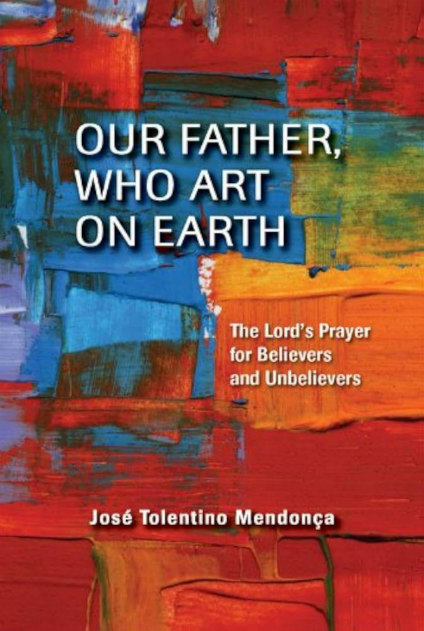
Cultural, poetic, and biblical reflections on every line of the Lord’s Prayer
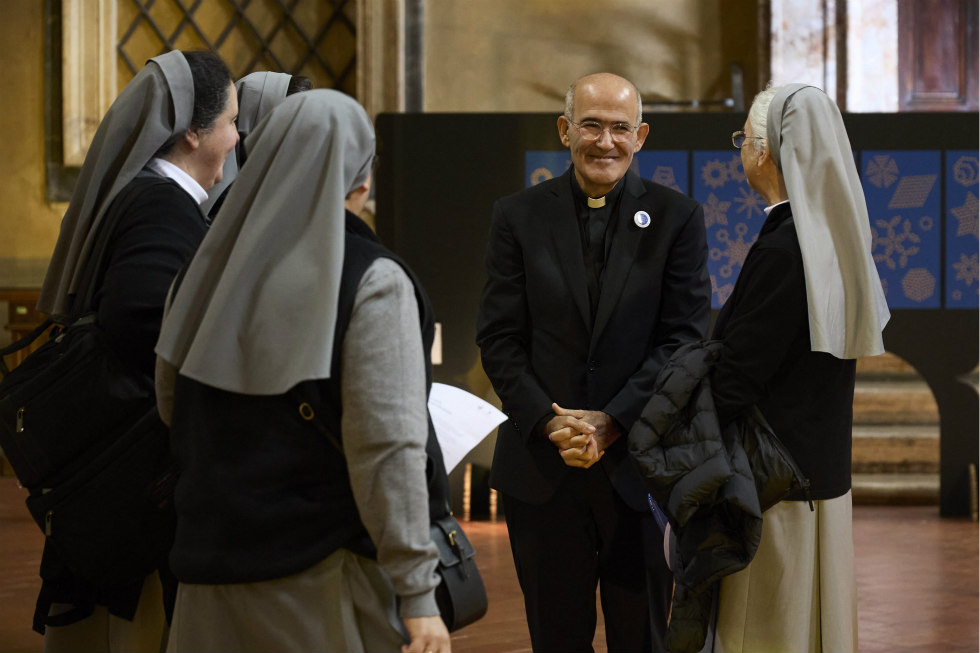
José Tolentino Calaça de Mendonça during the Jubilee of the World of Education
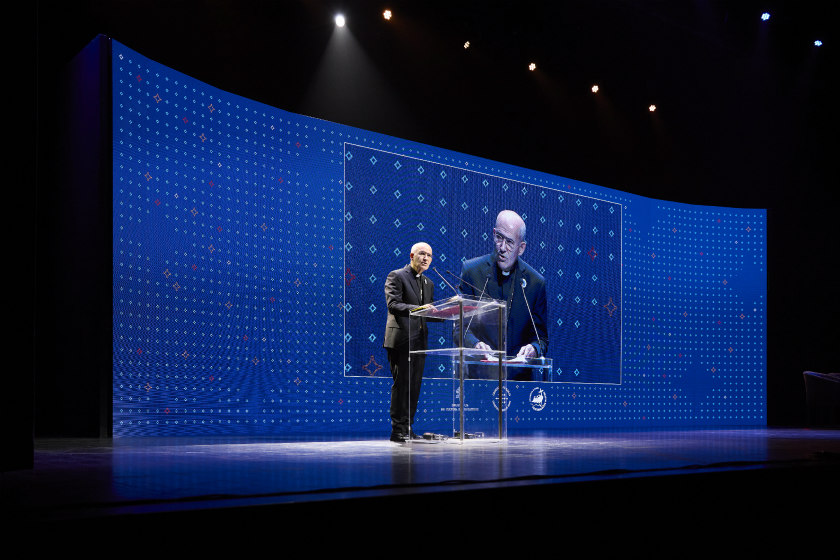
José Tolentino Calaça de Mendonça speaks at the Jubilee of the World of Education during the conference at Auditorium della Conciliazione in Rome.
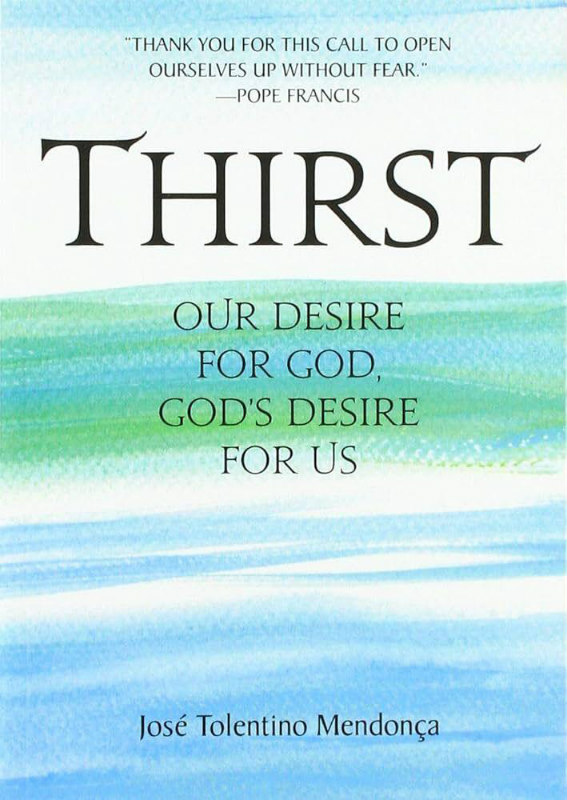
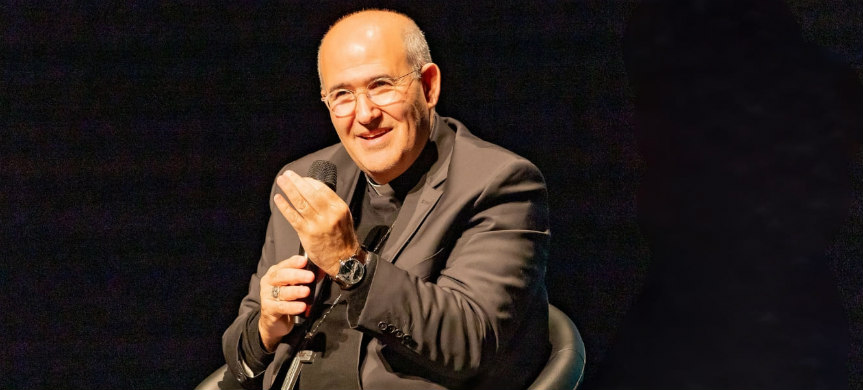
José Tolentino Calaça de Mendonça during the Jubilee of the World of Education
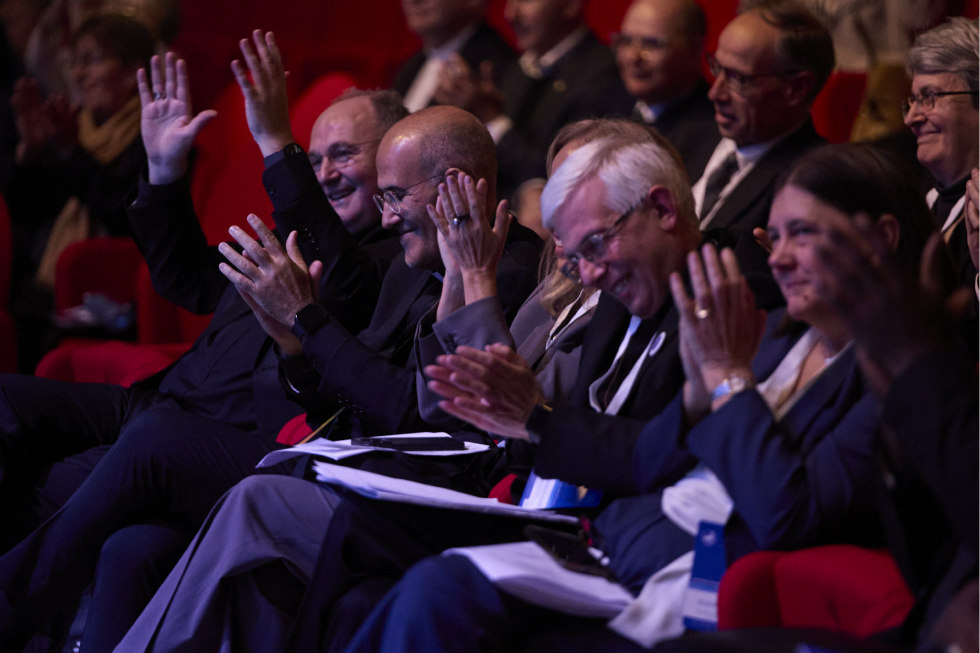
José Tolentino Calaça de Mendonça applauds at the Jubilee of the World of Education during the conference at Auditorium della Conciliazione in Rome.
“My vision as a man of the church, as a believer, as a Christian, is ultimately a poetic vision and ends up being my way of inhabiting reality.”
José de Mendonça, in your opinion, are the words gratitude and recognition part of today’s language?
One of the most beautiful words in the world is “gratitude” because it is the recognition of a fundamental grace that is the starting point of every story. Each of us is the consequence of a grace, because we did not invent life; we received it from others, from our parents immediately, and from the mystery of life, from the hands of God. Gratitude and appreciation are the profound explanation of life, and without gratitude, life remains exasperated, locked in a sort of endless request or need. Gratitude educates our gaze and shows us at every moment how we are the object of love, of friendship. We are speaking like this today, seeking each other, listening to those voices that may be the ones that carry this time forward.
It’s something we should be grateful for, because listening isn’t a given. For you to listen to me, and for me to listen to you, is a positive attitude in itself, and one that deserves recognition. If listening is practiced more, we have more reason for hope.
Poetry is different from the novel; it has a capacity to synthesise and the weight of each word is very important: gratitude, friendship, peace, and love are different words, but they are connected. What is the role of poetry in the world today?
I believe that the word is the greatest human invention. It allows us not only to communicate, but also to work internally. Even for our internal dialogue with ourselves, we need words. It’s the words we say to ourselves, which aren’t even verbalised, that help us to burn, to sum up the days. Words are also a hearth around which we find companionship. We’re having this chat today, and it’s a way to stay together. When this chat ends, each of us will return to our own lives, and who knows if we’ll ever meet again in life, but it was words that allowed us, for a brief moment in our history, to be so close. You looked at me, and I looked at you. You listened to me and I listened to you. This is a gift that words grant human beings. They allow us to move from solitude to companionship, from indifference to knowledge. Words are always a small homeland, even if temporary, because they allow friendship between strangers who didn’t know each other before and who perhaps will never meet again.
It’s often said that words are beautiful, but actions are different. There are exceptions, such as Churchill, who, with his words on the radio, managed to keep his country afloat against the entire world; his use of words was very important. What is the connection between words and actions?
You captured my personality very well when you said I shun oppositions. Just as I say it’s not about love or friendship, either or, and my preference is to combine them, I say the same about facts. If we think about the beginning of the Gospel of John, it says that in the beginning was the Word, the Word became flesh and dwelt among us. There is no separation between the word and the fact; the word without the fact is insufficient, and the fact without the word would remain enigmatic because the word is the key that allows us to see in the fact that which is its revelation. We need everything. Culturally, I think we gain a lot when, instead of trying to hastily insert full stops, we have the courage and humility to insert commas. This is not yet a full stop, it’s a comma. The discourse will then continue in a way unknown to us, but we must have the humility to understand our own history as a sentence that ends with a comma. Continuity lies in the openness of the world and of mystery.
We have found another word: “humility.” In today’s world, people fortunate enough to live in a democracy don’t seem to appreciate those who possess humility?
Humility is a form of silence, which is another important word. Humility is the most correct attitude because the humble are those who understand the scope of life, which goes far beyond our comprehension, our possibilities. It’s true that we are served a banquet, but it is a banquet of crumbs. What we touch is only a part, and in the end, humility is taught to us by great spirits. If we think of the great men and women of science, those who brought about momentous epochal changes, ultimately they were humble people who knew their actions were part of a tradition, one that depended on the contribution and participation of many, and that they had put their signature to a process that had drawn its inspiration and its potential from a multitude.
What’s interesting—I’m not saying this as a compliment, but because I want to point it out—is that the most intelligent people are often naive.
I really like naiveté; it’s there. There’s a quote by the French poet and dramatist Paul Claudel that speaks of the naiveté necessary for poets. The opposite of naiveté isn’t wisdom; it’s often pure cynicism. Between cynicism and naiveté, I think naiveté is always preferable.
You are now a great figure in ecclesiastical life, a man with an important role. Do you still have time to be a poet and what words most occupy you today?
I don’t know if I’m a great figure; I’m a character, an actor in a choral work. Since I have governmental duties, I know how much I depend on others. And I know how crucial the overall vision is to one’s ability to do something, to achieve something significant. It’s not that I’m humble, but I have a simpler vision of my contribution. One of the poems that has always accompanied me is a poem by the Portuguese writer Fernando Pessoa that speaks of Jesus fleeing from heaven and coming to sit beside him, the poet. At the end of this long poem, Pessoa writes that ‘it is because he is always with me that I am always a poet.’ A poet has no choice; he is always a poet. My vision as a man of the church, as a believer, as a Christian, is ultimately a poetic vision and ends up being my way of inhabiting reality.
Will poetry save the world?
Poetry is preparatory. I still remember Paul Claudel who, every day of his life, thanked a man very different from himself, the poet Arthur Rimbaud. He said, referring to Rimbaud, that he was the boy who had saved his soul from materialism and prepared him for a great love. I think poetry makes us incredulous. I look at reality, and poetry is a kind of school of incredulity. Rimbaud says the visible is not everything, the invisible must begin somewhere.
Your Eminence, thank you. It was a great pleasure speaking with you.
Thank you.
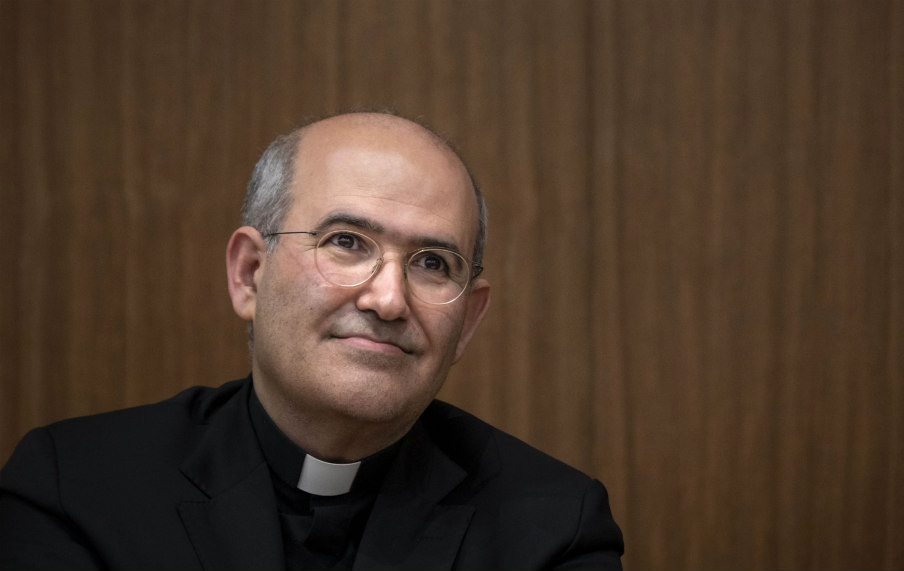
Lead portrait of Cardinal José Tolentino de Mendonça © Gennari
Translation by Alastair McEwen.
ENJOY THIS INTERVIEW? SHARE IT WITH A FRIEND