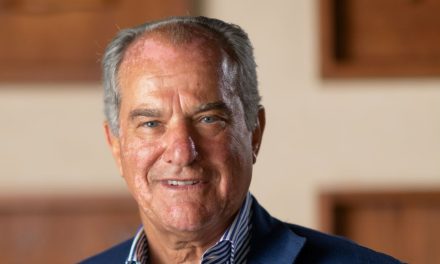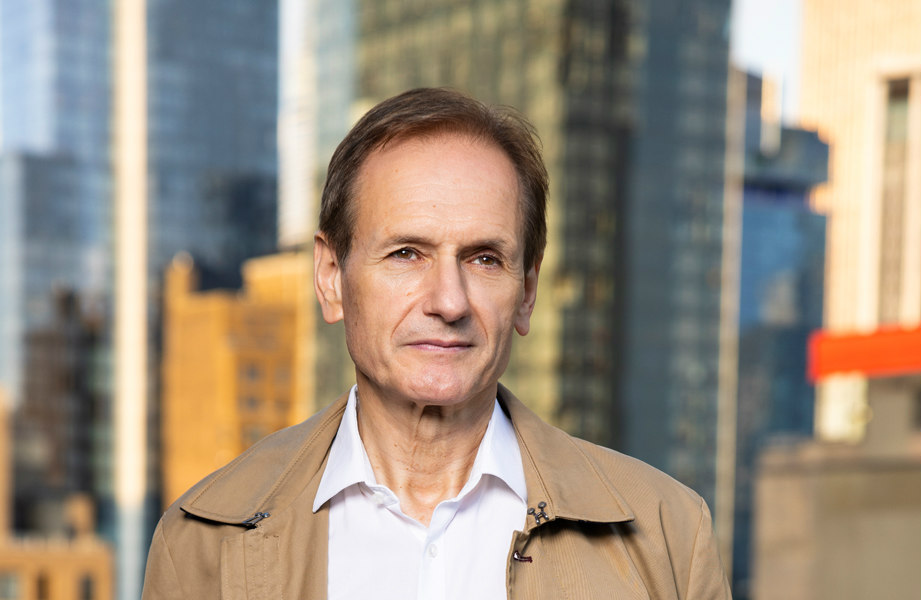
PROMOTING ITALIAN CULTURE AND BRIDGING CULTURAL DIVIDES. Claudio Pagliara is a journalist who became the Director of the Italian Cultural Institute on Park Avenue in New York in September 2025, soon after he completed his term as head of the RAI Radiotelevisione italiana correspondence office in the United States. With enormous international experience that includes living in Jerusalem for almost 10 years, he was foreign desk chief at Tg2 — Italy’s second state channel — for seven years. His recent book L’imperatore is a journey through America’s transformation and the challenge it poses to the world. Pagliara holds a degree in linguistic philosophy from Rome’s La Sapienza University.
24 Minutes read time.
You can listen to the podcast of this interview here.
Claudio Pagliara, with your vast experience as a journalist please can you give me your reading on the conflicts in Ukraine and the Middle East?
Having travelled around the world, I hope that what remains with me is a knowledge of people. We are so used to seeing destroyed houses in Gaza and in Ukraine, but behind that there are human stories. What gives me some hope for the future is that there were people that suffered in every conflict zone where I was, but people hoped that the future would be better. I know people, and I believe that the vast majority of people in any conflict zone want peace. So leaders that make choices towards peace will in the end appear and make the right choices. As Director of the Italian Cultural Institute in New York, my best hope is to build bridges: bridges among cultures, bridges among people that now are in conflict. We have to look back at European history and see that what we managed to do – at least until, unfortunately, the 24th of February 2022, when we had the beginning of a big war in Europe – brought peace in Europe. Peace can even be achieved in the Middle East, as difficult as it seems today.
Are today’s politicians around the world of sufficient quality to understand that hope, and able to achieve the peace you see in the future?
Not all the leaders that are in power today want peace, but we have to believe it when they do say we want to bring peace. I followed the Trump campaign, and President Trump, has promised to his people all along his campaign that he will put an end to the wars in Gaza and Ukraine. He partially succeeded in Gaza, but the situation is still very hot. In Ukraine, so far he has not succeeded, but he has pushed forward. In Europe I see leaders like our President Meloni who want to achieve peace and build bridges. Italy is one of the most supportive countries to try to alleviate the suffering of the people of Gaza with humanitarian help, so this is very important. But, of course, there are leaders that don’t want peace. Russia attacked Ukraine brutally and without any excuse, and we can’t forget the 7th of October when Hamas attacked Israel in a very unprecedented way and started this war that has cost the Palestinian people – who paid a very high price – and the Israeli people so much. There are evils in the world, but I have to tell you, I’m optimistic, and I wake up every day hoping for some good news. Most of the time I’m disappointed, but sometimes something good happens. So let’s hope, and not only hope, let’s act. Each one can do something towards peace. So we must do it.
“My first mission is to enlarge the love for Italian culture among Americans.”
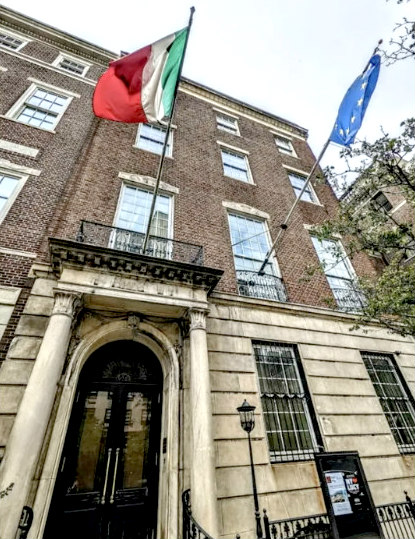
Exterior of the Italian Cultural Institute in New York.
Claudio Pagliara, your face is very well known to Italians because you were constantly on TV, often reporting in very bad situations. As a journalist rather than a professional diplomat, why did the job of Director of the Institute in New York appeal to you?
I really am so grateful to have been chosen for this position by our Foreign Minister, Antonio Tajani, and since the first day I have put all my energy into this new job. The mission is very simple and difficult at the same time. Simple because I have to bring one of the best things that Italy has:- our culture, our heritage, and our contemporary cultures. It’s a very wide concept. We know very well that New Yorkers and Americans love Italy, and sometimes they know Italy better than the Italians. They come every year, and every year visit different places. Difficult because we have to try to make this mission effective in a city like New York, the capital of culture in the world where we have big competition. Every evening, a New Yorker can just take a look at the Lincoln Centre programme and have such great choices. We have to bring excellence to our Institute with some vision, and my first mission is to enlarge the love for Italian culture among Americans. We want to catch the American public and that is so important that all our events are in English.
How have you changed the programme?
I have tried to change the programme in a way that would be more appealing for Americans, and to elevate the quality of the people that are invited to speak or to perform, or to present a book here in the Institute. The first signs are very good, so I’m happy, although of course we can always do better. The cooperation of what we call the Italian system – the Embassy in Washington DC, the Consul General in New York, and even Boston and Philadelphia are under my jurisdiction – to have an impact in the United States is very important. We know that we have very good stuff to propose, but it is most important to fight against some stereotypes that are still present in New York. For sure we had in the past great women and men of culture: Michelangelo, Dante, Raphael, so many. But we also have a contemporary country which innovates in each cultural field: in technology, in literature, in cinema, and in music. We want to show that Italy’s past is still present and in our genes.
What have you been doing in these several months that you have been in post?
I invented some new formats, and one that has been very successful is called “The Courage to Dream”. I invited an eminent Italian scientist, Dr. Gioia Rau, an astrophysicist who worked for NASA and now works between the private and the public sector in space exploration. I brought Luciano Floridi, a co-founder of the Digital Ethics Centre of Yale University, for a very successful conference here in the Institute. I will bring Elena Aprile, an amazing scientist in Gran Sasso National Laboratory, who is studying the obscure matter which is the glue that binds the universe together. These Italians are really at the front line of innovation and research.
And for literature?
For literature, I invented a new format that is going to happen at the end of March, when I have invited the 10 winners of the most important Italian Literature Prizes 2025 to New York where they will be judged again by an American jury who understand Italian. I call this prize “Super Book”, the Super Bowl of the book, the prize of prizes. I also invented another format called “Ink Waves” to celebrate 250 years of the United States, which coincides with 250 years of friendship between Italians and Americans. I’m going to invite four established Italian writers and four established American writers to New York, but not to talk about their own books. Each one will talk about which kind of book or author of the other country has influenced their way of writing. I imagine this as a way to create a bridge between the two countries.
What so strongly attracts Italians to America and Americans to Italy?
The reasons are not exactly symmetric. Americans love Italy for our culture, our food that is part of that culture, our cities, and even for our language. I don’t like to say we have the best language of the world, but it is not by chance that this language was the language of music, of opera, and great poets and artists. Americans love the sound of it and all that. Italians love America because they found here what is perhaps more difficult to find in Italy: opportunities for the young. America is still a land of opportunity. Sometimes I hear people saying the American dream is not anymore there, but I encounter young artists and young researchers that keep on coming. Maybe at the beginning they find New York so expensive, with crazy prices for apartments and for food, and they may live in a small room with another two people, but they say, OK, here I know that if I have the qualities, if I have the strength to keep on doing what I want to do, I will realise my dream. As Italy, we should not think that the people that are very good go away from our country. We should be concerned to try to make Italy more attractive, because these young people could come back to Italy after their experience in the United States and make Italy even better in many fields, mainly in scientific research. We don’t have the infrastructure of the United States, but we have to recognise the experience and the abilities of these researchers and give them a good salary in order to come back to Italy and to proceed with their dreams and their career in our country. This is very well understood in Rome, and steps will be taken to try to attract the people that came here home again. Each Italian that I meet loves the idea that one day he or she will be back in Italy, because there is a deep love of their own country. Italy will try to make this happen, because it’s very important for our economic development.
“We want to build a big family together with Italians and the American lovers of Italy.”
Claudio Pagliara, one of the core activities of the Institute of Culture is the promotion of and education in the Italian language. What makes Italian so appealing to people to learn?
This is a mission of the Italian Culture Institute, and we have a partner inside the institute that takes classes for Americans that want to learn Italian. I speak with these special students of all ages and sometimes I ask them why they want to speak Italian. In many cases, it’s not because they think they want to live in Italy, or they have an Italian boyfriend or girlfriend. No, they say because we want to go and see Florence and enjoy the beauty of the language when they explain the Renaissance art there. We want to understand your beauty in your language. We want to go to a restaurant and order a meal in your language. It’s love for the language, and it’s really important. I invented another programme on Saturday mornings which is very successful called “Reading in Italian” because the children of Italian parents that study in American schools lose the ability to use and read Italian. My assistant, Malina Mannarino, leads this programme and we invited children from 6 to 12 years old to read children’s books in Italian, and every Saturday we are growing, because Italian parents that have kids in American school need to be sure that their kids won’t lose the ability to use the “lingua di Dante”.
For the next four years as Director, is it your mission to really do something important for Italy and to expand the knowledge of what’s going on in the Italian world beyond some old fashioned stereotypes?
That’s my mission. I’m not going to say, neither now or in four years, that I succeeded. I prefer to get the feedback of others when it’s a judgement about my job. What I can guarantee to you is that I’m really putting all my energy into this mission. The goal is exactly as you said, and so far I see our social media growing, because as a journalist I put a very great effort into social media. I can also enter into some personal initiatives with the American press. I’m making an effort in this direction because it’s important if I bring Italian authors here that are already well known in Italy, and I don’t need only Corriere della Sera La Repubblica. I need the New York Times and the New Yorker.
In your previous jobs did you create a network of people who you admire and who admire your work, and therefore can you now involve them in what you are doing?
The key is to understand how important communication is. This is very well understood now in our foreign ministry, who push us to invest in communication. I’m a journalist, so it’s very easy to convince me that this is the right direction.
Do I understand that you also give a lot of importance to the library of the Institute, which is probably the most important library of Italian books in New York?
Yes, we have 30,000 books, some of them even rare and important and not easy to find. We have the chance to have 10,000 students at Hunter College nearby the Institute, and when I spoke with the Italian department there they said they have only a very little library, so I said bring your students to our library. They can enjoy the place, the building which is very beautiful architecturally speaking, and I have room for them and will be glad to have young people coming in the daytime to study in the library and to revitalize it. I can give you the news that we are planning to have in the Institute an Art, Cinema and Music Reviews Hemeroteca. We don’t have this yet, but we will in the future. I want to use contemporary advanced technology like iPad connected by internet to some other libraries so that the people can come and read what is relevant for them in the Institute. This is a big project because if I succeed I will really bring a lot of new people that are interested in Italian culture.
Do you have very good relationships with the various Italian cultural institutions, universities and museums in New York, Washington, Boston and Philadelphia?
Yes, first of all with the Italian institutions we have the new Consul General, Giuseppe Pastorelli, who is amazing because he was Vice-director of the Department of the Foreign Minister in place for promoting Italy. I couldn’t have a better partner. I had the chance to know the ambassador in Washington, Marco Peronacci, 25 years ago in Paris when I was foreign correspondent and he was working in the Italian embassy in Paris in the cultural field. We are all going in the same direction, each one with their own mission, but the direction is very clear for all of us. And yes I have very good relations and I’m building new relations with the universities. I am going in the coming days to Boston and Philadelphia to meet Italian professors and artists and others that live in these two very important cities.
The Italian community in Philadelphia is very large?
Yes, so the writers that will come and speak in the Institute will speak in different universities as well, and not only in the New York area but in Boston and Philadelphia as well. The cooperation with Philadelphia is very important, because Philadelphia is central to the 250 years of history of the United States. We are trying to partner in some projects that will shed light on the important Italians that influenced the history of the United States. We want to build a big family together with Italians and the American lovers of Italy. I see the Institute like a family house with many different events, but always very open.
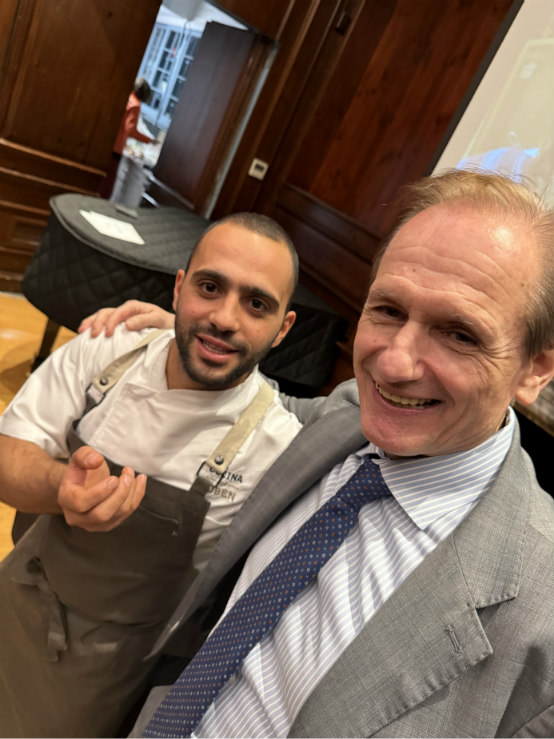
Masterclass with Chef Ruben.
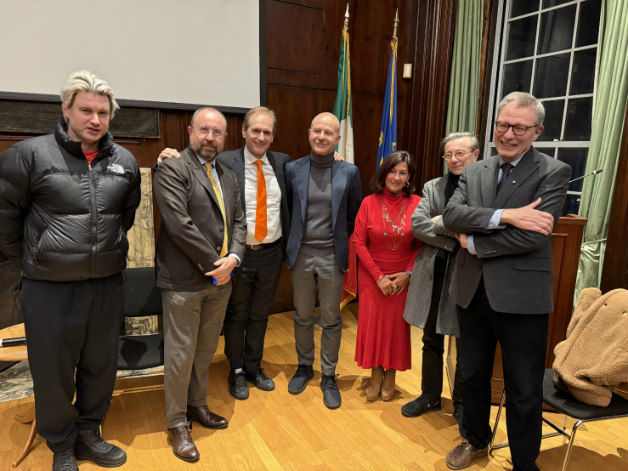
The Courage to Dream — conference with Luciano Floridi, Founder and Director of the Center for Digital Ethics at Yale University.
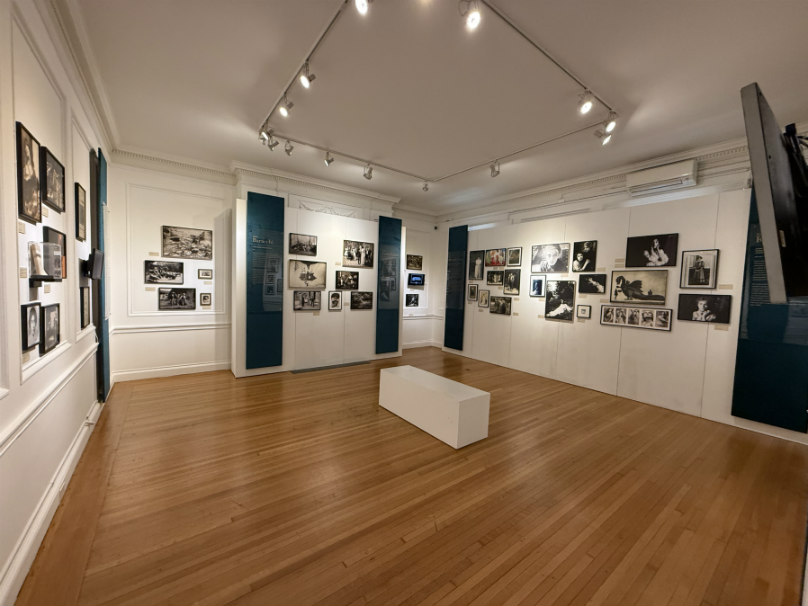
Exhibition: inVisibili. Le pioniere del cinema (inVisibles: The Women Who Pioneered Cinema) — with Ministero della Cultura – Archivio Luce and Cinecittà.
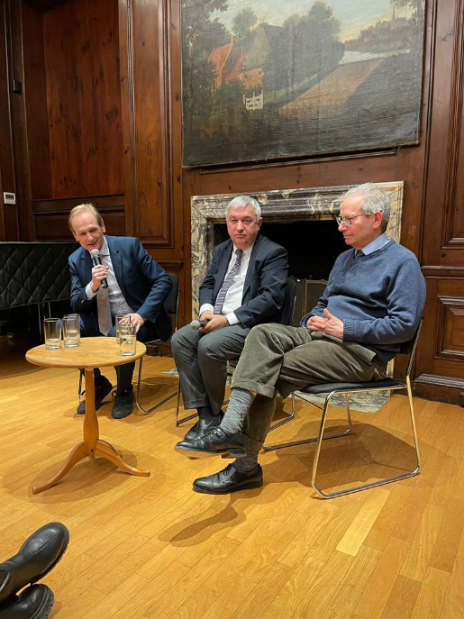
Book of the Month: La scossa globale — by Maurizio Molinari.
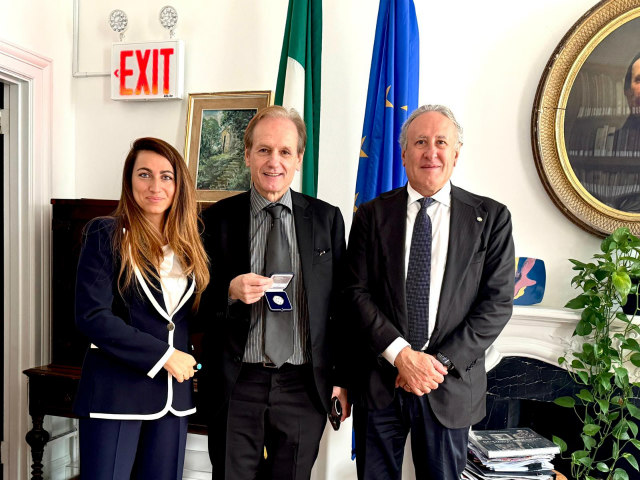
Matteo Lorito, Rector of the University of Naples Federico II, visiting the Italian Cultural Institute of New York.
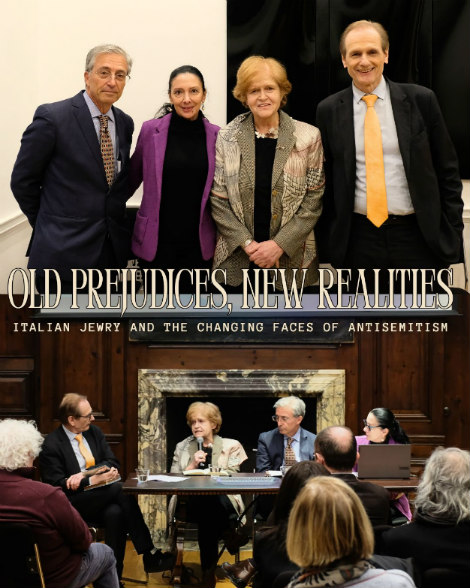
Old Prejudices, New Realities: Italian Jewry and the Changing Faces of Antisemitism — with Deborah E. Lipstadt, Cristina M. Bettin, and Stanislao Pugliese.
“Maybe not everybody knows that Italy is the most important contributor to peacekeepers around the world.”
Claudio Pagliara, from your perspective is the United States now abandoning Europe?
No, I don’t think so at all. I even wrote my book about the Trump presidency, titled L’Imperatore in Italian. It’s not America that has changed, but the world became more multipolar. We can’t forget that the United States has two oceans, the Atlantic and the Pacific, and for the United States the importance has shifted – not with the Trump administration, but already with the Obama administration – from Atlantic to Pacific. The really big competitors of the United States are growing in the Pacific, and China has a politically ideological system at the opposite of democracy, so when there is this pressure on Europe to invest more in their security, it’s the result of this shift of interest of the United States which is not linked to a president but is a historic shift. The Pacific now is much more important, and in the last 20 years and more the eyes of America have been on what happened in and around China. America has important allies there like Japan and South Korea, and everybody knows that Taiwan could be a very big problem because China reclaimed it as part of its territories but in the last 80 years Taiwan has been independent and in the last 30 years has built an amazing, very vibrant democracy, antithetical with China. There is a really huge problem that is far from what we usually daily speak about. But America has two oceans so has to look on both sides, and now Asia is more important because it is where population and wealth is growing. America thinks that Europe, that was on the shoulders of the United States, has the resources to do something better than before by itself.
Yes, America has two oceans, and during the Second World War there was a war in the Pacific and there was war in Europe. Even if you are an optimist, what do you think about the current world situation?
I’m an optimist, but I’m not blind. We are in a very dangerous period of time, that’s for sure. There are more and more conflicts, and it’s much easier to start a new conflict than to close the old ones. Two popes spoke about the “third world war in pieces”. It could have already started, so we have to stop it, but that’s not easy. The competition between China and the United States is global and not only about the economy, but also about important natural resources that are what make a country prevail in the technological field. These resources are spread everywhere; in Ukraine, in South America, in Taiwan. It’s a dangerous time, and what has already happened is really very bad so I’m very worried, but still I hope that the worst won’t happen.
Can Italians can be very good bridge builders because they understand the importance of conversation and diplomacy, also having the virtue of common sense?
I like the idea that we have common sense, and not just because I’m Italian, and we are peace builders. In the last 70 or 80 years we have always tried to build peace. Maybe not everybody knows that Italy is the most important contributor to peacekeepers around the world. We have an important mission in Lebanon, which is very dangerous for our soldiers there and they were even put directly in the crossfires during the recent war. But we are still there, and we are in many places in the world, because we are perceived by both sides in conflict as people that really genuinely want peace. We should be really proud of that.
The Institute of Culture in New York is a world of Italian and American cultural gathering, housing a great library for people who want to read in Italian, but is it also a place of peace?
Yes, and we fight against discrimination and racism, which is another part of the story. This January 27th the world has celebrated the Giorno della Memoria, Holocaust Remembrance Day, and we are witness to an unprecedented wave of anti-Semitism around the world, not just with words, even aggressive acts. I organised three events for this day during the week to remember the Shoah that must be remembered. In the consulate we read out, as we do every year, all the names of the Jews that were deported to Auschwitz during the Fascist-Nazi era. I did a panel about all the new faces of anti-Semitism, because you can be anti the government in Italy, but you are not anti-Italian or anti-Catholic. You can be against the government of Britain, but you are not against the British people. You can legitimately be against how the Israeli government reacted to the 7th of October, but this doesn’t allow you to say all the Jews are responsible and they deserve to be boycotted, aggressed, and that they can’t speak any more in public places. This is a very serious story. We have to clearly – clearly – say that this is not allowed in Italy any more, because unfortunately it’s bringing to Jews in Italy, who for 2000 years have been part of our community, the memory of what happened in 1938 when suddenly racial law put the Jews in Italy in another part, saying, No, you are not Italian, you can’t attend the schools, you can’t work. We can’t minimize what is going on, so another mission that we try to bring is to show that Jewish Italian culture is very important – and not just because of the Shoah, but because there are writers, there are artists, there is a vibrant community in many Italian cities, and I want to represent this reality. It’s an important mission that I have in these times of a very worrying rise of anti-Semitism all around the world.
Especially because the Roman Jews are probably the oldest diaspora Jewish community in the world?
Exactly. The origin is very well known. Titus destroyed the second temple in Jerusalem and brought Jews to Rome 2,000 years ago, and it’s the oldest community of the diaspora and has built its own special culture that gave an amazing contribution during the Unification of Italy (Risorgimento). The Jews participated in our Risorgimento and so they are Italians that believe in Italy. They were Italians of their own religion, but just as other Italians are Catholic and maybe now there are many Italians who are Muslims, they are Italians. We can’t discriminate among Italians. An Italian Muslim or a Catholic Italian has the right to speak in the university, so why should Jews be prevented from speaking in the universities, as happened because of pro-Palestinian students and sometimes even teachers. In Italy there should not be any room for that.
That’s a profound lesson from a cultural person. Claudio Pagliara, I thank you very much for this conversation, and wish you all the best.
ENJOY THIS INTERVIEW? SHARE IT WITH A FRIEND.