
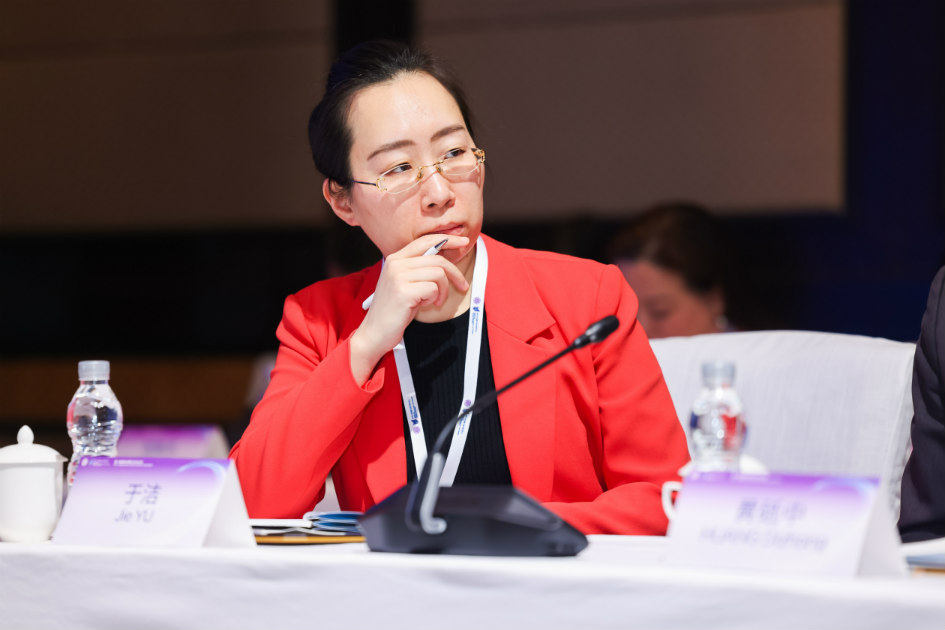
CHINA FIRST. Dr. Yu Jie is Senior Research Fellow for China, Chatham House. She focuses on the interplay between China’s domestic political economy and foreign policy and is a seasoned commentator in major international media outlets, including BBC News, the Financial Times and Foreign Policy. She regularly briefs senior policymakers from G20 governments and leading intergovernmental organisations. In July 2025, Project Syndicate recognised her as ‘one of the most notable female voices’ in global affairs.
22 minutes read time.
You can listen to the podcast of this interview here.
Dr. Yu Jie, you recently wrote a feature essay in Time Magazine exploring Beijing’s “China First” geopolitical strategy. What is “China First”?
This is probably the hardest question to answer! “China First” is an idea in relation to “America First”, a political slogan that President Trump used to unite his core supporters, whereas “China First” is a medium to a longer term strategy that President Xi has put forward to shape his country’s domestic political economy, but at the same time he would also like to use “China First” as a way of operating the country’s diplomacy. When it comes to “China First”, one of the key questions is how the country could achieve the economic transition from being largely driven by property development into something whereby China becomes the global champion on technology and innovation. Hence the country needs to spend most of its financial resources and manpower within itself, to focus on building this capability and resilient supply chain on technology for itself. That is one layer of “China First.”
And the second layer?
The second layer of “China First” is to do with Beijing’s management of other great powers, including the United States, the European Union, and member states of the European Union. For this sense of “China First” Beijing’s idea is not to reduce the rivalry between Beijing and Washington or to reduce the dispute between China and Europe, but instead to manage it to the degree that it is controllable and which will facilitate China’s domestic economic growth and development. Beijing’s economic success in the last five decades rests on the international order upheld by the United States until now, and the Chinese economy flourished by having a de facto trade partnership with the rest of the world. Now however we have seen the sense of rivalry between China and the West inclining, and Beijing will have to manage that, and so come to its own self-interest first.
“It is very much a self-centred way of looking at the world and its position in the rest of the world.”
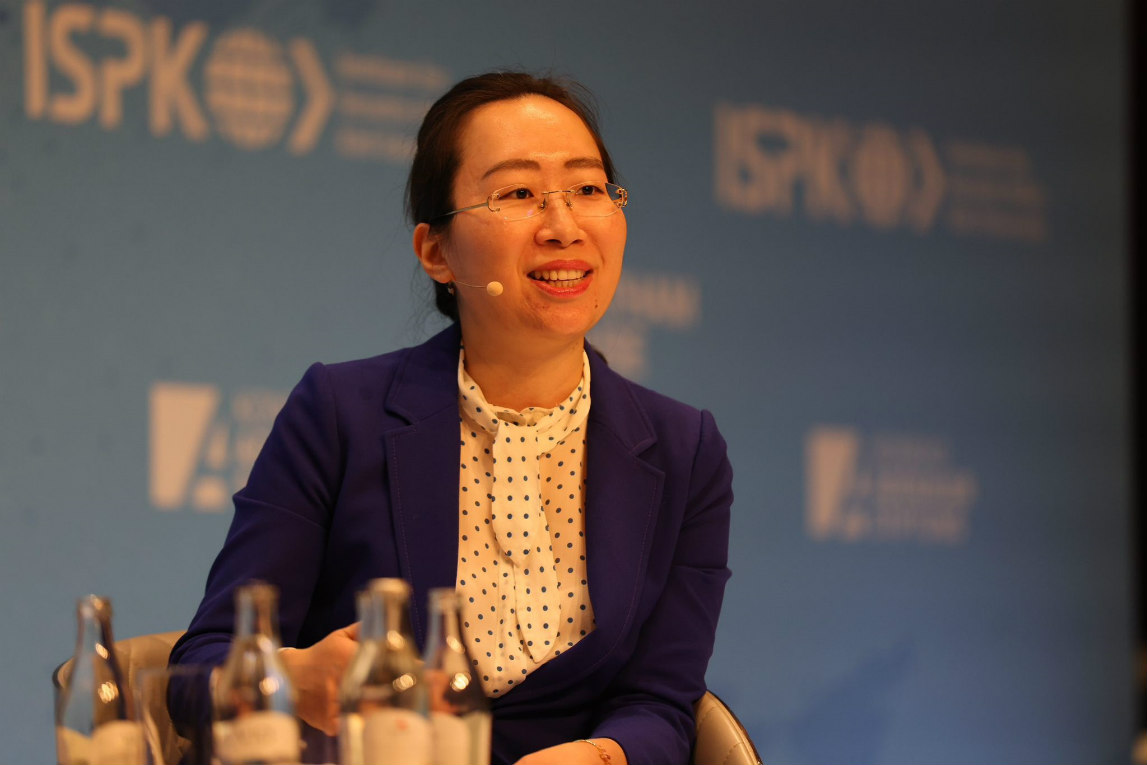
Dr Yu Jie at the Chatham House Europe’s Strategic Choice Conference on 26 November 2025
Dr. Yu Jie, is there a third layer?
Yes, thirdly, “China First” is about China and its neighbours. China is a country that shares borders with 14 different nations, and almost every single one of the 14 different nations and China had border disputes in the past. India even has an ongoing border dispute which has not been able to be fully resolved. Beijing’s emphasis on its diplomacy has to prioritise its immediate neighbourhood, and countries like India and Russia will be the top diplomatic priorities for Beijing to manage. It is very much a self-centred way of looking at the world and its position in the rest of the world. China is quite unique in that, unlike the United States, which considers itself a superpower and wants to engage almost every single flashpoint around the world and believes it has the capability to deal with those flashpoints, in contrast China actually believes that first and foremost is managing its own domestic affairs well, and then managing its neighbours. Those are its diplomatic priorities. It’s much less about engaging with global conflicts that they only half-heartedly understand. So these are the three layers of China First.
Three different large countries Russia, China and India have relationships to manage along borders with each other?
When it comes to China/Russia, the geography is first and foremost. That made not just Xi Jinping but even the previous generation of the Chinese leaders believe that apart from managing its relationship with the United States the first priority for China’s diplomacy is about managing its relationship with Russia and having a stabilised border. That stabilised border and stabilised neighbourhood would enable Beijing to focus on their own domestic economic development. That is how they see the world and that is the way they see diplomacy. Beijing and Moscow share a border 4,300 kilometres long, equivalent to the length of the whole continent of Europe, and if Beijing does not manage that border with Russia well then Russia would clearly serve as a national security threat for China. The way Beijing sees its relationship with Moscow is firstly the geography, and it took the two countries over 2,000 meetings since the early 90s until the beginning of 21st Century to conclude the China-Russia Treaty of Good-Neighborliness and Friendly Cooperation agreement to secure that border. That border with Russia secured will also give China some space to engage with maritime security in the South. Don’t forget, there’s another set of borders within China in the South China Sea that is largely contested and disputed among Asian powers. It also comes under the interest of the United States as well. So Beijing would have to secure its Western border in order to leave some space to deal with the borders in the East and in the South, and that’s the consideration.
Unlike the United States, China has not become embroiled in other countries’ wars and instead acts almost as a kind of arbiter in a position of neutral superiority, although there is always the issue of Taiwan?
Interestingly enough, in the past six months all the UNP5 members have visited China, and Beijing has now become a diplomatic crossroads. Some of the close partners of the United States, for example France, the UK, and Canada, are now able to find some sense of consistency in China’s dealing with them in terms of diplomacy and of trade relationship, and also in terms of multilateral issues. Hence, they would consider China as being a stable force of international politics. But this does not necessarily mean that they entirely agree with China and with Chinese positions on various wars.
And secondly?
Secondly, you use the word “arbiter”, but I would refrain from using that word because one of the key lessons that China has learned from United States is not to engage with conflicts that you have only partly understood. China takes a very much hands off approach when they come to mediate in the conflicts in the Middle East between Iran and Israel and the United States, even though China does have massive economic and energy stakes in the Strait of Hormuz. Beijing realised the position of the two parties as being too far apart and sees that it will be very hard to hold any ceasefire or any potential peace deals between the two, so Beijing were not really interested in doing that. For all these many years, China’s engagement with the Middle Eastern countries is largely based on commercial activity and less based on providing a strategic and security architecture. In fact, Beijing was the beneficiary of the U.S.’s security architecture being provided in the Middle East in the past decades or so. Beijing let the United States do the heavy lifting while Beijing was only dealing with commercial deals and Beijing will continue to play that card. However, given that the security architecture in the Middle East and that balance is broken, Beijing will have to come up with some new solutions. I have not seen so far a clear solution and a clear vision of what Beijing intends to do. I do not think Beijing is ready yet to be the global arbiter dealing with global conflicts.
“Both China and Russia would prefer a world led by multipolar order”
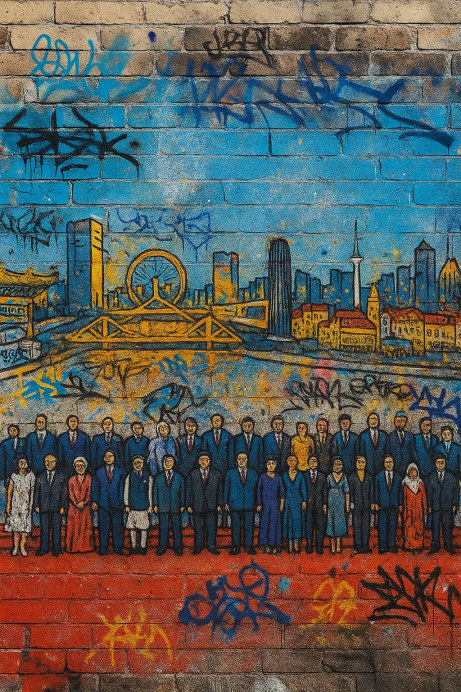
Dr. Yu Jie created this AI image of a group photo of world leaders taken in China last year
Dr. Yu Jie, Putin and Xi are allies but not real friends, and there is Taiwan, but what about Japan, which they still fear, and the Philippines?
With the seeming retreat of United States away from the Asia-Pacific region, the U.S.’s allies within the region – including Japan, Philippines and South Korea – are all looking to boost their defence capability in order to protect themselves in the absence of the U.S.’s leadership within the region. The worry is how this is going to be perceived by Beijing. One country’s defence could be perceived as the other country’s offence, and whatever Japan, South Korea or the Philippines might do will be conceived as being a provocation in the eyes of Beijing, not as self-defence. Those are the consequences we would have of the United States turning inward and shifting its focus to the Middle East. That’s one layer.
And the second layer?
Secondly, when it comes to the terms of alliances, Beijing has refrained to use the term “alliance” with Russia. Largely they use the term of “alignment”. This is precisely because they do have a common interest, but they also have different views of the world and prefer to engage with the world differently. China prefers to engage with the world through economic integration and by extending its influence through its economic tools to make the rest of the world more dependent on China. However, Russia’s engagement with the world is simply bringing disruption and making everyone fear Russia. That’s entirely different and puts these two powers in a very different outlook when it comes to international order. What really put China and Russia together is their common resentment of the US’s hegemony, and both China and Russia would prefer a world led by multipolar order so that different kinds of countries would have a say and not just only the terms and conditions of the international order determined by the United States. That’s put them in the same bracket. But given the absence of leadership of the U.S. we will see a world with many different shades of grey, but not a clear black and white colour as we’ve seen in the period of the Cold War. Instead, we’ll see countries will choose either China or the United States driven issue by issue, but not by ideology.
All the big powers, Russia, China, US, Europe, have problems. China is particularly concerned to keep the CCP in power in an economic situation of increasing wealth inequality and competition in the technology field?
A common challenge for all the major powers in the world these days, including China and the United States, is how to manage the precarious balance when on the one hand we achieve so much on technology, but the achievements of technological prowess and the expenses of job losses will affect the economic future of younger generations. We have seen Beijing put so much money and manpower in terms of investing in AI and quantum computing and so on and so forth, and the likely negative consequences are a direct cause of job losses among the younger generation within China. So, many youngsters within China would question their economic future and whether the current syllabus of education is fit for purpose in the coming AI age. Beijing’s five years plan would prefer to let AI touch upon every single aspect of Chinese society. Now, is the syllabus ready? And is the education ready? Perhaps the answer is far from satisfactory. The challenge for the Chinese government, and also for the U.S. as well, is how to find that fine balance. On the one hand, we want to use technology and make technology work for us, but then on the other hand we all have to deal with the negative consequences brought in by the technology. For example, massive job losses among young people.
There is also the problem that this technology demands a lot of energy, which they don’t really have, and they’re trying to find it or to make it, but it takes time.
Yes, and in terms of energy in relation to technology, China and the United States and Europe are very different, because purely and simply the usage of energy in China, particularly electricity and water, is much cheaper compared with, for example, the UK or Europe in general. Building technologies and data centres and using AI is already well established within China’s infrastructure, but nevertheless, it does not mean that China will have a relentless supply of energy. Look at how much concern there is on the crisis happening in the Straight of Hormuz, because China has been a net oil importer since 1994. 70% of Chinese fossil fuels rely on import and that picture has not changed, so what Beijing is really inclined to do is to add more renewable energy installation. By using more renewable energy in order to generate the data centre infrastructure that they want to run in a technology-led economy, China is ahead of the curve compared with European economies.
It was always “China First”, but for many years China was the engine driving the flourishing European and American economies, with luxury, automobiles, and plenty of other things. Now this has changed, and this new difference creates problems for European and American companies. What is happening and where do we now stand?
We’re standing on the cusp that Beijing might begin a multi-front of trade disputes with other countries, including Europe, and including some of the emerging economies that have their own industrial policies and want to build their own automobile industries. What we have right now is this gigantic manufacturing powerhouse of China that makes for the rest of the world that is buying from them, and perhaps even produces more than parts of the world can consume. Those trade imbalances will continue, and that’s just a fact. Many of the advanced economies which have given up their manufacturing capabilities for many decades suddenly realise that industrial policy is a thing they will have to operate and run in order to save their manufacturers and save their jobs. We’re going to see higher frequencies of bitter trade disputes between China and advanced economies, most notably Europe. And it is unlikely to resolve at any time soon given these particular and different economic models which China and Europe operate.
“Chinese young people no longer consider the West is the absolute one and only destination they want to go to.”
Dr. Yu Jie, how is China’s own economy going?
For China itself, the pain threshold of having a slower economic growth has become much higher for Chinese leaders. According to the 5-year plan they have put forward the economy will have to reach between 4.5% to 5% of GDP growth, but it’s very hard to achieve, particularly given the downsizing of the property sector and the service sector. We will see a slower Chinese economy. That is inevitable and is already happening.
India is now growing very fast, will China and India one day be equals?
It’s too early to tell. Notably India has been learning from the Chinese by building infrastructures and roads and railways in order to become a manufacturing hub. But for India the issue is that you cannot plan ahead as long as the Chinese do, because they have elections every few years and the BJP party may change. Maybe other new parties and new political thinking might emerge. So that is one difference.
It’s a difference between a democracy and an authoritarian political system?
The difference is between a party that runs the country for several decades and a party that only runs a country within a decade or so. But if I come back to this border issue, India also shares borders with other South Asian countries and India cannot become prosperous when almost every single major country that surrounds India is having difficulties. Sri Lanka and Pakistan are two most notable neighbours of India and currently under IMF bailout. We come back to this whole idea of “neighborhood first” and whether a stable border will help your national economy. Clearly in India’s case those borders are largely insecure, because those borders are still under dispute, and thus it will be very hard for India to purely and simply focus on its own domestic economic development alone. That makes India and China very different. If we go back to the conflicts last summer between India and Pakistan over Kashmir and I’m an investor looking into this very carefully, could I put my long-term investment into a country that suddenly decided to enter a military conflict with its neighboring country? Many investors will have to think twice in terms of the longevity of that investment in that country.
The European or other countries who invest in China, for instance, in the automobile market, big companies like Volkswagen or Stellantis, have bought Chinese companies. They became Chinese, and these cars will sell in Europe or in America for a much better price. How will this work?
I actually had a discussion with someone who was in Volkswagen and the person offered me a very surprising answer by saying the reason why we’re in China is we would like to adopt China’s research and development facility and innovation capability to help us to make money in Germany. It’s no longer about Volkswagen selling cars in the Chinese market, but instead using China as an innovation manufacturing hub to help its cars sell back to Germany. That’s Chinese technology for you these days! What we have seen so far is the shifting role of China from a manufacturing assembly line into an engine of innovation, the engine of trying something different. Eight years ago there were around 120 electric vehicle manufacturing companies within China. The market has now consolidated to around 20 major electric vehicle companies within China. Part of the reason is cut throat competition domestically that allows only the fittest company to survive. China nowadays has become almost like a fitness centre, testing both foreign companies as well as Chinese companies as to how fit they are in this vast domestic market.
In education something has also changed. Before all the elites of China were going to study in America or the best European universities. Nowadays, the Chinese study in China?
A change partially to do with the increasing international ranking of Chinese universities. Two of the leading Chinese universities are in the top 20 in the world now. Tsinghua University is now ranking number 19 and Peking University number 14. The Chinese government is putting enormous investment into tertiary education, particularly for those leading universities, which allows them to have the research capability and the personnel manpower they wanted. So that’s one layer, invested in the physical infrastructure. The attitudes towards the West within Chinese society in general have changed as well. Chinese young people no longer consider the West is the absolute one and only destination they want to go to. Instead they realise it might be perhaps easier to find a job if they are admitted to Chinese universities at home. The change of job market preferences as well fed into young people’s preferences of staying at home and attending university there. This is also to do with the gradual decline of the quality of some of the Western universities where professors may not spend enough time with the students tutoring them. Chinese students and many other overseas students do not always feel like they have received value for money for having this overseas education. So it’s multiple factors. A very important factor is the improving quality of the Chinese universities, but the major hindrance is on the political side. To have world-leading universities, critical thinking has to be absolutely encouraged and is the precondition of innovation and of many things else. But political interference towards universities in China has been increased to quite some extent, and perhaps hinders the creativity and the critical thinking required to solve the riddles of semiconductors and quantum computing. So, to some extent, this political intervention would also discount this effort of pushing forward a leading university in China.
What does China want?
What China wants firstly is an economy that continues to grow and for the economic growth to benefit all across different sectors of society. And, secondly, what China has already achieved: the sense of near peer status with the United States internationally. We have seen a Xi/Trump meeting, and that is the sense we’ve received. Thirdly, what China wants and particularly what Beijing wants is the inevitable reunification with Taiwan, and preferably not through military means. These are the three things I believe that China wants.
Does China want to be the leading country of Asia, and for Asia be the centre of the world like America is today?
Beijing has said quite clearly that they would prefer to have the leadership in Asia, but leadership is not only declared by oneself. Leadership requires followers and leadership requires a sense of attraction. For now, many Asian countries consider China the indispensable economic partner but not necessarily the security guarantor that China can provide. So when it comes to Asian leadership, China is still falling short when it comes to the security architecture provision as what the United States has done. India also has the equivalent ambition of being leader of Asia, and whether India would allow China to take the lead on China’s ambition of being the leader of Asia is also questionable. So, yes, China would have the aspiration of being the leader in Asia, but, as I said, the leadership would require to have the followership, and the followership is not very clear cut for now.
What symbolises power is military force, and countries spend billions and billions to build big boats and missiles. Now there is drone warfare and war itself has changed. Has military power changed and will it continue to change?
China already acquired certain military technologies, supersonic missiles for example, and now has three aircraft carriers in full operation , but whether Beijing would like to deploy its military capability around the world is an entirely different question. For the United States that’s very obvious, because the United States is a superpower based on alliances and they have to deploy their military resources to preserve those alliances. This is very expensive to run, and I do not see China have any willingness to preserve some sense of alliances with any country in the world, and hence deploying its military equipment for no clear reason. China’s utility of the military capability serves more as a deterrence than as an offence. That puts China in a very different category from the United States in terms of a superpower.
Are you an optimist for China?
I am optimistic, but I am cautiously optimistic. My biggest worry would really be that China is now in the period of economic transition which will require the government to adapt a new social contract to the population to find a fine balance between the prosperity generation of individual and economc resilience of the nation. And how quickly such a change can be made, it remains to be seen.
Thank you very much and good luck.
ENJOY THIS INTERVIEW? SHARE IT WITH A FRIEND.


