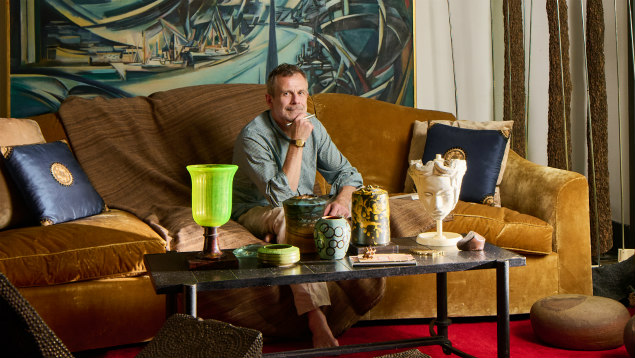
SEAMLESSLY BLENDING ART DECO AND CONTEMPORARY DESIGN. Benoist F. Drut is managing partner of Maison Gerard, a leading source for French Art Deco furniture, lighting and objects, and — more recently — postwar and contemporary design. Founded in 1974 by Gerardus Widdershoven, Maison Gerard maintains two premises on East 10th Street in Manhattan and is an elegant presence at both The Winter Show and at Salon Art + Design.
You can listen to the podcast of this interview here.
Benoist Drut, you were born and grew up in France?
Yes, I was born in a small village of 350 people. An hour away from Paris, yet a world away!
There were several antique dealers in the villages around our area and my mother was friends with most of them. We never went to a furniture store to buy a sofa. We would go antiquing and peruse the yard sales.
My parents made a choice to live in the country an hour away from Paris, but we often went to Paris to visit part of my family who lived there, and we would go for an exhibition, for the Biennale des antiquaires or for a show, so there were several visits throughout a year.
Did you know as a youngster that you would make a profession out of antiques?
I wanted to be an auctioneer very early on. I was really passionate about auctions. My first purchase at auction was a “dinky toy”, I was 12 or 13. I legally was not allowed to bid because you had to be 18, but the auctioneer was so amused that she took my bids, which made me very proud at the time!
To be an auctioneer in France at the time, you needed to have a law degree and a degree in art or art history. I was very inclined to totally stop my studies and start learning while working with an antique dealer, however my dad and I decided jointly that it would make sense to start with the hardest, the law degree. I went to Universite Paris II Assas, but I never became a lawyer.
“I always have my eyes open. I have to stay curious, aware, and inquisitive, that’s my job.”
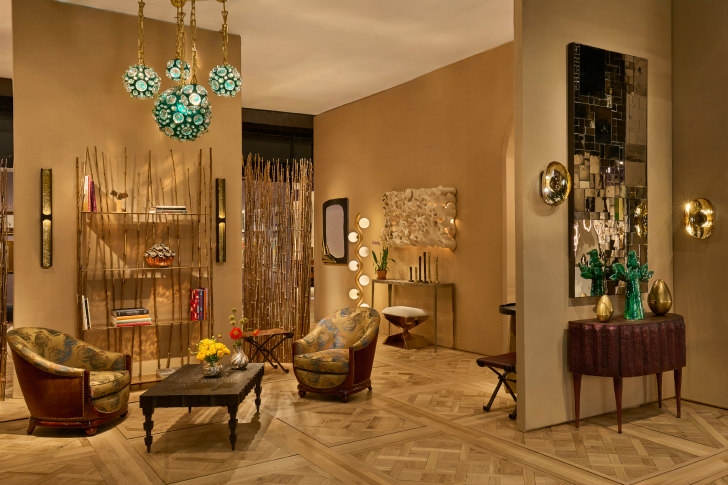
Maison Gerard: Salon Art + Design 2025, a cornerstone of New York City’s arts calendar and a leading platform for engaging with the finest design and art from around the globe.
Photo by Michael Mundy
Benoist Drut, did you become an auctioneer?
No, I worked with a young French auctioneer instead of attending classes at university!
I loved the work, but the British auction houses were trying to break the special rules that protected the auction market in France and forbade the big auction houses, namely Sotheby’s and Christie’s to hold an auction on French soil. Rules that had survived the Revolution of 1789.
The European community put an end to it, and I saw every day how difficult it was for an independent “commissaire-priseur” to survive. Also the profession had evolved in such a way that it was no longer practicing the old-fashioned way of conducting business and I realized this was not what I wanted to do.
Was it then that you moved to America?
As soon as I received my law degree, I traveled to America. My parents were very generous with my brother and I. We were the priority of their life; we never lacked for anything, however I knew that in order to be truly myself, I needed to start to earn my own money, pay for my own apartment, own a car, become independent and not depend on their generosity.
I had learned German and English at school and while I loved German as a language, I didn’t really see myself living in Germany, and I had spent several months in London, yet never really felt at home in London. New York on the other hand, was so appealing. I knew that Warhol was no longer there and that New York had changed, but there was this calling and off I went.
What did you do to become an independent person?
I had an enchanting first two months in New York City, being a tourist; going around with my little folding map, (it was before cellphones existed) and meeting all kinds of people from every age, background and culture. It was a beautiful Indian summer, cold but sunny and with a blue sky. It was magic however not sustainable. I needed to find a job if I wanted to stay.
My best friend at the time reminded me to call Robert Couturier, a French interior designer based in NYC that a friend of hers had suggested. I reached out to him and we met. Robert said that I seemed so motivated that he could call the collector Roger Prigent, which he did right away. I could hear Roger saying with a thicker French accent than mine, “tell him to come over now.” And so at 8 pm on a weekday, I took the subway to 74th Street where Roger had a townhouse. The first three floors were the gallery, and the second two floors were his apartment, which was also an extension of the gallery.
He was a very small man who had been a very successful photographer and was passionate about Napoleon and Empire furniture, 1800 to 1810. He had a very important collection but was collecting so much that with his sister he opened a store called Malmaison, that originally was on our block, on 10th Street and then moved it into his townhouse. Roger gave me a job that night. I was to be paid $200 before taxes and even 32 years ago it was not much! Certainly not enough to survive; however, it was a start.
What happened next?
I needed to have a visa, and the immigration lawyer that I was referred to had me apply for the wrong visa and my case was denied. That was terrible because that was going to send me right back to France, and I was hell bent on starting my life in New York City. After seven months, it was a tremendous setback.
A very important immigration lawyer in Washington came to my rescue. He said, “I can get you a green card but it will take two to three years and you won’t be able to travel. Is it okay with you?” And I said, “Yes,” and he asked me several times: “Are you sure it’s okay? You won’t be able to travel, you’re stuck here until we get the green card.”
How long did it take?
It took six years. This was probably the most difficult time that I ever had in the US. I could have returned back home; however, I would not have been able to come back to the US, so for six long years I stayed in New York City. I had changed jobs, and was now working for the antiques dealer Karl Kemp on East 10th Street. My parents came to visit. My brother came, everybody came, but it was very difficult and I could not change jobs again. I was basically saddled with that job.
You were learning about furniture. Did you have a preference?
Art Deco became one of my passions. I was working at 29 East 10th Street, and at 36 East 10th Street, diagonally across the street, was Gerard Widdershoven, the owner of Maison Gerard. A wonderful gentleman, Gerardus was Dutch but he spoke impeccable French and was known for his little noeux-papillon (bow-tie), and his love of the fashion label “Comme des Garçons”. Gerard quickly saw in me the kid he had been 20 years earlier. Gerard was living with AIDS and one of his concerns was that if he died Maison Gerard would die with him and he wanted Maison Gerard to live beyond him. He was 20 years older than me, so in 1998 when I was 28 he was 48. Gerardus quickly called me “mon petit heritier” (my little “heir,” not “hare” as a journalist once thought I said!)
48 and he thought about dying?
Yes, he was under AZT treatment, taking antiretroviral medication at the beginning of his journey with AIDS, and AZT was killing you as much as it was saving you. At the time, most people died of AIDS, so he assumed that he would too. He got extremely sick in 1995-1996 and we thought it was the end, and then one day his situation changed. He didn’t get worse, he didn’t get better, but definitely not any worse. And then little by little he succeeded to totally make a perfect comeback, asymptomatic with no more HIV in the blood. He was the recipient of one of the first cocktail / tri therapies. His doctor, Dr. Hitzman, was very avant-garde and saved him. And Gerard saw in me his heir.
You were already working with him?
No, I was still working with Karl Kemp, a direct competitor of Gerard, now located next door to Maison Gerard. In 1998 I finally received my green card. I had been working for six years for Karl Kemp and he and I were no longer seeing eye to eye on many issues. It was time for me to fly. Gerard offered for me to join him as a partner in his business. I was 28, I didn’t have much money, however, I had a great accountant who suggested that we create a new company where we would be 50-50 and I would repay Gerard for all he brought to the new company as we moved forward and hopefully make money.
When was Maison Gerard first established?
Maison Gerard was established in 1974. Specialized only in French Art Deco.
Gerard was a great antique dealer, very knowledgeable, and passionate.
He was not a great businessman, but he was an honest antique dealer and trusted and liked by everybody in the business. He gave me a big opportunity. The first year together we sold three or four times what he had done in the previous years. I was able to convince him to travel to Paris again and we filled container after container. We were on a roll, and we worked together so well. He retired at some point but he was still part of the DNA of the gallery so we never made an announcement about it. Regardless, even retired, he would come back for openings. Maison Gerard existed before me and I hope it will exist after me.
Gerardus passed away during Covid due to cancer.
And the gallery really developed with you at the helm?
Yes, little by little it became a big machine. When we started, we had one part-time employee. Now we are fourteen or fifteen people.
The two of us created something dynamic; it was not just me, nor was it just him – it was the two of us together on a mission. I was young and full of energy. I brought a new energy, and Gerard was of a different mindset, not worried about his mortality. He was asymptomatic, and living with a new lease on life.
I’d had six years of experience working with antiques in America, we started being more aggressive in our buying, and renewed the good old tradition of presenting exhibitions at the gallery. Oftentimes, we would publish catalogs to accompany these exhibitions.
“Being based in New York, our main competitors are in London and Paris, but we sell everywhere. Shipping is not difficult these days.”
Benoist Drut, do you have a very eclectic taste?
Yes, I do; however at the beginning of our partnership we were solely focused on French Art Deco. One day, while on a trip in France I met the designer Hervé van der Straeten. I liked a few of his works and I asked him to consider giving us a couple of pieces, because I thought his designs would really work well with the material we were showing. At the time, this was a really novel concept. Either you were an antique dealer, or you were showing contemporary design; there were no galleries mixing the two. Even Gerard took some time to warm up to the idea.
This is the way we live today, and I forcefully convinced him in the end. Slowly but surely we established our own rules about contemporary design at the gallery. It had to be a genuine creation. It could not be a reproduction. It could not be a copy. Gerardus’ concern was that we keep our integrity. And we did. Over time, we started showing more contemporary designers and presenting them along with antiques.
In this were you following what was happening in the market?
It happened at the same time. I followed my instinct. My conviction. This is the way I live, this was the way I wanted to operate! I wish I could tell you that I foresaw everything prior, but it was really a happenstance of life! And for sure it was very avant-garde. I remember a woman one day saying, “He’s nice, this young French boy, but he doesn’t know what he’s doing. He’s mixing new pieces with fine antiques!” Today everybody does the mix, but back then it was daring!
Who was influential?
Our business is mostly dealing with the interior design trade in America. Most of our clients have an interior designer and or an architect that will direct them and assist them with selecting pieces for their home. Being based in New York, our main competitors are in London and Paris, but we sell everywhere. Shipping is not difficult these days. We sell to Saudi Arabia, to India, to wherever our clients desire. It’s not a problem.
The furniture designer Jules Leleu became very important for you?
When Gerard and I started, creations by Jules Leleu from the 1920s and 1930s were very affordable and you could buy really good pieces reasonably. Everybody was concentrating on Ruhlmann, the uncontested master of Art Deco. After Ruhlmann you have a few big names like Dominique, Leleu, or Pascaud, that are really relevant. Our plan was to concentrate on Leleu and to really gather a great collection of early Art Deco pieces by Jules Leleu. At the time, we didn’t look later in Maison Leleu‘s production, we stayed very focused on the 1920s and 30s.
However, later this interest expanded?
Yes, especially after I met Françoise Siriex. Françoise had been a collaborator of Andre Leleu at Maison Leleu for many years and saved the Leleu archives from destruction when Maison Leleu closed its doors in the early 1970s. I met her one day, and a great friendship developed. I would send her photos of all the pieces that we were acquiring, and she would tell me where they came from, and we spent hours on the phone discussing the works.
She had donated these archives to the Musée des Années Trente in Boulogne-Billancourt, just outside Paris. However she did not have anyone to help her organize the 50 years of archives. One summer I spent several weeks with her. Every morning I would go to buy folders and transparent sheets, and then we would go through photos of interiors or pieces of furniture, box after box, and classify everything by project and by year. This organization gave birth to a 500-page book on Maison Leleu, showcasing the firm’s five decades of creations. Francoise opened my eyes to the special projects the firm was involved with throughout these years, this was the inspiration for us to also showcase the works of the later decades!
Are these pieces considered artworks or furniture?
Furniture by most people. Even if you have some galleries now that make a point in convincing you that design is as good as art and a sound investment.
But I refuse to participate in speculation! Only time will tell…
How is the market today?
We’ve had several past years of exuberance, where people in finance made an amazing amount of money, always doing better every year, and we benefited from those boom years. It seems that of late it’s a little bit calmer and this new presidency has affected the perception of monetary comfort.
How do you decide that you want a new designer or something new in the gallery?
As an example, for 20 years I would see furniture by Guillerme et Chambron, French designers of the 1950s, 60s, 70s. I could not stand their work! I would see it everywhere. I could have built a fabulous collection at the time, for no money.
One day, a very simple little nest of tables intrigued me. I noticed the very inventive design. From that day I started looking at their work differently.
I discovered other interesting features on some other of their creations. A table would be like a wallet; it would open and double its surface. From a table that seats three people, you could suddenly open it up and now easily seat 6 to 8 people.
That was enough to convince me to start collecting quietly. Whenever I saw something relevant by Guillaume et Chambron I would buy it.
Do you find these pieces in auction or is a person selling what is in their apartment?
Sometimes a person will contact you, other times works will be at auction. We often worked with people from the trade in Europe that would contact us first. The US market is a larger market than Europe, and it’s a very different approach.
Who are the new designers that you follow at the moment?
We always have new artists, there are always new meetings, and when it comes to working with a new living artist, it has to be fun. Sometimes somebody will suggest someone so I’ll look, and sometimes an artist will reach out to us to present their work. Other times, I’ll come across something great in the press or online and do my research and contact the person. I don’t spend much time on Instagram anymore, but I always have my eyes open. I have to stay curious, aware, and inquisitive, that’s my job.
And your furniture people are from everywhere?
Everywhere from Tel Aviv to Rome, Milan, Paris, Dublin, to Marrakech. Our relationship is always different with every artist. Oftentimes I’ll try to support them by buying some pieces, but I don’t have any investors behind me. This is very important for me. Nobody tells me what to do, especially somebody that has no clue of what my job is. I am free to do what I want, within reason. It gives me the independence that some competitors don’t have because they have to report to their investors.
Is it difficult to launch contemporary people?
Often we will start by “testing the waters” as I like to say… and see how it feels. We’ll start with a few pieces which we bring to New York and present in a show or at the gallery. We’ll see how the artist and the gallery work together (very important) and how their work is received.
Do you only sell in your gallery here on 10th Street?
We have two galleries on East 10th street. 10th Street is in our DNA. This is where Maison Gerard started, and it’s also a truly beautiful and welcoming block with really great fellow antiques dealers.
East 10th, 11th and 12th Street by tradition and decades ago was the importers’ district. This is where every day 40-foot containers would arrive filled with furniture from Europe that would then go to the 4 corners of the US.
Gerard would recall that when he started in 1974 those big importers would buy Art Deco cabinets to fill them in with straw to put the Art Nouveau ceramics, glass vases and lamps that they had purchased, instead of making crates. It was cheaper to buy an Art Deco piece that nobody wanted and then fill it with straw and use it as a crate! That was then!
Has New York changed a lot since the artistic extravaganzas of the late 60s and 70s?
It was a bit before me! However it is still vibrant with interest from all across the world. New York is really a magnet for creativity, ingenuity and entrepreneurship.
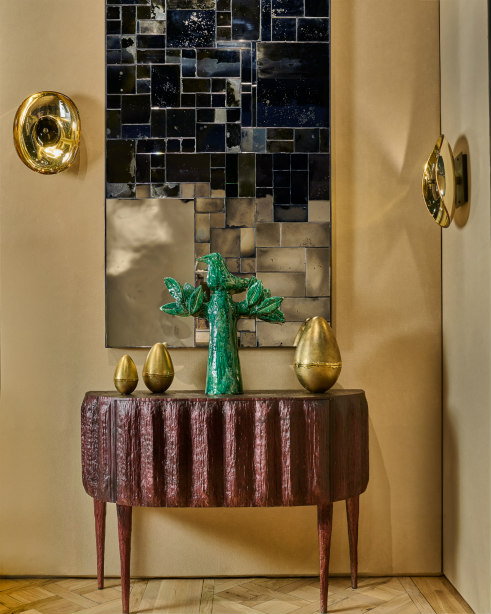
Maison Gerard: Salon Art + Design 2025
Photo Credit Michael Mundy
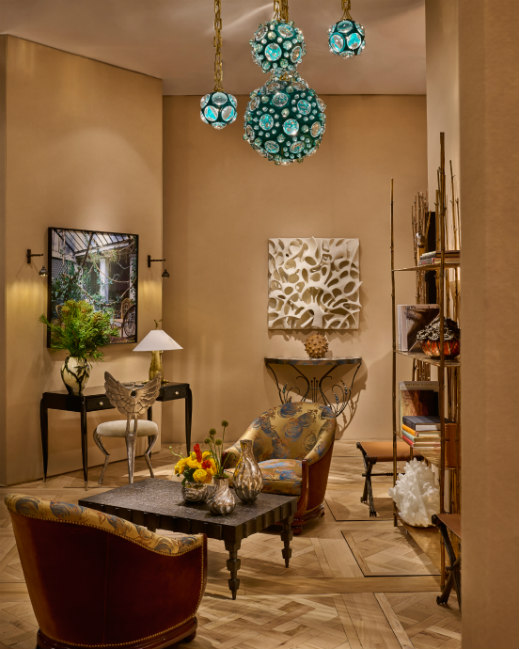
Maison Gerard: Salon Art + Design 2025
Photo Credit Michael Mundy
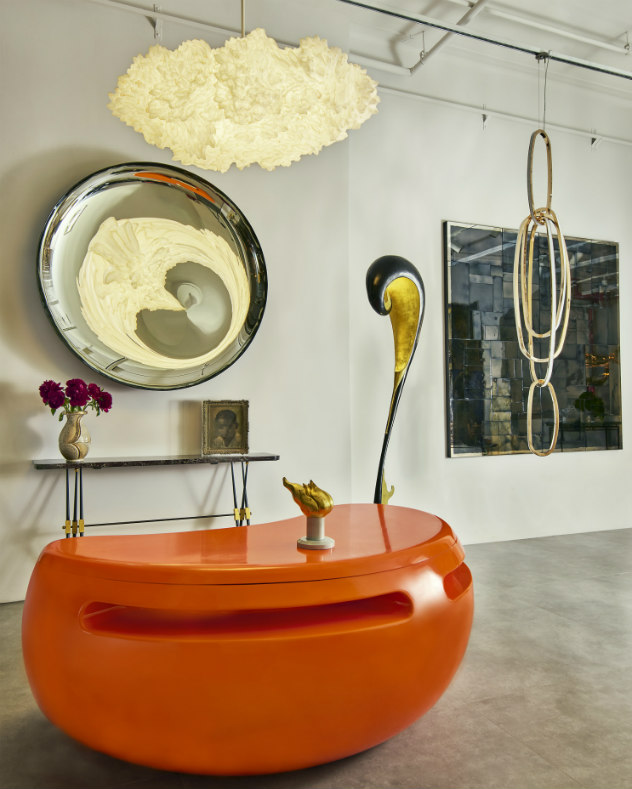
Maison Gerard: 53 East 10th Street
Photo Credit Michael Mundy
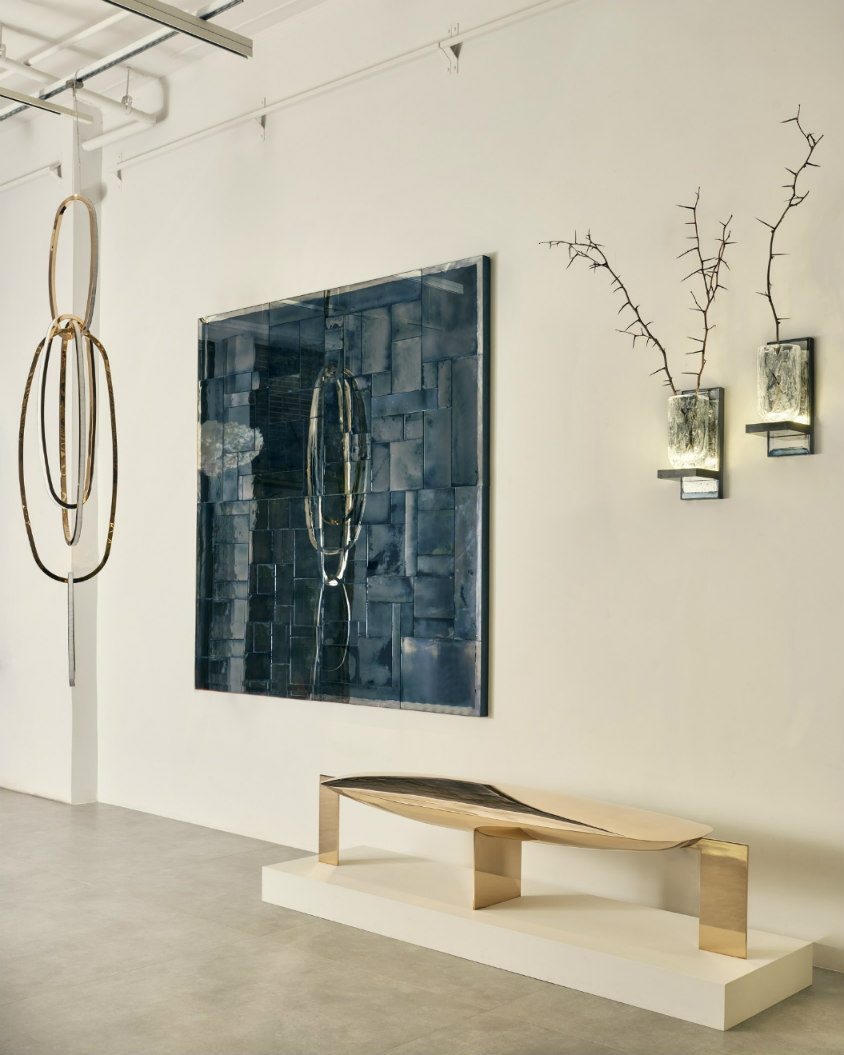
Maison Gerard: 53 East 10th Street
Photo Credit Michael Mundy
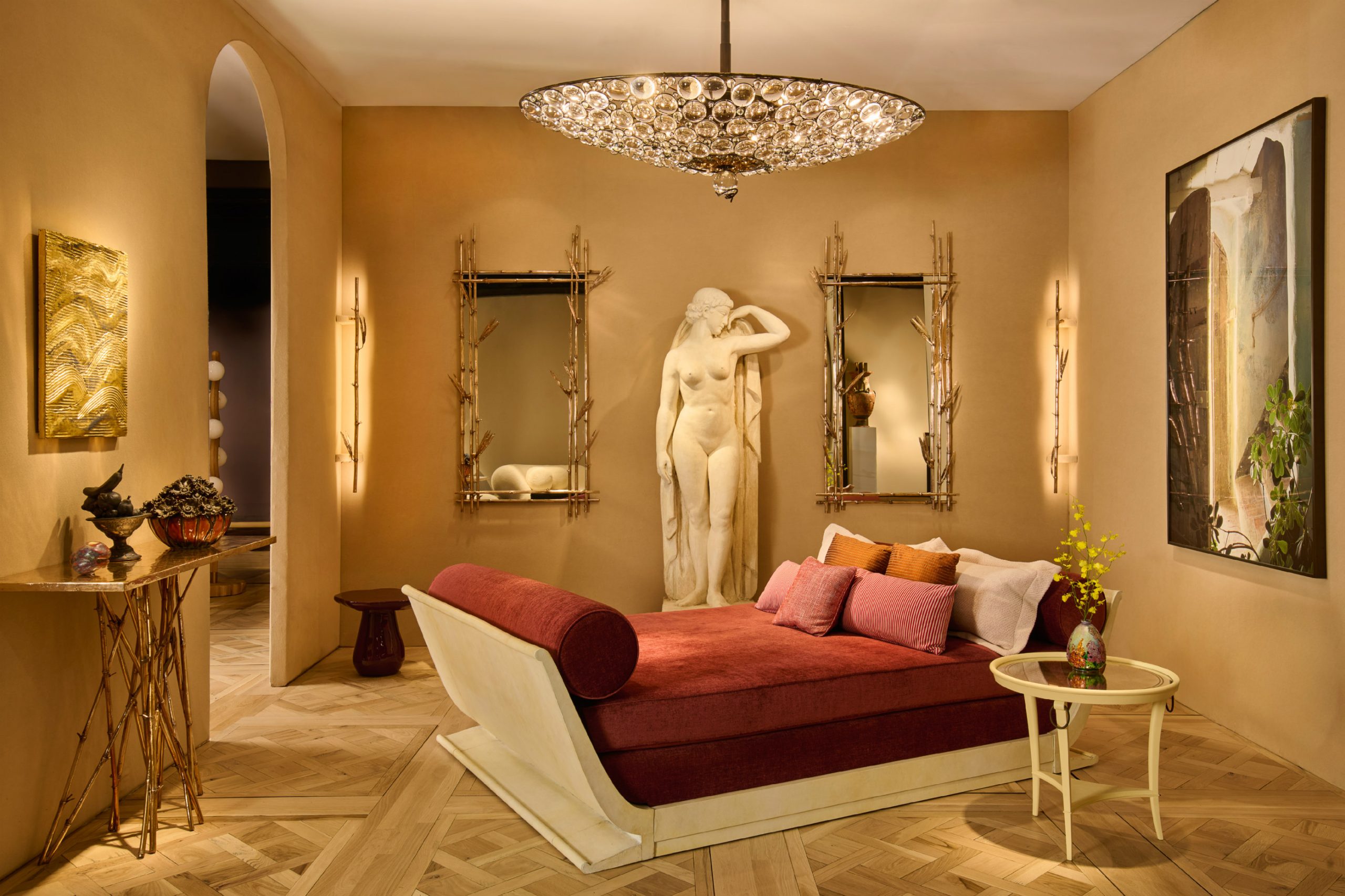
Maison Gerard: Salon Art + Design 2025
Photo Credit Michael Mundy
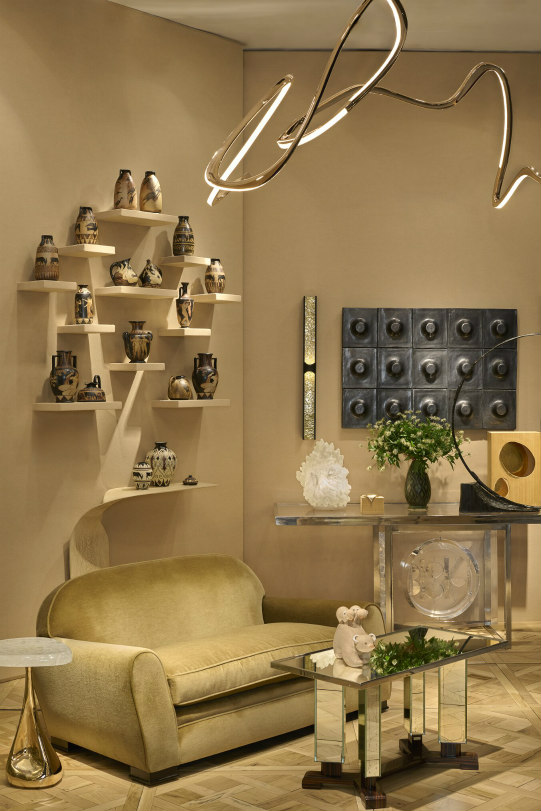
Maison Gerard: The Winter Show 2026
Photo Credit Michael Mundy
“I am known to spend more time with people that may not be able to afford some of our goods but are passionate about our material than with people who have the means!”
Benoist Drut, how was it for you during COVID?
At the beginning of COVID I took the dog and the plants, left New York and went to my house upstate, and there I stayed. I was very lucky to be able to do so.
I remember the night that we had to close the galleries and all businesses needed to shut down. My accountant had left a message that it would be a good idea to look at payroll. I knew what this meant “let go of some of your team and weather comfortably the months to come.” But I said no, that’s not ethical.
All year we count on our team to be working towards the greater good, we cannot let them down now. It’s not a one-way street here.
The following day I gathered the team on a Zoom, and said to them that we will do our best to weather the storm together, for as long as we can. And if at some point we need to do more, I will be the first one to show by example and apply the sacrifice to myself before I ask it of them.
And that’s what we did. After the first six weeks, with no revenue, no phone calls my manager and I realized that we needed to do something, otherwise we were going towards bankruptcy. So we gathered the team on another Zoom. I explained the situation and asked my staff if they would agree to accept a lower monthly salary by 15%, or 25% for the bigger salaries. To my surprise everybody agreed. I thought it was pretty special that everyone agreed to a lower salary so no one would have to be let go. Sure there were no restaurants to go to, no transportation, no shops open, so you were not spending much money. I cut my salary by 50% by mistake at the time, and I didn’t feel it because you had nowhere to spend money!
That’s how we weathered the storm and then little by little business came back. Some of our clients were at home for the first time in their lives, and all of a sudden they realized that they wanted the house to be finished. So we had several really big commissions at that time that allowed us and our designers to get through this period. Eventually we all went back to work.
Which contemporary designers are important for you?
We have a great artist Kiko López who lives and works near Avignon in France and who does beautiful églomisé mirrors using very old traditional techniques. Hervé van der Straeten and Marc Bankowsky with whom we’ve worked for many years as well as Stephen Downes who works in Alabaster. Niamh Barry, who’s really a magician, does the most beautiful light sculptures, sometimes 20 feet long, with very whimsical curves and shapes in bronze and Aline Hazarian who also works in bronze creating furniture and lighting.
There is also Ayala Serfaty who creates magical clouds, light sculptures, and amazing felt seating furniture and most recently bronze tables using the latest technology mixed with the most ancient techniques. We have a great roster of contemporary designers, I must admit.
And what about from before?
We have some that are no longer with us, like Matthew Solomon, who was a lawyer and a great ceramist. One day, he gave up his lawyer’s career and went back to doing ceramics. I fell in love with his work, and after a few months I called him and I asked if we could work together. We did for his last 10 years.
What is the Maison Gerard collection of 500 pieces of ceramics?
It is more like 1850 pieces at the moment!
Of those, we have probably 350 pieces by Roger Capron. What’s exciting is to build a collection. When my great aunt passed away she had a few pieces by Capron which ended up being passed on to me. One little dish gave birth to this larger and growing collection after several years of collecting! Right now we’re keeping them, they are not on view.
In the near future, we will have a beautiful exhibition. We’ll do a catalogue, like we’ve done many times when we bring out a collection. The excitement is to bring something that’s fresh to the world, that people have not really noticed or taken interest in. For example, I started many years ago collecting Jean Marais, the actor and ceramist who was the Beast in “La Belle et la Bête” and Jean Cocteau’s partner. I started collecting Jean Marais when nobody cared and I was able to acquire some great pieces at the time. It’s exciting when you start noticing the work of an artist early on. You have plenty of choices, yet you’re also taking a chance because nobody may ever like it.
Is it difficult sometimes to get an artist or a designer because they have other galleries or because there is competition?
We never poached an artist from another gallery. Some artists have left their previous gallery and then come to work with us. But to date we have never poached anyone! We sometimes partner with other galleries to jointly showcase the work of an artist.
Do you consider yourself a businessman?
I’ve never had the training of a businessman, I follow my instincts. I believe in capitalism with a human face, meaning that if the gallery does well, if we are successful financially, then I make sure that everybody on the team benefits from that. That it is not just me enjoying a life of the rich and famous and then leaving my staff behind. As a result, from the bottom of the ladder to the top, everybody gets a share of the pie. I’m happy working with people for many years because we know each other, we know our strengths and our weaknesses. It’s much easier than having to train somebody new every time. I always worry if somebody new is going to want to change everything. There is a reason why sometimes things are the way they are, and so I like when there is a bit of continuity. Our clients like that too. I refuse to have anybody paid on commission because you can’t make a sale without the people to hang the art, without the people to move it, to store it. It is a joint effort. Without my team, I am nothing.
In your gallery, there are couches, chairs, mirrors, accessories, objects, bookshelves, pieces of furniture. What is selling most?
You never know. Many years ago we presented a little stool made of bronze in the shape of little goat’s feet, and with a beautiful embroidery seat, and for three or four years we did not sell one. We kept giving photos away, people asked for memos, however nothing ever sold. Then one day Brian McCarthy, a great interior designer and client, asked us to upholster it with a woolly Mongolian lamb skin. That stool ended up on the cover of the magazine Veranda and that started this stool’s very successful career. After four years of no sales it became a bestseller. Everybody wanted that little stool with that little furry seat. You have to be patient and sometimes something wonderful happens. There’s no rules.
Most of the time there is always a professional interior designer or architect involved. Sometimes it’s a collaborative choice between clients and their designer. Sometimes it’s an order from the designer; I remember Robert Metzger, who was a big designer in the 90s, who one day said to a client, “And this will be for the living room.” And she said, “But I don’t like it very much, Robert.” And he said, “Don’t worry.” He looked at me and said, “Please send an invoice.” And then he looked at her and said, “You’ll learn to like it.” That’s the extreme but most of the time, it’s more a conversation between the clients and the designer.
Do you try to convince them?
No, I hate pushy salespersons and that’s also why nobody is paid on commission at the gallery. I don’t want my staff to feel that they have to force a sale. There’s nothing that I hate more than a pushy salesperson, I just run away from the store. Be honest. If the client is making the wrong choice, just tell them.
I always tell my clients the following: “You’re going to wake up to this piece and you’re going to fall asleep to it. It should speak to you, it should enchant you, it should make you smile. It should at least not make you bored.
Also, don’t ask for fifteen opinions, because you’re going to get twenty in return. Just follow your instincts. This is your home. This is you. It doesn’t have to be like everyone else’s home”.
You probably had some very well-known people as clients?
Paul Simon is one of my ultimate favorites, a wonderful client and friend, he’s a very beautiful soul and a very gentle man. It’s always a great pleasure seeing him.
Yes we do have quite a few clients that are well known. You can be assured that I will probably not recognize them at first. I don’t have a TV by choice and often have no clue of who the person is. Which is why I act so natural when a famous person comes into the gallery. I understand that they want their life to be their life, so we don’t usually name drop.
Whether you are well known or not, you are treated equally at Maison Gerard.
I am known to spend more time with people that may not be able to afford some of our goods but are passionate about our material than with people who have the means!
Do you have to wait before knowing if something went well or not?
I see my job as a farmer’s job in a way. You introduce an artist to your audience, like you plant a seed. Despite all the watering in the world, all the good press you may have gotten, the harvest sometimes takes longer than expected. You have to be patient, and keep doing what you do best. If you are passionate about this artist, if you believe in him or her, it will eventually take off. People will follow.
My job is to be an eye opener; I see so many things daily. I select what strikes me as most relevant, interesting, what makes me lose sleep at night, what I need to have, and then share my love and passion for that object or artist with my clients. This is in hopes that they will allow me to open their eyes to this new or old discovery. In hopes that they will purchase it, allowing me to bring more new discoveries, new artists and to build more collections!
When we do a show, I will judge the show after a year. I remember many years ago, we had done a show on the piers in New York and, exactly a year later, a client called me and said, “I seem to remember having seen a chandelier like this and that, like a spider kind of chandelier.” And it was day for day a year after he had originally seen it but it had stuck in his mind, and a year later he was ready for it.
Do you also buy at auctions?
We buy at auction, yes. They are an important part of our ecosystem.
I also like to buy from other dealers whenever possible. If we don’t support each other, who will! We are the ones who defend and promote artists and designers, past and present, raise awareness, and build their market. Auction houses and dealers all have their roles.
As tastes change do objects come back to you?
Yes, objects will often come back to you, especially after fifteen or twenty years.
Sometimes it’s due to a divorce and then the new wife will want to get rid of whatever reminds her of the previous wife. Sometimes death. Sometimes changes in taste. A beautiful object always remains a beautiful object. Most of the time I am happy to welcome back something that we sold decades ago. And out there will always be someone that will share the same love. You just have to be patient!
Are you very curious?
I’m very curious, when it comes to art and antiques, yes. And as I get older as I know more, I have also been more daring and even more curious. This is the beauty of my job. I learn something new every day. Even when you think you know it all, a little piece of information comes to you and all of a sudden it can open new horizons, new discoveries and take you where you never thought you would go!
You’re proud of Maison Gerard and glad to be still in New York?
I am very proud of Maison Gerard. Yes. I am proud to have carried the flame for over 25 years as Gerardus wanted it to be. And intend to continue for many more years. But this is not the result of solely my efforts, this is the result of a team of fifteen or so people that every day contribute to making Maison Gerard relevant and successful.
New York is still New York. It is a very liberal city, a vibrant city and an economically important city. New York is not America, New York is New York!
Thank you very much for this conversation.
Portrait of Benoist F. Drut at home in Sullivan County by Michael Mundy
ENJOY THIS INTERVIEW? SHARE IT WITH A FRIEND.