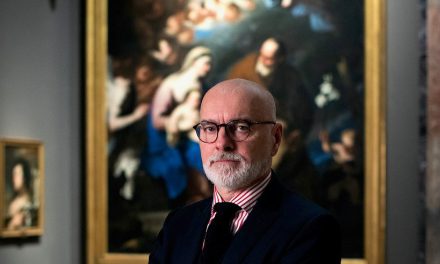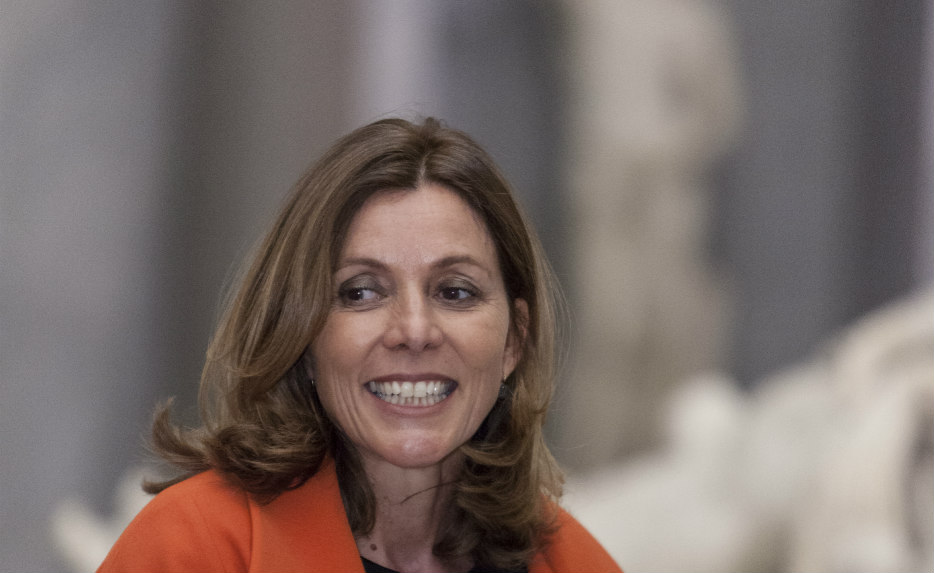
MANAGER OF A MASSIVE CULTURAL LEGACY. Barbara Jatta is an Italian art historian and the Director of the Vatican Museums. Appointed by Pope Francis in 2017, she made history as the first woman ever to lead the prestigious institution. A highly respected expert in the history of drawing, engraving, and graphic arts, before her directorship she built a long career at the Vatican, notably serving as the head of the prints department at the Vatican Apostolic Library. As Director, she manages a massive cultural legacy that spans 7 miles of exhibit space, including the Sistine Chapel and a huge collection of artifacts. Her leadership focuses heavily on conservation, education, and modernising visitor experiences across the Vatican’s various museums and galleries.
24 minutes read time.
You can listen to the podcast of this interview here.
Barbara Jatta, your grandmother Assia Busiri Vici was a prominent portrait painter, your mother a painter, your sister a conservator. Is the whole family very involved in the world of art?
Yes, and my grandfather Andrea Busiri Vici was a reasonably well-known architect, designer and art historian. All my family from my mother’s side, the Busiri Vici family, were architects.
How did you arrive at the Vatican?
Thanks to the American Academy of Art, professor Joseph Connors, and my previous internship at the Cleveland Museum of Art. In 1989 I started working at the Cleveland Museum of Art in the Prints and Drawings Department where I contributed to the organization of a wonderful exhibition showcasing Baroque drawings from Rome. I was there for a visit and I stayed to work specifically for this project. When I returned to Rome, Joseph Connors, who at that time was the director of the American Academy of Art in Rome, called me and said, “I know that you have been in Cleveland and you helped organize a great exhibition. Would you like to bring an exhibition to Rome and help me set it up?” I was overjoyed. I was 24 and I had just graduated from my PhD specialization years. I decided to help him, and eventually we curated an important scholarly exhibition at the American Academy on the Flemish artist Lievin Cruyl. For the exhibition we asked for a series of drawings from the museums of Oxford and Amsterdam, and a number of prints from the Vatican Library. I went to the Prefect of the Vatican Library to discuss the possibility of borrowing a selection of prints by Lievin Cruyl for the exhibition. He then asked me whether I would be interested in a position in the Prints and Drawings Department at the Vatican Library because the person covering that position had retired earlier that month. I regarded the opportunity as an exceptional privilege and accepted immediately. After some time, having seen the exhibition, he recognized my scholarly orientation. As a matter of fact, during that period, I was working as my professor’s assistant at the Sapienza University of Rome, and I was also working for the Italian National Institute for Graphic Arts. Therefore, I had specific training and knowledge in prints, drawings, maps and photographs. It is also worth noting that at the time there were no art historians interested in this field at the Vatican Library. These are the reasons I was later appointed Curator of Prints at the Vatican Apostolic Library.
“While the Vatican Museums are the museums of Popes and of the present Pope, we take care of worldwide and universal collections and it is our responsibility to share them with our visitors.”
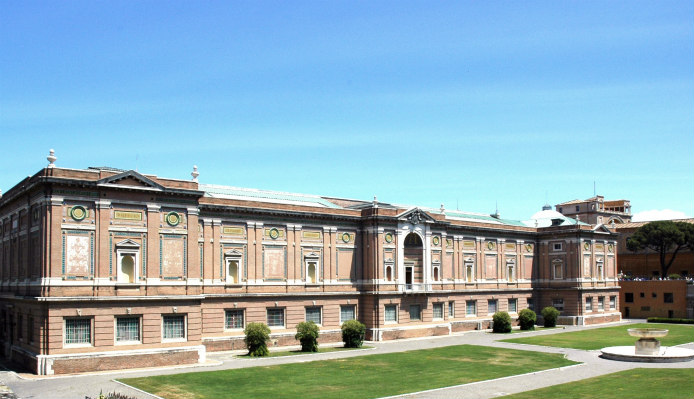
The Pinacoteca in the Square Garden, Vatican Museums.
Copyright © Governatorato SCV – Direzione dei Musei. Tutti i diritti riservati.
Barbara Jatta, at the same time, from 1994 to 2016 you were a professor at the Suor Orsola Benincasa University in Naples?
Yes. I stopped teaching when I was appointed Director at the Vatican Museums.
How did it happen that Pope Francis appointed you as the first female Director of the Vatican Museums.?
It was intimidating. The offer came as a complete surprise, as I was fully content with my position at the Vatican Library. In May 2016 I was travelling to Russia and afterwards I was visiting Notre Dame University in Indiana, at South Bend NDR, near Chicago, for a conference that the Vatican Library organized at the University. The subject was the role played by the Vatican Apostolic Library in humanistic studies in all U.S. Universities (not only the religious ones, but all the academic humanistic universities). On the flight back, the Cardinal Librarian and the Prefect of the Vatican Library informed me that we would probably be received by the Pope the following day and that I would be expected to present a project curated by the Department. It was the year of the Jubilee of Mercy, and for that Jubilee we thought to have a project centred on an artwork of graphic art, at the time, held by the Department I was directing and to be donated to the Pope. The next day, still jet-lagged, I visited Pope Francis together with the Cardinal and the Prefect and I presented the project to the Pope that he listened to very carefully. Later that week, I received my appointment as Director of the Vatican Museums.
You were in the Library first with Pope Benedict, then with Pope Francis and now with Pope Leo you are in the Museums, the most important arena besides religious meaning and the political and diplomatic side. Your responsibility includes the Raphael Rooms, the Sistine Chapel, the arts in the basilicas outside Rome such as The Archbasilica of Saint John Lateran, Saint Paul Outside the Walls, The Papal Basilica of Saint Mary the Great and more?
I am not responsible for the Basilicas. Rather, the Vatican Museums take care of all the artistic, architectural and archeological heritage in the Holy See’s possession, in accordance with a Vatican law.
Barbara Jatta, yours is a huge job, because the Vatican Museums occupy a big space in the smallest country in the world, the Vatican City, a state surrounded by Rome. How many people visit the Vatican Museums?
2025 was a very complex year because it was the Jubilee of Hope but it was also marked by the illness and passing of Pope Francis, his funeral, and the election of Pope Leo. Following his election, the number of visitors increased significantly and we closed the year with 7 million visitors to our collections. We had anticipated that it would be an exceptional year and had therefore already decided to extend our opening hours to twelve hours a day in order to welcome all public, pilgrims and visitors. Even now we are open to everybody from 8:00 am to 8:00 pm (with admission ticket at just 20 euros per person). We are willing to share a heritage that does not belong to us alone. While the Vatican Museums are the museums of Popes and of the present Pope, we take care of worldwide and universal collections and it is our responsibility to share them with our visitors. Our mission is precisely to preserve and share this patrimony. All the people that work at the Vatican Museums and at the Vatican Library are committed to the mission of preserving and sharing.
How many people work in the Vatican Museums?
We are a community of almost a thousand people: around 800 staff members supported by several collaborators. There are also 400 guides that work within our premises. The Vatican Museums are under the direction of the Governatorate of the Vatican City-State, the smallest State of the world covering just 44 hectares, yet the most universal. We emphasize that this is a holy land extending over 44 hectares. The Vatican City-State was established on 11 February 1929, at the request of Pope Pius XI through the Lateran Treaty. On the occasion, he declared: “When a country can boast Bernini’s colonnade, Michelangelo’s dome, the treasures of science and art held in the archives and libraries, museums and galleries of the Vatican; when a land covers and safeguards the tomb of the Prince of the Apostles, one has the right to say that there is no greater or more precious land in the world.”
What are the Vatican Museums?
We refer to the Vatican Museums in the plural, because they are not a single museum, but a series of museums. They represent a group of several museums that developed over the centuries as collections of popes and papal families. It was only in the eighteenth century that these collections evolved into museums in the modern definition of the term “museum”. With more than 20 museums, we reflect a humanistic vision of museums , which span Egyptian, Etruscan, Greek and Roman art, and continue chronologically through wonderful mediaeval collections, the great Renaissance artefacts, frescoes and the “Stanze di Raffaello”, maps, other artistic achievements of the Baroque time, and the works of the 18th century and the 19th century. We also have a huge collection of modern and contemporary art. Alongside these collections, the Museums hold a tapestry collection and cars and carriages collection. I would also like to draw particular attention to an amazing, yet still comparatively little-known collection of ethnographical objects originating not from Europe but from North and South America, Africa, Australia, Asia, China, Thailand, Japan, Korea, and many other regions of the world. The collection comprises a hundred thousand pieces that in the last years we have worked strongly to redisplay in a wonderful way, while re-connecting with the communities of distant lands. In 1925 Pius XI, the Pope who established the Vatican City-State, commissioned a major missionary exhibition asking to host this incredible collection and encourage dialogue among the objects. The following year he decided to establish a museum dedicated to all these artefacts, overseeing their anthropological selection. The hundred thousand pieces are still in-house where we preserve them with the support of specialized scientists and conservators that work with dedicated attention on different kinds of materials. It is a polymaterial restoration laboratory, and together with the other laboratories we represent a center of excellence in terms of conservation and preservation.
We have more than 100 staff members working on different types of materials including paintings, sculptures, wood materials, mosaics, paper, tapestries, coins, metal and ceramics. The skill and the professionalism of the in-house staff of the Vatican Museums is truly amazing. I consider myself a very lucky Director to be able to rely on such excellent in-house expertise, which plays an essential role in allowing me to fulfil our mission at a very high level.
“We have tried to make people understand that the Vatican Museums have so much more to offer beyond Raphael and Michelangelo.”
Barbara Jatta, does Pope Leo show strong interest in the museums?
I believe so. We have met him in person on some occasions where he has shown a genuine interest in art. On one occasion we offered him a painting of St. Augustine while on another occasion, following the restoration of the Baldacchino in St. Peter’s Basilica, we presented him with a 3D model of a sculpture and explained the restoration of the Cathedra by Bernini.
When there is a Papal conclave, you obviously close the Sistine Chapel to the public?
Yes, we did so last year. It was challenging, because we had to remove all the cameras and the whole audio system inside. Since we had to make all the necessary preparations inside the Sistine Chapel, we had to close it to the public. The Vatican Museum admission ticket specifies that we can close the Sistine Chapel at any time for liturgical reasons or for other occasions.
Does the museum also close for religious as well as diplomatic or political purposes?
There are special masses that the Pope celebrates such as all the baptisms of the museums employees’ children that he celebrates within the Sistine Chapel. Therefore, there are some liturgical moments happening in the Chapel during the year but not in the museum itself. The Vatican Museums extend over seven miles of display spaces, making them an extraordinary vast complex. The Museums also house some chapels that are not really used as chapels, such as the Chapel of St. Peter Martyr, and the Niccoline Chapel which preserves all the frescoes by Beato Angelico. Here we celebrate a mass every February in memory of Beato Angelico. It is a small yet wonderful and incredible renaissance chapel painted by Beato Angelico and commissioned by Pope Nicholas V. On certain occasions, the Secretary of State or the Pope may request the involvement of the Vatican Museums in welcoming heads of state. Whenever a leader of a foreign country asks me about visiting the museums I always advise them to go through the Secretary of State.
Barbara Jatta, who decides the programme of restoration and maintenance?
We have a Directorate, I work in strong synergy with two deputy directors, one responsible for management and one responsible for scientific activities. Our departments are led by curators, and each curator for each department makes suggestions for our three-year programme. Taking into account different aspects such as diplomatic issues and particular opportunities that may arise, we decide, together with the curators’ proposals, what to restore and what kind of projects to undertake such as new displays, conservation projects, photographical projects, new displays, or other projects. We put into place the three-year programme and work closely with the Directorate for Infrastructure and Services, because they help us in addressing all the infrastructural requirements necessary for the scaffolding and other infrastructural interventions.
American museums have donors who give collections, and money to restore or open a wing. European museums like the Louvre or Versailles have American friends raising funds for projects or restorations. Is it the same for the Vatican Museums?
Yes, it is the same. For almost 50 years the Vatican Museums has received the support of an organization called the Patrons of the Arts in the Vatican Museums (PAVM). It is organized into 19 different chapters, the majority of which are from the US, representing different states including Florida, New York, Washington D.C., California, Minnesota, South Dakota, Ohio and so forth. They pledge for the projects that we identify as our priorities . We are very grateful to them. We also have some patrons from Europe, and we have an Asian chapter based in Hong Kong, Singapore, and Korea whose support we value deeply because they represent Catholic communities and have a strong understanding of our needs. Increasingly, this relationship has become a mutual legacy since the Patrons recognize that our needs go beyond individual restoration and conservation projects. They have developed a deeper understanding of the needs of a museum like ours and as a result, they support several initiatives, including projects related to lighting or air conditioning.
Do they sometimes buy a painting?
No, because we value our freedom to make our own choices in terms of acquisitions, and involving a patron or a group of patrons may be complex. We make acquisitions mostly of modern and contemporary artworks, and sometimes we also make direct acquisitions. Last year we bought from an antique dealer in Milan a painting that we needed and that was particularly suitable for our collection. At the same time, we are in the fortunate position of receiving a very large number of gifts. We are entrusted with a high number of objects, and therefore we evaluate very carefully which gifts we are have the capacity to receive. Whenever we receive a collection, or paintings, drawings, sculptures, or other objects, we make it clear that acceptance cannot be conditional upon the work being displayed. This principle works very well, because donors are extremely generous. For example, two years ago we received the Franco and Maria Antonietta Nobili Collection from the heirs of Franco Nobili and his wife: 60 wonderful self-portraits by artists from the 19th century to the middle of the 20th century that we have showcased in a temporary exhibition within the Vatican Museums’ collections.
Do you organise many exhibitions and make lots of loans?
Yes, we have an internal exhibition office that deals not only with internal exhibitions but also with an high number of requests for loans. Our mission is to preserve and share, so of course I support the idea of sharing. This is why we lend several objects and paintings worldwide. The only consideration is that it is essential to ensure that visitors who come to the Vatican Museums continue to have the opportunity to experience the masterpieces they expect to see. For example, we recently lent a tapestry and a painting for the Raphael exhibition taking place at the Metropolitan Museum of Art in New York, but we did not lend our major Raphael works, as they remain central to the experience of our visitors.
The Louvre has La Gioconda, the Egyptian Museum in Berlin the Nefertiti. Are your icons the Raphael Rooms and the Sistine Chapel?
All our visitors intend to see the Raphael Rooms and the Sistine Chapel, but I would like to underline that for 10 years or even more we have tried to make people understand that the Vatican Museums have so much more to offer beyond Raphael and Michelangelo. They are of course the icons that everybody wishes to see but I will never stop saying that we are so much more.
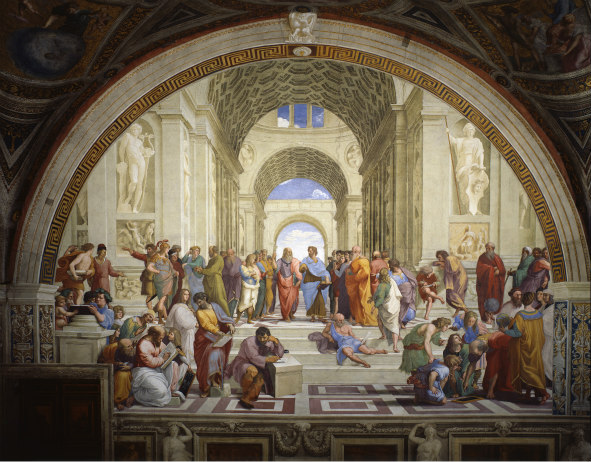
School of Athens, Room of the Segnatura, Raphael’s Rooms, Vatican Museums. Copyright © Governatorato SCV – Direzione dei Musei. Tutti i diritti riservati.
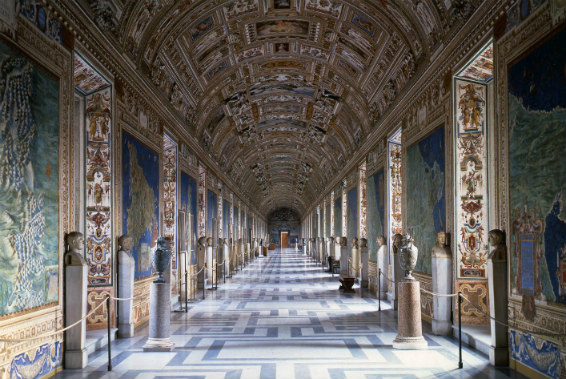
Gallery of the Geographical Maps, Vatican Museums. Copyright © Governatorato SCV – Direzione dei Musei. Tutti i diritti riservati.
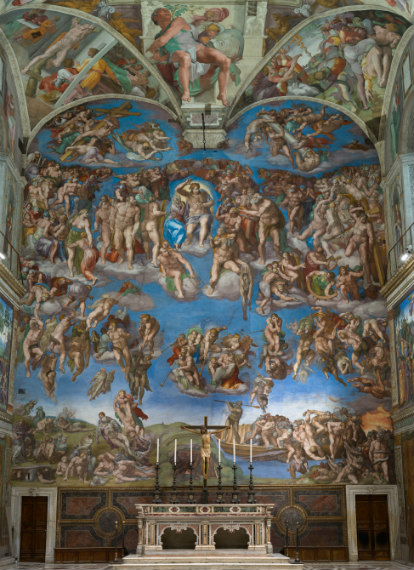
Last Judgement, Sistine Chapel, Vatican Museums. Copyright © Governatorato SCV – Direzione dei Musei. Tutti i diritti riservati.
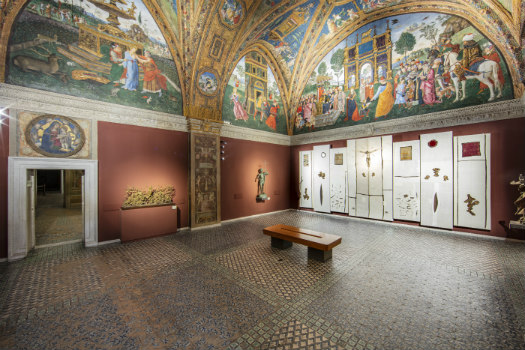
Collection of Modern and Contemporary Art, Borgia Apartment, Vatican Museums. Copyright © Governatorato SCV – Direzione dei Musei. Tutti i diritti riservati.
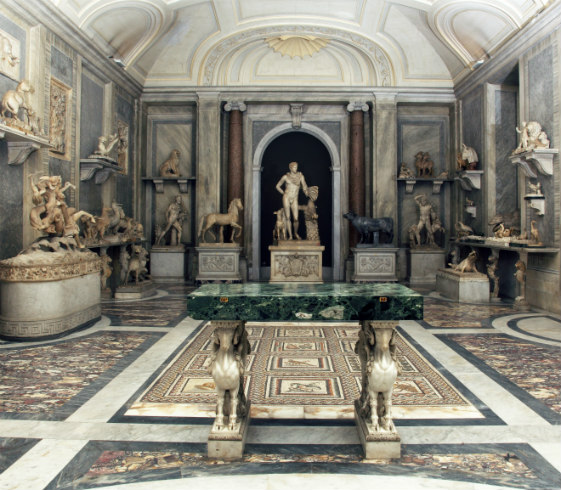
Hall of Animals, Pio Clementino Museum, Vatican Museums. Copyright © Governatorato SCV – Direzione dei Musei. Tutti i diritti riservati.
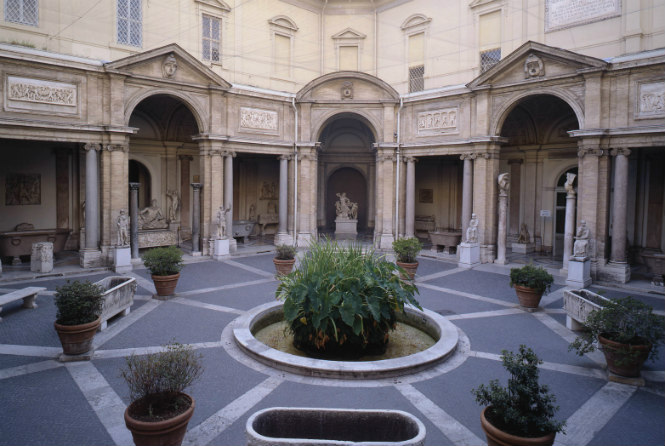
Octagonal Court, Pio Clementino Museum, Vatican Museums. Copyright © Governatorato SCV – Direzione dei Musei. Tutti i diritti riservati.
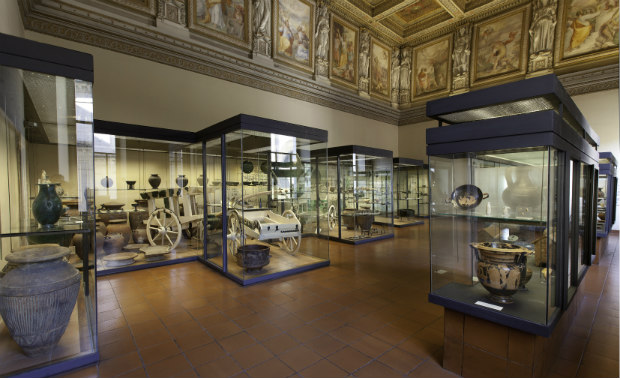
Gregorian Etruscan Museum, Vatican Museums. Copyright © Governatorato SCV – Direzione dei Musei. Tutti i diritti riservati.
“It is extremely important to offer our visitors a journey to the collections which is not only artistical or historical but also spiritual.”
Barbara Jatta, how else are the Vatican museums very important?
The painting collection in the Pinacoteca, built in 1930s by the architect Luca Beltrami, is a huge building with 18 fantastic rooms which clearly shows the development of the aesthetic of Western art from mediaeval times. From Margaritone d’Arezzo’s portrait of Saint Francis to the 18th century, it is a really incredible passage from Margheritone d’Arezzo to Giotto’s Stefaneschi Triptych, Melozzo da Forlì, Beato Angelico, Perugino, Raphael and many more. After Raphael, there are all the mannerists: we have a room devoted to Barocci, and then Caravaggio, Poussin, Valentin, and all the incredible artists of the Baroque era. So no doubt the Pinacoteca is incredibly important. Equally significant is the Museum of Antiquity, because of the incredible importance of Greek and Roman antiquities collections originating from the Roman Empire territories. The Museo Pio Clementino is the Museum of Museums, where room after room you encounter the Greek Cross Room, the Round Hall, the Hall of the Muses, the Hall of Animals, the Gallery of Statues and Busts, the Octagonal Courtyard. I can hardly begin to describe what you can encounter in these places. The Egyptian museum is of equal significance, because for those who are unable to visit Egypt or Turin, here you have superb examples of this civilization to which we owe a lot. At the same time, we preserve 30,000 objects of Etruscan art housed in one of the most marvellous places of the Gregorian Etruscan Museum: the Palazzetto del Belvedere.
How many days does it take to visit these museums?
So many! You can’t do it in a day.
You are at the head of all these cultural issues and many cultures and countries are represented and interact here in both a religious and a diplomatic way?
Yes, even when I was at the Vatican Library I worked with different Cardinal Librarians who were Italian, Argentinian, French, and Portuguese: Cardinal José Tolentino de Mendonça covered the position before starting working for the Dicastery of Education and Culture where he is today. Currently, Giovanni Cesare Pagazzi is the head of the Archive and Library. All my colleagues in the Vatican Library were scholars from all over the world; from the US, India, Germany, France and Belgium. It was truly an international milieu and the same international relations define the Vatican Museums, particularly in the field of research.
How is your own relationship with the Italian Ministry of Culture?
I have reached an age at which all my university colleagues are now directors of different museums. I have just returned from a meeting organized by the BIZOT group, composed of 40 people, that helps all the major museum directors worldwide, from the Louvre, the Metropolitan, the British Museum and many more. From Italy there is Francesca Cappelletti, Director of the Galleria Borghese, Christian Greco, Director of the Turin Egyptian Museum and myself. Since Francesca and I studied together at university and we know each other very well, we have established a very close professional relationship and share similar ideas. It is for this reason that the Vatican Museums and Galleria Borghese will host the BIZOT group meeting next October together. I have also established a strong professional relationship with Giulio Manieri Elia, the Director of Gallerie dell’Accademia in Venice, and many other colleagues who I know personally. These long-standing connections are significant, not only for facilitating loans between museums but also for advancing scholarly exchange.
Now two women are running the museums and the cultural affairs in the Vatican?
Sister Raffaella Petrini is in charge of all the political issues and is at the head of the Vatican City-State, as President of the Governatorate of the Vatican City-State, an extremely important role in the Curia. One of the first official acts of Pope Leo was to make that position eligible to be held by someone who is not a cardinal. This vision of Pope Leo shows he understands the competence and quality of people. A few days ago, he appointed a new Prefect of the Dicastery for Communication: a young Mexican-born journalist from the U.S. who is 40 and lay.
Barbara Jatta, as Director of all this you are in an enviable position but it must be a lot of work?
My colleagues from the press office can tell you how busy I am! But I have never lost the energy and the faith, which I find beautiful.
Is it easy to visit the Vatican Museums or do you have to book way in advance?
Last year we launched a new ticketing system to avoid secondary ticketing, and we are strongly encouraging people to book online, which is easier because it enables us control the admissions with a very sophisticated tool. It is fairly simple to visit the Vatican Museums, but during high seasonal weeks it can be difficult because demand is always double the capacity. For this reason, we have established a limit on the number of visitors, because we are convinced – and personally I am truly convinced – that it is extremely important to offer our visitors a journey to the collections which is not only artistical or historical but also spiritual, even if it may include pagan works, Greek, Roman, Etruscan or Egyptian. This journey enables visitors to look at different cultures, religions, and spiritual traditions through a wonderful open-minded perspective.
Do you have a cafeteria in the museum?
We have more than a cafeteria. We have a large cafeteria, a restaurant, a pizzeria, an additional cafeteria, a bistro situated in the Pine courtyard, and another one located in the Giardino Quadrato. We also have a small bar next to the Sistine Chapel, which faces the external arches, designed by Michelangelo, of St Peter’s Basilica. This is a place that I warmly recommend to anyone visiting the Museums.
Barbara Jatta, thank you very much for this conversation.
All images courtesy of Vatican Museums, all rights reserved.
ENJOY THIS INTERVIEW? SHARE IT WITH A FRIEND