CELEBRATING INDIVIDUAL SELF-EXPRESSION. Erdem Moralıoğlu is a British fashion designer and the eponymous founder of London-based fashion label Erdem, which he established in 2005. His Spring Summer 2025 collection was shown at the British Museum’s South Entrance amidst its 45 feet high columns. The show was based on The Well of Loneliness by Radclyffe Hall, published in 1928 and banned in the same year. The book gives voice and form to the love of two women at a time when the idea of gay love between two women was not even illegal, its very existence was denied as impossible. For Spring Summer 2025 Erdem pays homage to this story of the love of Stephen Gordon, a woman living as a man, and her relationship with Mary Llewellyn.
You can listen to the podcast of this interview here.
Erdem Moralioglu, have you lived and worked in your studio in Whitechapel East London since you started?
My old studio was in Bethnal Green, and I used to live east, but now my husband Philip and I live in Bloomsbury. We moved a while ago. If you dropped a pin in the middle of London, you would probably land on our house. We live very close to where the show was, at The British Museum, in the middle of the city.
In your Spring-Summer 2025 collection you had both romantic dresses and tailored suits. Can you describe your new collection?
I was fascinated by the book The Well of Loneliness and particularly the idea of gender. It describes very closely the relationship of two people, one a woman who was renamed by her father as Stephen – Stephen Gordon, a fictional character – and Mary who’s her greatest love. There were interesting parallels between these characters and the author Radclyffe Hall and Una Tunbridge, who was her real-life partner. They lived very outwardly and openly as a couple. The show to me was almost like this push and pull between Una and Radclyffe, the idea of the feminine countering the masculine. There’s a wonderful passage in the book of Stephen being fitted for a man’s suit on Savile Row, and the pride she has in being fitted for this suit and becoming who she felt was her true self.
“I wonder if Radclyffe today would be considered non-binary or trans.”

The ERDEM store on London’s South Audley Street
Erdem Moralioglu, why did you use the Savile Row tailor Edward Sexton for the suits?
We collaborated. They made the suits that opened the show. Some tailored looks are things that we made in the studio, and others were made on Savile Row. Savile row has a very technical and beautiful entirely hand finish. It felt very interesting to fit the jackets and the double-breasted jackets and how they fell on the female models, really making them become quite masculine in the process.
An interesting the contrast between those and the very feminine clothes with very light cloths?
It was Radclyffe to Una. It was the push and pull, the spectrum of gender and what one feels is their authentic self versus what one might biologically be born as. I wonder if Radclyffe today would be considered non-binary or trans.
You like transformation and have people such as the model and revolutionary activist Tina Modotti as your heroic characters?
Yes. Even Maria Callas I loved. The last full collection, the Autumn Winter 2024-25 fashion show was about Medea and a specific performance that Callas did at La Scala in 1953. I love the filmmaker Luchino Visconti above everything, and I am inspired by Susan Sontag’s The Volcano Lover, the story of Emma Hamilton’s love affair with Lord Nelson and people dancing on the lip of a volcano.
That was the theme of your Spring Ready-to-Wear show in 2021?
Yes, that collection was designed during Covid, and we had that show in a forest in the middle of really nowhere. You had the trees lining the runway, which weirdly gave a great freedom because we didn’t have to worry about an audience. There was no audience. You were allowed very few people on set, but there were parallels to that book which describes great change before all of the revolutions that were to take place. That little moment that she describes is very interesting. I love that book, and Modern Nature by Derek Jarman is my other favourite book.
They say you were influenced by the Merchant Ivory movies. Why?
My mother was English, my father was Turkish. We were in Canada and my mother, in order to feel some kind of connection to where she was from, the only kind of British television that was on there was the Public Broadcasting Service, and we would watch Merchant Ivory movies. So I had this very false idyllic idea of what the UK was, although that of course was something that I knew was false from a young age. My mum was from a very working-class family in Birmingham, the eldest of three, and left when she was quite young. Half of my family is still in Birmingham almost on the same street where my mum grew up. The Merchant Ivory films I grew up with was a fantasy of a time and place that never existed. Or existed for few.
But you come to the Royal College of Art in London to study rather than going to Paris or Milan?
I had a passport, so I was able to be here. John Galliano, Alexander McQueen, everything seemed to be beginning in London. I didn’t apply to St Martin’s, I applied to the Royal College where David Hockney and Ossie Clark went. I was able to get a Chevening Scholarship from the British Council and I began in 2001. That was a very interesting time for me. I was from Canada, from a very small college, and suddenly there was a lecture with Wolfgang Tillmans about photography or Hussein Chalayan giving a lecture in the architecture department. You had this whole world in front of you. What was also fascinating is you had printing studios, embroidery studios, millinery studios, weaving. My first friends when I moved to London are all friends I was at the Royal College with. You had extraordinary weavers and embroiderers. The person who we collaborated together on my graduate collection, 23 years later I hired her and she’s working with me. I still work with the same person who makes hats from when I was a student.
You are a faithful man.
I met my husband when I was at the Royal College. He was studying architecture and the first thing he said when we got together was, “One day I will design your first store.” And he did. In South Audley Street, Mayfair. It’s still there.
How many stores do you have?
Two, soon to be three. The third one is going to be the first outside London, in Seoul, and I am hoping for New York very soon.
Did you work for Vivienne Westwood?
In London, when I was still on my BA. The head of the atelier named Bridget, who was amazing and who I still know, interviewed me and took me on as an intern. Suddenly I was with Westwood! I loved those iconic collections that she did. I worked in the atelier and I also worked in the archives and got to turn the clothes inside out. I understood how things were made or tried to figure out how things were made. I would see corsets that were made by Mr. Pearl. These collections that I knew so well from television, I could see how they were made.
Was there a lot of fashion on television in Canada?
Growing up in Canada, strangely, we had a lot of fashion on television. You had Tim Banks on Fashionphile, Jeanne Beker on Fashion Television, Elsa Klensch on CNN, the French news from Paris. In France they report on haute couture and the ready-to-wear shows like it’s national news, unlike here in the UK where they don’t report on anything and don’t take it seriously.
“When you see someone wearing something that you’ve designed that might be almost 20 years old, but it’s absorbed into their life and they wear it in their own way, I find that really wonderful!”
Erdem Moralioglu, your twin sister Sara is very important in your life. Was she your alter ego?
She is amazing, and an incredibly talented film maker. My mother was very important as well. I was fascinated by women always from a very young age. My mother would have her friends over and I remember how they sat, how they talked to each other, how they looked, what they were wearing, how they moved. I remember looking at my mother’s makeup and dresses. I found things that were feminine forensically fascinating and also very powerful.
Do you have an ideal woman or an ideal type of clothes or some ideas that you repeat over and over?
There is a fil rouge, if we can call it that. It is handwriting, a language that you have. I can look at my latest collection and my very first collection that I did when I was at the Royal College, and you can see a thread of something. I’ve always been very fascinated by the language of femininity. That language can be things that evoke a femininity, whether it’s something as simple as a lace, or a silhouette that is particularly feminine, or a flower. It is something that I always go back to. I’ve always been interested in things that don’t necessarily go together, or a juxtaposition or a tension between the feminine. There is always something else or between something that is beautiful. There’s something that’s off, and I find this offness and this oddness something that is reoccurring and almost something I like to undo. I like the idea of things that don’t quite go together. I also like the idea that maybe the clothes are part of some kind of narrative or a story.
What is your vision of the woman you want to dress?
For me as a designer, there’s an element of making a proposal. I find it very interesting when you can explore ideas, like Radclyffe, but also explore the idea of creating something that has a function. I don’t necessarily know, or in a weird way care, if the end client understands the full story. There’s a different step that happens when the collection is taken apart and someone then goes into the boutique and tries something on. Your relationship changes. There’s this one moment where someone puts something on and is zipped into a dress. Their shoulders go back, and they either feel like a beautiful version of themselves or someone else, or they feel terrible. It’s a visceral, immediate thing. The idea of putting something on someone that they absolutely know they must have, that idea of desire is amazing. There’s nothing more exciting than seeing someone wear something that you’ve designed, that moment in that room where someone is trying on something.
With all respect, you show very young, tall thin models but you probably sell most of your clothes to other kinds of women?
If something is resolved, actually it could look so beautiful and chic on someone who is older, younger, bigger or smaller. If something is resolved, of course within parameters, it can work on lots of different people. Maybe that’s how I have maintained my independence. I will always be interested in creating things that people wear.
You’re successful in the fast-changing fashion world of big corporations that many of your colleagues work for but how come you are able to be independent and have your own name?
I’ve always been very curious and I’ve always wanted to do good work and I’ve always been very interested in her and who she is. I like the idea of who she is and what’s happening to her in her life. However abstract that could be in terms of something to apply to a garment, I find it very interesting if I see someone wearing something of mine that they bought 10, 12 or 15 years ago. There’s something about looking back at things and rewearing them, recontextualizing things. When you see someone wearing something that you’ve designed that might be almost 20 years old, but it’s absorbed into their life and they wear it in their own way, I find that really wonderful. Of course fashion is transient and there is that output you are producing constantly. You’re designing one collection, showing one while designing the next one. You’re producing the collection that you showed last year while you’re about to show the next collection, on this hamster wheel of creation. You have often four collections in rotation.
Do you enjoy to be with your people in the studio?
I love being in the studio and I love everyone I work with. We spend so much time together and I work with an extraordinary, amazing team. I also like the blank page of where do we go next and what’s the next story to tell? It’s almost like making a film. What’s the next film? I find that really thrilling and terrifying.
In your latest show a green dress somehow reminds me of the New Look of Dior, and what really impressed me were the large pockets that create the shape?
There was something very interesting about taking this silhouette and dropping it. You have this wonderful line of the body, and it’s corseted, that goes very fitted on the hip and then you had this space for the pockets. At that moment we were thinking about the year 1928, questioning how we twist this idea of something that is very fitted, but then you just stretch it down. It felt quite bizarre that the volume started a bit low, and it created this very elegant shape and you read the hip, which was quite beautiful. The dress is completely sheer, mounted on a corset, but done in a way that you read like an X-ray how it’s been put together.
It reminds me of a painting like Las Meninas by Velasquez.
It’s a pannier spirit that could be Velasquez or could be Versailles, but in my mind, it was this idea of this slight odd 20s volume. When you’re a boy and you put on your trousers, when you’re uncomfortable you put your hands in your pockets. There’s something very interesting that happens to your posture when you put your hands in your pockets; you round your spine and you relax.
Will this look be especially successful?
Who knows. It might be a disaster, of which I have had many. But you learn. There’s so many moving parts in creating a collection, and in our world the reaction to things is that some things resonate, some things don’t. How you react to disasters is the most important thing.
Are you shy, because you didn’t come out at the end of the show with all the models?
I was very quick. I’m quite shy in that situation. I find that quite overwhelming. You’ve just shown everything. I like to come back and just be.

ERDEM Spring Summer 2025 – Photographed by Jason Lloyd Evans – Look 13
Double breasted jacket and pleated front trousers in rose pink wool blend. Worn with poplin shirt with collar pin. Styled with midi Bloom Bag in chartreuse calfskin leather.
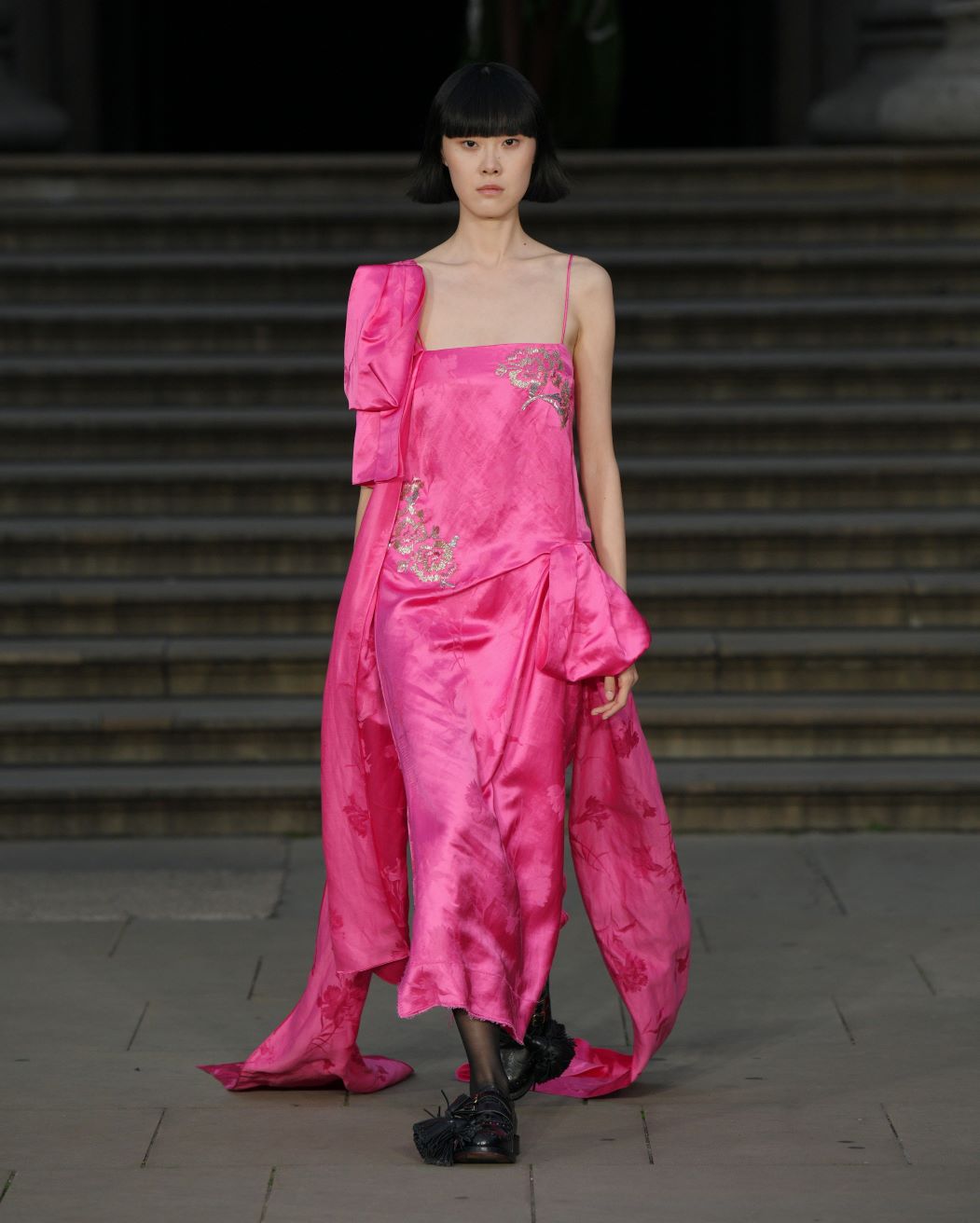
ERDEM Spring Summer 2025 – Photographed by Jason Lloyd Evans – Look 29
Slip dress with draped bow detail in coral linen jacquered satin with carnation buillion embelishment.

ERDEM Spring Summer 2025 – Photographed by Jason Lloyd Evans – Look 19
Mid-length dress with hand draped bodice and exploded dropped waist volume in ditsy flower printed raw linen.
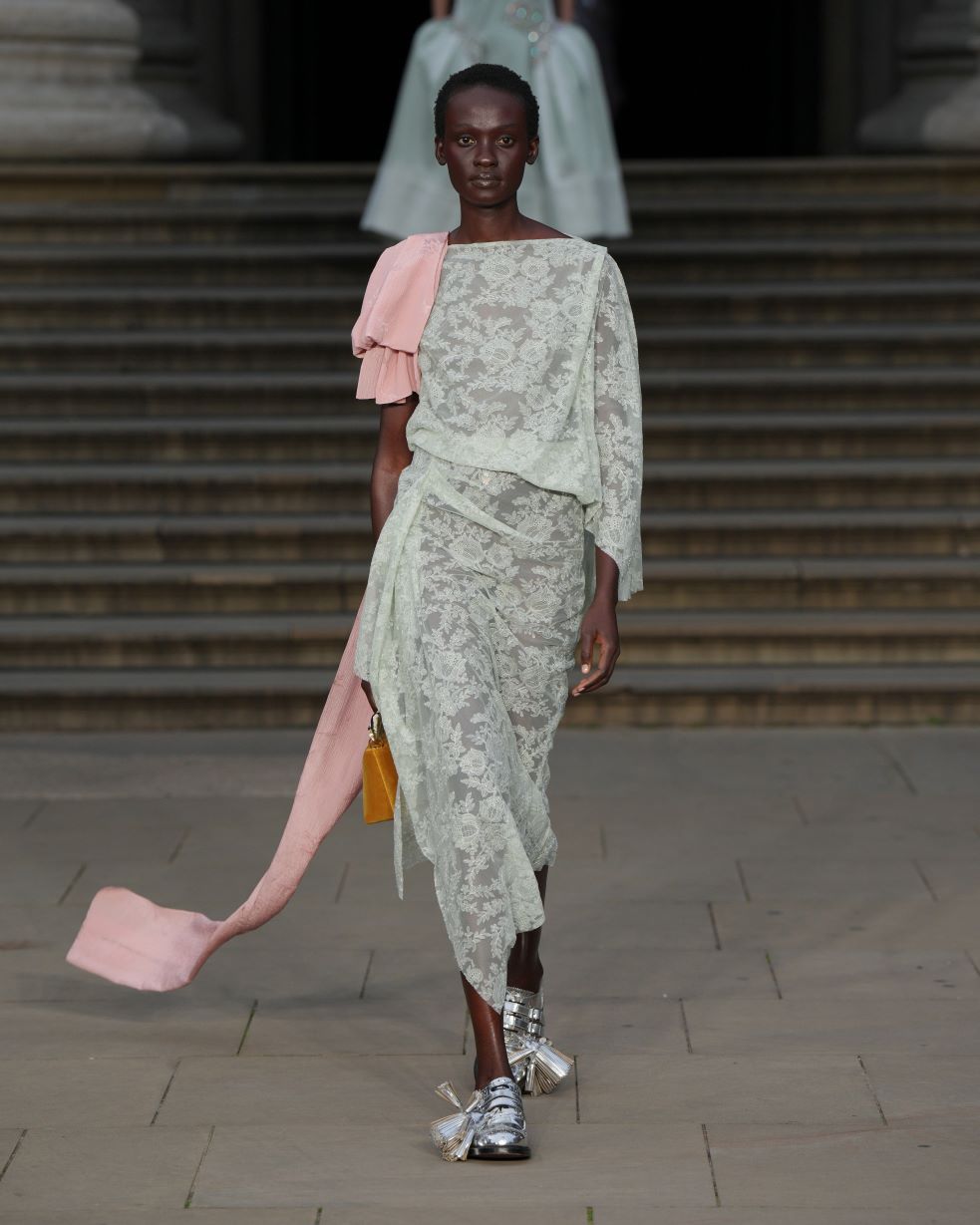
ERDEM Spring Summer 2025 – Photographed by Jason Lloyd Evans – Look 8
Sheer draped mid-length dress in spearmint embroidered lace tulle with bow drape in dusty rose silk. Styled with mini Bloom Bag in saffron velvet.

ERDEM Spring Summer 2025 – Photographed by Jason Lloyd Evans – Look 38
Skeletal cocktail dress with exploded skirt volume in green embroidered lace.

ERDEM Spring Summer 2025 – Photographed by Jason Lloyd Evans – Look 45
Tuxedo jacketin black grain de poudre with elongated scarf lapel with broken pieced crystal embroidery. Worn with ivory satin shirt with bow drape and black satin cami shorts.
“You can’t help but look backwards when you’re about to turn 20, but it also feels like the beginning.”
Erdem Moralioglu, do you have a good number of faithful Erdem followers?
I have clients where we make bespoke things. What people might not know is that most of my private clients come for things like tailoring or very specific dresses or trousers, and things that I make every season where I create a little wardrobe of things that they need. Often there are, of course, lots of special things like wedding dresses and dresses for special important events, but a lot of things are for every day.
What about the shoes and the bags in the show?
The shoes were all handmade in England with strange tassels. To me they were Radclyffe, so you had the men’s shoe even with the most delicate little 20s slip dress. I’ve never done a bag before so it was a special show.
Do you like designing accessories?
Very much. Because it’s her world. It’s like when Philip was designing the space for the store, he was figuring out what’s the carpet that she would stand on? How would the changing room feel? How would her closet feel at her house? How would her apartment feel, how would her home feel? Who is she? Those forensic questions like what’s the bag that she would hold? How would she hold it? Does she hold it like this, does she hold it under her arm? Is she shy? Confident? What is she? She’s so many different things.
Nowadays some say that luxury brands are over, that the famous names are too expensive. You also have had the very different experience of working with H&M, but do you think there is a move ahead to go back to the smaller atelier?
Within the fashion industry, like any industry, it evolves. It is different to when I started. It will be different in 10 years and in 20 years. When I started you didn’t even have online shopping, it didn’t exist. People evolve and adapt. Size and how big these groups are is an ongoing conversation. Going to the collaboration with H&M, I did that in 2017, a very long time ago and it was very interesting creating something that many people could access. Suddenly you were available in 70 countries around the world. Opportunities to be able to show what you do to so many different people are rare. When you’re a guest designer, you do it for one season.
Would like to do other seasons in that kind of world with for example Uniqlo or Zara?
It’s interesting when you’re given an opportunity to move outside of your comfort zone. I collaborated with the Royal Ballet a few years ago, designing costumes for a new piece called Corybantic Games with the choreographer Christopher Wheeldon. That was very much coming out of my comfort zone, working with the choreographer who was creating the piece as I was designing the costumes. The brief was: I don’t want colour, I don’t want any texture or anything. He really wanted to strip everything away. To get into his head and to figure out how to create these costumes was such an interesting process. It was for the Leonard Bernstein centenary, and the music was written in the 1950s. The Corybantics were a group of young Greek youths, and so I started to look at Grecian athletic strapping that often featured on Grecian statues and also 1950s underwear, corsets, girdles, Y-fronts, men’s costumes, women’s costumes, looking at undergarments from the 1950s, which are quite specific, and mixing the two. I loved to work at the Opera House and to have the opportunity to design something that’s actually being created at the same time as it’s being designed.
Do you now also have a line of men’s clothes?
I started a very small men’s collection, which I have paused because we did it during Covid and it was a Covid casualty, sadly. I would like to revisit men’s wear and do it properly when I’m ready.
Were people more elegant in the past?
People are elegant in a different way now than they are in the past, but I think it’s hard to compete with the 1930s when people truly looked so beautifully elegant. I also think there’s something about the idea of dressing, when people dressed for dinner, but those codes can be quite oppressive. Elegance is something also that’s in how someone moves, how they talk, how they look. You really do notice when someone’s elegant.
How did your parents react when you first told them you were going to be a fashion designer?
I had to announce it to my father because I was studying liberal arts and classics before I decided to go into fashion. When I first told him he reacted in a very positive way. He was from eastern Turkey, Antakya, where you’d have someone who would make shoes, someone who would make suits, you’d go to the shirt person for your shirts. It was a vocation and a skill, and he found it quite exciting, whereas my mother associated that more with all the negative notions of it’s a very difficult industry.
Do you face new challenges?
Every collection is a challenge. Figuring out what’s going to happen to her next is the biggest challenge. Another challenge which I’m very excited about is how you can enter the world physically when you enter the store. The idea of having more spaces around the world where you can enter the world and understand the world is very important and to have your own connection to the client.
Other people are Armani, Prada, Chanel and so forth and you are Erdem. You’re like Coco, Giorgio, Miuccia, known as your own label. Isn’t this quite special?
It’s wonderful. 2026 will be my 20-year anniversary since I made that first collection that I sold to Barneys. That’s how I really and truly began, and it wasn’t overnight at all, it really took a very long time to get to. I was very fortunate to work with Barneys and suddenly I was in a very important store in New York and Beverly Hills. From there, even though I was working in a very small studio in East London, people could see my clothes, and from there it grew little by little. You can’t help but look backwards when you’re about to turn 20, but it also feels like the beginning. I don’t feel like it’s 20 years at all. I feel like it’s five minutes.
Can we conclude by saying that you followed your dream and you made your dream become a reality?
Completely. Sometimes it actually comes true. It’s very strange.
Erdem Moralioglu, thank you.
Thank you.
Lead image of Erdem by Tom Mannion.
ENJOY THIS INTERVIEW? SHARE IT WITH A FRIEND.