
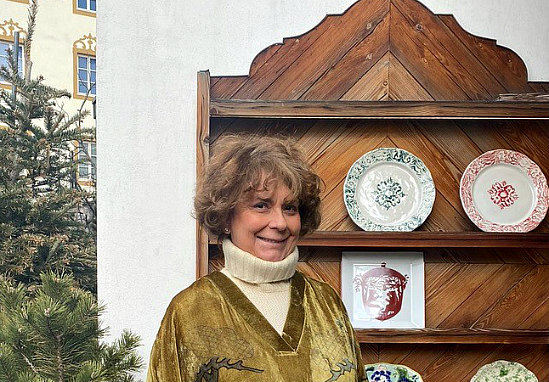
BEAUTIFULLY TRANSFORMING WALLS AND ROOMS. Idarica Gazzoni Frascara’s hometown is Bologna, Italy. After she studied with Van Der Kelen in his painting school in Brussels, Belgium, and learned the technique of faux bois and marbleizing she became a passionate artist, painting rooms and walls and ceilings in Italy and many other countries. In 2009 she founded Arjumand’s World and opened her first showroom for fabrics and wallpapers in Milano.
You can listen to the podcast of this interview here.
Idarica Gazzoni, where does your artistic passion come from?
Directly from Italian frescoes that I lived and grew up with in Bologna – a town that is very much decorated on walls and ceilings. We lived in a big house ground floor and our decorated ceilings influenced me. My mother was passionate about all the decorative painters in Bologna when Napoleon invaded this area during the Cispadane Republic. The influential Bolognese people, including the Pope, wanted to show off and they all decorated their houses immensely. That really pushed me into loving decorated walls.
What did you do at first?
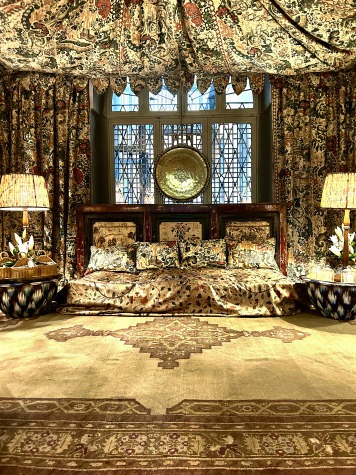
When I came out of painting school, I tried to do what they taught me, fake marbles and fake woods, like everybody. Then I really wanted to do flowers, leaves and panoramas, so I did those for a while and then five years later I copied a watercolour sketch by Antonio Basoli that I found here in Bologna in the Pinacoteca. He made it as a sketch for a wall decoration that was the military camp of a general – a huge tent from where, with the curtains up, you could see the battlefield with the weapons and all of that, but in a very romantic way. That was a great challenge.
“I fell in love with Arjumand because she was quite extraordinary and had all the details I was looking for.”

Idarica Gazzoni, did you decorate many houses around Italy?
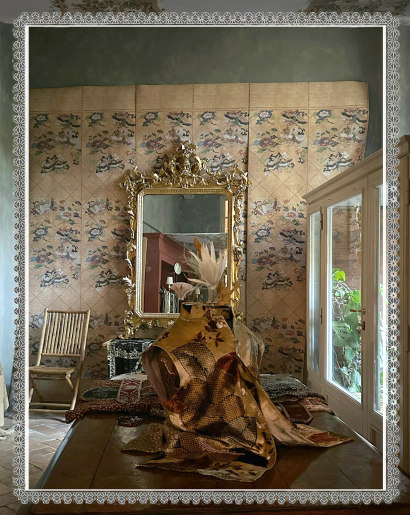
Many houses in Milano, many around Italy, also in London. I became passionate about faux tissues – fake fabrics – so I painted the walls as if they had texture, and that gave me immense joy. Because of that, when I stopped painting because I became too old I fell into fabrics and wallpaper.
Is it the case that in Italy they don’t use oil paints to decorate walls?
Exactly. At school in Belgium we were taught with oil painting, which is divine because you can really make layers, but in Italy everybody paints with water medium and so I had to learn how to paint with water on the walls. At the beginning it was a disaster, but then I sorted it out.
Arjumand is the name of a Mughal Empress of India for whom her husband built the famous Taj Mahal. Why did you give the name Arjumand’s World to the company you founded in 2009?
I was looking for a fil rouge, because when I was a decorative painter I could vary my styles to follow clients’ desires, but when you make your own brand you have to follow a path, you cannot go left and right. My inspiration was Asiatic: Ottoman, Persian, Mughal, so I asked a good old friend of mine, saying “I need to know a very important, glorious lady that I could fall in love with and be inspired by.” And she told me, very quickly, “Arjumand.” I said, “Who’s Arjumand?” She explained everything and I fell in love with Arjumand because she was quite extraordinary and had all the details I was looking for. She was beautiful – even if I wasn’t beautiful. She was the best wife of her husband – and I just got separated. She talked to elephants and went on battlefields with her husband – and I never did that in my life. I was really attracted to her. She was a Persian originally, married to the Mughal Shah Jahan, and so she could envelope all my decorative inspirations, and she would have liked them also. In my mind I made her travel from Agra to Tibet, then to China and Japan, then she came to Europe and Venice, always finding things that she could recognize as being her culture.
Istanbul is the Gateway to the East. Did your love of the Orient start in Turkey?
I went to Turkey with my parents when I was little, and I fell in love. It’s a beautiful place. All my youth we also had a house on Patmos, in the Dodecanese Islands, which was occupied by the Ottomans for centuries. All the beautiful clothes of the Sultans that I found in the Topkapı Palace fascinated me, they were so beautiful. Symbols were important in those centuries, because without medicines everybody was very insecure about the future and wars and invasions, so the Sultan had his beautiful outfits made of silk and covered with symbolic designs that could protect him – like the chintamani, a very antique Asiatic symbol that keeps the evil eye away from you. I got into this Asiatic symbolism.
Today, do your textiles differ according to the taste of each client?
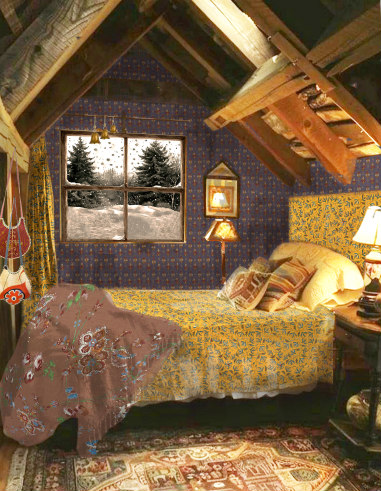
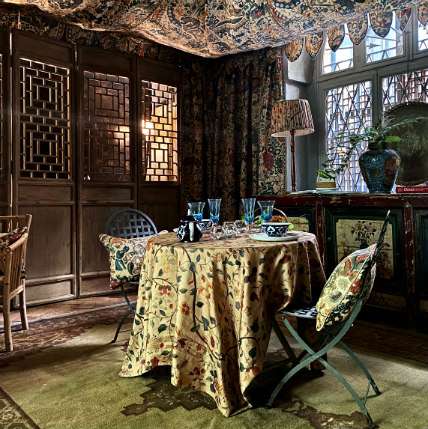
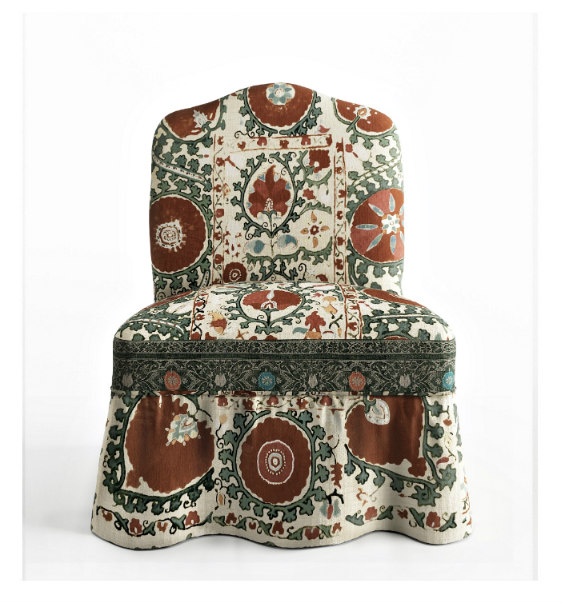
At the beginning I wanted to offer the dream of going to a market where you can find an antique piece of fabric and you can buy it, but normally it’s only a meter and a bit broken. Now you can buy ten meters from me, thinking that it’s that antique piece of fabric. All my fabrics are designed as just a little bit broken. That is what I also did on the walls, because I don’t like complete preciseness. Some little mistakes must be everywhere, because we make mistakes in life and it’s human. I wanted to offer people many meters of a beautiful fabric design, and I wanted to offer scenographic wallpapers. A painted room, four walls, makes you dream – the boundary of white walls doesn’t exist anymore. You feel like you are in a box with no boundaries and that you can be everywhere; but you are there.
Why do you use red in a lot of your work?
I have a lot of reds and it must be instinctive character, blood. I’m a very passionate lady! But I also have a lot of light blues that I love, and the light blues accord very well with the reds and actually pale greens also, because they’re complementary colours and they help each other to slow down the red and enhance the light blue. If you look at interior decorators like the Sozzanis, they always have red, light blue, light green, a little bit of yellow and a kind of sand colour. This was the normal palette.
You’re not an interior decorator but you have a precise idea of what a house or an apartment should look like and seem to like vast atmospheres, either 100% full or empty?
Crowded houses – one room after the other one, full of things, full of crowdy objects, paintings, etc. – can be a bit overwhelming. For me, living in a horrible house is something impossible. It makes me really suffer. Many people from my family walk into hotels and have to make it pretty immediately – even moving furniture, putting their pictures inside, flowers – so it’s a family story. The rhythm in between the empty and full for me is that you can make a lovely sitting room full of things and then it needs to be connected to another “full” room through an emptier space where you can clean your eyes and then be ready again to be transported into another space that you can enjoy.
“All the rules have changed.”
Idarica Gazzoni, together with your friend Maria Ousseimi, you fashioned a restaurant called Liza in Beirut?
We did Liza 10 or 12 years ago, and if somebody goes to Beirut, please go and have lunch or dinner there because it’s in a divine Ottoman antique house with super big spaces, lovely windows and extremely well decorated by Maria Ousseimi, with my help only for the walls and for the wallpapers that we invented.
What sort of wallpapers?
One room was made with huge banana leaves and all the rest is made with antique floor tiles that we put on the walls so that the envelope was as clean as possible to receive all the furniture and all the food and all the beautiful items that they have in Lebanon anyway. One room was called The Money Room, because Lebanese are merchants and love money, so we took old pieces of paper money from the 50s and enlarged them hugely. Those became decorative, looking like an 18th century French landscape.
You put images from Lebanese money on the walls?
Yes, we made it gigantic and it seemed like a papier peint decoratif. In the 50s, they had all the beautiful places, like Baalbek, on paper money. They were very finely decorated on the paper money, and so it was easy to scan and enlarge – it looked beautiful and it still looks beautiful. We did another lovely room that was made as a reminder for all the wars in Beirut, because that is very much in their mind since the Civil War many years ago, and so we did all these broken skyscrapers made with clay. That’s also a very imaginative room, worth going to see.
Does your work fit into today’s more minimalist world and younger clients?
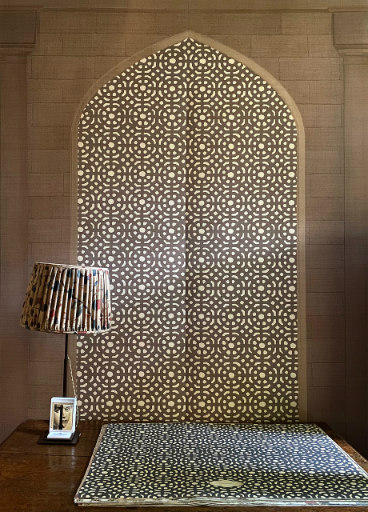
Yes, strangely enough. I was quite isolated – like a forbidden mosque- when I started, because I always liked decorations and so in Milan I was always a bit different because design was very fashionable – and it’s still very fashionable – and it’s the town of design in Italy, but I couldn’t follow it myself and I went on and on. Then finally, in the last years, all the world has become much more minimalistic. It needs to be like that, because the world has become simpler and there are less people that help you in the house. All the rules have changed. Everybody spends his entire life only working outside the house and not even eating in the house anymore. My idea of the decor that goes on the walls, with wallpapers – or fabrics that can be tensed on the walls – you can fill beautifully a room with wallpaper that can be crowded, decorative and make you feel cozy in a place – and you can put a modern sofa, two lamps, one mirror, and you’re done. It’s OK.
Can one put paintings on the walls with your decorative papers or fabrics?
Paintings don’t fit very well because they clash. You need to be very accurate to put them together. Maybe a Fontana would go beautifully in front of a Chinese 18th century wallpaper because it’s so clean. It depends. If you have the taste, you can try to do it. The colours are very important. You need to look at the nuances, the colour scheme, and if you’re accurate everything can be really mixed.
Why do you prefer dahlias out of all the flowers that exist in the world?
I have no idea why I like dahlias, because I never had them in the garden and never saw them really. I love the shape. I find them very pretty, very neat and beautiful little petals, one like the other one, very well displayed and a bit round and puffy. Maybe, like me! (laughs).
Do you put dahlias in your own houses?
No, I don’t really use my things because I’m overwhelmed by the creativity. Very shyly I do now use some things in my houses, but I’m afraid that I will get bored. It’s very different to design it from the beginning, knowing each little spot and thinking of each little thing for a couple of days – even 3 or 4 days it takes to make a proper design – and then find it also on your own walls. That can become a bit tiring. Instead, if you receive it, you can have all the time you want to look into it and to enjoy it.
You put wallpaper in a new club in Milan called The Wilde?
Yes. I admire Fabrizio Casiraghi very much as a super talented interior decorator. He was buying some fabrics of ours, but I had no idea they went into this club and when it came out I was so proud that the fabrics were in the trendiest place in Milano. It’s a closed club made by Fabrizio Casiraghi as if it was in the 40s and he combined the woods, the atmospheres, the furniture, and mixed fabrics, objects, metals, in such a way that I really admired.
Why is Tancredi di Carcaci an artist you admire?
I love Tancredi’s work because it’s precise. He started with these madonnas, kind of a big woman, like fertility symbols of the first woman on earth that he made with clay. Then he decorated all the dress of this goddess with decorative motifs, using dots and using a little knife into the ceramic. I found him admirable because he was 22 and a special young man to make a decorated goddess with clay that was 40cm high.
Is he recognised?
Now he makes exhibitions and from time to time he sends me what he does, in London. He told me I must go and see him, but I never really went. I think he’s going to become a special artist, yes.
© Idarica Gazzoni – Arjumand’s World
© Idarica Gazzoni – Arjumand’s World
© Idarica Gazzoni – Arjumand’s World
© Idarica Gazzoni – Arjumand’s World
© Idarica Gazzoni – Arjumand’s World
© Idarica Gazzoni – Arjumand’s World
“Being so small I cannot be like Zara Home, unfortunately!”
Idarica Gazzoni, which is your favourite city in Italy?
Probably Palermo, the very southern city in Italy that has many influences from the Arab world. It connects to the idea that I like Oriental architecture. It’s very interesting that in Sicilian dialect they still have Arabic words that come from an Arabic root to say things, so it has that move that takes you away from Central Europe.
This is very much like in Andalusia in Spain?
Yes, we have many Spanish customers because they appreciate decoration as much as we do. I like the movie director Almodóvar. The wallpaper that he always used in his movies is colourful and very cozy. I didn’t work with Almodóvar, but if you remember Almodóvar’s movies in the 90s, they always had these beautiful, very colourful wallpapers in the background. Spain is a place where they like the things I liked the most from the Oriental world towards Turkey.
Your family has a house in the island of Patmos which is very close to Turkey. Is it true that you like to receive and give presents of stones from Patmos?
Stones are beautiful when they’re used to make floors in Patmos or in Lindos also. We used to collect stones with my kids when they were little and paint them at the house. Probably we all have stones to keep the doors open in the house. I like stones as a shape, and I received a heart stone from my son one day and made it into a paperweight made of glass in Murano.
How do your clients work with you?
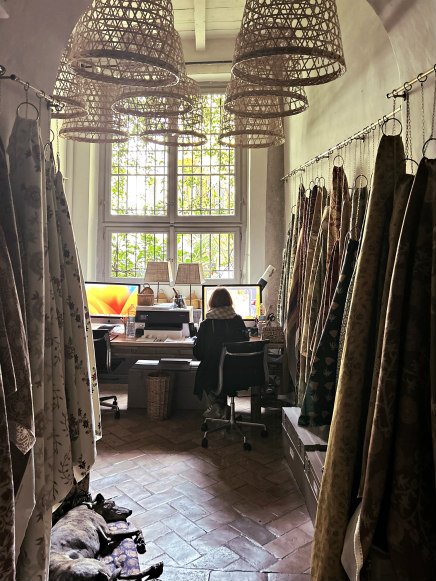
We work directly with interior decorators or with whoever has the imagination to accept something and to order it. When I started in 2009, globalisation was already completely there. I started going to Maison et Objet fair in Paris, and I found clients there, interior decorators and so on. I decided not to be represented by showrooms in general because I found that with the internet and the websites, it can get very confusing. It’s very difficult to give exclusivity to an agent or to a seller if you are on the web, so I decided to work directly with people with email and they can ask us for sample cuttings. We can ship everywhere. They can send us all the details, all the questions, all the images, and we can work on the images and make renders – easy renders not perfect renders – so that the client can imagine what it becomes. We work also on photographs of the room, and I must say the result is very similar to what it becomes at the end.
When you live in Bologna your hometown, why is Arjumand’s World in Milano?
The Arjumand showroom was born there in Milano and is still there. I go there every two weeks. My assistant goes the other week, so we are always in touch, and that place is quite well-known now. It was just that I wanted to live in a less crowded town, near to my family and to prepare my third age. Now we are opening another showroom here in Bologna.
Who manufactures your wallpaper or your textiles?
All the designs are made digitally because I learned to use the computer in the early 2000s because that helped me with the projects for my wall decorations. I know how to deal with Photoshop and all that, and I use it in my way. I design everything, and then the fabrics are printed in Italy near Como, in the best factories that also produce textiles for clothes. Some wallpapers are printed in France, and some others made in San Patrignano, where we started this joint venture with the lovely people of San Patrignano. That community near Rimini is quite famous in Italy to help people to get out of drugs and was created by the family Moratti. I really love doing this with them. They have a huge laboratory. They are very friendly. They work very well. They have beautiful machines to print. They can also hand paint on top of the print. The idea that I give my little contribution to them makes me feel happy, and they make me feel even happier because they are very nice and human people. Many come from Romania so – maybe foreigners don’t know, but people from Romania are fascinating and adorable and very creative and have good mood. They make jokes, and so it’s fun to be with them.
In which countries are you most well-known?
The big love affair is with the UK and the US. My oriental tastes suit the Anglo-Saxons. The countries where I sell the most are America, England, France, Spain, Switzerland and some Arabic countries, Lebanon. No Germany, strangely enough. And of course Italy, but I export more than what I sell in Italy.
Is it true that a place in London that inspired you a lot and that you love is the Victoria and Albert Museum?
Yes, immensely. Every time there’s a surprise. I’m amazed how a country like England could have offered to their citizens to be able to touch and see from so much time to all the population, all those beauties collected with such patience and from all the world. It’s really incredible. It’s a great gift that Victoria and Albert did.
Are you influenced by anything Italian?
Yes, Venice, the place where all the Oriental habits arrived and all the fabrics. If you think about Fortuny and Bevilacqua, the spirit of all the fabrics in Venice was given by Byzantium and the Ottoman world. Venice is a fascinating town that I feel very attracted to.
You are an artisan with sophisticated clients so I imagine you’re quite expensive?
Being so small I cannot be like Zara Home, unfortunately! I admire Zara Home, and I find them geniuses, but to lower your prices you need to produce a lot, and I’m not able to do that. Being small, I am, of course, a bit expensive.
Do you work with de Gournay in London?
No, but de Gournay has been one of my idols at the beginning of my career because when I was a decorative painter aged 25 he was already there in the King’s Road or Pimlico, and he was my idol because he was the first one that started doing all the chinoiserie. I don’t have chinoiserie. It is really his, because I respect everybody’s job. I don’t want to do the same as they do – also because their quality is super, because they hand paint on silk. I could never reach that kind of level of preciseness and richness. They are much more expensive than me.
Thank you very much for this nice interview. We wish you very all the best for this third period of your life, which I’m sure will be very successful.
ENJOY THIS INTERVIEW? SHARE IT WITH A FRIEND.


