

WRITING NEW CHAPTERS. Kamel Mennour is an Algerian-born French art dealer. In 1999 he founded Galerie Kamel Mennour in Paris. Today Mennour is a contemporary art gallery representing over forty artists with four exhibition locations in Paris.
You can listen to the podcast of this interview here.
Kamel Mennour, born in 1965, you sold prints and minor works before opening your first space in rue Mazarine in Paris in 1999 selling photography?
Yes, the art territory was totally new for me. I did a Master of Economics, so I had to learn and while I was selling very commercial prints and small paintings I was reading a lot, including photography books. I thought that showing photography in Paris could be very pertinent, and I was lucky because at that time there was a photography boom in Paris, and it was just before the Paris Photo fair. We were doing monograph exhibitions showing artists like Annie Leibovitz, Peter Beard, Stephen Shore, Araki, Daidō Moriyama, Roger Ballen, Martin Parr. Many of those were not shown in Paris at the time. I was the first and I was lucky to have this opportunity.
Photography became very important in France, with major events in Arles?
I was a very close friend of Lucien Clergue, who introduced me to some of the most important photographers at the time. Before Maja Hoffmann and LUMA, Arles was dedicated to vintage photography, so there were incredible shows that I could see there. Garry Winogrand or Lee Miller, many interesting American photographers that I could discover there in this moment of synergy between Arles and Paris.
“I was part of the art scene which was offering a very stimulating position for Paris as a big place on the world map for art.”

Ugo Rondinone: vierterdezemberzweitausendundneunzehn, 2019. Cadre de l’artiste, plaque plexiglass avec légende / Artist frame, plexiglass plaque with caption.
Aquarelle sur toile / Watercolour on canvas. 200 x 300 cm (78,74 x 118,11 in.) ©Ugo Rondinone. Photos ©Jean-François Jaussaud / Lux Productions. Courtesy the artist and Mennour, Paris.
Kamel Mennour, in 2003 you decided to diversify your activity beyond photography with contemporary artists, among them, Daniel Buren, Huang Yong Ping, François Morellet and others?
That’s right, I felt lucky because Buren, Morellet and others were already famous and that was a great catch. I also worked with new emerging young artists like Camille Henrot, Petrit Halilaj, Mohamed Bourouissa or Alicja Kwade. When I got into the contemporary art territory I went to find very young unknown artists and I accompanied them to Biennales, exhibitions in museums, bringing them to fairs like Art Basel. That time in 2005/6/7 was the beginning of a new era for the gallery.
In 2007 you bought a 400 square metre hotel particulier in rue Saint-André-des-Arts and inaugurated this with a Daniel Buren show?
Yes, Buren was extremely well-known and this hotel particulier offered the artists that I was interested in like Buren or Anish Kapoor a space to express themselves. It was the way to expand and to progress and to welcome bigger and bigger artists.
In 2013 and 2020, you opened yet another two spaces at 5 et 6 rue du Pont de Lodi, giving you four different locations in Paris?
My competitors at the time – like Gagosian, Zwirner, Lisson, Hauser & Wirth, Pace – were very strong, so I had to offer my artists other ways to express themselves and write new chapters. When you are dancing with the same music, in the end you get bored, so you want to have other music. Getting other spaces was a way to offer new spaces to the artists, and it was also a way to expand.
Anish Kapoor and Daniel Buren as well as Pier Paolo Calzolari, Philippe Parreno, Ugo Rondinone and many others came into your family?
It was exactly that, a family. I wanted to welcome a kind of DNA of artists who could understand what we wanted to express, crossing young emerging artists and established artists. Most of the very interesting young artists came to us, and also some of the most established, like you were referring to: Philippe Parreno or Rondinone, Lee Ufan, Tadashi Kawamata, Huang Yong Ping. Many came to us because they saw that we were one of the interesting artists’ galleries in Paris. At the time Paris was totally forgotten, but from 2012/13/14 Paris got very sexy and exciting. The FIAC fair was booming. There were new foundations in Paris: Bourse de Commerce – Pinault Collection, Fondation Louis Vuitton, Lafayette Anticipations. Art Basel also. I was part of the art scene which was offering a very stimulating position for Paris as a big place on the world map for art.
The centre of the art world had moved from Paris to New York, especially after 1964 when Rauschenberg won the Venice Biennale, and London took over in Europe with gallerists such as Anthony d’Offay?
Yes, d’Offay was someone that I was really following because he was extremely important. He offered his collection to the Tate and was a model for me. Paris was totally collapsing after ‘64 with Rauschenberg winning the Golden Lion in Venice, and I was asking myself why Paris could collapse so fast and definitely. With some of my competitors in Paris I worked to try to re-establish its pre-eminent position. With Emmanuel Perrotin, Thaddaeus Ropac and others we worked very hard to bring Paris back on the map. Now Paris is extremely desirable for collectors, museums and foundations.
“The work has to have something very particular that I can become obsessed with.”
Kamel Mennour, when new galleries open do they need to understand the spirit of the time?
Yes, it’s the zeitgeist. When I couldn’t understand why Paris, which was so pre-eminent and so important – welcoming the most important artists from all over the world – collapsed totally, I was thinking in a sociological way. It was a goal for me, because I was born and raised in Paris and I love my city, and I’m extremely happy now to see the vibrant moment the city is experiencing in art and other businesses.
Previously the art world moved between Paris, New York and London, but now there is Korea, Hong Kong, Mexico, LA, Miami and many other places around the world?
There’s globalisation, and I am part of that because I participate in those fairs all over the world. Hong Kong – I’m there. Seoul – I’m there. Miami – I’m there. New York – I am there. Now there are collectors, museums and foundations all over the world. In the middle of the last century everything was in Europe, and now there’s different spots but Paris came back as a cardinal place.
Is there more digitalisation in the business since the pandemic, and fewer fairs?
There was definitely an acceleration to work in an immaterial way. Initiated during the pandemic lockdown, our online viewing room (OVR) has introduced a new, dynamic layer to our exhibition program. This platform showcases a series of digital exhibitions which enhance the physical ones held in the galleries, featuring notable pieces or curated propositions that cannot be accommodated in my white-cube spaces. In the same vein, every year I curate a special exhibition, an artistic walk on the riviera with works displayed in my villa on the Riviera in the South of France, which is accessible only on Instagram. Digitalisation is not a reduction of my activities. It has definitely augmented the number of exhibition projects, the impact and reach of the featured artists, and how we conceive of and communicate about our activities.
This is a very different experience from the physical gallery, seeing beautiful images but not the real thing?
Physicality is still extremely important, that’s why fairs have predominance, but virtuality helps people not travel too much. When a client is looking for a work of, for example, Anish Kapoor, I can send them the image and they can say, I like it or I don’t like it, and we can negotiate and speak at length about the work. It’s another way of promoting artworks, but art definitely needs to be felt by people, and to be approached in different ways – with your brain, with your smell, with your eyes. You need to get close to the work.
What makes you decide a completely unknown person will be a good future artist?
When I’m selecting an artist, I have to sense that this artist can be in the DNA of the gallery, even if he or she is not close to some others. The work has to have something very particular that I can become obsessed with. I want to create this joint situation in which you have different characters who I would say – in a slightly pretentious way – are Mennour’s DNA.
Can you explain your DNA?
It’s difficult for me to express this, but some of the most interesting artists who have emerged over the past decade are now with me. Petrit Halilaj, for example, is on the roof of the Metropolitan in New York. Camille Henrot recently had a beautiful show at ICA Milano. Philippe Parreno conceived a genius exhibition at Leeum Museum in Seoul. Those are the young, very contemporary artists, along with some of the very accomplished, pre-eminent artists of the last century and the beginning of the new century: Anish Kapoor, Lee Ufan, Ugo Rondinone, Tadashi Kawamata or Huang Yong Ping. They are not an “ism” like it was in the last century, not a school, but they speak with the same language, inventing a new expression of art. I am very happy and proud to have created a situation in which you have different types of marvelous artists.
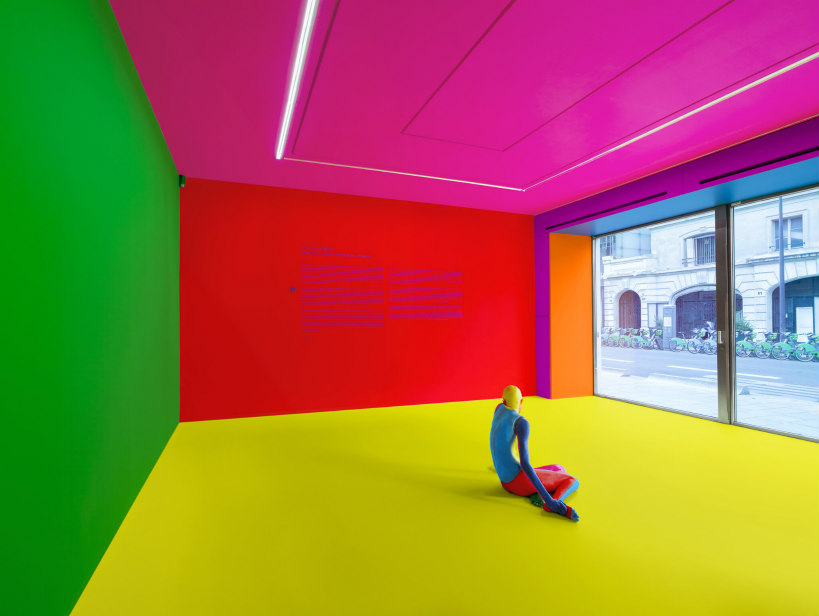
Ugo Rondinone: View of the exhibtion Ugo Rondinone “a rainbow . a nude . bright light . summer”, Mennour (28 avenue Matignon, Paris), 2021.
© Ugo Rondinone. Photo. Archives Mennour. Courtesy the artist and Mennour, Paris.

Daniel Buren: View of the exhibition « Plis contre plan, hauts-reliefs, travaux situés», Mennour (5 & 6 rue du Pont de Lodi, Paris), 2023.
Photo-souvenir ©DB-Adagp, Paris, 2024. Photo. Archives Mennour. Courtesy the artist and Mennour, Paris.

Ugo Rondinone: yellow green nun, 2023. Bronze peint / Painted cast bronze
120 x 38 x 55 cm (47,24 x 14,96 x 21,65 in.) Socle en béton / Concrete pedestal
68 x 43 x 43 cm (26,77 x 16,93 x 16,93 in.)
©Ugo Rondinone. Photos ©Jean-François Jaussaud / Lux Productions. Courtesy the artist and Mennour, Paris.

Lee Ufan: Relatum – L’Arche de Versailles, 2014. Acier inoxydable et 2 pierres. 1113 x 1500 x 300 cm
View of the exhibition “Lee Ufan Versailles”, Château de Versailles, 2014. Photo. Tadzio © Lee Ufan. Courtesy the artist, Mennour, Paris and Pace, New York.

Daniel Buren: Photo-souvenir : Les Nuages colorés, travail in situ, Lazard Frères Headquarter, Paris, France, juillet 2023.
Détail Photo-souvenir ©DB-Adagp, Paris, 2024. Photo. Archives Mennour. Courtesy the artist and Mennour, Paris.

Claire Fontaine: Foreigners Everywhere series, 2004 – Ongoing, Teasing installation view at Mennour, Paris, 2024.
© Studio Claire Fontaine. Courtesy: the artist and Mennour, Paris. Photo: Archives Mennour.
“We are growing a trinity between the artist with his artworks, the gallery, and the collector.”
Kamel Mennour, is all the recent diversification of the art world just a fashion, a moment, or is this what the art world will be from now on?
For some 20 years, the arts have offered us to be citizens of the world. Now that I think about it, I believe this is what struck me when I started. I come from Algeria. I am Algerian, and at the same time I am extremely French. I am diverse. I believe there is a fluidity that is to be accepted in our own identities. Maybe that is why I work a lot with artists from all around the world. Petrit Halilaj is from Kosovo, Mohamed Bourouissa and Zineb Sedira from Algeria, Alfredo Jaar from Chile, Lee Ufan from Korea, Anish Kapoor is a British artist born in Bombay. The title of the current Venice Biennale, Strangers Everywhere, is inspired from the artist Claire Fontaine, whom I work with, and maybe the DNA of the gallery is a little bit about that. There is this beautiful neon installation in the Arsenale saying Strangers Everywhere in Italian, in French, in German, in Korean, in Japan, in Hebrew, in Arabic. The art world is very sensitive to inclusion and taking a different direction now.
You like the idea of creating a diverse family of artists, and you also have a family of five children and the same wife over many years is their mother. In a way is that contrary to the zeitgeist of today?
My family is very important. When my wife and I started after university we were no one, with no money, even if she came from a very aristocratic family in Germany. When I had the luck of building our family, it was very important for me to get this balance between my business and my family. Having my family with me and behind me gave me a lot of strength and helped me a lot.
What are collectors looking for today and are the same people collecting?
No, it is a very big change. When I started, in a vernissage there were only 10, 15, 20 people. Now when we have an opening it’s huge. People travel from different cities to visit some of the shows that we and the other galleries are doing. Most of our collectors are in their 40s. There’s a new distribution of collectors, and we are educating collectors with the artists that we have the opportunity to present. We are growing a trinity between the artist with his artworks, the gallery, and the collector. Of course we have very established artists who are very expensive, but we are still representing a very new generation of artists to offer to this new generation of collectors.
Does the political uncertainty of the world today adversely influence the attitude of the collectors?
Eight or ten years ago I was selling installations and very weird sculptures. Now worried collectors are mostly buying art that is safe and classic. We see that every part of the world has problems. It’s not structural, but it’s conjunctural. I came from economics, so I know the market sometimes is up and sometimes down. I never say it was better before, because you always need to live in line with the future.
Your Mennour Institute is involved in education, philanthropy, and research into 20th and 21st century art history. Do you do a lot of educational work?
Yes, it’s a new chapter of the gallery. I want to be a welcoming territory for knowledge, sharing knowledge through master classes, scholarships, grants, and charities. For ten years I’ve been running a fundraising auction for the benefit of the world’s leading research center for genetic illness. This is part of my being as a citizen. When you can you give back. We hired some interesting and inspiring people. Sylvie Patry was number two at the musée d’Orsay, and Christian Alandete, former artistic director of the Institut Giacometti and Leslie Compan who was director at Brunswick. I brought around me a team of people who are extremely knowledgeable in the history of art, in modernity, and I want to share this knowledge with new people, students, teenagers, schools, researchers. This is part of what we call the gallery, and for 99% of people who come to the gallery, whether to mine or to others, it’s free. So it’s a fantastic opportunity for people to see art and to have knowledge. If I can do it at my position, it’s a gift that I’m giving to myself, because having this in my brain is very positive, and it’s also gifts that I give to people.
Are there new artists that you would like to have in your family?
Many. But if I was a trainer of a football team, I couldn’t let you know if I wanted to sign this player if I didn’t already speak with them and artists need to be seduced, to receive a vision and a framework from the gallery. You need also to show your areas of complicity with museums and foundations. After 25 years, I know the most important museum directors that I can contact directly and keep building a solid relationship with, as an artist needs this assistance, needs to be close to a gallery who has not only commercial positions but also connections with biennales, foundations, it’s helpful for them. I’m saying quite bluntly to the artist: if I were you, I would go with me.
Why should they come with you?
In France I am one of the galleries who is most connected with museums and foundations. One of an artist’s goals is to gain access to monographic shows in institutions. Some of the artists chose us because they know that we are very efficient on that level. It’s not only commerce – it’s certainly money, but it’s also connections. This is also an answer for your question about the gallery’s DNA. We have developed extremely close relations with international museums and foundations. They know that we are serious and efficient, and that we deliver. We just opened Lee Ufan’s beautiful show at the Rijksmuseum in Amsterdam. Every month, every week, we are inaugurating exhibitions of the artists we are working with in museums around the world.
The art scene is once again alive in Paris, but can there be a true renaissance without artists coming to live and work there as they did before?
No, there can’t be. The last two or three decades, Paris was considered a museum city not an art scene because studio rents were extremely expensive and artists go where it’s cheap. That’s why there was the boom in Berlin in the 90s, 2000, 2010. It was very inexpensive. But some artists now are leaving their city to come to Paris. Ugo Rondinone was established in New York and two years ago he bought a lovely studio in Paris. Lee Ufan is in Paris now too. Kapoor comes often to visit me and always tells me he would love to have a studio space here. These are signals. It can’t happen in a day, but we can sense that there’s something coming. I tell the Mayor of Paris and Emmanuel Macron that we need to support this dynamic and assist the artists to come, offer some free spaces, because artists can’t simply come and help bring creation to our city if it’s too expensive. I’m sure that in the upcoming years artists will come more and more. If I was an artist, I would come to Paris in a flash.
Thank you very much for this interview.
Kamel Mennour is President and Founder of the art gallery Mennour and the Mennour Institute, an initiative which develops educational and philanthropic activities. Among them, HEROES for Imagine is a fundraising auction of works for the benefit of Institut Imagine, world’s leading research, care and teaching center for genetic diseases. To date, HEROES for Imagine has raised 22 million €.
The fifth edition will take place in Paris on September 23 2024. Some thirty lots will be auctioned by Christie’s at a dinner hosted by Gad Elmaleh, Master of Ceremonies, and attended by over three hundred guest-donors, with one challenge to meet: to set a new record for sales.
Portrait of Kamel Mennour: Archives Mennour.
ENJOY THIS INTERVIEW? SHARE IT WITH A FRIEND


