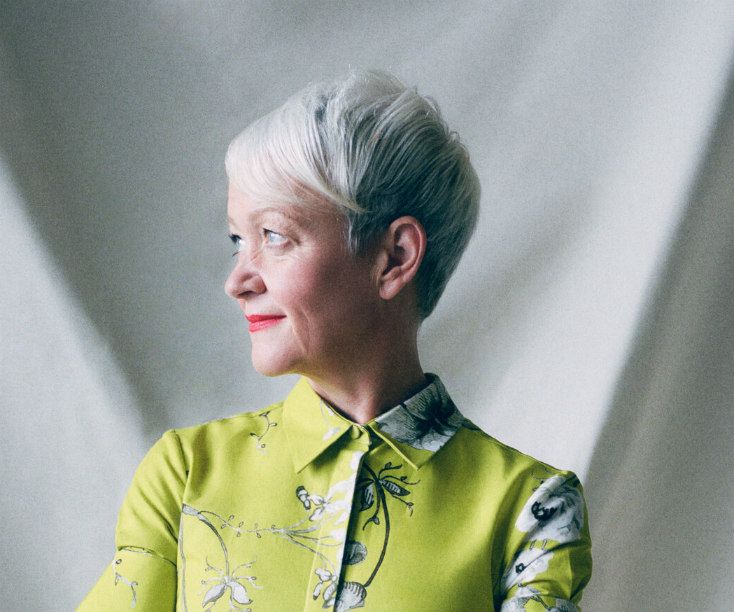
PUSHING THE BOUNDARIES. Maria Balshaw is Director of Tate since June 2017. The author of Gathering of Strangers: Why Museums Matter, published by Tate Publishing in June 2024, previously Maria was Director of the Whitworth, University of Manchester; Director of Manchester City Galleries; and Director of Culture for Manchester City Council. She is the first female director of the Tate, with overall responsibility for Tate’s strategic direction and day-to-day operations, and each of the four Tate galleries has their own site Director who reports in to her.
You can listen to the podcast of this interview here.
Maria Balshaw, when you were growing up in Northampton why was your intellectual curiosity stimulated by a book of Jean-Paul Sartre, The Age of Reason?
It was the cover of the 1980’s Penguin edition with Picasso’s Weeping Woman on the front that really inspired my intellectual ambition. It’s such a striking and powerful painting, and I wanted the book because it had this great cover. I was about 15, so intellectually out of my depth, but it made me curious about Cubist art so I went off to London to see if I could find the painting. When I got to Tate I found what I was looking for, because that painting is in Tate’s collection. In those days there was only one Tate so everything was hung at Millbank.
After completing your academic studies you trained for your future career in Manchester, and in 2006 became head of the Whitworth Art Gallery at the University of Manchester?
Yes, although the training began as I left academia, because in 2002 I went to be Director of Creative Partnerships, a programme which was based in 16 regions of the UK that was created by the last Labour government, after the 1997 election. It was designed to bring artists and arts organisations into schools. It was about embedding art and creativity into the mainstream curriculum in some of the most economically challenged areas of the UK. I had been researching that area as an academic, and I took on the leadership of this programme. That was my first training ground, because it taught me about the challenges that many young people find to connect to the arts, even if they subsequently realise they love it. I also got to realise just how important creative thinking is for the teachers’ development as well as for young people’s development, and I got to see artists making work in really unusual social contexts. I first worked with the artist Anya Gallaccio in a large culturally diverse school in Birmingham called George Dixon, where she worked with them to develop an edible playground project where they were growing food, making art from food, rethinking their whole school curriculum to engage with arts and creativity. They were so inspired by her as an artist being alongside them in school that it made me think much more about museums and visual artists and galleries and what we can do to shape creative futures for young people.
“We’re reshaping what people think about when they describe the art world”
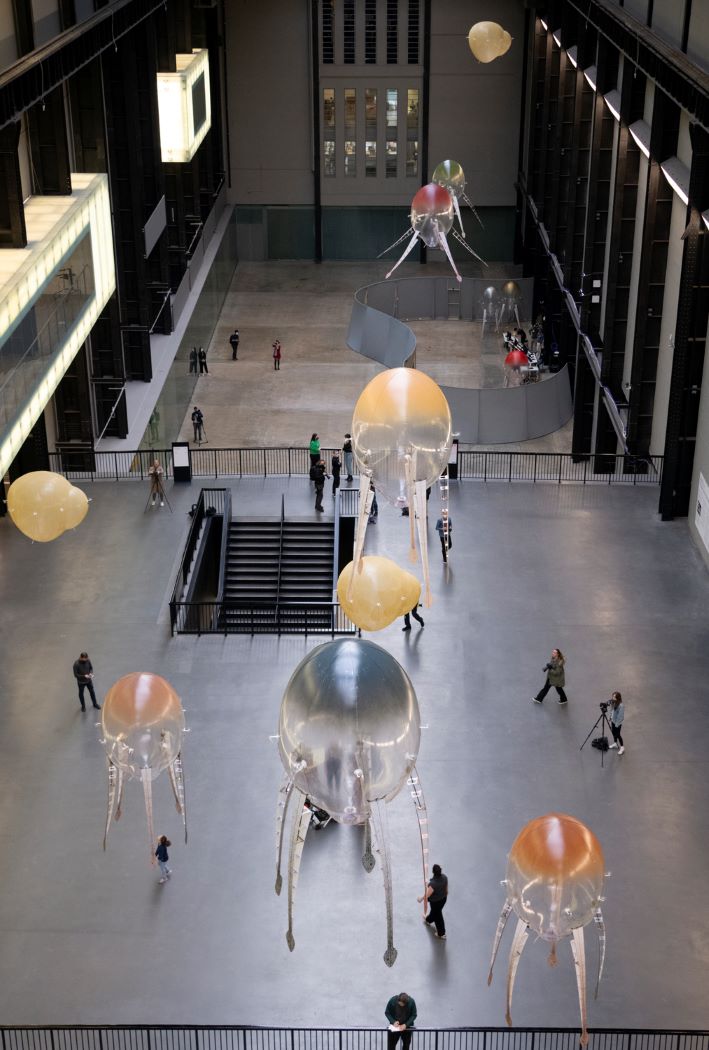
Anicka Yi, In Love With The World, 2021-22
Maria Balshaw, then you were recruited as Director of the Whitworth?
Yes, it is a university art gallery looking after lots of young students and that gave me an amazing training ground to experiment, because universities are also really good sites for experiment. Back then Manchester wasn’t as well-known as it is now for culture, and I got to do some quite risky things without people paying too much attention. It’s nice to be able to experiment a little bit in private before you come in the spotlight, and there were lots of amazing academics and artists who wanted to collaborate in the context of the university art gallery.
Please can you tell us a little more about what you did in Manchester?
I was part of a wider group of creative people who were given permission by the city council and the university to think and work internationally, and bring that work to Manchester. We were all very proud of Manchester, which was the foundation of the Industrial Revolution and had been a massive international trading hub. It was only in the 1970s and 80s that it fell from prominence and importance, and we felt that reigniting all those cultural links would make a huge difference, to not just the city, but the whole of the north of England. In my time there I was able to bring £21 million together to expand the Whitworth Gallery and make a really beautiful extension that connected it to the park that was around it. I got to work on projects with artists like Marina Abramovic, who worked with me over a couple of years to create an 18-day long exhibition that ran for four hours of performance each day. She started by conducting a drill with everybody that came in, so they became part of the experiment in live art. We thought it would be a very niche show, but it sold out every single day that it was on, because people were so keen to see what was unfolding in this live art experiment. Later on we did similar things at Manchester Art Gallery working with Hans Ulrich Obrist, and we made 11 rooms where we had artists like Joan Jonas reperforming old work, and Roman Ondak. We got good at engaging a large public in quite experimental and conceptual work, so they became part of the creative experiment as well.
In 2015 you received the honour of a CBE because of this great work, and when Nicholas Serota resigned in 2017 you took his job as Director of the Tate. Now you had to manage Tate Liverpool, Tate Modern, Tate Britain and Tate St Ives. How do you run this network of four galleries?
Each individual Tate has its own director who is responsible for the artistic programme, and ensuring that the programme at each gallery meets our overall artistic direction and our wish to be an international but also locally relevant museum. I have brilliant colleagues at each of the four sites: Alex Farquharson at Tate Britain, Helen Legg at Tate Liverpool, Ann Barlow at St Ives, Karen Hindsbo at Tate Modern. We work as a group of five leaders in the organisation to ensure that across Tate there’s a common set of principles. We’re about service to the public. We’re based on research and scholarship. We want to be at the cutting edge of new thinking about art, and we’re trying to shape new stories about art. We also all share a common vision around diversifying the audiences that come to public museums, but within that they each have their own distinctive role within Tate.
Are you better able to support and lead them because your earlier career experiences reflect the range of things that happen at Tate?
Yes. At the Whitworth I was responsible for the second most important collection of Turner watercolours after Tate Britain’s. The Whitworth has an amazing collection of Turner’s work, so I was very familiar with historic British art. And the Whitworth has a global textile collection, from the Coptic period to the present day. It also had very strong mid- 20th century British work – like Hepworth, Nicholson and Henry Moore. All of these elements were very useful for my role as Director of Tate. Over my years in Manchester I’ve done a great deal of research around art from both Anglophone and Francophone West Africa, and a long-standing research and set of friendships around South Asia. I brought all of that knowledge to Tate, so I’m able to amplify some of the things we do in those areas. One of the big projects that I led in Manchester was an exhibition of West African contemporary art called We Faced Forward, and through that we commissioned a beautiful 12-metre-long watercolour by Barthélémy Toguo. The Tate African Acquisitions Committee came to see it and they acquired it for Tate’s collection, so when I arrived in London as Director of Tate it was already on show at Tate Modern, a nice welcome to my arrival.
Is the wonderfully diverse and wide-ranging permanent collection of Tate the backbone of the four museums?
Yes, 80% of our visitors come for the “free-to-see” collection that we hold in trust for the public. Those displays absolutely underpin what we do, and when we make large scale exhibitions they very often tend to start with great works from the collection. Tate Britain is well known for its exhibitions of Pre-Raphaelite work because we have such fine things in the collection, but then so does Manchester Art Gallery, and Tate borrows from those regional collections when we make our big exhibitions. We also shape the contemporary scene, so Tate Modern in recent years has become increasingly recognised for the body of works we’re bringing into the collection from across the African continent, Latin America, and the Asia-Pacific area. In recent times we had an amazing exhibition called A World in Common, which drew on photography practice from across the African continent. Zanele Muholi, the eminent South African artist and activist, is on show at Tate Modern until January 2025. We’re reshaping what people think about when they describe the art world, to push the boundaries beyond the North American European axis to encompass the whole globe.
“People come because they want to learn something, and they enjoy doing it because at best our museums are non-didactic learning spaces.”
Maria Balshaw, in your book, Gathering of Strangers, why do you say that the future museum needs to be imperfect?
That’s very important, because at Tate we don’t mean that a permanent collection means a work is permanently on display in the same place. Permanent collection is the collection that we hold forever for the public, but we’re always adding to it, always changing what’s on show. Things go up, they come down. We make new ideas in front of the public. That’s the point of being a museum, that we think these things are important or now we’d like to show you these things. We won’t always get that right, and we won’t please everybody, but it’s also not a fixed position. The good museum is always presenting new ideas to the world. Some of them land, some of them don’t land so well, and we can change and evolve and respond to different conditions.
Because the museum is a work in progress?
Absolutely. For many years museum professionals have liked to pretend that that wasn’t the case, that you could get to the perfect display of everything and that’s it, it’s done. But that lets the dust settle, and no one wants to be in a place that’s dusty and never changing. You don’t want everything to change, but new ideas need to unfold, otherwise we’re not engaging with the public or the art.
Which are your icons, the paintings that people adore and revere?
For Tate Britain the most often cited work is Ophelia, perhaps the most famous of the Pre-Raphaelite paintings. People definitely make journeys to see it specially, and we know that because on rare occasions we loan that work. In the year that I joined, 2017, we lent it to the National Gallery of Australia – Australian museums have very fine Pre-Raphaelite collections, because the British took their taste and their paintings with them, so there were rich holdings there. Australia wanted to bring over some of the most famous works in the world into a once in a lifetime Pre-Raphaelite show, and it was hugely well-received there, but we got complaints at Tate Britain! We had to explain that Ophelia’s not gone away forever and we haven’t hidden it in a store, we’ve just lent it to the other side of the world so they can appreciate it for a little while. As long as we have that conversation with our public, sometimes you can let the treasures go, but sometimes you want to shine a light on them. Next year at Tate Modern we’re focusing attention on Picasso’s Three Dancers, one of the most wonderful works in our collection. It’s almost always on show, but again, occasionally, if for example the Pompidou asked to borrow it, we might lend it to them.
This exchange of important paintings is often done for major exhibitions between great museums all over the world?
Yes, and I talk about this in my book. The coming together of major institutions and pooling resources is a very good use of resources. In the past the Met or the Art Institute of Chicago might have thought, well, we’ll do this exhibition and we’re competing with Tate, or we’re competing with d’Orsay. But when we come together, the benefit is to the public in Chicago and then the public in London or the public in Paris, and it’s 3 or 2 institutions asking one lender if they can release their very important work. When we work in a coordinated way and share the curatorial research the benefit is wider across the globe but you’re minimising the demands on the work and the resources that each organisation needs, and there’s almost no crossover in audience between those who go to see something at the Met and those who come to see something in London, apart from perhaps a few art world travellers.
Despite the global availability of digital images on the internet do people still want to see the real thing?
Yes, absolutely. I don’t think it’s possible to have a museum that is just all images online. That wouldn’t satisfy people’s wish to have that material physical experience of this is the work and I’ve seen it in this place. We try to meet that, but also share and collaborate and allow access more broadly across the globe.
Previously museums were the domain of an elitist few, have they now become a real part of the life of society as a whole?
Museums have learned and have become stronger through deepening engagement with the public. They ask more questions of us. It makes us think harder about how to communicate and share expertise. People come because they want to learn something, and they enjoy doing it because at best our museums are non-didactic learning spaces. We don’t tell people off. If they don’t like a picture, they can go and explore something else. People respect and appreciate the expertise and knowledge that museums hold and can share generously.

Tate Late at Tate Modern.
© Tate Photography
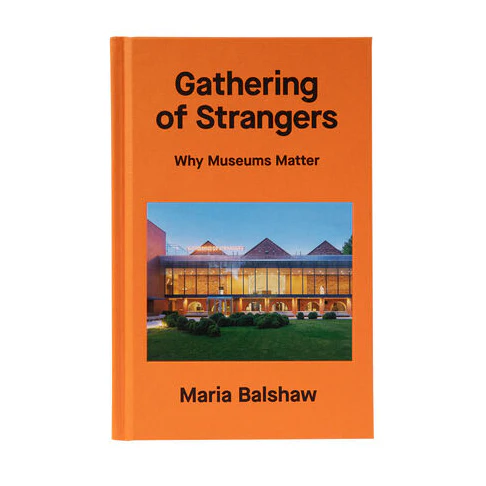
From Tate Publishing comes Gathering of Strangers, a love letter to museums from Maria Balshaw.
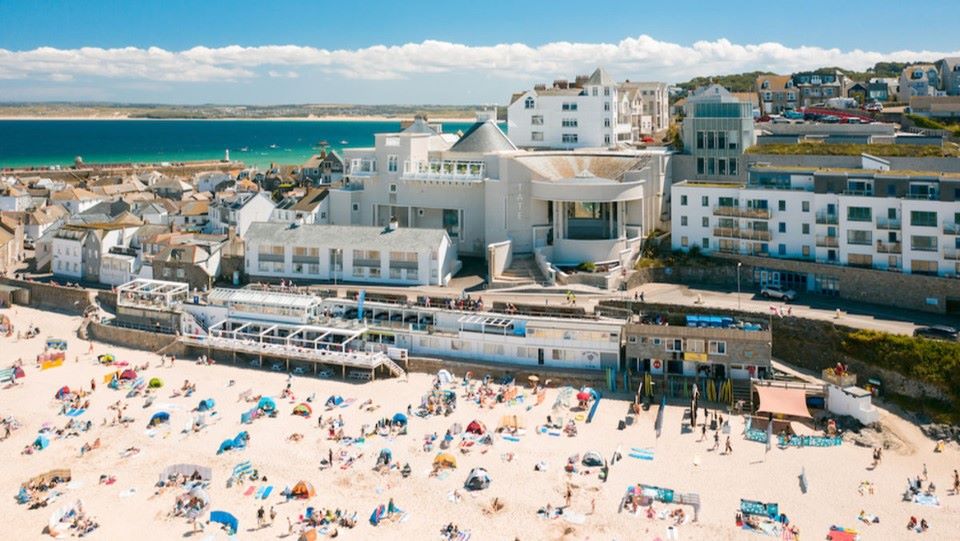
Tate St Ives
© Tate Photography
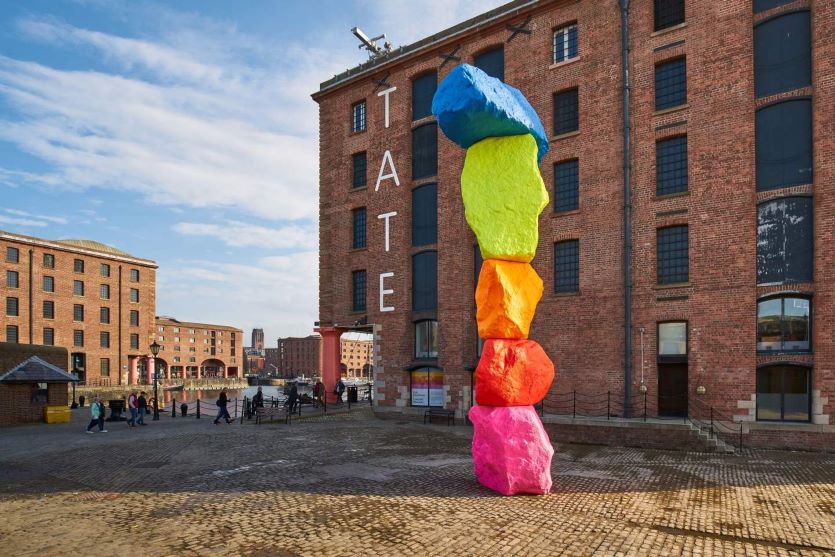
Tate Liverpool. Ugo Rondinone, Liverpool Mountain 2018
© Tate Photography
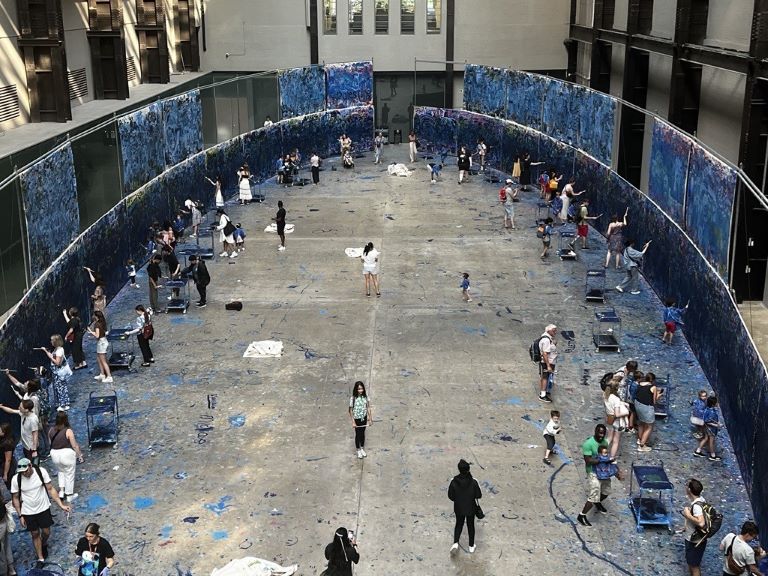
Artist Oscar Murillo has transformed the Turbine Hall at Tate Modern into an enormous painting garden.
Oscar Murillo, The flooded garden, 2024 © Tate Photography

Tate Late at Tate Britain
© Tate Photography
“When people are given the opportunity to bring their own ideas or participate actively, it makes them feel like the gallery is their own.”
Maria Balshaw, while some museums operate within a specialist category, others seek to encompass almost everything. Which is better?
One is not better than the other, they’re just very different experiences. I love the combination of ancient cultures and modern and contemporary art at the Met, but you do get quite tired walking around it and its visitors tend to go to one bit at a time. But, for New York, it is that one and only space where you can see all of those world cultures together. For us at Tate, Tate Britain is not better than Tate Modern or Liverpool or St Ives, they each have their own way of sharing their subject matter with the public. Tate Britain has a fantastic role in telling us the history of the country that we live in and what our nation is all about, because it goes from the Van Dyck right through to the Lydia Ourahmane which came into the collection two years ago, so it does the contemporary as well as the historic. Because Tate Modern covers the whole world it has a lot to deal with. Even though it only really starts about 1890, there are many continents to cover, and if Tate Modern got any bigger people wouldn’t be able to walk around it all in a day. They operate differently, and people have their own preferences. Some people love the formality of Tate Britain, the smaller room after smaller room and the grand architecture. Other people love that slope of the Turbine Hall and coming into the former power station at Tate Modern.
Do different publics attend the various Tate museums?
They’re slightly different, but related. The old stereotype was that the audience for historic art was just older people, but that isn’t true anymore. We have an exhibition at Tate Britain at the moment called Now You See Us, which is women artists from the 1700s through to 1920, and the demographic of visitors that are coming is from the youngest to the oldest. At Tate Modern, the Expressionists show is being enjoyed by a lot of students and older members. In fact, you get more difference depending on times of the day. Younger audiences like to come when we do evenings. It’s part of their social experience and they’re very happy to be in the galleries when there’s lively events on. Some of our older visitors prefer a morning when it’s calmer, and then end with lunch. It depends on what people want to take from the museum.
Do you believe that UK museums should continue to be free to enter?
I do, very much. When I was 16 and first came to Tate, I didn’t have the money and wouldn’t have paid to enter.
How do UK museums keep going?
I’m very pleased that the incoming government in the UK is saying they think that museums are really important for the education of young people, for social well-being and because we demonstrate a kind of soft power all over the world. Tate’s influence can be felt globally. Government support is roughly a third of our funding and it turns the lights on, but we also make a lot of money from selling tickets for the exhibitions (which are subsidised for young people), and selling coffee. We even import our own coffee. We sell very good tote bags and really wonderful artist merchandise and lots of books.
In the United States, besides the National Gallery in Washington, most museums are private. Does it make a big difference?
As wonderful as those American museums are, and they do really great work, they don’t serve as broad a public, because there is an entry fee to cross the threshold. That for many people is a prohibition. They don’t have the obligation, as an English museum does or a German museum does, to really serve a public. We have a government mandate to provide enjoyment and learning for people about art, which is a great mission to have.
In your book you wrote that you like to build relationships with new communities. How do you do it?
By working with artists and the communities that surround us in a spirit of connection and generosity. At Tate Modern now, over the six-week summer holidays where most children are off school and families are looking for things to entertain them, we’re working with Oscar Murillo. He is creating a huge installation work called The Flooded Garden, which invites people to create, to paint over drawings that communities have already made. They will form a vast installation over time. People are invited in, to participate and create under the guidance and inspiration of an artist to create an artwork that’s then for everybody, and it will reflect all the nationalities that live in and are visiting London. That project has been developed by our learning team and by our curatorial teams, to connect to the families that live on our doorstep who might walk to the Tate. By giving them artist quality acrylic paint, wonderful brushes and amazing canvas to work on, we ask them to be part of the art creation process, which gives agency and power to communities.
And in St Ives?
Over the last few months my colleagues have spent many days inviting people into the gallery to tell the stories of their memories of Barbara Hepworth’s studio in St Ives, because we’re redeveloping her studio space. Barbara occupied it and made sculpture in there, but it was also the dance hall for the town, so there are these amazing community stories about grandparents meeting for the first time and falling in love and getting married, or people having christenings there, helping us develop a better sense of what to do in those spaces. We get to collect and collate the community stories, so we’re a space for the communities. When people are given the opportunity to bring their own ideas or participate actively, it makes them feel like the gallery is their own.
Talking internationally, is London a place one should visit to come to the museums?
I absolutely think so. Along with its great history, London is still home to some of the greatest art schools in the world, hence some of the most exciting artists of our time are still emerging in this city and in the surrounds of London and so you see their work. A wonderful painting by Rachel Jones was in the last room of the rehang at Tate Britain recently, a work she only made a couple of years ago, an extraordinary abstract painting. She emerged from a London art school only a few years before, and we’re ahead of the game in sharing and showing her work, because we’re connected to that constantly evolving ecology of artists. In common with fellow institutions like Serpentine, the Barbican, Whitechapel Gallery, the Royal Academy, we’re all very committed to forging new histories and new ideas. The recent brilliant biennial by Adriano Pedrosa in Venice showed a very large number of artists from the Global South and from indigenous communities that we have been researching and showing at Tate. I feel we’re still pushing the boundaries of what people think. London is one of the most diverse cities in the world, and it’s very curious, and used to seeing unusual arts and culture. We can fearlessly be quite experimental here.
In the last few years, there has been coronavirus, Brexit, wars, climate change, sustainability, all sorts of issues. Is London reacting well?
All of those things are the turbulence that is contemporary life. The art market and the museum world has responded to the inconveniences of Brexit very positively and optimistically. Tate does more international and more European work than ever. The Mike Kelley exhibition Ghost and Spirit that is coming to Tate Modern in autumn was most recently in Dortmund. So we have found ways to work through this, and those galleries that have opened spaces in Paris or in Venice still have their spaces in London. We have been determined in a good way to keep international cooperation going, because the art world is international. We can’t be any different to that.
Maria Balshaw, thank you very much.
Portrait of Maria Balshaw © Tate Photography by Erdem Moralioglu
ENJOY THIS INTERVIEW? SHARE IT WITH A FRIEND.