EXPLORING HYBRIDITY. Dr Amin Jaffer is Director of The Al Thani Collection. He is responsible for working with the Centre des Monuments Nationaux and a global team in the creation of a museum space for The Al Thani Collection at the Hôtel de la Marine, Paris. He is also Artistic Director of the 2025 edition of the Islamic Arts Biennale in Jeddah. For 10 years he was International Director of Asian Art at Christie’s. At London’s Victoria and Albert Museum he was External Exhibition Curator responsible for the exhibition Maharaja: The Splendour of India’s Royal Courts.
You can listen to the podcast of this interview here.
Amin Jaffer, you were born in Rwanda to a family of solid Indian business people. How come you became so passionate in arts?
My life working in art and in institutions is rather improbable, given my origins. My father loved to explore the world and when we travelled my mother would take me to museums. I was six years old when she gave me a camera and took me to the Louvre for the first time. I took photographs of all of the predictable things. That was the beginning of a lifelong passion, not just in works of art, but in public art and public art projects.
How come you born and raised in Central Africa?
Both my mother’s and my father’s families were typical Kutchis. Kutchi is part of Gujarat in western India and Kutchis dominated the sea trade between western India and the east coast of Africa. Rwanda was German until the end of World War One, and it was given to the Belgians as war reparations. Rwanda and Burundi became part of the Congo and it therefore opened up. My grandfather, who was born in Africa, wanted to extend our family business there, which he did.
“When I went to meet the maharajas I was fascinated by their hybrid existence.”
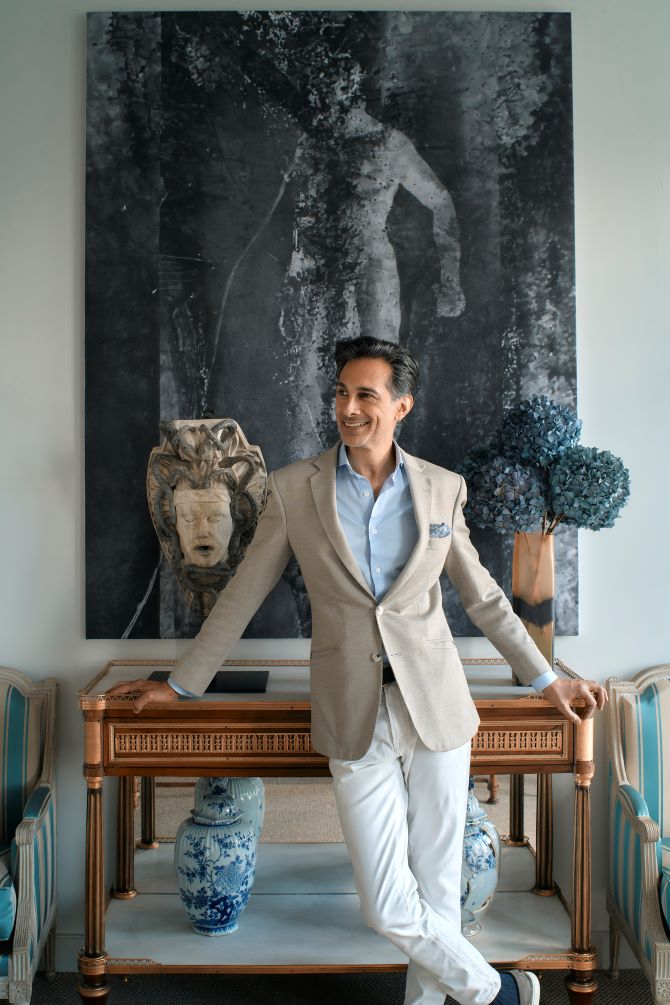
Portrait of Amin Jaffer © Antonio Martinelli
Amin Jaffer, when did you separate from Africa?
I realised that I would never work with my father in the family business – it wasn’t my centre of interest – and in the late ‘60s and ‘70s the Belgian, British and Indian communities in Africa were fast disappearing in a very insecure and unstable environment. After I became 16 I physically and emotionally separated from Africa as a home, because I fell in love with the culture of institutions, of museums, in the West. I really didn’t know where I belonged. My parents’ world was Brussels, Paris, the cities of the West, but I felt myself always very Indian. I had a big identity crisis in my teenage years.
After you finished school in Canada, where your sister was at McGill University, your academic career started in England?
Yes, but I wanted always to know India. I became very interested in works of art that were born out of the meeting of two civilisations. I was interested in hybridity and as a young student at the Victoria and Albert Museum I went into the Indian Gallery and saw a late 18th Century chair in ivory in completely a Robert Adam form. The head of the furniture department told me he couldn’t tell me a thing about it because it was Indian and not really anything to do with the furniture department. The head of the Indian department said this type of chair is European, nothing to do with India. I had this sudden moment of awakening:- the chair represented myself, caught between these different cultures without a real identity but as a product of these different forces.
What did you learn from this chair?
That from the moment Europeans arrive in India they have a very big problem. They find Indians sitting on textiles on the ground, but Europeans cannot function without a chair so they use cabin furniture from ships, and start to commission Western style upright furniture for their daily lives. Indian artisans start to make Indo-European furniture out of mother of pearl, ebony, ivory, silver, precious materials. One part of the story is these hybrid objects are made for Westerners who want to live in India, but the second aspect is how, over time, Indian elites start to westernise and to sit on chairs, and the interiors and the disposition of rooms in Indian palaces and houses changes. Indians never had the concept of a bedroom or a dining room – the textiles moved according to the season. This revolution in body culture reflected the rise of Western political and social power in India. This became the basis of my doctoral thesis, as a result of which I had to go to India. Hugely excited, I landed in Bombay – and felt immediately at home. I heard around me languages that I understood. It was the first time in my life that I disappeared physically because everybody looked like me. I now know what I am and who I am.
You travelled around India researching the collections of these princes known as maharajas?
The Maharajas, the Nawaabs, the Nizams…. There are different titles of rulers who occupied the 500 plus states that made up India in the 19th and 20th Centuries until independence in 1947. They were stripped of their titles and privy purse in the ‘70s by Indira Gandhi. Nevertheless many of them still occupy their palaces.
Were they respected by the English when they ruled India?
There was institutional racism and Indians had a second-class position as the occupied race. After the uprisings of 1857/58, Queen Victoria became Empress of India. You had direct rule, and a maharaja, even though he was a prince, was not allowed into the British club because he wasn’t white. The maharajas were politically totally controlled, could have no army, no foreign policy, and even if they wanted to go on holiday to Europe they had to ask permission of the Viceroy.
Nevertheless they kept their big palaces and beautiful furniture?
When I went to meet the maharajas I was fascinated by their hybrid existence. Their palaces were often superficially Indianised with turrets and then, when you went inside, there would be the billiard room and the smoking room. It was a British interior, and all the furniture was made in London.
Were they anglophiles by choice or obligation?
A bit of both. Queen Victoria and her government understood that to fully dominate India they needed to ensure the Indian princes subscribed to British values. Schools were set up all around India where princes would learn English and the habits of a British gentleman. They would do the obligatory grand tour to Britain, pay homage to the Queen at Windsor Castle and look at factories, schools and hospitals. They were encouraged to replicate this model, and very good art schools were set up all around India in this period of the creation of an imperial structure. All this worked for some princes, while others rejected being part of the system, and others became part of the independence movement. But an Indian prince who’s been raised in this way can no longer live in the traditional Indian palace. He needs all the trappings of the Western lifestyle.
Resulting in wealthy Indian princes with European manners and habits?
Yes, automobile collections, libraries, fascinating jewelry. Extraordinary commissions were made by the maharajas of jewels from Boucheron, Cartier, Chaumet and Van Cleef. They went to the Western luxury houses with gemstones which would be remodeled and reset in a Western interpretation of an Indian style. I became fascinated by how Indian princes guarded their customs and traditions, processions, ceremonial coronation, but increasingly the paraphernalia was no longer Indian, it was Western. It’s this hybrid. The subject of the maharajas became a fascination, and we did a big exhibition at the V&A that opened with a model of an elephant with all the trappings to show procession and ended with the most fantastic Rolls-Royce. Over the centuries, the maharajas had gone from the elephant to the Rolls-Royce. My book Made for Maharajas was all about objects made in the West for princes – necklaces, portraits, cars, silver objects, crystal, furniture – and the palaces themselves redesigned by Western architects.
“When we do an exhibition at The Al Thani Collection, we don’t just show beautiful things. There has always to be a very strong premise behind it and a real purpose.”
Amin Jaffer, this became the subject of a number of books of yours, such as From the Great Mughals to the Maharajas: Jewels from the Al Thani collection which was a show in the Grand Palais?
Yes, I had the great luck to meet a super dynamic, at that time emerging collector in various domains – French 18th Century furniture, and paintings and objects of high quality from Europe from the early modern period – a prince from the Qatar royal family called Sheikh Hamad bin Abdullah Al Thani. He became passionate about India. He had already an important portrait of the Maharaja of Indore, painted by Boutet de Monvel. Sheikh Hamad formed a very important collection of Indian royal jewels, and I worked with him over many years to show these jewels in major exhibitions at the V&A.
Was Sheikh Hamad an important client of Christie’s?
He was, and while being International Director of Asian Art at Christie’s I also had the privilege to work with Sheikh Hamad on producing books and exhibitions at the Met, the V&A, the Grand Palais, the Palazzo Ducale here in Venice. We did a very beautiful show in the Forbidden City in Beijing, in the Fine Arts Museum in the Legion of Honour in San Francisco, and then different exhibitions from The Al Thani Collection, for example, at Fontainebleau.
Where is The Al Thani Collection located?
In the Hôtel de la Marine, in the Place de la Concorde in Paris, but Sheikh Hamad did not start collecting with the idea of making a museum. He started collecting works that fed his appetite as a connoisseur. Fascinated by different world civilisations, he was collecting works of art that touched and moved him, whether they were Neolithic or contemporary. These objects are high points of human creativity, often requested for loans to exhibitions in museums. When Sheikh Hamad and I started to do things together we worked with institutions to do exhibitions just from The Al Thani Collection, and by 2017/2018 in our own ways we both felt that a more permanent home where the collection could be displayed was needed.
Why in Paris?
Paris happened organically rather than strategically. Sheikh Hamad is a collector of 18th Century French things of some renown, and one day he received a letter from Prince Amyn Aga Khan, one of the ambassadors for a project to restore the Hôtel de la Marine. He asked Sheikh Hamad to come and see the site and to see whether there was anything that could be done with The Al Thani Collection given that there were gallery spaces within the monument for which no purpose had been identified. Sheikh Hamad gave me the letter and asked me to go to Paris.
What happened?
I met Philippe Bélaval, the head of the Centre de Monuments Nationaux (CMN), the French governmental agency responsible for looking after the restoration of the monument and to finance it and open it to the public in the Place de la Concorde. Over several months we had conversations, and it was agreed, finally, that The Al Thani Collection, for a period of 20 years, would occupy a space formerly reserved for the tapestries of the Kings of France. The Hôtel de la Marine was built for the King of France’s art collection and after the Revolution the building was given to the Navy, but recently the French Navy was moved to a building more suited to today’s technology. The historic apartments were easily convertible into museum space, but on the piano nobile there were 500m² of excellent space with high ceilings and grand volumes but no decoration, because these were storage rooms for tapestries.
That’s where you were invited to do something?
It was possible because there was no historic decoration there, so we could make a museum of today. All of Paris expected that the project would be an 18th Century style museum, but Sheikh Hamad said to me very quickly that it would be a mistake to make a pastiche of the 18th Century in a palace that has already superb authentic 18th Century interiors. What we must do is a museum, not just of today, but of tomorrow. After a long search the Franco/Japanese architect Tsuyoshi Tane was chosen. He conceived a brilliant original interior, which evokes a bit from the 18th Century but is totally contemporary. He divided the space into four galleries. We opened the museum in autumn of 2021, just after Covid period, and have exhibitions from The Al Thani Collection, but we also show exhibitions created in dialogue with other museums, such as the Gulbenkian Museum and the Ca’ d’Oro in Venice, and we’ve done two brilliant exhibitions with the Victorian and Albert Museum.
What were the V&A shows about?
The first one was on the medieval period and we gave it a provocative title, Quand les Anglais parlaient français. It’s about the Norman and the Angevin period, when the Kings of England were French in terms of bloodlines and culture, and when they occupied more land in France than the Kings of France through strategic marriages. The V&A contributed the most extraordinary precious loans, like the reliquary holding the bones of Thomas Becket, and many objects that show how closely intertwined culturally, economically, artistically was England with continental Europe. Many works of art which you are convinced are French but are made in London actually, or many things that have these curious joint prognoses because of ecclesiastical or dynastic links.
Was this a post-Brexit political statement?
I’m not a very political person, but I like to make people aware that it’s dangerous to oversimplify ideas of identity, nationhood and culture. The overall rhetoric of Brexiteers was that Britain is separate from Europe because the British are different people. It’s not the case at all. The English language is made up of middle and old German and middle and old French. Most of Europe, including much of the British Isles, was Roman occupied for 400 years. There’s a basis and a foundation of a close relationship.
Was this exhibition successful?
Very. The medieval period is always viewed as a dusty time, but the serious museum going public of Paris ensured that the show was a big success. Also, when we do an exhibition at The Al Thani Collection, we don’t just show beautiful things. There has always to be a very strong premise behind it and a real purpose, so when you walk through an exhibition you understand the meaning of the works of art.

Amin Jaffer: Furniture from British India and Ceylon

View of the exhibition Medieval Treasures from the Victoria and Albert Museum: When the English spoke French © The Al Thani Collection 2023. All rights reserved. Photograph by Marc Domage.

View of the exhibition Treasures of the Collection Al Thani at the Hôtel de la Marine. © The Al Thani Collection 2021. All rights reserved. Photographie par Marc Domage.

View of the exhibition A Taste for the Renaissance: a dialogue between collections © The Al Thani Collection 2024. All rights reserved. Photograph by Marc Domage.

View of the exhibition Gulbenkian Revealed: in the Collector’s Private Realm. © The Al Thani Collection All rights reserved. Photographie par Marc Domage.

Amin Jaffer in Venice © Renato d’Agostin
“When the French public came to see the Renaissance show, their response was that they had no idea The Al Thani Collection is so rich in the Renaissance.”
Amin Jaffer, what are your next projects?
We are opening a beautiful exhibition in the autumn of works of art from across The Al Thani Collection divided according to colour. Called Colour Speaks all Languages the idea is to show the public how different colours mean different things to different people, with objects from antiquity to the present day.
And after that?
We’re working on a blockbuster show for 2025. I can’t tell you about it yet because we’re still negotiating, but the idea is to do things that are complementary and original. The way that works of art are shown in The Al Thani Collection is quite different from the way in which French national museums show things. We don’t show works of art in context, which the great national museums do very well. We show works of art in isolation, because the idea is to look at and understand an object, the materiality, the aesthetics. We’re not afraid to say the word beauty. Our goal is to create an aesthetic museum offering that’s complementary to the big museums of Paris. In the latest press reviews of our big Renaissance show we were delighted to read more than one journalist saying that across these two years The Al Thani Collection has established itself as a new museum presence in Paris.
Is The Al Thani Collection still growing?
Yes, the collection is reflective of the taste and the journey of Sheikh Hamad, and collecting is very much Sheikh Hamad’s domain. He visits exhibitions, reads the catalogues, and travels around the world following his interests. Like any collector, his interests evolve in different areas and directions, and that results in new acquisitions. We have many, many, many areas in which to show the richness and the diversity. In fact, our Renaissance show really looked at why people acquire certain things. When the French public came to see the Renaissance show, their response was that they had no idea The Al Thani Collection is so rich in the Renaissance. We didn’t have the chance to show it until now, but The Al Thani Collection is full of mystery, and over these next years we will show some of that.
You are also a Director of the 2025 Islamic Arts Biennale in Jeddah?
At the end of 2023 I was approached by the Diriyah Biennale Foundation of Saudi Arabia, asking me whether I’d be interested in being an artistic director for the Islamic Art Biennale in its second edition. I had not been to the first one, but Julian Raby, a towering figure in the world of Islamic art who was head of the Freer/Sackler, was involved in it. Sheikh Hamad went and I had heard very glowing reports.
What made it so interesting?
The conception of the Biennale is to show historic works of Islamic art from across civilisations in dialogue with contemporary creation. The display and scenography was done by OMA, the office of Rem Koolhaas, and was super visionary and original. I saw the photographs and was very impressed, so when I was asked to do the project I of course was very honoured. But I didn’t understand how I would manage it because I have already a full-time job working with The Al Thani Collection.
How do you handle these two big jobs from your house on the Grand Canal in Venice?
I’m part of a numerous and very highly qualified team. From 9 in the morning until 6 in the evening I am in non-stop meetings on all different aspects, whether it’s communications, publicity, catalogue layout, loan agreements, insurances. There’s lots of negotiating to do all the time and things to organise, but one can work well here. I came to Venice when I was 9 the first time, and when I was 18 I was lucky to know Valentina Cortese, the actress, who I wrote to out of the blue as a fan because I saw her apartment in House and Garden magazine. She received me, and she opened Venice for me. After that, although I was a student with very reduced means, I would always come and rent little apartments, or stay in a pension for a month and write. I found always the city inspiring because I grew up since my earliest days with a huge dislike of cars. I never owned a car in my life.
Unlike a maharaja?
No, I prefer the elephant! And because I was here from very early time, I made early friendships from my 20s which I still have. Over the years I always dreamed to be in Venice. It was never possible, but when Covid happened I rented the top floor of a Gothic palazzo on the grand canal that I had stayed in before. I enjoy the life here, particularly the simple aspects like going to the market. I love the aspect of the boat and nature, of walking all the time, of feeling well. For most of Europe Venice was the beginning of the Orient, so it suits me very well because I am an Oriental in Venice.
Are you working on a new book?
The next book is the catalogue of the Islamic Arts Biennale, where I’m co-writing a big introductory essay and working with the team on the catalogue entries and the structure. Then we’re going to start working on the 2025 Al Thani exhibition catalogue which I can’t say more about at this stage.
Do you go to Paris a lot?
All the time. This summer I am exceptionally out of Paris because of the Olympics, which took place just in front of where I live and my road is completely barricaded. The museum was open, but we had to close our temporary exhibition space because it’s very hard to have insurances when you have a stadium in front of the front door.
Have you been a nomad all your life?
Britain has been the dominant force in my culture. I was born with a British passport and my mother’s family is Anglophone so I grew up understanding British process, thought, school education and culture. I feel very aligned to what happens in Britain, but more and more I feel separated from the British Isles and the way I live doesn’t accord with London at all anymore. Living in Venice and Paris you become very used to walking absolutely everywhere because the cities are manageable in scale, and in London it’s totally impossible. Also, London is a city that evolves, and almost every time I go there’s another building I loved that’s disappeared. If you drive along the South Bank of London now, you see on the left-hand side completely new developments of mammoth dimensions. I’m somebody who looks back a lot in life and I find that jarring.
Thank you very much for this interview.
ENJOY THIS INTERVIEW? SHARE IT WITH A FRIEND
Lead portrait of Amin Jaffer © Renato d’Agostin