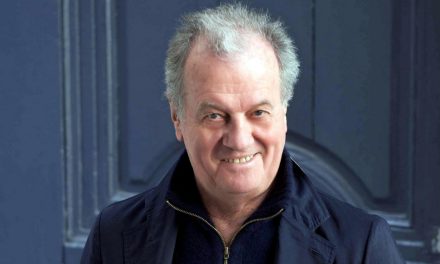
A CROSS DISCIPLINARY WORLD FOR YOUNG ARTISTS. Jonathan Reekie has been Director of Somerset House Trust in London since 2014. During this time, the renovation of the historic site with its grand Renaissance architecture has been completed, including the launch of Somerset House Studios for artist residencies. Reekie has established Somerset House as a home of cultural innovators and in 2025 Somerset House celebrates its 25th birthday, marking its extraordinary transformation to one of London’s best loved cultural spaces and home to one of the largest creative communities in the UK.
You can listen to the podcast of this interview here.
Jonathan Reekie, your career started with opera?
Yes, my first job was in Italy at the Musica nel Chiostro Batignano Opera Festival in Tuscany. The Batignano festival was in an old monastery and we performed operas in an olive grove. But I didn’t study music or arts. Going into opera was an accident caused by my love of opera and the arts and an amazing opportunity to get into that world. Opera is the original multimedia art form, and I’ve always loved so many different things coming together – music, design, the voice, drama, theatre.
Opera audiences can express very strong feelings, throwing tomatoes if they don’t approve?
Yes, that’s only in Italy though, not anywhere else! After Batignano I worked at Glyndebourne, at a time when some of the best British theatre talent was working in opera. I was very lucky to work with directors like Richard Jones and Graham Vick. My light bulb moment was at Glyndebourne, where I discovered that contemporary opera excited me more than anything else. I suddenly realised I loved working with living artists, and that’s driven my career ever since.
And led you to Somerset House?
Yes, over a 25-year journey working in opera and theatre and music, with a real love of supporting artists to realise their dreams, I realised how much the world was changing and how much the way artists work and think has been changing. There is this curiosity to see the world not through the lens of one particular art form, but between a collision of all art forms. Artists needed a different kind of arts institution that was fit for the 21st century, and when I came to Somerset House ten years ago there was a blank canvas opportunity at Somerset House to rethink what an arts institution might be and to make something artist centred.
“Thinking about how artists can help us make a better world”
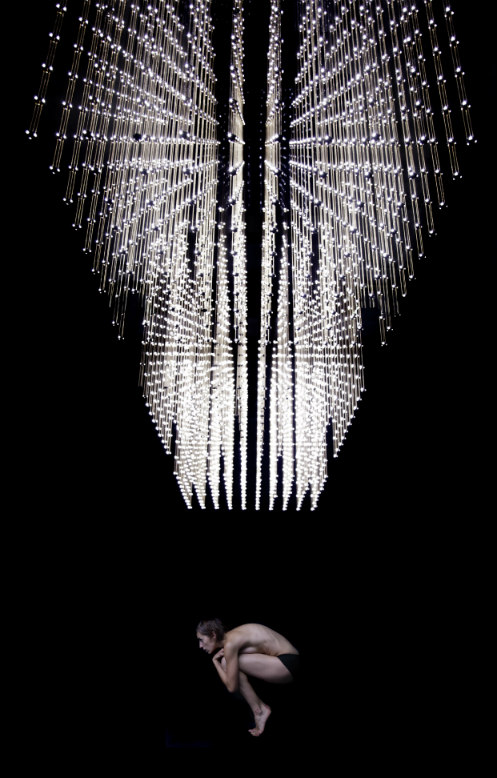
Wayne McGregor‘s FAR, Company Wayne McGregor (Catarina Carvalho), 2010, Photo Ravi Deepres
Jonathan Reekie, what is the relationship between Somerset House and the Courtauld Institute, which is located in the same complex?
Today we’re very friendly neighbours, and the Courtauld is amazing, one of the world’s greatest collections of art and one of the best places to study history of art in the world. The Courtauld was here since 1989, but we opened to the public in May 2000, and so the rest of Somerset House as a cultural space has happened since the Courtauld. What we’ve created with the rest of Somerset House is a place for contemporary culture and a home for cultural innovators, for artists and other creatives who are wanting to think and work in different non-traditional ways.
That’s why Somerset House is known as a working arts centre?
Yes, that’s the description of it. It’s full of people who are working, so as a cultural institution it’s unusual. You have a public cultural program on the surface that everybody engages with – exhibitions, events, music, across all disciplines – but below the surface there are 2500 artists, makers, cultural entrepreneurs and other creative businesses who are based here. It’s their work space, a factory of creative imagination.
How many people work specifically with you at Somerset House Trust?
About 120 staff across the curation, the exhibitions and the live events, but also this is a huge beautiful historic building and a key part of our job is to preserve and animate it for today’s generation and future generations. We get over 3 million visitors a year, so we’re one of the most visited buildings in the UK.
How do you run the artist residencies?
70 artists can be here for up to seven years, so they are long residencies and across all disciplines – visual artists, people making music, dance, digital, fashion – art in the broadest way, and they’re alongside 350 designer makers. We’ve made a very different model that comes back to this idea of trying to create a different kind of cultural centre, one that works for today’s artists, but also today’s audiences.
Do artists have to apply or have a special merit to be here?
You have to apply or be invited, and the selection is very careful because it’s curating a community. It is very important to create a group of people who are going to be mutually supportive, and to choose a range of artists who go across different disciplines so they’re not competing with each other. We also want to choose artists who are at different life stages.
Do you make the selections yourself?
No, the Studios team headed up by Marie McPartlin does it, but we have constant criteria. We’re looking for artists who are innovating within their field and who want to be part of a mutually supportive community. If you want a private studio cut off from the rest of the world, this is not a good place for you.
During 2023 a series of events and shows which will be scheduled month after month, starting on January 23 with an exhibition called “Soil: The World at our Feet”. Can you describe this exhibition?
Our program approaches key contemporary issues and trends in thought provoking and different ways. We like to challenge conventions and offer alternative perspectives. For a lot of people, soil is dirt, not something we think and worry about. Actually the health of our planet – and therefore the human race – is very dependent on soil, but in modern times we’ve been completely neglecting that important fact. The Soil exhibition will be very sensory, very immersive, and full of wonder and joy about this extraordinary thing that provides this unbreakable bond to all of life on Earth. It will be through the lens of over 50 artists, designers and thinkers from all around the world, so it’s definitely a global perspective. At Somerset House, we feel artists play a very important part in showing us the world in different ways, teaching us about things that perhaps we’ve overlooked. Our kind of exhibition making very often looks at key contemporary thematics and then uses artists and designers to tell the stories of that subject through art and design.
“Bringing artists back into a space in the centre of the city is very crucial if London wants to remain a creative centre.”
Akinola Davies, a multi-disciplinary filmmaker, writer and video artist, who is one of your residents, will show his new film accompanied by live music. What kind of film is it?
Akinola is a brilliant film maker from the south east of London, still young and emerging, but really gaining a reputation. He’s been working on a huge project with the BBC about this amazing film archive of Africa that very few people know about and have seen. Akinola has been using that archive to inspire new films that he’s made. We have a big popular music series in our beautiful Somerset House courtyard every summer, and Akinola will create a show incorporating his new films as part of that music series.
What kind of sculpture is the artist Tai Shani, 2019 winner of the Turner Prize, going to show in the courtyard of Somerset House?
Somerset House’s courtyard is one of the most magnificent public spaces in London, a beautiful, large space surrounded by wonderful Georgian buildings. It’s like a piazza, very un-English and feels quite Italian or French. Tai is another Somerset House Studios resident artist, and as you say, she won the Turner Prize. Jasleen Kaur, the 2024 winner of the Turner Prize is also a Somerset House Studios artist, and the 2023 Turner Prize winner Jesse Darling is an alumna of Somerset House.
Somerset House is really producing winners?
It’s a massive incubator of today’s creative talent in London, and Tai’s piece – The Spell or The Dream – is an invitation to artists and members of the public to dream about a better world. The sculpture will take the form of a sleeping figure inside a glass box that is actually seen to be breathing. Very gently the figure moves through animatronics, dreaming of a better future. The invitation is to everybody who comes also to dream of a better future. It is accompanied by a live 24/7 radio station throughout the six weeks of the summer where it’s based in the courtyard.
Do your artists come from all over the world?
Yes, they come from all over the world because London is a global city, full of people from all over the world. We can provide workspace and living space. There are many international artists based at Somerset House, but they are international artists who for a while are based in London. We can confidently say that London is one of the great creative cities of the world, but bringing artists back into a space in the centre of the city is very crucial if London wants to remain a creative centre. This is another of the motivations for us having Somerset House Studios.
Many artists went to Berlin for economic reasons. Are they returning to London?
London has challenges like other big global cities, it’s expensive to live here and that is a barrier. By offering subsidised workspace to artists, we’re doing something to help that barrier. Although it’s challenging for artists to make a living from their work, London is still a very important market for artists. It’s a place where a lot of artists can work and have sustainable careers.
While a very few become billionaires, sadly many good artists have difficulty entering the market?
The statistics about earnings of artists are really depressing, but we offer subsidised space and some of our network of donors give support directly to the artists. We also run different bursary schemes or projects. For example, there might be a technology fellowship for a few months. We support artists in any way we can find.

Akinola Davies Jr. Courtesy of the artist
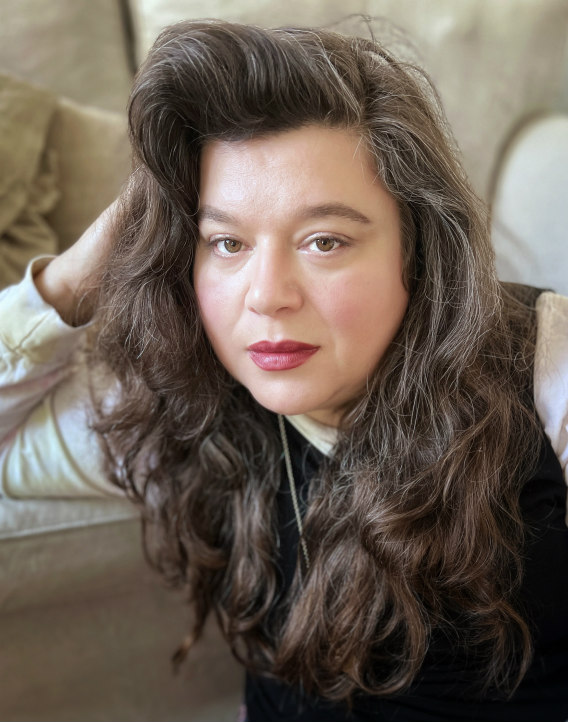
Tai Shani Portrait, 2023. Courtesy of the artist
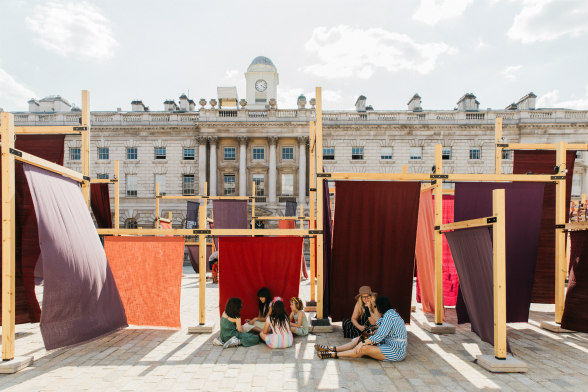
London Design Biennale, 2023. Photo by Iona Wolff
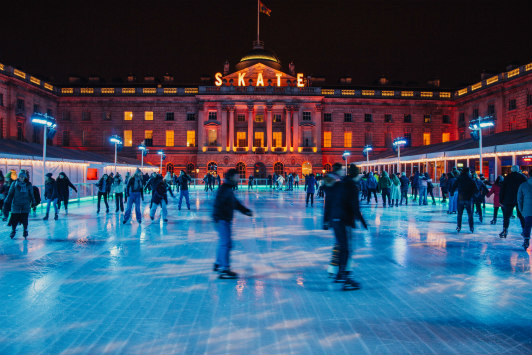
Skate at Somerset House. Photo by Owen Harvey
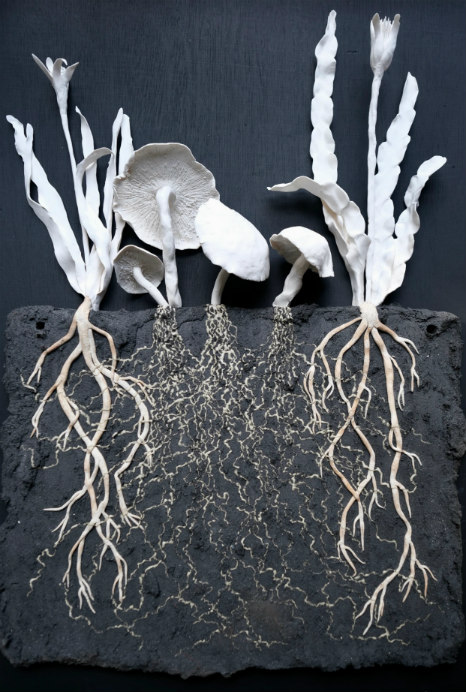
Unearthed – Mycelium by Jo Pearl, 2023 © Elsa Pearl
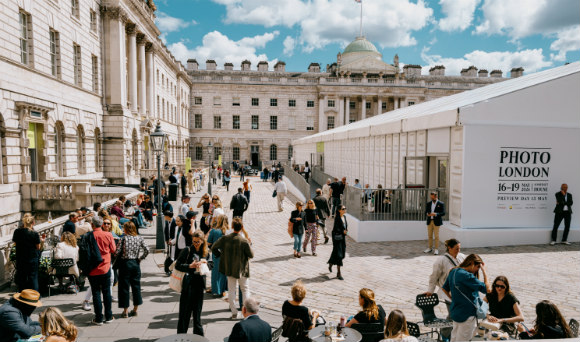
Photo London 2024 © Graham Finn Carlow Courtesy of Photo London
“If I can help make a better environment for artists to work, think and thrive then I will always feel very fulfilled.”
Jonathan Reekie, what is the Somerset House Trust’s business model?
We do not receive any funding from the government. We are a self-funding trust. We’re a charity, but all of our income we have to earn ourselves through a variety of ways.
As you are the Director is this part of your job?
Yes, sadly. I wish I didn’t have to worry about money, but of course I do. Half of our income comes from rents to creative businesses who are based in offices at Somerset House. Then we have a big commercial events business where people can do their events here, like hold a party. And Art fairs come to Somerset House, such as Photo London and 1-54 Contemporary African Art Fair, which attract a big audience and help underpin our business model because we generate some income from them. Food and drink onsite also generates income, and we do fundraising and sponsorship with brands. Ours is a very mixed economy. Our famous skating rink in the winter is also part of how we generate income to invest in our cultural program.
In the London art scene there is a lot of competition, the Tate, the British Museum, The National Gallery, the Royal Academy, the high level galleries and so on?
There are lots of reasons why we’ve deliberately tried to create a different model here. The idea of a much more plural cross-disciplinary world is so important to so many artists now, but there are a lot of other reasons why we’ve created a different model at Somerset House, and one of them is that younger audiences are in search of different kinds of experiences.
Younger people have their own tastes and attention spans?
Yes, younger audiences are less interested in the more traditional models, and you can give people the new, different kinds of experiences they’re looking for without diluting the artistic integrity of what you’re doing. By engaging in contemporary issues and presenting arts and artists in different kinds of ways, we’ve generated a different kind of audience for Somerset House. Most of our audience is under 45, whereas I think most arts institutions’ audience is mostly over 45.
Are you teaching at Somerset House as they do at the Courtauld?
No, our focus at Somerset House is about jobs for young people and careers. We have a huge program that’s around creating different entry points for young people into the arts and creative industries. We do a lot of work to help young people navigate a career in the arts and creative industries. In Britain, the creative industries is one of the biggest and most important industrial sectors. It’s consistently one of the growth areas of the British economy, and yet it’s very difficult to find your way into this sector.
Do you create exhibitions philosophically, following what’s going on in the world of today and the cultural movements associated with it?
It’s about the zeitgeist, sometimes following and sometimes anticipating. We did a very successful exhibition last year about the phenomenon of cuteness, which globally is probably the most important cultural phenomenon of today. Most of the culture of cuteness happens on people’s phones. It’s not necessarily in shops and certainly not in museums, but it was a very popular exhibition. Another show we’re doing next autumn which has got a very different texture is with the choreographer Wayne McGregor, the artistic director of the Biennale di Danza in Venice. Wayne has this extraordinary career exploring the relationship between the body and technology, and what it means to be human from a physical point of view. An artist who defies categorisation, he’s always inquisitive, always in search of the new. This is a very typical Somerset House exhibition, thinking about the future and thinking about how artists can help make us make a better world.
Why do artists help make a better world?
In different ways. One of the most important is they help us see the world differently because they have a different perspective on everything. Through their art they can make us see things in a fresh way, and they can often give us ideas or suggestions about how to solve the world’s problems.
Can technology be a form of art?
Certainly, there’s a very rich, creative component of technology, but not all artists are like this. Some artists will make you something beautiful to hang on your wall, but that’s not really the kind of art that we’re making at Somerset House. The conversation here is about artistic and social innovation at once. Most artists are very preoccupied with what is happening in the world, and a lot of them want to make work that reflects that. Part of that is about helping us find solutions.
What is your job really about?
The main part of my job is to think about what’s happening in the world and what space Somerset House can occupy, how we can support artists and creativity in a very challenging environment. There’s so much amazing art and culture happening in London all the time, and I see my role as making Somerset House about something that’s a bit different from all of that, something that stands out. In this conversation, I’ve been describing some of the ways we do that, but my job is absolutely about making art and creativity central to today’s culture and today’s audiences.
Is it also a way for you to keep young yourself?
Yes, I’ve felt all through my career that one of the most enriching things you can do is surround yourself by really talented young emerging creatives and artists. I love it, and yes, it does keep me young. An artist once said, the thing about Jonathan is he wears a suit so that none of us have to wear suits. I’m proud of that. If I can help make a better environment for artists to work, think and thrive then I will always feel very fulfilled.
Is dialogue with the younger generations easy, or do you sometimes get lost?
I am lost all the time. They are talking to me about things that I’m not sure I understand. But that’s okay, working with artists is very much about trust. It’s about understanding enough about an artist in their practice to know that you can trust them, and then to just give them that trust, and to give up control.
With so many winners of Turner Prizes, probably you picked the right people?
It’s the artists that win the Turner Prizes, not us. But yes, I think we’re doing something right.
Thank you.
ENJOY THIS INTERVIEW? SHARE IT WITH A FRIEND.