
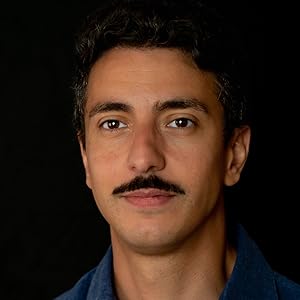
SPEAKING TO THE DEFEATED. Federico Campagna is an Italian philosopher based in London. His research concerns the metaphysics, politics and history of world-building. His books are Technic and Magic (Bloomsbury, 2018) and Prophetic Culture (Bloomsbury, 2021) and his next book Otherworlds, Mediterranean Lessons on Escaping History will investigate the history of cosmological imagination during times of crisis in the Mediterranean area.
You can listen to the podcast of this inteview here.
Federico Campagna, can you please summarise your new book Otherworlds: Mediterranean Lessons on Escaping History?
The book is a counter-history of the Mediterranean – a special place that has had one advantage over many other places in the world: it has experienced world-ending catastrophes many times over. This is an advantage because it gives you familiarity with events that usually are paralysing for other people. If you walk through the streets of Palermo in Sicily you see the different civilisations that have existed there. Each civilisation was not just a set of political and economic structres, but an all-encompassing way of being and of looking at reality, and each of them ended. So the people of Sicily are used to the fact that even what seems most stable, natural and obvious – the “world” itself – can at some point end; and yet you survive.
Does the book focus on moments in the history of the Mediterranean when worlds ended and people felt lost?
Yes, and it looks specifically at the strategies that they adopted, not so much to change the world – there are moments in history where you cannot change the world, it’s beyond your power – but ways of inventing new worlds from scratch. The book begins in the Bronze Age and it ends today. I can imagine it being updated 100 years from now with the stories of people that in the next 100 years will find themselves in similar situations.
“The values of old are gone, and you have to reinvent your way of life from scratch”
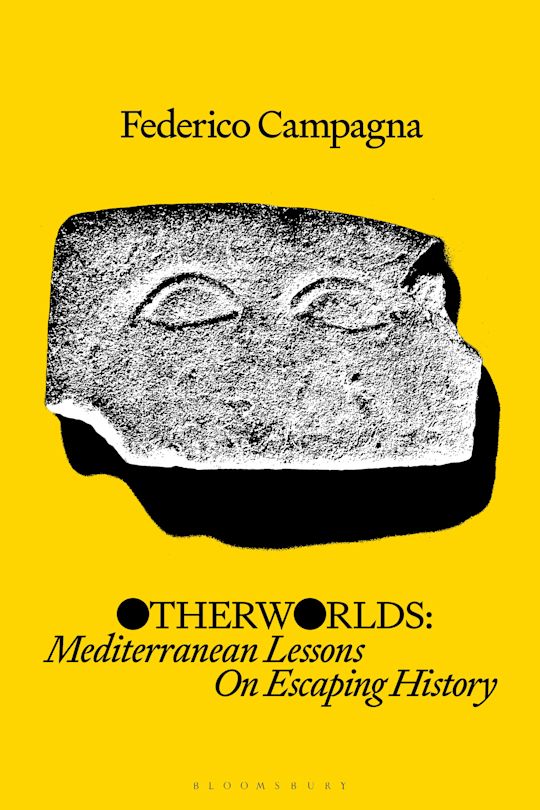
Otherworlds: Mediterranean Lessons On Escaping History by Federico Campagna.
What can survive the end of the world?
In Otherworlds, philosopher Federico Campagna constructs extraordinary stories and alternative histories of the Mediterranean, nexus of migrations and odysseys, ruins and romances, to depict a world in which the imagination is the only engine of survival.
Federico Campagna, is it an optimistic book?
It wishes to reassure the reader that when all the things that are stable around you collapse, something in you remains safe, because a person is not entirely part of the world. A person is the creator of their world, so it is possible for a person to survive the end of the world – and that’s optimistic. I do not deny at all the difficulties of undergoing an apocalypse. The feeling of displacement is very great. The values of old are gone, and you have to reinvent your way of life from scratch, but nonetheless this is a useful lesson. Even when a world is stable and strong, you should never fall for the temptation of believing its values to be natural and real.
What do you mean?
You still have the possibility of realising that everything that appears around you and appears natural and factual, in fact is a fiction, the product of an imagination. My philosophical approach is to distinguish the plane of reality from the plane of the world. The plane of reality is things as they are in themselves – and they are an unfathomable, immense, ineffable mystery that includes you. The plane of the world is the things as you perceive and understand them, including yourself as an identity – and those things are fundamentally fictions, and so they can easily collapse and can easily be reinvented. When they collapse and are reinvented, you might feel a deep sense of disquiet, but nothing essential is lost.
Do your earlier books Technic and Magic and Prophetic Culture open a door to a Mediterranean way of thinking which Northern countries tend to ignore?
Yes. My personal political background is in left-wing anarchism, and unfortunately as a left-wing anarchist you have a constant experience of political defeat. Often you find yourself unable to change the world, in a situation in which the change you wish appears impossible. Questioning why it was impossible is how I got into metaphysics. I started to realise that certain changes were impossible because the collective imagination that we have about what is possible does not allow them.
What is this collective imagination?
The way in which we open our eyes every morning and make sense of the world that surrounds us is this collective imagination. The fundamental ideas about how time flows, how space is organised, how identities are defined, is metaphysics. In every single age of the world and in every single society these ideas define the range of what is possible or impossible to think and to do. My intuition was that to expand the range of the possible, we had to transform our metaphysical assumptions, that’s how I got into Technic and Magic, Prophetic Culture and Otherworlds. It might sound surprising to get into metaphysics from revolutionary politics, but there is a straight line between them.
What do you mean by ‘technic’?
The idea of technic is mythologically connected to the North, and the idea of magic is mythologically connected to the South. Technic is the way in which we wake up in the morning, look around ourselves, and suddenly believe and are firmly convinced that the system of language that we use to catalogue, to organise, to understand and manage the world is perfectly coincident with reality. This is very much what we believe at the moment, that we have grasped reality for what it really is, we have dominated it within our language.
And what by ‘magic’?
Magic is a different system of reality. We wake up in the morning, open our eyes, and remain aware that even though we can tell the time, can separate distances in space, can name things, these are ultimately fictions – because in fact there is a kernel within everything that is beyond language, beyond understanding. Magic precisely advises somebody to constantly keep in mind that there is an excess to every single thing – to a pen, to a glass, to the moment in the day. There is an excess which remains ineffable, and that excess is the greatest part of that thing. The rest – what you can say, or what you can understand – is fleeting. It is linguistic. It is fictional. And it can be modified.
What is an example of how that impacts daily life?
At the moment in which we are speaking there are market crashes, the return of nationalisms, and so on. Nationalism is a prime example of how linguistic definitions significantly modify the way in which you live your life. You can be asked to kill or to die or to reject somebody at the border in the name of the linguistic idea of the nation or in the name of other linguistic entities like currencies or financial values. Magic invites you to keep in mind that it is a bad idea to try to destroy something real and ineffable in the name of something fictional and linguistic.
Do we live in a metaphysical world at the moment?
Yes, and we always do. Metaphysics is one of those automatic things, like heartbeat, digestion, breathing. The word metaphysics originally it derives from a system of cataloguing of books. Aristotle wrote a book called Physics, and the book after the book on physics was called Metaphysics. It’s a bit like Terminator 2, but “meta” also means “beyond” the physics. So metaphysics refers to the investigation of those aspects of reality that lay beyond the realm that you can immediately understand and apprehend through language, as well as to the process through which we create a linguistic “world” out of an ineffable “reality”.
How does it work?
You can observe a lighter or a pen for what it is made of physically, materially, and then you start interrogating yourself in what way you can understand that it exists. Does it exist as a unique concrete object, or rather as a bundle of qualities? When you say that it exists, does it mean it exists in time or it exists eternally? Does it exist in the same way in other possible worlds? Do things like pens and dreams “exist” in the same way? And so on and so forth. Metaphysics is something that you do every day and that everybody does in every moment since birth, simply because every day we need to make sense of our surroundings. Every civilisation in history responds to each of these questions differently, because many possible answers are available. For example, you can decide that a dream is real or that it is not real. Or you can decide that you look at yourself in the mirror and it’s not you. Buddhism, for example, encourages you to do that.
“An apocalypse reveals all the things that usually, in your daily life, you tend to not notice immediately.”
Federico Campagna, what is your role as a philosopher today, in our technological era?
To be honest, my main role is as a father of a 10-year-old boy, and the role of philosopher is certainly secondary to that. But more generally: today is not so different from other times, and we can understand this easier if we question the notion of what technology is. This is precisely what a philosopher does and why philosophy is relevant in every age. Technology is not just spaceships. The glasses that I’m wearing, the clothes that I am wearing, are a technology, but also the words that I’m using are technology, language is a technology. So technology is the array of tools that we use to negotiate the boundaries between ourselves and our environment, and these boundaries allow us to modify the environment. They also allow us to define ourselves as opposed to the environment.
Surely there is more technology today?
There was just as much technology in Palaeolithic times as today. Actually, if you think about it, the most technologically creative era in our history is the Palaeolithic times. This was when we invented words, language, grammar. That was the most earth-shattering technology we’ve ever invented. Language is the essence of technology. In fact, language is any form of thought that we use to individualise things. With language we take something out of the great chaos of reality and call it with a name. By doing that, we create it as an object, and we learn how to interact with it – and at the same time, we create ourselves as “subjects” in our world. So numbers are a language. The zero and one of old-school coding is a language. The language of physics is a language. These are all forms of language.
Would you say that philosophy is a science?
Philosophy is a strange science, because it is a “science” in the old understanding of the term, Sapientia or wisdom. Philosophy is the science of all sciences. It checks every other science. It looks at how another science like bioengineering works and checks the way it works, its assumptions. It checks the logicality of how it proceeds, checks the method, but also includes it within a general understanding of everything else and connects it with everything else. This is the antidote to hyper-specialisation, which is a problem that we are having at the moment. If we are to coordinate our efforts as a human race, it is always necessary to connect the bits. Philosophy does precisely that.
How does philosophy react to artificial intelligence?
Artificial intelligence is really not surprising, in particular for religious thinkers, to whom every intelligence is artificial. If you assume the presence of a creator God(s), the entire world is artificial, including human intelligence. Artificial intelligence has to be included within the general scheme of things and it makes sense within a certain worldview. It’s not infinitely powerful in itself.
In recent years there are catastrophes all around us, from Covid to wars to economic crises. What is a catastrophe?
The word catastrophe, in Greek, means to end a sentence, put a full stop and then start on the next line. It is a beautiful word because it is an optimistic term. Another useful term that shows the optimistic side of a catastrophe is apocalypse. Some events are perceived as apocalyptic because they destroy everything that there was before, and, etymologically, an “apocalypse” is a moment of “revelation”. When we face apocalyptic situations, whether a pandemic or a massive financial crisis or an all-out war, we can see nakedly all those structures within our collective imagination that allowed for those things to happen. An apocalypse reveals all the things that usually, in your daily life, you tend to not notice immediately.
Was the recent pandemic apocalyptic in that revelatory sense?
Yes. The most apparently stable general systems can unravel at an incredible speed. The recent pandemic shows to what extent our attachment to physical health as the only form of “health” allows us to be powerful during certain moments, but also makes us extremely vulnerable in moments in which this physical health is threatened – and we feel that we’ve lost everything. A revelation. These moments invite us to reinvent the world, to reinvent our fundamental ideas about the rhythm at which we sing reality into existence. Each particular option creates a set of possibilities, and we have to decide which option we take on the basis of the possibilities that it allows.
Do philosophers have the same high degree of social importance today as they had in the past?
Philosophers are perceived as very important in moments when the collective idea about how things truly are is not so certain. The more uncertain you feel, the more you consult philosophers. They are not specialists in giving you answers, but in giving you methods to check and to doubt all of your responses. Today we are perceiving once again that maybe we didn’t get everything right, and also that the solutions that we invented not only were not particularly right but also had consequences that are unfolding in front of our eyes right now that are catastrophic in the bad sense of the word, and so if we must rethink our assumptions about everything philosophers will come in handy again. A philosopher invites you to reconsider and check every belief that you have. There is however the problem that we have sometimes between philosophers and propagandists.
Do you mean how we deal with our doubts?
Yes, sometimes in moments of doubt it is not philosophers but propagandists that come with an answer to these doubts, and offer you a solution to stop doubting again. For example, they will tell you: if get the idea to make America great again and firmly believe in that, then you can relax. Well, if you fall for that, a disaster is going to ensue – most likely, to start, the establishment of a nationalist dictatorship. And the problem is that when dictatorships fall it is certainly good news, but it doesn’t resolve anything. What often really remains is the desire to believe once again with absolute certainty, and that will breed a new form of dictatorship immediately afterwards.
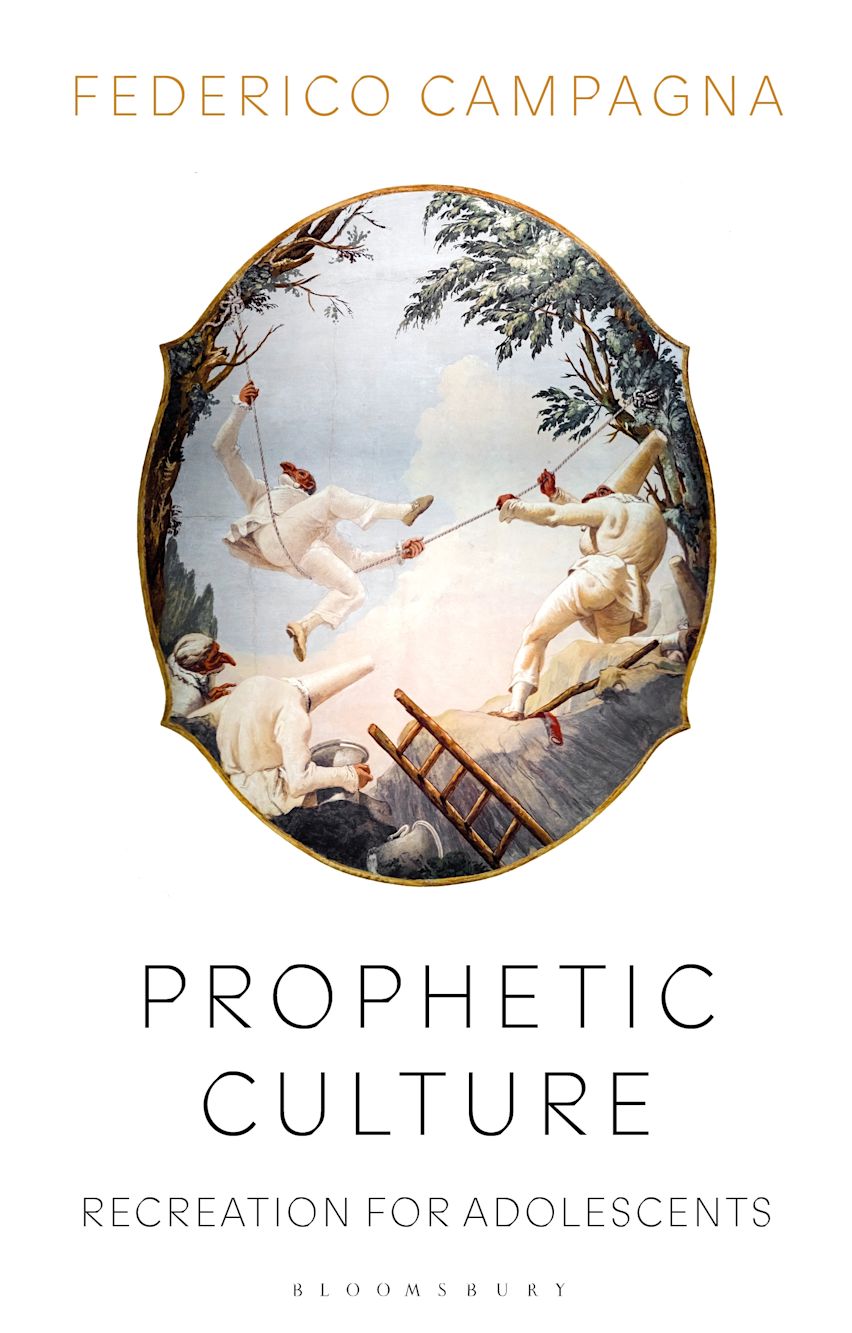
Prophetic Culture: Recreation For Adolescents by Federico Campagna. Selected as one of The Tablet‘s Books of the Year 2021
Throughout history, different civilisations have given rise to many alternative worlds. Each of them was the enactment of a unique story about the structure of reality, the rhythm of time and the range of what it is possible to think and to do in the course of a life. Cosmological stories, however, are fragile things. As soon as they lose their ring of truth and their significance for living, the worlds that they brought into existence disintegrate. New and alien worlds emerge from their ruins.
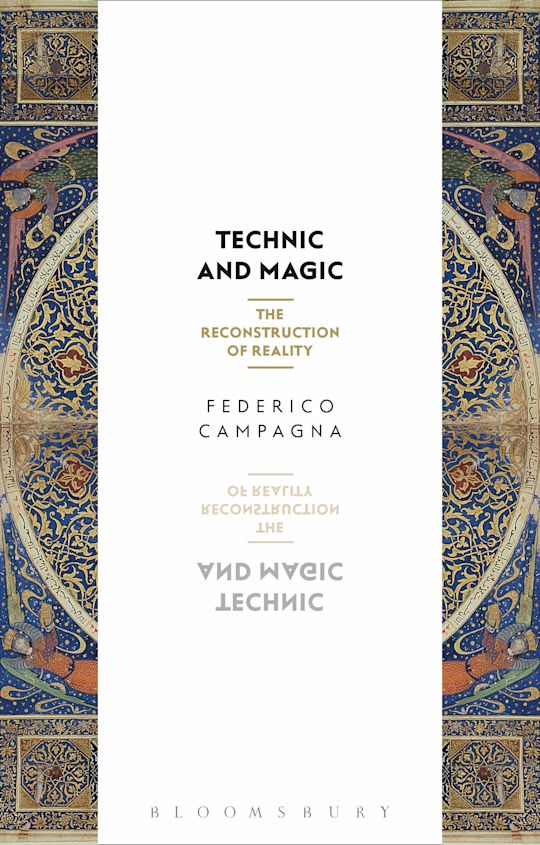
Technic and Magic: The Reconstruction of Reality by Federico Campagna
We take for granted that only certain kind of things exist – electrons but not angels, passports but not nymphs. This is what we understand as ‘reality’. But in fact, ‘reality’ varies with each era of the world, in turn shaping the field of what is possible to do, think and imagine. Our contemporary age has embraced a troubling and painful form of reality: Technic.
“The world is produced outside of us to a minimal extent. It is produced within us to a maximum extent.”
Federico Campagna, how does philosophy differ from religion?
Philosophy leads you all the way to religion and religion brings you back all the way to philosophy. Philosophy is the way in which we check our ideas to the extent to which you can be certain of them, and that’s where philosophy leads you to religion. Philosophy and religion go together, because this last check – to what extent your ideas are entirely true – shows you that there are always gaps and limits. Logical systems always have a hole within them, and this hole shows you that your thought has a limit. This limit doesn’t mean that thoughts are stupid or useless or should be abandoned, but it tells you that you can only trust them to a certain extent.
What is the extent beyond the thinkable?
As limited cognitive machines we do not apprehend the totality of the universe. Beyond what we can apprehend there is something ineffable, in the sense that we cannot “say” it. This relationship with the ineffable is religion. Religion can be many things, like philosophy can be many things. There is an aspect of religion which is social, and that is the most dangerous part. Mass religion is the attempt to translate this intuition that there is a beyond to the knowable into a series of edicts, of laws that then regulate everything else. We pretend that the ineffable speaks to us and issues a series of specific dictats that we must follow, and then, of course, we have to punish the people that don’t follow them. A second form of religion is rational religion, which is similar to what I was just saying: you get there intellectually and you set the boundaries of the sayable and the unsayable, and you try to bring them together to a certain extent. Finally, there is a mystical form of religion: embodying, actually bringing within yourself, including inside your every thought, the realisation, the intuition of the beyond. Not by saying, “I have grasped the beyond, I now speak in the name of God, and now I know precisely what there is beyond,” but simply you have this glitch in your consciousness inserted in everything you say. It’s like a pause, like a caveat to everything that you say. Mystical religion is the most precious part of every religion, and it is in itself not a content but a method.
What does mystical religion tell you?
Mystical religion doesn’t tell you anything specific, except that within every speck of dust there is infinitely more to what you can grasp and understand. This limits and relativises the world. As a method you find it in Taoism, in the illuminationists of Shia Islam, in Judaism, in Christianity, and so on and so forth. One of the great thinkers was Nicholas of Cusa. He was German by birth but Italian by thinking, a Renaissance philosopher, and his idea of “learned ignorance” is an example of how philosophy and religion go together. The fact that you need to think and to relate with the world with learning to a certain extent, but with ignorance to another extent,
When we were suffering and frightened during the catastrophe of the pandemic we rediscovered the flourishing of nature, animals and trees, and used to say, life will never be the same again, everything will change after this. Why is the result that nothing changed?
We hoped that an external event like the pandemic would bring substantial change, also in the future, but then we discovered that change in the world only minimally depends on external factors and maximally depends on internal factors. So even though the world outside had changed, the way we continued to world-build, to imagine metaphysically in our mind, had not changed. The world is produced outside of us to a minimal extent. It is produced within us to a maximum extent. That’s precisely why things rarely change in that way. It’s not enough to have an external shock to change things.
Religion implies faith and acceptance, but in philosophy there is question after question. How can these two go together?
Every word that we use has many meanings, and depending on how we understand faith, we are talking about different things. There is a mechanical faith, in the sense that I have a strong hope that somebody else will do something if my hope is strong enough. This kind of faith you have even in relationships – if I love my partner enough, she will love me back. This faith belongs to the area of folk magic, a bit like a fantasy that there are relationships of cause and effect between things where in fact there is no relationship of cause and effect. But in another sense faith is not a form of belief or of ungrounded and mechanical hope, but it is knowledge. For example, when we understand the word God to mean not some guy with a beard sitting somewhere in the sky, but God as something beyond our understanding, the all-encompassing existence that holds up the existence of every single thing; the eternity that holds up time; the fact that beyond the limited concepts that we have created, such as being and time, there is an infinite expanse that transcends our concepts but allows us to think. If you do so, then God is “something” that you know in a particular way. You know it because you know that your concepts are limited and you know that there is more to your concepts. You do not know the name of what is beyond the limits of your concepts, but you are certain that there is that because you know your own limitations. The relationship you have to that beyond is not discursive linguistic knowledge. You cannot name it, but it is absolute certainty that there is. That is faith, technically, but that is also the accomplishment of philosophy.
At the end of the day we will all die. We invent immortality but we don’t survive.
From our point of observation onto the world that surrounds us, we can detect certain patterns. Things come into life, come into presence, move about, and then they die. The seasons move in a certain way. The “how” of how things proceed in the world is not especially mysterious. What changes everything is not the how, it’s the “what”. This moment in time will be followed by this moment in time. This we know with a good level of certainty, but what this moment in time is, and what this next moment in time is, that is an unfathomable and infinite mystery. The fact that moments in time follow each other – so, how they flow – allows us to have a notion of time. What each moment in time is in itself, if we consider it enough, allows us have an idea of eternity, and this is immediately relevant to the problem of life and death.
How come?
Every moment in time in itself does not flow. Every moment in time in itself is a moment that exists eternally. Similarly, when we look at what life and death are, they are the silhouette of an arc that begins and ends in a particular way, but every instant on the arc is not reducible to the movement of all their progression. Each of them has an existence in itself, every moment, which pierces time and looks into eternity. An example of how we can understand this is that when we draw a line it is made of a series of points, none of which has a volume in space. Similarly in time. A second is made of a series of instants, each of which has no duration in itself. We often panic about life and death in terms of the succession of instants, but sometimes we do not appreciate that the things that are, are eternally. Death does not correspond to disintegration, and life does not correspond to coming into being.
Does philosophy continually adjust itself to the progress of science and technology?
Philosophy has the advantage of not being excessively fascinated and distracted by the changes of history. To use an old Buddhist metaphor, philosophy is just a ferryboat that takes you from one bank to the other bank of the river. You don’t need to turn the ferryboat into a spaceship. You don’t need to make it into a submarine. You don’t need to put TV screens on top of the ferry boat. The job of the ferry boat is always the same. You start from a place, you get to another place. In Buddhist teachings (dharma) it’s discussed as from the bank of ignorance to the bank knowledge. In every interaction that we have with any activity and any object that we encounter in the world, we have a philosophical approach to the extent to which we do this journey on the ferry boat.
For example?
I have a relationship with myself as an individual being, and I am educated from birth to say that I am Federico, a heterosexual male from Italy of a certain height and weight, and so on and so forth. Thus, in conformity to this linguistic identity, I am supposed to behave in a certain way, to be a certain thing. Philosophy takes you along this ferry boat journey by questioning every single step of this very notion of having an identity. Then you move on and you start inventing things – including yourself – anew. This method, which I have applied to the problem of my personal identity, I can apply to any other thing. When I deal with currency, when I deal with time, when I deal with nationalities, with anything, with notions of good or evil and so on. This is a method. It is a way of walking. It doesn’t need to progress in close step with history. The challenge is constant. The water on the river constantly changes, but the two banks remain always the same.
Since you say philosophy doesn’t change much with the times, are the works of Plato, Aristotle, Saint Thomas Aquinas and Saint Augustine enough?
I teach at university and when my students ask me recommendations on what to read, I usually ask them if they have read Plato, and if they haven’t I recommend they read all the Dialogues, and then that’s probably enough.(laughs) Because once you learn how to ride the ferry boat, then you can do it yourself. It’s not that kind of discipline where you need to have read everything. Plato is an excellent start, and often in philosophy the necessity to say new things is zero. It’s the same also in the Jewish Bible. The amount of prophets that are sent over and over and over again to say always the same thing, reminding the people of Israel always of the same thing every time. It’s not useless, but it’s not innovation – you just say it with a different language. Maybe the words used by Plato might not be evocative enough today and then you need to use different words.
This is what literature has to do with philosophy?
Literature is a fundamental part of philosophy. The same methods require different retellings that are attuned to the sensibilities of different communities in different moments in time. That’s why you can teach philosophy to a 10-year-old child very easily. You just need to find the rhythm, the method, the “literary style” to do it. That’s why you need new issues in philosophy. Apart from that, no, many things remain precisely the same. That’s why we still read Advaita Vedanta or St. Paul. For example Kafka by any point of view counts as a philosopher. He is a rare example of a philosopher that can write very well, and so he’s mistaken as a literary writer, but that’s testimony to the fact that many philosophers don’t write very well.
Is your book Otherworlds the consequence of Prophetic Culture, which was the consequence of Technic and Magic?
All the books that I’ve written have been specifically aimed at people who are defeated by history. Other people, like Machiavelli, used to write for the powerful. Some people like Marx used to write for the weak in order to make them strong. My job, as I understand it, is to speak precisely to the people who are defeated and have no hope of gaining worldly power in the short term. This group of people is often overlooked. You can hope for a revolution that will come tomorrow and emancipate the working masses, God willing, but meanwhile, if you are part of this group that is dispossessed, how do you make sense of your life if you remain in a state of defeat until you die? I try with my books to provide philosophical tools to make sense of their (our) life, to help them (us) redeem it.
Do you encourage people to remain defeated and to accept whatever comes?
Absolutely not. I endorse an emancipatory politics, but I recognise that for a lot of people the experience of their life will be an experience of defeat, and we should not leave them completely without existential tools. Otherworlds introduces you to a series of friends, tells you hundreds of stories of other people like you, that were in your same situation, and how they tried to make sense of a general historical catastrophe they could not avoid or revert. Reading it, you will feel less alone, and maybe you will learn some tricks on how you can do it.
Is there a curiosity for philosophy in universities nowadays or do people think that to be an engineer or a scientist is all that is needed?
The idea that we have today of what a university degree is for, and even high school, is to find a job. That’s training, which is not education. For training, philosophy is largely useless, and so it’s much better for people to study dentistry if they want a job. On top of that, education has become increasingly expensive, especially in the United Kingdom or America, and so as an investment for a middle-class family it makes more sense if your son or your daughter studies engineering. Philosophy is almost entirely disappearing, and that’s why I teach courses to students in architecture, in art, in design, next year even in fashion. Nonetheless, people have a desperate need for philosophy – and if they cannot find a philosopher to help them with, they will then translate it into a desperate need for an authoritarian father figure that will tell them what is right. The problem is that there’s not many philosophers around to satisfy people’s need for philosophy. Simply numerically I am one of the very few, and so a lot of people satisfy this need by going and voting for Donald Trump or Viktor Orban or other equivalents of a daddy that tells you what to do. This is absolutely catastrophic, and this immense need not being catered for becomes very dangerous, like in the Gnostic myth in which Sophia’s unsatisfied desire for knowledge becomes a malevolent monster.
It is interesting that you apply philosophy in other disciplines. You built a library for the art dealer Ernst Beyeler’s foundation in Basel, also spent time at the Museum of Rivoli, and are in charge of building a library in Luma Arles?
Yes, and I’m doing another library for the Museum of Modern Art in Graz, Austria. We philosophers nowadays basically survive off other fields, a little bit like being court musicians in the 18th century, and often with the same level of frustration. That’s exactly what happens to all philosophers nowadays. We survive off the arts, off design, off other fields that are equally considered useless but that still have a bit more money. Our society should be very careful about the fact that every civilisation in history is remembered by – and leaves as its legacy – what it managed to produce in arts, culture, philosophy, literature, music. Our contemporary civilisation is investing nothing in these fields that will be its legacy, and considers them entirely useless. This means that we risk remaining like the high middle ages – that of us, nothing will remain apart from the waste. Is this really what we want?
Thank you very much Federico Campagna.
ENJOY THIS INTERVIEW? SHARE IT WITH A FRIEND.


