THE CHRISTOPHER GIBBS AESTHETIC. Lucy Moore is an author and historian, well-known for her engaging biographies, including of the dancer Nijinsky, the politician and rake Lord Hervey, and three generations of Indian princesses in Maharanis. She wrote Anything Goes: A Biography of the Roaring Twenties and the widely acclaimed In Search of Us: Adventures in Anthropology. As Editor of the book Christopher Gibbs: His World she sought to create an enduring memorial to Christopher Gibbs, the renowned British antiques dealer, decorator, and quintessential English gentleman-aesthete, who died in Morocco in 2018.
23 minutes read time
You can listen to the podcast of this interview here.
Lucy Moore, who was Christopher Gibbs?
Many different people. He was known latterly in his life as a great antiques dealer, but also as a decorator to the elite of the British. Some call him the inventor of shabby chic. Some say that he was the person who brought a sense of high glamour to British interiors after the war. Born in 1938, he was an antiques dealer from the very start of his career. Age 20 he started a shop with money lent to him by his mother. As a child, he describes always picking up plates and looking at the other side of the plate; and wanting to know where pictures came from; and cutting down all his father’s favourite shrubs and bringing them inside.
Was he a celebrated lover of beauty?
Yes, and he had lots of wonderful friends. Mick Jagger said he was learning to be a gentleman from Christopher. He was around in the 60s with the Stones a lot, and took them to Morocco when they went there for the first time. He also had a great deal of impact on British cultural life, arranging huge donations to the National Gallery in London through his friend Paul Getty, who he advised. He also advised the Victoria & Albert, the National Gallery and the National Trust on how to show their collections best.
“The gentleman-aesthete is a great English tradition and he was part of that.”

Lucy Moore, Christopher Gibbs was born into a traditional English country family and went to Eton to be educated, but always had a specific talent for antiques?
He was special. My husband is his nephew, so I see him also from the family point of view. They’re a very loving upper middle class quite old-fashioned country English family full of vicars and cricket players. Christopher was a scholar. He was unbelievably knowledgeable and he loved the stories about objects. Christopher was a mentor to a great friend of ours who works at Christie’s who describes going to sales with him, looking around and thinking, oh, there’s nothing much here that I’m interested in. And then Christopher would say, “Have you seen this?” and talk about something that looked quite ordinary. Within minutes, our friend would be desperate to own it.
Almost as if he could pick up a pebble on a beach and be able to say what it is?
Yes, he wasn’t a geologist but he had that wonderful gift for seeing an object, knowing about the house that it had come from, knowing about the family who’d commissioned it. For an antiques dealer it’s a very handy skill. You see a portrait of Madame X and you know exactly who might want to buy it because you know that she married the first cousin of that person who lives in that specific house. He was wonderful at those kinds of connections.
Was he a great friend of the travel writer Bruce Chatwin?
They had a similar aesthetic in that they both rather loved grandeur but they also loved things of humble provenance that were just beautiful to them. Bruce was a nomad, the sort of person who just wanted to have a couple of things which he kept, but he was a secret collector. Christopher describes going to see him and he would say come and see my latest thing and he’d unwrap it, whereas for Christopher it was much more about creating a space that was full of the things that gave him pleasure.
Aged 20 he opened his first antiques shop in Chelsea. Did his way of dressing also set trends?
Sometimes people called him the King of Chelsea. He loved getting himself dressed up at that particular stage in his life. Post-war so much was for sale in England, and all over Europe as well. Great houses had been abandoned. Lots of them were being destroyed because people couldn’t afford to keep them up, so there were lots of wonderful antiques to buy for someone like Christopher, but also there were wardrobes full of amazing clothes. He would buy old bits of chintz and have them stitched in to make a lining for his coat. He was apparently the first man to wear flares. He was definitely one of the first men to have long hair at that time. He went to Morocco as a young man at the same time he opened his shop, and he would wander around London in a kaftan and people hadn’t seen that sort of thing before. My mother went to a convent school in England and remembers Christopher – who was a friend of her friend’s sister – driving down in this tiny little car stuffed full of people all wearing marvellous velvet and sheepskin collars and smelling of patchouli. As they all unloaded from the car, the nuns inside were absolutely appalled.
Did his many friends include Mick Jagger, Anita Pallenberg and the Gettys?
Absolutely, they were all his friends. It was a lifetime friendship with Paul Getty, and with Talitha Getty, his wife, but then she tragically died. In fact, it might have been Christopher who introduced Victoria, who became Lady Getty, to Paul. Mick Jagger, the Stones, Anita Pallenberg, Cecil Beaton. He had a fling with Rudolf Nureyev. They were all young, having a wonderful time, and they all knew each other.
Your book is a picture album of his life, his homes, his friends. You include his letters and articles, many of which were published in Vogue and through these articles you describe his life using his very words. How was his relationship with the famous decorator David Hicks?
Christopher was much scruffier than Hicks, whose work he enormously admired, but living in that orderly way wasn’t for him. His mind was much more encompassing all sorts of different things all at the same time. He wasn’t ever worried about things matching or there being a pattern to things. When Christopher died I found old tear sheets and the proof pages from all these articles, but I don’t think the one on David Hicks was ever published. He was a bit rude about him and the other decorators of the day. It’d be wonderful if someone else wanted to write a proper biography, but for this book I just wanted to collect what he’d written and to try and create a picture of a world. That sort of writing is so ephemeral. It disappears in a flash.
Were his houses somehow the mirror of who he was?
Yes, part of the reason he was so admired as a decorator was because he had extraordinary personal charm, which was reflected in the places that he created. The first flat he rented was in Cheyne Walk, overlooking the river Thames in London. That’s where they shot some of the party scenes of the film Performance with Mick Jagger and Anita Pallenberg. Christopher wasn’t in Performance but they called the housekeeper in the film Mrs Gibbs as an homage to him because he’d done all the scenery dressing for them. Later he moved into Albany, an apartment complex in Piccadilly. That was his London life, and he bought and restored Davington Priory in Kent.
“One of the great triumphs of his working life was discovering an unattributed Holbein”
Lucy Moore, was Christopher Gibbs always hard at work in the antiques business?
He sold his first pieces to the Victoria & Albert Museum in the 60s and was much involved in trying to preserve things for the nation and conserve these amazing houses. He was very involved in an exhibition called The Destruction of the English Country House. He was in his 40s when his parents died and the house that he and his siblings had grown up in, Clifton Hampden in Oxfordshire, was empty and none of the other siblings wanted to live there. His elder brother was living in Australia with an Australian wife, another one was in Scotland, so it came to Christopher, who said he’d like to go and live there. He then had about twenty years of very happily living in this wonderful childhood home that he’d grown up in, which was so attuned to his taste. He sold the Priory and with Clifton Hampden he loved buying things that had been in it and had been sold and bringing them back. He loved that 19th century aesthetic. His family were very keen on the Tractarian movement in the 19th Century. They helped found Keble College in Oxford. It’s a high church Anglicanism, almost Catholicism, but not quite. George Gilbert Scott, who worked with Pugin, designed Clifton Hampden, so it’s a world and a Puginesque aesthetic that he really loved. He was there until 2000 when he sold it and moved permanently to Tangier.
When he moved to Morocco did he keep the London apartment in Piccadilly?
Yes, at Albany he had what they call a peppercorn rent and a long lease, very luckily. He never closed his relationship with his country, and was buying things and dealing until he was probably 70 and still coming back to London for work things. He was very much involved in Getty’s charitable trusts, and was coming back for those meetings and giving money, as he said, “to unpopular causes.” His social life was in England, and Morocco was where he went to retreat. As it turned out, Tangier has become fantastically sociable, and he had to pretend that he didn’t like going out at all in order to get peace and quiet, but at the time he saw the Moroccan side of his life as one of retreat and a place to read and be in the garden and have a more peaceful life.
When he started going to Morocco in 1958, Tangier was not in fashion. Later he bought the house of Marguerite McBey, the widow of the Scottish painter James McBey?
He rented various places and by the time he decided that he wanted to settle he had bought a wonderful house in town in Tangier to live in. He and Marguerite discussed before she died that he would buy the house from her executors. From his mid-60s, he was thinking about having somewhere more permanent and being in Morocco all the time.
Why Morocco?
It was more old-fashioned and he could be like an 18th century gentleman, saying “Oh please can you knock that wall down there,” and you could live having that grandeur of nice people looking after you. He found Tangier very congenial, with its English church which he loved and was a warden of for many years. He loved that mixture of the louche William Burroughs type people and the old English ladies who’d landed up there and who he’d take to church every Sunday.
Was he religious?
Yes, very much so. When he died they had the funeral in Tangier and his wonderful Moroccan taxi driver friend, who’d always driven him around, said the Arabic prayers for the dead over the coffin. Then they walked the coffin down the Old Mountain before it got taken off to the church and all the African members of the congregation sang “When the saints go marching in” as they buried the coffin. Then he had a big memorial service in London at St. James’s Piccadilly which he’d loved. He also had another one in Clifton Hampden. He’d planned it all out.
He bought the house of Marguerite McBey, and gave a lot of importance to his garden and gardening?
He would be the first to say that he loved gardens but wasn’t much good at getting his hands dirty, but he loved plants, and couldn’t conceive of a house without its garden. After he bought the house from Marguerite, almost immediately a bit of neighbouring land became available which had a ruined chapel on it. Over a period of several years working with Cosimo Sesti he put in a swimming pool and made this little chapel into a bachelor house with a library. It’s the most lovely place. He would send people to stay in the main house of the McBeys and he would stay up in the chapel. His friend Peter Hinwood has still a house in the garden, and the two of them would meet for their meals in the main house.
Was he also close to the Italian gardener Umberto Pasti?
Yes, they shared a passion for native Moroccan plants. Umberto knows more about Moroccan flora than anybody and introduced him to a botanist who he worked with sometimes but he was very close to Umberto in those years.
Were paintings important in his life?
He loved the story of the painting. There’s a huge picture of Hercules wrestling Antaeus in one of the rooms in Tangier, because he lived on the Straits of Gibraltar by the Pillars of Hercules he loved that he had this wonderful picture, and he also loved the fact aesthetically that it was a marvellous muscular naked man. One of the great triumphs of his working life was discovering an unattributed Holbein “Tondo of Thomas Wyatt the Younger” so he definitely had an eye for paintings. He loved and collected Wenceslaus Hollar engravings of Tangier. He loved Sir John Lavery’s pictures because they were of the hill that he lived on. It was the story and the connection that really got him excited.

Clifton Hampden, the 19th century Oxfordshire vicarage built by Christopher Gibbs’ great grandfather, from the garden

Essentuial elements of Christopher Gibbs’ look in the drawing room at Clifton Hampde; striped curtains, long rumpled Morocccan cushions, a bit of blue and white china, and a cat cushion
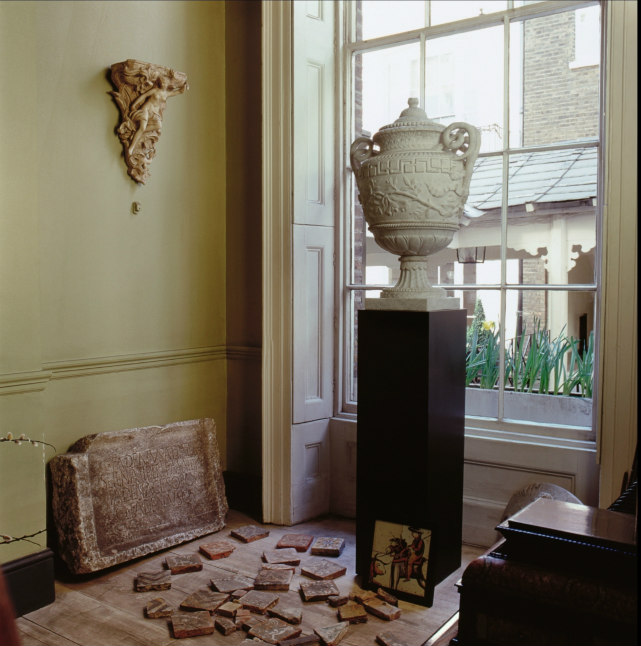
Fragments of tiles and antique marbleare arranged beneath an 18th century replica of an antique cinerary urn
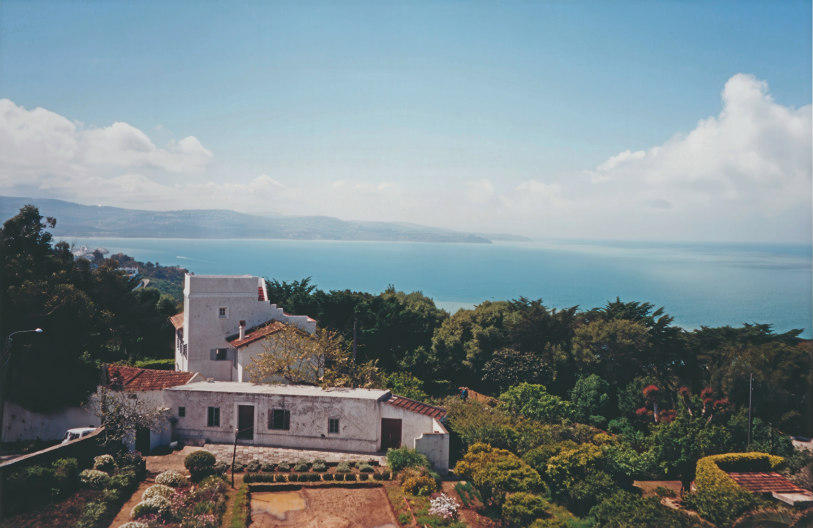
The view down to El Foolk from the Chapelle, before work on the pool began
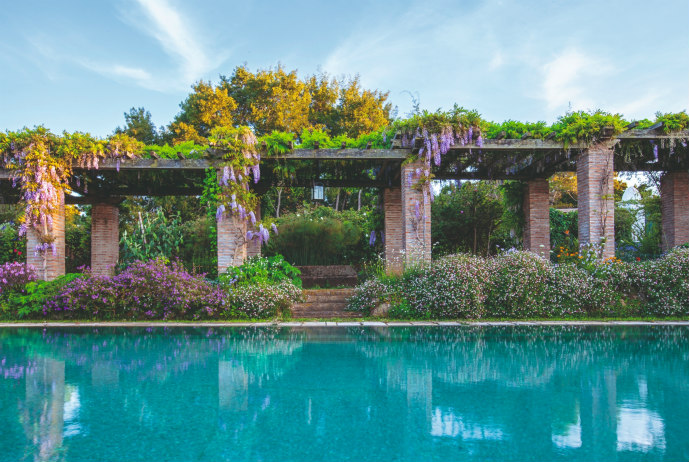
Wisteria tumbles over the pergola above a sandstone seat that used to be at Clifton Hampden
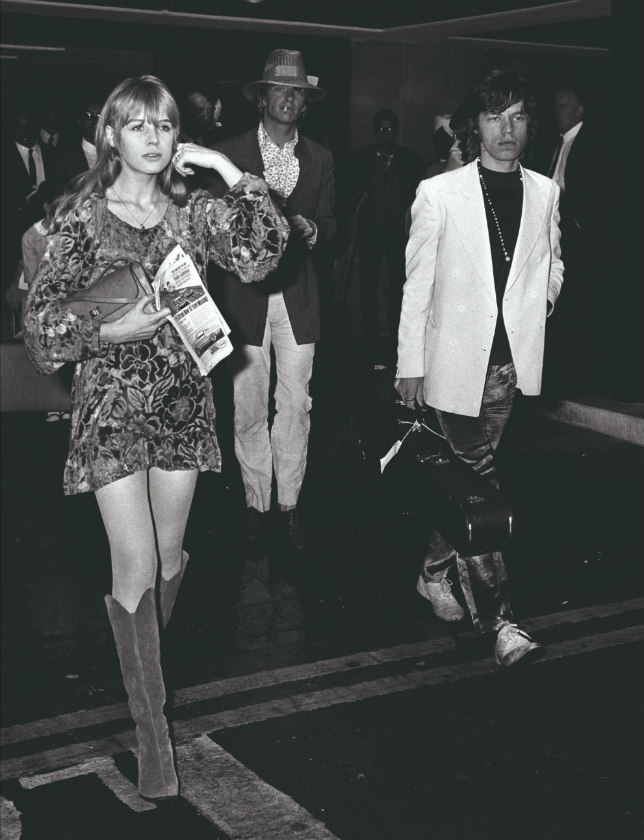
Marianne Faithfull, Christopher Gibbs and Mick Jagger making their way to the Butler Society Dinner at Kilkenny Castle, Ireland, August 1967
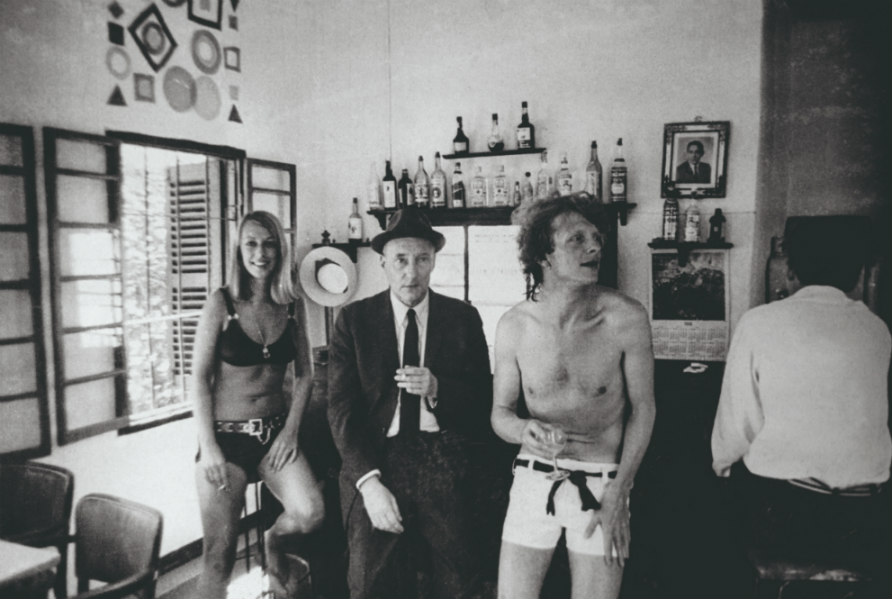
The artist Nicolette Meeres, William Burroughs and Christopher Gibbs in Tangier

A carpet-covered table and brightly painted cane chairsoutside the hammam, with a tiled panel on the wall

In Tangier, Peter Hinwood with Christopher Gibbs
“Extraordinary personal charm, which was reflected in the places that he created”
Lucy Moore, while critical of some decorators of his time, Christopher Gibbs was close to the acclaimed designer David Mlinaric?
Very much so. They worked together a lot, helping to restore Spencer House, and for the National Trust, and with the big British galleries and the Victoria & Albert Museum. They were great friends as well as colleagues. David’s wife Martha worked for Christopher in his shop before she married David in the mid-60s. They were completely intertwined.
Did he travel a lot?
He went to Paris as a student. I’m not sure he ever went to America. I thought that he had met Robert Mapplethorpe in America, but actually he met Mapplethorpe in London. I really think he went to Tangier and decided that Morocco was the place for him. He never went to India, unlike so many of his contemporaries. I never heard him talk about New York. He went to Australia to see my husband’s family who were all growing up out there, and he liked to go on holiday if somebody asked him to a Greek Island or something. But Morocco was his place. It really spoke to him. It answered something that he was seeking.
ou knew him, what kind of person was he?
Full of charm. When I first met him, my husband took me to stay with him and he had a little cottage in Clifton Hampden. The snowdrops he loved were out and he took us around to show us all these special secret places that he knew where the good snowdrops were. That was really fun. I’d just written my book about Lord Hervey, quite an obscure person in English history, who was an advisor to Robert Walpole, but not very prominent except for having written his memoirs. Christopher said, “Of course I know Lord Hervey. Not only that, look at this cup and saucer. I just bought the china that came from the house of his lover, Stephen Fox.” He knew something about everything so I loved that side of him, but he also was just very warm. He could be a little bit waspish, as you can see in some of the articles in the book, but he was a kind, very charismatic person who was a delight to be around.
Was he friends with King Charles?
Yes, he became friends with King Charles through Candida Lycett Green, John Betjeman’s daughter. As far as I know, they were very fond of each other, and it was a lasting friendship for both of them. I know Christopher felt very close to him.
A British gentleman with a very conservative way of living who liked old objects and antiques, at the same time he was someone who revolutionised fashion. Certainly eccentric, was he a bit of a rebel?
Yes, and he was always very comfortable with being gay. He’d spoken to his parents about it, and it was very much accepted. There were five brothers and of the five brothers two were gay, nobody thought anything of it. But that was at a time when it was against the law to be a “practicing homosexual” as they would have said. He was quite a revolutionary in that sense. He was also very relaxed about drugs in the 60s. He obviously wasn’t carrying on taking lots of drugs into his later life, but he campaigned for drugs to be decriminalised. In many ways he was a forward-thinking person, although as you say, he did like to live himself in this rather old-fashioned way.
Why did you particularly want to put together a book on Christopher Gibbs?
I wanted to establish something which would be a permanent memorial of him. It was a complete labour of love. I absolutely adored him. We’re so lucky to have had him in our lives, and I really wanted to do something that would preserve his legacy for future generations so that in 250 years somebody will be able to pick it up and know that he existed. The houses will be dispersed, the gardens will be gone. He’s a very important figure, a Horace Walpole or a William Beckford. The gentleman-aesthete is a great English tradition and he was part of that. I wanted to put a stick in the ground to say he was here and this is what he did.
He’s not a star like Mick Jagger, more a friend of the stars?
People wanted to be his friend rather than the other way around. The houses and the gardens were an expression of his personality. He was a marvellously attractive person who always had a story about something. He was comfortable with the grandest things but also the humblest things, and that is very modern and important. He loved people and houses who were what he described as being “true to themselves”. He couldn’t bear the idea that you might go to buy a flat pack chest of drawers when you could buy yourself, probably for the same money, a beautiful old chest of drawers that somebody else had used before you. He loved that sense of provenance and didn’t like the ordinary.
Was he interested in contemporary art?
I don’t think so really. The artists of his time that he was interested in were his friends, such as Patrick Procktor or David Hockney or those kind of people who were part of his world. He liked their work because of that and he liked again always things with history with a kind of provenance that was connected. He loved all the McBey pictures because they came from the house that he loved.
As a decorator, can one say that there’s a Gibbs style?
I don’t think so, because the decorating he did, for want of a better word, was because friends of his asked him to do for them what he did for himself. It was all about having interesting things and making them look lovely, and he loved the bones of a house. For him it was very much about the objects, the pictures, the furniture, that taken all together would create a sense of that person. It created a sense of him in his houses and he helped his friends do that in theirs. I can only imagine that the houses he did up for Mick Jagger would look like Mick Jagger, but I don’t know.
Do you sometimes go to his house in Tangier that the family has kept?
Absolutely. It’s a most magical place. It feels as if Christopher has just gone off for a swim or gone down to buy something in the market. It feels still full of him. It is very resonant of him.
Lucy Moore, there is a lot of love in your words today, and also in your book. Thank you very much for being with us.
ENJOY THIS INTERVIEW? SHARE IT WITH A FRIEND.
Portrait of Lucy Moore by Sophie Lindsay
Christopher Gibbs: His World, £50, Published by Clearview Books