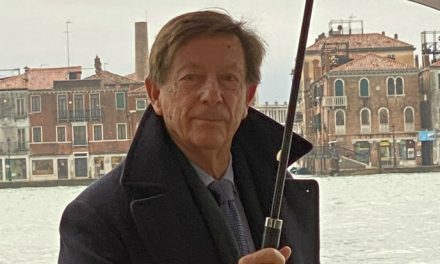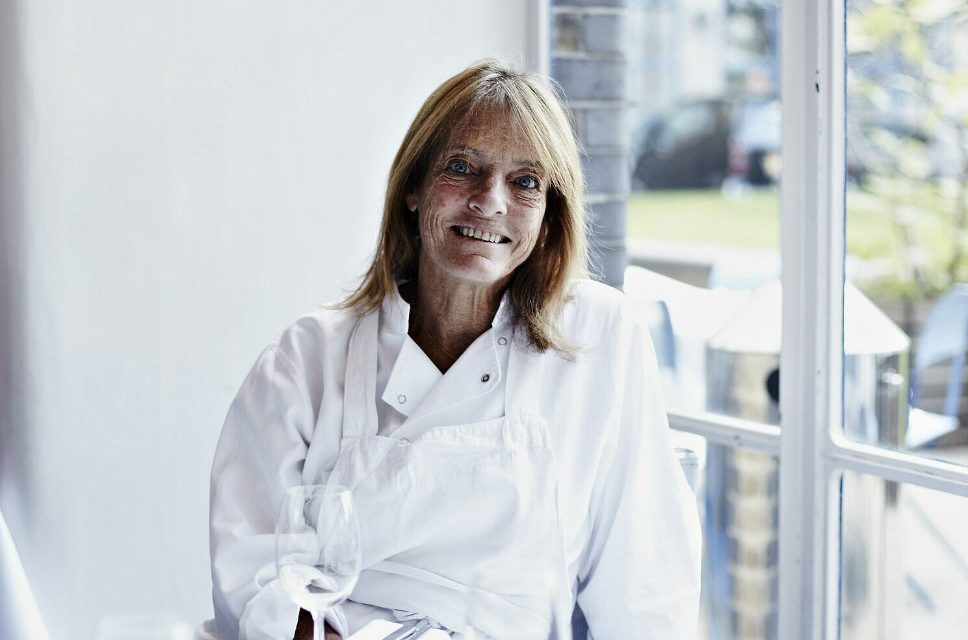
EASY PEASY LEMON SQUEEZY. Ruthie Rogers, CBE is an American and British chef who owns and runs the Michelin starred Italian restaurant The River Café in Hammersmith, London. She is the widow of the Italian-born British architect Richard Rogers, Baron Rogers of Riverside, who together with Renzo Piano created the Pompidou Centre in Paris.
21 minutes read time.
You can listen to the podcast of this interview here.
Ruthie Rogers, how did you become so interested in food and create the River Café, a must-go-to destination when in London?
The trajectory is of many things. I grew up in upstate New York in a small town which became a very famous town because it was called Woodstock. My parents were great friends with the artist Philip Guston. Artists and musicians were always around us, and food was important in our house, very much a vehicle, a way to gather around a table and to talk. My father was very political.
What was your father’s profession?
He was a doctor and my mother was a librarian, but food and people were always part of our lives. More people came to our house than we went to other people’s houses. I was part of the whole political movements in the 60s and Vietnam formed of a lot of my culture. When I met Richard and fell in love I was 19, so I was very young. He was 15 years older, but the real moment for us was in the 70s when he won the competition with Renzo Piano to do the Pompidou Centre.
“I always want somebody to come to the River Café and leave happier than they arrived.”
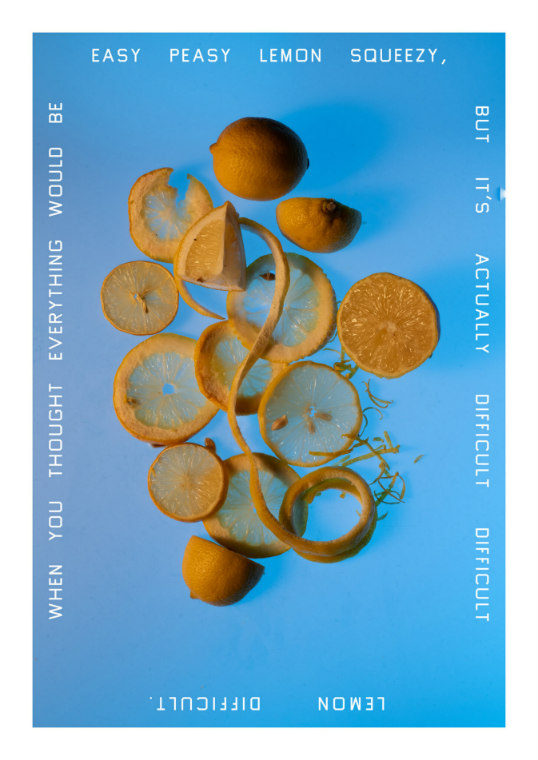
Ed Ruscha – Easy Peasy Lemon Squeezy –
Ruthie Rogers, do you love Paris?
I do. For six years we lived in the beautiful Place des Vosges, when it was even considered a slightly dangerous area – it wasn’t as fashionable as it is now – and we had a life of building this building. I had a baby there, and Richard and Renzo came home for lunch most days. It was a revelation to go to the market, to cook. The tabs in our cheque book show that everything was spent on going out to restaurants – Richard and I travelled miles to try a new restaurant. When we came back from Paris, Richard loved the idea of finding a place where there could be a community of people working together. We found these warehouses right on the river Thames in Hammersmith. They were an oil depository, and so he tore down one so we could have a view. He had architects, designers, frame makers, and artists in the studios, and as I’m a graphic designer I was working in the office editing books and doing exhibitions. We needed a place to eat. We were used to Paris where you go down to a café.
A social centre?
A place where everybody in the community can meet over food, over a cup of coffee. The idea was like you do in European culture, you meet in a café, in a place to talk over food or a Negroni or a Campari or a glass of wine. After trying to find somebody else to do it, Rose Gray, an artist who’d gone to college with Richard and who I had known for years, went and had a look at this teeny tiny little space and said, let’s do it ourselves. I was ready to do something new as our two children were both in school, so we opened a place called the River Cafe. It had nine tables. Rose made sandwiches and I made a pasta, and the next day she would make the pasta and I would make sandwiches. It started very small, only open for lunch, but, very slowly and very organically, it grew.
The River Café became the best Italian restaurant in London with a great atmosphere, is it very difficult to get a table?
I always say the best time to book is the same day because you always have cancellations, but it isn’t that hard to get into. Richard’s mother was born to a rather privileged family in Trieste, and she came here during the war with very little but she wanted to eat well and she was an incredible cook with an Italian tradition. She taught all of Richard’s friends and girlfriends how to cook, and she influenced me enormously. Having family in Florence and a mother-in-law from Trieste, we realised the restaurants in London did not reflect the kind of food that we cooked or ate in Italy. We went back to very regional, very simple food, with really good ingredients. We only had Italian wine, and we cultivated relationships in Chianti for the wine, but then we went down to Puglia and understood the cooking from Puglia, we went north to Piemonte for the wine and discovered the porcini and the polenta. Our roots really are in Italy.
Are high quality seasonal ingredients very important to your cooking philosophy?
There are very few ingredients on a plate in the kind of Italian cooking that we are influenced by. If you just serve a piece of grilled turbot or sea bass with a half a piece of lemon and salsa verde, the fish has to be the freshest fish, the lemon has to be the juiciest, most wonderful lemon, and the salsa verde to be fresh herbs and very good olive oil. Everything has to be chosen with great care.
With your close friends Ed Ruscha, Jony Ive and Heather Ive you have created a book about lemons called Squeeze Me, published by Rizzoli?
Even before he became a friend, I’m a huge admirer of the work of Ed Ruscha. He’s always done books – books that are very small and larger ones, very personal books, and I said, well, maybe we could do one. He had a retrospective at the Museum of Modern Art in New York, so he said, wait till that’s finished. Then the retrospective went to Los Angeles and he said, wait till that’s finished. I showed up at his door a couple of years ago and said, okay, what about now? And he said, okay, I’ll do a book. It should not be a big big book and be about one ingredient. So I said, okay. His studio is in Culver City, quite urban, in a car park on a highway, but it’s fantastic and you walk in and then if you go into the back, it’s concrete, there’s cars out there, but it’s very beautiful, and there are a lot of lemon trees. So we said, what about lemons? Then we knew that we wanted a book about lemons, which wouldn’t be very big, and we started working on it. I started looking at all the recipes, and Ed did all the art in his studio.
The design of the book is very beautiful.
We were doing it in Los Angeles and I showed it to my very close friends Jony and Heather. Heather is a poet, and Ed needed words because a lot of his work has language on the image so I asked Heather if she would do some. There’s a quote from Pablo Neruda, there’s Oscar Wilde, Hemingway. A lot of them are written by Heather. Then Jony agreed to do the graphic design from his office LoveFrom. It was a book of four really good friends: Heather Ive, Jony Ive, Ed Ruscha and myself as a collaboration. One of the least painful, easiest and happiest books I’ve ever done.
You say that lemon is a mood, a spice, a herb as much as a fruit, and in your book are forty-seven recipes, from pastas and meat to risottos to tarts to drinks. The yellow lemon on a blue background. Is it a work of art?
It’s a book which has beautiful works of art by Ed. He did all the photography and the blue that he has chosen as the background is phenomenal. I’m really proud of this beautiful book when I hand it to somebody. The fact that it’s called Squeeze Me is sexy and fabulous. It’s a book of joy, and it has really good recipes. We tried to do the recipes almost as captions, so they’re quite small and there’s a lot of white on the page. That gives Ed’s work prominence, and every one of his images of the twist of the lemon is beautiful.
“A lot of immigrants talk about the food of their grandmothers, because very often the mothers adapt and the grandmothers retain the cooking of their country of birth.”
Ruthie Rogers, among these forty-seven recipes for drinks and food, is one special to you?
There are many. The pork cooked in milk with lemon peel is something that is so northern Italian, and has magic in the sense that if you squeeze lemon into milk, the milk curdles and then that cooks and becomes a sauce with just two ingredients: the milk and the lemon. A recipe is half poetry and half science. The science part is the chemistry of what happens when you put a squeeze of lemon into the milk and cook it, and the poetry is the deliciousness of the taste. I love the spaghetti with lemon because that to me is about being in Amalfi in the summer with my friends Jony and Heather, and sailing and stopping at Lo Scoglio or other restaurants and you’re given a pasta just with lemon and basil and you think it’s the most delicious thing you’ve ever had.
What about cakes and desserts?
There’s an almond and lemon cake. Italians have their cakes at breakfast, their ice cream walking down the street and very often an espresso for dessert. I love to have a coffee and a piece of dry cake in the morning. The cakes that we have here are possible to eat at the end of a meal, but it’s very Italian to have at the beginning of the day with a cappuccino. I love the lemon sorbet, having been taught by my mother-in-law how to make a really good lemon sorbet. And what could be nicer than a dry martini with a twist?
You have written 13 books and another one soon coming out is titled Table 4 at the River Café, based on your podcast interviews with famous people, architects, politicians and movie directors like Coppola. There is also a YouTube where the famous architect David Chipperfield interviews you?
David Chipperfield is a great architect and has a studio and a foundation in Galicia in Spain. I spent a few days there, talking and looking at the markets, looking at the architecture, going into the cooking of the region, and then we did a talk together and he interviewed me and I interviewed him.
Is food culture today more important than ever?
The culture of food has really changed a lot since 1987. People travel more and discover food of other countries. Very often if somebody comes back from a country, the first question isn’t what did you see but what did you eat, did you discover a new restaurant? Food tells you about a culture. If you arrive in Venice and go to the market it tells you about Venice and it tells you about the fish, it tells you about the way people shop, how they speak to each other. Restaurants have changed as well. It used to be either you went to a fancy restaurant and ate very well, or you went to an informal restaurant and it was fun but you maybe didn’t have as good food. Now restaurants are re-evaluating the way people want to eat, with their friends and their children. They want to see the food being cooked, so you have an open kitchen. People want to experiment, they ask questions.
Is this why you did your podcast Ruthie’s Table 4?
I did my podcast during COVID, and if you talk about food and memory it tells you something about the person through food. Did your mother cook? Did your father cook? Did you all sit around the table after school? A lot of the many different people I’ve interviewed grew up in poverty and are not entitled. They discovered food when they were successful, so see food as a measure of their success. Paul McCartney remembers when he didn’t have to look at the price before he ordered a glass of wine. Tracey Emin remembers coming to London as a young artist and really struggling with how she could eat. Everybody has experiences, memories. A lot of immigrants talk about the food of their grandmothers, because very often the mothers adapt and the grandmothers retain the cooking of their country of birth. Food is like music. I can remember what I was wearing and where I was sitting when I heard a certain piece of music, and similarly food brings back very strong memories.
How much do you cook yourself?
I cook every day in one way or another. It can be a bowl of pasta for my grandchildren who come to visit, or it can be coming into the restaurant. I cook less in the restaurant because of the amounts of food that we have to cook now, we’re so much bigger it is a different world, but I’m in the kitchen at least two nights a week, and I’m in the River Cafe every day.
Is it true that you change the menu every day and only decide the menu just before the opening of the restaurant?
Since the beginning, the chef comes in in the morning for lunch, we sit down and rather like you would do in your house we go in the kitchen and see what vegetables and fruits there are, what’s in the fridge. We see how the tomatoes are, the greens. We see what meats have been ordered, what fish has arrived. Then we sit down and write a menu for lunch. The menu evolves. It can depend on the weather, on the team you have cooking, or on what you feel like eating. We rewrite the menu, and while we’re writing the menu the chefs are filleting the fish, boiling the crabs, making the pasta. When we finish the menu, everybody has their jobs. If they’re just beginning, some people will boil spinach and make a salsa verde. If you’ve been here for a long time, you’ll make a risotto. The whole process begins again at around three o’clock when the evening chef comes in, has a conversation with the day chef and asks what did you cook, what’s left over, what can we do? Then they write the evening menu. So the menu is actually written twice a day.
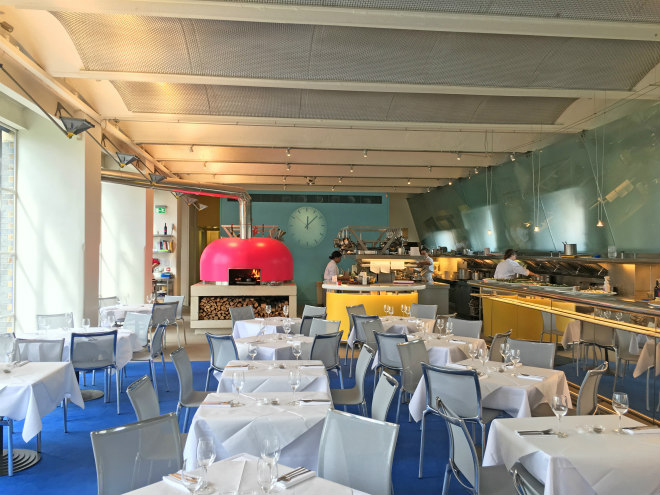
The River Café
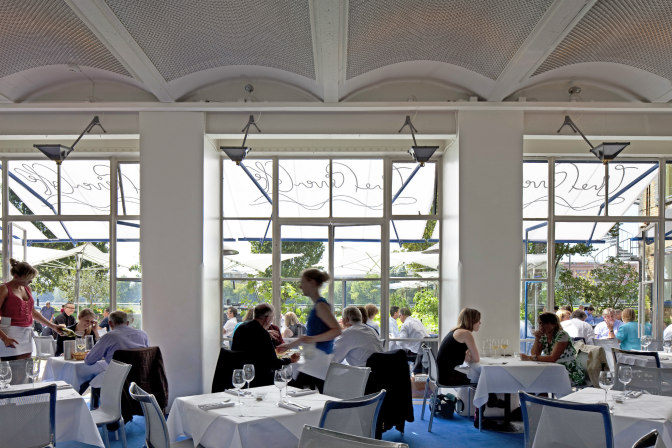
Interior light at The River Café
Photo by Richard Bryant
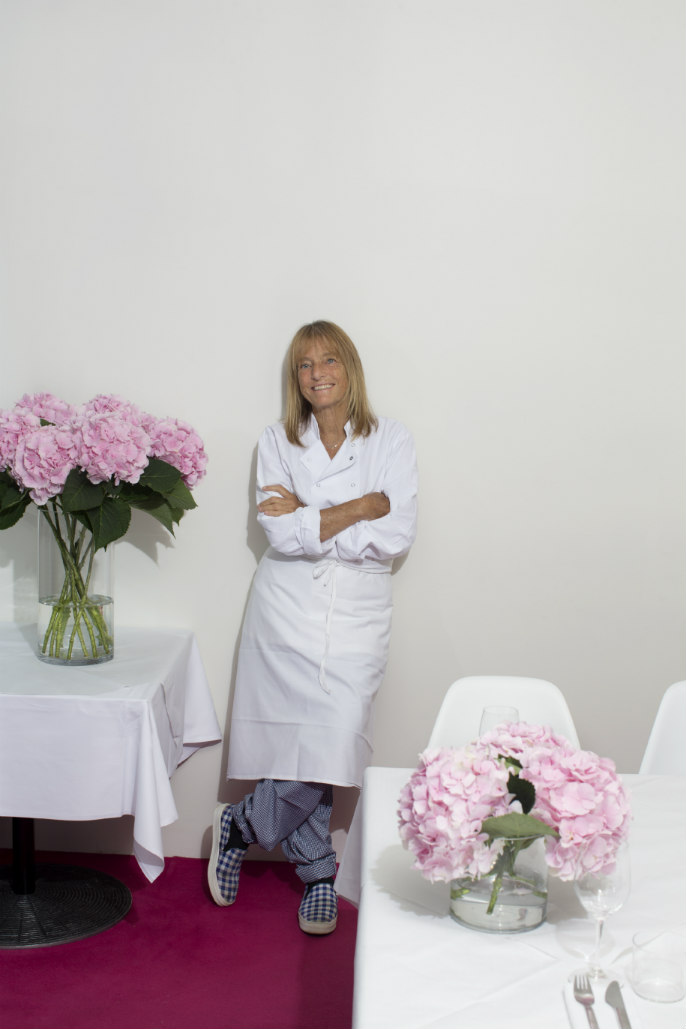
Ruthie Rogers by Matthew Donaldson
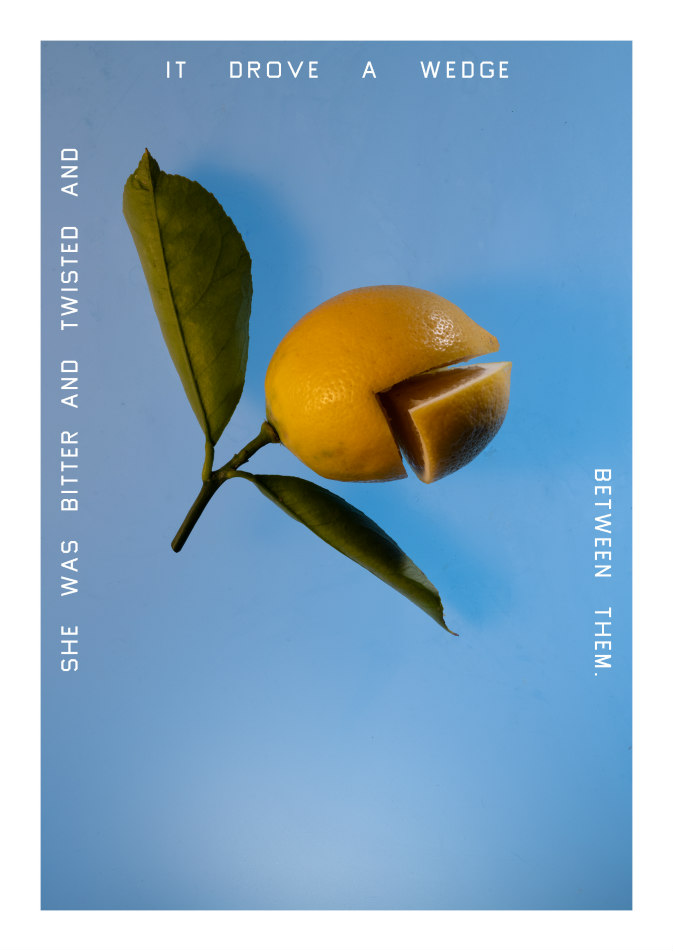
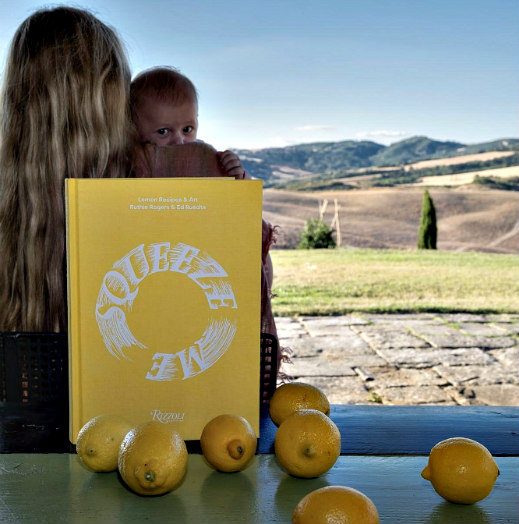
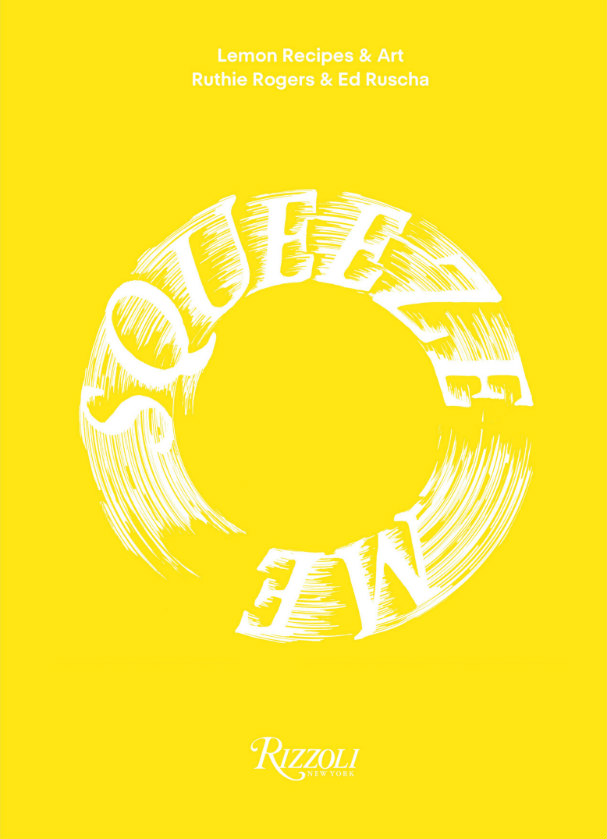
“I’m really proud of this beautiful book when I hand it to somebody. The fact that it’s called Squeeze Me is sexy and fabulous.”
Ruthie Rogers, do you always start lunch or dinner at the River Café with a pizza?
We always have pizza, but the chef will decide whether it has taleggio with potato and thyme or whether it has tomatoes and capers, or something else. We always have calamari with red chili, and we always have a mozzarella plate – but one day the mozzarella plate might have black olives and smashed chickpeas and braised cicoria, the next day it might come with a salad of borlotti beans and arugula. It all comes from the process of working together.
Do you also organise large party events in other locations?
We did a sit-down dinner for 700 people in June for the 25th anniversary of Tate Modern. We kept the River Café open that night, so we called on 42 chefs who’d worked for us in the past and said do you want to come and do this? They were so happy to see each other again, it was rather like a school reunion. We turned the small rooms around the Turbine Hall at Tate Modern into kitchens and each kitchen would turn out the food for seventy people. That made everything easy. Everyone was responsible. When it came to doing the risotto, every little kitchen made a risotto for seventy people and then the waiters took it out. It was beautifully done.
But how can you organise and serve a menu for 700 people?
It was easy. We had risotto, and then we had sea bass and spinach and roasted artichokes. Nobody waited more than fifteen minutes for their food. All the food came out at the same time. Somebody asked one of my head chefs, Sian Owen, how do you feed 700 people? And she said, you cook for 700 people the way you would cook for 7, with care, with patience, with love, with joyousness. Nobody was stressed, nobody shouting at each other. When I went around the tables and people said to me, gosh, this food is so good, I said, well, if you want to really know what’s good, go in the kitchens and see how happy the chefs are.
You say it was easy but to bring all these different elements together must be very complicated?
If you’ve been doing it every day it’s no more complicated than what a journalist or a movie director does. Everybody who works with people has a value, and the way we run the River Café, and always have, is to value the people who work here, to understand and treat them as individuals, to teach through hope rather than fear, to have a kitchen that is open so nobody shouts, but it’s very clean. We have a business as well, so people come here from a distance and they pay quite a bit of money, so we have to be as perfect as we can. It’s very rigorous. You have to have the food cooked, the restaurant has to be cleaned, and everybody has to be happy.
What are your personal values?
Curiosity and social commitment to what is going on around you in terms of the society that we live in. Is it fair? Is it a society that we want to improve, our local communities and our global communities? Is the world we live in sustainable? How you participate. Richard, my husband, was an active member of architecture, and as a person who does what I do, I’m an active member to make sure that the people who I deal with are treated with respect. For me it’s making friends, it’s commitment, it’s trust, it’s love. Friends are very important, but I would also say that society and the world, especially the world we’re living now, which is so divisive and so cruel to so many people, has to be made better however we can. We have to oppose what we don’t think is right, and form an opposition to what we think is going on and is unfair and is not who we are. As an American, I feel very strongly that right now what’s going on in my country is not who we are. We don’t put people on aeroplanes and we don’t take vaccines away from babies. I’m being political, but I think if we’re not political, we’re ignoring.
You’re political because you come from a political family?
No, it isn’t inherited. It’s something that you see or you don’t see. Obviously my parents were one way, but I know many people who have their political values in opposition to the world they grew up in, so how you form them is not very relevant. It’s what you try and do. Society is very important to me.
Are you a happy woman?
I am. Yes. I’m really lucky. I’m really happy. Yes. I am.
Are you able to have a good time even if the world is so confused?
Yes. I wake up every morning and think we’re really terrible but I live with hope that it will get better and what we can do to make it better. So “happy”, “sad”, I don’t know how those words fit in, but every day is a different day and I’m supported by great people.
After all, good food is something that makes people happy?
I do think it does. It is shocking and appalling to talk about food poverty, about children who don’t have enough food, who don’t come home to the kind of food that we eat or serve or my grandchildren eat. There is huge inequality in that. I always want somebody to come to the River Café and leave happier than they arrived. Somebody can sit down and have a meal and have good food and be with a friend or family and leave feeling good. That gives me great pleasure.
Thank you very much, Ruthie Rogers. We wish you every success.
Thank you.
Images courtesy of The River Café