

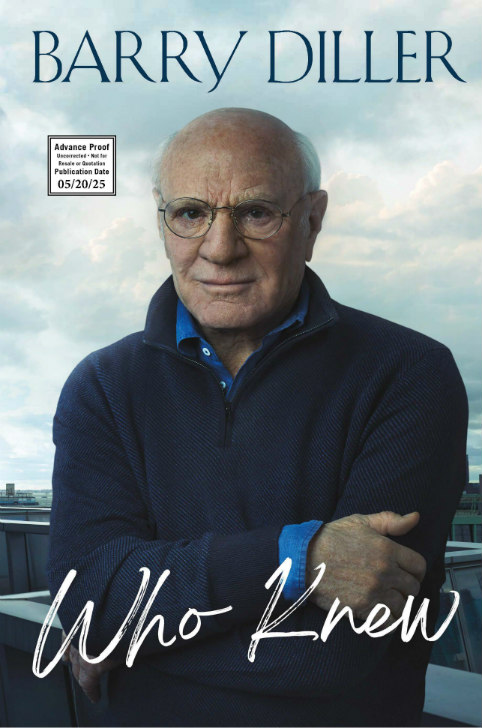
WHO KNEW. Barry Diller is an American businessman and philanthropist who recently published his life story in his book Who Knew with Simon and Schuster. The chairman and senior executive of IAC and Expedia Group, he founded the Fox Broadcasting Company with Rupert Murdoch and USA Broadcasting. He was inducted into the Television Hall of Fame in 1994. Barry Diller is married to the fashion designer Diane von Fürstenberg.
23 minutes read time.
You can listen to the podcast of this interview here.
Barry Diller, why did you choose the title “Who Knew” for your autobiography?
It came to me. I was trying to figure out what I was going to call this off and on, as it took me so long to write it. I was about two thirds through writing it and one day the words “Who Knew” popped into my head and I thought, it’s perfect. Some of my friends criticised and said it’s too flimsy and not serious enough, but I continue to like it as the title.
Why did you call your family dysfunctional?
I did have a dysfunctional family. Not the fault of my parents, who were perfectly decent people, but they really never were parented. Parents who are clueless tend to have children who are then clueless parents, and mine were very typical of that. My parents really weren’t engaged in my life from almost the very beginning, and also, where I grew up was a very cloistered small town in a larger town.
“You fake it until you make it”
Barry Diller, you were living in Beverly Hills in L.A.?
Yes, and even little Beverly Hills was stratified. I had a brother who was involved in drugs from a very early age and I was sexually confused and all of that. The good consequences were that I had to figure out how to navigate on my own from a very early age. That strengthened me. The bad aspects were that because I really had no parental interest, I didn’t think I deserved much of a future. All of that early stuff brewed into things that I benefited from in the end, though some of it was a struggle for sure.
Were you always close to your mother?
I’m not so sure of that. Maybe in the very early period, but after the age of 8 or 10 I was close to no one, and I’d given up on my mother because I didn’t think she’d basically protect me. That froze me off from trusting any humans.
That’s sad, as you also had to hide the early signs of your sexuality?
At the age of 11 or 12 I went to the Beverly Hills Public Library and looked up books on homosexuality, and every one of them, one after the other, were descriptions of it being a mental disease. That was the information, so I certainly couldn’t and didn’t talk about it to anyone else. To read that you are not only outcasted but mentally ill, when you don’t really feel mentally ill, is pretty devastating to a child.
You say there was little dialogue in your family, but did not lack financial resources and that your father liked Patek Philippe watches and Cadillacs?
I did get that love of cars from my father. I also got the watch.
Were you always very ambitious?
I’d never shown any great sign of ambition, but when I got to ABC and I’m 22 or 23 years old, suddenly the engine started firing. I started to get monomaniacally interested in the possibilities. We were the number three network, but at that time the three networks were it in the United States of about 100 million television households, and so, against today where there are so many options, then there were just three options. If you made a successful television programme, 35 to 50 million people watched it. I was so struck by that, and when I began to get ideas for doing things that were different than the other networks and was able to start projects like the first time television offered original movies, they were extraordinarily successful from the first hour of the first day. That super lit my ambition, and I had a great time in the late 60s and early 70s.
Was the advice you gave yourself never to do things that had been done before?
Yes, I’m not interested in repeating or trying to translate someone’s success into something else. What really intrigues me is what hasn’t been done, or what has at least gambling odds that it would succeed. When we started doing movies for television, it spawned doing the miniseries. The height of it was a programme called “Roots”, a really original story about African slave experience in the United States. It ran for 11 nights, two hours a night, and got more than 60% of the huge audience of almost all of the US. Later “Roots” was exported everywhere in the world. It was culturally relevant for months and months, and that was a great thrill.
In the book the aphorism “Fake it until you make it” is stated many times?
My wife Diane is the one who coined it after I had gone into some new venture and didn’t know what I was doing. She said, “You fake it until you make it, because it’s a new experience. You don’t know anything about it. You’ve got to fake it.” In my case, mostly, I did succeed and therefore then make it.
“It became the number one network, and when there were only four networks that was some achievement.”
One of the people with whom you succeeded was the legendary actress Katharine Hepburn?
I’d never met her, and I was at ABC aged 23 or 24 when she made a show called “The Glass Menagerie”. It was ordered by ABC before I got there. I was in charge of I don’t know what at the time, but somehow the call got to me and I answered the phone, and it was Hepburn. I thought this voice must be a fake, but it was definitely Hepburn, and she said: “You can’t put my show on with commercials because it will interrupt the flow.” I said, “I’m sorry, Miss Hepburn, but that’s what we do. We have to put commercials on it. We can’t pay for the stuff that we make.” She said, “Well, you can’t have this happen. This show is too good. Can’t you make an exception?” I said, “I don’t think we can make an exception, but maybe there’s some ways we could think about this.” She said, “Alright. I’m coming over now to talk about it,” and hung up the phone (as Hepburn did, she never said “goodbye” or “hello”). She walked in my office, rose up the blinds because she thought it was too dark, and said, “OK, well now what?” We started talking and figured out a way that we could actually sell this maybe to one sponsor and they would only interrupt it once with commercials. I said, “If you’ll go with me to try and sell this….” At the time this was to IBM, which was the biggest tech company in the world. Hepburn and I – I had just met her two days before – drove up to Armonk New York to their headquarters and we sold them the show and it went on. It was a great success.
And out of it you became friends?
Yes. Hepburn didn’t like L.A. very much but had spent, of course, a big part of her life there, at this time was living in New York. She’d just done “Coco” on Broadway, about Coco Chanel but she would have to come out to California often and we would get together. She loved driving around L.A., old haunts and old situations of hers. She would like to sneak into the swimming pools in those six or seven big houses that she had occupied in the 1930s and 40s, and we would take a dip in the pool and then scurry out hoping no one would discover us. I had great times with Hepburn.
You were also friends with stars like Warren Beatty, John Travolta and Barbara Streisand?
All of these characters from that period were in my life, partly because of work, however it gets to be friendships of various kinds. I met Warren Beatty when I was in the mailroom at William Morris, as I did Jack Nicholson. Warren’s four or five years older than me, Jack only a couple of years older to me. Warren was a star at 21, with his first movie. Jack couldn’t get a job in the early time that we became friends.
Charles Bluhdorn, the head of Gulf and Western, came into your life and absolutely wanted you at Paramount. You became the CEO of Paramount and did a great job there, and were very sad when he died suddenly?
He died at the age of 56, very young. He would have owned the world if he lasted. I picked up a lot at his feet about very large-scale businesses. In the late 60s through the 70s until he died in ‘83 he was the biggest industrialist in the world. His company Gulf and Western owned an endless number of companies. Being in his orbit, what soaked into me was an understanding of very large-scale businesses, so I was incredibly lucky.
In the book you also describe your relationship with Rupert Murdoch?
I did not contemplate Rupert Murdoch in my life, I only knew him socially slightly. I’d gone from Paramount to Fox and he bought the first half of the company from its owner, and so we started to work together. This is the great good luck of being involved with someone who was an extraordinary entrepreneur and gambler. He established always something that hadn’t existed before, in Australia, in the UK and in the United States. This was his first venture in the United States of any size and when I came to him and told him that I had tried while I was at Paramount to start a fourth network because I thought that the three networks were just all acting alike and that it was time for a fourth network even though everybody said that was crazy and people had tried that before and it never worked, he said: “Do it. How much will it cost?” This is in 84, just turning1985; a billion dollars was a lot of money then. He said, “I’m totally up for it. I’ll bet the company.” Now, very few people would snap up for something just because it sounded like a good idea, and secondly, would ever bet the company on a single thing. Rupert actually enjoyed doing that. That stimulated him. It took us about a year and a half, which isn’t very long when you think about it, but when you live through it, it’s a long time. It became the number one network, and when there were only four networks that was some achievement.
Why do you advise that when hiring people you should give them responsibilities beyond those for which they are considered ready?
It’s a very simple formula. Hiring people with experience who’ve already risen up several rungs on the ladder is okay, but it rarely works out when you bring senior people into already founded companies. It is so much better to find someone who’s young and doesn’t have a lot of experience, or who you think has some spark and energy, and drop them in the water. You give them an assignment that’s way beyond their history, experience, confidence, and see what happens. The better percentage of the time they succeed. Of course, some fail, but the odds are just so much better and it’s such a better process that it’s what I’m comfortable with.

Unlikely scouts, unlikely mother

Katherine Hepburn and Laurence Olivier on the set of Love Among the Ruins, 1973

With Rupert Murdoch
Photo by Ron Galella,Ltd./Ron Galella Collection via Getty Images

David Geffen and Diane

The IAC Frank Gehry Building

Little Island under construction, 2016
Photo by Micahel Grimm
“Serendipity struck again”
At a certain point you, a great corporate manager in a very important position, decided to become an entrepreneur and be your own boss?
I’d been this very successful corporatist, but, as much as I made as if those companies belonged to me, they didn’t, they belonged to somebody else. I thought, ‘Am I capable of independence? I’ve certainly been very successful in this corporate life. Could I be competent in my own?’ I had no idea, but the idea kept banging in my head until I said, “You know what? I can’t accept that I’m not capable of doing it.” That, negatively – not positively – forced me out, without a job, without a prospect, without an idea of anything other than being on my own, I left one of the most successful positions in the entertainment business.
Because you had made enough money?
I’ve been financially independent since I was four years old, so I wasn’t worrying about who was going to pay for dinner but losing power was definitely in my head. I thought, ‘I’m going to go from being certainly in the top two or three people in the entertainment business to being a non-entity.’ Those things are what mightily prevents people from leaving senior positions for some kind of independence. I got it also into my head and thought, ‘Am I really not going to do this because I’ll have to fly commercially for the first time in 25 years and I don’t want to stand in line at an airport counter?’ And I just said, “No, I can’t make a decision over that.”
How did you feel during this long year when you were out of work?
Exhilarated, being on my own with a blank piece of paper, which I like, but at the same time and somewhat gnawing was, ‘Will anyone ever hear of me again? Will I actually be able to do something?’ It was a worry overshadowed by a kind of freedom. I was on my own, looking very curious and fresh at the world for the first time since I’d gone to work for a company.
With Diane you had also created and found a real family, perhaps for the first time?
A family found me.
What did Diane suggest?
She said to me that she had been to this place called QVC which was a television shopping channel, and that I had to go see it. Now this is in 92/93, and it was the first time I had ever seen this primitive convergence of televisions, telephones and computers. A product would be offered for sale and the computer would track the calls coming in like waves coming into shore, and I saw screens that I’d only known to be used for telling stories being used for this interactivity. I was fascinated by it. I didn’t know, of course, about the coming of the internet. I did know that this use of screens for something other than telling stories was going to be a very important thing in a digital future. Serendipity struck again, and I found out this company was available to be bought, and so I bought into it and it changed the rest of my life.
You became an entrepreneur?
This was my beginning. Also it was very early days in the internet, so we began to buy and start, by all sorts of different transactions, internet companies – until we had about 65 of them and created an awful lot of value. I became engaged as an entrepreneur in the world of the internet and e-commerce. It’s been a fascinating process, and it was absolutely that phone call from Diane that ignited the beginning of IAC, Inc, which today owns brands across 100 countries in media and internet.
Today IAC is probably worth $100 billion, and you also have Expedia, a very large travel company?
I was lucky to be at the right place at the right time, which is a lot of success. It was fertile ground, because no one else was there at the beginning and so I faked it until I made it. I didn’t know much of anything about tech, but over the years my little fluency developed and developed, and we have ended up having built a lot of very valuable enterprises.
You also became friendly with the renowned architect Frank Gehry, with whom you built the extraordinary IAC headquarters in New York?
I have always been interested in architecture, and building Frank’s first building in New York was a great thrill. He’s great. People scared me off of Frank before I’d really known him. They said, “Oh, my god, you’ll go four times over budget and it’s difficult,” but not only did none of that happen, it was a great collaboration and we built a building that will stand the test of time. Then that got me into developing High Line, an elevated railroad track in New York that had been not used for many years which we built into a park. Then we had the opportunity to take a torn down pier and rebuild it, which I wasn’t interested in, but the idea of a floating island interested me, and that was another architectural challenge that we opened a few years ago, and it’s now in the top ten attractions in New York.
The Hudson River Park Trust asked you to do this, and it took 10 years to build with Thomas Heatherwick, a British designer. Everybody told you to call it Diller’s Island, why did you choose the name Little Island instead?
I didn’t want it to get named after me, and that was what people were calling it when somebody remarked in a meeting one day, “Well, you know, it’s only a little island.” I thought, ‘Little Island, that’s a great name for this whimsical place we’re building.’
Why did you build Little Island?
I’ve always liked public institutions, public parks and public places. I’ve always been amazed when I come across something that was begun 50, 80, 100, or 400 years ago, usually by an act of will of someone’s or an idea like Central Park in New York City, for instance. When I got the opportunity to do it I’m lucky our family has enough resources. It was insane in a way to try and build an island in the Hudson River, and it took ten difficult years and it cost wildly more than anyone thought it would or should.
Have you made a family Foundation with your wife Diane von Fürstenberg and her children, Alexander and Tatiana?
Yes, and all of the children and grandchildren over the age of 21 participate in it, now seven or eight of us. It has contributed to two or three hundred different organisations over the last several years, in everything from medicine to education, to helping people, to this and that. It’s waiting now for the next generation. Everyone in the family who’s over 21 can contribute anything they like in any given year up to seven figures. Their donations are all over the place, but I hope the foundation will find a central purpose for the next generation. It is going to have a lot of resources, because that’s the way Diane and I have handled our estate planning.
Since many years, you don’t have to queue in the airport, because you have made enough money to have your own plane?
Even better: I have enough money to have Diane have her own plane!
Can you explain your pride that your stepchildren are aware of and prepared for the responsibility of wealth?
If your children and their children are raised in wealth and are responsible, decent people who understand the responsibilities of having great wealth, I see no reason to deny them of it in the future. Wealth disparity is so great now that unless those that have it think deeply about how to distribute it for the greater good, the whole thing will come crashing down. I’m very lucky that Alexander has spent years, and – of his own assets – many millions of dollars trying to enact legislation in the U.S. to give every child a savings account. The vast majority of wealth is with people who own equity in companies, and certainly more than 50% of the U.S. population doesn’t, so he has introduced these methods for allowing people to participate in equity. That’s the responsibility of having it.
Does charity work bring you back to your Jewish origins?
I feel Judaism as part of my deep history and where I “belong”, but because my father was raised in a very religious household of 13 children he hated the stricture of very conservative Judaism and so spurned being in any way active religiously, probably since the age of 20. My mother grew up in an orphanage, so she didn’t have any, and so we never had any Jewish tradition in our family.
Why do you spend a lot of time boating?
Because I love the water, I always have. I was recently away from New York for 4 or 5 weeks and when I came back to New York I landed and went immediately onto a little boat of ours, because I miss the water so much. You just can’t keep me away from it. This summer Diane and I will go back to Greece where our boat is.
What do you do on the boat?
I swim, and I work. I’ve worked every day, some amount of the day, for ever, and I hope I will continue to do. Today you can do it from any place, we have very good communications on the boats. So I work some and then I swim – but not as long as Diane swims: two hours a day, ridiculous! And we go on hikes, and I ride my bike.
What do you think about the world of today?
I’m optimistic, but I’m also pragmatic and realistic that there are threats today. There are spear tipping points, whether it’s China or the escalation in the Middle East or the horror of Ukraine that are very worrisome. The threats and challenges are more prevalent. There is more polarisation. There are more extremes.
Do you understand the politics of your president?
These are the politics I refuse to speak about. I will not utter his name.
And finally, is artificial intelligence really a big thing?
Artificial intelligence is going to be the next clear revolution. We are entering the next radical revolution. That’s what AI is going to be. There’s no question.
Thank you very much.
ENJOY THIS INTERVIEW? SHARE IT WITH A FRIEND


