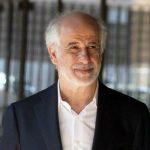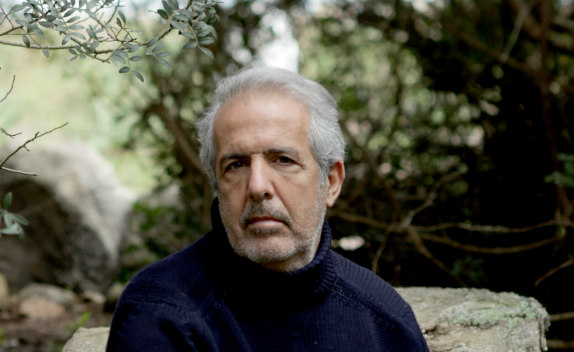
INTIMATE DIALOGUES WITH ANTONELLO DA MESSINA. Marco Delogu is an acclaimed Italian photographer, publisher, and cultural director whose work focuses on portraits of groups sharing common languages and experiences. He served a successful four year term as the Director of the Italian Cultural Institute in London from 2015 to 2019, noted for his innovative approach as the first photographer leading such an institute. Since 2022 Delogu is President of the Azienda Speciale Palaexpo, an instrumental body of the city of Rome that manages an integrated system of cultural spaces and events, capable of reaching a large and attentive audience.
29 minutes read time.
You can listen to the podcast of this interview here.
Marco Delogu, you just published a special book titled “Marco Delogu Antonello da Messina” of your images in dialogue with the images of Antonello da Messina, the early Renaissance painter of southern Italy. How did this wonderful project come to your mind?
In 2006 there was a fantastic exhibition of Antonello da Messina at Scuderia del Quirinale in Rome. Antonello painted just 35 pieces of art – oil on wood, oil on canvas – and almost every one was there. (There is one in an attribution process that is at the National Gallery in London, that probably is Antonello.) When I went to see this exhibition I had Stendhal syndrome. The museum was closed because it was Monday and I spent the whole day walking around by myself. I was completely mad, I almost lost my identity. I’m not an art historian but I studied art in Italian high school; and I studied Antonello, but just briefly. But Antonello was in my mind, so I photographed four Antonello paintings, starting with L’Annunciata di Palermo.
Did you photograph them with a special process?
Yes, in a very special process with my big view camera, putting just a portion; sometimes a bigger portion or a smaller portion. With L’Annunciata I was focusing on the face and on her eyes and not on the rest of the things, the book and her hands. I printed the photographs of four paintings of Antonello and I put them in my studio. I needed time to revisit these photos, but recently I decided that Antonello is my big maestro, and I wanted to do something.
“Antonello was in my mind, so I photographed four Antonello paintings, starting with L’Annunciata di Palermo.”
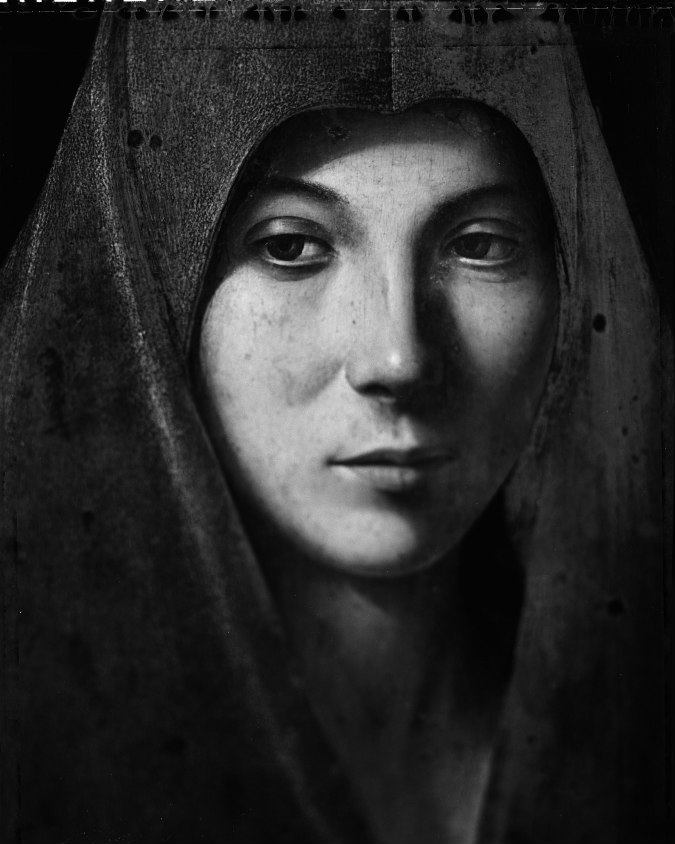
The Virgin Annunciate is a painting by the Italian Renaissance artist Antonello da Messina, housed in the Palazzo Abatellis, Palermo, region of Sicily, Italy. This photograph by Marco Delogu focuses on her face.
Marco Delogu, you are a specialist portrait photographer and Antonello is a great portraitist, maybe that’s what touched and inspired you to put your work side by side with his?
You are completely right. Going to sleep I was resting quite easy thinking about Antonello. I’m so close to a painter like Antonello and I’m so far from another great painter like Caravaggio. Da Messina’s portraits are very deep and the light is soft and the way they look at you is so intense. The idea to do something was always very close to me as I remembered going back to Palermo to see L’Annunciata. I was fascinated, but I didn’t know what to do. We live in this border between one millennium and another and at a certain point I decided that I wanted to put in dialogue the pictures that I did some years before. The idea was that I photographed and worked on Antonello in 2006 and I wanted to have that dialogue with images I made before the year 2000. This was not some silly exercise. It means that Antonello is so close to me that his work was in my mind before I photographed it.
Which picture of yours did you decide to put next to the Virgin Annunciate, L’Annunciata di Palermo?
After a lot of deliberation, finally I chose one of the iconic pictures I took of a gypsy woman in a camp next to Rome. I went there because I wanted to do some pictures and I saw this woman called Senada just by chance. I usually set up my pictures, but this one was completely by chance. I was taking another picture that is the last one in my book, and Senada’s partner Davide said that his wife was in this abandoned house. The son led me there and I couldn’t see anything, and finally I saw this apparition. There was Senada feeding this second son named Jonathan. Immediately I said: “Might I take a picture?” and she said, “Yes.” This was with my big camera in a gypsy camp – imagine the difficulties, and it was very hot – and I took this picture of Senada that has a little bit of motion in it – but the idea of her gaze is so fantastic.
Senada and the Madonna have the same mouth, more or less?
Yes, she has the same mouth, and has a completely different gaze but with the same power. I didn’t want to do something stupid like asking a beautiful model to pose like the Annunciate of Antonello. I maintained my own identity, but of course it refers to Antonello’s work. It’s a challenge that I have to do in total freedom.
In your book the next great picture is of Cardinal Ratzinger, who later became Pope Benedict XVI. Why is he juxtaposed with Antonello’s crying “Christ at the Column”?
There are no geometries, but in 1998 I happened to spend half an hour in a big room with Cardinal Ratzinger. I was a little bit intimidated because, even if not yet Pope, he already had such a big personality. So I made a picture from quite far away; and then, little by little, asked if I could get closer.
Was he seated on a kind of a throne in this room?
Exactly. In this incredible, empty, big room in the Vatican. It was a kind of a prophecy, because he was sitting in a sort of trance and then,, when I arrived very close with my 4 x 5 inches view camera, finally, I got this gaze. And this gaze at me by Ratzinger was incredibly good.
How was your relationship with this very interesting Pope who renounced being Pope?
The relationship became very relaxed. At the beginning I was a little bit anxious, even though I am never anxious when I’m next to important people and I have photographed Mikhail Gorbachev, who was another big, powerful person in the history of the last century. When Ratzinger was Pope I was at a communal lunch with him and then I had another occasion to photograph him. At one point his bodyguard became very nervous, and he pushed me, and my camera was destroyed. Batteries were falling down on the floor, and I remember Joseph Ratzinger – already Pope – getting these batteries and giving them back to me. He was always so elegant, with his red shoes and with his secretary, Father George, who was the most beautiful man in the world. During these few times, just three times in my life, I always had a good relationship with him. There was an incredible atmosphere and not many words, but he did talk about himself and about his brother, about Germany, and about the doctrine of the faith.
While you were photographing him?
Yes, because it took 30-35 minutes.
Why did you put him next to Antonello’s Christ at the Column?
There is no geometry at all in these being next to each other, but there are figures and there are these eyes which lead the photos.
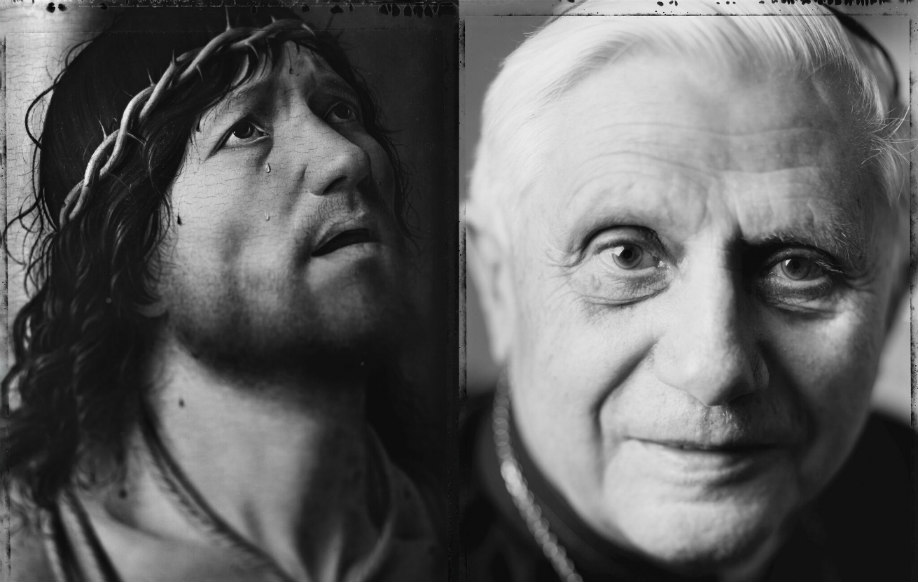
“If you want to get into these two pictures, you have to enter and then to get away from these eyes.”
Marco Delogu, also in your book is Antonello’s Portrait of an Unknown Sailor in Cefalù, a man with very ironical eyes. Why did you put the imprisoned man Pierluigi Concutelli next to him?
I put this man who was in jail there because he died, and he had been the most important person in jail in the years of his conviction sentence. He was the biggest pain in Europe, because he killed someone directly. Unfortunately, this was a friend of my father, Vittorio Occorsio, the judge. Then he put a bomb in the train between Florence and Bologna, the Italicus Express. Then he killed three people in jail. Then he was the founder of Ordine Nuovo, the horrible fascist extreme right organisation. He wanted to do everything Mussolini wasn’t able to do.
Did you go to see him in jail?
Yes, I went to see him in jail. When I entered the jail together with our mutual friend the novelist Edoardo Albinati I said: “I don’t want to meet Pierluigi Concutelli,” but then at a certain point I was locked in a room together with Concutelli. He had a very big voice, and because I was going into the jail for many days, he recognised me and he said: “I know you know the son of Occorsio. Why don’t you tell him this?” I wrote “this” down among my little notes on the photos and I don’t know who gave me the courage to then say: “No, I’m not going to say anything to this guy because you killed his father.” He said: “I killed his father as a member of the state.” I said: “You killed his father. Full stop.”
Were you afraid that he would kill you?
In a way I was afraid, but thank God after 30 minutes the police opened the door again. We were there together because there was a kind of revolt and he was allowed to go in this computer room and when I arrived with someone else he said that I had to meet Concutelli. I didn’t want to, but Concutelli had just burned his beard. He had a long beard, and in the picture you can see he had a very short beard. A camping gas cooker had exploded near his beard and so the beard was burnt and he cut his beard in front of me. He was re-cooking the pasta from the central kitchen on this camping gas stove, and so I had this lunch – me, this Prima Linea terrorist from Turin, Pannizzari and Concutelli – and it was such a strong situation that I said: “Okay, the last picture in jail I want to take is Concutelli.” When I lately rediscovered the pictures of Concutelli, I saw that there was something so close to this anonymous sailor of da Messina. It is a completely different diptych from the one of Ratzinger and Christ for many, many, many reasons, but it works much better in a graphic way.
Was Concutelli respectful with you as an artist?
He probably wanted me to talk with Occorsio. But of course I never talked with Occorsio. Anyway, he was respectful. There was a big story about the revolt of the Asinara prison island in 1978, when the left terrorists didn’t kill him and his comrade Tutti, and the deal was that they had to cook for them every time they met in other prisons. So Pannizzari was there – he saved Concutelli – and Pannizzari said, “Pigi, (Pierluigi) Pigi, you have to cook for me and for my friends.” So, that was it.
Next you have placed a very old prelate, whose picture you took just before he died, along with a beautiful picture by Antonello of the wounded Christ?
Yes, his name is Paolo Dezza, and I didn’t know that he was going to die. I photographed him in Casa Generalizia dei Gesuiti, where the last floor is a private hospital for the high personalities of the Jesuits and I went there to see him. It was an incredible meeting, and it took a lot of time because I didn’t want to leave and he was even laughing and everything. He was John Paul II’s professor of metaphysics.
How old was he when you took his picture?
90. He was appointed as Cardinal a few years before by John Paul II, and he knew that he couldn’t have any role because at the age of 75 the cardinals can’t do anything, not even vote in the conclave. He was old, and he told me so many stories, including about the expedition to the North Pole by Umberto Nobile which was sponsored by the Archbishop of Milan, and one of the deals was that Umberto Nobile had to put the flag of the Archbishop of Milan on the North Pole. But Umberto Nobile never arrived there. All the pictures of this expedition were in a room next to him, and Paolo Dezza gave me permission to go there and see them all and reproduce 27 pictures of this disastrous expedition to the North Pole.
This meeting with Paolo Dezza was two days before he died?
One week before he died. He told me many things about Pius XII, and about an aristocratic guy called Padre Peter Gumpel, who was the son of the second aristocratic German who tried to take the life of Hitler. Pius XII took him into the Vatican and he changed his name and worked there as a Jesuit. He was also the postulator for Pius XII, the person who has to present the case for beatifications. He only died three years ago at the age of 98 and I met him and photographed him too.
What linked Paolo Dezza to that image of Christ?
This. When I was leaving, very happy about the portrait being finished and about everything, he said: “What are you going to do next week?” I said: “Eminence, I’m going to stay in my studio and work.” He “Why don’t you come to my funeral?” I said: “What!” and he said “Give your mobile telephone number.” I had just got my first mobile – honestly, in ’98, because I was refusing to have a mobile, but in ‘98 I had my first phone and I gave the number to his assistant. His assistant called me up just half an hour before the funeral, which was made by John Paul II, with about 30 diplomats from all over the world in a chapel in St. Peter’s. John Paul II made his speech in Latin, he was completely ill that day so nobody could understand anything.
And you took pictures of the funeral?
No, no, I never took pictures of that funeral, but I went to the funeral. I put Paolo Dezza with Antonello’s Dead Christ supported by three Angels, because of this idea of pain. And then I like Antonello for the portraits, but I also admire when Antonello opens his vision and there are landscapes in the back, like for the other annunciations or the Saint Jerome in his Study that is in London. So I thought they were absolutely a great couple.
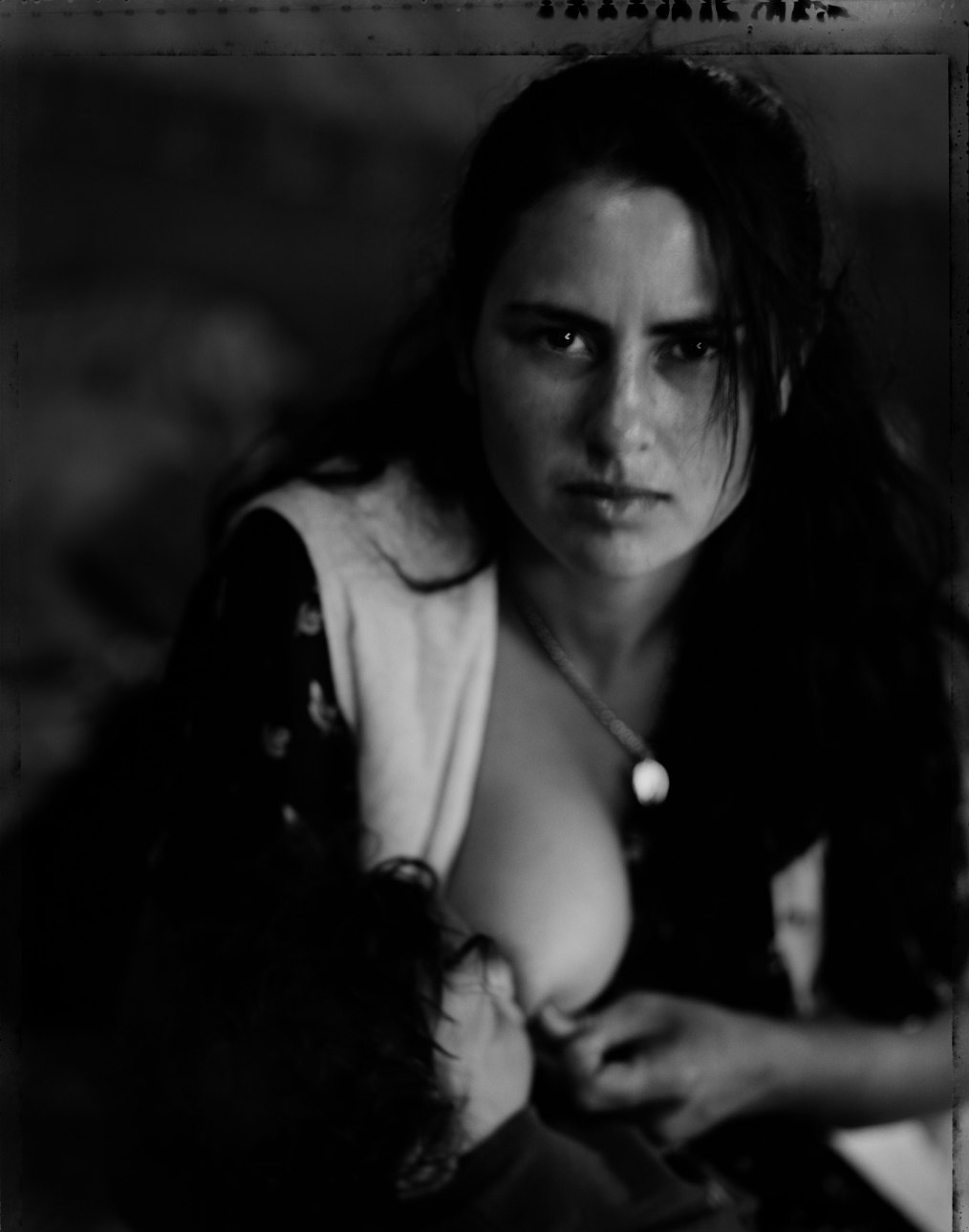
The gypsy mother Senada by Marco Delogu is depicted in dialgue with the Virgina Annunciate of Palermo painted by Antonello da Messina
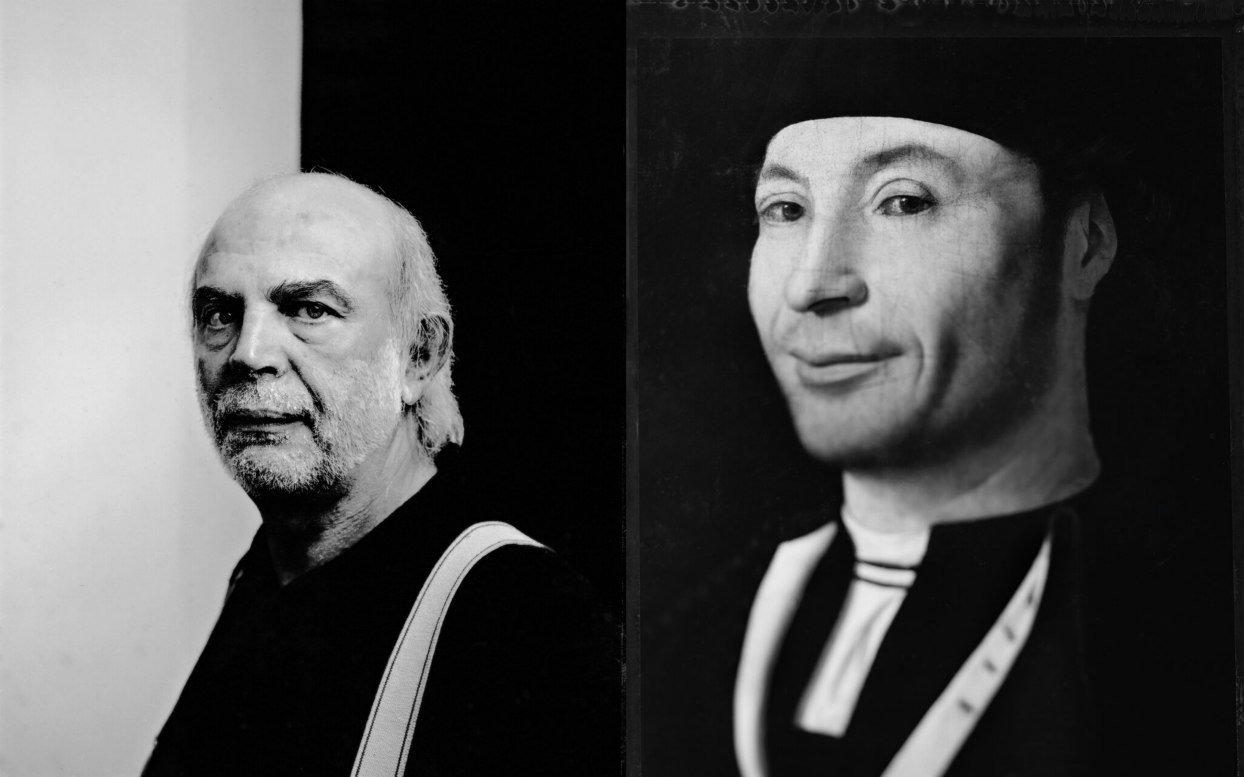
The notorious criminal Pierluigi Concutelli juxtaposed by Marco Delogu with Antonello da Messina’s Portrait of an Unknown Sailor which is housed in the Museo Mandralisca of Cefalù.
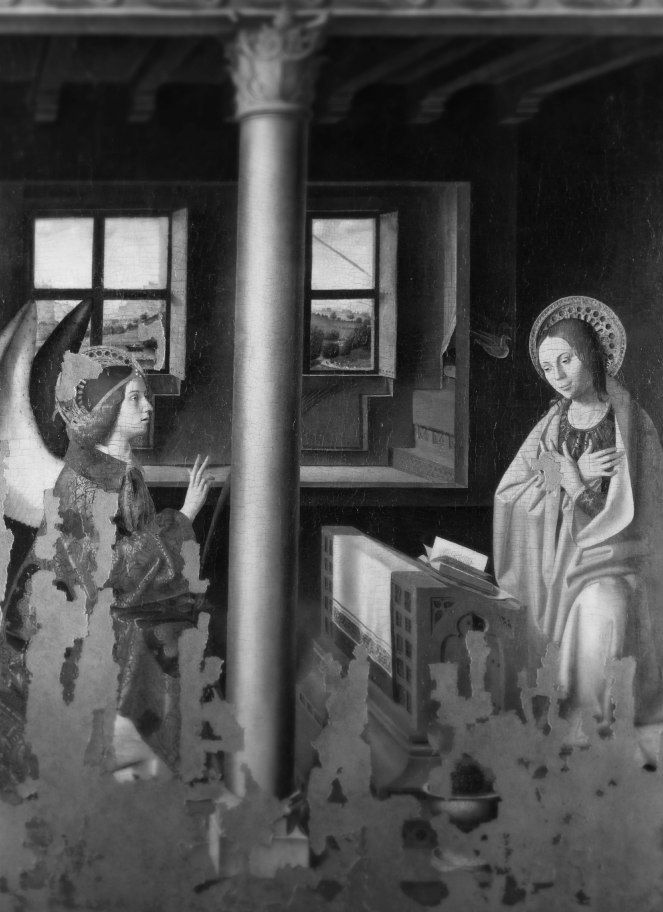
The Annunciation is an oil-on-panel painting by the Italian Renaissance master Antonello da Messina executed in 1474. It is housed in the Bellomo Palace Regional Gallery in the historical center of Syracuse, Sicily.
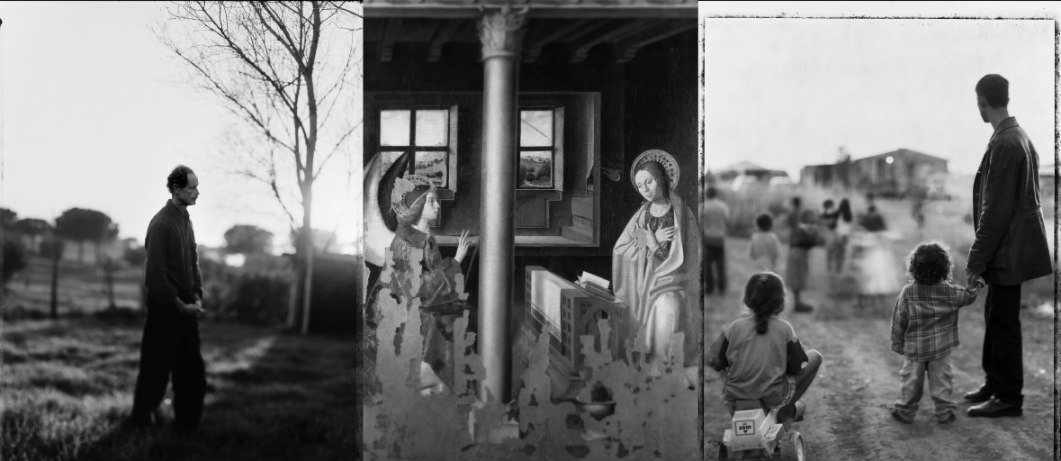
This iconic Renaissance work depicts a young, humble Mary interrupted by the Angel Gabriel in a domestic setting, and is known for its meticulous realism, complex light, and subtle depiction of the divine moment. Next to the painting are two photographs of Marco Delogu’s. On the right, Davide, holding the hand of a child, the husband of Senada, the gypsy woman that he juxtaposed with The Virgin Annunciate of Palermo. On the other side is a very simple depiction of the writer Erri De Luca, standing with his hands together in a country landscape.
“I want to finish my work with Antonello da Messina and then I just want to go on and be open.”
Marco Delogu, with 11 pictures your book is like a story, and another painting you portray is Antonello da Messina’s masterpiece The Annunciation, painted around 1474, and housed in the Galleria Regionale di Palazzo Bellomo in Syracuse. Why did you put the writer Erri De Luca and the gypsy Davide in dialogue with Antonello da Messina’s Annunciation in Syracuse?
Let’s start from the less important part of this triptych: the graphic works very well, but the revolution of Antonello is that it’s the annunciation without the angel, for the first time in the history of art for L’Annunciata of Palazzo Abatellis. In these times, in this picture, in this big painting that is in Palazzo Bellomo in Ortigia, Syracuse, Antonello put the angel. So I needed two figures, and one is Erri with his hand that also leads the tree, the hands, the face. For me, emotionally and from the vision, he worked so well with the angel, and there is a little bit of foggy landscape and this very sharp person. I didn’t do these pictures of the Annunciata of Palazzo Bellomo in 2006. I didn’t do these pictures at all. I asked someone else to do these pictures of the painting of Antonello with certain rules that are my rules, such as the depth of field. It’s the only picture where there is a lot of landscape and other things and I put next to it Davide, the partner of my Madonna Senada who is the gypsy feeding the baby; and so it’s like a circle.
Out of all the writers you have met, why did you choose Erri?
Erri and I were friends when we were kids, but he is 10 years older, so we were friends with a big age difference, not very big friends. Then he went away to Africa and worked all over the world, and when I met him again, he was translating the Bible. So I said to myself, if I have to put a writer, I will have someone who is working on the Bible and I saw some pictures that I took of Erri and these pictures worked very well with this painting. I needed to do this painting because it was in the same room when I did a show for the first time in Palazzo Bellomo in Syracuse, and it was such an honour for me to do an exhibition next to Antonello, and this is a big picture, 180 centimeters by 180 centimeters with a lot of problems, as you can see. But it’s very, very powerful, and the honour of being in that room for six months was another inspiration.
You’re not a pretentious person, and obviously don’t pretend to be the Antonello da Messina of today, but still, it needs a certain courage to do work like this. Is this kind of work a new inspiration for you?
Yes, I never did something like that before. It could perhaps be quite close to when I photographed the heads of Roman statues, emperors or philosophers in the old Roma. It’s a problem with the unconscious. I get inspiration from my life, getting to know Erri for many years, getting to know Ratzinger and Cardinal Dezza, Davide and his gypsy partner Senada. But there is something else: the passion to go to see a piece of art in a museum, the passion for study, the passion to have masters.
Are you a religious man?
No, but I have so many questions about what is. I was born in a very Catholic family, but when I was very young, my father and mother finished with Catholicism and became communist. But my uncle was an archbishop who was very close to Pope Paul VI, and I went to see him just a year before he died, and this is where all my interest in the cardinals began. I’m talking with Don Matteo Zuppi who is the head of the Italian bishops, the bishop of the Sant’ Egidio community, the Archbishop/Cardinal of Bologna. I said to him: “I don’t know what is going to happen to me but I don’t feel any religion, but I’m open,” and he, playing games with me, joking, said: “Sometimes you should try to go and look for religion, not just waiting and waiting.” I don’t know what is going to happen, but of course the older I get the more I interrogate myself on why I lived this life, why I do this work, why I am interested in power as the president of a big institution, and the more I go on, the more I want to stay with myself and probably just work like that.
You want to be an artist, even if you are now in a position of power in the city of Rome because this big museum and others are part of the Roman museums?
Exactly. Absolutely.
You were a very active and intelligent director of the Institute of Culture in London but ultimately want to be remembered as a photographer, rather than as a director and museum president?
Yes, honestly, I’m a photographer. Like Giorgio Bassani was vice president of national TV, but he was a writer, and we remember Bassani for his beautiful novels, for his beautiful romances. When I was in London, I gave funds to retranslate Bassani because 2016 was the Centennial of his birth, and everybody has to struggle in life but this book is an artist’s book, not a book of a huge number of copies. I wanted to do it because I really needed and wanted to say for myself what gave me emotion, what gave me pain, what it is to be a photographer.
When and why did you decide to be a photographer?
I started very young in ‘80, ’81, when I was 20, 21 years old. I also started with some very difficult work, because it was the Year of Disabled People in America, USA, and it was incredible because there were a lot of people with problems coming from the Vietnam War.
Why did you start your career in America?
I was born in Rome from a Sardinian family and went to England for two years, 1978-1979. In 1981 I wanted to go America and the way I could pay for myself to be in America for four months was to accept this idea of following the relationship between the biggest university and disabled people, because it was the Year of Disabled People. When I went back to Italy I started to work in psychiatric hospitals, because my father was involved in the famous Legge Basaglia opening the asylums. Three years after the law was passed I visited 16 asylums all over Italy to see what was the state of these psychiatric hospitals. So I started with two quite tough things. Then I had to understand what I wanted to do, if I wanted to be a historian and do university studies, or if I wanted to be a photographer, and I decided to be a photographer, also because I wanted to work on my own. I didn’t want to follow the career to become a professor where you have to be a student and then an assistant and then more than assistant and then a little professor and then professor. This is why I’m going back to my freedom in my photography.
How come you worked as president of institutions?
It’s a challenge, and sometimes it’s quite difficult because I don’t want to be in the middle of every bureaucratic decision, but we did many shows, talks and parties in my four years in London, and it was a different way to see a city. London changed my life, including that I got married, had my son, and met so many people. I always remember our friend Joseph Rykwert. Being Director of the Italian Cultural Institute was a great way to meet fantastic people. Joseph was at the top.
Did you take pictures of Joseph Rykwert?
Yes, pictures that I didn’t like, because there is a problem of distance in those pictures. I was so crazy for Joseph, I went to his house in Hampstead full of 45,000 books of the history of architecture and other books, literature books, etc. and then I didn’t keep the distance between me and Joseph. When I did the pictures of Joseph I was so close to him, not only physically, but also mentally. So the pictures, I didn’t like. Something similar happened with another great Joseph. I spent three hours talking on top of the Janiculum Hill in Villa Aurelia talking with the poet Joseph Brodsky and as I was talking with him I said to myself, this is a gift for three hours, viewing Rome, talking with Joseph Brodsky. Finally, when he said: “But you came to make a portrait of me.” I said: “Yes, but three hours is much more than a portrait for me.” I took a regular portrait, nothing extraordinary, and then I saw a beautiful portrait by Irving Penn of Joseph Brodsky and I said: “Okay that’s the portrait. Someone else already did it.” I enjoy these three hours so much and I am not that obsessive that I always have to take portraits. For me being a photographer is also a great chance to meet interesting people.
After your four years in London, how is it now to be in Rome?
It’s a very interesting city, quite difficult, not fast like many other cities, like London or New York. It has less political problems right now than New York from the Trump administration or after the Brexit that was from 2015 to 19 in London – Brexit was a disaster. I did something immediately in the first year here, putting together the foreign academies of art. Rome is the only city in the world which has this network of academies. There are 34, six very big – the French, the German, the American, the Spanish, the Swiss and the British School of Rome – and then there are others a bit smaller, like the Polish, the Romanian or the Scandinavian, etc. I wanted to go back to Italy and in Italy I wanted it to be in Rome. There are so many beautiful things to do and so much beauty. We have to stop saying that Rome holds nothing for contemporary art or writing because the other day I discovered that the American novelist Jonathan Safran Foer lives in Aventino, next to my house, and Cy Twombly passed all of his life here, as have many iconic artists. Other people like James Joyce didn’t like it and I can understand that, there is a chaotic and even problematic part, but there are so many things and especially if you go to the secret Rome to see archives of the state, archives of city hall, archives of the Vatican. For cinema it’s an important city, as it is for literature from Morante to Moravia to the youngest generation. How many thoughts were made in Rome!
These days there is a lot of talk about the vitality of Milan, is the vitality of Rome something different again?
It’s one of the lively cities in the world, albeit with so many handicaps. It’s not a place where there are many companies who could support art. The vitality of Rome is different from the vitality of Milan where there are entrepreneurs like Prada or other big collectors who invest in art. Rome is not like that at all. You have to make a balance between what you get from the state, what you get from city hall in terms of museums. The oldest museum in the history of the world is the Museo Capitolino and there is an international community in Rome that is very interesting, from young people to old people.
Are young people interested in art?
Yes. I suffer because I don’t have so much time to study the young photographers or young artists, but sometimes I just see something and I say: “This is a young artist!”
After this tremendous book project with Antonello da Messina, who are you going to face now?
I want to finish my work with Antonello da Messina and then I just want to go on and be open. I was trapped in a way, doing series of portraits: writers, artists, inmates in the jail, traditional farmers, and jockeys of the Palio di Siena, etcetera. Now I want just to go free, and walk, and take pictures if I see someone I want to take pictures of.
How do you feel that nowadays everyone has a telephone with a camera and people take pictures all the time?
I am completely sick about the numbers of images, but I’m not against the technology when used for the right reasons. We produce so many images that is just rubbish, but I have the need to do pictures. The last time I saw a friend of mine called Michela Murgia, an Italian writer, I saw her by chance in a restaurant. I was by myself and she was by herself. She had just arrived from Paris and we had a pasta together and then she said: “Sorry I have to go home. I feel very sick.” I said: “No, stay!” and she said: “No I feel sick I have go home.” I gave her a hug and she said: “Probably this is the last time we will see each other,” because she knew she was going to die in a few days. And she said, “I will tell you one thing. You gave me a print of the picture of your gypsy, and that print is in my bedroom. Every night before I go to bed I say a prayer watching that portrait. You already did this picture! It’s enough.”
Thank you Marco Delogu.
Portrait of Marco Delogu on the island of Culuccia by Leila Barber
ENJOY THIS INTERVIEW? SHARE IT WITH A FRIEND