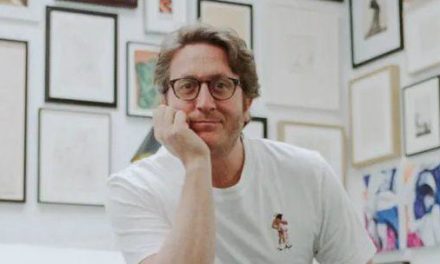
TALKING ABOUT A LOST WORLD. Ralph Toledano is an art historian and a writer. He recently published La Lune dans le Tourbillon, the fourth volume of a series of novels that explores the lives, questions of identity and spirituality, failures and hopes of members of the Sephardic elite of Moroccan origin: Un Prince à Casablanca, Revoir Tanger, Le Retour du Phénix were the previous ones.
28 minutes read time.
You can listen to the podcast of this interview here.
Ralph Toledano, why did you switch to fiction and leave your profession of art historian after you published with great success books on Italian painters, Antonio Joli, Francesco di Giorgio Martini and Michele Marieschi?
Because came a moment when I understood that I have so many personal things related to my experiences in life and my mosaic of cultures that shapes my identity that I couldn’t keep only researching on 18th century or 15th century painters, going to archives and digging. As an art historian, I spent many decades of great endeavours, visiting lots of private collections, being hosted by dukes in Scotland and seeing their collections and browsing through the archives in the attics. That was enthralling and taught me lots of things – not only about art, but about civilisation, other ways of life, other regions, other latitudes and longitudes. There was a moment when my mother died when I understood that I had to start doing what I had always loved above any other things: literature, real literature, and not technical literature. History of art is technical literature and you cannot put so much of yourself in it. You have to be always behind the artist whose memory you serve. This is why I started; there was an urgency.
You were born in Paris into a Jewish Sephardic Moroccan family. Is this what you missed and wanted to write about?
I didn’t miss it. I was born in Paris, but I went back to Morocco when I was six days old, so I grew up in Morocco in a society that was completely organic, between Casablanca and Tangiers, where the geography of the towns was entirely familiar to me. There was not a corner of a street or an avenue where there was not a building, a villa, a house, or an apartment of someone related to my family by blood of friendship. I grew up in the old world that hadn’t much changed in the human way since centuries. This is how I collected so many memories and so many confidences and secrets about all the families in the milieu of my parents. All that feeds my books. I had in myself the memory of an ancient and specific world and I thought, I hope rightly enough, that I was the only one that could save that memory for the future. This memory is also universal, because anything that is true, that has been observed and lived in a very sound and receptive way, is universal, be it Japanese, Moroccan Jew, or Scottish aristocratic.
“Forgiveness is the key to hope and to reconstruction.”

Ralph Toledano: La Lune dans le tourbillon
As Flaubert did with Madame Bovary, in La Lune dans le tourbillon, is the character Luna you in a way, even if this woman who had a very superficial daily life is very different from you?
Luna is completely irresponsible, and completely self-centred, indeed.
In this book Tangiers is a different city from the one of the past and has lost its light, and this woman named Luna, who used to be very beautiful, has become fat and poor and lives in a decaying apartment on the Boulevard Pasteur, the main street of Tangiers?
She has lost everything. She destroyed her marriage. She hasn’t seen her son for 30 years. She inherited a bunch of millions from an uncle who cherished her, and she spent 30 years spending them away between Switzerland and Italy rubbing shoulders with a very phony cafe society to which her lover belonged. He pretended to be an Italian Count but was an adventurer in fact and stole much of her wealth. The rest was just spent in big hotels, on expensive living and high-fashion dresses, convinced that those luxuries were the epitome of European civilisation. She had it completely wrong, exactly in the same way as her mother had it very much wrong when she married. When the grandmother ordered the wedding trousseau, she decided for black satin bed sheets because the salesman who travelled through Levant and North Africa convinced her that it was the last fashion. Luna’s mother fell into the pit where everyone in her family had been falling into since a few generations.
But they started in a very glorious way?
Yes indeed, apparently. Morocco was extremely poor, and the Jews were protected by the Sultan. But this protection went with much petty humiliations and huge taxes to be paid. Her great-grand-grandfather, who was already well to do, saved an Italian ship that was sinking in the Bay of Tangiers, lent money to the officers and hosted them. This granted him the Italian protection. Although it was not even Italy yet in the 1850s; it was still the Kingdom of Piedmont Sardinia. This ancestor became the Legate of the Kingdom, and from this moment they inherited through generations the title of Consul General of Italy. That protected them completely from any local laws that were rather arbitrary, especially concerning subjects belonging to religious minorities.
She doesn’t regret this situation of loss, because in the Tangiers apartment she is thinking, understanding, maturing and accepting this change, not as a tragedy, but as a different life, and you show us the new relationship she has with the Muslim people of Tangiers.
Yes, she discovers them – because she had never seen them in her life. She had always had Spanish staff. She had never spoken a word of Arabic, and saw them vaguely in the streets. Her society was the diplomatic corps, she would entertain the Minister of England and the Minister of Portugal and that sort of people. She would never pay attention to the Moroccans, except for some minor highnesses of the Moroccan royal family or the Sherif de Ouezzane who was the Moroccan equivalent of a European Duke. There were two or three Muslim families that she was vaguely acquainted with, because they had received a very much westernised education. The petty people was a crowd of ghosts that did not exist for her.
But she discovers them?
Yes, she discovers them, and it’s an incredible enrichment, because Luna is clever and she understands that from any situation in the world one can draw honey; not bitter honey, but sweet honey, because experience and understanding of whatever happened, even if it ended up with a horrible failure, is the great enrichment of life. We go through life from experience to experience. Failure and mistakes are sometimes the best thing that can happen to a human being, because they put us in such an uncomfortable situation of unbalance that we are obliged to make an interpretation of what happened to us, and this is what Luna does. Of course that needs brains, intellectual structure and moral intuition. This is why there is no nostalgia in Luna; she would think too vulgar to regret the glorious times when she had seven maids and a liveried chauffeur.
Luna establishes a friendship with Anne-Marie, a woman of a type she would never have even spoken to before, and she tries very hard to reestablish a relationship with her son Victor when he comes back to Tangiers?
She is a very ambitious woman. Not ambitious in the meaning that she is a career woman, all the contrary. She had millions and she lost everything – only some crumbs remain that prevent her from being completely a pauper. Her ambition applies to the moral and psychological spheres of life. Her endeavour is to understand the reason of her disasters and to turn destruction into reconstruction. She has a great sense and hope of fixing up things that have been broken. At the beginning of the book, she gives an example: there was a crystal vase, it fell on the floor and was reduced to thousands of particles of glass. How can you get it back to its beautiful shape? Luna wants to repair all that has been destroyed, and she undertakes a deep analysis, through generations, of what led her to the terrible collapse of her life. From those moral and psychological discoveries she hopes to explain her guilt to her son. Not because she wants to get rid of it, but because everyone should revise and analyse the constitutional elements of one’s history and fate. She didn’t do it when the son was young, when she was married with a very nice but very boring and provincial man. And therefore, in the manner of Madame Bovary, she eloped with a fake Count on the Riviera of Lac Léman.
So there is a Jewish side of her life but she lives very far from that religion and lives close to the Muslim world, something that nowadays seems quite rare and strange?
First of all, a historical fact. The Jewish diplomatic and merchant class in Morocco to which she belonged were all issued from the rabbinical cast. Those were the people that spoke languages and that had acquaintances in Livorno, in Marseille, in Amsterdam, in London in the City through regular letters between rabbis. With the Industrial Revolution they became the go-betweens and the merchant class of the very underdeveloped country that was Morocco. In her genes, in her remembrance, and thanks to her imagination and her intelligence of life, she understands that there was a treasury that has been sadly despised and she tries to reconquer it. That makes of her a real Jew.
What is a real Jew?
A real Jew is someone who lives in the middle of the creation and serves the entire population of the world. It is not for themselves that the Jews have to be a kingdom of priests, but to help the rest of the world be more peaceful and less disorganised and messy. Luna understands that there are wonderful things in any human being, and sees the sparkles of humanity in the woman aged 23 called Latifa. This young Moroccan Muslim is a very essential figure in the book. Luna shares a taxi with her to go to the hospital where her friend Anne-Marie is recovered after an accident. Latifa has lots of preconceptions of what a Jew is, because she has never seen a Jew, and her meeting Luna will be a revelation. She thinks that all the Jews slaughter young Palestinian children and she sees such a human person in Luna, with such delicacy, such curiosity and such simplicity, that she says, “Well, I discovered something.” On her side, Luna discovers an average women belonging to the plain world, the little people in Morocco. It is due to Latifa that she will return to the house of her forebears where she grew up and lived until she left everyone and everything behind.
“One has to take the best of the past and project it in the future, because the future is hope of bettering life as a whole, and not only for oneself.”
RalphToledano, is Luna a character you have known or is she pure fiction?
Nothing is pure fiction. There is not a word, an idea or a situation, in any of my books that doesn’t relate to real facts. But it’s a mixture. I’m like a bee that goes in a garden with thousands of flowers and collect pollens here and there. Like the bees, I try to make honey. I hope not a bitter one but a sweet one. Luna is a mixture of many real persons. She’s also my father, in a way, I must confess, and many other people of our milieu.
Your milieu was among these Sephardic Jews of Tangiers and of Morocco in a world that doesn’t exist anymore?
As a milieu, it has completely disappeared. There are some leftovers of my social universe in Geneva, in Paris, in Madrid, in New York, in Israël, but those people are getting assimilated to other cultures. In its heydays, it was a very restricted milieu. When I was born there were 300,000 Jews in Morocco, and probably just 1,500 of those 300,000 Jews belonged to that very restricted merchant class, bankers and diplomats that had studied in Europe and were very much emulating the example of Alexandria of Egypt. Alexandria started its boom with the Canal de Suez in the late 1860s, whereas Morocco did not start developing before the French arrived in 1912. Tangiers was the diplomatic gate of the Moroccan Empire Cherifien. The great-grandfather of some friends of mine bought a De Dion-Bouton or Panhard, one of those luxury French cars of those years, and when the driver – who came with the car, because you bought a car with the mecanicien – arrived he said: “Well, that’s amazing. I shall drive the car around in the courtyard of the house every day 10 times so that the battery keeps working.” There was not a road in Tangier in 1910. The use of the wheel did not yet exist, but besides this underdevelopment there was a reduced group of families that I’m coming from, and this is what I describe.
Is the Tangiers that you describe in your novel the Tangiers of today?
No, because my novel takes place in 2007, when Tangiers was still in a dire state of disrepair. After the late King Hassan died, in 2000 his son fell in love with Tangiers. A few years later he started refurbishing it, creating new roads to lighten traffic, giving orders to repristinate the facades of many buildings that were falling into pieces. It was a sort of Cairo. I describe the decadence, but now if you go to Tangiers, thank God, you will see a city that has been remade up and with all sorts of architectural surgery – I wouldn’t say Botox but plasters. Most of the neighbourhoods are refurbished and flowering.
Is the Sephardic Jewish community coming back?
No! There are two or five Jews and they’re all over 90! I shall give a lecture in Tangiers on the 23rd of October and I wish to find them alive or able to come after this summer. No, it’s completely finished. The Jewish community of Tangiers in its heyday, when I was a kid, was 18,000, and the population was 150,000, so the Jewish community was more than 10%.
Prominent Jewish people were advisers of the King and very respected. How come they disappeared?
My family has often been close to the throne, but they took distance when Morocco was forced into the Arab League by Nasser. This is the moment when my great-uncle, who was a Minister in the first government of independence, had to give back his portfolio. The other uncle, who was Chef de Cabinet of the Ministry of Economy and Trade, could remain because it was not a political position. My mother was also a lady-in-waiting of the sister of the king, and her aunt, too. Private relationships with the royal family remained, but the country was forced by the population, by the mentality, by the tide of history and politics, to get always more pan-Arabic, and in a pan-Arabic society, even though the princelings and the kings would embrace us and keep on being friendly with us, there was a feeling that we could not survive much longer in this country. Also because we had become very used to the colonial French culture, to another way of life, and getting back to the Arabic rhythm of society was very difficult for us. So the very poor Jews left Morocco for Israel in 1948, ‘50, ‘52.
And what happened to the class that you describe?
Even the less rich ones that were shopkeepers or employees had to lose something. But the grandest ones that I describe had to lose everything they had: buildings, properties, real estate, factories. The bankers left easily to Geneva, because they had a few months to transfer the funds; they opened a new bank in Geneva and kept the same clients. But if you had real estate or companies, you were stuck. It took a generation to sell slowly one thing after the other, very badly so often. Papa sold Grandpa’s factory for a song. It was just after the tentative of coup d’état against King Hassan, and I told Papa, “But Papa, it’s ridiculous this amount of money that you’re getting out of such a big factory surrounded with 20 shops that yield rents.” He said, “Look, $20,000 is much better than a kick where you think. And if I don’t sell it now, we will have to relinquish it and go with our suitcase, if they allow us.” The example of Egypt, of Syria and Iraq, was very present to us, and we knew that monarchy was the only guardian of our stability and protection, especially for the families that were linked with the palace. My Morocco was a paradise, because it’s such a beautiful country, one of the most beautiful in the world. Every corner of the country is divine and the neo-colonial way of life that we had was splendid. Lovely houses. Lots of servants. Lawns. Gardens. Sport clubs….
You talk about a world of yesterday, but your character is confronted with the world of today?
Yes, she knows that dwelling on the past is a curse. One has to take the best of the past and project it in the future, because the future is hope of bettering life as a whole, and not only for oneself.

Villa Pinto Toledano, Marshan ridge, Tangiers © Ralph Toledano

Sidi Masmoudi road, Tangiers © Ralph Toledano

Sidi Masmoudi road. Sidi Masmoudi is a local holy man whose grave is on the road. © Ralph Toledano

Villa Laredo, inspiration for Villa de l’oued in Ralph Toledano’s former novel Revoir Tanger. © Ralph Toledano

Moshe Nahon synagogue where Ralph Toledano attended services with his grandfather as a child. © Ralph Toledano

Moshe Nahon synagogue, Tangiers. © Ralph Toledano
“A collapse is sometimes necessary for a rebirth”
Ralph Toledano, what are you really trying to say with your books?
I felt the urge of talking about that world, which was the world of other favoured privileged social classes. The aristocracy in France mostly now lives like Petit Bourgeois, a bit less in Italy where there is more generosity in spending and where the first-born law was applied only in 1861.
But these people you describe really didn’t behave very well.
The family of Luna were absolutely terrible, because they were a copy of the European bourgeoisie, and the European bourgeoisie is itself a copy of European nobility. So they were the copy of the copy of the copy. They had lost their own culture and needed to get back to real roots going back to millenniums and get really deep into our heritage to behave with more dignity. This doesn’t mean that one has to say seven prayers every quarter of an hour, but reading and meditating the original texts. Luna reads the Psalms all the time and this is her way to get back, because without roots you cannot flourish. A tree that had its roots cut off cannot flourish.
You enormously criticise the society you describe and you’re not nostalgic of privileges which has made this class of society irrelevant?
They were like empty bottles, so there is no nostalgia. But Luna also says that it was necessary to go through those stages of evolution, because she also thinks, as I think myself, that there is a providence in everything. Failures are very often a providence, because something that failed allows you to grow – if you’re clever enough, as I said before – and this is the universal lesson of the book which can be applied to any other country and gives some universal energy to my writings.
There was also a positive aspect there too, inasmuch as Greeks, Jews, Arabs, Muslims, Christians, Europeans, and so on and so forth, all lived together?
There were lots of very positive things. There was a great relationship between Jews and Spaniards; but Spaniards of the same class. It was always seamstresses with seamstresses and ministers with ministers. The title of ambassador didn’t exist then, it was reserved to Saint Petersburg, Moscow, Vienna, Paris and the big European cities. People would be together at the same social level. In every horizontal layer people communicated and interacted.
What language were they speaking together?
It was a mixture all the time because there was always a word that resounded better in English or in French or in Portuguese or in ancient Judeo-Spanish. Very seldom in Arabic, truly. And then there were the transformations of words. For instance, the sideboard would become El Saibor in a sort of Spanish. It was a mixture, but they all had very good Spanish. In my family, some had an excellent Spanish, extremely grammatical and very rich in vocabulary, but never the Spanish that you hear in Madrid. They spoke a very classical Spanish with no mannerisms in the pronunciations.
What language does Luna speak with her son Victor?
She speaks French with him, because they all went to the French schools. Until a certain period, one had to go to French Schools because French was the international language, and then study in Geneva or Lausanne or Paris and Montpellier. I went to the French speaking kindergarten when I was not even four, and I didn’t know a word of French. I spoke only Spanish because I was always with Spanish nannies and grandparents who spoke Spanish between them, but they spoke very good French also. They put me in this kindergarten and I came back crying with all my soul saying: “Papa, put me in a Spanish one.” He said, “No, sorry darling. You have to get used to speak French because your future is in French.” In the 1950s the idea was still that French was the key to the universal world.
It wasn’t yet English at that time.
No, not yet. We spoke English in the family, because my great-grandfather was American Consul and grandmother had an English teacher.
Luna goes back to Tangiers at the end of her life because she cannot be anywhere else. Do people who were in this community in Tangiers still see each other?
I still have a strong link with some of my relatives, with my siblings very much, and I see and speak with some of my cousins even if they live in faraway countries.
Because no one lives in Tangiers anymore?
No, in Tangiers there is a lady who takes care of all the beautiful things that we left behind. The Toledano synagogue unfortunately was destroyed because we had given it to the community. The walls were falling apart and 25 years ago the president of the community was afraid that some stone would fall upon the head of a passersby in the Medina. He decided therefore to sell the house with the courtyard to someone who deals with Moroccan slippers and copper trays. But there are still two other synagogues, the Synagogue Moses Nahon and the Synagogue Chaar Rafael.
Two synagogues and no Jews?
Exactly. Synagogues are now museums. And there’s our cemetery, which is one of the most beautiful places in the Mediterranean, below the Portuguese fortifications. Tangiers was Portuguese for 200 years and was given as a dowry by Catherine of Braganza when she married Charles I of England, along with Bombay. Tangiers had less economic success than Bombay, because India was much richer than Africa.
Why did you decide to write about this world in fiction? Why you didn’t you write a big history book?
Because history has terrible limits. History has to be objective and must rely always on written documents, whereas novels are a free world of oral tradition, sensibility, and expresses the little cracks of life. Leonard Cohen wrote that there is a light in every crack and this is where the truth comes from. Literature tries to get into those cracks where history never gets with sensibility. When the writer has been a witness of a certain world, he must try to tell with his own words and feelings things that no historians would write. I carry some sparkles of history with me (many people do) and this is what I put in my books. I’m a witness of a world of many sorts of systems of thought, of sensibilities. I have to translate them in words, hoping that they could enlighten the life of some of my readers. Especially the idea that a collapse is sometimes necessary for a rebirth, which is my essential idea.
Did you go back to live in Morocco because you felt in exile?
I go often to Morocco but I never went back to live there. I’m in exile everywhere. As long as the world is the mess that we know, I am in exile. My kingdom is an ideal kingdom of harmony that doesn’t exist anywhere in the world. I have several mother countries, and Tangiers is my nanny. When I arrive in Tangiers and I smell the perfume of eucalyptuses at the airport and the earth that has the flavour of cumin, I feel that I am in the arms of the old cook at home in Casablanca who was the pillar of the house, and much more the owner of the house than my mother. She would give orders to all the house, including her patron. Tangiers hugs me in a wonderful embrace.
Why did you live in Jerusalem for many years?
I thought that I would reconstitute the millenary roots of my tree, but in the last 15 years I went from disappointment to disappointment. I still believe very much that all the ailings of Israel will be healed, and that the country will become an example of society, which it is not the case even inside the Jewish society, let apart the Palestinian problems and all the countries around that want to get rid of the country. When I realised the internal ills of the country, it was a great pain because I thought it was the harbour at the end of the Odyssey. I keep Israël for the future. Maybe we have to keep lots of things for the future and always hope, and always project ourselves in a very positive way, and always try to give an interpretation to the worst moments and the worst events of our lives, an interpretation that would be so generous and optimistic and full of hope that we could keep on believing in the eternity of Life. The eternity is the spring of energy that carries us on and which is the treasure of our lives.
Like Luna, you try to mend, you don’t judge, you just let things flow?
Her son Victor is so bruised by life that Luna is obliged to try to apologise, because otherwise there would be no relationship. But, as you saw in the book, there’s also a series of providences that happen. The first one is when Anne-Marie gets into the life of Luna. The presence of Anne-Marie is the proof that Luna is changing, because she’s taking care of someone who is now even much more miserable than herself, that never had an instant of glory in her life. There is another providential event: that dinner in the Medina of Tangiers, where Victor listens to the music coming from the next courtyard and the owner of the little restaurant introduces him to his blind brother who is such a good musician and he says, “We couldn’t operate him because we didn’t have the money. Papa had eloped with another woman and we were in very hard economical strictures.” But the blind boy is the only one of the siblings who takes care of his father in such a sweet way, and sits by his bed all the day playing music. When Victor understands that there is such a thing as a pardon, he understands that maybe this is the key to life, that the key to life is forgiveness. Forgive, and stand always above all the wounds and all the terrible things that can happen in a life. Forgiveness is the key to hope and to reconstruction.
Ralph Toledano, thank you very much.
ENJOY THIS INTERVIEW? SHARE IT WITH A FRIEND.