

A TRYST WITH TIME. David McDermott is an artist whose work has been exhibited internationally since the 1980s. In his experiments with time he emphatically insists on the beautiful and the miraculous, looking beyond the promises of techno-modernity and mirroring themes of 19th century artists’ rejection of the Industrial Revolution.
26 minutes read time.
You can listen to the podcast of this interview here.
David McDermott, have you lived and worked in Dublin, in Ireland, as an artist for more than 35 years?
Yes. I’m an oil painter. The word artist has been destroyed in the last 50 years. It’s become just a worthless title, but I’m an oil painter.
Born in California?
Born in Hollywood, but I was only there for three weeks. I was raised in New Jersey in an upper working class family. My father was from Croatia and my original name was Kačić, a common name in Croatia. They changed my name to McDermott.
Did you become a great friend of Andy Warhol because you had a similar upbringing?
I don’t know, but I never tried to push my friendship with Andy. I just knew it was inevitable, that we had so many things in common. When he died, I said “What a jip.” To be jipped means you’re cheated.
“This old-fashioned concept of moving forward in time and abandoning the past, abandoning civilisation to move forward, it’s a very outdated concept.”
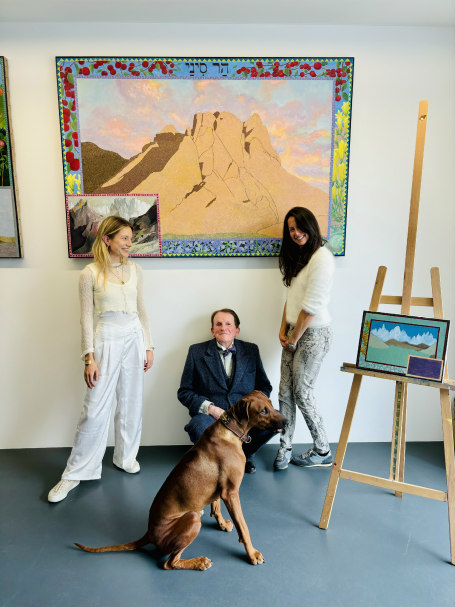
David McDermott and Lola Montes exhibited The Great Mountain Paintings 1888 & Landscapes From The Underworld at the Vito Schnabel Gallery – St. Moritz from July 27th to September 15th 2024
David McDermott, is Kačić a Jewish name?
My grandmother said my father was Jewish, that he had the map of Jerusalem all over his face. He was supposedly in a concentration camp but when I asked my mother if he had a tattoo on his arms she wouldn’t tell me. My mother was old American, Southern. My great-grandfather was Chief Justice of the Confederate Supreme Court and his name was Dylan Jordan. I was the only boy born in 100 years.
Were you very spoiled?
I was an only child till I was 10, and then my stepfather had a daughter and everything changed because I was another man’s son in the house with his daughter and he accused me of molestation when I was 13. So untrue! I’ve spent the rest of my life proving that that was impossible, that I would have molested my three-year-old half-sister. To this day, I’m hardly on speaking terms with my half-sister over that, because I tried to tell her when she was about 17 about the accusation, and she wouldn’t listen and said that’s not true and wouldn’t believe me. I’m not friends with her. My mother just died at 97 and my half-sister had taken care of her so I thanked her. She’s selling the house, but I don’t want anything. She can have it all.
Did you go to university?
I went to Syracuse University and majored in advertising and minored in oil painting. Then I went to New York because my mentor said to me, you have to move to New York because you can be the greatest eccentric in Syracuse and no one will hear of you in Utica. That made sense to me.
Why did they call you eccentric?
I’ve always been a time experimenter. Since I was 12 years old, I knew I was a time experimenter. That’s the most important thing to me. All the money they spend on space, and they spend nothing on time. Time, that’s what’s important. I don’t believe in space anyway. When you think of the money they spend on those rockets, and those rockets, they’re just pollution. That’s all that is. Every time they explode a rocket the amount of pollution!
Why did you move to Ireland?
Because there wasn’t any taxes on artists, and I was very seriously attacked by the American tax authorities and they destroyed me. It was very difficult. I tried to pay taxes and I had Julian Schnabel’s accountants and they figured it all out but then the art market crashed. I thought I had to move to a place where I didn’t have to be afraid of the tax collectors.
Have you been happy in Ireland?
In the Irish Constitution, it said any way an artist spends his money is of value to the Irish people. So if an artist takes his money and buys some sports car and is driving all over, that’s a benefit to the Irish people. I love that idea. I tried to move outside of Dublin, I did have a great estate. But anyway, I was very involved with my partner and I absolutely trusted him and I felt that I was working on the real art and that’s the time experimentation.
Before, when you lived in an apartment in New York, you were friends with the most extraordinary artists and people of the time?
Oh, that’s true, but I’ve always been devoted to time experimentation. My great experiments took place in Manhattan. The idea is that all time should exist at the same time. This old-fashioned concept of moving forward in time and abandoning the past, abandoning civilisation to move forward, it’s a very outdated concept.
Is it true that you lived in New York without electric light?
That’s true, and this one millionaire would have his chauffeur drive his limousine to our house and he would ring the bell, and then my partner would go downstairs and on the automobile telephone he would talk to my friend because we didn’t have a telephone. I love the past.
You also dressed like in the past?
Anybody can do that, that’s just the basic, but when beyond your clothes you have a room, you have a house, you have an estate, it enlarges. These multi-billionaires could create whole towns and villages that would be completely trapped in some of my favourite time periods. I love 1926 to 35, that’s a wonderful time because it’s just before the collapse. The crash comes officially in October 29, but it takes a while for it to have power, and it helped to keep the 20s mummified. New York, when I first moved there, basically was a 1920s city, because there hadn’t been any money invested in it.
Who were the artists you shared your life with?
There were a lot of them. There was Donald Bachelor. He just died. And there was Philip Taft. And there was Peter Shue. There was Julian Schnabel. I never was that friendly with Francesco Clemente.
Were you a friend of Jean-Michel Basquiat?
A friend is someone you can borrow money from and can live at their house with them, but I knew Jean-Michel. I could have gone to lunch every day with Andy Warhol because there was a woman who was in charge of advertising, Paige Powell, and she wanted me to come every day because it was so boring for Andy to have to entertain these Japanese corporations.
Were you interested in Warhol as an artist?
I consider Andy Warhol one of the important artists of the 20th century. There’s Picasso and then Pollock and then Warhol; and then Julian Schnabel is actually very important because he found a way to revive painting after ten years of conceptual art. It was brilliant the way he did it because he broke the dishes and glued them in the wooden panels and then painted his abstract expressionism. When I went to school that’s what they were teaching.
“Right now, my painting’s a rebellion against modern art.”
David McDermott, what kind of artist are you?
Not that good. I tricked the public into thinking it’s better than what it is, but that’s always been the way with artists.
You’re too modest, because you did many things….
Julian was able to buy paint, and Bruno Bischofberger didn’t buy any paintings in the 1970s because of the conceptual art, and he wasn’t interested, but as soon as Julian broke the dishes and glued them and then painted the 1950s abstract expressionism on top of the dishes, painting was revived. That’s why they went to Italy and bought Clemente, Cucchi, and Chia – because they needed painters immediately, and there weren’t any.
But there were big painters such as Lucian Freud, Paola Rego…..
That was earlier. Lucian Freud and Bacon, they call that work ‘bed-sit art’. A bed-set is a room where you have a cooker and the toilet is in the corner behind a door. These English and Irish aristocrats wanted to have that life after the war, and they would take these bedsits. Bacon was a bed-sit artist. When I first moved here 35 years ago, I had a bed-sit.
Dublin is the city of Bacon’s birth. Do you consider him a great artist?
It’s a kind of art. It’s very popular. Lucian Freud was another one of them. They painted in these bed-sits in messy style. I don’t find it very interesting. My favourite works are the pre-Raphaelites, I love them. I don’t really like the Impressionists and Vincent van Gogh, but there are enough people that like them so they don’t need me to like them also. I do like pre-Raphaelite, they’re exceptionals. That work was very inexpensive to buy when I was young. It was unpopular.
Did you buy pre-Raphaelite art?
No. There’s a saying: there was this old Jewish man and he said, “Remember when coffee was only a nickel?” And the other old Jewish man said, “I’d rather pay a dollar for a cup of coffee and have the dollar than pay a nickel for it and not have the nickel.” So don’t feel badly about what you didn’t buy.
What is your art about?
Right now, my painting’s a rebellion against modern art. Modern art has been going on for about 100 years, and they’re very satisfied with themselves. It’s going to collapse now. The art that was in control before the modern art was the aesthetic movement, which starts in 1850 and lasts till 1930. The Art Decorative was the last of the aesthetic movements. The aesthetic movement is a combination of abstraction and the decorative styles from around the world. In the 20th century, they were pulling out the decorations from archaeology – Babylonian, Assyrian designs – and the modernists hated this, wanted to destroy it. It was an art that was invented for the common man, so the ordinary man could have art.
What do you do?
I’ve been making aesthetic movement paintings of mountains. I’ve been painting all the famous mountains: Mount Fuji, Mount Vesuvius, the Matterhorn, the Dolomites. Mount Sinai I painted too.
Why mountains?
Because people love mountains, and when they look at a mountain they’re empowered. Now I’m painting the important man-made monuments, and right now I’m working on the Taj Mahal. Nobody in the 20th century has painted the Taj Mahal. I was just told there’s an iconic photograph of King Charles’s first wife Diana sitting in front of the Taj Mahal, and that’s the only reference to the Taj Mahal. Andy would like the Taj Mahal. Andy asked me once what he should paint, and I told him, you should just paint a house. You should paint food. You should just try to do your best, because people would really like to see what a good painter you are.
Do you draw well?
I try to do my best. One time I saw this painting in Amsterdam in a museum and it was of a ship at sea, and all the rigging was done with pencils. As a child, I would have thought, you can’t make an oil painting and put pencil on it. Do all the detailing in pencil? That showed me that art is about tricking.
Were you a friend of the poet Rene Ricard?
Yes, I knew Rene very well. I met him very early on. He discovered Basquiat, but Basquiat was really made by Glenn O’Brien, the first editor of Interview Magazine. He made a movie called Downtown 81 and in the movie Jean-Michel comes to New York and he meets all the famous people in one day. Jean-Michel became famous with that.
Was he a great artist? He died very young.
Yes, and the fact that he and Keith Haring died so young, once you die that’s another story.
It makes you famous, like Rimbaud, the poet?
I knew an artist who was a transition painter between abstract expressionism and pop, and he actually was on the cover of ONE so many times. It was 1958, 59, 60, 61, right there. He was convinced that when he died, he would then become famous. He didn’t become famous, but he did die. His name was Edward Avedisian. Did you ever hear of him? He was celebrated because everyone was buying abstract expressionism and then pop came and he made the transition.
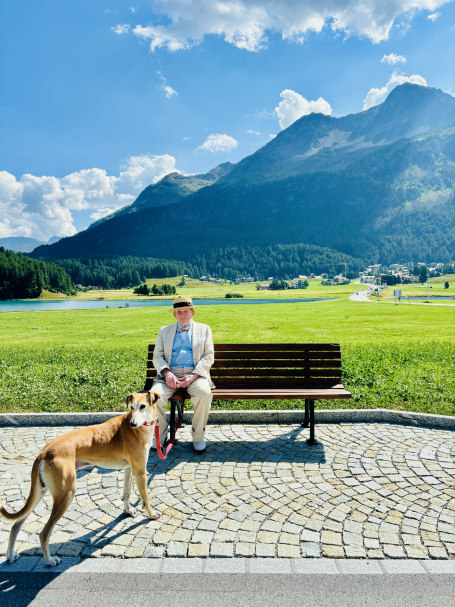
David McDermott
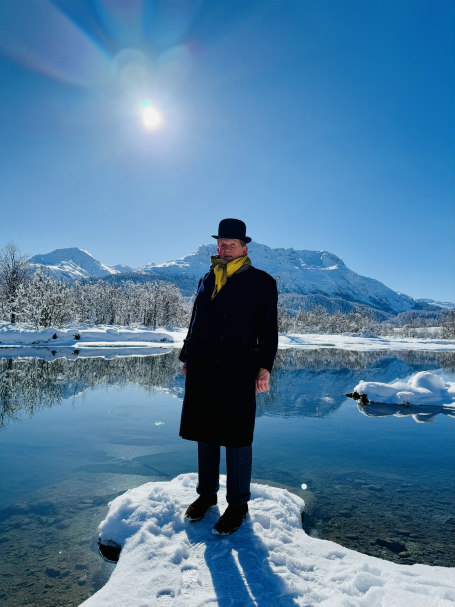
David McDermott
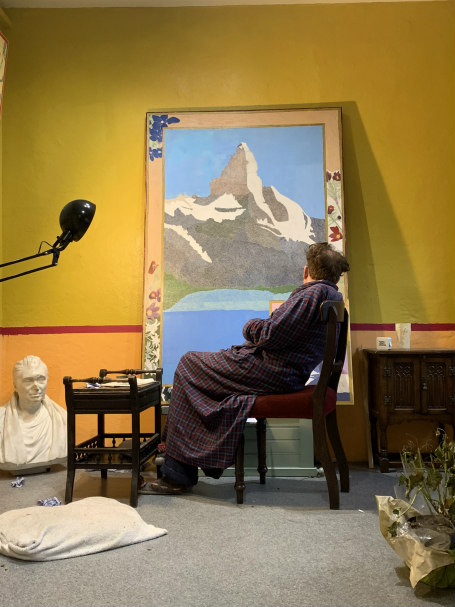
David McDermott working on his oil painting of the Matterhorn.
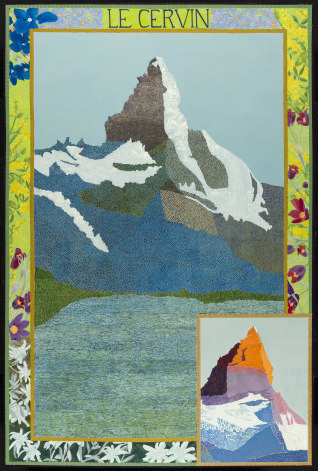
“Le Cervin” is the French name for the Matterhorn, a famous pyramidal peak in the Alps, situated on the border between Switzerland and Italy. It is known as “Monte Cervino” in Italian. The mountain is a popular destination for mountaineers and tourists, known for its distinctive shape and challenging climbs
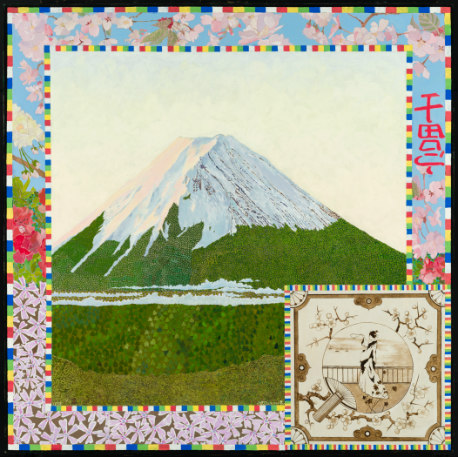
Mount Fuji (Fujiyama), on the island on Honshu, Japan, is a classic stratovolcano. This volcano reaches 3776 meters above sea level and is noted for its steeply sloping (35° near the summit) and symmetric profile. It is often called one of the most beautiful mountains in the world.

Mount Sinai, also known as Mount Moses or Mount Horeb, is a mountain in the South Sinai region of Egypt. Standing 7497ft (2285m) tall, the peak is best known as the possible location of the biblical Mount Sinai, where according to the both the Bible and the Quran, God told Moses the Ten Commandments.
“I’m very interested in my life now, which is different from the one I escaped from.”
David McDermott, you say that you like Pollock. Did you meet him?
No, I never did, but I knew his girlfriend Ruth Kligman. In the history of art, he’s definitely very important. But he knew that Rockefeller was backing him, with the CIA or the FBI, that’s my thinking.
They say that they have also backed Rauschenberg?
I didn’t know that, but I have a friend here in Ireland who was an assistant to Rauschenberg.
What do you think about all these wars now going on?
Okay, come on! That’s not fair to bring that into this interview. I’m well read on it, but I’m not interviewing on that subject because that’s a trap, because if you say the wrong thing, then you’re destroyed. Do you know why the British were so important to India? Now they never mention this, but the British came to India and took one of their traditions and said, you’re not doing it anymore. They said, that’s it. They never talk about it in the press but the British stopped them from burning the wives on the funerals. Let’s have the feminists champion the British for stopping them. Some of these men would have many wives and they’d all get burned on the pyre for thousands of years – and you’re not going to say that that was a great thing for women?
Have you travelled a lot in your life?
I didn’t fly in aeroplanes for 30 years. It was a part of the art experiment: the very big world. For example, it takes 30 hours to get from Dublin to Milan, overland, and it takes two days to get to Morocco from Dublin. I travelled across the Atlantic 20 times by ship. I was even in hurricanes going in the winter on container ships. I was on the Queen Elizabeth when it was nearly capsized and I saw the water coming down.
Were you afraid?
No, I wasn’t afraid. The most dangerous thing I ever did was to go into the glacial cave – because you have the glaciers in Switzerland. I like Switzerland because it’s protective, it’s as if it’s a castle. You’d never feel that you would have your suitcase stolen.
Where do you do your painting?
I was moving around this last year, but I painted every day in St. Moritz in the Vito Schnabel Gallery to finish my paintings for the exhibition, because they’re very complicated and elaborate. I had to work seven days a week. I’m just doing my small-scale watercolours right now. I’m going to paint St Basil’s Cathedral in Moscow, the one with the turrets. It’s amazing, and nobody paints it, and I’m going to paint the Sphinx.
Can you move around forever or do you want to establish yourself?
There was this one castle that I was shown in Spain, because I’m all about house, house, house, not location, location. This castle has 25 bedrooms, and they’re all furnished from 1900. You know the old saying from The Leopard, “If you’ve seen all the rooms, it’s not worth living in.” I love to live in them because I love the idea of walking through the rooms. Artists have always been about rooms, bases.
But property on this scale is very expensive.
No, it’s not at all. It’s so inexpensive, because the rich people want to live in compounds. They don’t want to live in little villages and in the old mansions. There are mansions all over France, Italy, Spain, and the rich don’t want to live in them.
Aren’t they very expensive to heat in the winter?
I don’t believe in heating. When it’s cold, you live in one room with a fire. I also don’t believe in restoring the houses. Look at my hand. I’m in decay, and I love decay anyway.
Are you still working on your time experiment?
Yes, for example, I just bought this crocodile suitcase but I’m not going to use it until I have the cloth cover made that it slides into to protect it when you move about. I have an example of a suitcase that has its original cover, and they used to put their monogram seals on them when they travelled.
Is your way of living part of your art?
I do believe that individuals, whether they call themselves artists, that that’s the only thing you really have is your life, and you have to make your life extraordinary. It’s the one thing you have control of; and then you might get control over a shelf in the corner of the room. The idea is to be very grand. Think about those billionaires; how many billions would it cost to buy Venice? If you owned Venice, you could really turn it into an amazing time experiment. When I visited Venice I only took gondolas. That was one of the rules and it cost a lot of money then but it was nothing compared to what it is now. I love the past.
Do you read the newspaper and watch television?
I have been listening to news broadcasts on the BBC, reading the New York Times, the Washington Post, the Guardian. I listen to these broadcasts while I’m painting, and I’ve never been so interested in the present as I have been lately, and I think that’s because I’m old.
You’re not old, you’re in your early 70s.
Yes, but that’s old. The teens and the twenties, that’s the great period. I was very creative. Now I started doing these watercolours and I hadn’t worked with watercolours for 60 years. I worked with them when I was 12, 13, 15. All I worked in was watercolour. I did very good water colours when I was little.
Do you still have them?
No, they’re gone. I know a very good one is with my half-sister’s daughter. But I’m very interested in my life now, which is different from the one I escaped from. I was brought up in the suburbs of New Jersey In the 1950s and the 1960s and I had to get out of there. And I did.
Are you going to have new exhibitions?
I’m going to work on my new collection, which is going to have Big Ben, the Eiffel Tower. I’m gonna do four paintings that will be the Great Wall of China. I’m going to show with Bruno Bischofberger’s first child, Lea Bischofberger. She just opened a gallery in Zurich, and so I’m going to show with her. Now, that’s amazing because she is kind of like Bruno and a woman, and I was talking to her and she told me she had just rented a gallery but she didn’t know what she was going to do. I said, well, you have to show my prints.
You worked for many years together with another artist Peter McGough. What is the difference between the work you did with someone else and the work that you do today?
I’ll tell you. Peter is working in the genre of the LGBT movement. It’s very big, and he’s been very much involved with Black Lives Matter, and he is creating all this work that is transgender. That’s the kind of work that would only be noticed in New York City. This is the work he’s doing right now. His work became very sexual.
And when you worked together?
The Oscar Wilde Temple was my idea. The idea is that Oscar Wilde would have been turned into a religion because in the 19th century they turned anything to a religion. They had talking salamanders. There were different concepts and Oscar Wilde had poetry. It’s all there to make a religion, and Peter took that idea and turned Oscar Wilde into a promoter of sexuality, and it would be similar if Orson Welles became the champion of the obese so it wasn’t about his films anymore, it was about the fact that he was so fat and then all the fat people would use him as an example of how fat people are important. And that’s what they did with Oscar Wilde, making the homosexuality the whole raison d’etre of Oscar Wilde and I don’t believe that at all. I believe that Oscar Wilde was devoted to aesthetics and I wanted this Oscar Wild Church or Temple to be a promotion of aesthetics. That’s why I’m painting mountains and the Taj Mahal, and he’s painting sex. One of his paintings says, I am a bitchy art fag. That’s the painting. It says, I am a bitchy art fag. Now who would want that? Would you want that on your wall?
Before you changed and one went in a direction and the other in another, you did some work together. What kind of work was it?
It was about promoting the past. I was using art to promote 1912, 1901, 1888. I was using art to get people interested in the past, bringing the past into the present. I very much believe that.
And now you are in another life?
I thought that with this art career, I was going to be able to make a truly great time experiment. I was using all of my wherewithal to create this experiment, and I really had it when I was betrayed by my partner. Because I had this escape, And everything was there. Every drawer you would open, it would have objects of the past – and I’m very knowledgeable of the past. I hope when I’m introduced to King Charles that we really get along and he adores me.
Are you going to be introduced to King Charles?
That’s what the woman I met today said. She was going to introduce me to Prince William and Princess Kate and they were gonna buy my Taj Mahal paintings. She always says what she means, she’s not someone who just talks. And then she said that she was going to introduce me to King Charles.
This seems to excite you a lot.
I belong in the hands of the very powerful people. I wouldn’t spend that money sending rockets off to Mars. I read about colonising Mars in a Japanese science book that promoted the idea of conquering the universe. It’s just ridiculous. They just found a planet. It’s 2,500 light years away and it has gas around it, and they’re saying this is the first planet that they found that they think there’s life. 2,500 light-years away! It’s insane. They can’t even keep the oceans clean and they want to go to Mars and they’re going to drop nuclear bombs on the North to make water. I read all about it but it said it might only last a hundred years. It’s absurd.
Are you worried about this?
No, I’m not worried because I’m old, and when you get old, it just becomes a show and you’re just watching this show go on. History is a show when you read about it. In Prince Charles’s book he talks about this city in Africa and when he was born in maybe 1948 there were 30,000 people living in the city and he said now there’s 5 million people there. The only way that contemporary people think is to expand, to make it larger, to make it bigger.
And you’d want to make it smaller?
Yes, I think it should be. I like the idea.
But there are many more people in the world.
Unfortunately, and that’s a real issue because the only reason people have for existing is to have children. Especially women, if they don’t have a child their life is just irrelevant. So they’re all moving constantly to have these babies. It’s really kind of sad.
What? To have babies?
I just put it to you, it’s their only reason. And the men playing the soccer and the football, I mean, that’s just unbelievable that they’re gonna watch this ball bounce around. Think about all the balls that bounced around in the 1950s and 60s, and they don’t care anything about those balls and they’re all focused on this ball. My grandmother said they should be watching the government, not a ball bounce back and forward.
Thank you.
Enjoy the past, the present and the future.
ENJOY THIS INTERVIEW? SHARE IT WITH A FRIEND.


