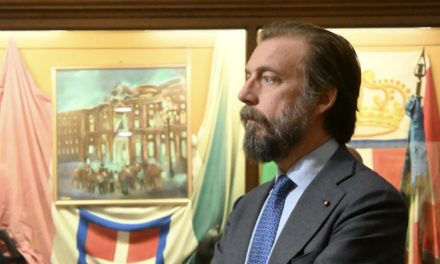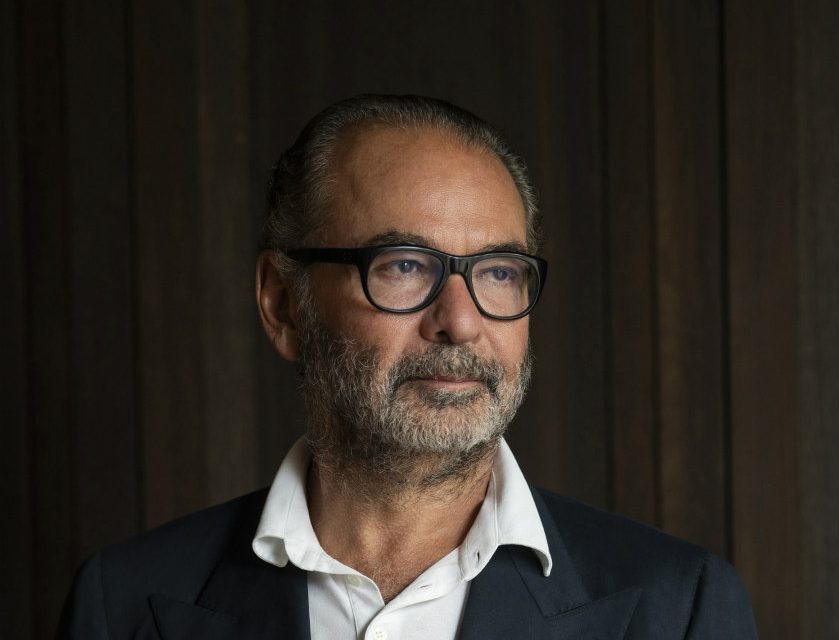
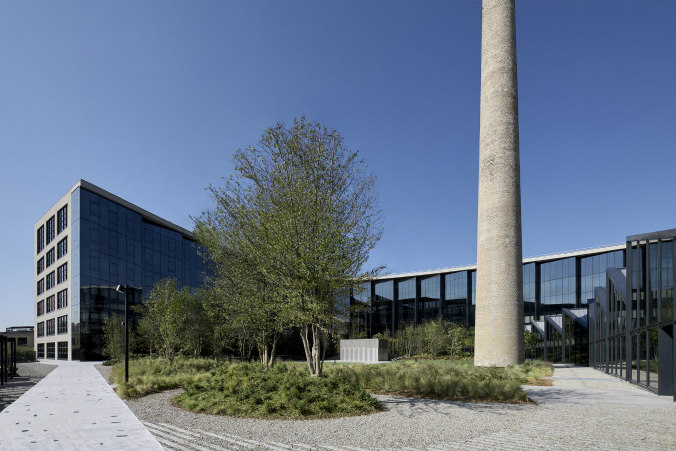
ALWAYS FOCUSED ON WHAT’S NEXT. Remo Ruffini is the Chairman, CEO and creative director of the luxury fashion brand Moncler. Born in Como, Italy, Ruffini started his career in America working for his father’s company. In 1984 he launched New England, his own sportswear brand, before buying Moncler in 2003. He transformed the Moncler brand, focusing on its signature down jackets and expanding it into a globally successful luxury group. Moncler now has a new global headquarters in Milan designed by Citterio and Viel ACPV architects. Located in the urban regeneration Symbiosis business district, and spanning a total area of 77,000 square meters, including a six-floor building rising 32 meters, an expansive showroom, and surrounding green area, the new headquarters, named Casa Moncler, house over 700 Milan-based employees and features sustainable design elements and collaborative workspace.
Remo Ruffini, when you started out did you think you would have a wonderful headquarters like this and 700 people working with you?
No. I was twenty years old and my parents were both in this business; we had a few arguments on whether I should work for one or the other. I spent a few months with my dad in New York. He had a clothing company, but I had to find my own idea. I spent a weekend in New England, which was my passion; it was 1982, the time of the button-down shirt. I told my dad that I was going back to Italy because I wanted to build something on my own. I left with the idea that I had in Martha’s Vineyard, to create the New England brand, which was really to my taste. So I started doing my own little thing and for the first year I was on my own: I was the delivery boy, the president and CEO. I was everything, I hired some guys just to help me with shipping. I started like this, and I acquired Moncler after about twenty years.
You developed the New England brand for around for twenty years?
Yes. I branched out, and it became an Italian sportswear brand with a strong American influence. I traveled extensively in that part of America to find ideas and I reinterpreted all the refined American country style of the East Coast through Italian taste and style. Although much smaller than Moncler, it was a very successful company. It was my baby; I was very fond of it and loved it. I spent almost all my days and weeks in the office. More than a job, it became almost an obsessive passion. I had a partner who had a group of companies he wanted to merge with, and I didn’t agree with this strategy so after twenty years I left and rediscovered another of my great passions, the mountains. Since I was a child, the mountains had been everything to me. I was born in Como and lived in Como, but I no longer do. At the time you could go skiing in the afternoon when you left school because it was a twenty-minute drive to the area above Lecco.
“My mantra has always been to elevate the brand as much as possible in terms of design, while keeping its roots in mind.”
MONCLER HQ
Photo Leo Torri
Remo Ruffini, did you wear the blue Moncler puffer?
I wore the famous blue puffer. I bought it on the same day I bought my scooter, when I was 14. We lived outside Como, and my mom told me I had to buy something to protect myself because in the morning, when I left the house at 6:30 or 6:45, it was seven to ten degrees below zero. We went to a sporting goods store and the only thing that stood out was this jacket, available in three colours: blue, green, or yellow. My mom said, “Let’s get this jacket, it will keep you warm every morning.” There weren’t yet any paninari – whose style mixed designer labels with American casual wear –because we’re talking about ’75/’76 although it was perhaps the beginning of that era. From then on, I became fond of this product. For me, it represented the kind of dream you have when you’re 14: you have a moped and you feel free, you can go wherever you want, always with this Moncler down jacket. It stayed in my mind, even though I didn’t use it anymore over the years because eventually I got a car. Then one day someone told me that Moncler was for sale.
Moncler was a French company based in Grenoble, and you had left New England and wanted to do something else?
I was forty years old. I told myself I couldn’t retire, and then this opportunity came along. Moncler wasn’t very present on the market at the time, so I didn’t really have a perception of the product but I had memories of the scooter and of when I went skiing. I was very passionate about the mountains, so I approached a bank in Milan which told me what could be done, and after four or five months I acquired the brand. It was an exciting story.
And you moved to Grenoble?
The company was partly based in Grenoble and partly near Padua where we still have our industrial hub in Trebaseleghe. The company was founded in 1952 with the construction of a factory in a small village near Grenoble, although it later changed locations several times. My first impression when I went to see the factory was that I saw products that didn’t match the image I had in mind, the products of the 1970s: these colourful, shiny, huge, and heavy down jackets. What I saw instead looked like a classic collection, almost as if they had used a brand to make a different type of product. My priority was to reorganise the industrial side of things, because my dream from the beginning was to create a great product of the highest quality – contemporary, and therefore much lighter than those used in the 1950s, 1960s, and 1970s.
What did you do?
I went back to the archives and started trying to bring back that almost identical product but with the comfort of today. The first few years were difficult because the brand was poorly distributed. It was sold in low-end sporting goods stores, it was always on sale, and there was no quality in the product. For the first two or three years I worked on the foundations of the company, and then everything else followed. I told myself that I couldn’t continue selling in these stores and there was also an industrial problem. It was a market that didn’t belong to me, and I didn’t know it because I came from a totally different market, so I tried to create a strong brand, which has always been my mantra: to elevate the brand as much as possible in terms of design, while keeping its roots in mind. In everything I did, I always stayed close to the brand’s founding years, its DNA. I evolved the product over time until I managed to get out of sporting goods stores and into other types of stores. There was no talk of luxury yet. Luxury was a term that was just starting to be used, but at the time there were many more multi-brand stores than today, and they sold excellent products.
Importantly you moved products for the mountains to products for the city. Now instead of coats almost everyone wears down jackets in winter, so you changed the fate of these jackets?
As I said before, they were enormous jackets. They protected you, but they weighed 1 kg, and even those from the 70s and 80s weren’t waterproof, because there was no need for waterproofing on expeditions since it doesn’t rain at 4,000 or 5,000 meters. They only kept you warm. I revolutionised everything. I tried to bring in technology that I didn’t know anything about because I was self-taught and came from a different world. I wanted to bring in a product for which I had written on the company walls, in different languages: “From the mountains to the city.” That was my dream. In 2006 and 2007 we managed to make a jacket weighing 99 grams. We went from the famous 1 kg jacket I used to wear to school to a jacket that weighed just 99 grams! We worked very hard on sustainability; we went through a major innovation process in all areas of the company, and yet we have always remained tied to our roots, tied to our world, tied to my perception of the 1950s, when people used down jackets to go to the Karakorum mountain range to climb at 7,000 metres. The roots of the brand are everything to me. I always say: “We can do anything, but we must never betray the brand.”
What is iconic about Moncler that will never change?
The product itself, which I protect more than anything else. It carries the names of these mountains – there was the Himalaya for example (now Maya), or the Karakorum. These are the jackets that looked like this in 1950 and I have updated them, made them contemporary, improved the fit, the quality and the lightness. But if you look at them, they are basically the same jackets. We don’t even display them in the store. We protect them. They are in high demand, but we keep them in the store’s warehouses and only sell them on request. Consumers must be familiar with the brand, come into the store and ask for a Maya or a Karakorum. It is at this point that we tell them what we have available in their size and colour.
What are your colours and do they change with fashion?
Our traditional colours and classic blue and black are always available. Each season, we add two or three new colours that are more seasonal while always trying to stay close to the brand’s roots, the colours of the 50s, 60s, and 70s. When I went public about twelve years ago, my slogan on the Italian stock exchange was “Survive fashion“, a fundamental principle of mine. I have to be current, contemporary, and have an excellent relationship with my consumers, but Moncler doesn’t have to follow trends. That’s still our strategy today.
“
Remo Ruffini, you have stores and showrooms, where one perceives the language of luxury, but with a distinct identity. What makes you different?
Fashion is made up of trends; every year there is a trend. For example, one year everyone does purple because a certain brand did purple. I have never followed trends; I evolve my product. Every season I have something new, but it is guided by our history. We never look outside. If we look outside, it is to see consumers on the streets. That’s the greatest research you can do. When I have time, even though I don’t have much lately, I like to sit in a bar in Tokyo for three hours pretending to read a newspaper and watching people pass by. For me, that’s the real trend: people walking down the street.
I remember Giorgio Armani saying that he went to London because he was inspired by watching people there.
Armani had his own taste: his trend was his own. We have a totally different taste, but we’re a bit like that. We develop our product, but we don’t follow fashions and we don’t follow trends. We have our own strong point of view, but we take our trends from consumers on the street because that’s where you really understand what people are interested in and what they want.
In this world of jackets that you see everywhere there are Uniqlo, Zara, and others that cost much less. Are yours very different?
Like many products in this world they are very different. They are very different in terms of technology, very different in terms of quality, they are different in terms of the materials we use to create these garments, these down jackets. They are very different and have a different price, they have a totally different history.
For you there is no competition?
I don’t think so. In the luxury sector, we don’t really have any competitors because the luxury sector is largely made up of companies that concentrate on accessories. There are few companies like ours that focus on outerwear, knitwear and ready-to-wear clothing. Most luxury players concentrate on accessories, bags, and shoes.
Do you make shoes too?
Yes, we also make shoes, but we don’t have the same strength as the specialists. When I think of all the luxury brands, almost all of them started out in leather goods, with a few exceptions. Prada made suitcases, Ferragamo made shoes. One of our mantras is uniqueness, so we always try to be as unique as possible. As I said before, we don’t look at our competitors, we look at the consumer. That’s the big difference. Today it’s difficult, but I believe that our uniqueness is paying off because when consumers need a product that we have communicated, and we have communicated its value rather than just the product itself, they come looking for us. This is fundamental for me. We have customers who come back to us. I always hope that they will buy one of our jackets and use it for three, four, or five years and then come back after those years, happy with their purchase, to buy another one. That said, there are also those who follow trends more closely. If Moncler make a yellow down jacket, they want it even if it’s not the fashionable colour. The fact that Moncler made it makes it fashionable.
You have a beautiful store in Rome on the corner of Via Condotti and Piazza di Spagna, a place where there are more tourists and global travelers than Italians. Do many people buy in store, or do the stores serve more as showcases for people to see what’s going on and then they order online?
Now it’s changing a lot. In fact the opposite of what you’re saying is happening. E-commerce, the digital world, was incredibly successful between 2016 and 2019, and during COVID it reached its peak because people couldn’t go out anymore. In the post-COVID era, even more so.
Excuse me, but during Covid, when people couldn’t go out, were they buying down jackets?
Yes, because for example, you couldn’t go out in Europe or in the US, but you could go out in China, or the other way around. It was patchy, with markets opening and closing, and it was a time when e-commerce was booming. Today, things changed. Today, the online is more likely leveraged for comparison: people stay at home, log on to their iPad or PC and see what Moncler has done, see what another brand has done, and then go shopping in person. Today the physical experience is winning out over the digital experience. Even though we all have our cell phones in our hands all day long, when it comes to buying a product, especially in luxury, people have returned to enjoying going to the store. They arrive very well prepared because they have already studied practically everything on our online channels. That’s why we continue to invest in an omnichannel approach, taking advantage of the latest innovations to create more immersive experiences online – we have recently launched a redesigned Moncler.com.
Is Moncler considered Italian or French?
More mature consumers still perceive the brand as French because that is how they remember it from years ago: in 1968, it sponsored the French national ski team, and our logo features the French flag. Apart from Japan, which is our historic market, the Asian markets are much newer and see us as a product designed and conceived in Italy.
“The true energy of a brand crosses generations: it’s when a grandmother and her grandson come into the store and both buy a jacket.”
Remo Ruffini, what is the difference between the markets of the two great empires of China and America?
There is a huge difference. America is a super mature market for the world of luxury, while China is a relatively new market, even though it is a hugely successful market and projections for the future indicate that it will double in size over the next eight to ten years. What I think about every day is my consumer, how to attract them – not only in terms of product, but also in terms of strategy and marketing. The example I always give to the team is to think about the different Asian cultures: if we go from Tokyo to Beijing or Seoul, it’s only a two-hour flight, yet they are three totally different cultures, not even close to each other. The culture of someone from Milan is much closer to that of someone from New York than that of someone who lives in Tokyo is to that of someone who lives in Beijing.
Do they want the same things or do they want different colours?
We don’t work by country, we work to create a global product, one that is for the whole world. So we don’t do what our competitors do, which is to create a collection for China, a collection for Japan, or a collection for America. We don’t do Asian fit; we have our own product and we try to attract consumers, explaining our vision and our strategy to them. There are many other things besides the product that make a brand successful. Especially for a high-quality product, culture is essential for the brand to convey its ideas to today’s fast-moving consumers. A consumer in Shanghai is an exceptional consumer, but also a very fast one, quick to pick up on trends, because the Chinese market is less mature than the US market and they still look for products that are highly recognisable.
Brands are still a status symbol for them?
Yes, and they are also very quick to perceive a shift in trends. We follow the outdoor sector closely because we are very outdoor-oriented. I was reading a study on Tmall, a large digital store, in which the demand for outdoor products, or at least the term ‘outdoor’, has grown by 600% in two years from 2021 to 2023. There has been something of an outdoor boom since the pandemic. People no longer want to stay in the cities, they want to get out and to be in the open air, they want to have different experiences. China has been very quick to pick up on this trend.
What do you do in China, Japan, or America to communicate with consumers?
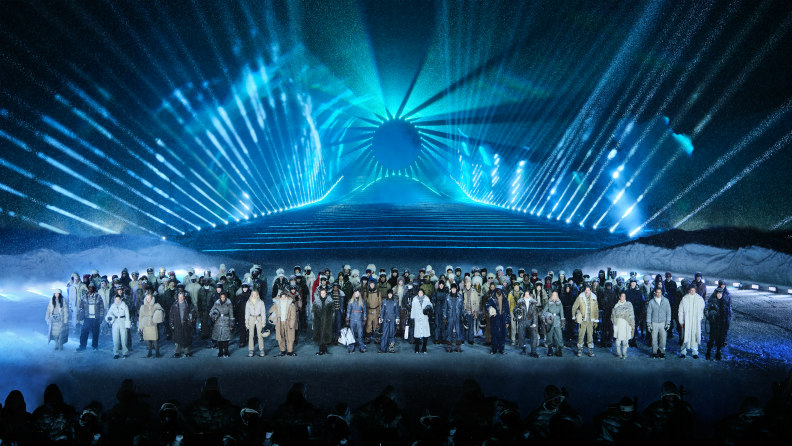
We do a lot. That’s why I say that we need to understand cultures well, because I believe that we can still have a product for the world. In terms of communication, however, in terms of how we dialogue with our local communities, we need to take a totally different approach: we need to know how to attract Japanese culture and we need to know how to attract Chinese culture. I recently held an event in Shanghai – the city of Genius – where we reinterpreted our strategy for young Chinese consumers, and it was an exceptional event in the sense that I could feel the energy of the people who came to see us. We don’t do traditional fashion shows; over the years we created three dimensions to fully express the Moncler brand potential: Moncler Collection, Moncler Grenoble and Moncler Genius. With Moncler Genius, every year or two we hold an event, more of a a brand experience I would say, and launch multiple collections with a range of totally different creatives. In Shanghai for example we worked with Edward Enninful, Hiroshi Fujiwara, Donald Glover, Lulu Li, Mercedes-Benz by Nigo, Palm Angels, A$AP Rocky, Willow Smith – as well as Rick Owens and Jil Sander. The event can be in Milan, where it all started, or in London or in Shanghai. When we did it in China in October last year, we interpreted it in our own way for Chinese culture. It was the first large-scale event we have done in Asia, and it was a huge success.
Do the counterfeits in the souks of Turkey and Morocco, where you find Moncler down jackets, Chanel and Hermès bags that look very similar to the originals, disturb your market?
It is very disturbing because tourists who go to these countries also buy fake products. We are fighting this and have a structure dedicated to combating this phenomenon. In some countries, the rules are clear and you can really fight it. In other countries it is much more complex because there is no regulation.
Do counterfeiters also make fake packaging?
They do everything, even that. They have become professionals. Today it is declining somewhat, in the sense that many governments are making it possible to block this mechanism. The real damage is that it associates the brand with a product that isn’t high quality. That’s the key issue: an inadequate product creates the wrong perception. This is the real damage caused by counterfeiting, so we fight it as much as possible. Online counterfeiting has also emerged, which is even more difficult to combat because it originates in countries where there is no regulation. Sometimes we manage to shut down websites, but they reopen after three days with a different address. It is a very complex area, but we must not give up because it can damage the brand.
Yours is a product that everyone needs, but are your customers young or old?
My dream has always been to connect with all generations. I often talk about what happened many years ago, when I saw a grandmother and her grandson come into the store and both buy a jacket. That is the true energy of a brand: I don’t want my stores to be full of young people, and I don’t want them to be full of people my age. When you manage to communicate with all generations and attract all generations, I believe you have created a brand that can speak many languages, and that is a fundamental point for our brand strategy.
In a fast-paced world, where there is impatience and a much wider range of choices, do you need to plan to endure for the long term, or is it just a coincidence?
No, you think about it a lot. You need to have a clear, consistent strategy to ensure that your product lasts over time. As I said before: quality is fundamental, consumer satisfaction is fundamental, contemporary style is fundamental, and a vision for the future is fundamental, because as we can see, everything can change overnight.
Does a volatile global situation make it difficult to decide, for example, whether to build a new factory in one country rather than another, also considering the time needed to build it?
It’s very complex. I’ve never seen such volatility in my life as there has been in the last five years, in the sense that from 2019 to 2025 everything has happened in the world. In my opinion, we need to be very flexible. We have completely changed our culture to be much more flexible, to be much closer to the consumer.
How do you decide how many down jackets you will make this year in a certain colour?
This is the complexity I was talking about, which has emerged over the last five years. Before, there was a trend for quantity, colours, and styles. Today, that trend no longer exists. Once upon a time, you would send your requirements to Japan, China, America, or Holland. Today, that is no longer the case. Today, the game is to place the right product at the right time, so logistics becomes one of the cornerstones of a company like ours, because logistics gives you the possibility of maximum flexibility, if it is well organised. We are just at the beginning, but I think artificial intelligence can work wonders on logistics in terms of product allocation. We have many products, and there are products that sell out completely after one season, and there are products that sell less.
What do you do with products that remain on the shelf and do not sell?
We have a strategy whereby we’ve never had a sale in our stores, and we try to buy much less than we need in order to have a high sell-out rate. We try to sell as many items as possible so that we don’t have too much leftover stock. Our dream is to never have sales for the rest of our lives. I believe this shows great respect for the consumer.
Where is your central warehouse?
Our central warehouse is in Piacenza, then we have local warehouses in every region where we operate; for example Paris in Europe, New York in the US, Seoul, Beijing, Shanghai, Hong Kong in Asia and Tokyo in Japan, where we have local warehouses that distribute to our stores.
It’s clear that you love to work but what is really your job?
Yes, I do really enjoy it and my job today is to manage people, it is the most important thing. The truth is that I have sought out and found people who are better than me. This is the basis of everything: you need to have people who teach you. The team is everything and today we have an exceptional team. I only receive three reports, because I decided to divide the company into three areas with three people managing the three areas. However, I have a top management team of thirty or forty people who are top managers of the highest calibre.
Do people from all over the world work in Moncler’s HQ?
Yes, there are people in marketing, buying, merchandising, and retail. We have divided the world into six areas, and in each of these, there is our office with the entire structure and all the people. Here we have the headquarters people. Everything is structured to have a single company, but a company that is distributed throughout the world.
Do you move around from one place to another?
No, I have meetings all day long. Every hour I have an appointment and every hour I meet with someone or a team and discuss what we need to do. I devote a lot of my time to creativity and marketing, which are what I like the most.
Are you someone who controls everything?
I can’t control everything because the company is big. I try to be as close to the consumer as possible. I believe that everything starts from there, and I’ve found some exceptional people who give me the opportunity to devote myself to the things I like, such as creativity, but also the opportunity to be close to the consumer because here they need to understand what the strategy is for the next two or three years. That’s part of my job: I have to understand what’s going on in the world. Although it is impossible to make any kind of plans today, there are decisions to be made.
You took Moncler public in 2013 and in September 2024 Bernard Arnault’s LVMH took a stake. Do you want to keep Moncler as a family business?
I would like to. To be precise, LVMH acquired a stake in my holding company, Double R, which controls my stake in Moncler. My son Romeo works in the commercial department at Stone Island, a company owned by Moncler that I bought four years ago, while my son Pietro manages the family holding company. I divided them up according to what I believe they are best suited to do, and they are two young people who are definitely working hard. I have no doubt about that. I believe they are two young people who want to succeed, and then we’ll see. I always say that stripes are earned in the field; if they manage to build their strength and leadership, they could be the ones who continue to run this company.
Are you an optimist or a pessimist?
I used to be very pessimistic, but now I’m trying to change my character because I believe that energy is often more important than other values, and energy is very difficult to generate if you’re not optimistic. So I’m trying to change, but not always succeeding.
Does the business make you anxious, or are you used to it?
It’s a seasonal, volatile business, and I’ve gotten used to it a bit. With everything that’s happened in the last five years, during the pandemic when we closed the company and we didn’t know if or when we’ll reopen it, if you have thousands of people as employees, you have to let go of some of your pessimism, otherwise it’s a disaster.
Has success changed you?
As a person, I don’t believe so. I do my job and I like it. I’m still the same person because I believe that one of my strengths is never being satisfied or complacent. I never think about what I’ve done, but I always think about what I have to do tomorrow, what I have to do to improve myself in order to last over time. I’ve never given myself time to enjoy what I’ve done, my mind is always focused on what ’s next.
How do you keep yourself informed?
I read a lot, not just books. I really enjoy surfing the web and cultivating my passions. One of my greatest passions is definitely architecture, apart from sport. I like sailing, I like skiing, I really enjoy cycling. I do a lot of mountain biking, which has been one of my passions for the last ten years. I played squash for many years, but today, mountain biking, after skiing, is my greatest passion.
Where do you mountain bike?
In August, I went to a fabulous place in an area of the Dolomites that I didn’t know, a place that is unique in the world for cycling. Otherwise, I usually go to Switzerland or Como, because Lake Como is surrounded by these very high mountains with trails that are therefore suitable. I try to spend my weekends doing sports.
Do you also exercise during the week?
I do a lot of Pilates to try to treat my back, and then I lift weights to keep my spine, back muscles, and abdominal muscles strong.
Do you like architecture because you’ve designed your own houses?
Yes, but we also have a lot of work to do here at Moncler. We own nearly three hundred stores globally and they are all different. I try to study each city and create an experience, because I always say that if a consumer in Shanghai enters a store in Shanghai, when they go to Paris they should have a totally different experience, just as they should have a different experience when they go to a store in New York or Milan. In fact, if they go to Madison Avenue in New York, they should have a different experience than if they go to Soho. I put a lot of my passion into the stores.
Would you like to have become an architect?
I think so, but maybe it would have required too much studying. I didn’t really want to study to become an architect. I wasn’t very successful in my studies.
Nevertheless I don’t think it went too badly. Do you also design boats?
That’s more difficult, but when it comes to design, let’s say I have very clear ideas. I’m passionate about the whole art world and I really like the different eras of design. I find the rationalism of the 1940s an amazing movement and late 19th-century Spain and Andalusia have incredible architecture, as does Sicilian Baroque.
Do you also like to go and see them?
Yes, I’ve seen almost all of them, but I like to learn more about them after I’ve seen them, whereas usually people do the opposite. I remember discovering Sicilian Baroque not many years ago. I was already at Moncler and had to do a photo shoot with Bruce Weber. He told me he wanted to do the shoot in Sicily, and I replied that Sicily had nothing to do with us, that it would be better to go to the Alps. But he insisted, and when we went I found places I had never seen before.
From there you started studying Sicilian Baroque?
Yes, and it is incredible. I was born in Como, a city that is an expression of late 1940s rationalism, home to great architects such as Giuseppe Terragni, who created works of art that are no longer even noticed today. Even though I passed by them every day as a kid, I never really “saw” them. When I started studying what Terragni had done in the 1930s and 1940s, I found myself looking at houses, public buildings, and the stadium in Como, which are phenomenal.
You didn’t like studying, but now you spend your life studying?
Exactly. I was not very successful in my studies, but I have been more successful today in studying the world of architecture. This has given rise to many ideas outside the world of architecture, because when you understand the different eras, the different histories, the different styles of the different eras, you understand evolution. In my opinion, rationalism laid the foundation for the minimalist movement that re-emerged strongly in the late 1980s. So if you knew rationalism well, with the arrival of minimalism, it was easier for you to understand and communicate. Architecture is very close to our world of fashion, so knowing architecture helps you understand the next step in the trend. Today there is a super clean trend, the one they call quiet luxury, due to the excessive maximalism of 2015 and 2017, and suddenly this total cleanliness has arrived.
And also in art?
It’s a bit the same thing. If we think about what was born in 1920, in 1930, art deco, art nouveau, etc., from this super-decorated world we arrive at Fontana’s Spatial Concept with the cut on a canvas. This is what happens a bit in fashion every day: the maximalism of the early 1900s is followed by total cleanliness. If we think about art, there are key moments in trends that revolutionised the world before them. When I think of Burri putting pieces of burnt plastic on his paintings and Fontana cutting the canvas with a knife, today I personally understand why it happened, just as I understand why four years ago T-shirts with large colourful lettering were popular and today people want blue T-shirts.
From what I understand, black and blue will not fade away?
As someone who is more of a fan of blue, I would say that blue will not go out of fashion, but it depends on how it is treated. You can print a Martian touching the moon on a T-shirt, or you can leave it blank and focus solely on quality, which is what has happened for two or three years now. There have been high-quality brands that are doing very well selling very simple products. They sell practically only quality. This is what has also happened in art.
Is achieving simplicity one of the most difficult things?
It is in architecture too. Because if you think about building a house without a gap in the door, without the protective baseboard, without the invisible doorframe, any mistake stands out. In a down jacket it’s the same thing. When you make a printed jacket, no one sees what the zipper looks like. But if you make a jacket with nylon that weighs forty grams and where the zipper has to be perfectly hidden, that’s minimalism. In rationalism, the slightest wrong detail is immediately noticeable. In Art Nouveau houses, on the other hand, which are full of decorations, even if there are a few mistakes, no one notices.
Is Milan the right place for you?
Milan is a great city to live in and it’s the right city to work in. It’s a small, simple city with little traffic. At the weekend, in two hours by car, you can go skiing, you can go to the sea or you can go to the lakes. It is an ideal city if I compare it, for example, to the difficulty of getting around for those who live in London.
London gave you the important Trailblazer Award at the 2024 Fashion Awards.
Yes and it was truly a great honor for me to receive that award at Royal Albert Hall. Also I deeply love the energy of London, but it seems to me that lately there is less energy and some of that energy has been transferred to Milan, which is experiencing a moment of great success.
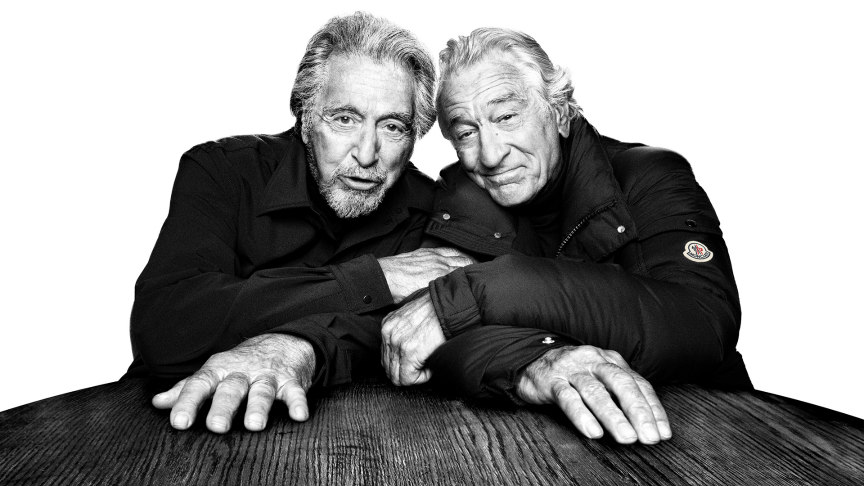
Remo Ruffini, thank you for welcoming us to this place that is coming into being. Can you tell us more about the genesis of the newly launched campaign “Warmer Together” with Hollywood icons Robert De Niro and Al Pacino?
Moncler is often associated with winter and puffers, but for me, it has always been about something deeper. Moncler is about connection, human warmth and sense of togetherness. This campaign was born from these core values, and from a powerful idea, that warmth is only real when it’s shared. This is a fil rouge that runs through our brand, and it lives far beyond the product itself. Bringing Robert De Niro and Al Pacino together felt natural, because their friendship and connection embody this spirit in a timeless way that spans decades. It’s a friendship that we’ve all seen over the years. Their bond and chemistry in their work and life is evident. With the legendary portrait photographer Platon behind the lens, his portraits and video conversations capture not just two legendary actors but two friends sharing an emotion and recollections. He has this rare ability to reveal the truth in people. His portraits remove all distractions, focusing entirely on the human bond and that’s where the magic happens. That sense of intimacy and human warmth is what makes this campaign so powerful, and so true to Moncler.