
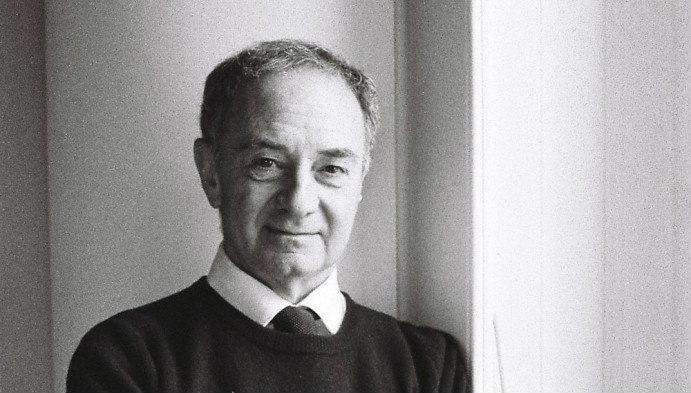
A PASSION FOR GREECE. Paolo Colombo is an Italian artist and poet. Born in 1949 in Turin, Italy, he lives and works in Athens, Greece. He was a curator between 1986 and 2017 in Philadelphia, in Geneva, in Istanbul, in Torino and in Athens. His works of visual poetry are exhibited widely.
21 minutes read time.
You can listen to the podcast of this interview here.
Paolo Colombo, you are Italian by birth, studied in Switzerland, lived in the United States, worked in many countries. Why is Athens your city of choice?
It is the city where I have lived the most in my life, all together about 22 years, mostly because of encounters. Greece seemed like a magic place when I first came aged 19. After I had finished 8 years of boarding school on a Swiss mountain, my first vacation was in Crete. I had an awakening, a love for the land, for the country, for the light, for everything that Crete stood for. I loved the life of Greece at the time, which was not an easy time. It was the summer of ‘68 and there was a military junta led by the colonels. Many of my friends thought that it was wrong to go to a country where there was a junta, but I saw things in a possibly more apologetic way. I was in Crete, living with people whose main concern was survival, and who definitely did not like the colonels. Crete is historically a left-wing part of Greece, and they asked me to bring records of Theodorakis, whose music was forbidden in Greece and which I loved deeply.
Did you speak Greek?
I knew a little Greek, not large amounts, but people were extremely hospitable, and therefore incredibly friendly to whoever was trying to speak their language.
“Greece is my world”
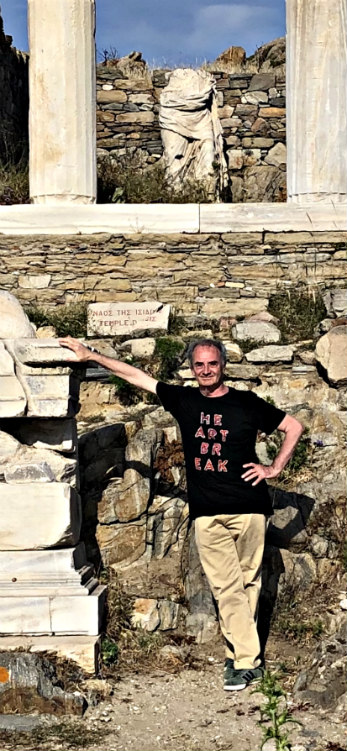
Paolo Colombo, was it in Greece that you realised that you were going to be an artist?
I knew from the age of 12. I became aware in the first two weeks of boarding school that I wanted to paint. I didn’t really put it as clearly as “I want to be an artist”, but our drawing teacher – who just passed away and with whom I was in contact throughout the years – had asked us to bring to class a box of Caran d’Ache gouache, two paint brushes, pencils. In the third lesson of the first semester he took out a book and asked us to take a dictation. He read us a paragraph from Thomas Mann’s novella in which Tonio Kröger, on a beach in the North Sea, in the distance sees the two loves of his life, Hans Hansen and Ingeborg Holm. Hans and Inge Holm came together to kiss. Then he said, “Please illustrate it.” I decided then and there that that was what I wanted to do forever. I had no idea of Greece until I was 18. I had read the Iliad and the Odyssey because they are part of the Italian curriculum, and one of the Italian poets was actually a Greek poet who wrote in Italian, Ugo Foscolo.
When did you decide to establish yourself in Athens, far from the madding crowd in some ways?
I kept on going to Greece for holidays and I went to see other islands. In February of 1972, I was at the University of Rome studying English and Foreign Literatures, including Modern Greek literature. I went to a concert by Theodorakis, and the concert was amazingly beautiful. Everybody was rooting for him. He was in exile, defending the idea of democracy in Greece. In the line of seats in front of me there was a young woman; and I understood that if I didn’t meet her, I would never know happiness in my whole life. As I am shy, I don’t know how I managed to meet her, but we began talking and became very good friends. She lived in the United States, so the next year I invited her to come to Greece in a house I had rented in Paros for us. She was going through serious problems, and had been institutionalised in a hospital. I decided that I wanted to be close to where she was, in Connecticut. I was granted a Harkness Fellowship and spent one year at Yale. She was in a hospital in Middletown, Connecticut. We saw each other three or four times – and then I lost her, and the whole world lost her. She disappeared. I had no way of reaching her, and when my fellowship finished, there was an agreement with the Harkness Foundation that one would leave the United States for two years and go back to his or her own country. I decided to go to Greece instead because she and I used to read the poet George Seferis together, and we were bound together by our love of Greek poetry. We used to go on a train to Ostia in February and March and look for a free beach and read George Seferis. I thought that if I was not going to be with her, moving to Greece I would be in a place where we both wanted to go. That’s how I ended up in Greece in 1977.
You are an artist, but you are also a poet?
I was loaned from the art world to the world of words. I do write poetry. I also write very short proses. Throughout the period of high school, I was quite undecided whether I was going to be a painter or a writer. I tend to see things in images, and poetry worked out well because imagery is at the core of poetry.
Many of your works are painted poems?
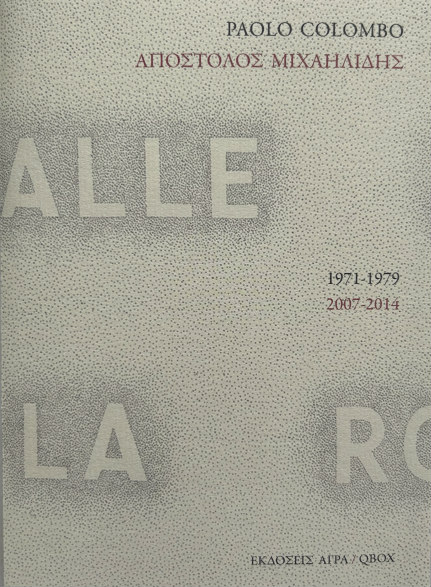
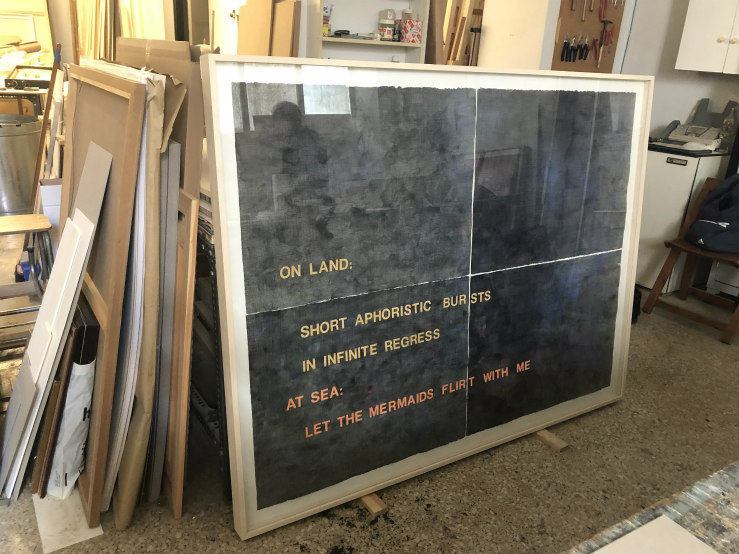
In 1977, when I moved to Greece, I started transcribing some of the poems that I had written into large works made of pencil drawings. Each piece was made from 800,000 to maybe 1,200,000 dots. Because of condensation of the dots around the letters one could read the text, written as if in sand or in fog, as if gusts of wind could erase them. I liked the idea that the images were ephemeral. They were composed of 4 to 9 sheets of paper, which made them look like fragments, like epigraphs. They were light grey on white, and they ranged in dimension from one metre to two metres 50. They were part of a meditative process: I made 4 or 5 dots, then I sharpened the pencil and I made another 4 or 5 dots, and the same gesture was repeated for months. In the meantime, under my table, the shavings of the pencils grew higher and higher. These were the first poems that became drawings.
Why do you write in English and not in Greek?
I didn’t speak Greek that well, and my first batch of poems were written at the same time in English and Italian. I would write lines that would have similar sonorities and a similar rhythm in both languages. They were written in Italian because my mother tongue is Italian, and in English because I was living my sentimental life in English. Afterwards I kept on writing more in English, rather than Italian.
Do you find English a better language than Italian for poetry?
Yes and no. Can I give you an example? One stanza of a poem:
In passion,
our eyes become nostrils,
our hips sway
and the spirit squanders.
In passione,
i nostri occhi diventano froge,
i fianchi oscillano
e lo spirito sperpera.
The spirit squanders comes close to the beauty of Italian “lo spirito sperpera”, but other lines might work better in English.
“Language is very connected with painting, regardless whether I make a painting of a poem or not”
Paolo Colombo, do you compose your poems suddenly?
No, I hardly take notes because they’re rather short. Until they perfectly flow in my mind I don’t write them down. For the longer ones I might take a few notes. Crucial for me in what I write is to give a sense of time and space. May I give you an example?
Then when
I thought my shadow was handsome,
he came dancing,
but not to stay.
I have never said beautiful words,
yet we both know the performances of John the Baptist.
I fixed the action in an abstract time, but still a time nonetheless.
Are you very influenced by music?
I’m influenced by Greek music, because it has an easy marriage with poetry. Poems by Seferis were put to music. Nikos Gatsos, one of the great Greek contemporary poets, published only one book of poetry and wrote 50 of the most beautiful songs ever. He thought that the idea that the song would be hummed, popular, like folk art, was very important for the translation of the text into music. Language is very connected with painting, regardless whether I make a painting of a poem or not. Kenneth Koch, an extraordinary American poet from the 70s, said that poetry is image and song. If you allow me, I will give you an example of a short poem in which space and time are indicated.
At night, the blind women of Athens
mend clothes and speak of angels.
La notte, le cieche di Atene
rammendano e parlano di angeli.
There is an indication of a night, and an indication of the location. There is an image of complicity, of solidarity, of women whispering in darkness. It is an image that can only be conveyed in poetry, simply because if you’re blind, you do not mend clothes. The English version was made into a painting.
You are very meticulous, and it takes a long time to do your work. How does the connection between writing your poems and doing your artwork happen?
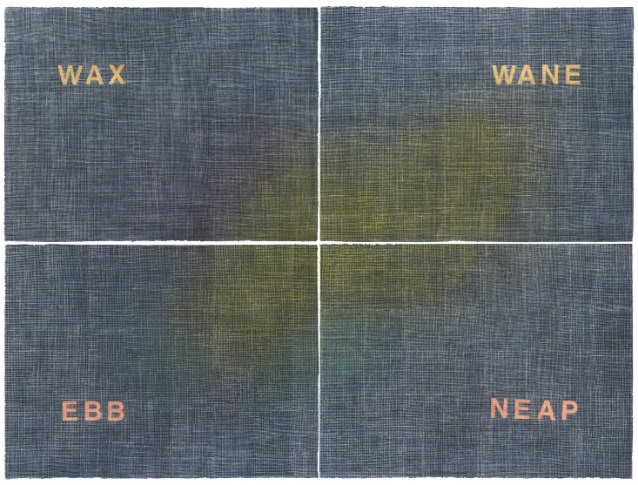
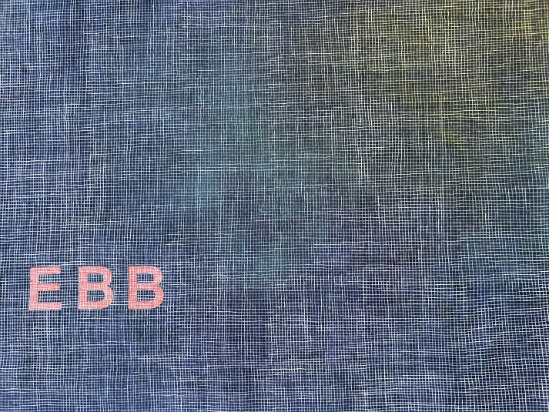
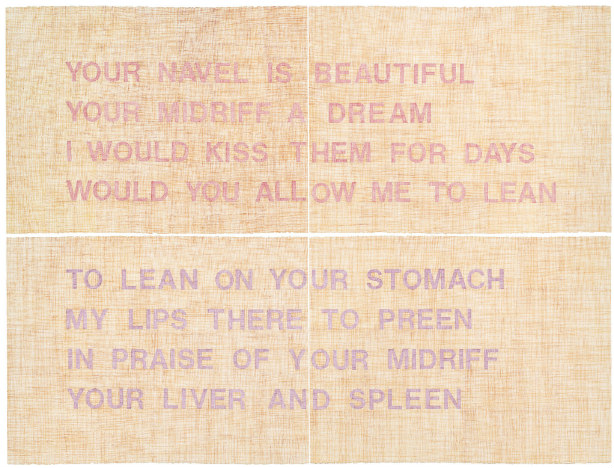
“At night the blind women of Athens” was painted as a huge embroidery in which the canvas, with the weft and the warp – the vertical lines and the horizontal lines of the canvas – is painted, and upon it the letters that compose the poem are painted as if it were an embroidery. It takes ages to make, and the whole point is that the issue of time is embedded in the painting for the viewer to see. Another example is the shortest and most austere poem I’ve ever written. It’s 4 words and it’s 14 letters, and you have to imagine a dark night so that you can see through a black tulle fabric and behind there is darkness with some yellow reflections of the moon on what could be the sky and the sea. It is composed of 4 words, one at each corner: top left corner, top right corner, bottom left corner and bottom right corner. The words are: Wax Wane Ebb Neap. Wax, wane, are phases of the moon. Ebb, neap, are phases of the tides. When you read that, written as an embroidery over the tulle, you understand that behind the fabric is a dark night and a dark sea. As a poem, it can be remembered by everyone. It doesn’t take much to remember 4 words, but each word requires a long time of silence around it. It encompasses 28 days and 6 hours, the time of phases of the moon and of the tides.
What is the difference between a poem that is written in a book or on a piece of paper and a poem that becomes an artwork?
This poem only exists as an artwork, because there’s no way for the book format to allow the distances and silence between Wax Wane and Ebb Neap, but everybody knows that this is about the moon, and it’s about the tide. It took me 3 months to make this painting; it can be grasped in 3 seconds. That gives me an infinite joy, to know that time can be compressed in the utmost way. At the same time there is a total economy of means, because I’m describing the night and the sea in a drawing with 14 letters: wax wane is 7, and ebb neap another 7. Describing the night in 14 letters took me many, many nights of work.
Is mathematics involved in your compositions?
No, not really. All of these poems or paintings are conceived while I make another painting, as it takes me from one month and a half to 3 months to complete one. While I paint, I think of 4 or 5 other paintings that slowly get edited, and maybe only one stays.
Is everything in your head?
Yes. There are no sketches. There’s no notes. There are no manuscripts.
Even for your prose short stories?
These are short stories about characters in Greece, and again, Greece is my world. Those I might write and correct and edit. There might be a sheet of paper with a few corrections. They’re going to become paintings, but in a different form. No longer the dots and the threads and the fabric, but they’re going to be like mosaics.
Are you going to make them into paintings?
Yes. One is particularly long to become a painting. It’s called “Maro Kapetanaki”, and it’s actually the real name of a real person. Here it is:
Maro Kapetanaki
It was the season when cats play in the gardens.
They met at the telephone station. In 1969, it was the place where to make or receive a telephone call in Ierapetra.
Just out of school, Maro had a summer job with her friend Kalliope, connecting telephones through an intricate system of wires and jacks. The young man was to enter University in the fall.
There was a gentle flare between them. Not knowing each other’s language, pointing to a calendar they arranged to have lunch together the following Sunday.
They met at a tavern close to the sea, with turquoise lacquer wainscoting and a lighter opaque coat to the ceiling. They were two of six clients.
She ordered a white fish soup, made boiling a bright red scorpion fish. Local music was coming from a gramophone and accompanied their lunch.
Maro wore a green cotton jumper with two straps over her shoulders. After their lunch, sensing that the young man was a foreigner, the owner switched the music to a slow French song. The young man invited Maro to dance; they got up, and for the first time their hands touched their naked arms. After a few notes, she let go of his hand and went to the table. There, she found a deodorant stick in her purse, and rubbed it under her arms.
He fell in love.
They didn’t speak each other’s language. They spent the afternoon saying ah, in long sighs. He did not know then what she had always known: in her mother tongue the root of the word elegy is Ε Ε λιγειν—that is: to say “ah”, “ah”. For Maro it was an elegy in the afternoon.
He walked her home, slightly inebriated from the touch of Maro’s arms.
She lived in a white single family home with a column on which rested a trellis. They exchanged addresses.
Months later, the young man received a postcard with a view of Ierapetra. On it was written χαιρετισμουσ—Greetings. He responded with an equally terse and loving text. He mailed it from the post office at the Vatican, in part for reliability and in part for their beautiful stamps.
He treasured Maro’s postcard for months, until she began to fail from his memory.
In Ierapetra, Maro slipped the young man’s postcard into a book, precisely in the pages where it said:
“Not as she is, but was when hope shone bright; Not as she is, but as she fills his dream.”
You don’t use many words to describe a scene, but the story is very clear.
It will become a mosaic because it is a prose. It will need the look of the solidity of a mosaic, even though it’s going to be a watercolour that looks like a mosaic. It will take 5 or 6 months to make, painting 8 or 9 hours per day.
Surely it is too much to work for 8 or 9 hours a day for 5 or 6 months?
Yes, I’ll take a day off, but other days are going to be even longer because when I’m staying in my studio I wake up in the morning and I go to my desk and sometimes I work for hours and hours and don’t even notice. While I paint, I’m thinking about the next stories which I’m going to be writing.
“I love the language, I love the music, I love the dances”
Paolo Colombo, some writers, like Joyce for example, lived away from their home country but wrote about it. Do you write about Italy?
I’m certainly informed by Italy, Italian being my mother tongue, and certainly informed by Italian painters. Among my very favourite painters are two who were born in Greece. One could almost say they are Greek painters because they’re so unusual for Italian painting: Giorgio de Chirico and his younger brother Alberto Savinio. This connection of Italy/Greece is important in the sense that Greece was a moment of memory for Giorgio de Chirico – and all his work is about memory. For example, the little train in the back of his paintings is the train that his father built in Volos, the first train track in Greece. The book by Savinio on infancy – The Childhood of Nivasio Dolcemare/Infanzia di Nivasio Dolcemare – is about his childhood in Athens. I left Italy to come to Greece, but my mother tongue has certainly informed the way I write English, and has informed my spacing in the stanzas of poetry.
Has Greece changed very much over the years and have your feelings for Greece also changed?
Greece has changed, but has not changed my feelings. It’s as if it has been a port in which I have arrived. Throughout my adolescence I was changing room and roommate every year, or every 6 months. My life was a table, a bed, a chair and a bookshelf, changing regularly. When I came to Greece, I had that extraordinary feeling that Seferis writes about, which is waking up in a small port that you have never been in, and the shutters are still closed because it’s dawn, but there’s a sense of security, of rest, of peace. This is what I found in this country, and I’ve always loved it, even though it has changed. The world changes, so everything might be considered worse than before, but I still love being here and I love the language, I love the music, I love the dances. I love museums like the Benaki Museum where high art is exhibited alongside icons and embroideries and costumes and little shoes and folk art on the wall.
From what you say, and from your poems and your artworks, you live inside your love story?
It is a love story. I have turtle doves coming to my terrace waking me up in the morning. It’s wonderful to hear them. I made a series of paintings related to the musicians of this country. I wrote a poem that’s called The Man Who Sang Amanedes that is dedicated to Dalgas, a singer from the 30s, born in Turkey, who was pushed out of the country when there was the exchange of population in 1922-23. His voice was considered second only to Caruso. He called himself Dalgas because dalgas in Greek means passion, and dalga in Turkish means wave, and he could modulate his voice like a wave and he sang songs of sorrow. He was a very elegant man, singing in boats, in bars, in cafes. He died in 1945. It is a short poem, but it is also about Greece, and it is called “The Man Who Sang Amanedes”. Amanedes are songs that are composed as couplets in a few lines interjected by the word aman, which means alas, alas, alas. Songs of nostalgia and sorrow.
The Man Who Sang Amanedes
We heard him first in Smyrna,
songs in the mode of the Argo Sirtó.
Fifteen syllables of epigrammatic character.
He sang like
(so they say)
the bülbül sings.
Keeper of the night
he sang,
he sang in waves,
mimicking the sound of the sea
there, where
the curls of water tremble
near the shore.
No longer young,
Dalgas was employed in boats,
accompanied by an Ionian estoudiantina.
In Greece, he loved Argyró Nikolaou, mother of Anna.
Così passò buona parte della vita.
In 1941, in Athens,
with the arrival of the German army,
he began to dim
and gradually fade in a city
that was bleak and grim.
Thank you very much Paolo Colombo. We will finish the interview with his music from 1935. Listen here.
I cry for you, my sweet mother.
And I suffer in exile
I don’t want you to ever cry, mother.
Light a candle for your child.
Portrait of Paolo Colombo by Marion Lambert.
ENJOY THIS INTERVIEW? SHARE IT WITH A FRIEND.


