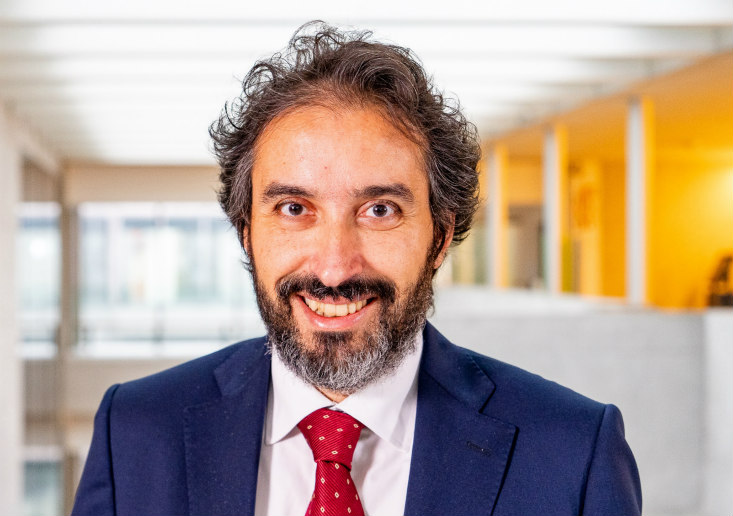
THE DEMOGRAPHER WHO LEADS AN INTERNATIONAL UNIVERSITY. Francesco Billari is Professor of Demography at Bocconi University in Milan, Italy. He became Rector in November 2022 after having held the role of Dean of the Faculty. He has worked at the University of Oxford Department of Sociology, at Nuffield College, and at the Max Planck Institute for Demographic Research. Billari served as President and Secretary-General/Treasurer of the European Association for Population Studies, and received the Clogg Award for “outstanding innovative scholarly achievements” from the Population Association of America in 2012. A Fellow of the British Academy, he is an affiliate of the Population Studies Center, University of Pennsylvania. His recent book Domani è Oggi offers a demographic lens to shed light on the potential futures shaped by today’s choices.
22 minutes read time.
You can listen to the podcast of this interview here.
Francesco Billari, why did you get interested in demography and what is demography?
As a child I was interested in geography and in statistics. I do not know many children who are data geeks, but I was a data geek in the late 70s and early 80s. I was also interested in people, and this is how I got interested in demography, which is the intersection between people, places, and data. It’s a discipline that is about all of us, about all the key family events and moves that we have in our lives, from birth to death.
Does demography have a special role in thinking about the future?
Yes, one of the great demographers of the last century was Alfred Sauvy. In 1945 he was charged by General de Gaulle to establish and direct a great demographic institution, the French National Institute for Demographic Studies. Fred Sauvy used to say that a standard high-level traditional watch has three hands, and the longer and fast moving second hand is a bit like politics, moving fast and giving us a sense of emergency and unpredictability. Then there is the minute hand that moves very slowly in a more predictable way, but still moving and this is the economy. Then there is the hour hand, the slow hand of the watch that you do not see moving, even if you have a fantastic watch. For Sauvy, this is the demography hand, apparently not moving, but telling you something about the future.
“The important thing is that all young people should think that going to university is a wise and desirable idea.”

‘For diagnoses and solutions, we need to use the eye that looks at today, also to generate consensus, by networking evidence, expertise and best practices. We also have a fundamental need to use the eye that looks to tomorrow, to examine the plausibility and desirability of the trajectories we are taking. We must evaluate a multiplicity of tomorrows, thinking about what could happen in one, five, ten, sometimes twenty or forty years. We can do this through the demographic lens.”
Francesco Billari, how does demography inform us about growing and shrinking populations?
Demography helps us in thinking about the future, sometimes by looking at the past. For example, Italy is one of the countries with the lowest levels of fertility in the world and declining births since the mid-60s. Except for the immediate post-World War II, the largest number of births in Italy was in 1964, more than one million. With data from 2024, Italy has a little bit more than 350,000 births, so three births in 1964 for one birth in 2024. The biggest age group in the Italian population now is people born in 1964.
What happens with population decline?
We don’t have many recent instances of population decline, except for disaster situations, so we still have to learn what happens. We know that, at the global level, we live in an era of highest life expectancy, lowest fertility, highest population ageing and slow population decline in some parts of the world. For the first time in history, we have several generations living together and several populations living together and also a high rate of migration between these populations.
There is population decline in some specific areas of the world, including China?
Yes, and one way to answer the decline in the number of young people is to invest more in these young people, to give them higher education and to expand their educational level. This is what is happening in many countries, especially in East Asia: Korea, Japan, China. In these countries the youth population is shrinking fast, but the rate of education is increasing fast. You have fewer people, but higher levels of human capital.
What is your demographer’s view of artificial intelligence?
If artificial intelligence is about making sure that we have a higher potential for human productivity, we need humans who are ready for the challenges of artificial intelligence. That comes with higher educational levels and learning technical human skills. The countries that are doing a bit less well, Italy is among them, are those where decline in the number of young people is not accompanied by educational expansion. I’m more worried about the ability of these populations to face the challenges of productivity in an era dominated by artificial intelligence.
How much of a problem have you found AI to be at Bocconi, and what safeguards have you put in place for your students?
We have a new strategic plan, a five-year horizon, but we’re going to revise that. We have taught a lot about AI, which is not only a challenge but also an opportunity, so we struck an agreement with one of the AI big players to make sure that our students have access to the most recent technology. AI is giving a social sciences and management university fantastic opportunities, but AI is also a challenge because some of the jobs like a junior analyst that typically students will have going out of Bocconi may not be there in the future. Our task is to make sure that our students can overcome the level of a junior analyst and are able to become senior analysts. To do that, we have to raise the bar and make sure they can use AI. They know what they’re doing: if they’re studying finance, accounting, political science, law, that’s something that they have to know; but on top of that, they have to be conversant with AI.
Is Bocconi a private or a public university?
Bocconi is a private not-for-profit institution founded in 1902 by an entrepreneur, Ferdinando Bocconi. He wanted to leave a legacy and establish university-level education in economics and management in this part of the world, where there was no university-level education. For more than 120 years Bocconi has been a proud Italian institution and it has become an international university since at least a quarter of a century. I think we are managing our diversity in a good way.
Would a student experience a big difference between studying economics at Bocconi and at one of the many Italian state universities?
I emphasise that the important thing is that all young people should think that going to university is a wise and desirable idea. I am happy to promote all universities in the world. It is a good idea to attend a university, and actually if we look at OECD data the majority of young people are going to graduate from university.
“We want to change the world by research.”
Francesco Billari, what is special about Bocconi?
Bocconi is Italian, but it’s also a global European university. The majority of our education is in the English language, the lingua franca of our time. Bocconi is a university with 120 nationalities. This is one of the differentiating factors, and Bocconi is in Milan, which has always been a border city between global north and global south. We are located one hour south of Switzerland, and two hours, or less on a fast train, from the Mediterranean Sea.
What does it cost to study at Bocconi?
We ask wealthy students coming from wealthy families to support the cost of education and of the campus. The fees depend on an undergraduate degree or a graduate degree or an MBA which is a bit higher, and the fees are far less than American universities. But a third of our students get some form of support, and 12.5 percent of our students pay zero to attend Bocconi. If students come from a family anywhere in the world which doesn’t have support and they get admitted to Bocconi, they will not pay to attend Bocconi.
How important is it to get a degree, even from different ranking universities?
Again, it’s important to have a degree. We don’t have to take rankings as gold results, but Bocconi is systematically placed as a top five institution in Europe in terms of reputation. This means that Bocconi graduates can easily get a job, and in many cases all over the world. Bocconi is the number one institution in the European Union in social sciences and management and we compete with top UK institutions. We are an international university: half of the first-year students are not from Italy, and more than a quarter of our faculty is not Italian. We are proud to say that we produce graduates and alumni that make us proud.
Where do your students come from?
The majority are still from Italy. Internationally, the number one nationality is France, then Turkey and Romania. At the Master of Science level, Germany is the second nationality after Italy. There is an increase in applications from the UK and the US, and in terms of schools of origin, the UK and US are number two and number three origins for first year applications. Very diverse.
What about people coming from the Far East?
We certainly have many students from Asia. Chinese students are, after German students, the number three nationality of our master level students, and Indian students are increasing very rapidly. In specific specialties like marketing we have a growing group of students and faculty from Korea because that’s an important specialisation for this country. Our student body is rather heterogeneous, with students from different continents, depending on the level of the degree. At the MBA level, we have many students from Latin America, which is different from what we have at the undergraduate level.
How do you convince eminent professors to leave Oxford or Harvard or other famous universities and to come and teach in Milan?
Living an international life is today part of being an academic, a researcher, a professor, a scholar, and close to 30% of our faculty is not Italian. Of course, we have to provide market salaries, and even if we are not-for-profit, being private gives us some advantage because we can offer salaries that are a bit better than state university salaries in Italy. For those academics who have lived abroad there is also a tax incentive to move to Italy, and we provide the opportunity to teach in the English language. It would be particularly hard to ask a professor of economics, of finance, of computer science, to move to Italy and teach in Italian if they’re not Italian.
How much do you support research?
We provide research support in an environment that is aspiring to be at the global level of top-notch research, and departments where they find colleagues they are happy to work with. Some faculty come with partners, spouses, children, and we rely on the fact that Milan, being an international city, provides opportunities that are a bit better than other Italian cities. Of course there are always challenges compared to moving to London, where, by definition, you move to a global city that is used to having people from all over the world.
Is the importance you attach to research appreciated around the world?
Yes, we would not have been so high in the rankings without investing in research. Up until 25 years ago, Bocconi was a fantastic teaching institution. I’m a Bocconi undergraduate alumnus and we’ve always had fantastic teachers. In the last 20 to 30 years, we have invested a lot in building Bocconi as a research university, and now we are definitely on the research map. Otherwise, you cannot be on international rankings and attract top-notch professors like me back from Oxford or people from American universities. One way to measure research success is whether we matter in competitive research funding, and Bocconi is number one in Europe if we take the economics and management area of the European Research Council grants. We are very well placed in many social sciences and also technology and mathematics fields. Research is definitely an important part of our DNA now. Bocconi also provides seed research funding to assistant professors. Not only do we collect external funding, but we have donors who support our research, and our education is also research-based. We want to change the world by research. We want to change the life of students by providing them access to top-notch knowledge, “knowledge that matters”, as we say, and this means we have to produce our own research.
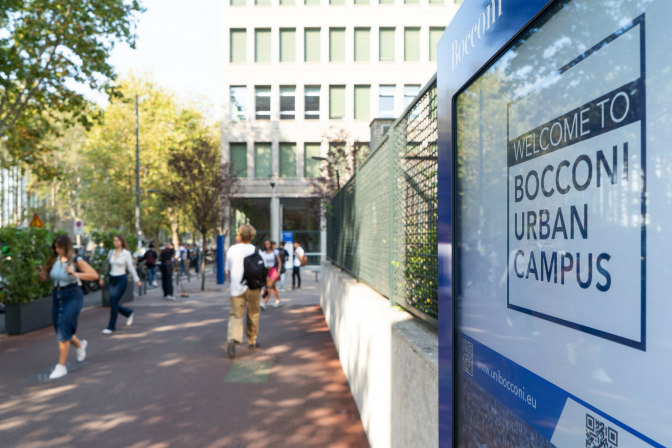
Bocconi Urban Campus, Milan
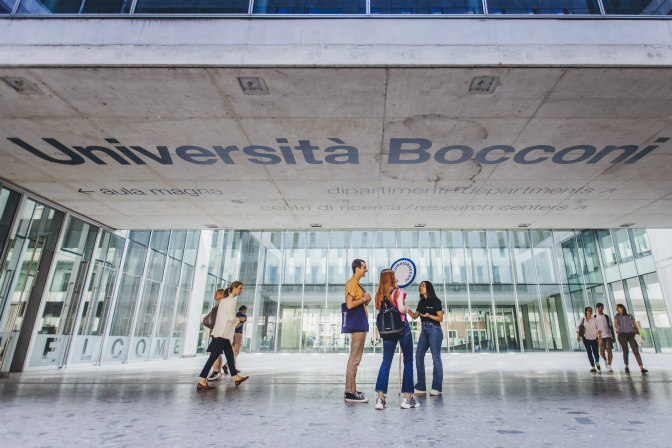
Bocconi is a private, not-for-profit international university
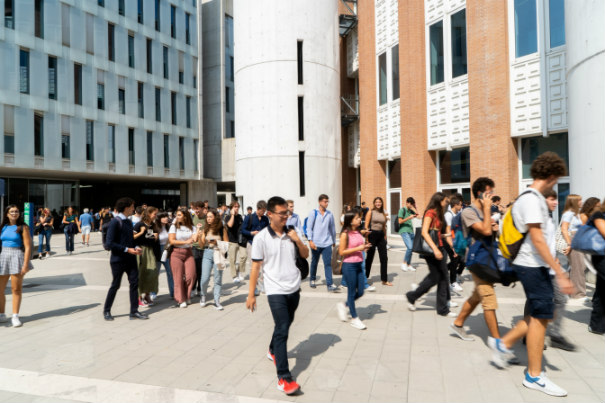
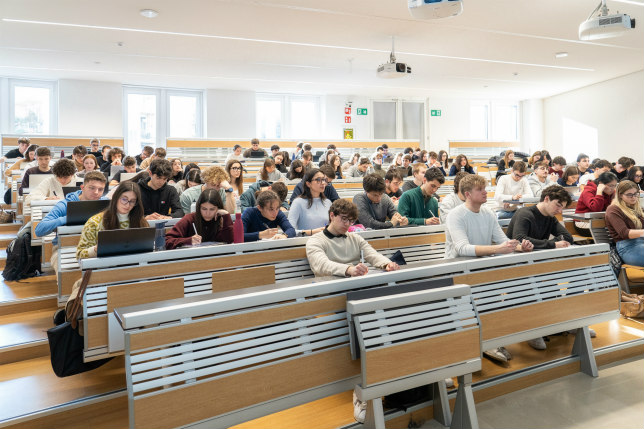
Bocconi is alive with students from all over the world

Students enjoy the libraries at Bocconi

Teaching is all in English at Bocconi
‘For diagnoses and solutions, we need to use the eye that looks at today, also to generate consensus, by networking evidence, expertise and best practices. We also have a fundamental need to use the eye that looks to tomorrow, to examine the plausibility and desirability of the trajectories we are taking. We must evaluate a multiplicity of tomorrows, thinking about what could happen in one, five, ten, sometimes twenty or forty years. We can do this through the demographic lens.”
“We still have to learn how to deal with this diversity that comes with demographic change. It is completely new for humanity.”
Francesco Billari, how many people are there in the Bocconi world?
We have 15,000 students and about 1,500 faculty members – of which almost 500 are permanent core faculty members – and close to 800 staff members. The Bocconi world is a huge community, an urban campus-based university. We don’t have many urban campuses in Europe, and there are not many in the world. Milan has become a university city over the last decades.
Where is the Bocconi campus?
In central Milan, 15 minutes south of the Duomo Square, the core centre of our place. It is close to the canal area called Navigli, a lifestyle area with many bars and cafes and a very picturesque side of Milan. Bocconi started in the very centre of Milan, close to the Corriere della Sera, the flagship newspaper of Milan, and then in the 1940’s moved to what was then the southern edge of the city, but now it’s central city and it’s still just 15 minutes’ walk from Duomo. We have at the moment 2,000 accommodation places for our 15,000 students, and we have a goal of expanding that to 3,000.
Are you close to the Olympic Village of the 2026 Winter games?
The Olympic Village is walking distance to Bocconi and it will become a student residence, we hope including Bocconi students. We want to have a campus that is lived in almost 24 hours a day by our students. This is very important, because we do not want to push learning only from an analytical, technical perspective, but also from soft skills. These skills are social and emotional and can only be learned by interacting together, so leaving the parental home, living with students from all over the world and thinking about the future.
Do you think that it is better for a student to study in the middle of a city, like Penn in Philadelphia, or in a remoter place like Cornell University in Ithaca?
I lived for one year as a visiting professor at the University of Pennsylvania in Philadelphia. Our daughters were born there, so I’m very attached to West Philly and the university neighbourhood. Both models work, but in a different way. Milan is a new university city, but in this area we had an historical university city called Pavia, half an hour south of Milan. It is one of the oldest university cities in the world. If you study in a global city like Milan, Boston, New York or Philadelphia, you are studying where many economic things are happening. Milan is possibly the world capital of design and we are particularly strong in fashion. We have a vibrant finance community and we have sports, so this is different from a small university city. We are also building a partnership with a Polytechnic and Engineering top school we have in our city, to push startups in Milan which is still lacking a little bit the flair of the startup world that Boston and New York have. We are in a university city, a global city, an international city which has a high quality of life, even higher than Philadelphia or Boston potentially, but we need to provide a future for our graduates.
Interactions between professors and students have changed over the years. There is less distance, and includes words like kindness and inclusivity. What are your impressions?.
If I have to choose one moment in the history of universities, I choose today. We are living the best moment in the history of the university and I hope the future will be even better. The market counts and students are increasingly enrolling in universities all over the world. Overall, if we look at choices made by young people, young people want to go to attend universities. This means universities are a success story. This century is the university century.
How challenging is being at university today compared to the past?
I come from the country of Maria Montessori and we know that people can learn different ways which are not as tough as the past, in more inclusive ways without having to fight and to suffer. We still have to work hard but can learn in a way that is also fun. Our libraries have a queue of students in the morning wanting to get in there. Now libraries are places where students study and interact, so we also have rooms in libraries where students can prepare for group work and for joint endeavour.
In short, students are flocking to universities?
Yes, and the challenge for professors and staff is to recognise that we are diverse. I am a professor of demography and I have to understand my audience. When I started teaching demography it was in Italian for Italian students, and talking of the demography of China and India was one thing, but if I teach in English, in an international class where I have Chinese and Indian students, I have to be better prepared because I am in front of people who know what China and India really are. It’s a challenge for me, and I have to be more attentive, which makes me a better professor and a better researcher. That’s true for all professors and all researchers.
Considering migration, the UK has had an Indian origin Prime Minister and the Mayor of London is of Pakistani origin, so immigrants belong In one or two generations?
Yes indeed, they are the population. In our era life expectancy is 73 years at a global level, the highest in human history. Everywhere in the world people are living longer and moving more. Almost 300 million people live outside their country of birth, but within countries people also move to cities and we are also in the peak urbanisation era. One of the challenges that we face is that demography is pushing a higher population diversity by social origin, by ethnic origin, by generation, by gender. This diversity is a big opportunity but we still have to learn how to deal with this diversity that comes with demographic change. It is completely new for humanity.
What is your experience of the recent problems around freedom of expression and violence in certain universities?
We should encourage young people to express their feelings and their views. It’s normal and how society progresses. For centuries adults and older folks have complained about young people; and young people have brought change. However, we should never tolerate intolerance and violence. Universities can be inclusive only if they are places where we respect each other and are ready to debate with each other even with different positions, different religions, different political views. Universities have to be a safe place for debate, and I don’t tolerate intolerance. Bocconi doesn’t tolerate it. We have been lucky that there have not been riots or a violent episode at Bocconi, but we are aware that in other places people were prevented from speaking and were, in some cases, harassed. That’s not what we tolerate, and we will certainly not tolerate it in the future.
Is yours a big responsibility to teach that difference of opinion does not mean hatred and enmity?
Yes, we have a big responsibility. A Nobel Prize economist, Amartya Sen, reminds us that our identity is always multiple. Once we make our identity binary and say Us and Them, I’m part of Us and they are Them, I’m only white and they’re black, I am on the left and they are right, then this is a potential fuel for conflict. Universities can teach that the world is more complex than Us and Them, than simple binary divisions, left and right, religion A and religion B, men and women, all genders, social origin, capitalist and working class, all of us has a special identity and sometimes it’s intersecting. I was born in Milan, my parents are from Southern Italy, from Calabria and Sicily, and in Italy normally this means different identities, so my identity is an intersection of identities. As a social science university, it’s very important for us to teach and also show with our actions that this multiplicity of identities is first of all a blessing for humanity because it brings wider perspectives and it brings more innovation. But it also brings the responsibility to avoid the Us and Them situation, which is where we get to violence. Amartya Sen was very right in saying let’s not cut the world into two groups. We are never two groups anyway, so why should we? But we need to emphasise that, study that, repeat that.
Thank you very much.
ENJOY THIS INTERVIEW? SHARE IT WITH A FRIEND