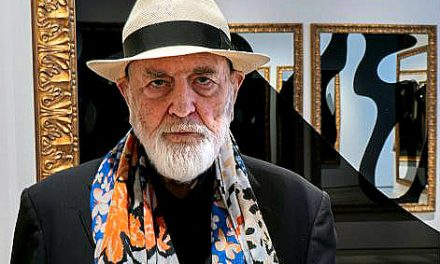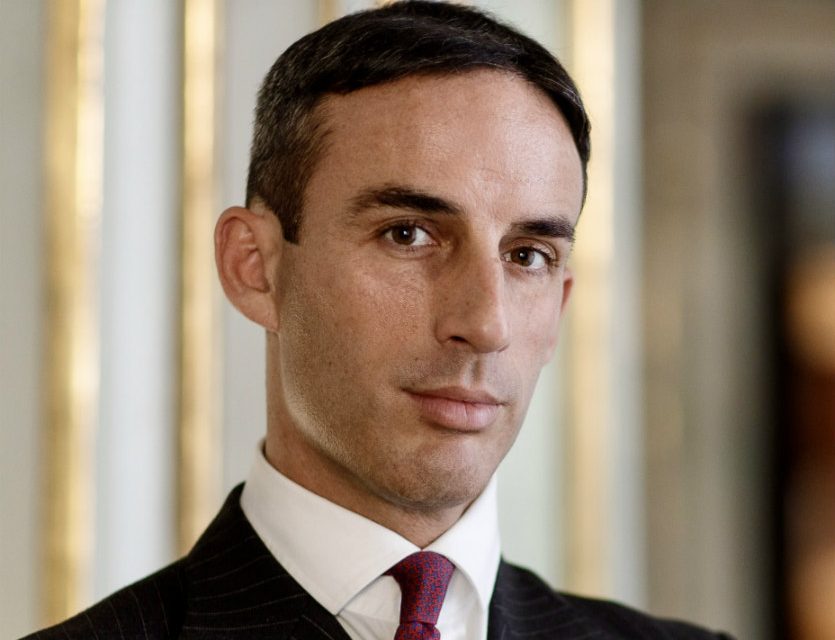
REVIVIFYING ROME. Thomas Clement Salomon is the director of Rome’s Baroque Palazzo Barberini and the Galleria Corsini since January 2024. Palazzo Barberini is home to the National Gallery of Ancient Art, with a collection of paintings by Caravaggio and other Caravaggesque painters that now includes the very recently acquired Caravaggio Portrait of Monsignor Maffeo Barberini. Thomas studied art history and archaeological heritage protection law, for many years he helped organize major exhibitions at the Scuderie del Quirinale in Rome and the Palazzo Reale in Milan, worked at the Galleria Borghese with the Director Francesca Cappelletti, and was Scientific Director of MondoMostre Skira, the world’s leading producer of exhibitions. He has travelled extensively between the United States and Europe, managing the loans for dozens of important exhibitions.
25 minutes read time
You can listen to the podcast of this interview here.
Thomas Clement Salomon, the superb “Caravaggio 2025” exhibition which you organized in Palazzo Barberini had a huge attendance. How many people came?
Four hundred and fifty thousand.
The big news is that the Italian Ministry of Culture just bought Caravaggio’s portrait of Maffeo Barberini especially for the Palazzo Barberini for 30 million euros. How did this come about?
I worked on a very important exhibition dedicated to Caravaggio in Milan in 2017, then I worked at the Galleria Borghese where highly significant paintings by Caravaggio are on display. Appointed here as Director of the Gallerie Nazionali, I thought that for many reasons we should organize a major exhibition dedicated to Caravaggio for the year of the Jubilee in 2025. The Gallerie Nazionali have four paintings by Caravaggio in our collections, and the most important Caravaggesque painters’ collection in the world. In this exhibition were displayed a few extremely important discoveries like the painting of Ecce Homo that is now in Madrid, and this portrait of Maffeo Barberini.
What is the story of Caravaggio’s Maffeo Baberini?
An incredible story, because this painting was discovered in a private collection in the early 1960s, so more than 60 years ago. When Roberto Longhi, the scholar who rediscovered Caravaggio in the 20th century, saw this painting, he wrote that it is a masterpiece. For Longhi the lost portrait of Maffeo Barberini is “the first modern painting”, so I had always seen this painting in books about Caravaggio, but no one knew where it was or who the owners were. All the most eminent scholars told me: “I don’t know. I think they have it, but they’re saying that they don’t have it.” It really was a mystery.
“No one knew where this Caravaggio was or who the owners were.”
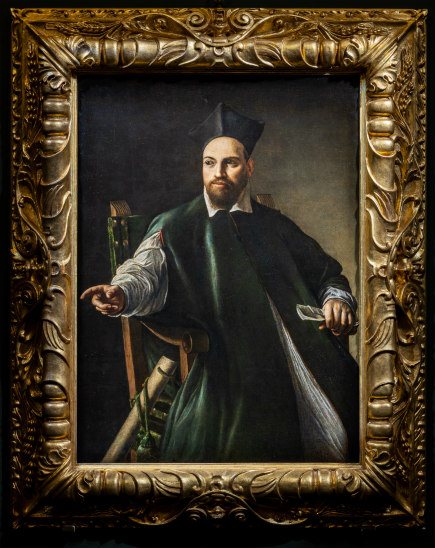
Portrait of Monsignor Maffeo Barberini is a painting by the Italian Baroque master Michelangelo Merisi da Caravaggio.
Thomas Clement Salomon, a sort of spy story, because nobody knew who this painting belonged to?
Nobody. There was an idea of someone, but no one was sure. It was incredible. It was the missing Caravaggio, so when I was appointed here to this job that I love, for me it was also a responsibility to do everything to find this painting, especially organizing a major exhibition about Caravaggio. Then a friend from Los Angeles told me he knew who the owner was, and I asked to put me in contact.
He told you it belonged to a family in Florence?
Exactly, and it was funny because at the first meeting, with three or four people, they said, ” We represent the owners, but we don’t have the painting. Why did you ask for this meeting?” And I said, “We’re organizing a major exhibition about Caravaggio, one of the most important ones, and of course we would like to have this painting on display. But I’m also interested in acquiring the painting for the Italian state, for our museum.” They laughed and said, “We think highly of you, you’re nice, you’re polite, but this hasn’t happened in 60 years, so why should we lend the painting now? Why should we show the painting? Why should we sell the painting? The painting is not for sale.” I kept the conversation going, we met up again, I pressed the point and I talked with the Minister of Culture at the time, proposing for the State to buy this painting, because it’s extremely important to buy a Caravaggio portrait given that only three or four have survived to the present day.
This must have had great meaning for you, running the National Galleries in Palazzo Barberini and this rediscovered Caravaggio, a portrait of Maffeo Barberini?
Enormous meaning. Worldwide there are 60-65 paintings by Caravaggio but only three or four portraits that are certainly by him. This extremely important portrait does not represent a friend or just anyone, but Maffeo Barberini, the future Pope Urban VIII. The work is really a key painting for Caravaggio and for the history of art of the beginning of 17th century. The first time that I talked with the Minister of Culture of that time, he told me: “Director, we’re not buying without seeing a painting which has been hidden for 60 years. If you convince the owners to have it on display, we might try to perform a miracle.” Luckily, I convinced the owners to show the painting for the first time since it was discovered in 1963. It was very difficult for them to come to this decision after 60 years of saying no to everyone, but it was probably because of Palazzo Barberini and the Jubilee, and they also understood our interest not only to have the painting on display but to buy this masterpiece for the Italian State.
Because it could be a very important opportunity for the Italian State and for the Ministry of Culture?
Because the Italian State had not bought a Caravaggio painting for 70 years. The last was Judith Beheading Holofernes, which is in our collections. In any case, we convinced the owners to have the painting on display, and in November 2024 all the leading newspapers around the world wrote great articles about this painting. Then the Ministry of Culture understood that everything was okay, that the painting really was by Caravaggio, and that it was an enormous success to have it on display and eventually to buy it for the State.
The Minister of Culture was Alessandro Giuli, the current Italian Minister of Culture?
We started with the Minister Gennaro Sangiuliano and the Direttore Generale Massimo Osanna, and then everything became more difficult because the Minister changed so I had to start all over again, talking with a new Minister and a new Head of Cabinet. But with great insight, they immediately understood the importance of this opportunity. We were also contacted by foreign museums that were interested in purchasing this masterpiece. This painting’s value on the U.S. market could be $100 or $120 million and we bought it for 30 million euros. Of course the painting could not leave the country even if there was a lot of interest from other foreign museums, but there are private collectors in Italy who could buy it. So the Minister took very important decisions, because he understood the importance and he decided to buy the painting for the State. It was a two year long very difficult negotiation, and when the “Caravaggio 2025” exhibition closed in July 2025 we still didn’t have an agreed deal. The owners were asking for a lot more than the amount that we had decided to agree, and for a long time I thought that it was going to be impossible to finalize this.
What convinced the owners to reach an agreement?
First of all, it was not one owner; there were six or seven owners and this made everything more complicated, because I didn’t know them all. Some were really keen to sell the painting to the Italian State, and others did not want to sell. I don’t know what happened on the owners’ side, but when the Caravaggio exhibition closed in July and we still didn’t have an agreement, they proposed to have the painting on display here in Palazzo Barberini for a longer period and do more fundraising, and I said, “No thanks. This was the Caravaggio period. We did this enormous exhibition. We had the painting on display. The Ministry of Culture is offering you the most important amount in the history of the Ministry of Culture. We want to buy the painting, but we also want to try to buy it well, with a lesser amount for the Italian State.” Two days after I had said no, their lawyers called me and said, “Okay, the owners decided to sell the painting to the State.” We were very happy. It was a historic moment. We needed a few months more to work on all the documents, and the Minister decided to announce this enormous acquisition a few days ago.
Does the portrait need to be restored or is the painting in good condition?
The painting today is in extremely good condition. It had an important restoration in the 60s/70s. We showed it to a few restorers here in Italy, and some of them said that with a new restoration the colours could improve, others said no, it’s perfect like this, it’s better not to touch it. I want to make it very clear that this painting today is in good condition. There was an important restoration in the past, as for other paintings by Caravaggio, and as for many other masterpieces. Like every work of art that is 400 years old, it’s difficult for it to be perfect.
Are you going to make a special event in the museum around the painting?
Yes, we will have it on display here in Palazzo Barberini with the Judith Beheading Holofernes, the last painting that was acquired by the Italian State in the 70s. Then we will see. We are thinking of creating a beautiful gallery to display our five paintings by Caravaggio, but we need more time.
“Bernini, now you have to become the new Michelangelo.”
Thomas Clement Salomon, how many Caravaggio paintings can we now see in Rome?
Five in the collections of the Gallerie Nazionali di Arte Antica, six in the Galleria Borghese, one in the Vatican Museums, in churches you have three in San Luigi dei Francesi, one in Sant’Agostino, and two in Santa Maria del Popolo in the Cerasi Chapel. And there are two paintings by Caravaggio in the Musei Capitolini and Galleria Doria Pamphilj.
In fact, Rome holds the majority of the Caravaggio’s in the world?
Yes, Rome is the city for Caravaggio. He was born in Milan, but there are only a few of his paintings. There are the Canestra di Frutta in the Pinacoteca Ambrosiana, and the Supper at Emmaus in the Pinacoteca di Brera. There are important paintings of his in the Uffizi in Florence, in Sicily, and a few masterpieces in Naples.
And the Caravaggio’s around the world?
Just to mention a few: in the US you have the beautiful Card Sharps, a painting originally from the Barberini collections now at the Kimbell Museum in Fort Worth. At the Metropolitan Museum there are three: La Negazione di Pietro, The Musicians and The Holy Family. In Cleveland there is The Crucifixion of Saint Andrew, and at the Nelson-Atkins Museum in Kansas City there is a beautiful Saint John the Baptist. In Hartford at the Wadsworth Atheneum there is a beautiful St. Francis. In Europe there are Caravaggio’s in Malta and important paintings at the Louvre in Paris. At the National Gallery in London there are three paintings. In Berlin is a sad story, because there is just one painting, a beautiful one, the Amor Vincit Omnia in the Gemäldegalerie. During World War II, two Caravaggio paintings disappeared.
Italian museums have so many masterpieces, do you really need to buy more works?
We’re talking about Caravaggio. He’s really a national “hero”. One of the aims of our Ministry of Culture is to save and offer to the public works of art hidden in a private collection as this one was, or that could be bought by other private collectors. We are a museum that buys works of art, but I believe we have to focus on extremely important acquisitions. And that was exactly what we did with the Caravaggio.
At the moment you have another major exhibition of Bernini, the Baroque sculptor who had a strong relationship with the Barberini family?
Yes. We are a museum with a strong personality. We’re not a Kunsthalle, an empty venue where we can exhibit Picasso or Rothko or whatever we want. We have one of the most beautiful palazzi in Rome, the Palazzo Barberini. The architecture is by Bernini, Borromini, Maderno, Pietro da Cortona; so the best of that time.
There is an amazing ceiling in the main room with frescos by Pietro da Cortana, and you have two incredible staircases, one by Bernini and one by Borromini?
I believe our collections and the venue have a strong personality that we have to respect. So we are focusing on the most important highlights of our collections, like Caravaggio, now Bernini; and not only enormous names, we did an exhibition about Carlo Maratti, so also less known artists. That’s fundamental. From my humble point of view, the challenge is to say something new about these artists. The Caravaggio exhibition was almost impossible to organize because every museum is very jealous of their paintings and they have an enormous value. Their public visits the museum and just look for Caravaggio. We had for the first time on loan the Portrait of Maffeo Barberini and the Ecce Homo, and we have used the same approach for Bernini. Bernini is of course so famous, he created Baroque Rome, but this is the first exhibition dedicated to the relation between Gian Lorenzo Bernini and the Cardinal Maffeo Barberini, who became Pope Urban VIII. They were friends when they were young, and the day that Pope Urban was elected he called Gian Lorenzo Bernini and said, “You are very lucky to live under my pontificate, but we are luckier to have you living in these years. Now you have to become the new Michelangelo.” And as Michelangelo was for the 16th century, Bernini was for the 17th century; he became an architect, a painter, and together they created the Roma Barocca. In this Bernini exhibition there are about 70 works: busts, sculptures, drawings, paintings from all over the world; from the Getty in Los Angeles, from the Morgan Library in New York, from the Louvre in Paris, from The National Gallery in London, telling this story of friendship and relationship of power, of beauty, of art, between Urbano VIII Barberini and Gian Lorenzo Bernini.
What an interesting fil rouge that Pope Urbano VIII is the same Maffeo Barberini who is depicted in the Caravaggio painting that you have just bought. How many visitors are coming to the Bernini show?
A huge amount. We are very happy because visitors are the lifeblood of a museum. We work for the public. When I arrived here we had only 170,000 visitors, now we closed 2025 with 700,000 visitors. I am glad that the museum is alive. There is a lot of competition in Rome, because in other smaller cities like Milan and Turin you have beautiful museums, but Rome really is the city for art and culture and you have the Colosseum, Castel Sant’Angelo, the Vatican Museums, Galleria Borghese, the Scuderie del Quirinale, so we’re very glad to see this museum alive with a lot of people. It’s already sold out during the weekends and we have nearly 2,000 visitors during the week, every day, only for the exhibition.
The city of Rome is a museum in itself, so how do you attract people to visit your museum in the Palazzo Barberini and Galleria Corsini?
It is difficult, and exhibitions help if they are well conceived. Exhibitions also help people rediscover the permanent collections. I love museums. I would like to live in a museum, I’m so proud and thankful to work in a museum because it’s where the most important human creativity is on display. I’m always visiting museums, but other people are not like that, so if you do strong exhibitions this helps, but it’s not only about the exhibitions. We worked a lot on the gardens. We restored the facade of Palazzo Barberini, we have rearranged some of the galleries and we receive requests for many events. We recently proudly hosted the Valentino fashion show, important valorization for us and advertising for the museum. Having all the fashion newspapers talking about Valentino in Palazzo Barberini makes me feel that maybe in Thailand or some foreign country they read about Palazzo Barberini also thanks to Valentino, and maybe they will come to visit us and learn something about Raffaello, Caravaggio, and Bernini.
Do a lot of Roman residents and Italians come?
Yes, a lot of Romans, and a lot of people from all over Italy as well as from foreign countries. We also created a membership so people have the possibility of visiting our exhibitions when they’re closed to the public. We organize talks, lectures and book presentations. We propose many activities for our public and members.
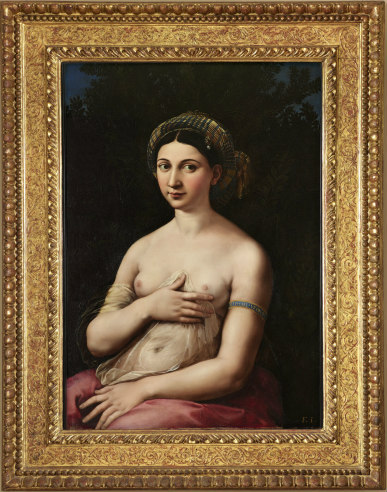
La Fornarina (The Portrait of a Young Woman) is a painting by the Italian High Renaissance master Raphael, made between 1518 and 1519.
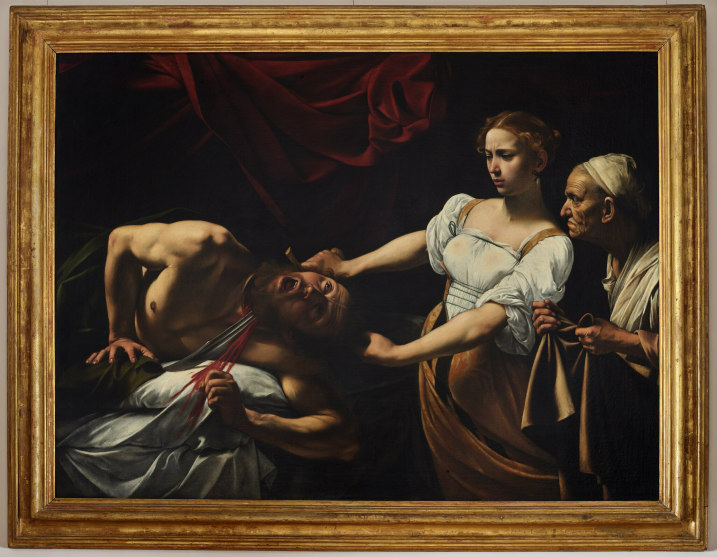
Caravaggio’s Judith Beheading Holofernes (c.1599) is a masterpiece of Baroque realism and intense dramatic tension, housed in the Galleria Nazionale d’Arte Antica at Palazzo Barberini, Rome.
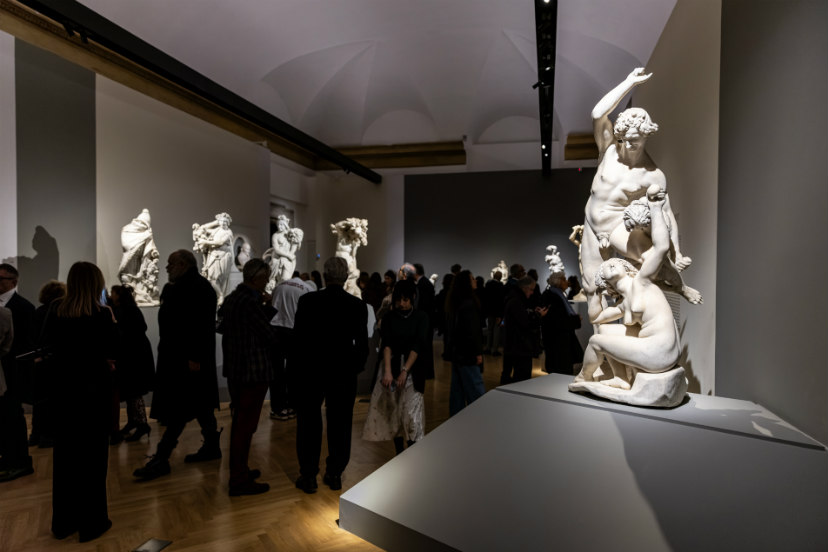
The major exhibition “Bernini e i Barberini“(Bernini and the Barberinis) runs at Palazzo Barberini in Rome from February 12 to June 14, 2026.
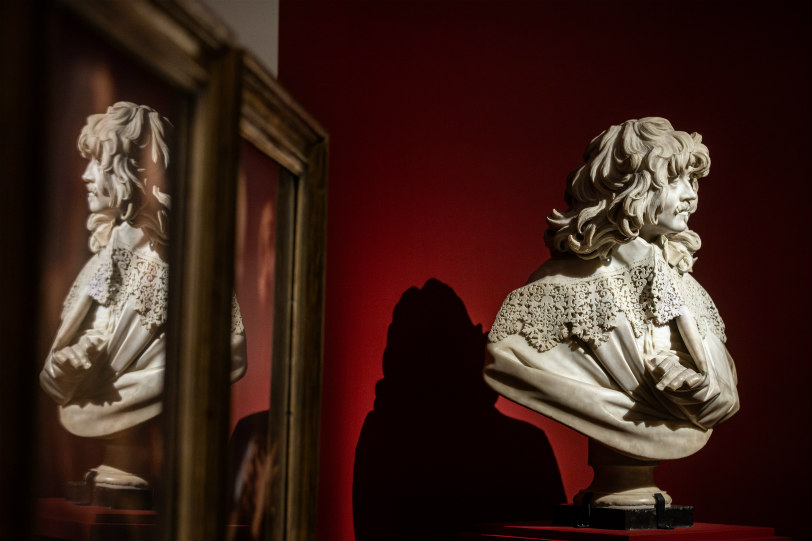
The bust of Thomas Baker is a 1638 marble portrait sculpture created by the Italian artist Gian Lorenzo Bernini. Thomas Baker (1606-1658) is believed to have been the Englishman who delivered van Dyck’s famous triple portrait of Charles I to Bernini in Rome.
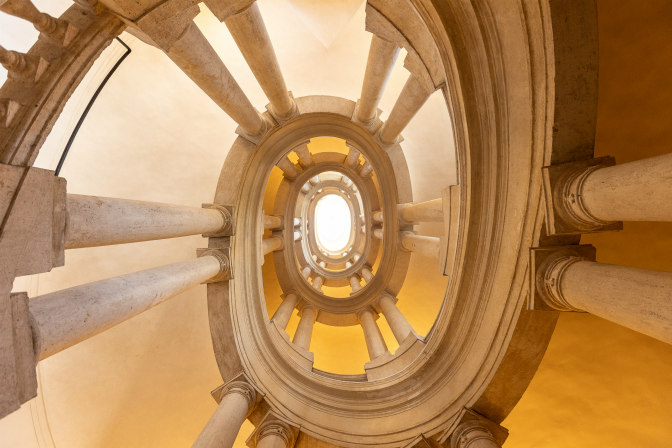
The Borromini Staircase at Palazzo Barberini in Rome is a renowned Baroque masterpiece, feturing a helicoidal (spiral) design constructed between 1633 and 1643. Located in the south wing, this intimate, oval-plan staircase uses 12 pairs of Doric columns, featuring Barberini bee motifs, to create a feeling of suspended movement.
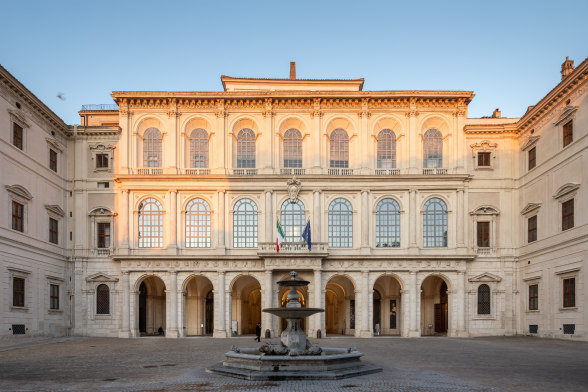
The Palazzo Barberini, a masterpiece of Roman Baroque architecture (built 1625-1633), features a distinct, grand facade showcasing a unique H-shaped, open-winged design. It was designed by Carlo Maderno and completed by Gian Lorenzo Bernini and Francesco Borromini, featuring three tiers of loggias with Doric, Ionic, and Corinthian columns, along with innovative false perspective windows.
“Poussin is a great painter of course but Velázquez is enormous.”
Thomas Clement Salomon, in fact, it’s a big job to be the director of two museums?
I love it. I love beauty, I love what is on display in a museum. When you are a director, unfortunately you don’t have a lot of time to study the works of art. A museum is a bit like a company. Many people work here, you have a budget to take care of, so you need that approach as a director.
What surprises do you have in store for us after the Bernini show?
We will close the exhibition dedicated to Bernini in June, and in July an extremely important masterpiece will arrive from a European capital, of an artist we don’t have in Italian collections. We can’t say who it is for the moment, but I can tell you we have another extremely important project for the next year dedicated to Velázquez and Italy. Velázquez is one of the greatest painters of all time and we don’t have him in our collections but he was working in Rome when Bernini was working in Rome and Velázquez was inspired by Bernini and many other Italian artists. He came to Italy when Urbano VIII was Pope, so this is really related to Italy and to Rome.
Was Velázquez also inspired by Caravaggio?
Yes, what Velázquez saw in Rome changed his style, so it’s very important for us to work on this extremely difficult exhibition. The last exhibition dedicated to Velázquez here in Rome was more than 25 years ago, when exhibitions were very different from today.
Are many Velázquez paintings in Italy?
One in Rome in the Musei Capitolini, the Portrait of Innocenzo X in the Galleria Doria Pamphilj, one in Modena; there are only a few paintings by Velázquez in Italy. He came to Rome twice and some of the paintings that he painted in Rome are at the Prado in Madrid, so we will have a lot of paintings coming from Spain, but many of them are also coming from the U.S. and from other European museums.
Are you interested by foreign artists who were in Rome?
Yes, it’s interesting because there is a relation with our collections and what our collections represent, but I have to say that Velázquez is a dream, Velázquez is a very difficult exhibition because in Spain he is like Caravaggio is for us, so to obtain the loans is very difficult; they are really jealous about Velázquez.
Another foreign painter considered almost Roman was Poussin, but I don’t think there are many paintings by Poussin in Italy?
We have two paintings by Poussin. He’s also a very great and important painter. Pierre Rosenberg, the extremely famous director of the Louvre, believes that Poussin is probably the most important painter ever. He’s a great painter of course but Velázquez is enormous. It is interesting that in Italy for every century you have many important painters: Raphael, Caravaggio, Guido Reni, Carracci, and many others, but in Spain there are not so many, but they are extremely important: Velázquez, Goya and Picasso.
“Raphael: Sublime Poetry” opens at the Metropolitan Museum in New York on the 29th March. Will you lend Raphael’s very famous masterpiece La Fornarina?
Yes it will go to New York and we’re glad to lend it. We have to protect and preserve and save our masterpieces for our public, and this is the priority from which we start but if you have an extremely serious scientific project from an extremely serious and important museum like the Metropolitan, and they are lending us in exchange a Caravaggio that allows us to have an important exhibition with 24 paintings and 450,000 visitors. I think it’s absolutely right to cooperate to be generous and to work on these exchanges at an extremely high level. We are also asking the Metropolitan for Velázquez for next year. It’s important to have very strong relations and co-operation between the best museums.
Do you understand more than many that this exchange between museums is very important because in the past you obtained essential paintings for numerous shows?
Absolutely. But it’s also a matter of inspiration. We can’t open the door of our museum and hope that people will come in. We have to work, we have to think, we have to talk with other museums in New York, in London, in Paris, and see what they are doing, being generous with them, making exchanges. It doesn’t make a lot of sense just to open the doors and wait for people to come in.
Does an exhibition sometimes travel to more than one country?
There are very interesting partnerships, but it’s nearly impossible to organize an exhibition in more than one venue when you’re talking about Caravaggio, Bernini, Vermeer, Rembrandt, these big names, because the paintings are so important that there are no museums that would let them be out in another venue for more than three or four months. But it could be possible if all the works are coming from a museum where they closed a part of the galleries for construction or restoration and let part of the collection travel. Sometimes you can see a two or three venues exhibition, like the loan request we received for an exhibition that will be in San Francisco and then in Paris, dedicated to very interesting artists, but not at the level of Raphael or Leonardo.
And there are probably some paintings or sculptures that are too fragile to travel?
That is the priority for each loan request that we receive. The first thing is we talk with our conservation lab and understand if it can travel or not. Many works can’t travel, so the answer is just no. Unfortunately, sometimes we also have requests from ambassadors helping some exhibitions, but if the painting is really fragile there is nothing that we can do. Conservation is our priority, so we can’t lend if the work is truly fragile. Sometimes you can evaluate different opinions from different conservation laboratories, but if we are sure that a painting is fragile, it cannot travel.
Thomas Clement Salomon, acquiring the Maffeo Bernini by Caravaggio after the “Caravaggio 2025” exhibition is a remarkable achievement by you and the Ministry of Culture. Then in 2026 you show Bernini, you have a secret work coming, and we eagerly wait for Velázquez to come! Congratulations for all your incredible achievements and good luck for the Gallerie Nazionali. How many more years do you still have here as Director?
I’m here since January 2024. In theory it’s a four-year job, plus another four years if you are confirmed, but I don’t think much about the future. I try to do my best and make things happen today and tomorrow, speedily and working hard.
All images courtesy of Gallerie Nazionali di Arte Antica
ENJOY THIS INTERVIEW? SHARE IT WITH A FRIEND