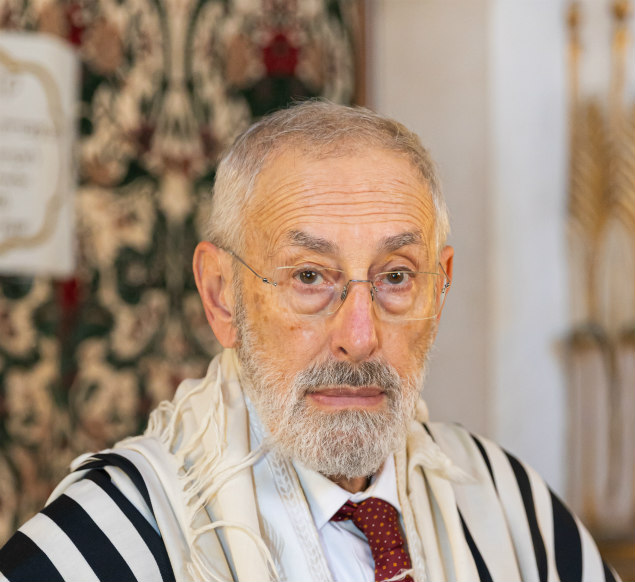
COMMITTED TO DIALOGUE. Riccardo Di Segni is the Chief Rabbi of Rome and director of the Italian Rabbinical School since 2001. He is a retired medical doctor specializing in radiology, and as Vice President of the National Comittee for Bioethics (Comitanto Nazionale per la Bioetica) in Italy combines his rabbinical duties with his background in medicine. Di Segni is an author whose work focuses on religious, historical, and cultural aspects of Jewish life.
23 minutes read time.
You can listen to the podcast of this interview here.
Riccardo Di Segni, how did you manage to combine being Chief Rabbi of Rome with the practice of radiology?
First of all, it is a classic combination. There are precedents, even very illustrious ones, such as Maimonides. In the history of Italian Judaism, many rabbis have also been doctors, even if, more recently, the combination has fallen into crisis because both activities are very demanding. My answer to your question, somewhat ironically, is that I’m not sure to have managed it.
I imagine you have little free time.
Free time is a marginal option. Since I retired, my rabbinical activity is what absorbs me totally.
“Despite everything, Judaism endures.”
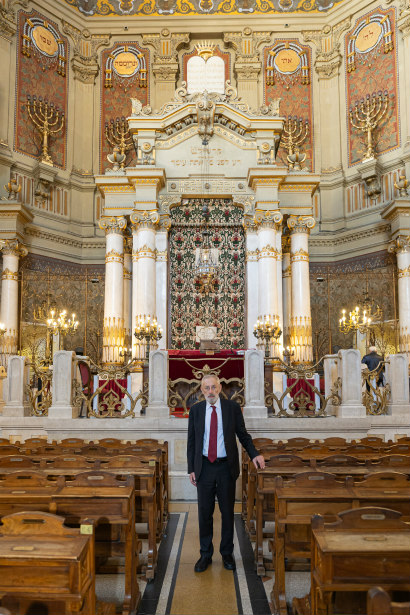
The synagogue associated with Rabbi Riccardo Di Segni, the Chief Rabbi of Rome since 2001, is the Great Synagogue of Rome. It is also known by its Italian name, the Tempio Maggiore di Roma.
Luca Sonnino Photographer
Riccardo Di Segni, Rome is home to the oldest Jewish community in the diaspora in the Western world, unique because Roman Jews are neither Ashkenazi nor Sephardic. You are the son of a Roman Jew and an Ashkenazi mother. Who are the Roman Jews?
They are descendants of Jews who arrived in Italy, specifically in Rome, more than 2,000 years ago. The Roman Jewish community has the strange privilege of being the oldest community that has never moved. Rome has never been without Jews for more than 20 centuries. There is therefore an original nucleus of specifically Roman tradition, with its own liturgical traditions, to which the Spanish Sephardim were added, typically after being expelled from Spain. However, they were careful to create not one synagogue, but two: one for the Catalans and one for the Castilians. National divisions also translated into Jewish divisions! Since 1967, Rome has also been home to a large Sephardic Libyan community.
There are therefore differences in worship, in the celebration of religious services, and in cuisine. Among your rabbinical occupations, do you also devote yourself to this more practical aspect?
Rabbinical activity is above all practical. There are differences, especially from a liturgical point of view, with different melodies and texts. There are also dietary differences that are integrated, because Roman food is not shunned exclusivist. There is now a communion of food exchanges and it is therefore a difference that has been settled positively and without conflict.. There are also cultural differences in approaches to life, which, after many years in Italy, change and evolve, but remain visible.
Is your role to help these differences coexist peacefully?
It is to try.
There has been a strong resurgence of anti-Semitism after the tragic events of 7 October 2023, and this is the first time that you, as spiritual leader of the community, have found yourself in such a situation. What can you tell me about this?
It is not the first time. There have always been episodes or waves of anti-Jewish hostility. These have strengthened after 7 October, characterising these past two years with the intensity of this phenomenon. Unfortunately, the Middle East conflict serves to uncover and resurface a whole range of feelings that usually flow more or less underground, but are waiting for an opportunity to come to light.
We often talk about the Jewish people, but are the Jews a people, a culture or a religion?
The Jews have existed for 35 centuries, when religious and national distinctions followed different criteria. Today, there is a clear distinction between nationality and religion. But when this interferes with the Jewish condition, it is like putting a large object into a small box: no matter how you arrange it, something will be cramped and uncomfortable. We Jews identify with our condition very differently: some consider it merely a religious affiliation, others national, and still others combine the two in various ways. Jewish identity is a complex reality that the states in which Jews live also view differently. In the Soviet Union, for example, the population was divided into nationalities, and Jews were a nationality, not a religion. In Italy, according to state law, we are a religious minority within the Italian nation.
The existence of the State of Israel has created a distinction between Jews of Israeli nationality and Jews of the diaspora. Should all Jews be Israeli?
Israel is a state. It is a state with a Jewish majority. But you can be Israeli, a citizen of the State of Israel, without being Jewish. In fact, there are many Muslims, Christians, and people of other religious denominations. Being Israeli does not therefore mean being Jewish, but it does mean that a part of the Jewish people living in Israel has established a state that is predominantly Jewish. Other Jews live scattered around the world and are citizens of the states in which they live, where they are distinguished by their culture and faith.
If being against the state of Israel and its policies does not mean being anti-Semitic, is this a way of masking anti-Semitism?
There are whole series of distinctions and nuances. It is everyone’s duty to be critical of their own government and governments of other states, which does not mean being hostile towards that nation or state. On the other hand, one can slip into being critical of the government, the state, and that state’s right to exist. What is happening, and what I see every day on social media, is that people tend to identify certain behaviours as an evil nature ingrained in the Jewish condition; Jews are defined as evil by nature, and what is happening is simply, according to some, a manifestation of their evilness. At this point, criticism of a government hides a much deeper feeling of hostility that is no longer a purely political and military issue, but a substantial one. That is where the risk lies.
“It is the world that is changing, not just Israel.”
Riccardo Di Segni, why is it impossible to explain and therefore to live normally with the fact that there are intelligent Jews, stupid Jews, good Jews and bad Jews, just like in all other peoples?
This is one of the fundamental, age-old problems, namely how to react to the spread of hatred and prejudice. The problem is that even if a Jew is completely detached from his historical or religious roots, for some people he still symbolises diversity, and in a society that wants everyone to be the same, diversity is not tolerated. So it is difficult to explain that we are not all intelligent or that we are not all rich, because they do not believe you anyway. The problem is that Jews represent something that does not always have the same shape, but even when they do everything they can to erase their identity, they are still not accepted.
The core difference between Christians and Jews is that the former have the Messiah while the Jews are waiting for the Messiah. In countries such as Morocco and other North African countries, Muslims and Jews have always lived close together and fairly peacefully. Is the problem with Muslims today more related to the political situation in Israel, or has this prejudice always existed with them too?
We must be cautious about making generalisations and fuelling images that may be more mythical than real. The conflict between Christians and Jews is that Christianity has Jewish roots, and this has never been resolved, though in recent decades there has been a positive turnabout in the relationship. As for Islam, its faith includes a concept of domination in which, at best, the people of the Book, who may be Christians or Jews, are tolerated to the extent that they are submissive. The relationship of Jews in Muslim countries has always been one of limited tolerance and submission; it is not all joy. Today, in the centre of Tripoli, a complex of three or four skyscrapers has been built on top of the Jewish cemetery of Tripoli. This exaltation of tolerance is therefore very relative.
Given the proximity of the synagogue in Rome to the Vatican, what are the relations between the Vatican and the Jews today?
We have a well-established tradition of relations and communication with the Catholic world at every level, from the man in the street to the Pope. Our relations have improved overall in recent decades. However, the events of 7 October created obstacles and misunderstandings due to very different views. The situation is now relatively less dramatic, albeit unstable, and with the new Pope we are working to mend these tensions. Someone ironically said that it will take a lot of needle and thread.
How are relations with the Muslim world?
The Muslim world is like a galaxy in which there are many different positions and no central authority, so we have a good relationship with some representatives, but not with others.
Having been Chief Rabbi of Rome since 2001, do you feel that the Italian and European communities are under serious threat at the moment?
The term ‘serious threat’ is perhaps an exaggeration, but we are in a risky situation with open hostility from some sectors of public opinion. One sector is extremely harsh and hostile towards Jews, even if it does not declare it; whether this represents a threat is questionable. Of course, we must be vigilant.
Some say that the only safe country for Jews is Israel because the myth of the United States as a country of salvation has faded as they too suffer from these same problems. Do you think that Jews will increasingly tend to go to Israel?
It depends on how the situation escalates. For example, the reactions of the Jewish community to New York’s new mayor are interesting. I don’t think there will be a mass migration from New York; at most they will go to Miami. Throughout history there have always been movements of Jews, but also from Israel to other countries. There are movements in all directions, so it is difficult to make predictions.
What is the relationship between Roman Jews and Israel?
There are now many families of Roman origin living in Israel, so firstly there is a family relationship. Additionally, there is an emotional and identity-based relationship, and there are also Jews who are very critical of the current government policy. From a spiritual and historical perspective, they are the majority is very attached to Israel.
Are they also disappointed by the change in perception of Israel?
Israel, which was founded with a socialist, left-wing leadership, has already much changed in this respect since the 1970s. It is the world that is changing, not just Israel. Observe the fate of the left throughout the Western world.
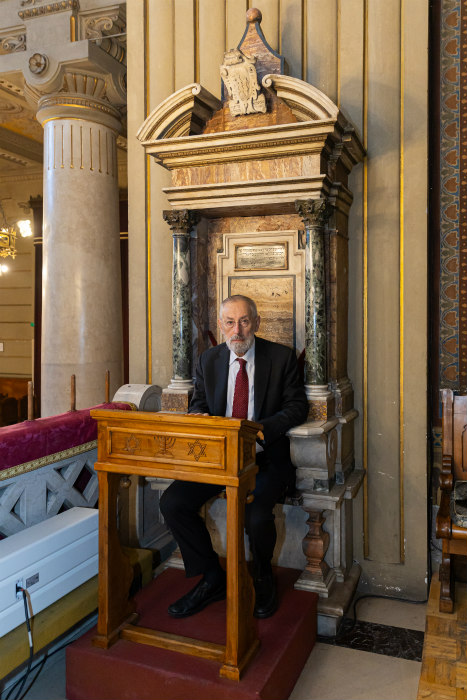
Rabbi Riccardo Di Segni, the Chief Rabbi of Rome
Luca Sonnino Photographer
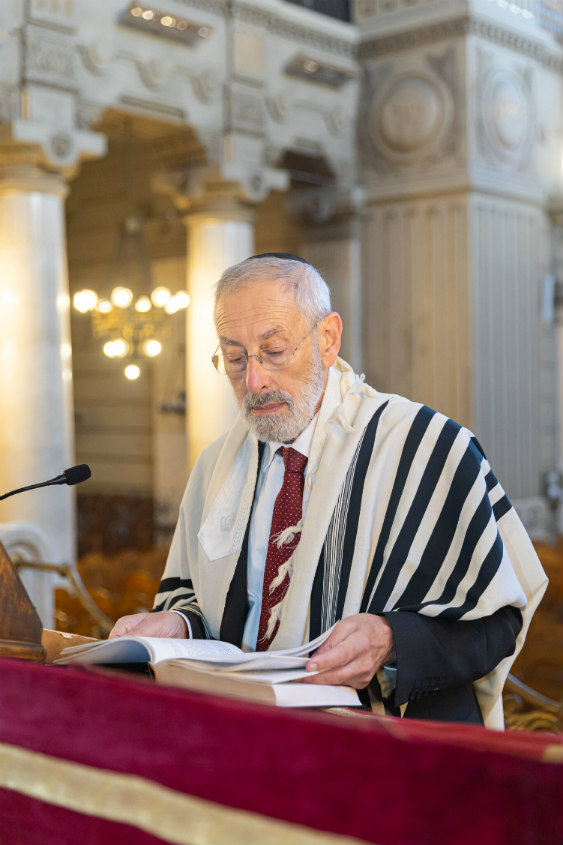
Rabbi Riccardo Di Segni, the Chief Rabbi of Rome
Luca Sonnino Photographer
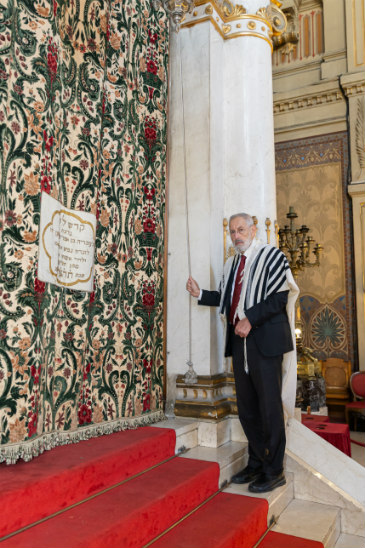
Rabbi Riccardo Di Segni, the Chief Rabbi of Rome
Luca Sonnino Photographer
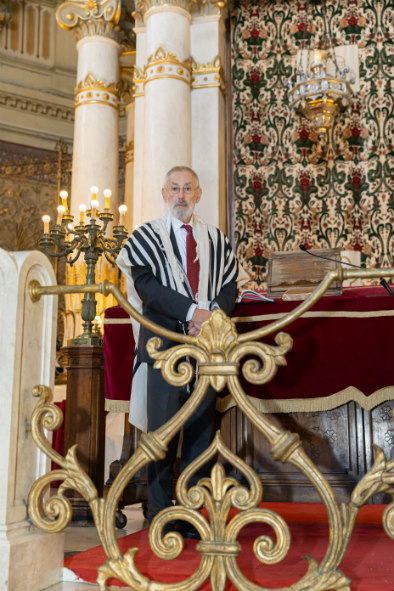
Rabbi Riccardo Di Segni, the Chief Rabbi of Rome
Luca Sonnino Photographer
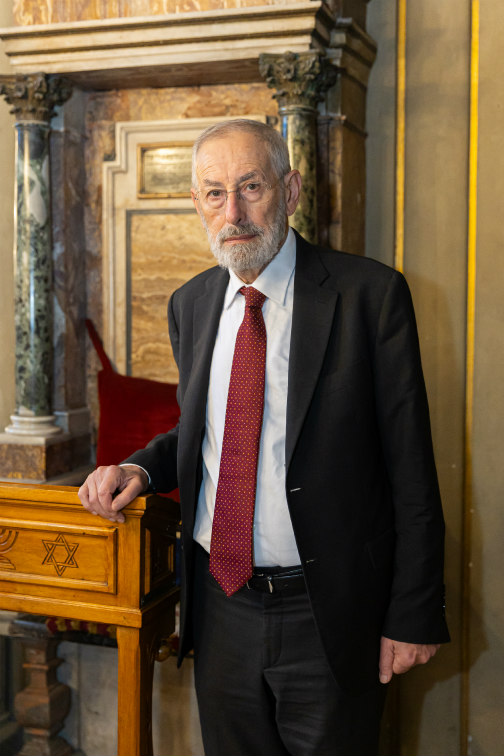
Rabbi Riccardo Di Segni, the Chief Rabbi of Rome
Luca Sonnino Photographer
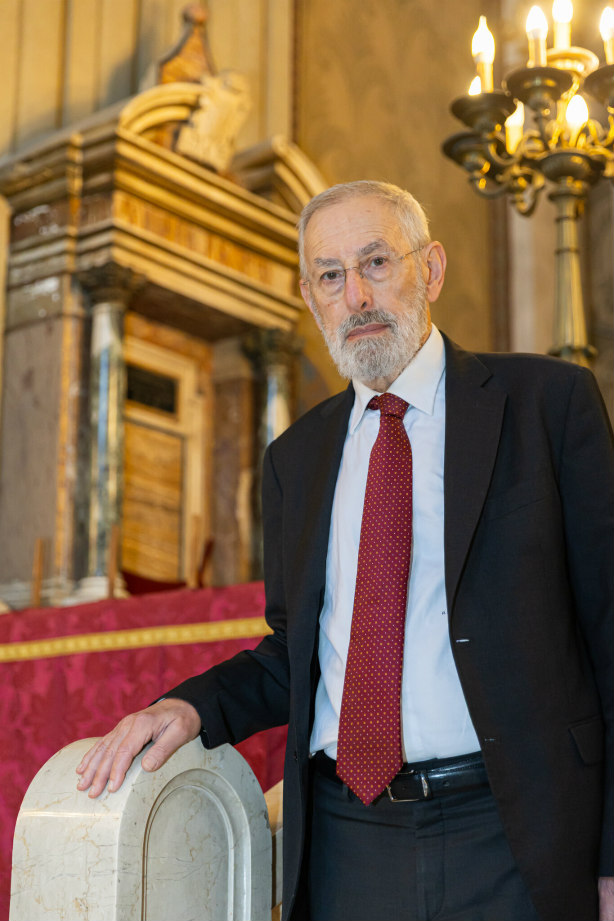
Rabbi Riccardo Di Segni, the Chief Rabbi of Rome
Luca Sonnino Photographer
“My mother always told me, ‘It’s difficult to be Jewish.’ It is a very demanding religion that regulates every moment of existence.”
Riccardo Di Segni, many intellectuals, including Jews, have now sided with the pro-Palestinian movement, and we constantly hear the term ‘genocide’ being used. What do you think about this?
Being Jewish, as emphasised before, does not exempt one from responsibility for making errors of judgement. Not all Jews are intelligent or say the right things. Beyond “correctness”, even in the Jewish world there is extreme diversity of opinions. Regarding the issue of “genocide”, it is an extremely delicate and dangerous matter. We have denounced the use and abuse of this term in every way possible. Beyond what a court may rule, the use of this term conceals an extremely risky political and psychological operation, namely to trivialise the Shoah and to show that Jews should not be pitied for the genocide they suffered because they are capable of doing the same thing. This means wiping the slate clean with regard to the Shoah, and it is a political operation that did not begin two years ago but is very dated.
In June 1982, during the war in Lebanon there was a trade union demonstration in Rome during which, as a sign of contempt, a coffin was placed in front of the synagogue. Rabbi Toaff protested to Luciano Lama, who was secretary of the CGIL (Italian General Federation of Labour) trade union, who replied that it was a reaction of indignation by workers to the ongoing “genocide”. This was 1982, and already a left-wing political leader was using and abusing the term genocide. So this is an old story, only at the time no one cared, while today, through sheer insistence, it is a prevalent theme.
In many other countries, such as Ukraine or Africa, the same thing is happening, or even worse than what is happening in Gaza?
The problem is ‘No Jews, no news’; news involving Jews causes more of a stir. In Nigeria, there is severe persecution of Christians, and thank goodness the Pope spoke about it, because, before that, not even official sources were talking about it. It is news that has not been reported with the attention it deserves, unlike the news coming out of Gaza, which has a completely different media relevance. This is clearly a suspicious operation.
Many people think that there are a great many Jews, but in reality there are only a few million in the world. How many Jews are there in Rome?
There are between 12,000 and 14,000. They are few, but any man in the street could tell you that there are about 400,000.
Today, there is talk of fear and unease in the Jewish world but why don’t we also talk about the vital, joyful, cheerful, optimistic and witty side of Jews?
You are preaching to the choir. What I have always said to my community is to stop talking about anti-Semitism, to try to downplay the negative and focus more on the positive.
What kind of people are the Jewish people?
First and foremost, they are people like anyone else on the street, with their own problems and moments of serenity and joy. Despite everything, Jewish culture is a positive culture. We try to work on this, but we are crushed by reality, by history and, even if the situation is improving in this sense, by ignorance. Many Jews have lost their connection with their traditional heritage, and what has bound them to their Jewishness has been the negative attitude towards them. To completely reverse this perspective requires attention to one’s roots, which are not only the negative roots that history has inflicted on us. Today, there is a significant reversal, at least in Rome; people are returning to study, traditions, and everything that characterises a positive life.
Is there also a return to spiritual life?
Yes, there is. In the synagogues, there is a flourishing of religious life that did not exist before, in all possible shades.
A fundamental element of the Jews of the diaspora is that they are integrated into the countries where they were born and where they live. In Italy, there is a substantially high percentage of Jewish writers which is not widely publicised?
No one has ever denied Bassani’s Jewish roots. According to critics, Primo Levi, in addition to his memory, is a great poet, not just a witness. There are many names that have marked 20th-century literature, many present today. No one denies this significant presence
But prejudice remains.
This is normal, even it is not pleasant.
How do you explain the survival of this people who do not want to convert other peoples to their religion and who are not against other religions, despite all the horrors we know?
My answer is a providential and faith-based one, bringing up a whole series of sociological considerations. There is a story about Frederick the Great of Prussia who asked an advisor, ‘I want proof of God’s existence,’ and the advisor replied, ‘The Jews, Your Majesty.’
How did the Jews endure their situation for centuries?
Throughout history we have lost hundreds of thousands, if not millions, of people, and even today many people are turning away. Despite everything, Judaism endures.
Is it difficult to be Jewish?
Absolutely. My mother always told me, ‘It’s difficult to be Jewish.’ It is a very demanding religion that regulates every moment of existence.
Is it a religion that provides answers?
As many as you want, although it mostly asks questions.
Other religions have forgiveness, the Catholics have confession.
We also have forgiveness on Yom Kippur. Yom Kippur represents a ‘reset’. After a year of difficulties, including psychological and spiritual ones, on Yom Kippur we do a sort of ‘cleansing’, starting afresh.
How does a Jew know if he has been ‘cleansed’ when the rabbi does not act as an intermediary?
The rabbi tells you that if you retrace your steps and leave the wrong path, you can start over, but it is up to you. Participation is important.
One thing that many people do not know about Judaism is that in order to recite certain prayers there must be ten adult men, regardless of social class or education. Why does this rule exist?
Collective prayer is worth much more than individual prayer because when you are together, any negativity is spread out and softened. The example given is that of perfume. In the temple in Jerusalem, among the components that accompanied the sacrifices, there was a perfume whose composition was established by the Bible and, even more strictly, by the masters. Among its ingredients, which were all fragrant spices, there was one that smelled bad, but when added to the mixture, it accentuated the scent of the others. So, when we are together, we create positivity. Some prayers must therefore be recited collectively.
No one is immune to wrongdoing. In your opinion, what are the wrongdoings of the Jewish world and Israel today?
Every human being and community, and Jews are no exception to this rule, is imperfect, so their behaviour is inevitably accompanied by practical or moral errors. We have a duty to be self-critical and critical, but also careful. In my book Jews at War, I told a beautiful story. We have a rule to read a section of the Torah once a week, so that, in a year, the reading is completely finished. After reading the Torah, we add a passage from the literature of the prophets to complement it. In the prophetic passages, we also find invectives against the Jewish people, invectives that are very harsh, such as those of the prophet Ezekiel. There is a chapter that begins with these words: ‘Son of man, make Jerusalem know her abominations,’ followed by a very long list of criticisms. It is said that once, in a synagogue, a cantor went up to the podium and chose this passage for reading, and the teacher told him that before speaking of the abominations of Jerusalem, he should think of the abominations of his own mother. This is to say that no one can go up to a podium and criticise without first engaging in self-criticism. Criticism is indispensable, but one must have the qualities to do so, and the personal moral integrity.
Do you feel this in your community?
Yes, of course.
But do you feel listened to as a rabbi?
Heard, yes, but things can be heard with one ear and let out the other.
However, if I understand correctly, there is a return in the younger generations.
Yes, but not only among young people, also among adults.
Does the constant reading of negative things about Jews bring the community together?
Absolutely, because people feel threatened and offended by it.
As Chief Rabbi of Rome, do you feel that the Italian authorities listen to you?
I think there is not necessarily agreement, but considerable respectful attention.
What do you think is the attitude of Italians towards the Jewish world?
It is very varied, but recently there has been a hostile polarisation.
How do you deal with this?
We try to denounce it, and put in place defence mechanisms, in the sense of informational defence. These are extremely difficult mechanisms because we believe and have proof that there is a media offensive of disinformation. If I have to criticise the Israeli government on one point it is that they have completely neglected the media aspect of this whole situation; they have other priorities.
Are Jews in the diaspora who are pro-Israel, perhaps because they have friends and family in Israel, embarrassed?
More than embarrassed, they find themselves in difficulty. How they react depends on the place and the time. When the war in Lebanon broke out in 1982, a considerable number of Italian Jews opposed the Israeli government’s decisions. In this war, the landscape has changed somewhat, as the wave of hostility towards not only Israel but the Jewish world generally has been so great, and the events and perceived risk so serious, that even those most critical of the Israeli government have shown substantial solidarity with the difficulties of the Jews of Israel.
What was the purpose of your latest book, Ebrei in guerra (Jews at War), co-written with Gad Lerner, the Italian journalist and TV presenter?
It has several purposes. The first is to demonstrate that among the various political forms and historical opinions that divide Jews, there is also the possibility of respectful dialogue, discussion, and the exchange of opinions. This was the fundamental message. Furthermore, every day on social media, I see that my arguments are incompatible, unacceptable and criminalised by a section of public opinion that is purely pro-Palestinian, but there is another group of people who are willing to reason or hear a different voice. This book, therefore, was also a way to convey a different opinion to an audience that would otherwise not have accepted it.
The problem is ignorance?
It is not just ignorance. The Palestinian issue has become a rallying point for dissent and a banner to wave when there were no other forms of gathering for certain political movements. They managed to recreate unity and cohesion to return to organise the protest on the streets.
Are you very proud to be a Roman Jew, to be the Chief Rabbi of this ancient and vibrant community which not everyone knows about and which, despite being a small community of 12,000 people, is very important in the Jewish world?
Of course. Every person is important for the Jews in his own way, and every community is important for the Jewish people. Even more our community with its special history. Not only for the Jews, is also important for Italian nation and history.
Rabbi Riccardo Di Segni, thank you very much.
Hanukka sameah – Happy Holiday!
ENJOY THIS INTERVIEW? SHARE IT WITH A FRIEND.