CHOSEN TO SAVE SUN BEARS. Dr. Wong Siew Te is a Malaysian wildlife biologist, wildlife conservationist, tropical forest ecologist and nature lover. He studied veterinary science in Taiwan and later wildlife biology at the University of Montana where he began his focus on the rare and little-known Malayan sun bear, the endangered smallest species of bear in the world. In 2008 Wong founded the Bornean Sun Bear Conservation Centre (BSBCC) in Sabah, Malaysia, and he still runs it today. A CNN Hero, Wong received the President’s Award from the International Association for Bear Research and Management.
29 minutes read time.
You can listen to the podcast of this interview here.
Wong Siew Te, were you crazy about animals since childhood?
Yes, I have loved animals all my life. Since childhood I have all kinds of pets and they fascinate me. Since seven years old I always wanted to be a veterinarian or an animal expert and those ambitions did not change. I went to vet school in Taiwan to study, but then I realised that the vet programme was not what I thought a vet would do. At the time the vet programme was concentrated on livestock, and all the animals in the livestock industry end up dead at a very young age and are produced in a very inhumane way and I didn’t like to kill sick animals and cut them up, but it’s part of the study. When I was in Taiwan, I got to learn about birdwatching, and through birdwatching I got to learn about wildlife, and after that I worked as a research assistant with the wildlife professor at our university in Taiwan. After two years working with him, I felt like my interest was in wildlife and therefore went to the United States to study wildlife biology at the University of Montana.
How did you decide to research sun bears?
Back in 1998, I was given the opportunity to study sun bears in the rainforest of Borneo. At the time, no one had ever studied sun bears. I was a first year undergraduate studying at the University of Montana in the United States when I met Professor Chris Servheen, the co-chair of the IUCN’s Bear Specialist Group, and at the time the sun bear was the least known bear in the world. He was looking for a Malaysian student to study sun bears and I happened to be sitting in the class where he talked about his and his students’ research work on various bear species across the world. At the end of the lecture I asked him whether he had any projects working with the sun bears, knowing that he was looking for a Malaysian student. I said, choose me! And it worked.
“The bears are very shy animals. They all know that humans are the most dangerous animal that has ever been created on planet Earth”
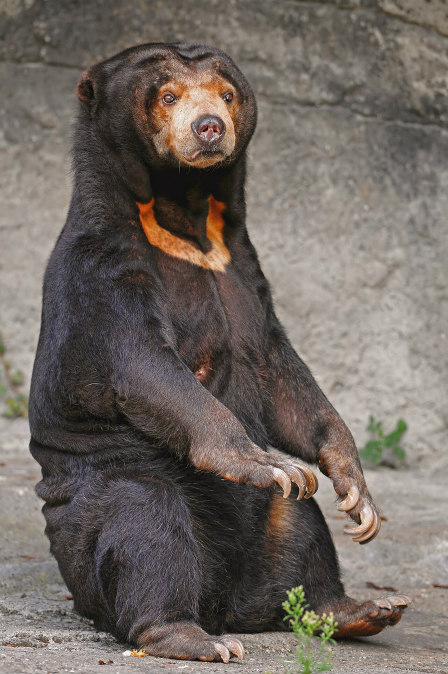
Sun bear, (Helarctos malayanus), the smallest bear in the world, found in Southeast Asian forests.
Wong Siew Te, were you aware of the existence of sun bears?
Yes, but not a lot. I’d seen sun bears in zoos and when I was in Taiwan we had sun bears being rescued from the pet trade. The understanding of sun bears was not great, and then my affinity towards the sun bear was just normal, since my interest is in all animals.
There are sun bears in zoos?
Across Southeast Asia there are sun bears in zoos, mini zoos and crocodile farms, which will have a sun bear or two to display to attract crowds. I feel very privileged to be given the opportunity to study them in the rainforest of Borneo.
Who are these sun bears that we don’t know much about?
There are eight different species of bears. Sun bears are the smallest species, and the Bornean sun bear found on the islands of Borneo is even smaller than the mainland or the Malayan sun bears. A full-grown adult Bornean sun bear male weighs 45 to 50 kilograms and the female is 30 to 35 kilograms. To put it into the perspective of another four-legged mammal, the sun bear is like a big dog such as a rottweiler. They are very arboreal and spend a lot of time climbing trees and sleeping on trees.
They must be very robust to sleep on trees?
Yes, sometimes they climb up a tree and sleep on a branch, sometimes they build a nest and sleep up there. They have to sleep on trees because they live in a rain forest and the forest floor is always wet. The only dry spots in the forest are up on the trees. Also, on the rainforest forest floor, blood-sucking leeches are very aggressive and abundant. The only place where they can escape from blood-sucking leeches, especially when they are asleep, is up on the trees. Also, when they’re asleep sun bears are very vulnerable to tigers who prey on them, and the only way to escape from tiger predation is up on the trees. All in all, there is lots of benefits to using the tree canopy. Besides sleeping, they forage up on a tree, plucking fruits directly from the tree. Some big trees have all kinds of epiphytes, ferns and so on, and there are lots of insects to eat. There are lots of benefits for them in being arboreal.
Do they have a very long tongue and like to eat bees and insects?
Yes, they have a very long tongue, 30 centimetres long, and they love to eat honey. A lot of the honey that they can find is up on the tree. Sleeping with a dry body, escaping from predations, harvesting fruits, finding honey, feeding on invertebrates, are all on the tree. The tree canopy in the rainforest of Borneo and Southeast Asia is very high, the average canopy height is 50 metres, and access to all these big trees means that their space and resources increase. They do not just forage on the forest floor, but also in the canopy.
What do these bears look like compared to the much bigger grizzly bear or polar bear?
They still look like a bear. However, they have very short sleek dense fur, black in colour, with an orange chest patch on their front which is unique. The function of that chest patch is to warn other bears or other animals that they are present, and to show them that they are big, and macho. They also have tiny little ears, which is a good adaptation for them in a tropical rainforest so rainfall won’t be able to funnel into their ear canal.
Are they very tough?
Very tough. They fight among themselves, and they are fighting bears literally because they live in this rainforest with always limited food resources, so they compete with each other. When they fight with each other their loose skin acts like an armour to protect them, just like the loose skin of the Shar-Pei Chinese fighting dog breed acts like an armour to protect them.
Do they live in families?
No, they live individually, solitarily in the forest, except mother and cub live in a pair. Since food resources are scarce, they cannot afford to have many mouths to feed at the same time. Because they cannot find sufficient food to support a big family, they usually raise one cub at a time. Twins are very rare.
How long do they live?
If they live for 13 or 14 years in the forest, that is considered as long. However, if they are well taken care of in captivity, in good zoos and so on, their lifespan can be much longer. The oldest bear at our centre is 34 years old. The oldest bear that we know of lived in Honolulu zoo and was 37 years old when she passed away.
“The orangutan receives a lot of conservation attention, but not the sun bear. That’s why the idea of setting up the sun bear centre first came about.”
Wong Siew Te, how many sun bears exist in the world?
We do not know, there is still very little research. West Malaysia is the only place where there is an official number of 300 to 500 sun bears. We do not how many are left in Borneo, however much less than the orangutan, which is about 100,000 individuals on the islands of Borneo. Currently I have PhD students conducting studies to come up with a population estimation of sun bears in Sabah so hopefully in three years’ time we will have a better idea of how many sun bears are left in the wild in Sabah.
What is the distribution range of sun bears?
They only exist in Southeast Asia. They range from the eastern tip of India, the eastern tip of Bangladesh, the southern tip of China, Myanmar, Thailand, Cambodia, Laos, Vietnam, peninsula of Malaysia, Sumatra, and Borneo.
How do sun bears behave when they come into contact with humans?
The bears are very shy animals. They all know that humans are the most dangerous animal that has ever been created on planet Earth, so when they sense human presence they run away for their life. Because what kind of people are in the forest? The poachers. Those bears that don’t run away from people end up dead.
Where is the sun bear conservation centre that you founded?
Our centre is located about 14 miles away from the city of Sandakan in a forest reserve called Kabili-Sepilok Forest Reserve. It is in Sabah, a Malaysian state on the islands of Borneo.
Why did you decide to create this centre?
I experienced two extremes when I studied sun bears. I experienced a good extreme, studying and knowing how they live in the forest and how important they are to the forest ecosystems. However, I experienced another extreme, which is deforestation. I saw logging and poaching them for meat to eat, for body parts such as gallbladder to use as traditional medicine, for canines and claws which the local people believe possess supernatural power. Also, people keep them as exotic pets. In 2004, I did a nationwide survey of captive sun bears and found out that there are many in captivity, all living in a very sad situation in small cages. The sun bear baby is very cute, and a lot of people thought that as long as they bottle fed a baby sun bear he would turn into a chihuahua. Which is not going to happen. It was really, really heartbreaking to see these captive sun bears living in small cages, shaking their head all day long, a stereotypic behavior of high stress, anxiety or boredom. During that survey, my last stop was at the Sepilok Orangutan Rehabilitation Centre. There was a rehabilitation centre for the orangutan, but not for sun bears, and both species face the same problems: deforestation, hunting, poaching, people keeping their babies as pets. The orangutan receives a lot of conservation attention, but not the sun bear. That’s why the idea of setting up the sun bear centre first came about.
Who finances it?
The first six years, during the construction phase, I had to fundraise from many people: general public, government support, big corporates and funding agencies. Everybody chipped in until we opened to the public in 2014. Then we opened our doors to welcome tourists: come and see the bears, come and learn about the rainforest and learn about the bears. Tourists and visitors need to pay, so we generate revenues from ticketing and souvenir selling. This was on a good track from 2014 until the pandemic hit us on March 18, 2020, and we were shut down for almost two years. So then we went back to fundraising and asked people to help, to adopt our bears and to help us get through the second year of the pandemic in 2021.
How many bears do you look after in your conservation centre?
Right now, we have 45 bears at our centre and two bears that we care for through our soft release programme at Tabin Wildlife Reserve, so in total we currently care for 47 bears.
What is the physical structure of the centre?
We set up our centre on the edge of the forest reserve. Half of our land is outside the forest reserve. The other half, where we built our forest enclosure for our rescued bears, is in a rainforest setting. We built a big fence with about 3 hectares divided into 10 different pens. Each pen is linked to two bear houses and each pen has a group of bears that live in there. All of our bears are bears that were rescued by the Sabah Wildlife Department, the authority for wildlife in Sabah. People keep them as illegal pets after their mother has been brutally killed by poachers, and we help the Sabah Wildlife Department to take care of the sun bears that they rescued or confiscated. Sun bears are protected by law under the Wildlife Conservation Act passed in 1997. Nobody is allowed to keep a sun bear. However, there are stupid, irresponsible people, criminals who want to break the law. When the Wildlife Department receives reports or finds out that certain people are keeping sun bears illegally, they confiscate, rescue, prosecute the owner and then send the bears for our care. That’s how it works. At our centre during the daytime the bears roam these three hectares of forest enclosures and then at nighttime they come back to the bear houses and spend the night there.
How do the bears arrive at your centre? The Sabah Wildlife Department is the wildlife authority. After they rescued the bears, they bring the bears to our centre. We are not a law enforcement agency. I cannot go and rescue a bear because I was not authorised to do that by law. They are the ones who do all of the rescuing work or confiscation work or prosecution work. We assist, we help them, we partner with the Sabah Wildlife Department to take care of the bears and rehabilitate the bears. If those bears cannot be rehabilitated and released back into the wild, we are the ones who keep them for the rest of their life.
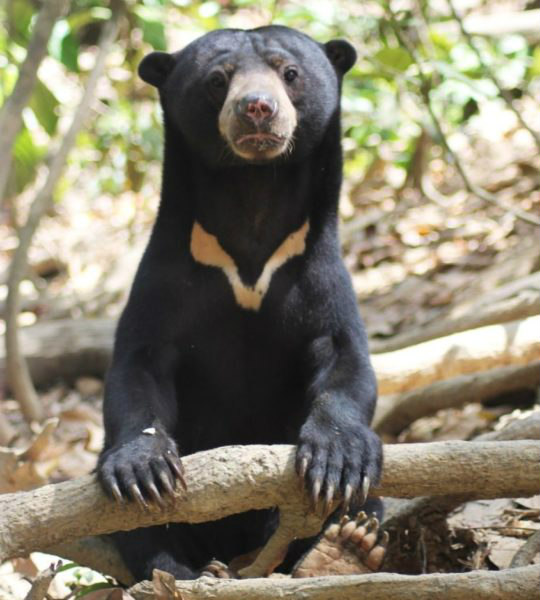
The function of that sun bear chest patch is to warn other bears or other animals that they are present, and to show them that they are big, and macho.
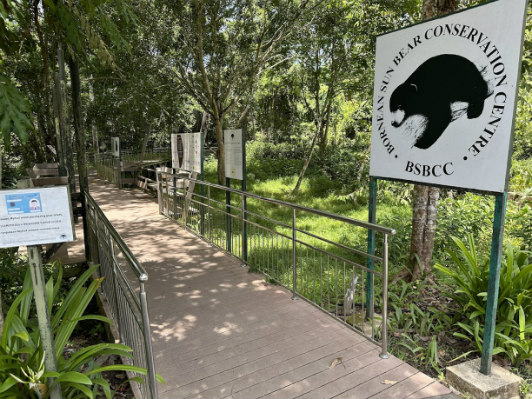
The Bornean Sun Bear Conservation Centre (BSBCC) is located in Sepilok, Sandakan, Sabah, Malaysia, specifically within the Kabili-Sepilok Forest Reserve. It is situated next to the famous Sepilok Orangutan Rehabilitation Centre in the eastern part of Sabah.
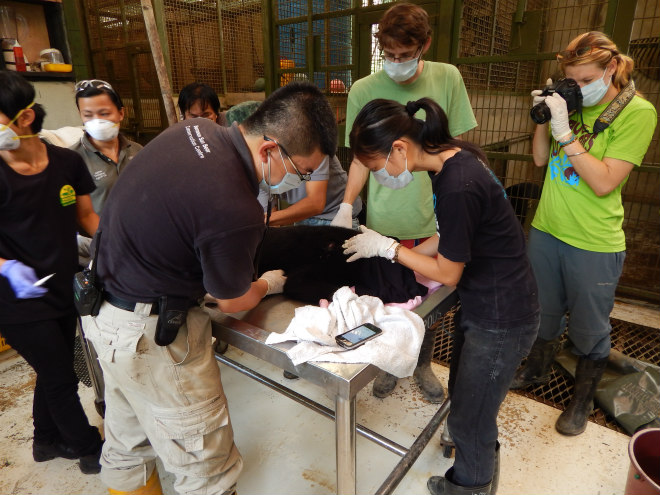
Wong Siew Te and team treat one of his beloved endangered sun bears.
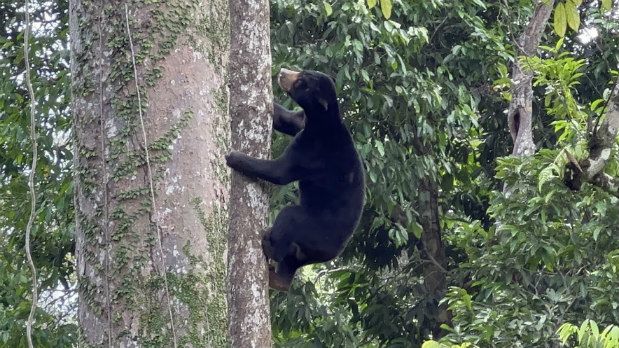
Sun bears are very arboreal and spend a lot of time climbing trees and sleeping on trees.
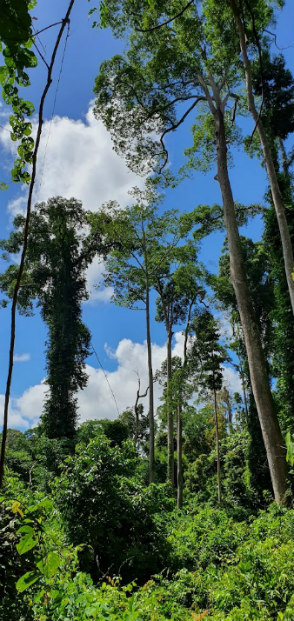
The tree canopy in Malaysian rain forests is very high, the average canopy height is 50 metres
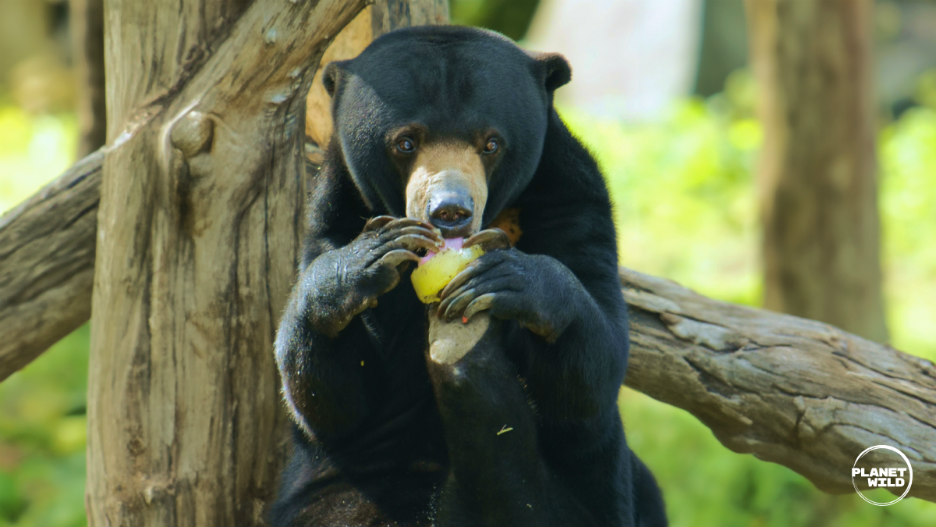
Good things come to those who forage!
“I think I was the chosen one to help and to save sun bears. My professor chose me to study wild sun bears, and I accepted. Everything happens for a reason.”
Wong Siew Te, if sun bears are used to living on trees, why do they live in houses?
Because our bears are rescued bears. We need to manage them and they live in a very unnatural situation. We need to make sure that each bear is well taken care of. We have to make sure they eat their dinner at 4 o’clock sharp and we can have a close examination of their physical condition. When they live in the forest enclosure we may not see them, and we train them to come back to the bear houses in the evening so we can examine their physical condition. We give them dinner, and if a bear is sick or not healthy then they might not have good appetite and we need to take a close eye and find out what’s going on. These rescued bears are not normal. They are not a wild bear. Their mother was killed. We are preserving originally a wild animal, however they were kept as pets before they were rescued and sent to our centre, and we try to rehabilitate them so that they can have a second chance to live in the forest.
You release them back into the forest?
Yes. We have two methods. One is the hard release method, where the bears are raised in our centre and then we pick the ones who have the best chance of surviving in the forest and release them. Another method is a soft release programme, where the bear cubs live in the forest interior with a team of people who take care of them, and walk them in the forest every day until they become adult. Until they get independent from their caretaker our team act like their surrogate mother.
Do they reproduce in the centre?
We discourage breeding because 18 years ago I made a mistake by creating the centre to house 40 bears. Right now, we have got more than 40 bears. So we don’t encourage breeding. However, over the years there was some accidental breeding; the bears mated and then give birth. There were four incidents like that that happened more than 15 years ago.
Do the bears sometimes come down from the trees?
Yes, sometimes they come down from the trees to move from one place to the other, or to look for food on the forest floor. However, when they sleep or take a nap, they have to be up on the tree.
Do they change trees or are they always in the same tree?
They change trees all the time. They have a big home range and wherever they go there’s always a tree because they are a forest dependent species. They live in this big deep tropical rainforest.
What other kinds of animals live in the forest?
In Borneo, talking from the biggest animal, we have the Bornean Pygmy Elephant. In the past, we had the Sumatran Rhino, but since 2019 the Malaysian Sumatran Rhino are all extinct. There are Sambar deer, Muntjac Barking deer, two species of Muntjac, and two species of Mouse deer. There are eight different species of Civet, and then there are all kinds of primates: the Bornean orangutan, the Proboscis Monkey with a big nose, many species of Leaf monkey, two species of macaque. There are Slow loris. There are Western Tarsier. There are so many animals. The diversity in the forest is very high. In Borneo, there are 700 different species of birds. A lot of wildlife lives in the forest.
How do the sun bears find the honey that they love to eat?
They have a very good sense of smell. They sniff out where the honey is on the treetop, and then they climb all the way to the treetops to the beehive in order to harvest the honey. They are very good climbers. The honey that they get hold of in the forest can be separated into two different groups. One is from the forest giant bee which build honeycomb on a very tall tree, where sometimes even the bears have no access. The other group is the stingless bee that build their hives inside tree trunks, and the bears have to climb up the tree and use their very sharp teeth to rip apart the tree trunk and excavate the cavities and use their very long tongue and paws to dig out the honey.
Are sun bears ever confronted with other kinds of bears?
In the area north of West Malaysia, starting from Thailand, Cambodia, Laos, Vietnam, Southern China, there are two different species of bears that live in the same forest: the Asiatic Black Bear and the Big Sun Bear.
These are bigger bears?
The Asiatic Black Bear is a much bigger bear. Those sun bears that live sympathetically with Asiatic Black Bears are also much bigger than our Bornean sun bear. A big male can be up to 100 kilograms.
What happens if they encounter each other in the woods?
We do not know, there are very few records. However, in Cambodia many years ago, they rescued a hybrid between sun bears and the Asiatic black bears. Meaning that there was some love chemical that happened when a male met with a female of the different species.
Why are sun bears the least known bear?
They are the forgotten bear species because they live in a very dense forest. Even the local people in Malaysia do not know there’s a bear living in their forest. Normally, people have no access to go into the forest. They are very shy as well. It is not easy to see or photograph a sun bear in the forest. That’s why they were kept little known until some 30 years ago when I started my study and then raised the awareness of sun bears in our country. After the establishment of the Bornean Sun Bear Conservation Centre we actively raise awareness to the general public even more about the existence, needs, threats, and conservation issues of the sun bears.
Having established the sun bear centre, will you try to save other species as well?
Probably not. I think I was the chosen one to help and to save sun bears. My professor chose me to study wild sun bears, and I accepted. Everything happens for a reason.
Are you a Buddhist?
Yes, I respect Christianity, Islamic teaching and Hinduism, but I’m Buddhist in my heart. I’m more than happy to devote my life, and since I’ve been doing this for the last 28 years this is what I do best because I am the only one in the world who has been continuously working with sun bears for the past 28 years without any stop, and the more I know about them, the more I understand their situation, the more I know about them, the more I worry of their survival and existence, because human population growth requires a lot of resources. A lot of forests are being chopped down because of that. They need us. We need to give them room so that they can survive and share the planet with us.
Do you protect the forest at the same time?
Yes, we try our best to protect forest but forest protection is not my thing, it’s the government’s. Through nature based tourism we need to show the government that the standing forest has a commercial value. This forest will attract lots of nature lovers, animal lovers, bird watchers, to come and enjoy and recreate and watch wildlife. Their presence creates jobs for the local people, and their presence helps to put a big money sign on the local economy, so that the government realise that if they keep forests and wildlife healthy they will make people healthy and happy, and during the next election the people will vote for a government who keep the forest and protect wildlife. Eco-tourist money will make people happy, they have a livelihood and then, after that, the local people would protect the forest and wildlife, and also vote for the government. This is a five-win scenario. It is a win for the politicians and the government who protect the forest and wildlife. It is a win for the nature based tourists to come here and recreate and see wildlife and enjoy the forest. It is a win for me as a conservationist who wants to protect the wildlife. It is a win for the local people because they have their livelihood, and finally it is a win for nature and wildlife.
How many people work with you in the centre?
Right now, we have got 44 full-time staff. Practically one person for each bear.
Can you describe your daily life?
I have a big team, so everybody has their own jobs, and my job is to oversee every unit and make sure that every unit is run properly. My job every day is actually quite boring. I need to check my computer, check on email, write reports, and meet funders and so on. At about 11 o’clock or so, when there are a lot of visitors, I need to go up to the platform to meet the visitors and try to answer their questions.
You said that bears are afraid of people, so how do visitors get close to the bears?
Our centre is open for visitors. In total we have 10 different forest enclosures, and we have 3 natural forest encloses open for the public to view them from a distance. These bears that were kept as pets before are already habituated to the presence of people, raised by people since little. This animal is a good ambassador to tell people what a sun bear looks like and how a sun bear behaves.
They sleep during the day and get up at night?
From my study, when a sun bear lives in a forest with very little human disturbance, they will be diurnal. This means that they sleep at night time and then do active foraging and looking for food in the daytime. However, when the bears live in forests with human disturbance, if there are people going into the forest to work or to hunt, they switch to being active during the night time and sleep during the daytime. In the past, I have radio collared bears, and when these bears decided to be a good bear they would sleep at night time and then look for food in the daytime in the forest. However, when a bear decided to raid our camp or our field centre, he would sleep in the daytime and be active all night long to look for garbage, and break into kitchens to look for human food. They have the ability to switch their activity. They are very intelligent, a large mammal with big brain capacity. Their brain size is only slightly smaller than ours. They have memories and feelings. The only things that they don’t do is speak our human language. They speak they own language and have their own communication way. They vocalise with each other, they speak with each other.
They are individualists and don’t create a group, but do they have a society and a hierarchy?
In the wild, often it’s mother and cub. Once in a while they meet and fight with each other. They try to exclude each other and sometimes they kill each other. At our centre, because we have no choice but to put several bears at the same time in the same place, especially when they are cubs growing up together, we mix them up with each other and then we give them sufficient food So that they don’t have to compete for food so they can mix in a group. And then they communicate with each other. To tell you how intelligent they are, they are the only bear species that knows how to use tools. They crack coconuts and they find a piece of rock or piece of hardwood to crack a coconut. Many years ago when Jane Goodall discovered the chimpanzee can create a straw tool from tall grass and use that straw to poke in the termite nest and fish out the termites, that tool discovery was Wow! really bizarre. But besides humans, animals learn how to use tools, and I’m telling you that the sun bear can use a tool to break a coconut.
Do they learn one from the other?
We do not know. It may be. We are still learning. I always say that the sun bear is my sun bear teacher and I’m their human student, because we learn so much from them. They have this facial expression, they use tools, their activity patterns, their food habits, their social behaviors, and all of them is new to science. We have published a lot of papers on the findings of our studies.
Are you writing a book?
I am writing a long due book. The publisher has been chasing me for the draft. I do have my biography book called Saving Sun Bears. I have PhD students and Master’s students, and I give lectures in various countries across the world. We have students from Malaysia, from Japan, from the UK, from US, and Australia as well. I’m not alone and right now I am building up my team, because the work that needs to be done is enormous. I’m not a PhD student or a Master’s student anymore. Now, my position is to advise students to do sun bear research and to do tropical forest research. Locally, in Sabah, we work closely with people working with elephants, with proboscis monkeys, with orangutans, all these charismatic species that face the same problems. Regionally I’m hosting a wild animal rescue network conference, so all of the wildlife rescue centres or government agencies who rescue wildlife can come together and have a coalition discussing issues, helping each other. I’m also in the IUCN Bear Specialist Group, where bear experts across the world meet together and solve many problems that we face. We also help each other on research projects, research challenges and research ideas.
Thank you very much Dr. Wong Siew Te, it has been a very interesting interview.
ENJOY THIS INTERVIEW? SHARE IT WITH A FRIEND.